Cairo University
Faculty of Computers & Information
Information System (IS) Department

Modeling & Simulation
Final Exam 2005/2006

Duration: 3 hours
3rd Jan. 2006

Instructor: Dr. Mohamed Saleh

(Q1) Define the following terms {use graphs & give examples whenever possible}
- Positive Feedback Loop
- Dynamic Hypothesis
- Doubling time
- S-Shaped Growth
- Management Flight Simulator
- Mental Model
- Speculative Bubbles
- Model Boundary Chart
- Static & Dynamic Equilibrium
- Chaotic Oscillations
(Q2) Theoretical Question

Reference modes are used to visualize systems behavior over time. During the course you have
studied 5 families of system behavior.
State the names of only 3 families. And for each family, draw a simple time plot to illustrate its
behavior, then draw the associated causal loop diagram, and also draw a simple stock & flow
diagram that generates the behavior exhibited by this family
(Q3) Derivation Question

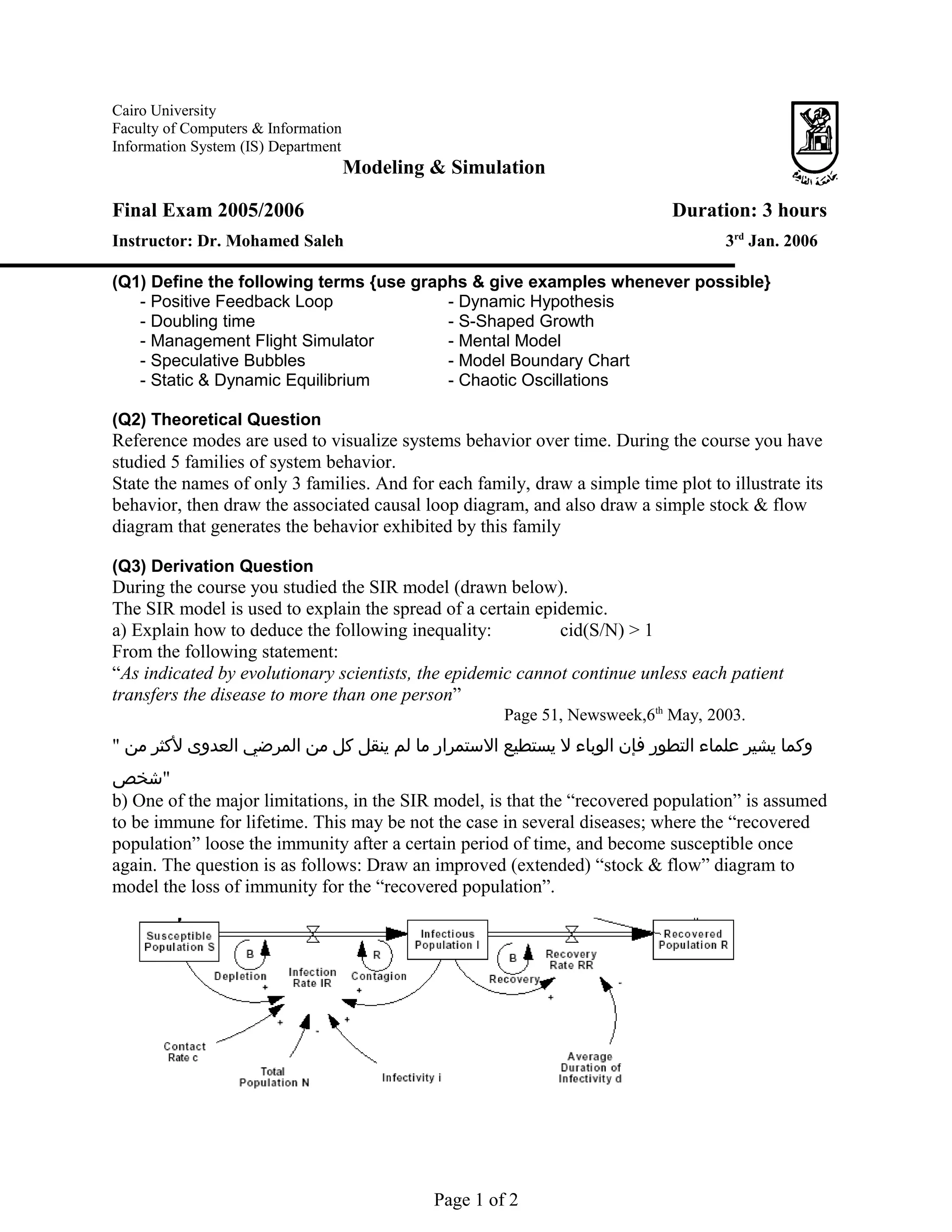
During the course you studied the SIR model (drawn below).
The SIR model is used to explain the spread of a certain epidemic.
a) Explain how to deduce the following inequality:
cid(S/N) > 1
From the following statement:
“As indicated by evolutionary scientists, the epidemic cannot continue unless each patient
transfers the disease to more than one person”
Page 51, Newsweek,6th May, 2003.

" ‫وكما يشير علماء التطور فإن الوباء ل يستطيع التستمرار ما لم ينقل كل من المرضي العدوى لكثر من‬
‫"شخص‬
b) One of the major limitations, in the SIR model, is that the “recovered population” is assumed
to be immune for lifetime. This may be not the case in several diseases; where the “recovered
population” loose the immunity after a certain period of time, and become susceptible once
again. The question is as follows: Draw an improved (extended) “stock & flow” diagram to
model the loss of immunity for the “recovered population”.

Page 1 of 2
c) Explain how the SIR model can be adapted to study innovation diffusion. Draw the associated
stock and flow diagram.
(Q4) Modeling Question

During the course, you studied a system dynamics model designed to simulate the growth of staff
faculty (teaching assistant ….. professors) till year 2025. This model takes into considerations
the following points:
• Promotion mechanisms of staff faculty
• Quit rates of staff faculty.
• A retirement rate of professors
• A hiring policy designed to maintain a standard ratio between students and each category
of staff faculty.
Draw a complete stock & flow diagram of the model. Write all equations of the model.
(Q5) Causal Loop Question

Draw 5 positive loops that can represent engines of corporate growth.
(Q6) Graphical Integration

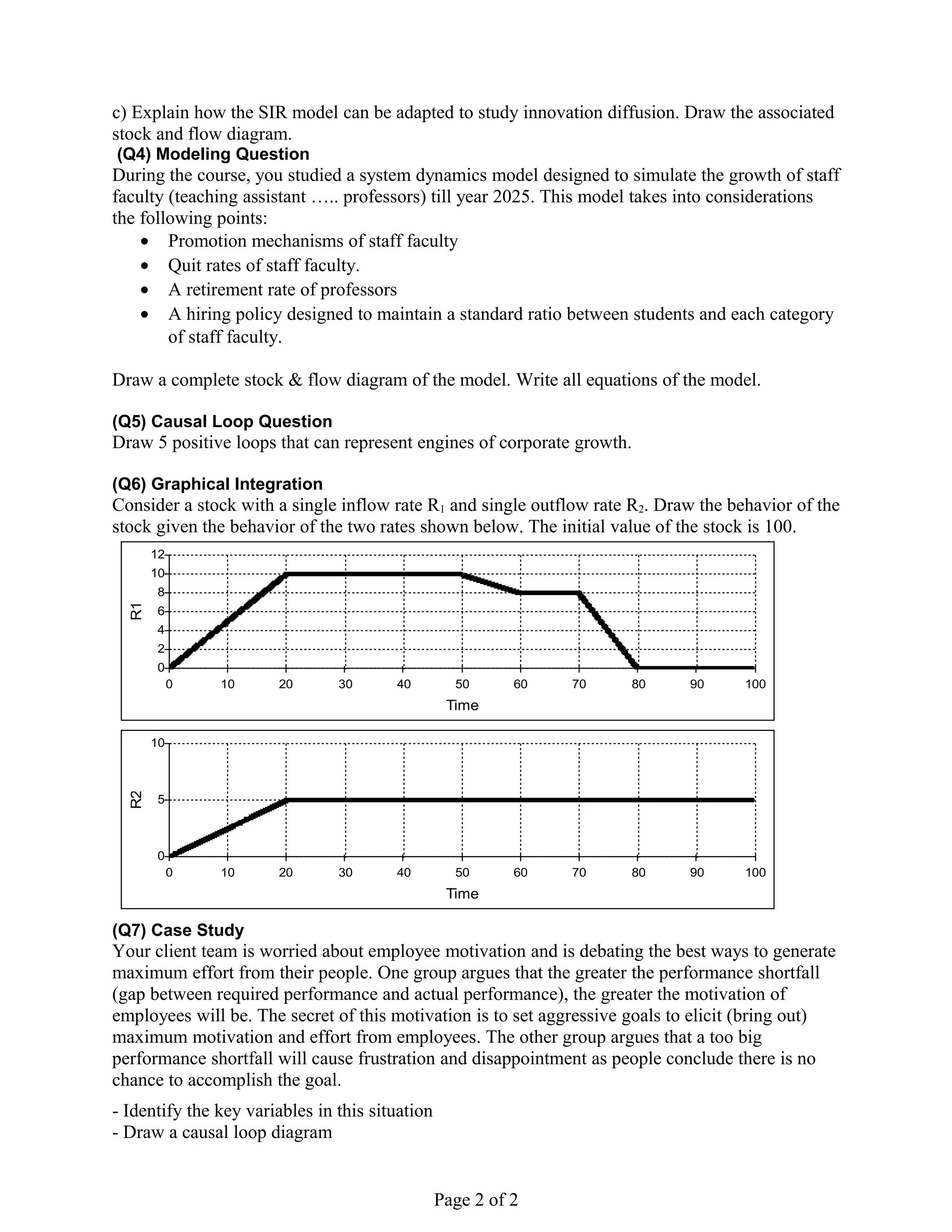
Consider a stock with a single inflow rate R1 and single outflow rate R2. Draw the behavior of the
stock given the behavior of the two rates shown below. The initial value of the stock is 100.
12
10

R1

8
6
4
2
0
0

10

20

30

40

50

60

70

80

90

100

60

70

80

90

100

Time

R2

10

5

0
0

10

20

30

40

50

Time

(Q7) Case Study

Your client team is worried about employee motivation and is debating the best ways to generate
maximum effort from their people. One group argues that the greater the performance shortfall
(gap between required performance and actual performance), the greater the motivation of
employees will be. The secret of this motivation is to set aggressive goals to elicit (bring out)
maximum motivation and effort from employees. The other group argues that a too big
performance shortfall will cause frustration and disappointment as people conclude there is no
chance to accomplish the goal.
- Identify the key variables in this situation
- Draw a causal loop diagram

Page 2 of 2

Sd final05 06_is

  • 1.
    Cairo University Faculty ofComputers & Information Information System (IS) Department Modeling & Simulation Final Exam 2005/2006 Duration: 3 hours 3rd Jan. 2006 Instructor: Dr. Mohamed Saleh (Q1) Define the following terms {use graphs & give examples whenever possible} - Positive Feedback Loop - Dynamic Hypothesis - Doubling time - S-Shaped Growth - Management Flight Simulator - Mental Model - Speculative Bubbles - Model Boundary Chart - Static & Dynamic Equilibrium - Chaotic Oscillations (Q2) Theoretical Question Reference modes are used to visualize systems behavior over time. During the course you have studied 5 families of system behavior. State the names of only 3 families. And for each family, draw a simple time plot to illustrate its behavior, then draw the associated causal loop diagram, and also draw a simple stock & flow diagram that generates the behavior exhibited by this family (Q3) Derivation Question During the course you studied the SIR model (drawn below). The SIR model is used to explain the spread of a certain epidemic. a) Explain how to deduce the following inequality: cid(S/N) > 1 From the following statement: “As indicated by evolutionary scientists, the epidemic cannot continue unless each patient transfers the disease to more than one person” Page 51, Newsweek,6th May, 2003. " ‫وكما يشير علماء التطور فإن الوباء ل يستطيع التستمرار ما لم ينقل كل من المرضي العدوى لكثر من‬ ‫"شخص‬ b) One of the major limitations, in the SIR model, is that the “recovered population” is assumed to be immune for lifetime. This may be not the case in several diseases; where the “recovered population” loose the immunity after a certain period of time, and become susceptible once again. The question is as follows: Draw an improved (extended) “stock & flow” diagram to model the loss of immunity for the “recovered population”. Page 1 of 2
  • 2.
    c) Explain howthe SIR model can be adapted to study innovation diffusion. Draw the associated stock and flow diagram. (Q4) Modeling Question During the course, you studied a system dynamics model designed to simulate the growth of staff faculty (teaching assistant ….. professors) till year 2025. This model takes into considerations the following points: • Promotion mechanisms of staff faculty • Quit rates of staff faculty. • A retirement rate of professors • A hiring policy designed to maintain a standard ratio between students and each category of staff faculty. Draw a complete stock & flow diagram of the model. Write all equations of the model. (Q5) Causal Loop Question Draw 5 positive loops that can represent engines of corporate growth. (Q6) Graphical Integration Consider a stock with a single inflow rate R1 and single outflow rate R2. Draw the behavior of the stock given the behavior of the two rates shown below. The initial value of the stock is 100. 12 10 R1 8 6 4 2 0 0 10 20 30 40 50 60 70 80 90 100 60 70 80 90 100 Time R2 10 5 0 0 10 20 30 40 50 Time (Q7) Case Study Your client team is worried about employee motivation and is debating the best ways to generate maximum effort from their people. One group argues that the greater the performance shortfall (gap between required performance and actual performance), the greater the motivation of employees will be. The secret of this motivation is to set aggressive goals to elicit (bring out) maximum motivation and effort from employees. The other group argues that a too big performance shortfall will cause frustration and disappointment as people conclude there is no chance to accomplish the goal. - Identify the key variables in this situation - Draw a causal loop diagram Page 2 of 2