



Elad Sofer - Agile Coach
 Co-Founder of Practical Agile
Email : elad@practical-agile.com
 blog: www.thescrumster.com
        twitter: @eladsof


                                   elad.sofer@gmail.com
elad.sofer@gmail.com
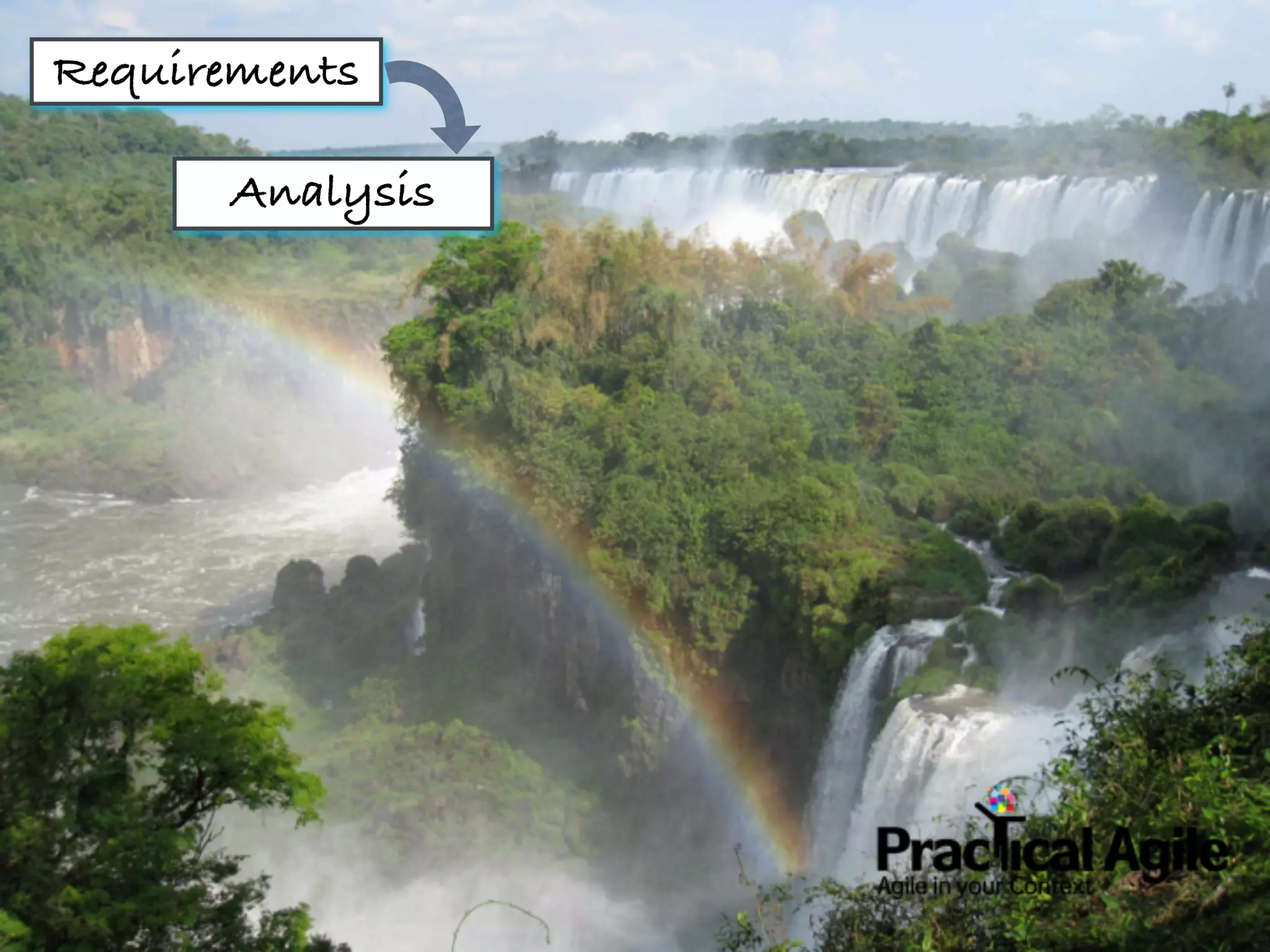
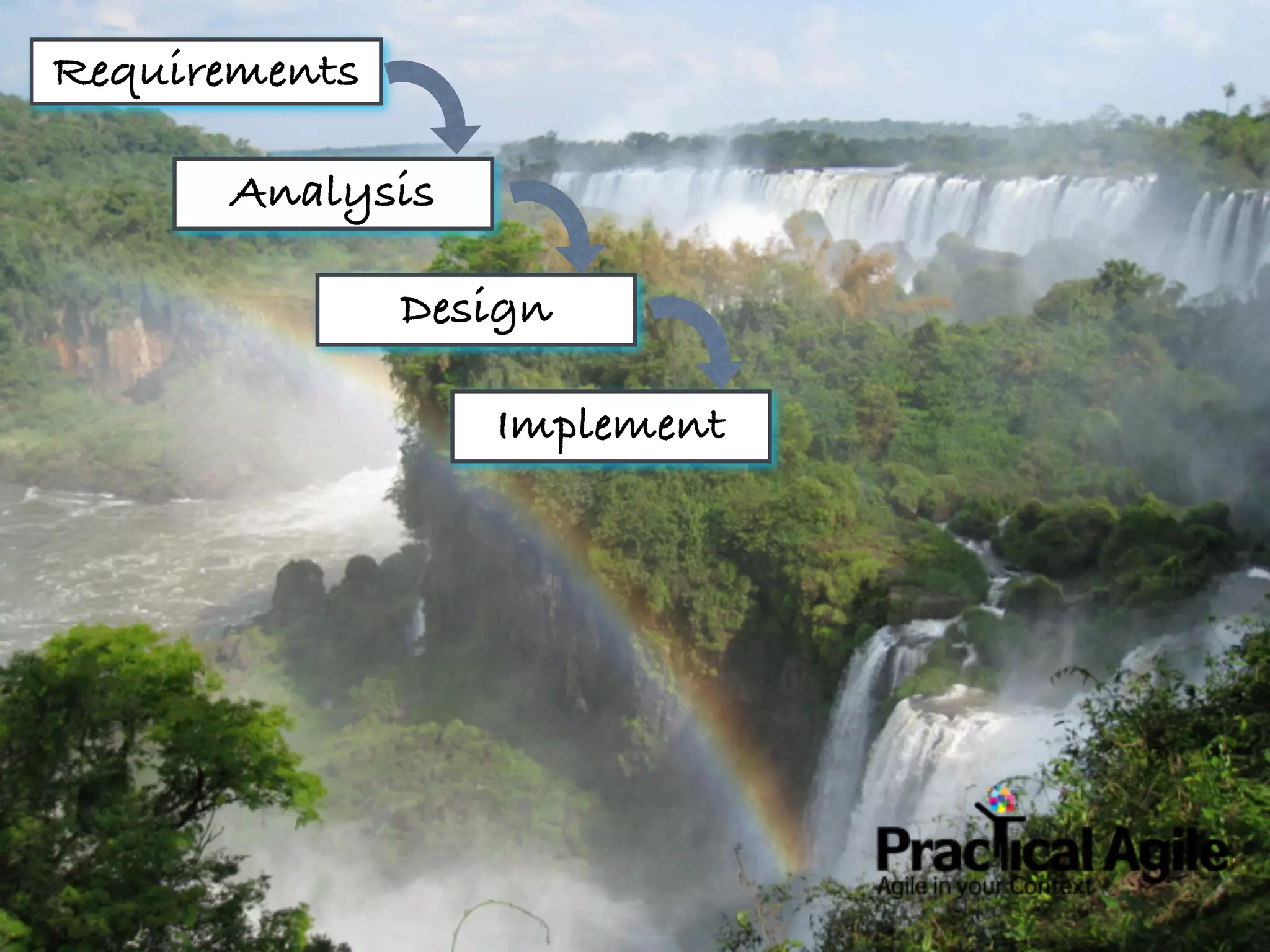
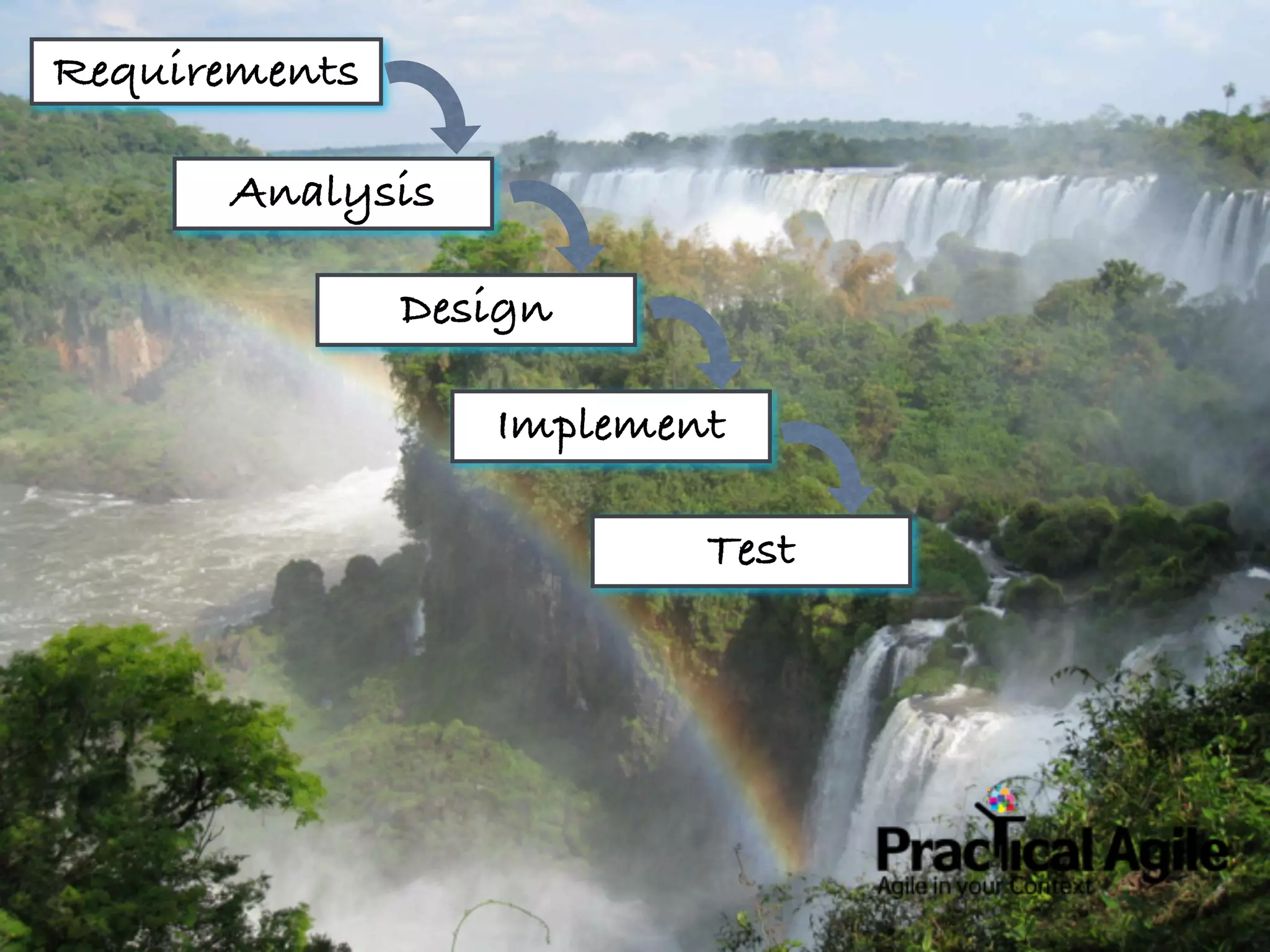
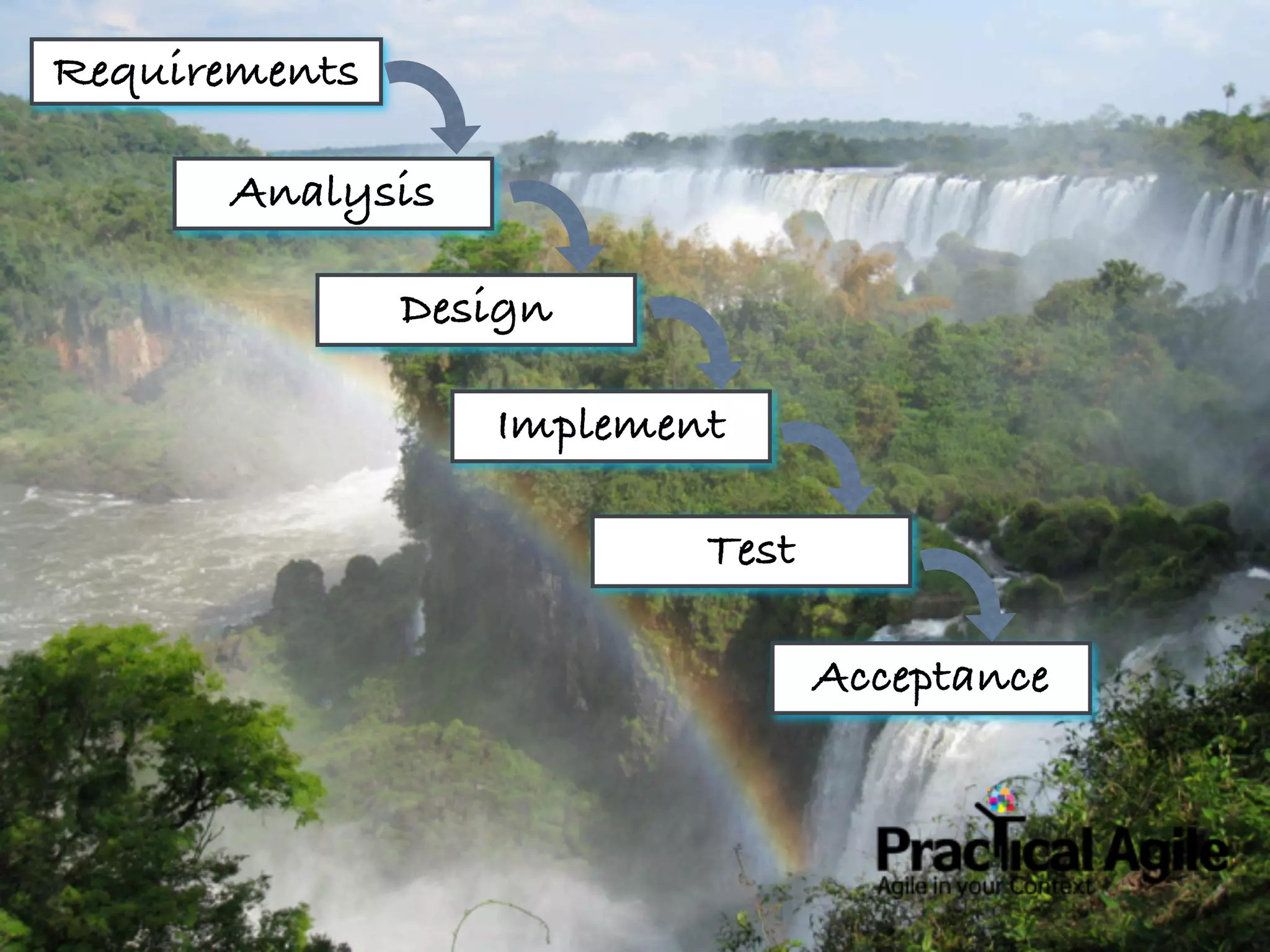
Requirements
Requirements

      Analysis
Requirements

      Analysis

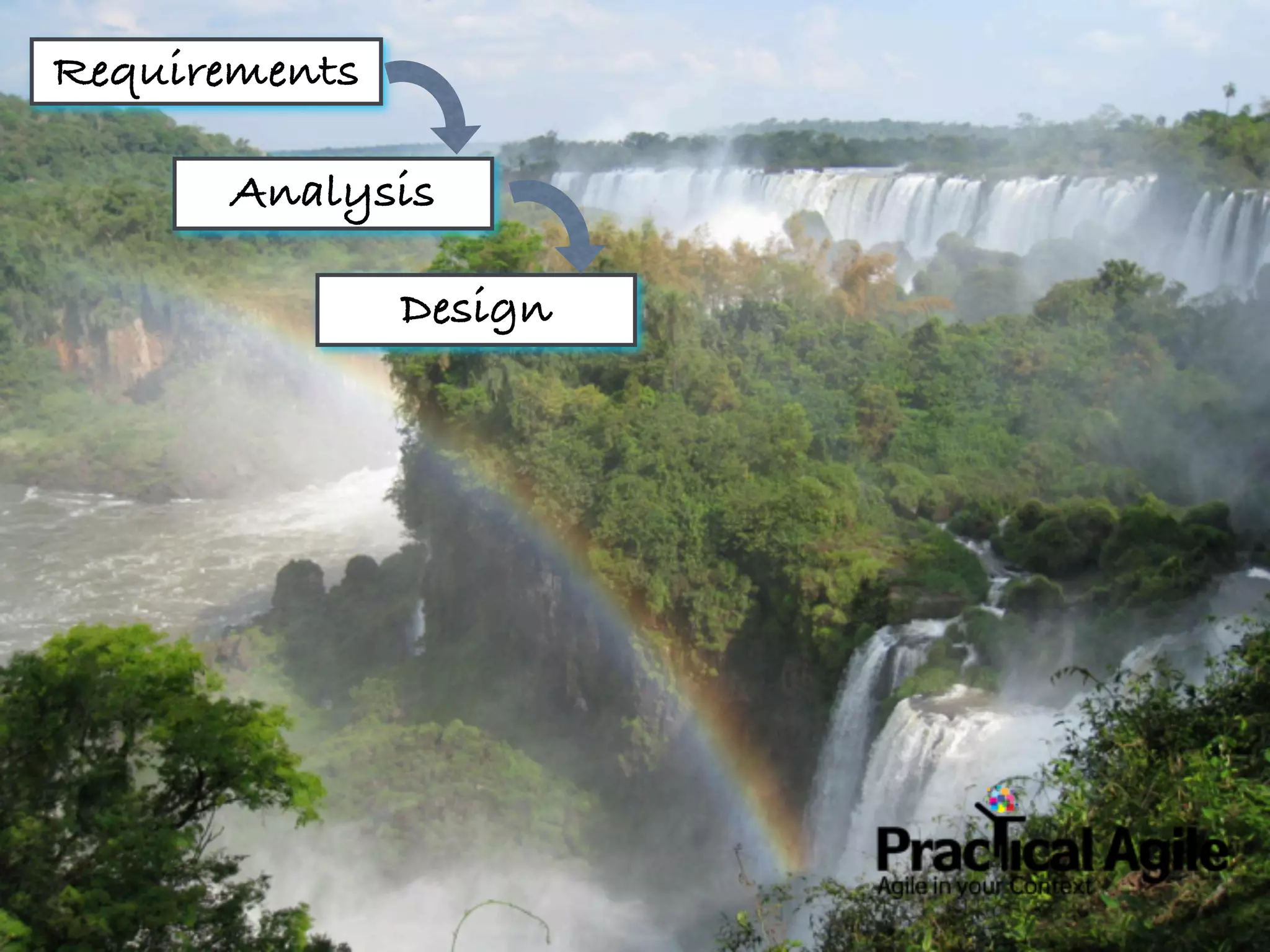
               Design
Requirements

      Analysis

               Design

                  Implement
Requirements

      Analysis

               Design

                  Implement

                          Test
Requirements

      Analysis

               Design

                  Implement

                          Test

                                 Acceptance
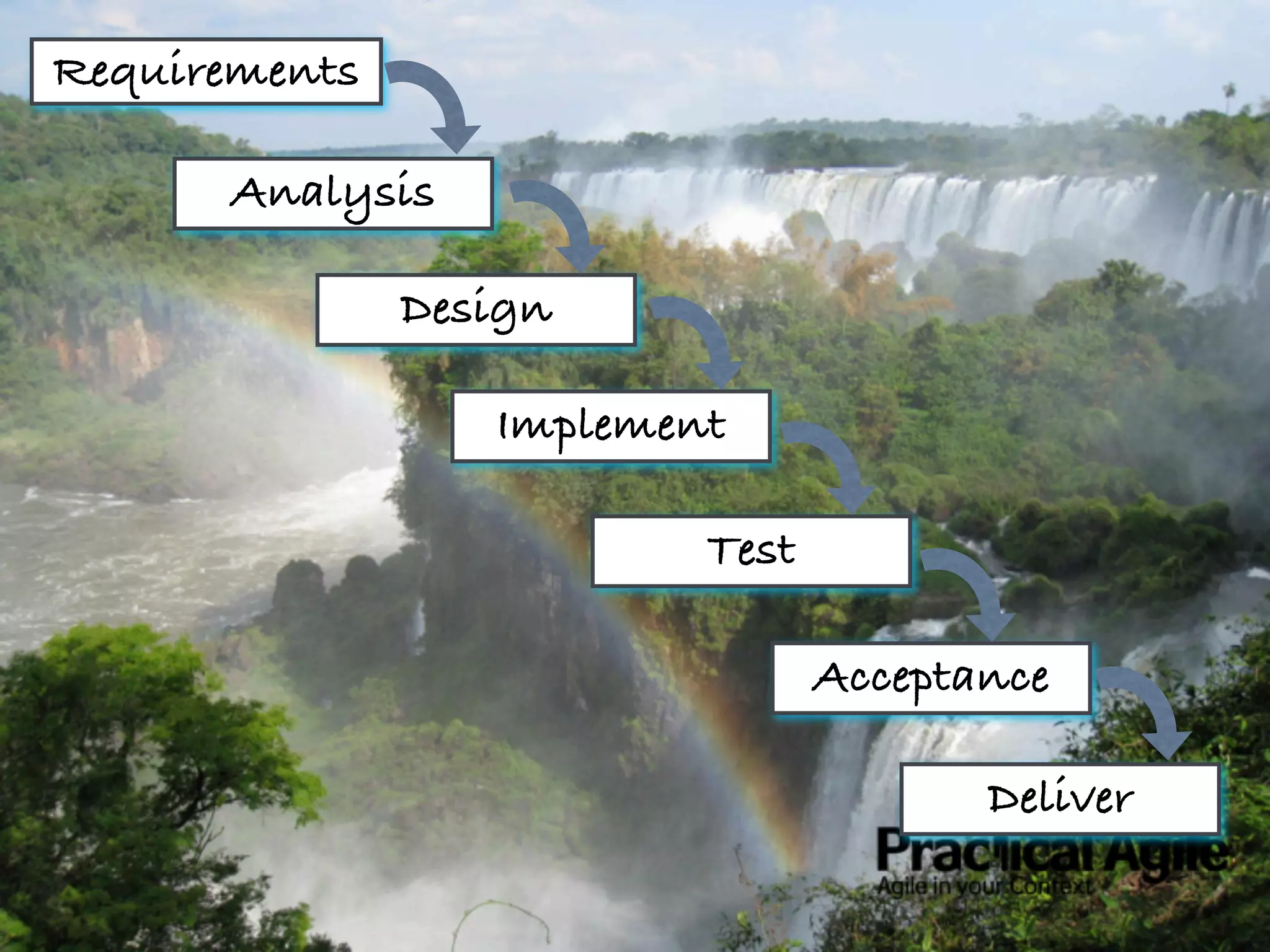
Requirements

      Analysis

               Design

                  Implement

                          Test

                                 Acceptance

                                        Deliver
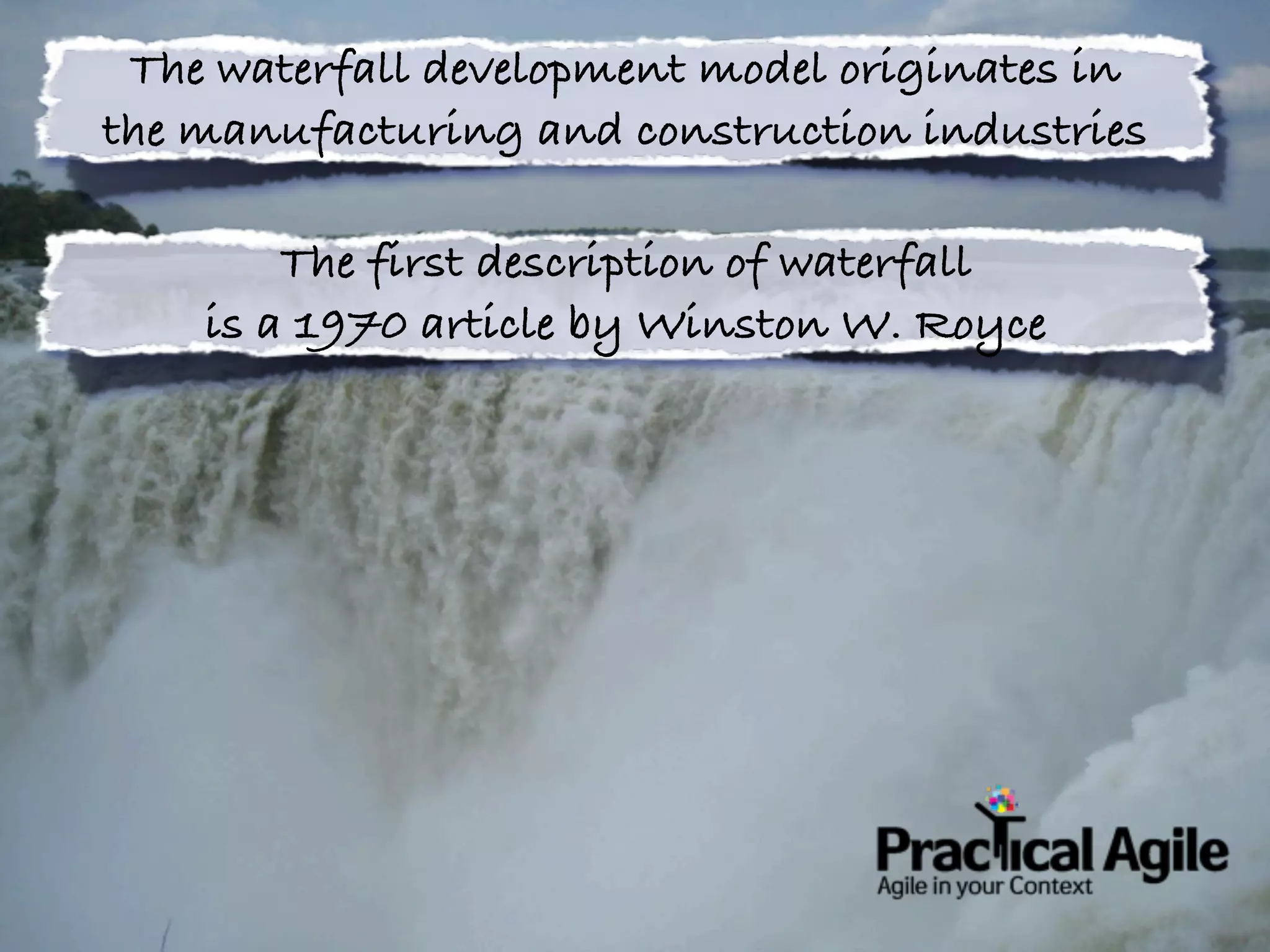
The waterfall development model originates in
the manufacturing and construction industries
The waterfall development model originates in
the manufacturing and construction industries

        The first description of waterfall
    is a 1970 article by Winston W. Royce
The waterfall development model originates in
the manufacturing and construction industries

        The first description of waterfall
    is a 1970 article by Winston W. Royce

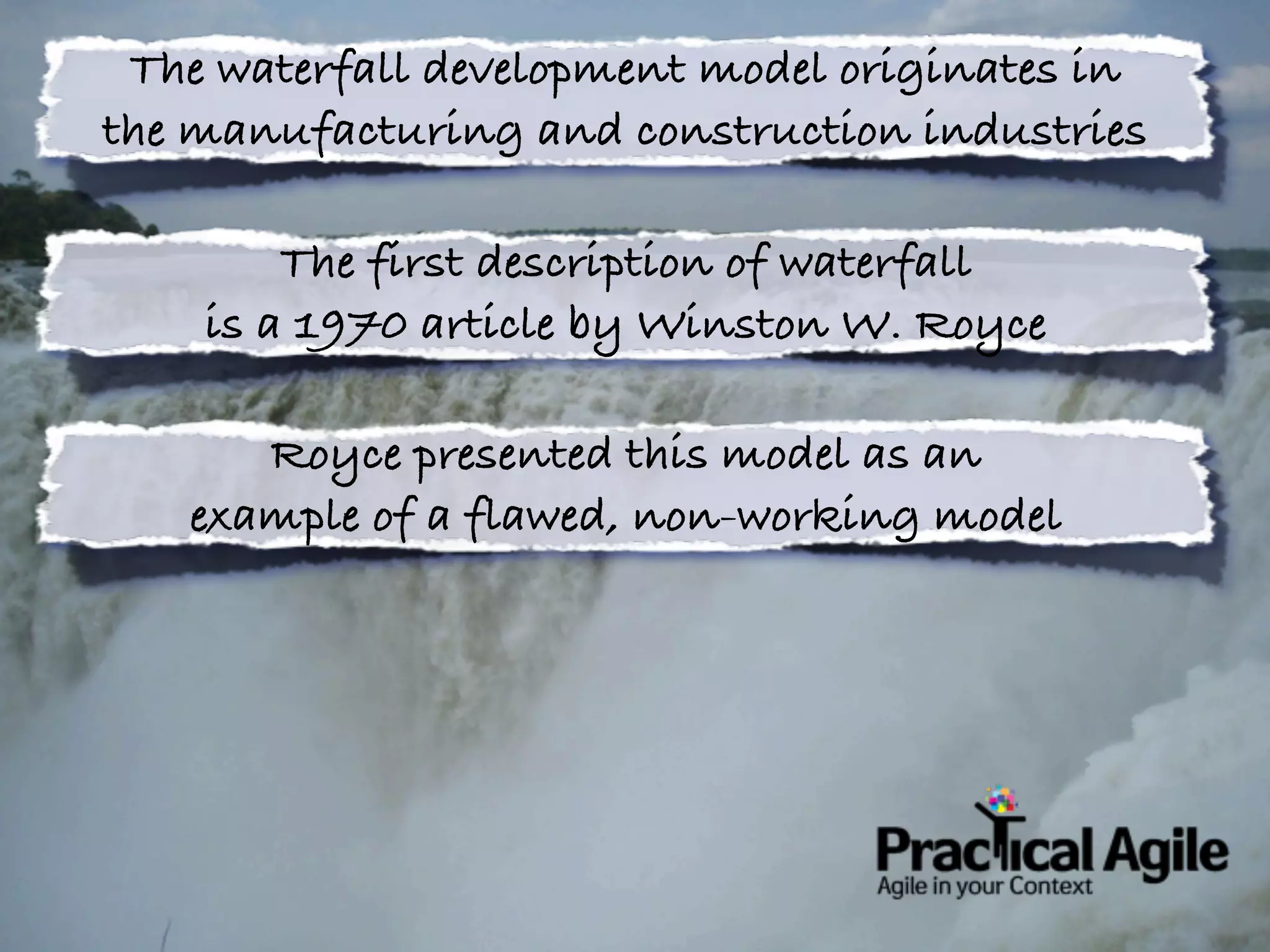
      Royce presented this model as an
   example of a flawed, non-working model
The waterfall development model originates in
the manufacturing and construction industries

        The first description of waterfall
    is a 1970 article by Winston W. Royce

      Royce presented this model as an
   example of a flawed, non-working model

"I believe in this concept, but the implementation
   described above is risky and invites failure"
                    [Royce 1970]
Wishful thinking
No matter how hard you try, it ain’t gonna work
elad.sofer@gmail.com
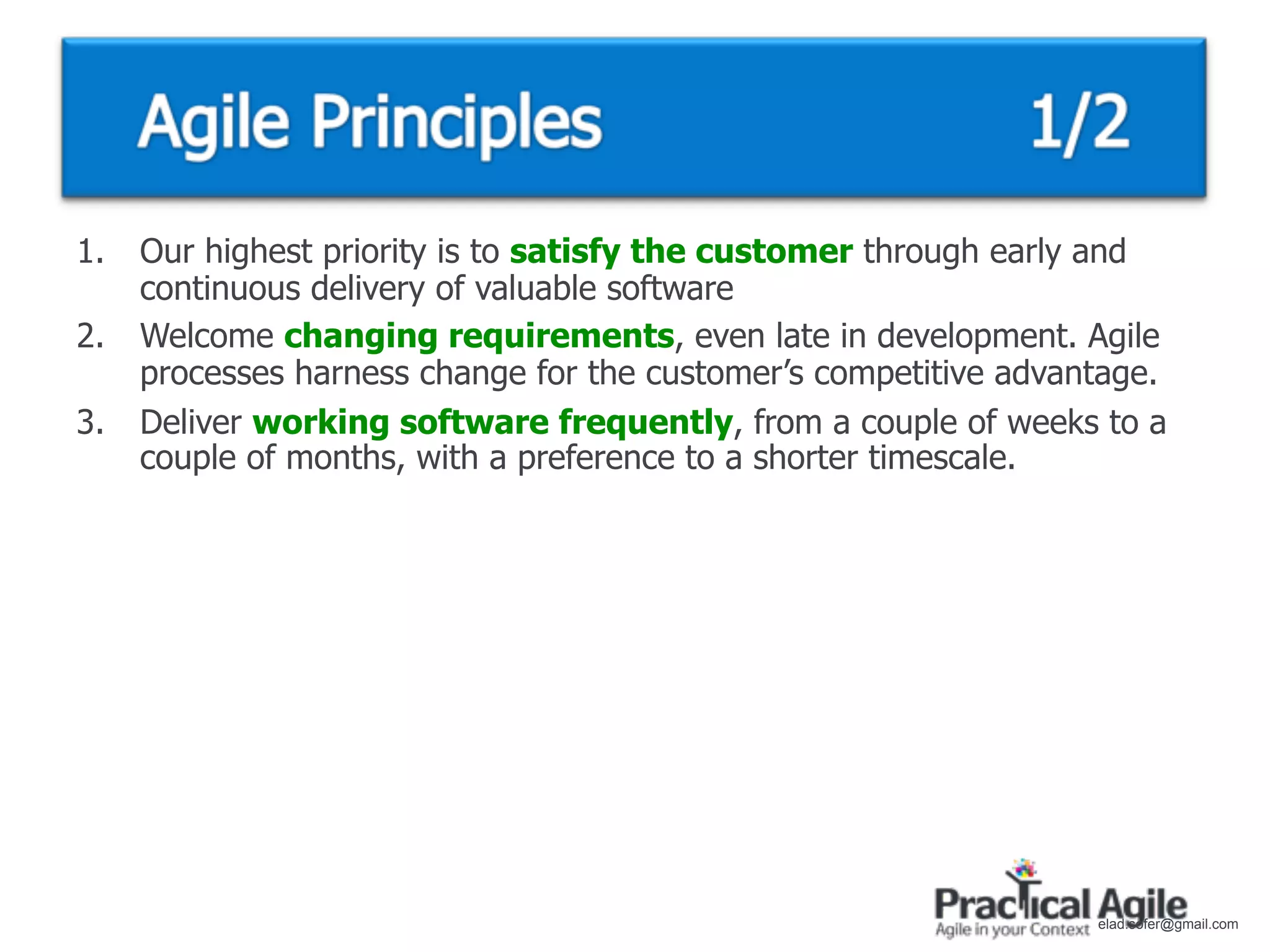
1.   Our highest priority is to satisfy the customer through early and
     continuous delivery of valuable software


                                                                    elad.sofer@gmail.com
1.   Our highest priority is to satisfy the customer through early and
     continuous delivery of valuable software
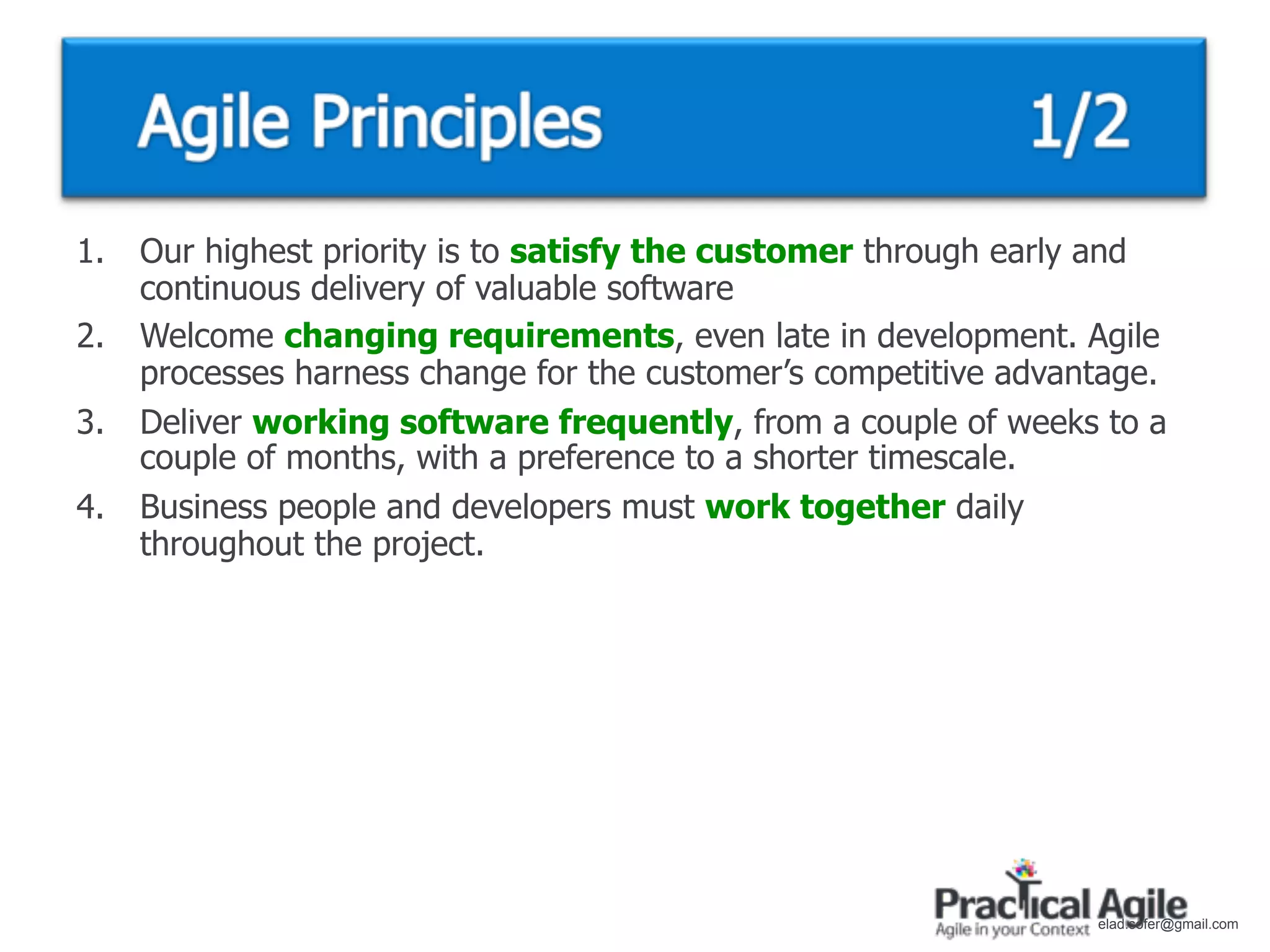
2.   Welcome changing requirements, even late in development. Agile
     processes harness change for the customer’s competitive advantage.


                                                                   elad.sofer@gmail.com
1.   Our highest priority is to satisfy the customer through early and
     continuous delivery of valuable software
2.   Welcome changing requirements, even late in development. Agile
     processes harness change for the customer’s competitive advantage.
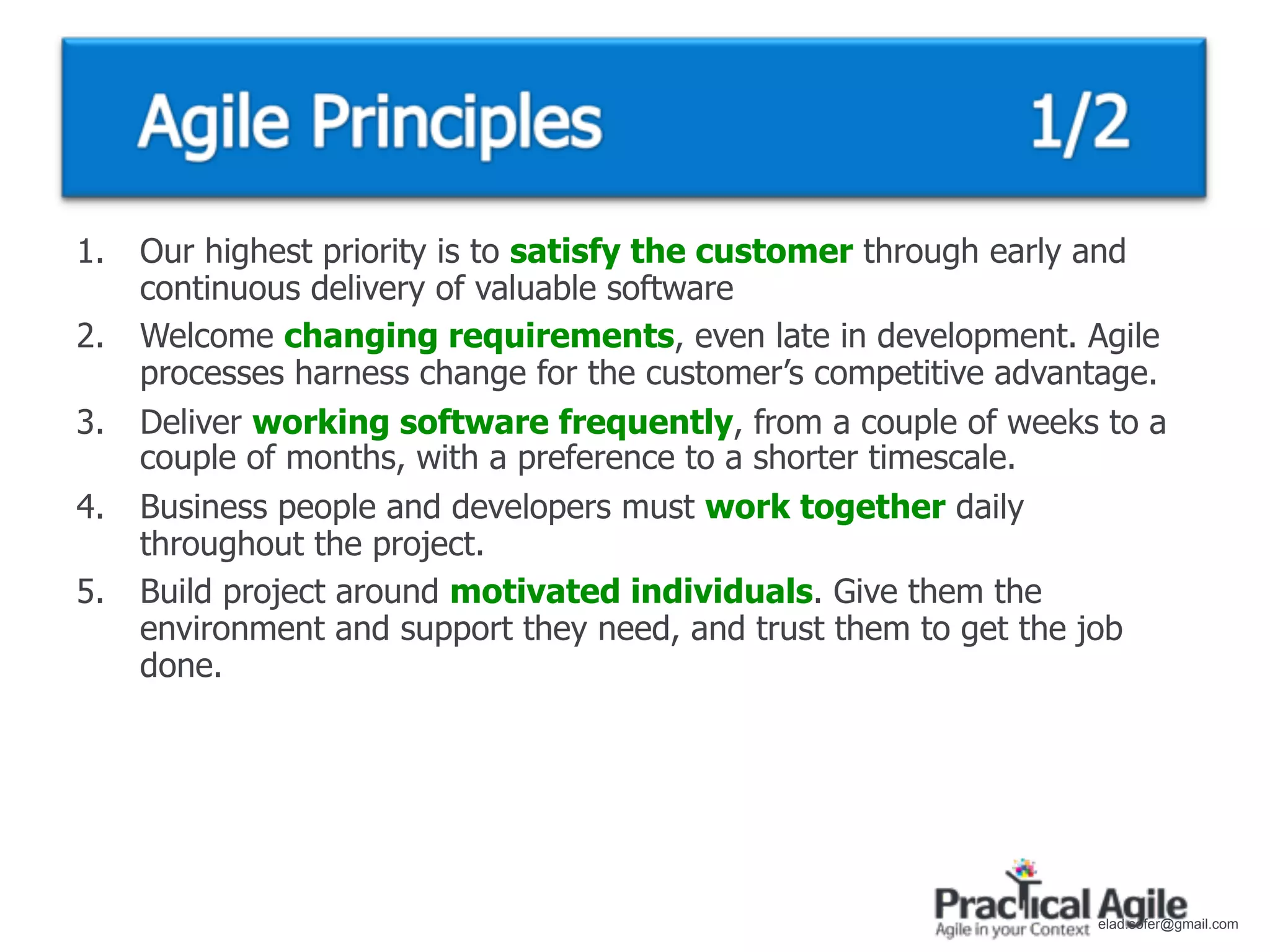
3.   Deliver working software frequently, from a couple of weeks to a
     couple of months, with a preference to a shorter timescale.


                                                                  elad.sofer@gmail.com
1.   Our highest priority is to satisfy the customer through early and
     continuous delivery of valuable software
2.   Welcome changing requirements, even late in development. Agile
     processes harness change for the customer’s competitive advantage.
3.   Deliver working software frequently, from a couple of weeks to a
     couple of months, with a preference to a shorter timescale.
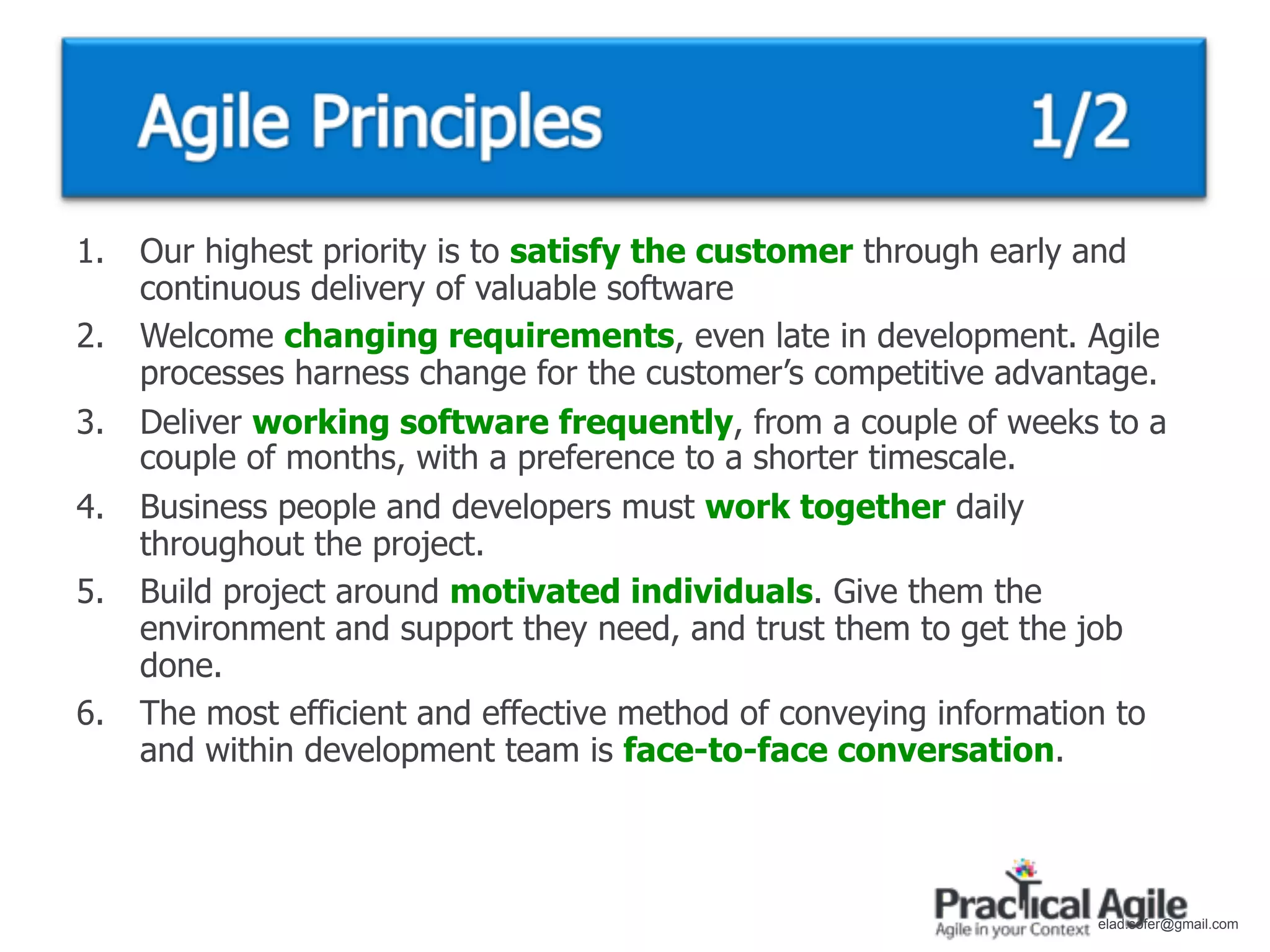
4.   Business people and developers must work together daily
     throughout the project.


                                                                  elad.sofer@gmail.com
1.   Our highest priority is to satisfy the customer through early and
     continuous delivery of valuable software
2.   Welcome changing requirements, even late in development. Agile
     processes harness change for the customer’s competitive advantage.
3.   Deliver working software frequently, from a couple of weeks to a
     couple of months, with a preference to a shorter timescale.
4.   Business people and developers must work together daily
     throughout the project.
5.   Build project around motivated individuals. Give them the
     environment and support they need, and trust them to get the job
     done.


                                                                  elad.sofer@gmail.com
1.   Our highest priority is to satisfy the customer through early and
     continuous delivery of valuable software
2.   Welcome changing requirements, even late in development. Agile
     processes harness change for the customer’s competitive advantage.
3.   Deliver working software frequently, from a couple of weeks to a
     couple of months, with a preference to a shorter timescale.
4.   Business people and developers must work together daily
     throughout the project.
5.   Build project around motivated individuals. Give them the
     environment and support they need, and trust them to get the job
     done.
6.   The most efficient and effective method of conveying information to
     and within development team is face-to-face conversation.


                                                                   elad.sofer@gmail.com
elad.sofer@gmail.com
7.   Working software is the primary measure for progress.


                                                        elad.sofer@gmail.com
7. Working software is the primary measure for progress.
8. Agile processes promote sustainable development. The
   sponsors, developers, and users should be able to maintain a
   constant pace indefinitely.


                                                             elad.sofer@gmail.com
7. Working software is the primary measure for progress.
8. Agile processes promote sustainable development. The
   sponsors, developers, and users should be able to maintain a
   constant pace indefinitely.
9. Continuous attention to technical excellence and good design
   enhances agility.


                                                            elad.sofer@gmail.com
7. Working software is the primary measure for progress.
8. Agile processes promote sustainable development. The
    sponsors, developers, and users should be able to maintain a
    constant pace indefinitely.
9. Continuous attention to technical excellence and good design
    enhances agility.
10. Simplicity – the art of maximizing the amount of work not done –
    is essential.


                                                               elad.sofer@gmail.com
7. Working software is the primary measure for progress.
8. Agile processes promote sustainable development. The
    sponsors, developers, and users should be able to maintain a
    constant pace indefinitely.
9. Continuous attention to technical excellence and good design
    enhances agility.
10. Simplicity – the art of maximizing the amount of work not done –
    is essential.
11. The best architectures, requirements, and designs emerge from
    self-organizing teams.


                                                               elad.sofer@gmail.com
7. Working software is the primary measure for progress.
8. Agile processes promote sustainable development. The
    sponsors, developers, and users should be able to maintain a
    constant pace indefinitely.
9. Continuous attention to technical excellence and good design
    enhances agility.
10. Simplicity – the art of maximizing the amount of work not done –
    is essential.
11. The best architectures, requirements, and designs emerge from
    self-organizing teams.
12. At regular intervals, the team reflects on how to become more
    effective, then tunes and adjusts its behavior accordingly.


                                                               elad.sofer@gmail.com
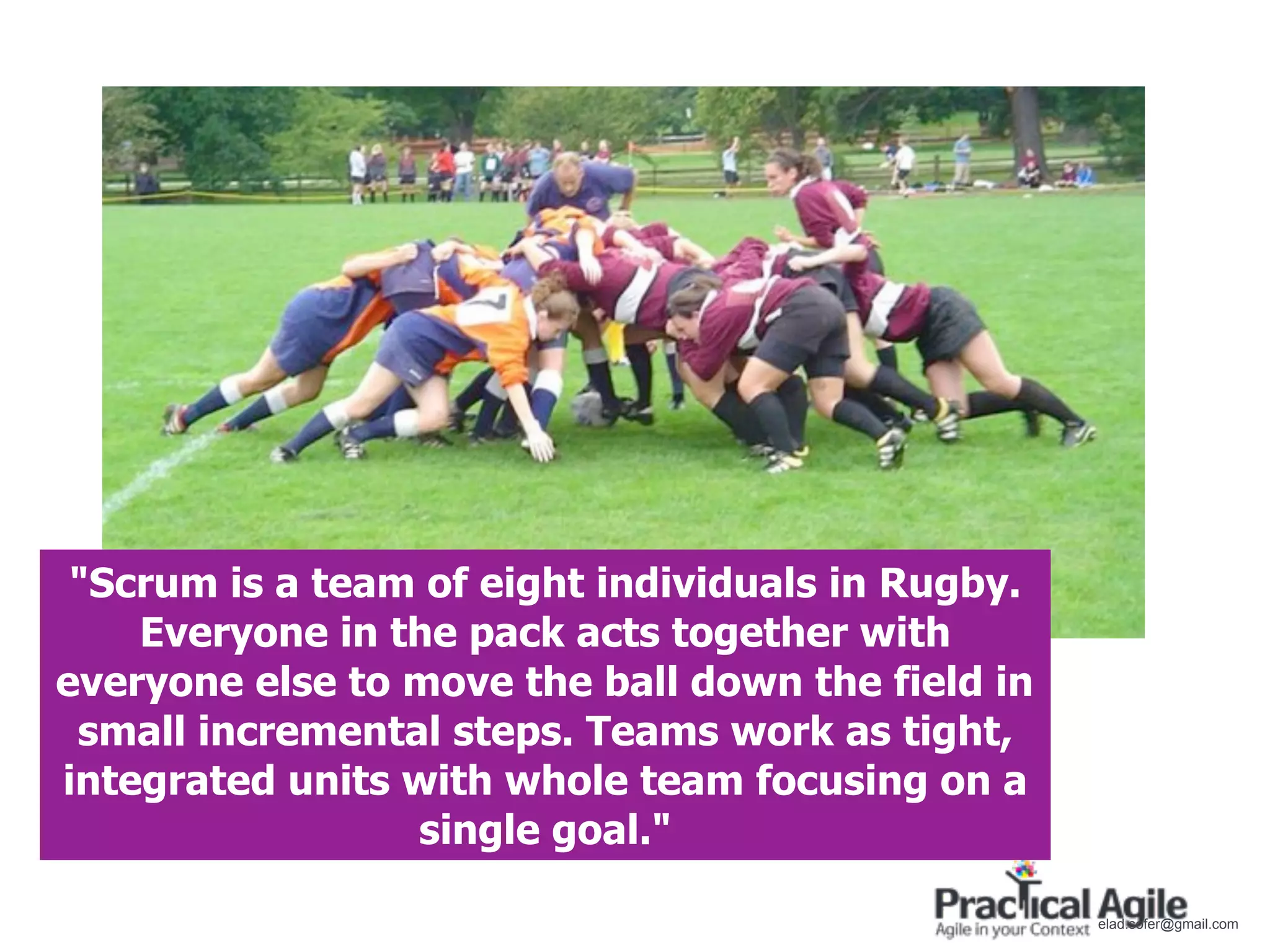
"Scrum is a team of eight individuals in Rugby.
    Everyone in the pack acts together with
everyone else to move the ball down the field in
 small incremental steps. Teams work as tight,
integrated units with whole team focusing on a
                 single goal."

                                                   elad.sofer@gmail.com
elad.sofer@gmail.com
• Understanding that we cannot predict the future.


                                             elad.sofer@gmail.com
• Understanding that we cannot predict the future.
• One size does not fit all.


                                             elad.sofer@gmail.com
• Understanding that we cannot predict the future.
• One size does not fit all.
• Constant improvement.


                                             elad.sofer@gmail.com
•   Understanding that we cannot predict the future.
•   One size does not fit all.
•   Constant improvement.
•   Transparency


                                               elad.sofer@gmail.com
•   Understanding that we cannot predict the future.
•   One size does not fit all.
•   Constant improvement.
•   Transparency
•   Team work


                                               elad.sofer@gmail.com
•   Understanding that we cannot predict the future.
•   One size does not fit all.
•   Constant improvement.
•   Transparency
•   Team work
•   As simple as possible & as little as possible.


                                               elad.sofer@gmail.com
•   Understanding that we cannot predict the future.
•   One size does not fit all.
•   Constant improvement.
•   Transparency
•   Team work
•   As simple as possible & as little as possible.
•   Prioritizing – Industry statistics show: 65% of all
    features are rarelynever used.


                                                  elad.sofer@gmail.com
• Understanding that we cannot predict the future.
• One size does not fit all.
• Constant improvement.
• Transparency
• Team work
• As simple as possible & as little as possible.
• Prioritizing – Industry statistics show: 65% of all
  features are rarelynever used.
• Empirical approach


                                                elad.sofer@gmail.com
• Understanding that we cannot predict the future.
• One size does not fit all.
• Constant improvement.
• Transparency
• Team work
• As simple as possible & as little as possible.
• Prioritizing – Industry statistics show: 65% of all
  features are rarelynever used.
• Empirical approach
• Fun !!!

                                                elad.sofer@gmail.com
elad.sofer@gmail.com
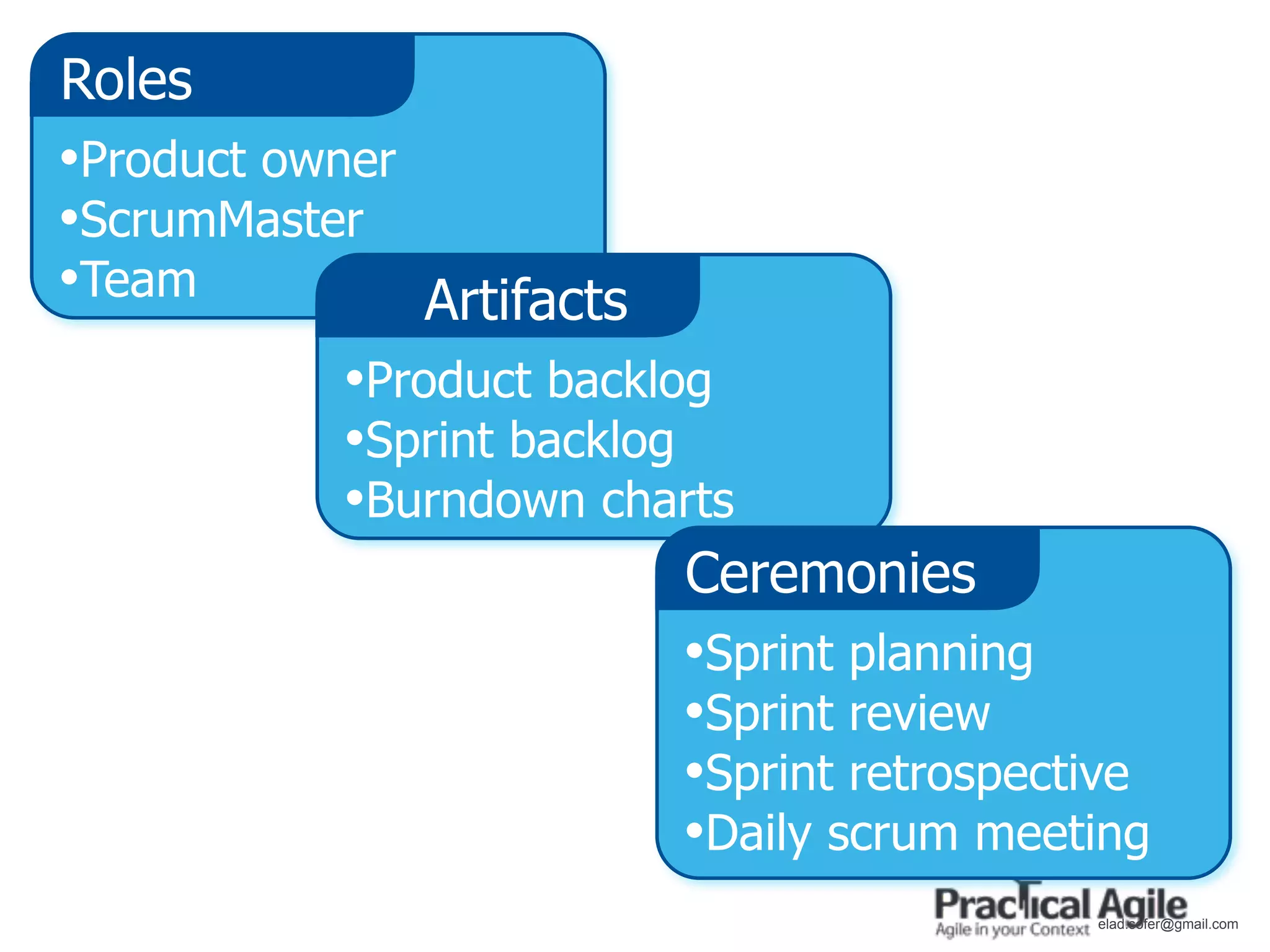
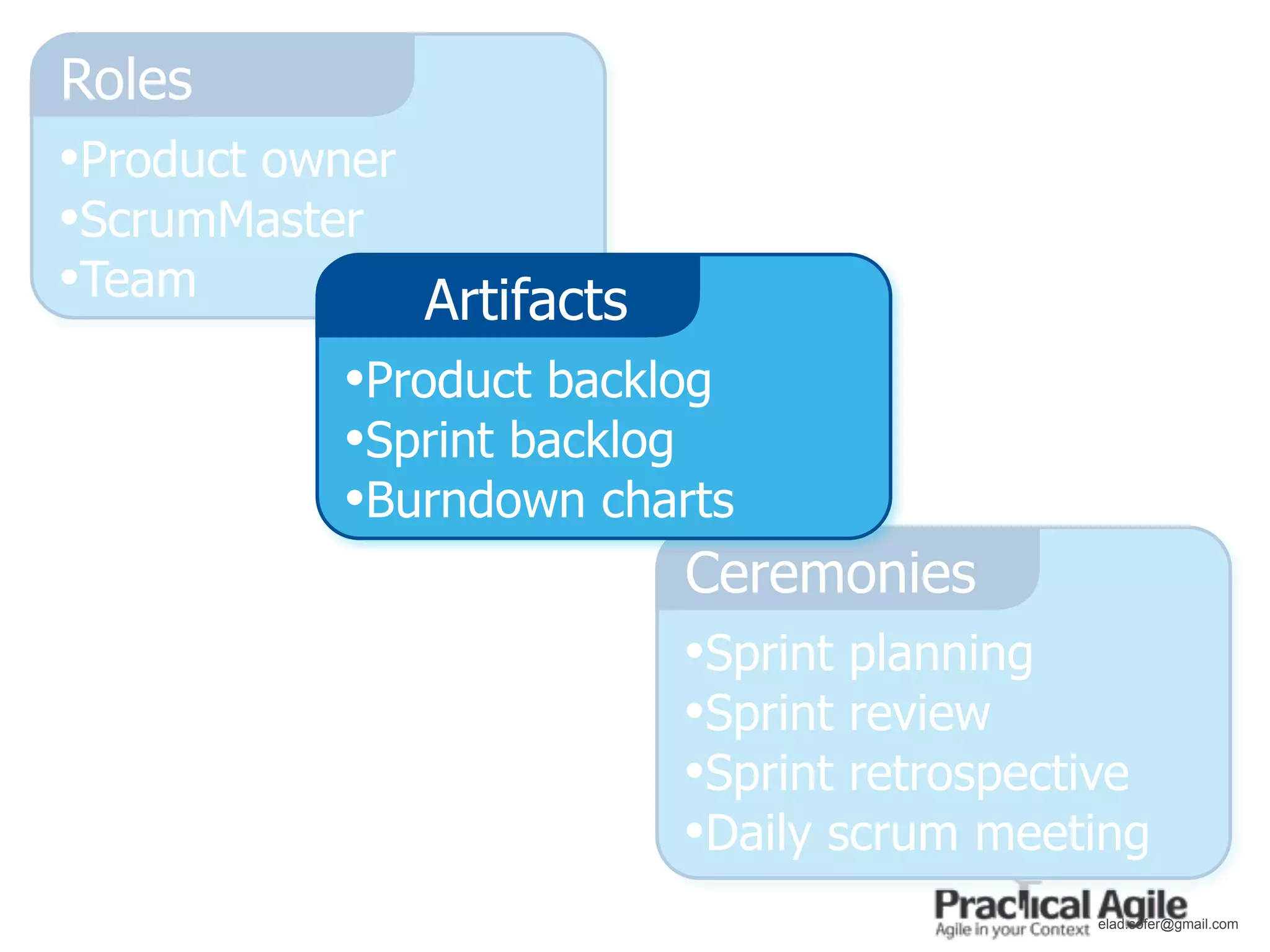
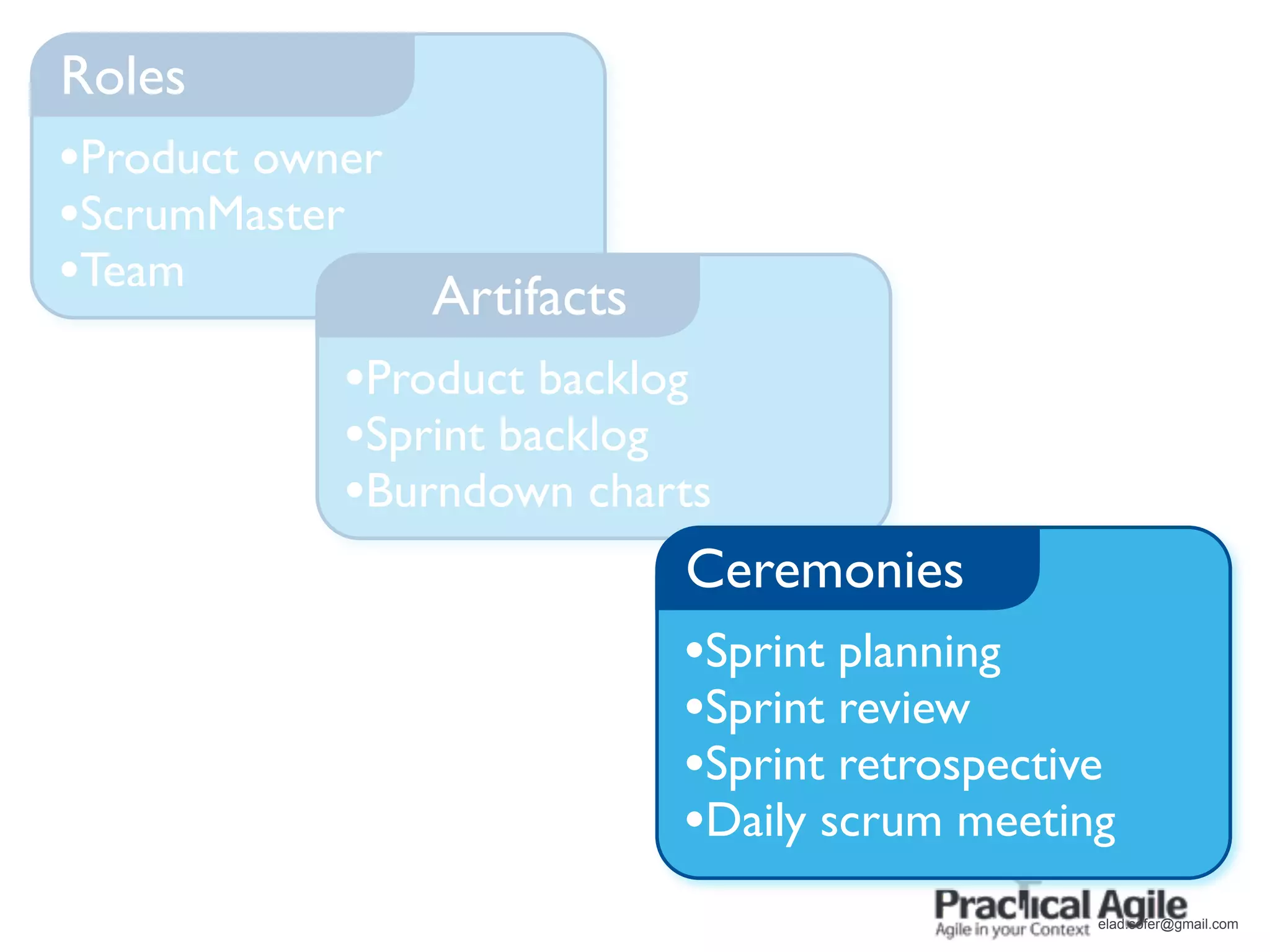
Roles
•Product owner
•ScrumMaster
•Team           Artifacts
            •Product backlog
            •Sprint backlog
            •Burndown charts
                         Ceremonies
                         •Sprint planning
                         •Sprint review
                         •Sprint retrospective
                         •Daily scrum meeting
                                           elad.sofer@gmail.com
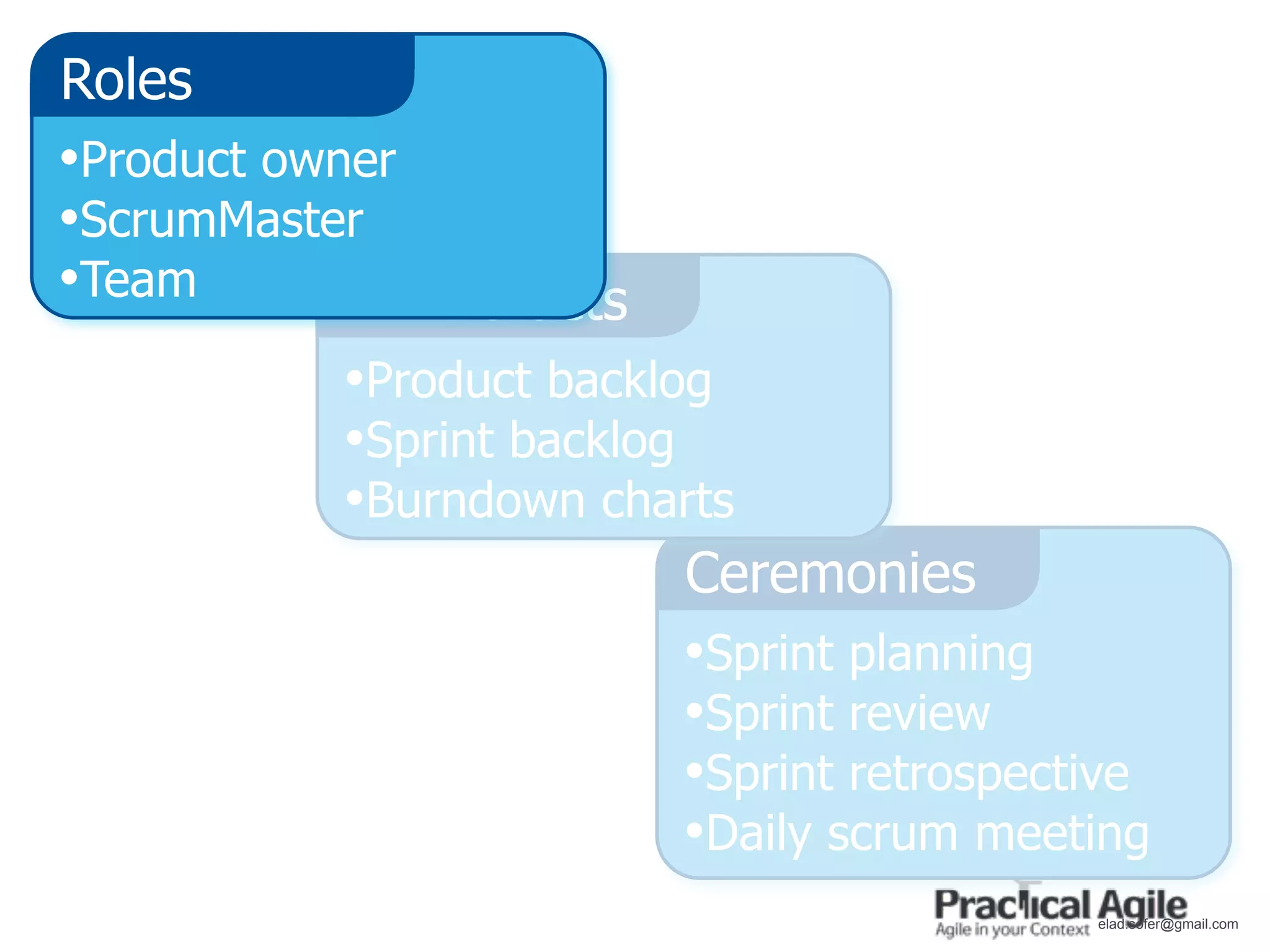
Roles
•Product owner
•ScrumMaster
•Team           Artifacts
            •Product backlog
            •Sprint backlog
            •Burndown charts
                         Ceremonies
                         •Sprint planning
                         •Sprint review
                         •Sprint retrospective
                         •Daily scrum meeting
                                           elad.sofer@gmail.com
elad.sofer@gmail.com
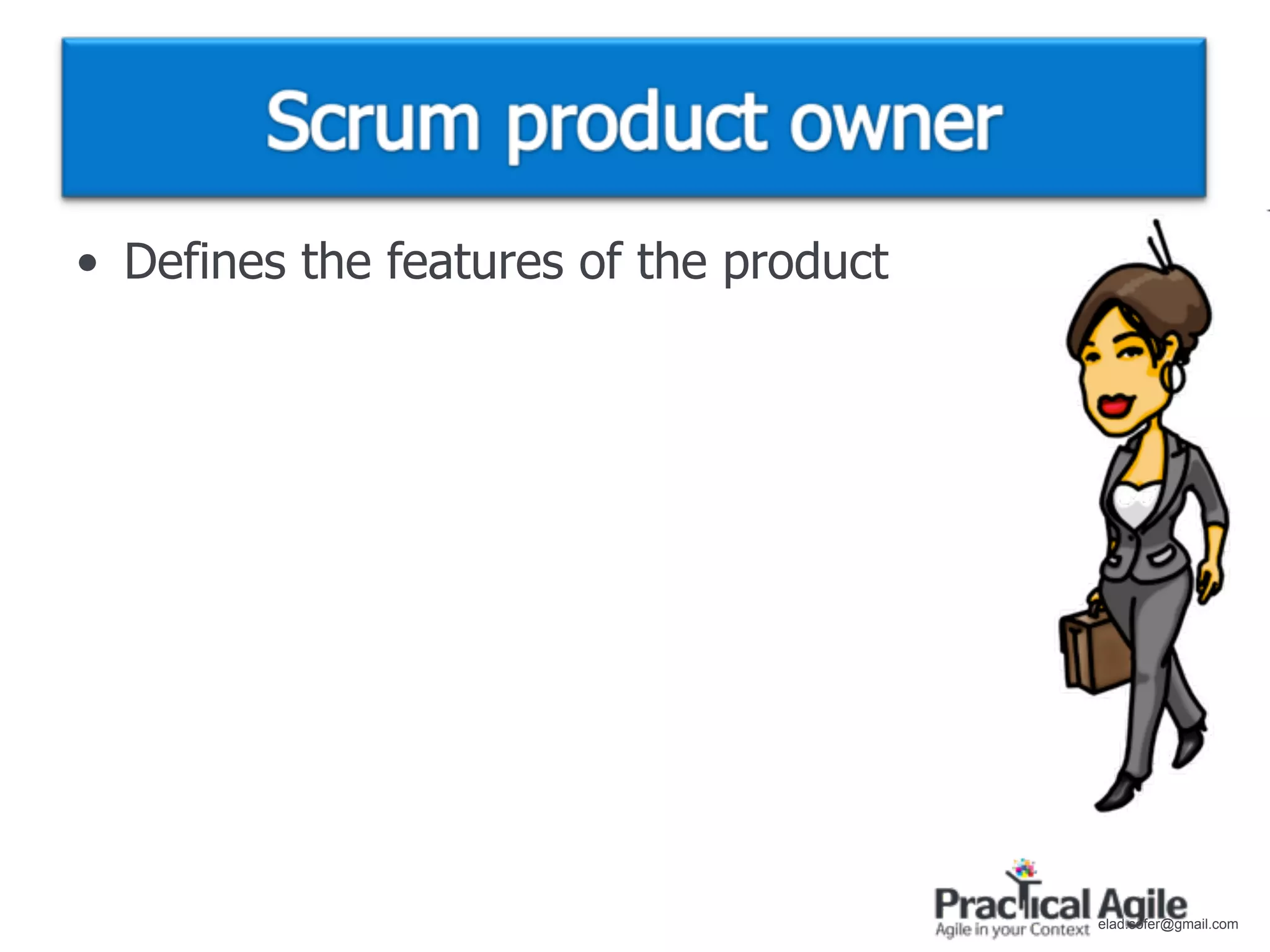
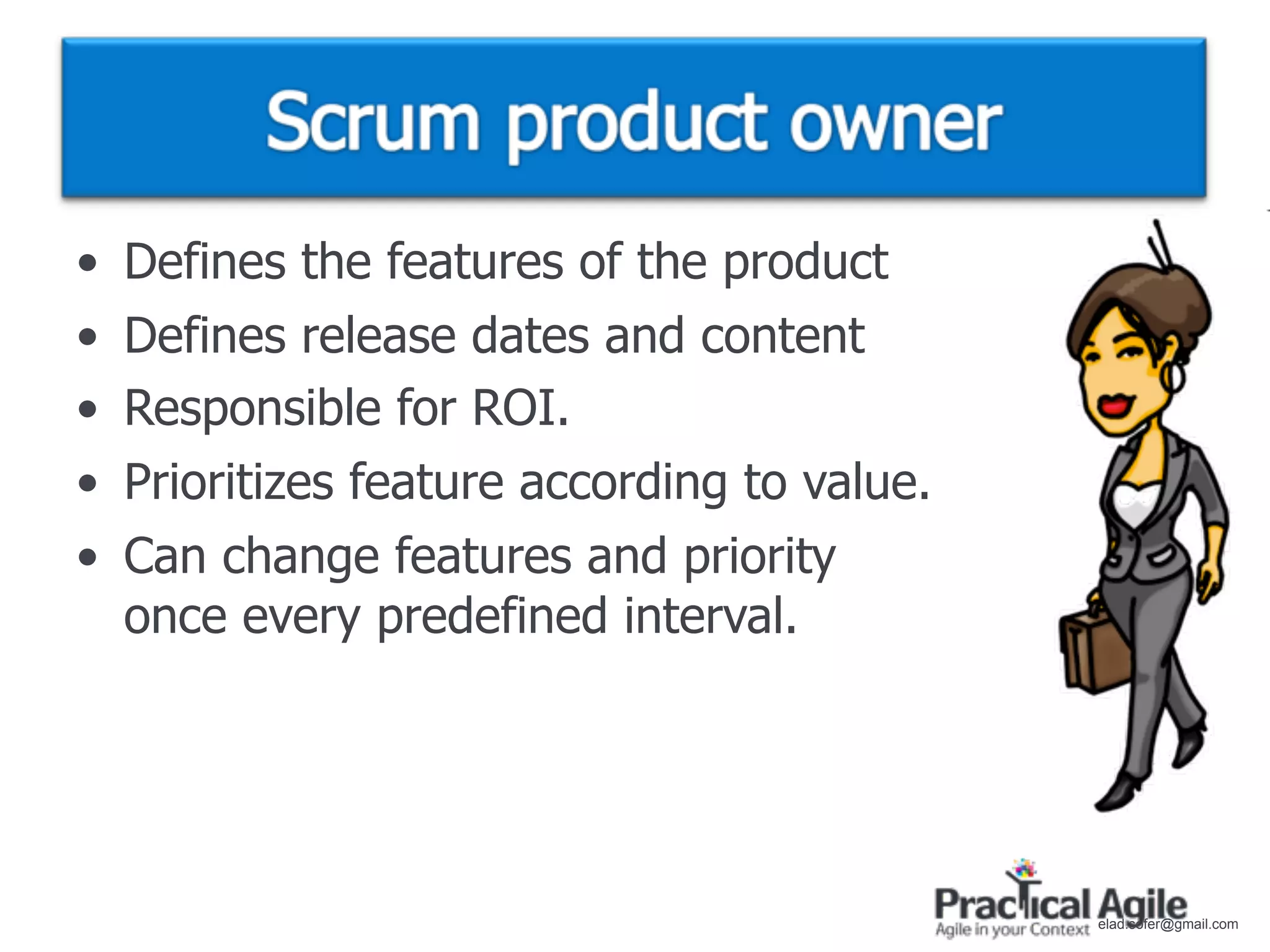
• Defines the features of the product


                                        elad.sofer@gmail.com
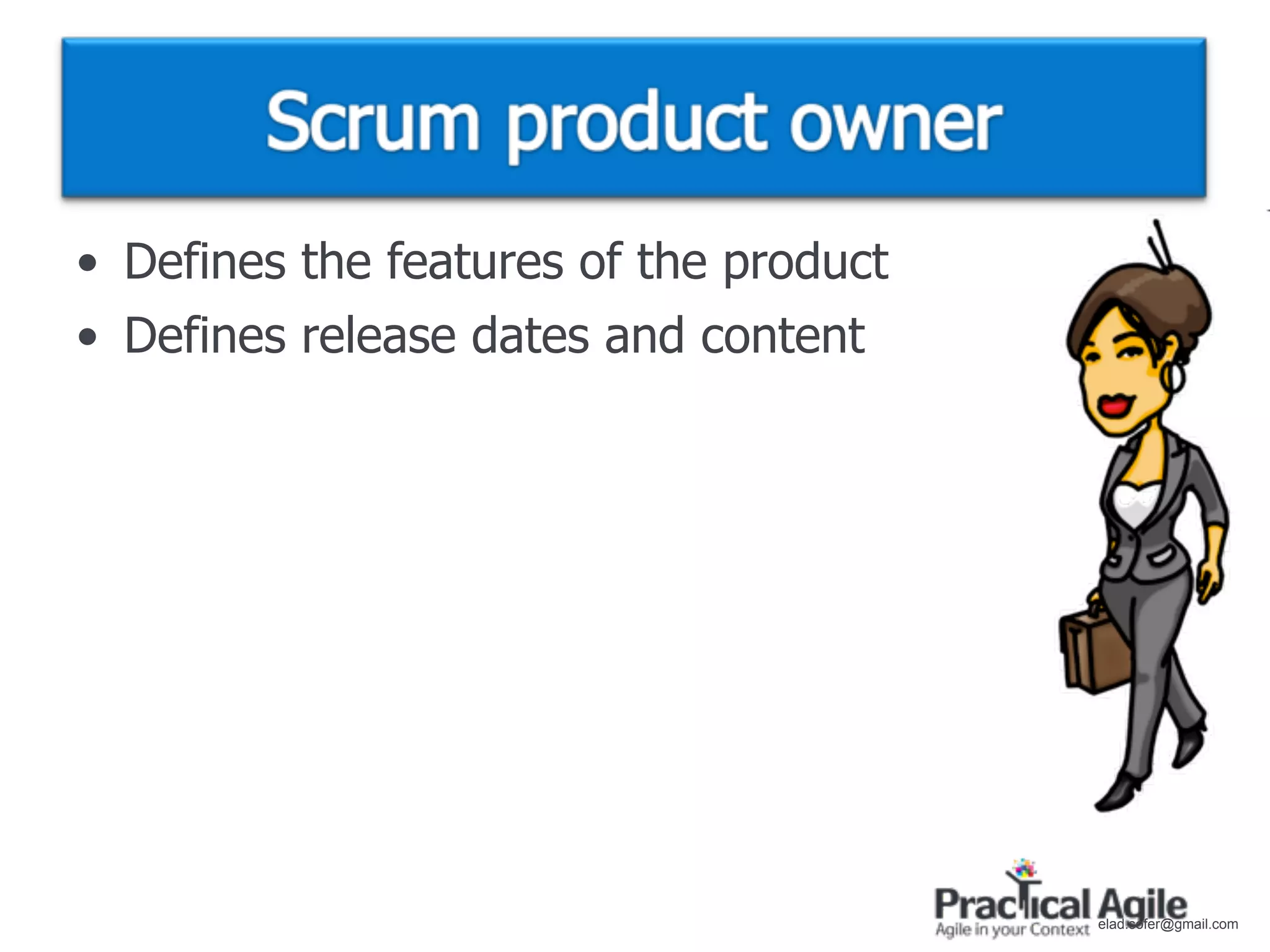
• Defines the features of the product
• Defines release dates and content


                                        elad.sofer@gmail.com
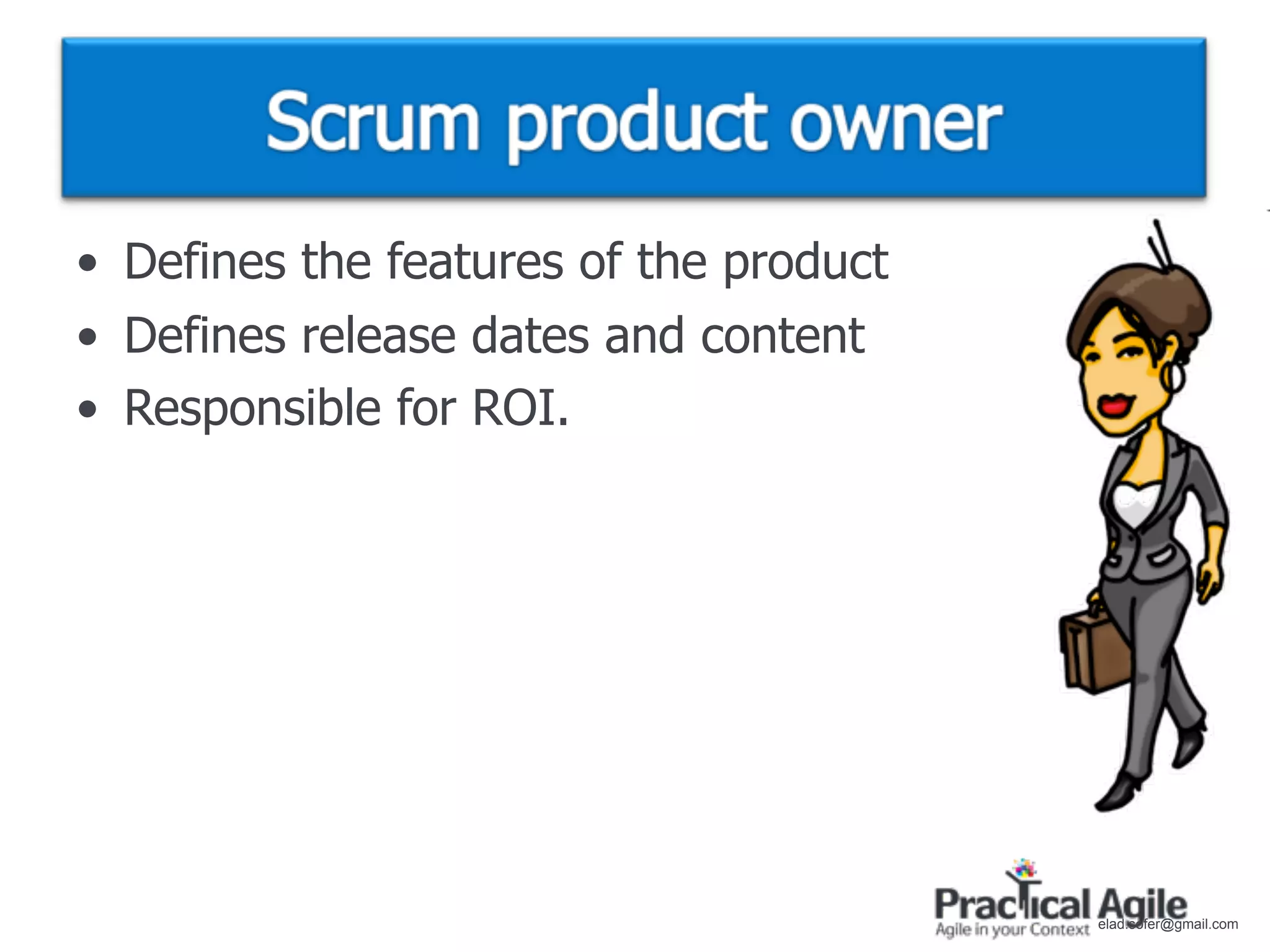
• Defines the features of the product
• Defines release dates and content
• Responsible for ROI.


                                        elad.sofer@gmail.com
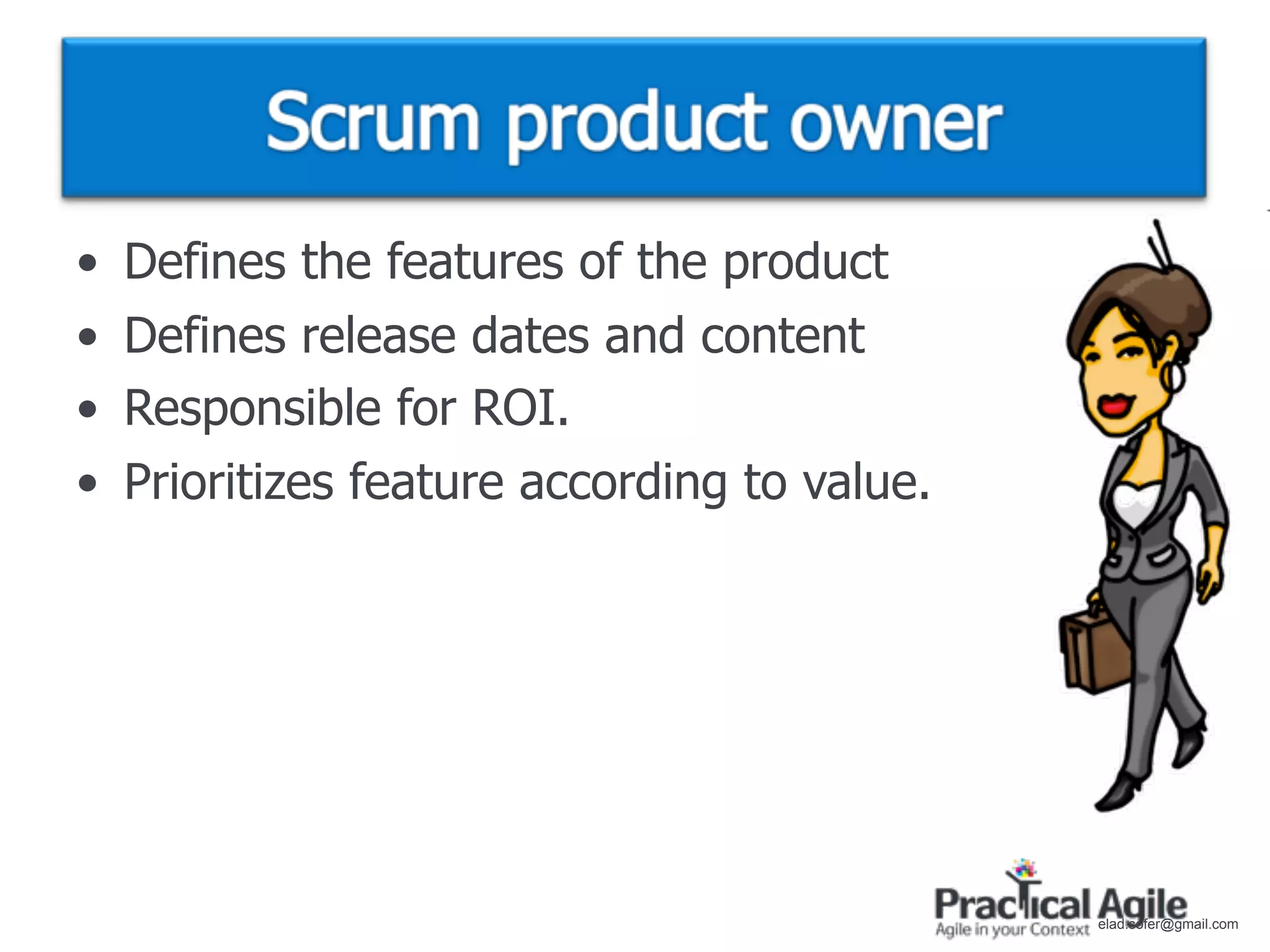
•   Defines the features of the product
•   Defines release dates and content
•   Responsible for ROI.
•   Prioritizes feature according to value.


                                              elad.sofer@gmail.com
•   Defines the features of the product
•   Defines release dates and content
•   Responsible for ROI.
•   Prioritizes feature according to value.
•   Can change features and priority
    once every predefined interval.


                                              elad.sofer@gmail.com
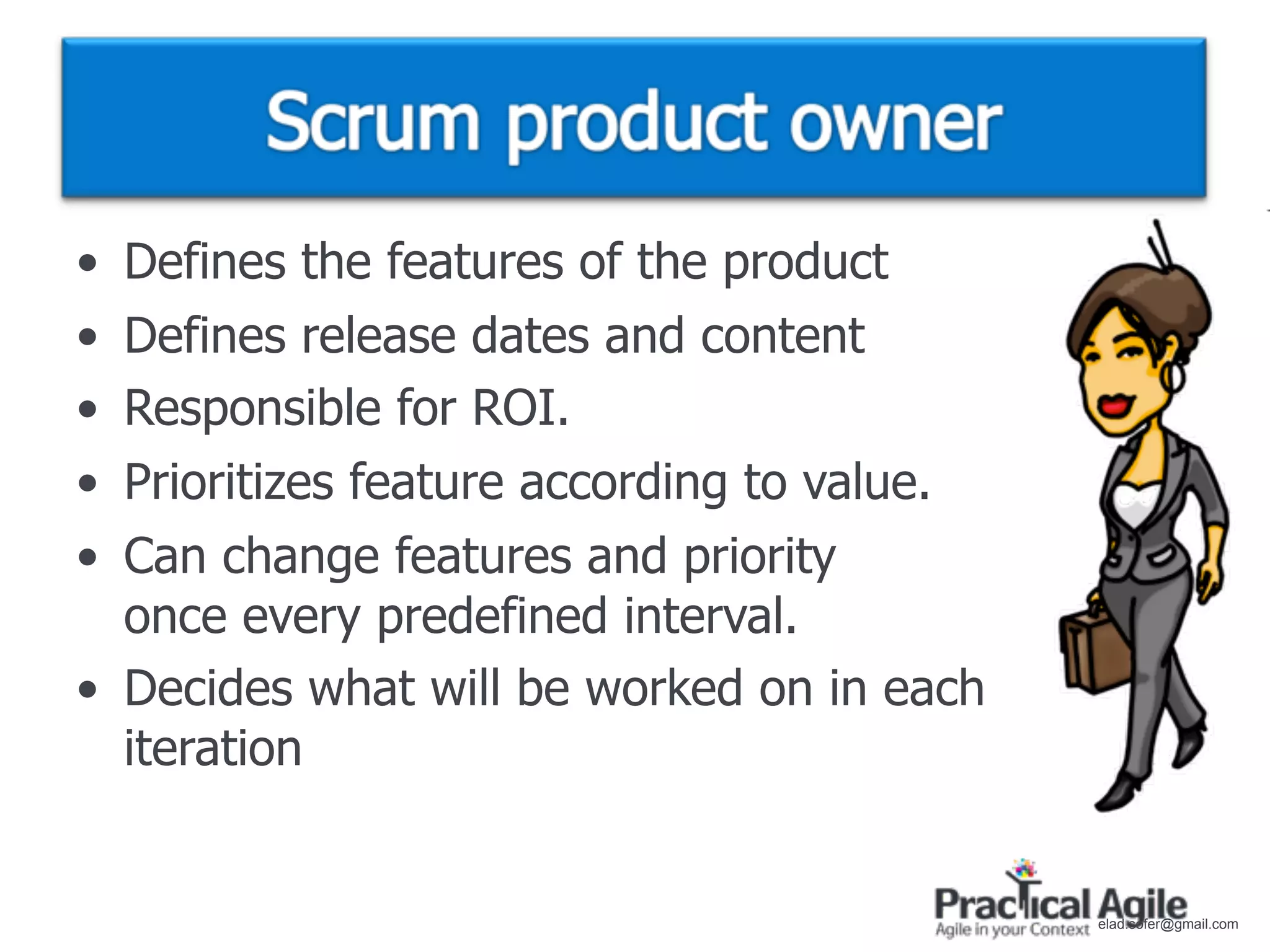
• Defines the features of the product
• Defines release dates and content
• Responsible for ROI.
• Prioritizes feature according to value.
• Can change features and priority
  once every predefined interval.
• Decides what will be worked on in each
  iteration


                                            elad.sofer@gmail.com
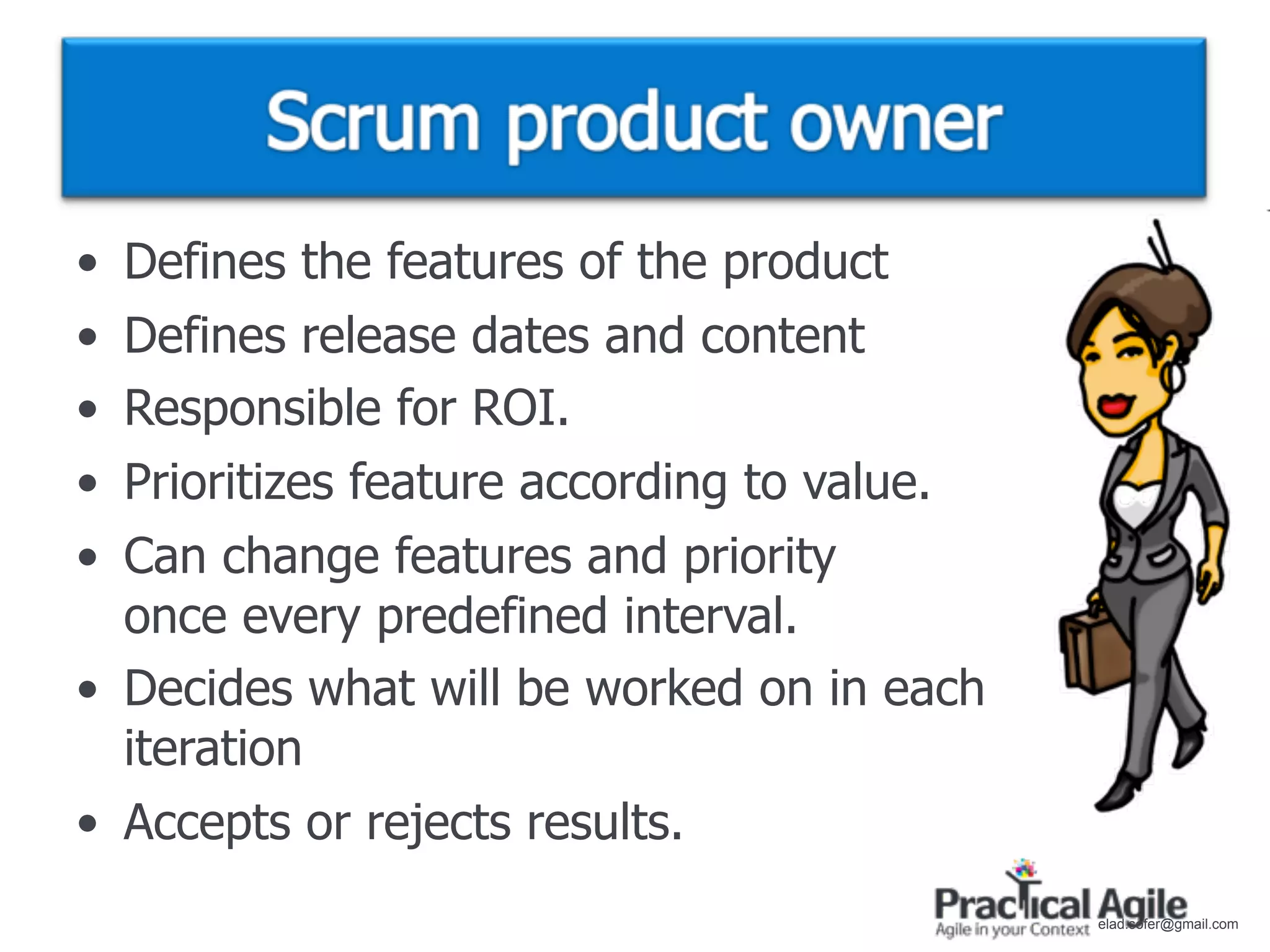
• Defines the features of the product
• Defines release dates and content
• Responsible for ROI.
• Prioritizes feature according to value.
• Can change features and priority
  once every predefined interval.
• Decides what will be worked on in each
  iteration
• Accepts or rejects results.
                                            elad.sofer@gmail.com
elad.sofer@gmail.com
• Responsible for the scrum process.


                                       elad.sofer@gmail.com
• Responsible for the scrum process.
• Protects the team.


                                       elad.sofer@gmail.com
• Responsible for the scrum process.
• Protects the team.
• Helps removing impediments.


                                       elad.sofer@gmail.com
•   Responsible for the scrum process.
•   Protects the team.
•   Helps removing impediments.
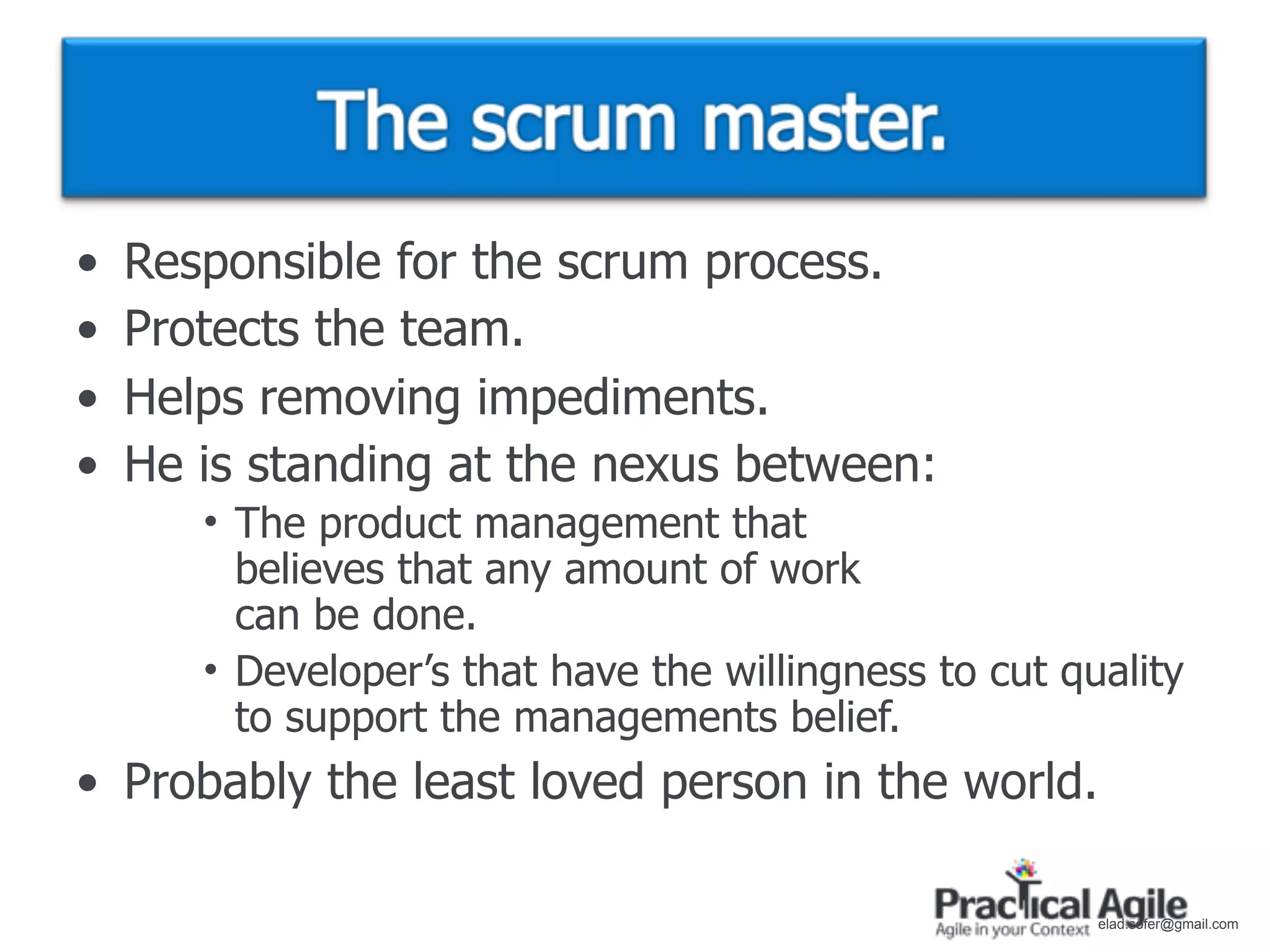
•   He is standing at the nexus between:
       • The product management that
         believes that any amount of work
         can be done.
       • Developer’s that have the willingness to cut quality
         to support the managements belief.


                                                        elad.sofer@gmail.com
•   Responsible for the scrum process.
•   Protects the team.
•   Helps removing impediments.
•   He is standing at the nexus between:
       • The product management that
         believes that any amount of work
         can be done.
       • Developer’s that have the willingness to cut quality
         to support the managements belief.
• Probably the least loved person in the world.

                                                        elad.sofer@gmail.com
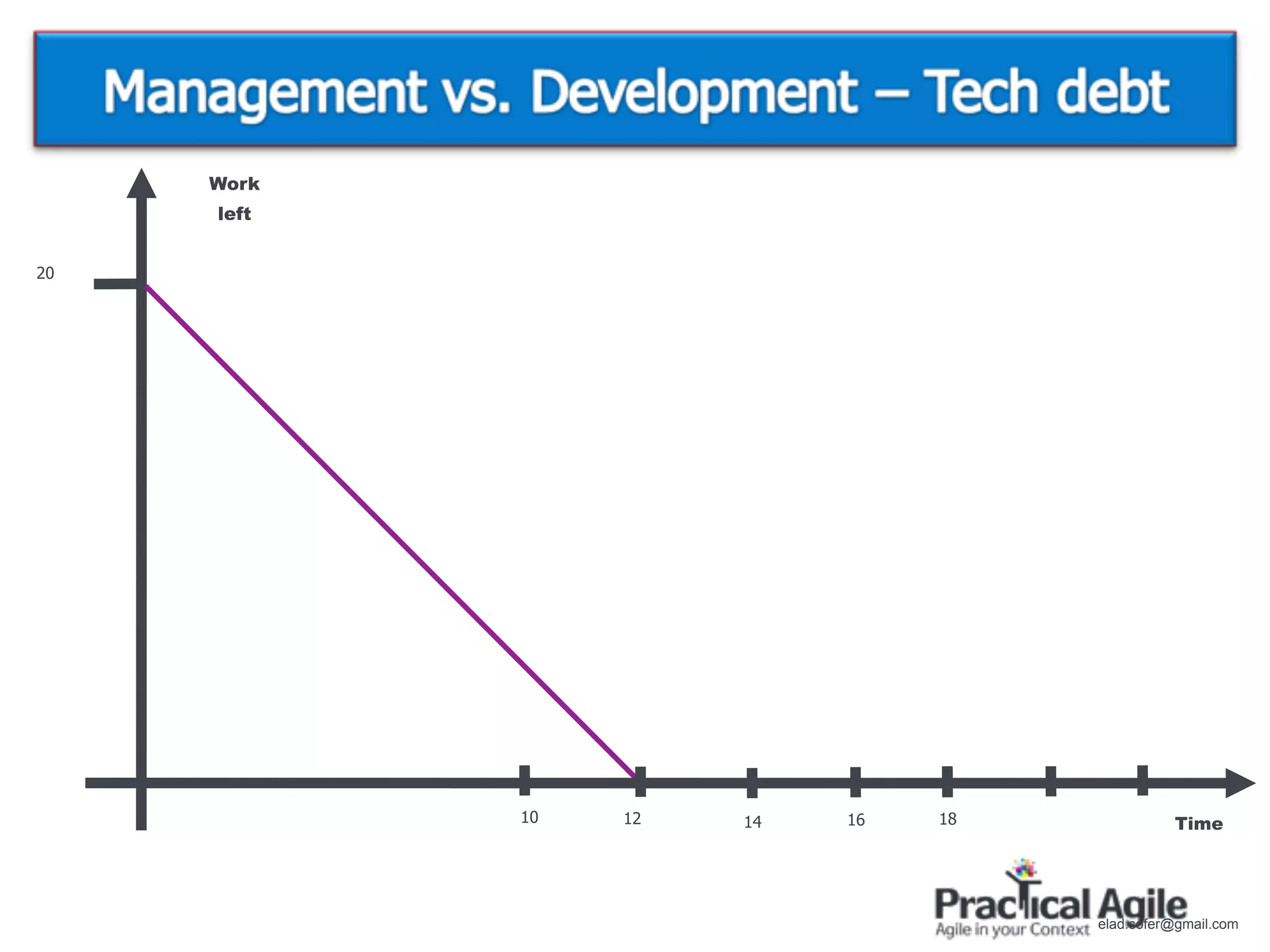
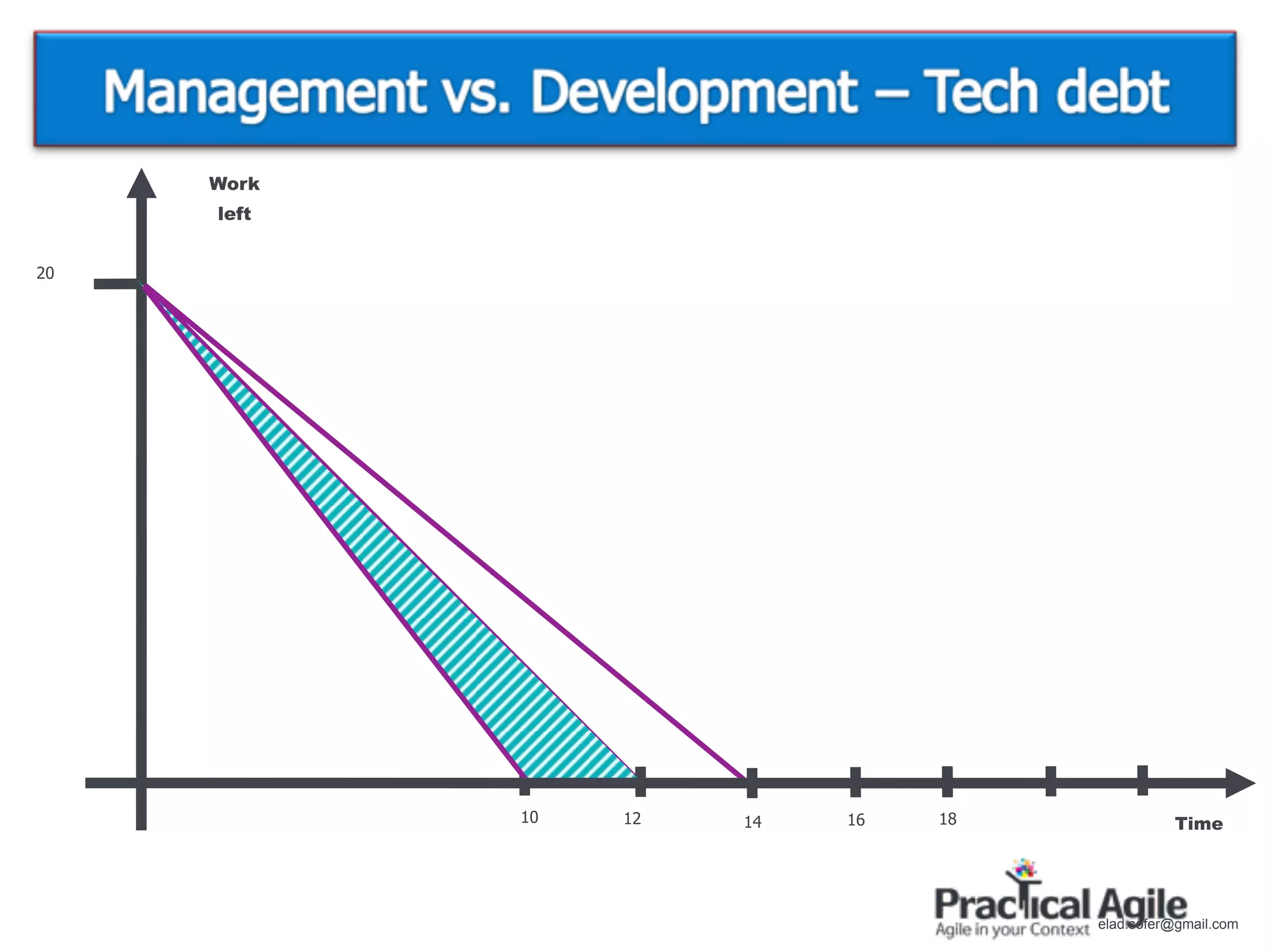
Work
     left


20


            10   12   14   16   18             Time


                                     elad.sofer@gmail.com
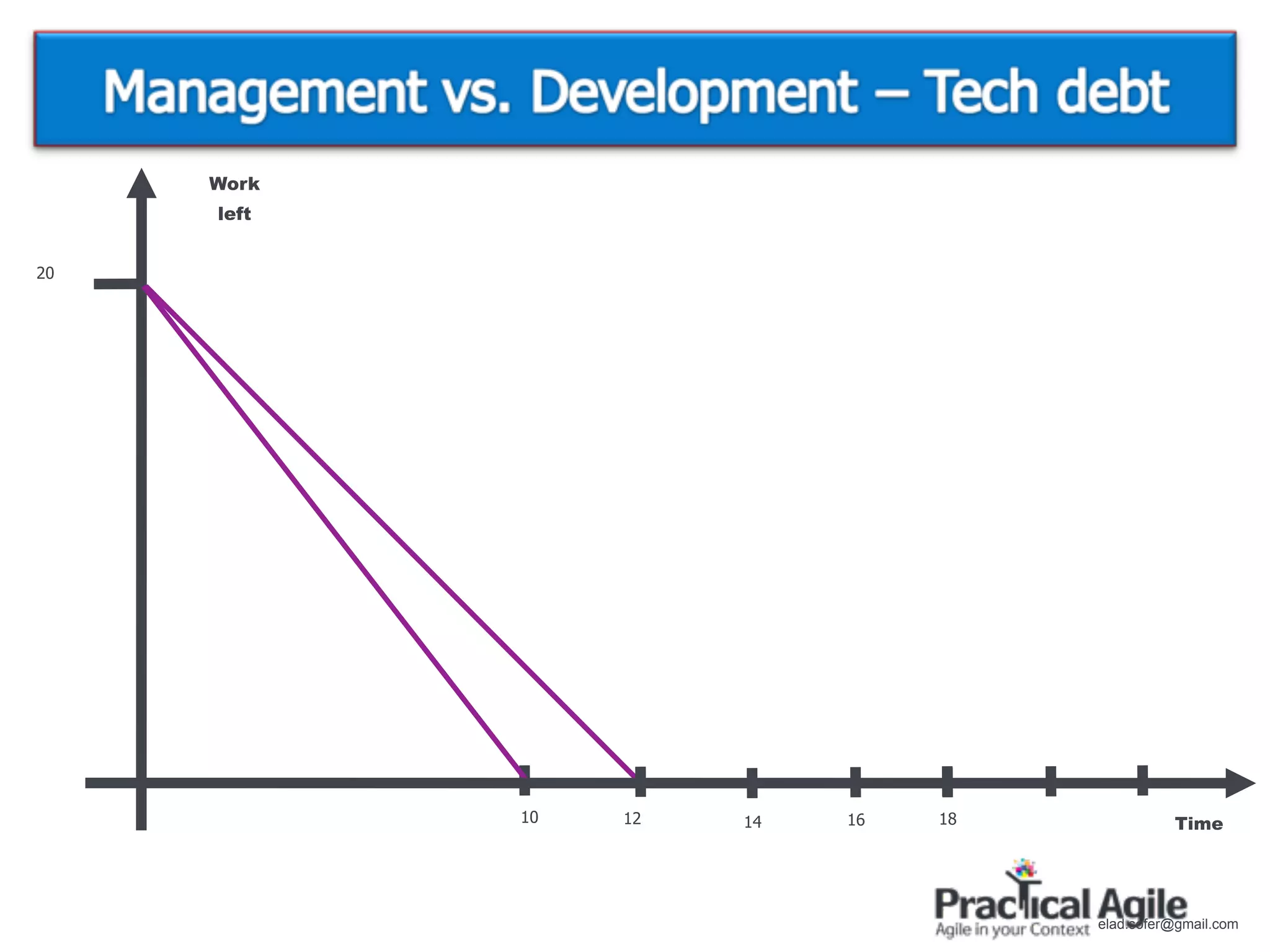
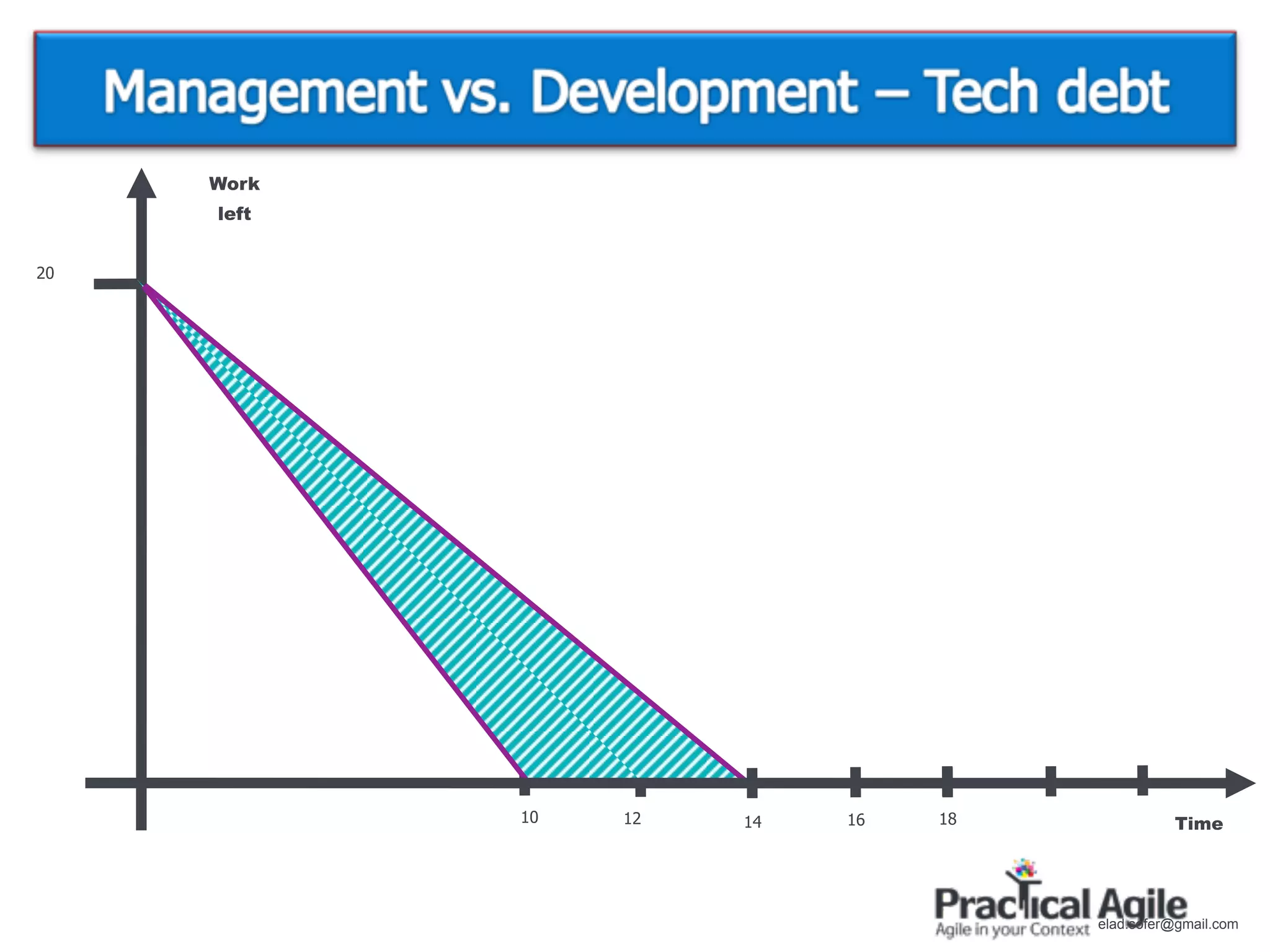
Work
     left


20


            10   12   14   16   18             Time


                                     elad.sofer@gmail.com
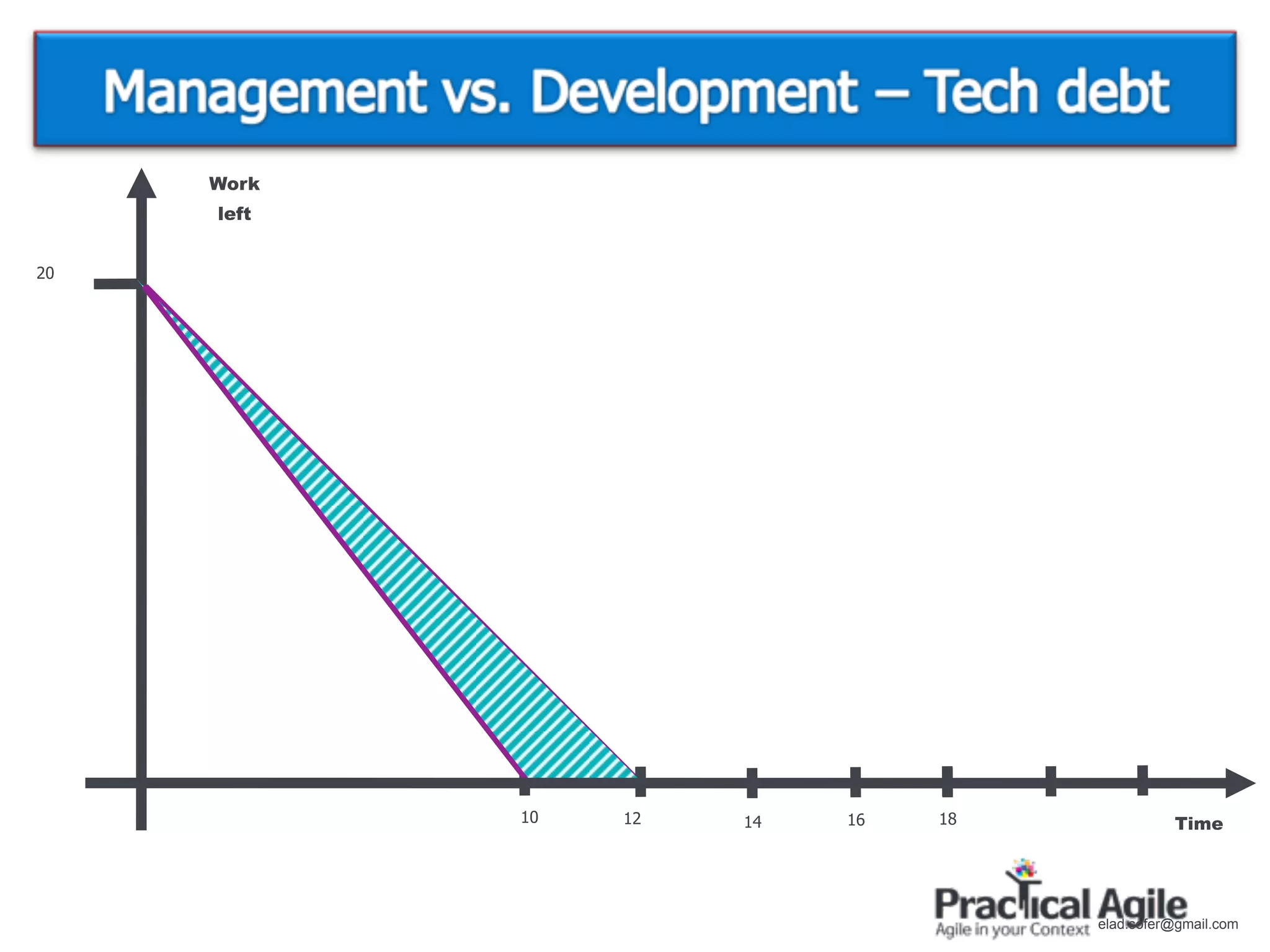
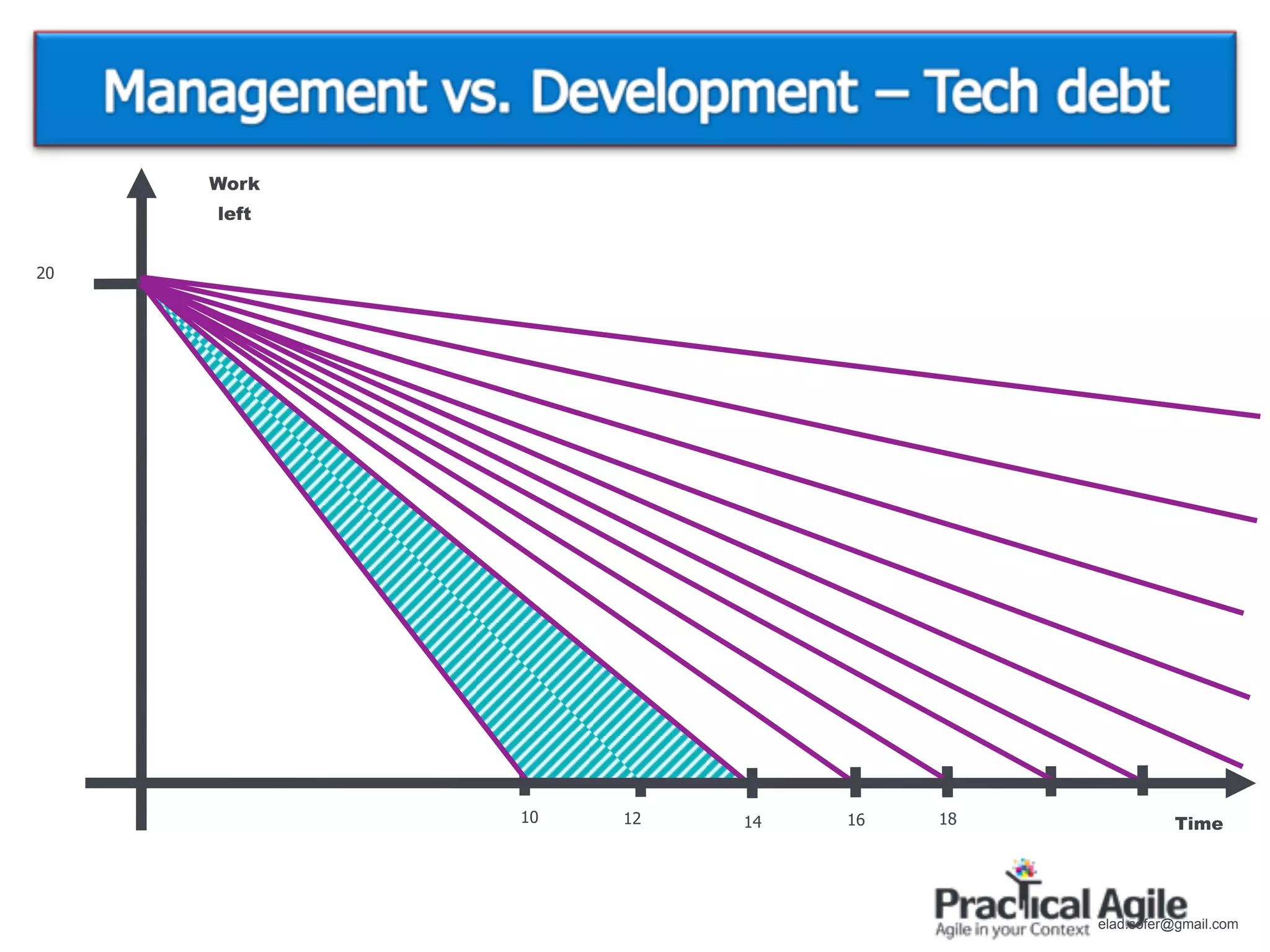
Work
     left


20


            10   12   14   16   18             Time


                                     elad.sofer@gmail.com
Work
     left


20


            10   12   14   16   18             Time


                                     elad.sofer@gmail.com
Work
     left


20


            10   12   14   16   18             Time


                                     elad.sofer@gmail.com
Work
     left


20


            10   12   14   16   18             Time


                                     elad.sofer@gmail.com
elad.sofer@gmail.com
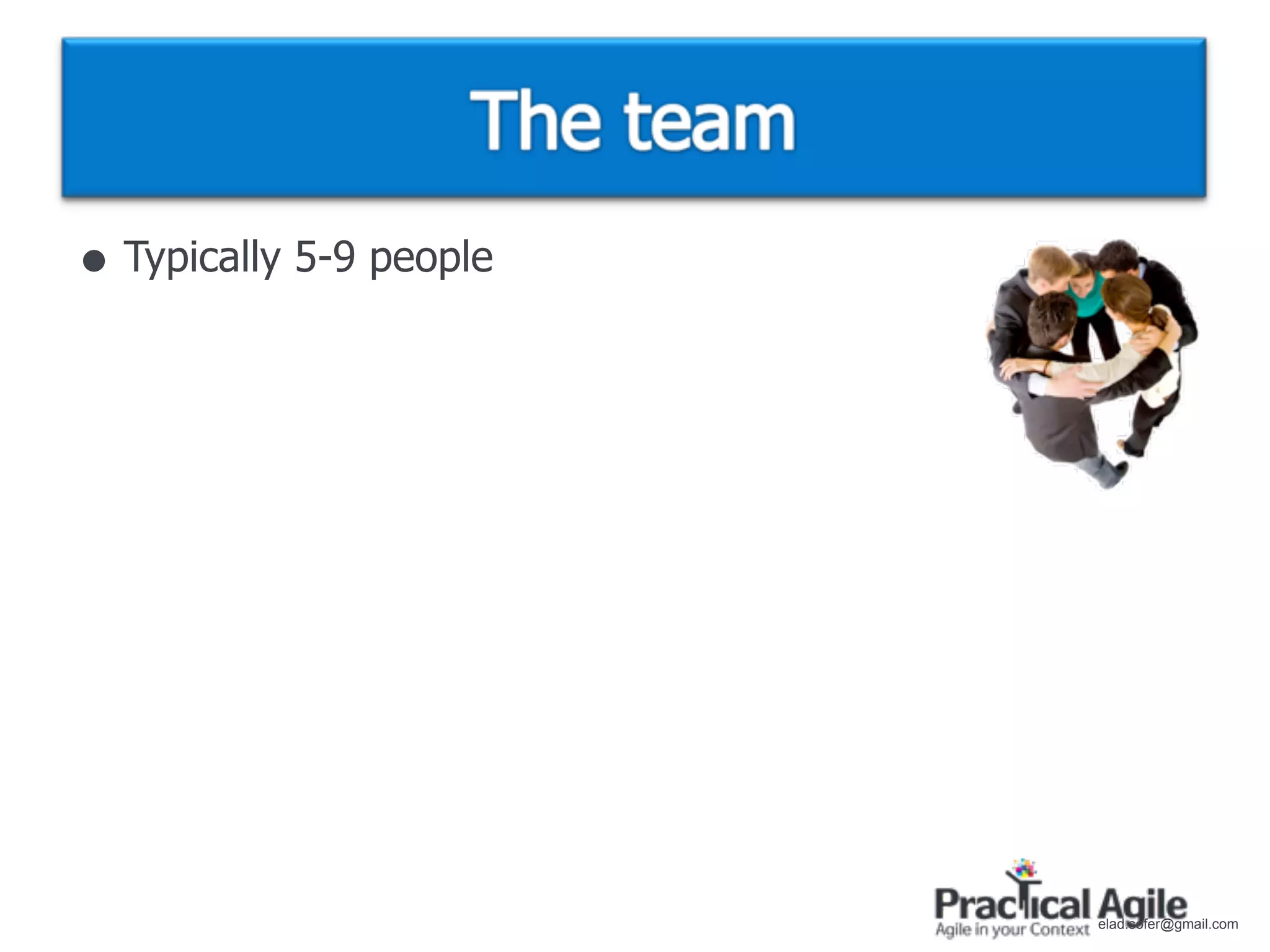
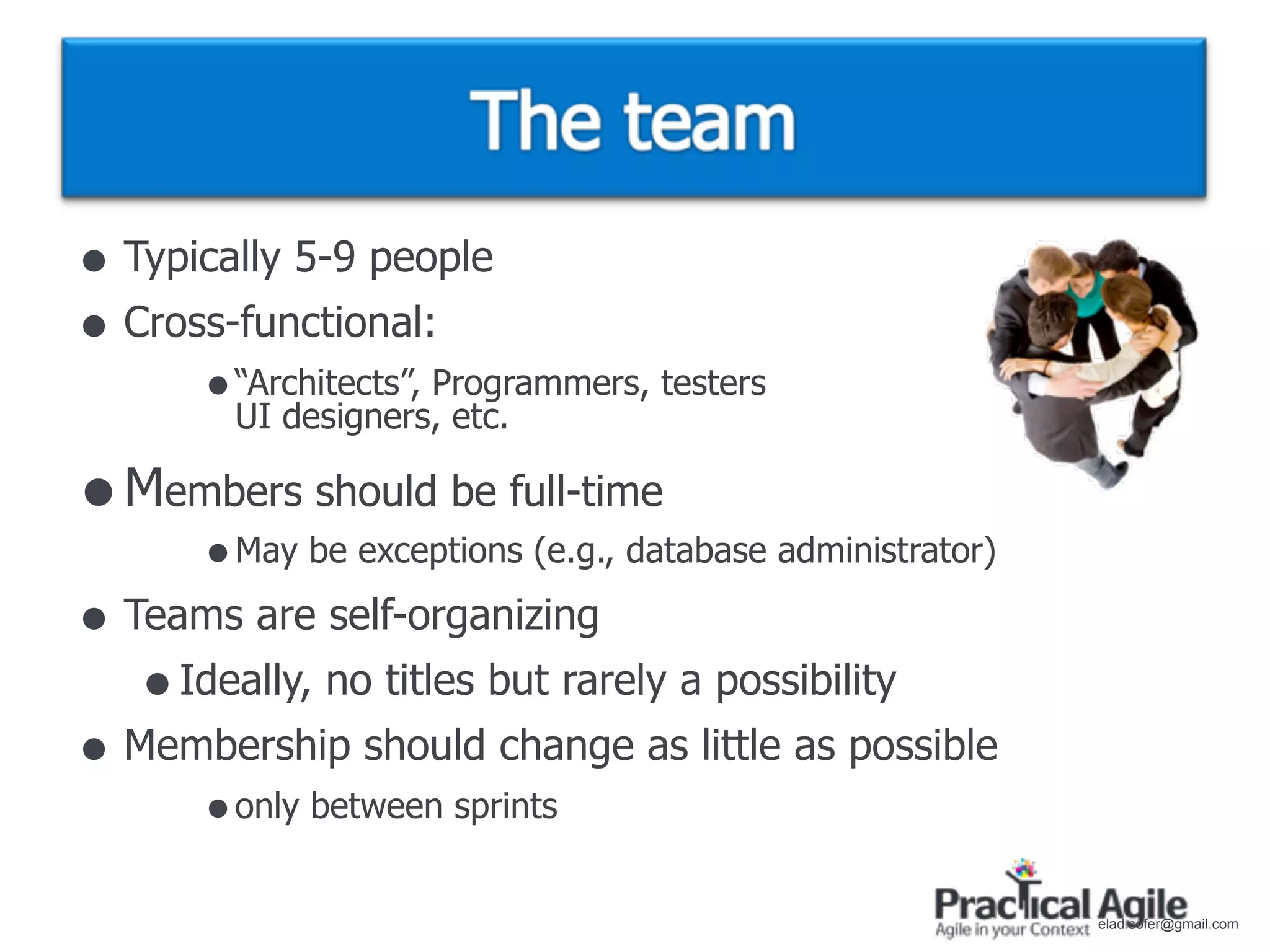
• Typically 5-9 people


                         elad.sofer@gmail.com
• Typically 5-9 people
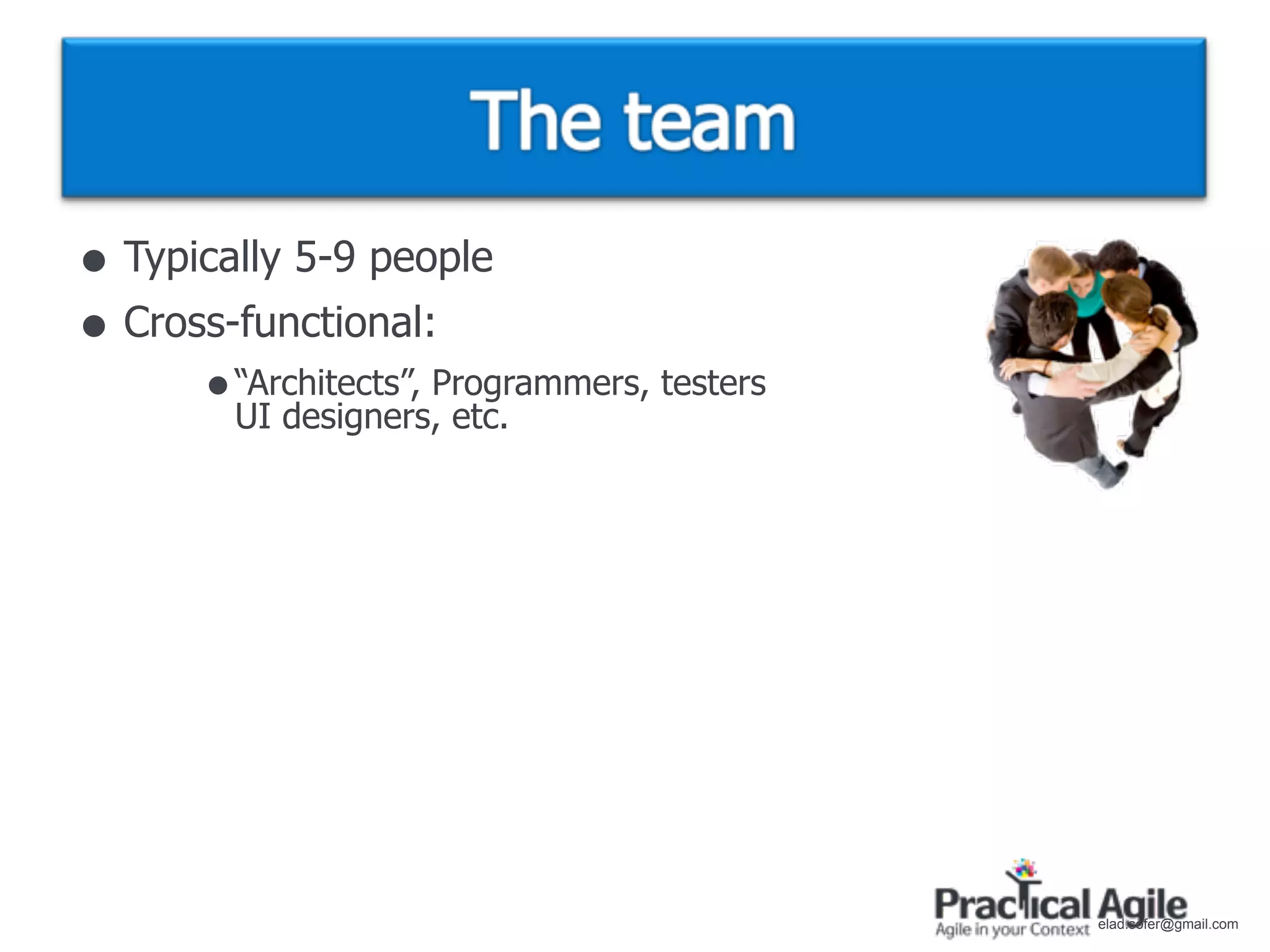
• Cross-functional:
      • “Architects”, Programmers, testers
        UI designers, etc.


                                             elad.sofer@gmail.com
• Typically 5-9 people
• Cross-functional:
      • “Architects”, Programmers, testers
        UI designers, etc.

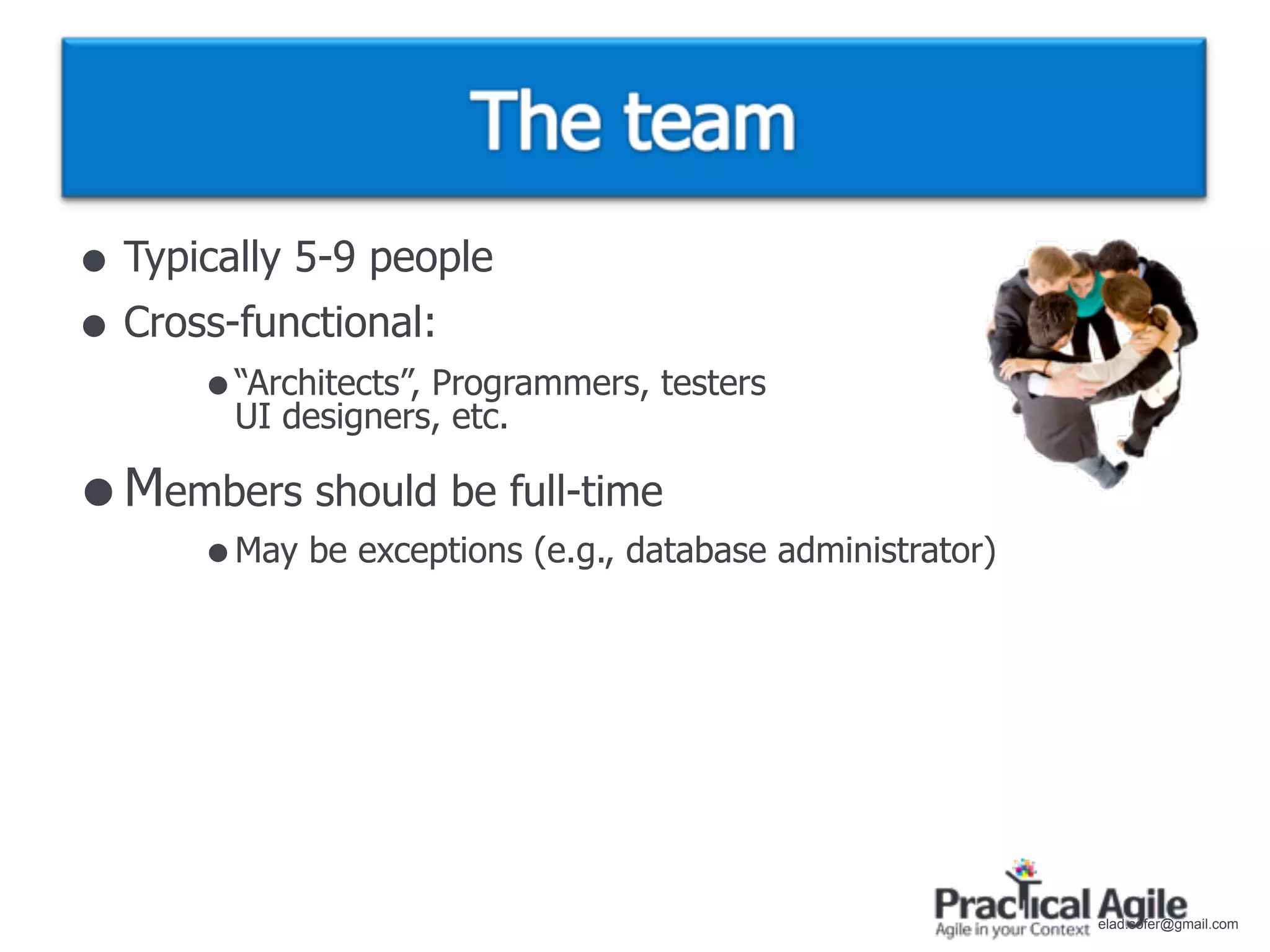
• Members should be full-time
      • May be exceptions (e.g., database administrator)


                                                           elad.sofer@gmail.com
• Typically 5-9 people
• Cross-functional:
       • “Architects”, Programmers, testers
         UI designers, etc.

• Members should be full-time
       • May be exceptions (e.g., database administrator)
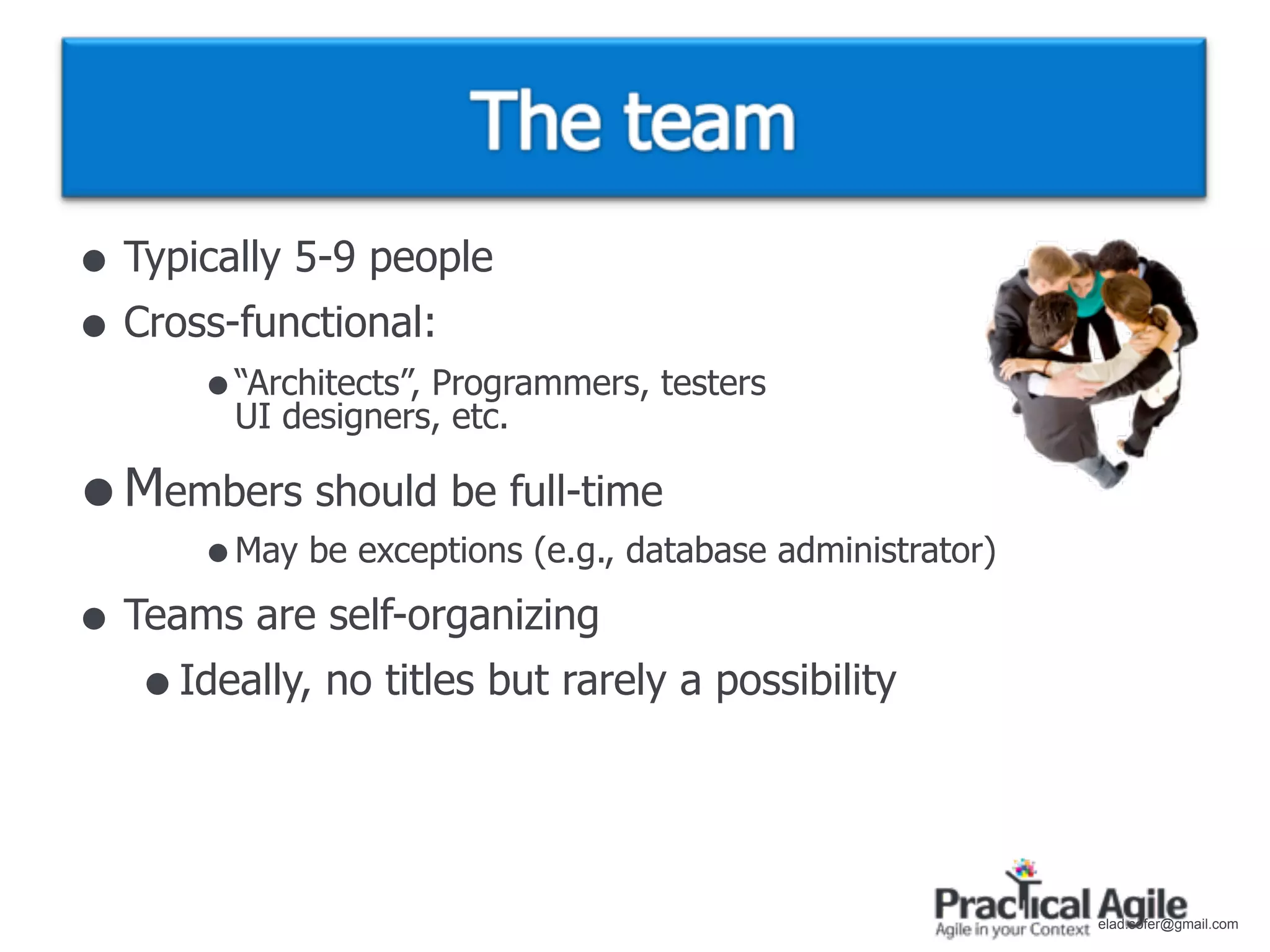
• Teams are self-organizing
   • Ideally, no titles but rarely a possibility


                                                            elad.sofer@gmail.com
• Typically 5-9 people
• Cross-functional:
      • “Architects”, Programmers, testers
        UI designers, etc.

• Members should be full-time
      • May be exceptions (e.g., database administrator)
• Teams are self-organizing
   • Ideally, no titles but rarely a possibility
• Membership should change as little as possible
      • only between sprints
                                                           elad.sofer@gmail.com
Roles
•Product owner
•ScrumMaster
•Team           Artifacts
            •Product backlog
            •Sprint backlog
            •Burndown charts
                         Ceremonies
                         •Sprint planning
                         •Sprint review
                         •Sprint retrospective
                         •Daily scrum meeting
                                           elad.sofer@gmail.com
elad.sofer@gmail.com
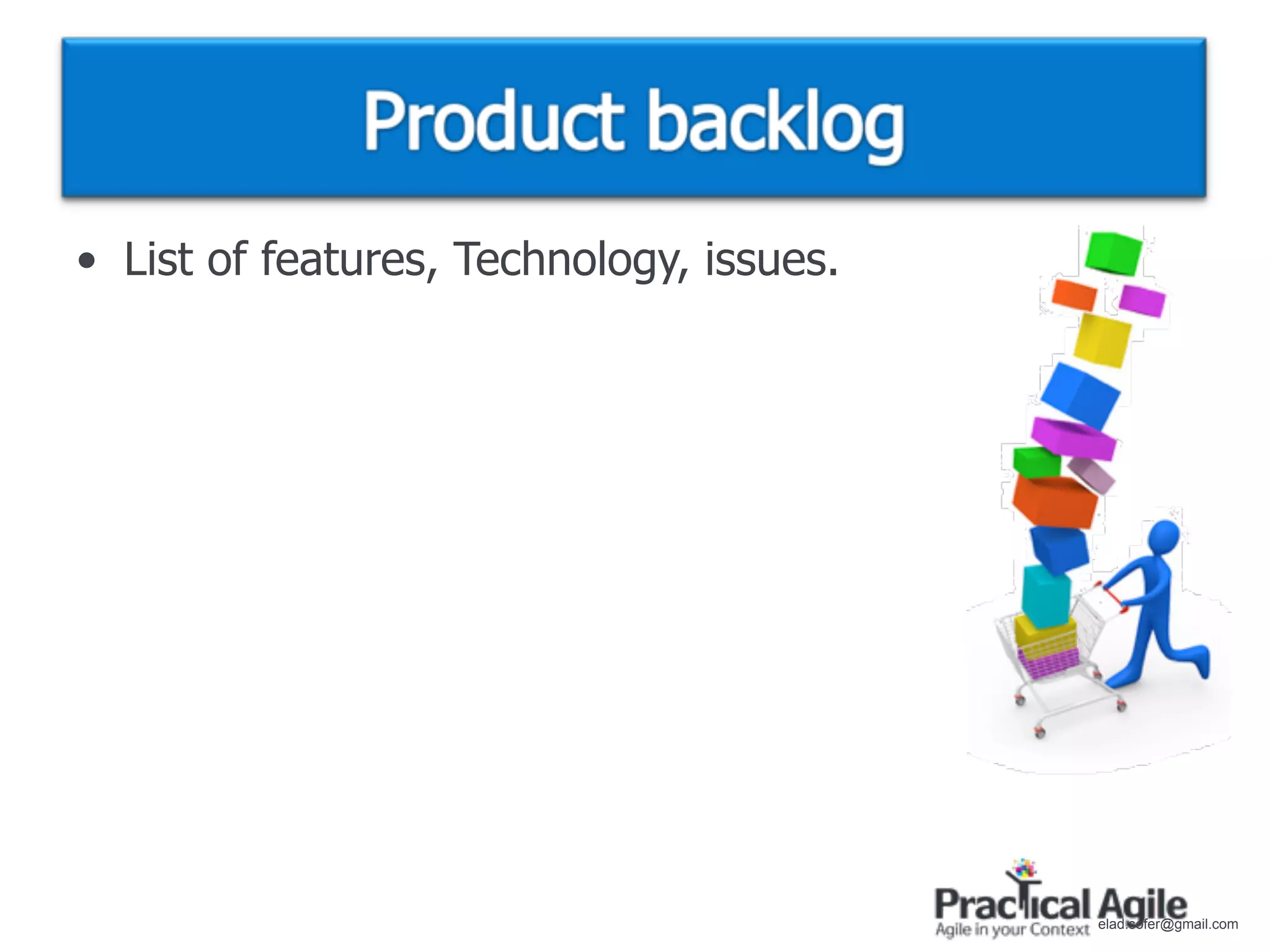
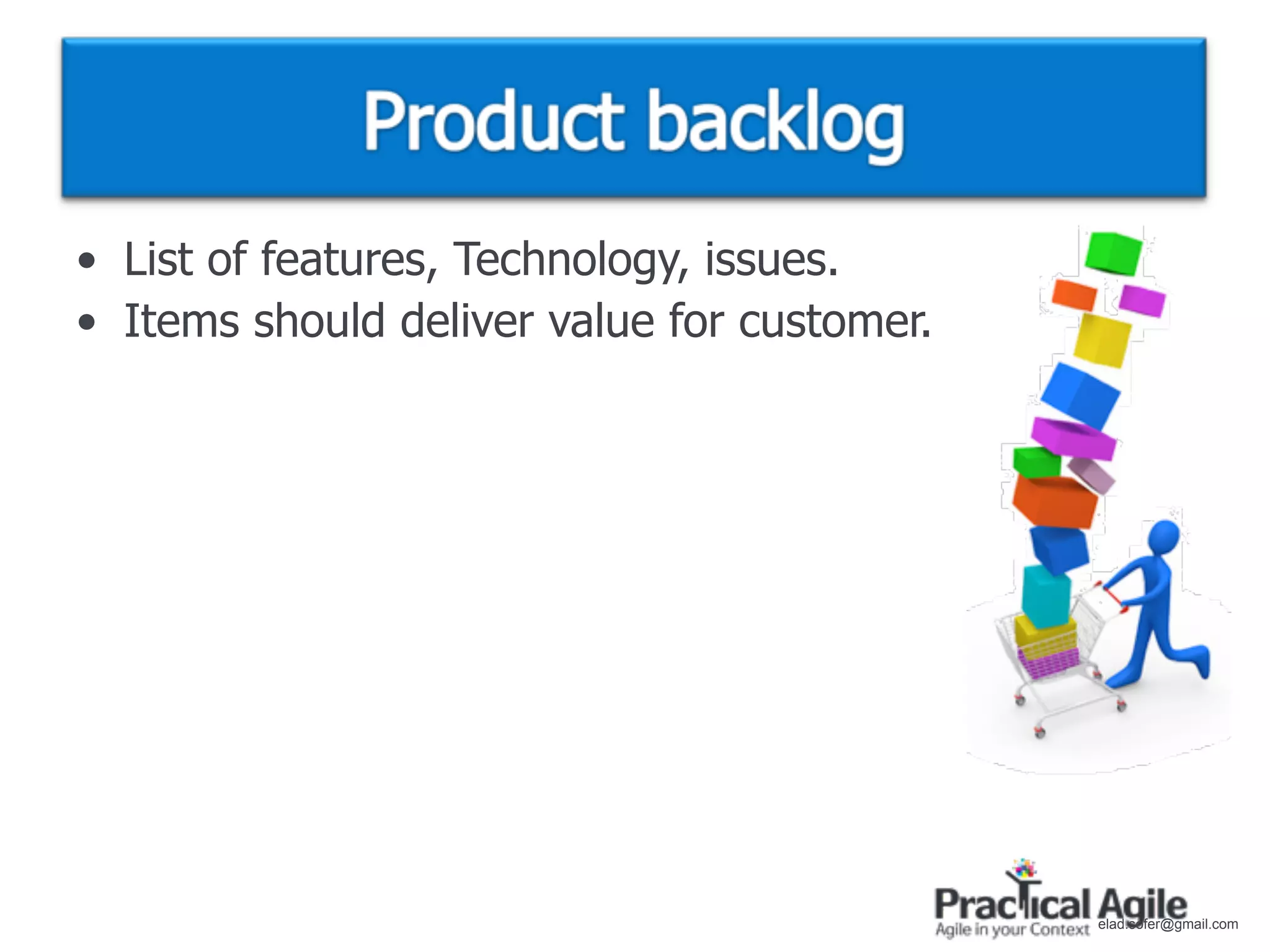
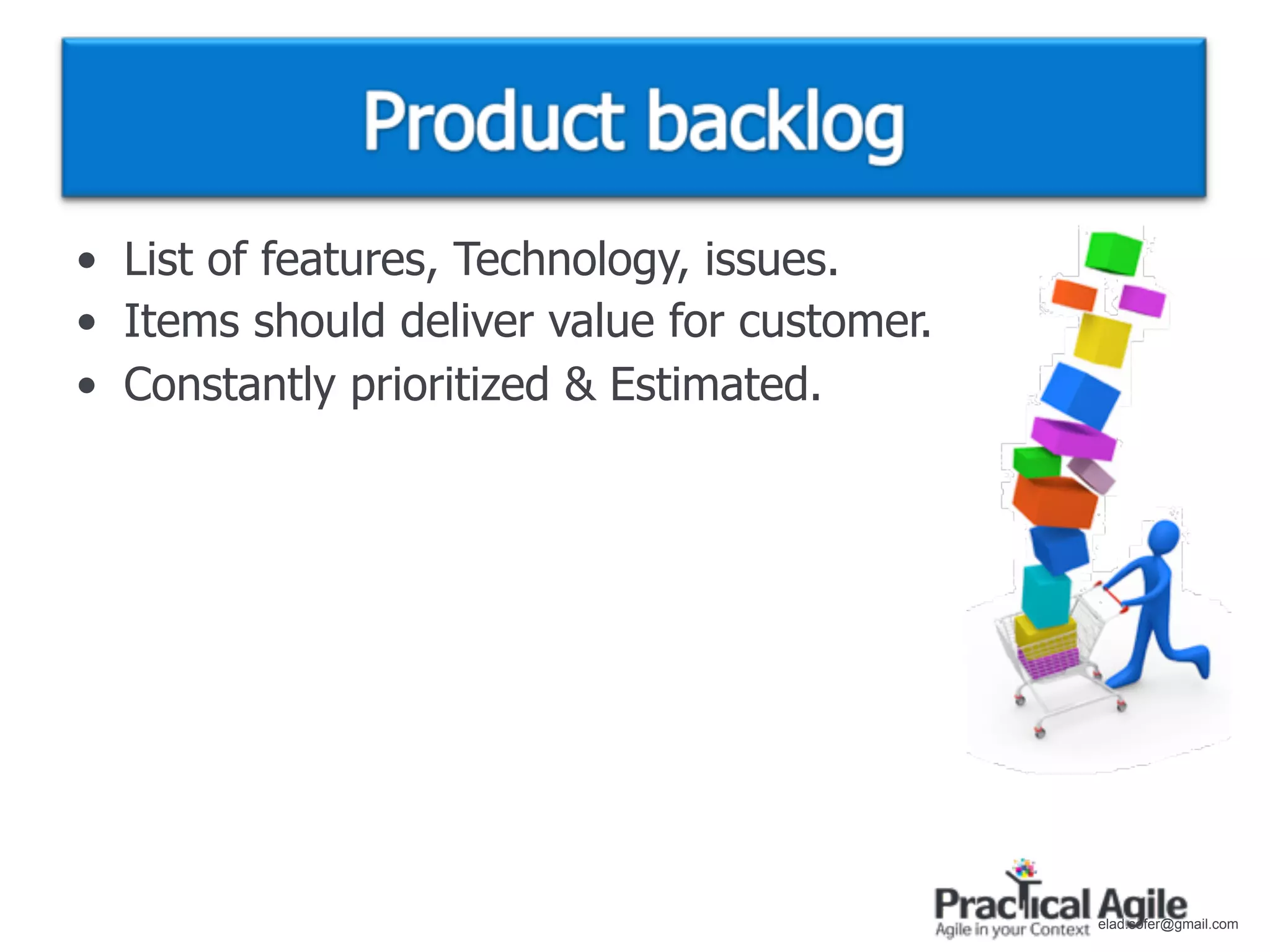
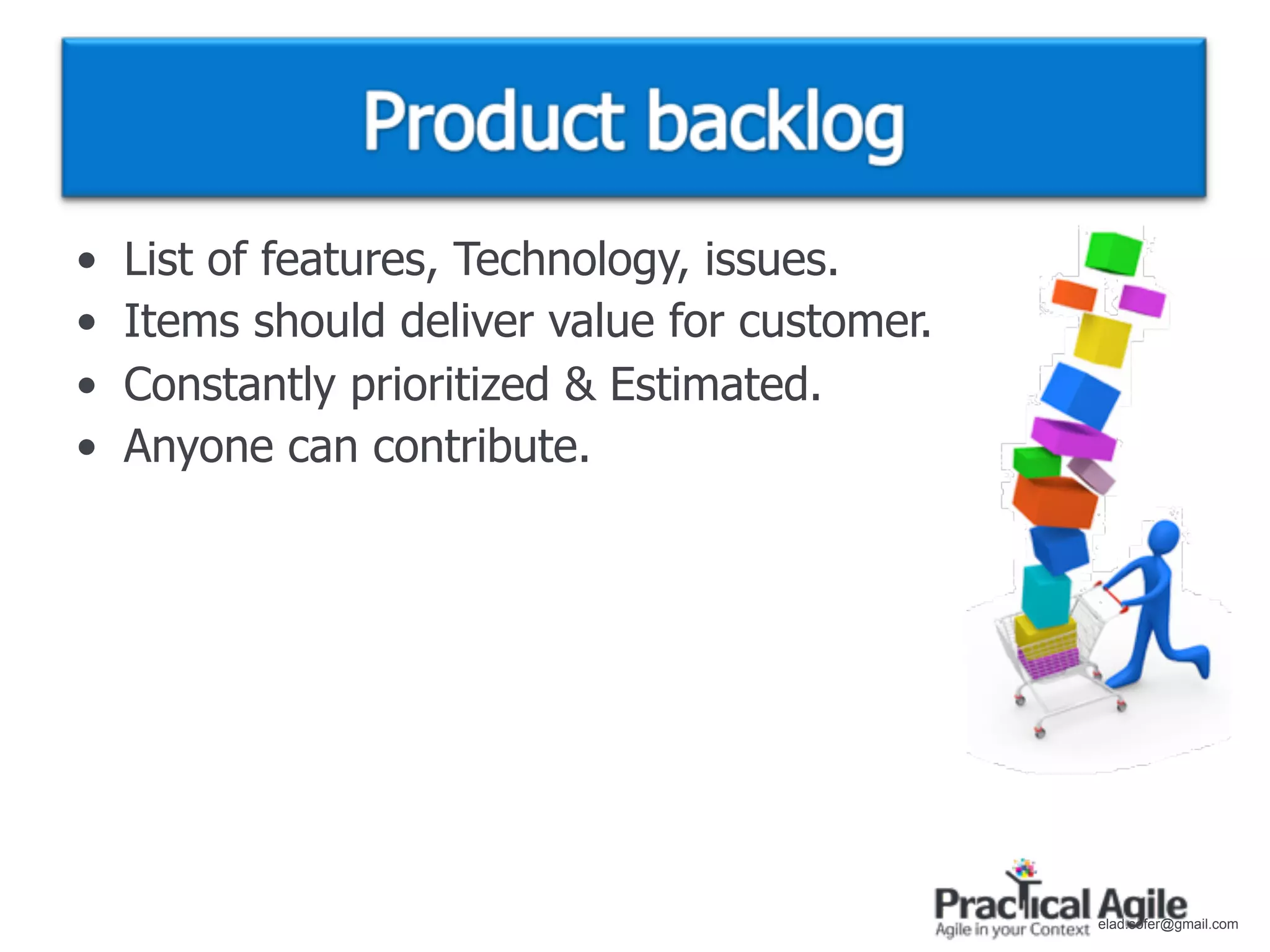
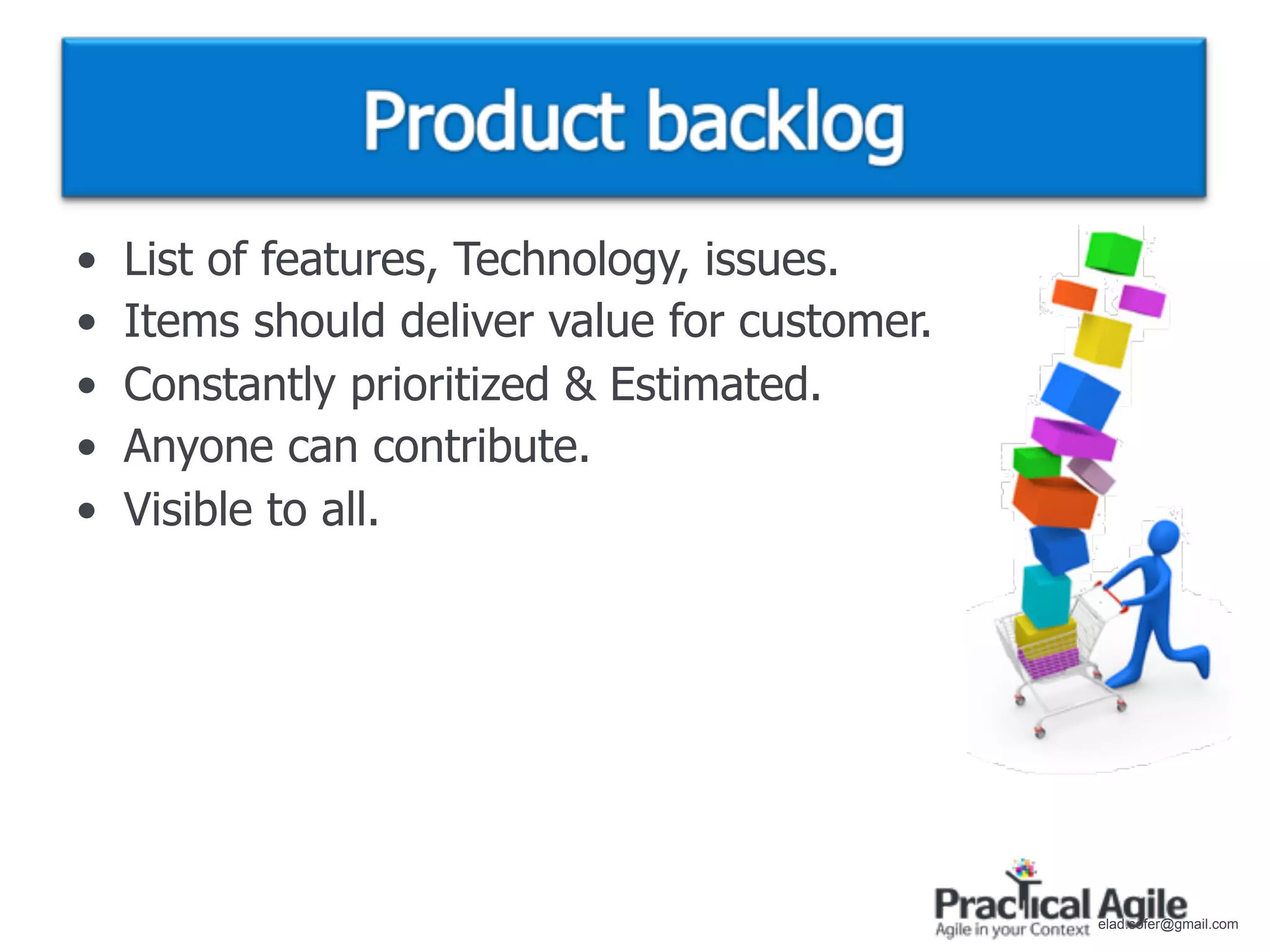
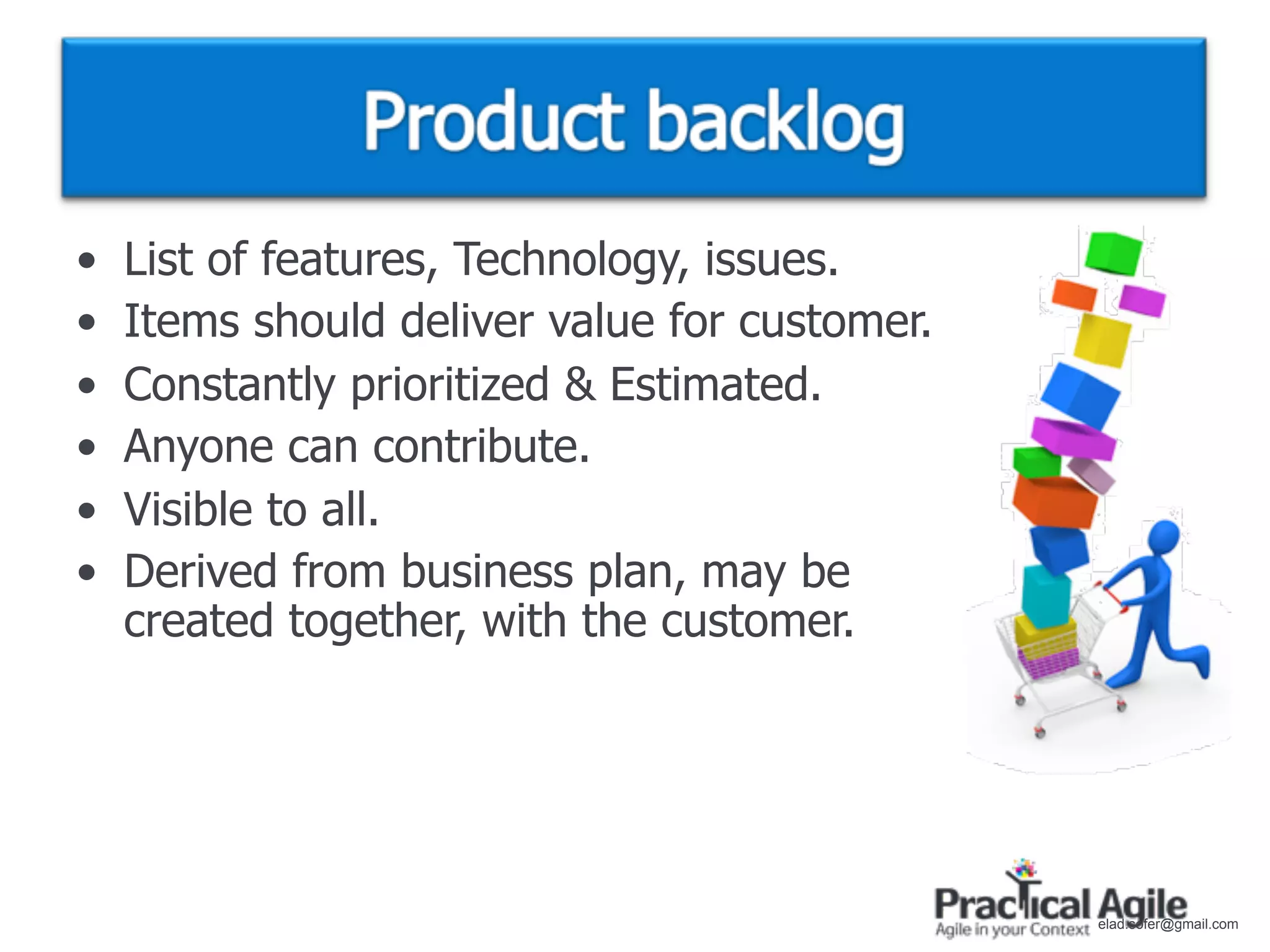
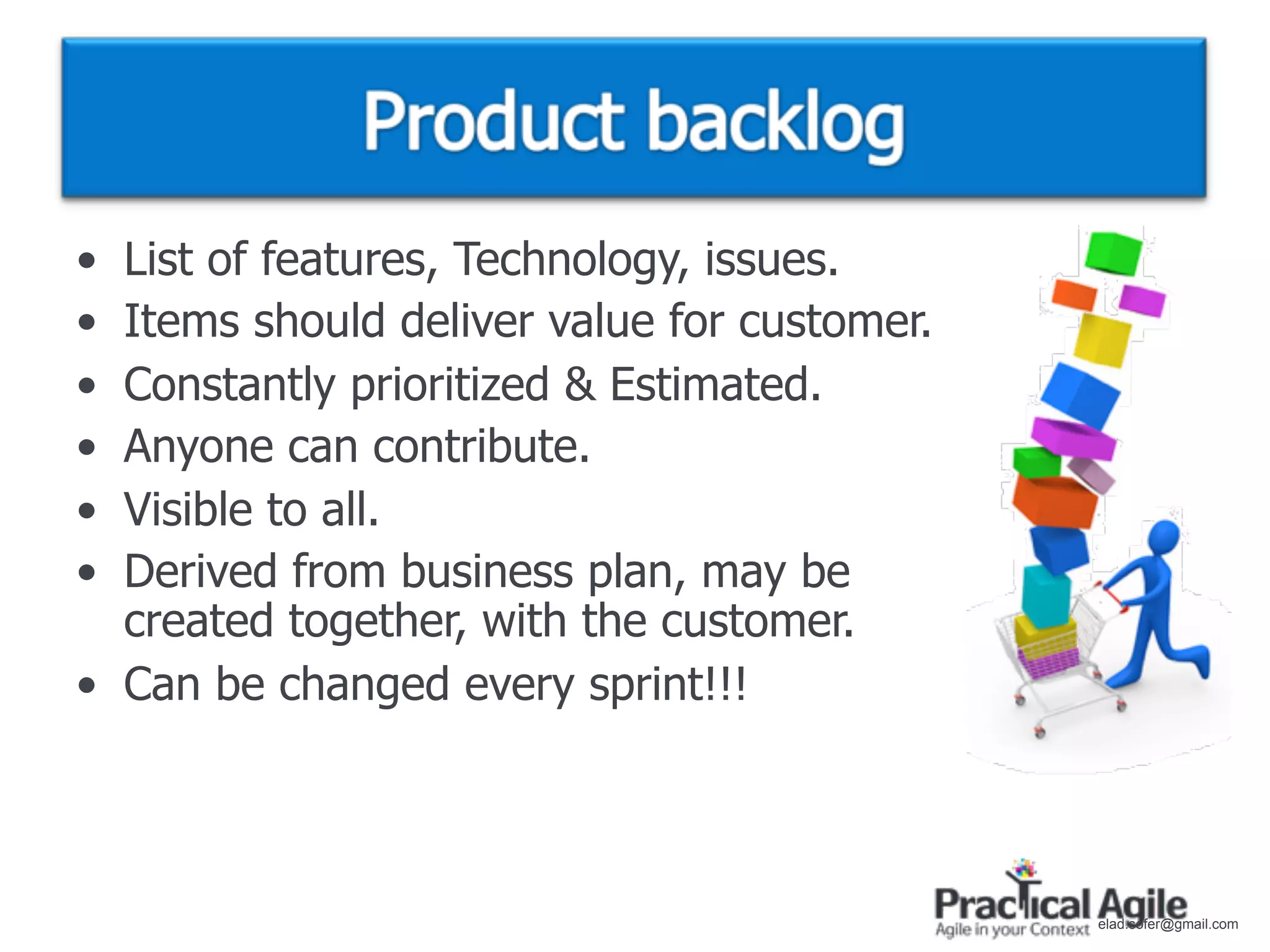
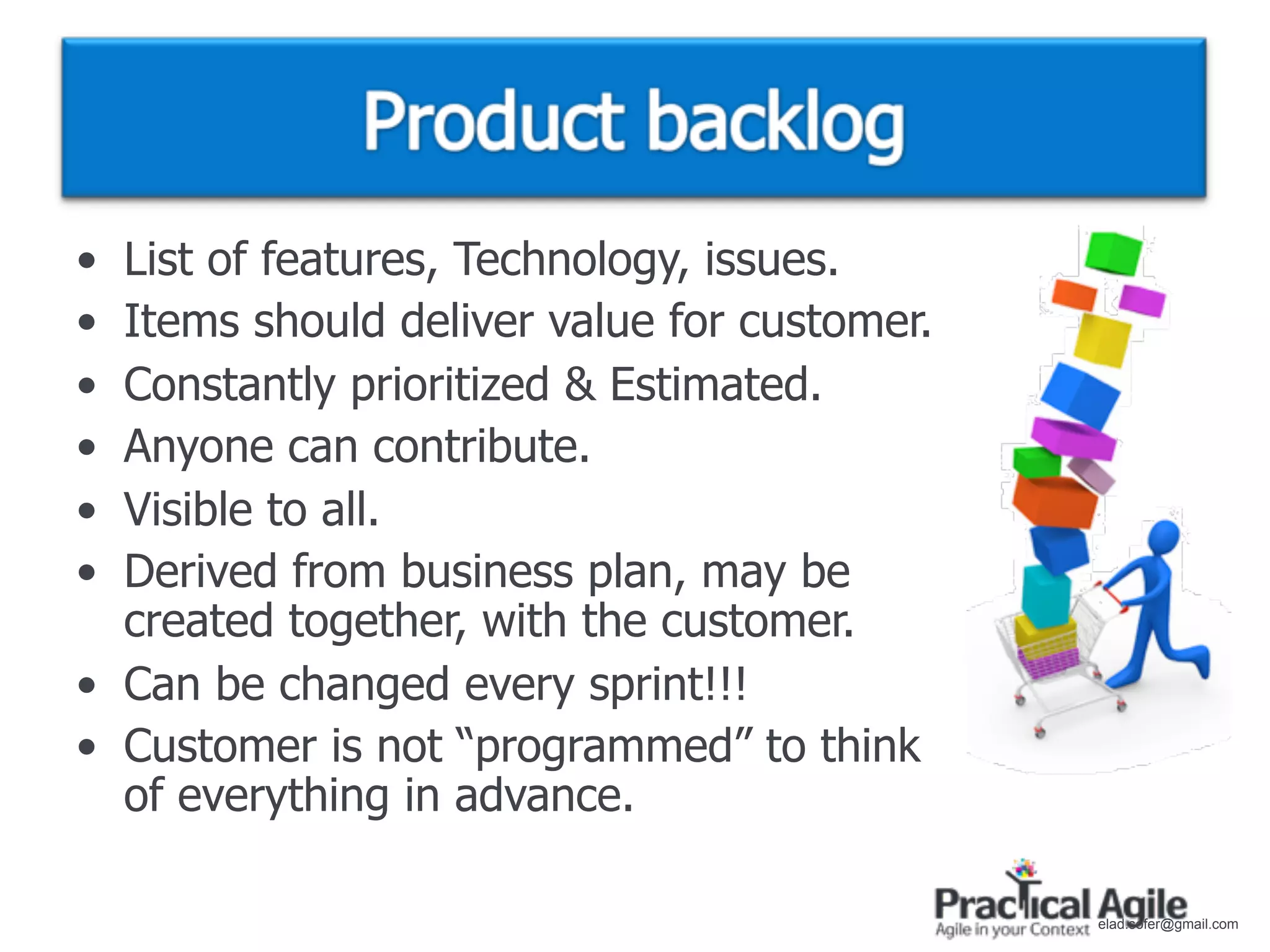
• List of features, Technology, issues.


                                          elad.sofer@gmail.com
• List of features, Technology, issues.
• Items should deliver value for customer.


                                             elad.sofer@gmail.com
• List of features, Technology, issues.
• Items should deliver value for customer.
• Constantly prioritized & Estimated.


                                             elad.sofer@gmail.com
•   List of features, Technology, issues.
•   Items should deliver value for customer.
•   Constantly prioritized & Estimated.
•   Anyone can contribute.


                                               elad.sofer@gmail.com
•   List of features, Technology, issues.
•   Items should deliver value for customer.
•   Constantly prioritized & Estimated.
•   Anyone can contribute.
•   Visible to all.


                                               elad.sofer@gmail.com
•   List of features, Technology, issues.
•   Items should deliver value for customer.
•   Constantly prioritized & Estimated.
•   Anyone can contribute.
•   Visible to all.
•   Derived from business plan, may be
    created together, with the customer.


                                               elad.sofer@gmail.com
• List of features, Technology, issues.
• Items should deliver value for customer.
• Constantly prioritized & Estimated.
• Anyone can contribute.
• Visible to all.
• Derived from business plan, may be
  created together, with the customer.
• Can be changed every sprint!!!


                                             elad.sofer@gmail.com
• List of features, Technology, issues.
• Items should deliver value for customer.
• Constantly prioritized & Estimated.
• Anyone can contribute.
• Visible to all.
• Derived from business plan, may be
  created together, with the customer.
• Can be changed every sprint!!!
• Customer is not “programmed” to think
  of everything in advance.

                                             elad.sofer@gmail.com
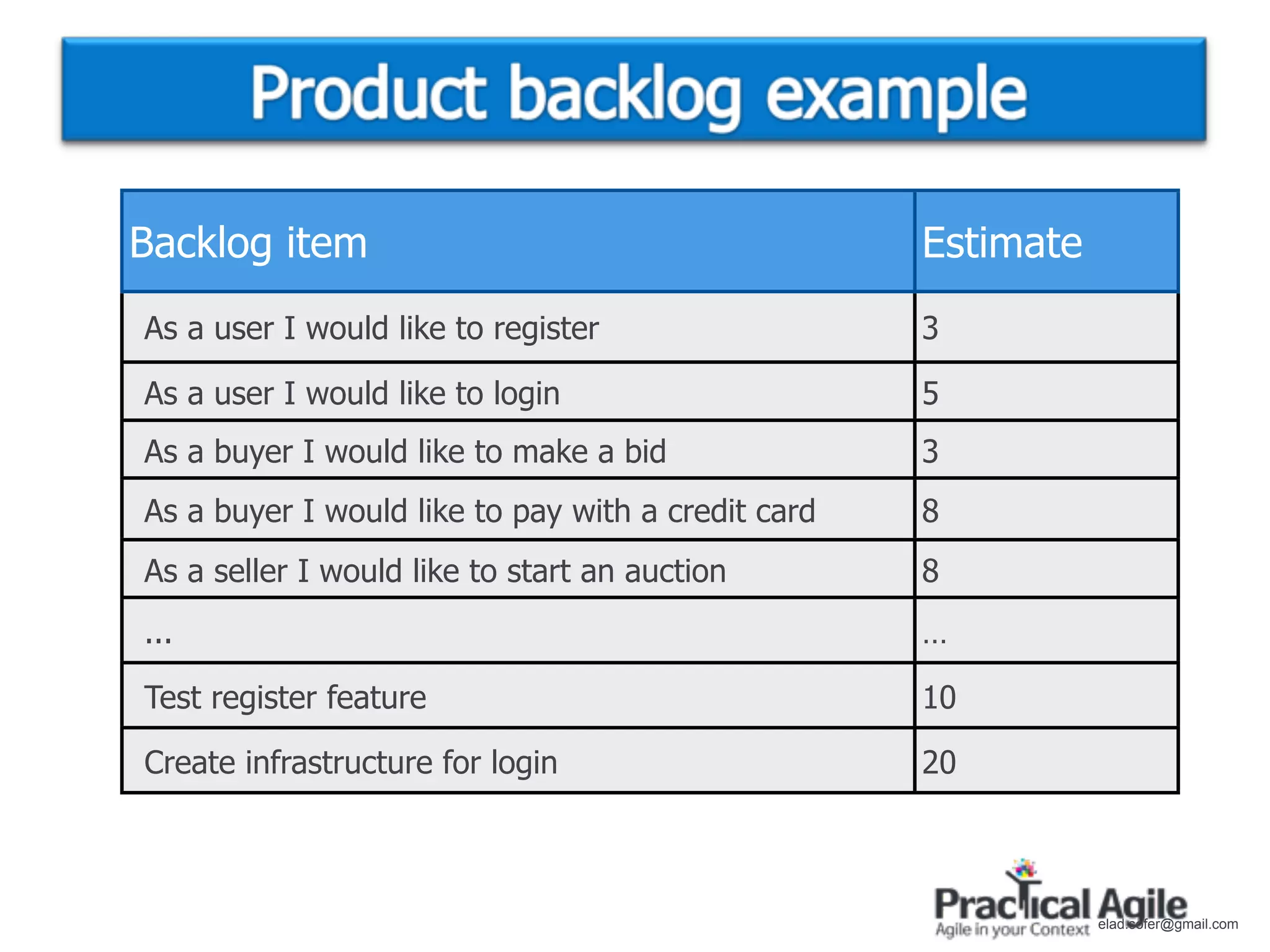
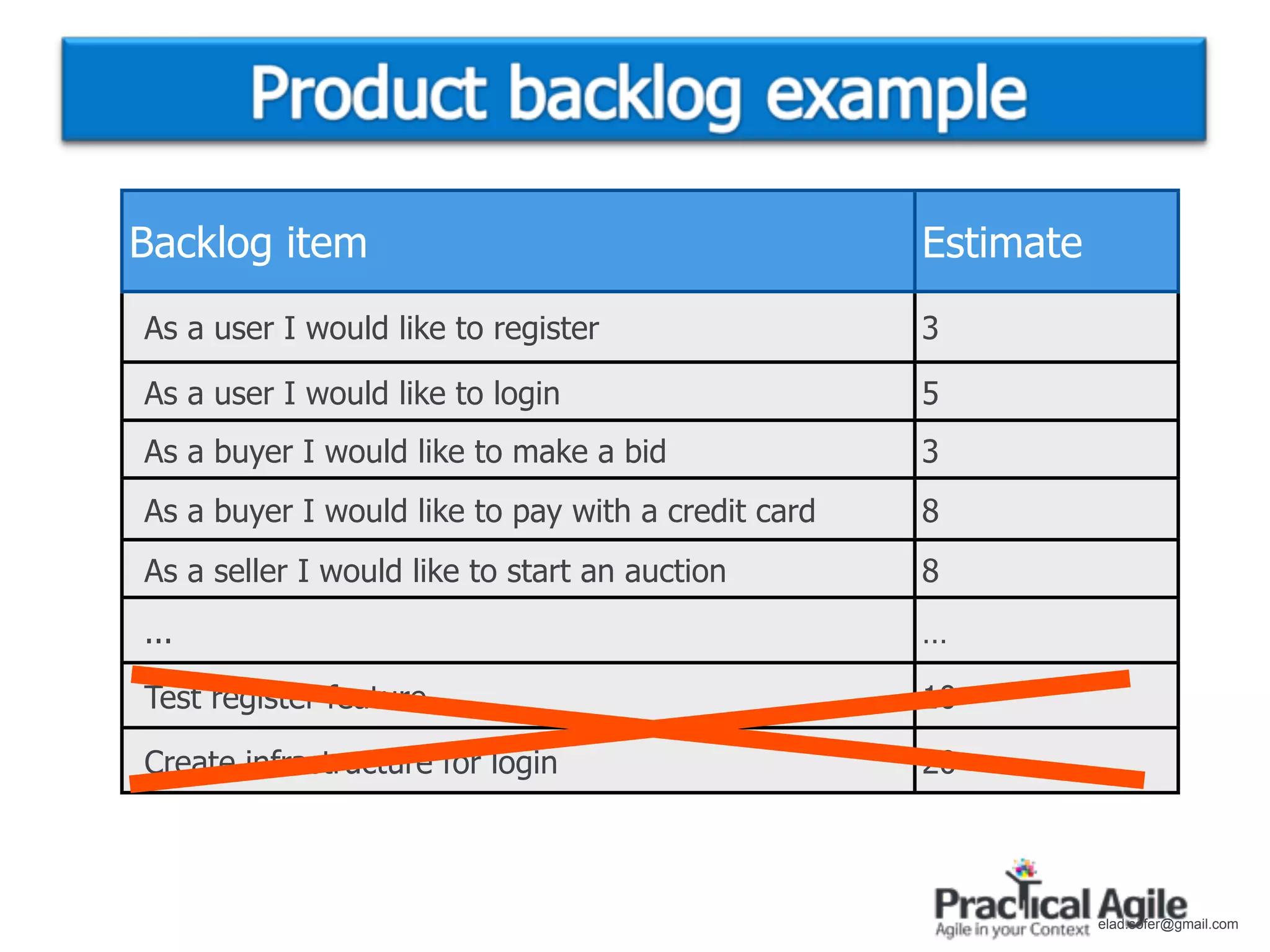
Backlog item                                        Estimate
As a user I would like to register                  3

As a user I would like to login                     5
As a buyer I would like to make a bid               3
As a buyer I would like to pay with a credit card   8
As a seller I would like to start an auction        8
...                                                 …

Test register feature                               10

Create infrastructure for login                     20


                                                               elad.sofer@gmail.com
Backlog item                                        Estimate
As a user I would like to register                  3

As a user I would like to login                     5
As a buyer I would like to make a bid               3
As a buyer I would like to pay with a credit card   8
As a seller I would like to start an auction        8
...                                                 …

Test register feature                               10

Create infrastructure for login                     20


                                                               elad.sofer@gmail.com
elad.sofer@gmail.com
• The sprint backlog is defined by understanding
  and agreeing on the sprint goal(s) and selecting
  the appropriate items from the product backlog.


                                                     elad.sofer@gmail.com
• The sprint backlog is defined by understanding
  and agreeing on the sprint goal(s) and selecting
  the appropriate items from the product backlog.
• The goal is determined by the customersproduct owner
  team.


                                                          elad.sofer@gmail.com
• The sprint backlog is defined by understanding
  and agreeing on the sprint goal(s) and selecting
  the appropriate items from the product backlog.
• The goal is determined by the customersproduct owner
  team.
• The team compiles a list of tasks that are
  needed in order to complete the sprint goal(s).


                                                          elad.sofer@gmail.com
• The sprint backlog is defined by understanding
  and agreeing on the sprint goal(s) and selecting
  the appropriate items from the product backlog.
• The goal is determined by the customersproduct owner
  team.
• The team compiles a list of tasks that are
  needed in order to complete the sprint goal(s).
• A task should be as small as possible and should not exceed a
  time period of 2 days (time not effort).


                                                          elad.sofer@gmail.com
• The sprint backlog is defined by understanding
  and agreeing on the sprint goal(s) and selecting
  the appropriate items from the product backlog.
• The goal is determined by the customersproduct owner
  team.
• The team compiles a list of tasks that are
  needed in order to complete the sprint goal(s).
• A task should be as small as possible and should not exceed a
  time period of 2 days (time not effort).
• If a task X can not be defined, there will be a task to define
  the task X.


                                                             elad.sofer@gmail.com
• The sprint backlog is defined by understanding
  and agreeing on the sprint goal(s) and selecting
  the appropriate items from the product backlog.
• The goal is determined by the customersproduct owner
  team.
• The team compiles a list of tasks that are
  needed in order to complete the sprint goal(s).
• A task should be as small as possible and should not exceed a
  time period of 2 days (time not effort).
• If a task X can not be defined, there will be a task to define
  the task X.
• The sprint backlog can be modified throughout the sprint.
                                                             elad.sofer@gmail.com
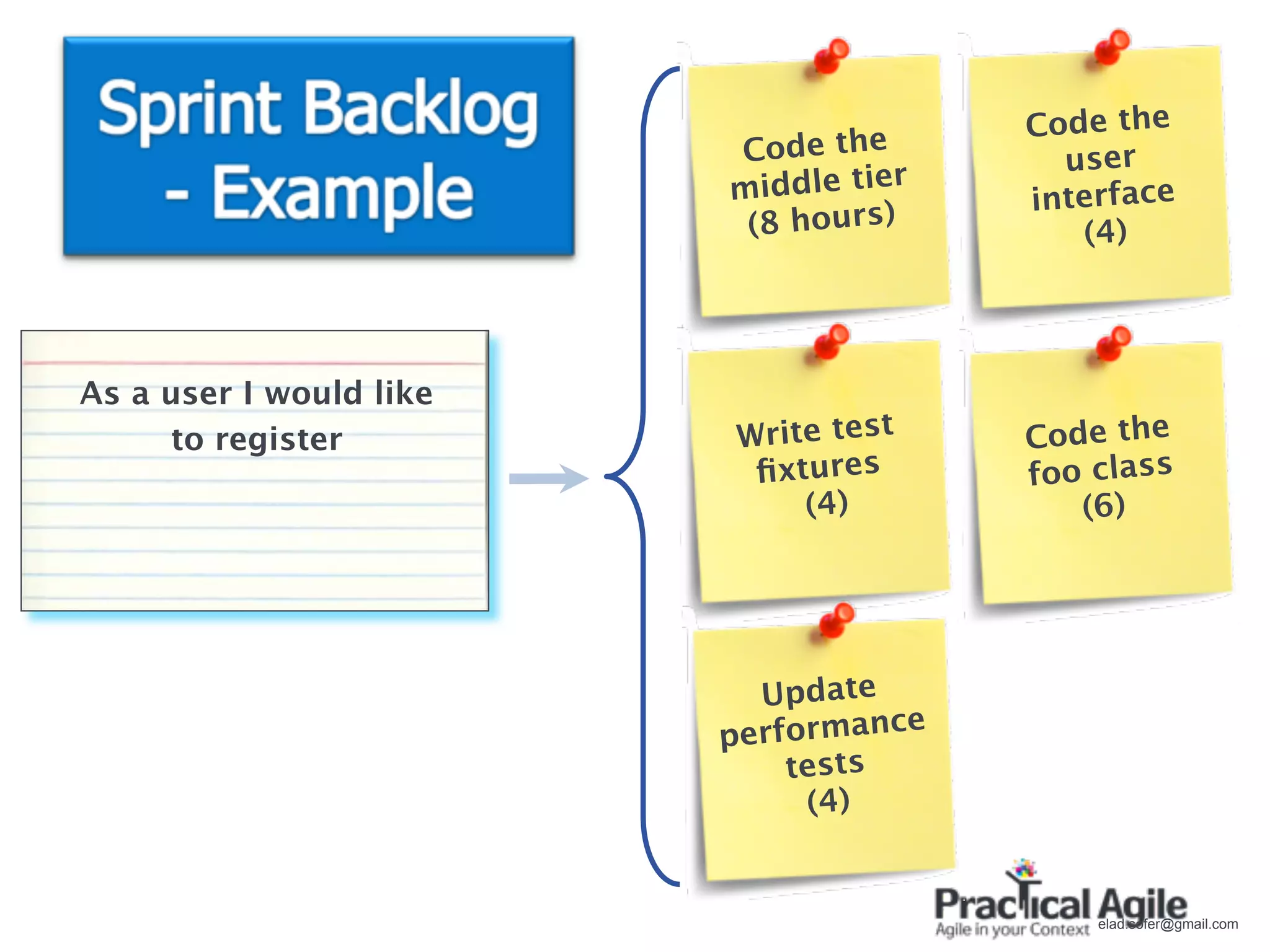
Code the
                         Code the         user
                         middle tier    interface
                          (8 hours)        (4)


As a user I would like
      to register         Write test    Code the
                           fixtures      foo class
                              (4)          (6)


                           Update
                                    e
                         performanc
                             tests
                              (4)


                                            elad.sofer@gmail.com
elad.sofer@gmail.com
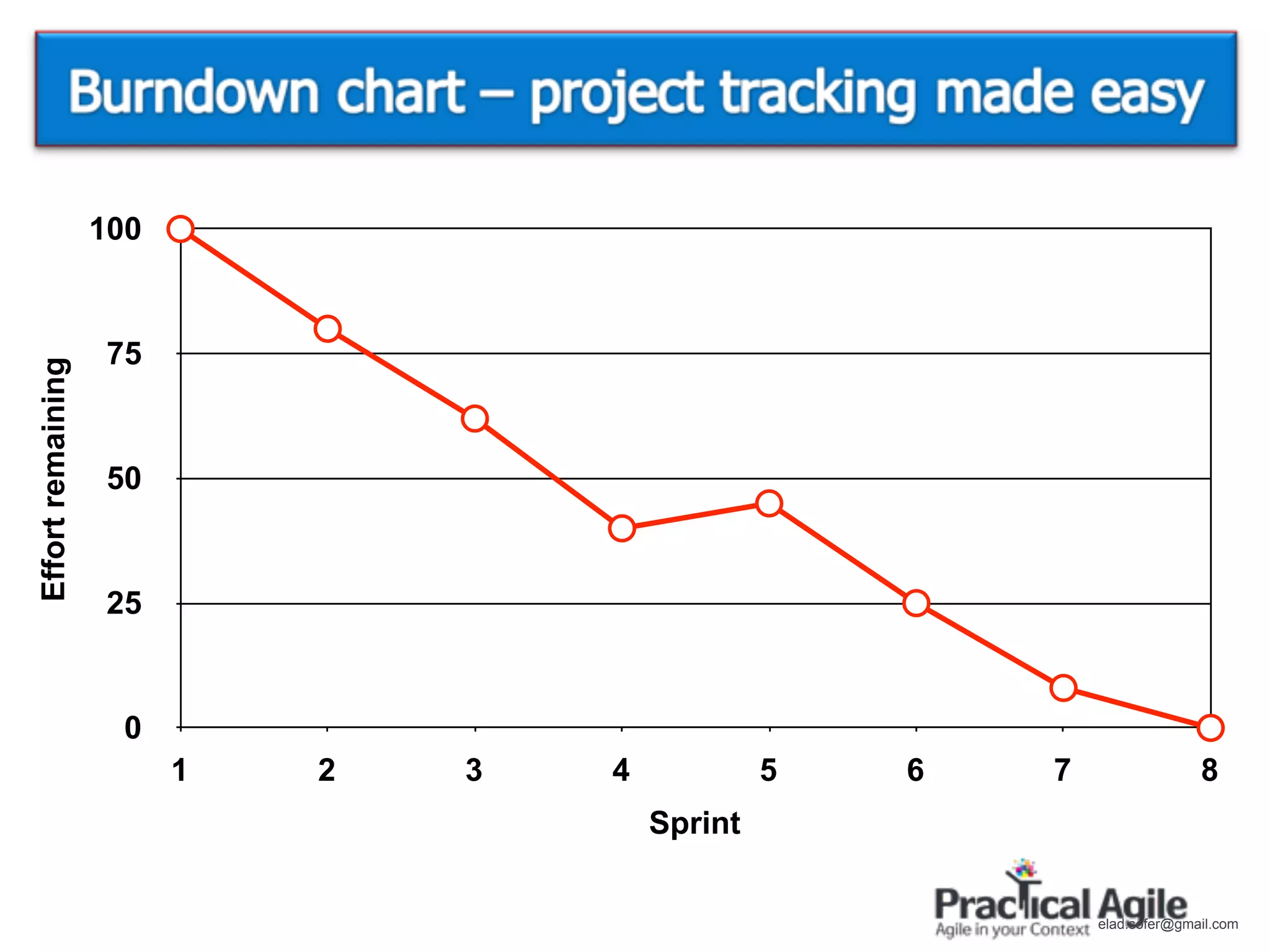
100


                    75
Effort remaining


                    50


                    25


                     0
                         1   2   3   4            5   6   7                 8
                                         Sprint

                                                              elad.sofer@gmail.com
elad.sofer@gmail.com
Roles
•Product owner
•ScrumMaster
•Team           Artifacts
            •Product backlog
            •Sprint backlog
            •Burndown charts
                          Ceremonies
                          •Sprint planning
                          •Sprint review
                          •Sprint retrospective
                          •Daily scrum meeting
                                              elad.sofer@gmail.com
elad.sofer@gmail.com
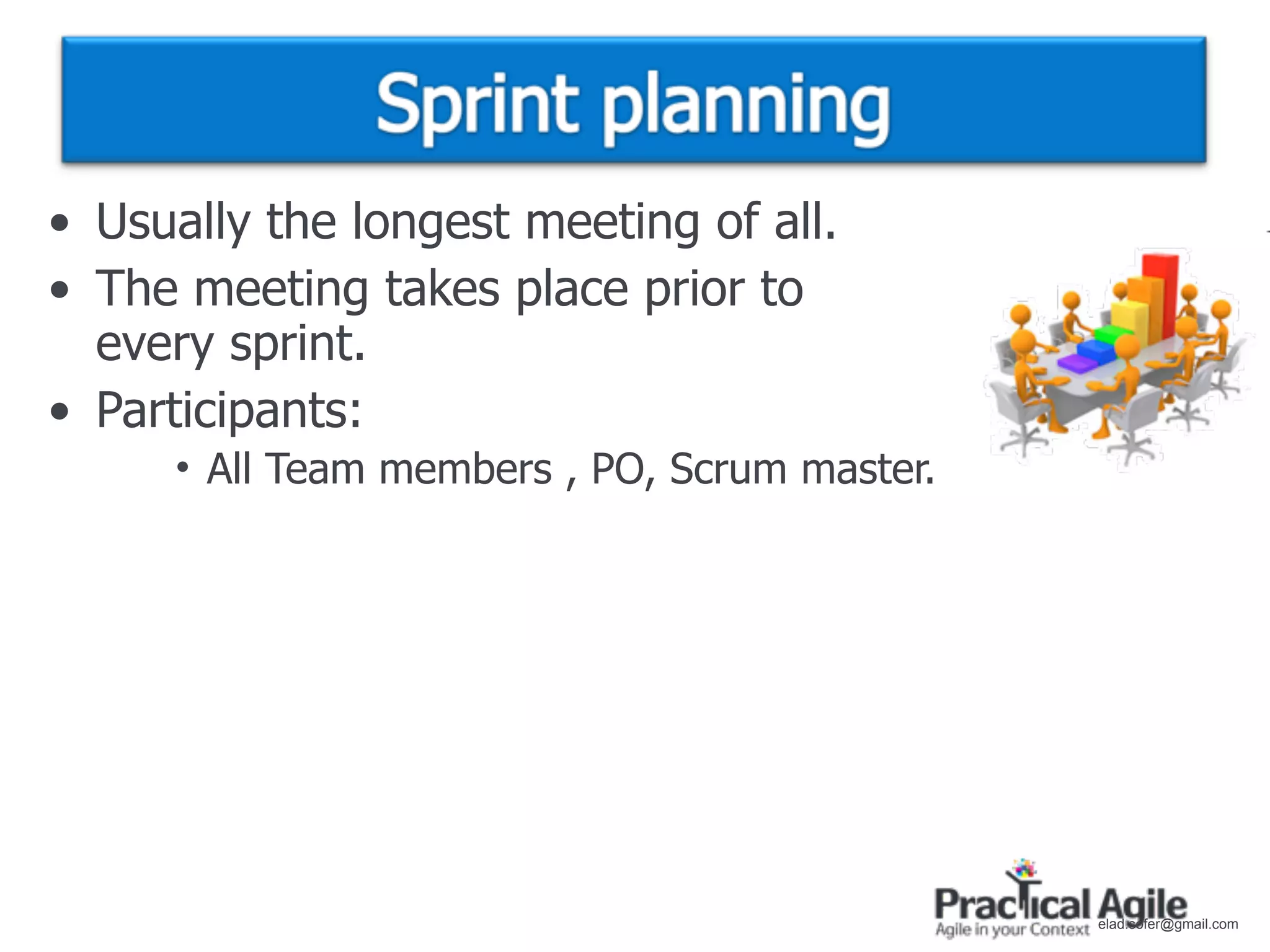
• Usually the longest meeting of all.


                                        elad.sofer@gmail.com
• Usually the longest meeting of all.
• The meeting takes place prior to
  every sprint.


                                        elad.sofer@gmail.com
• Usually the longest meeting of all.
• The meeting takes place prior to
  every sprint.
• Participants:
     • All Team members , PO, Scrum master.


                                              elad.sofer@gmail.com
• Usually the longest meeting of all.
• The meeting takes place prior to
  every sprint.
• Participants:
      • All Team members , PO, Scrum master.
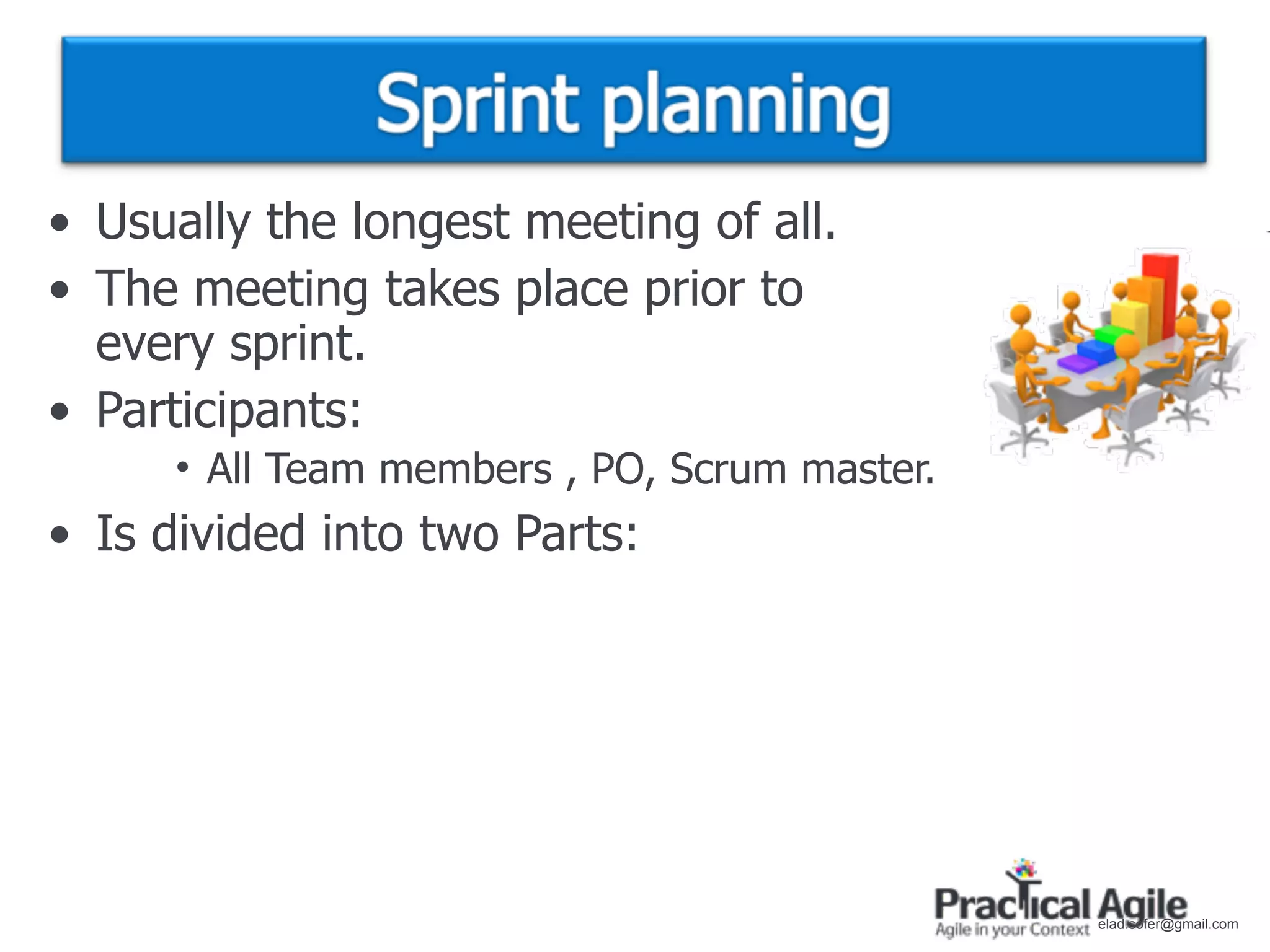
• Is divided into two Parts:


                                               elad.sofer@gmail.com
• Usually the longest meeting of all.
• The meeting takes place prior to
  every sprint.
• Participants:
      • All Team members , PO, Scrum master.
• Is divided into two Parts:
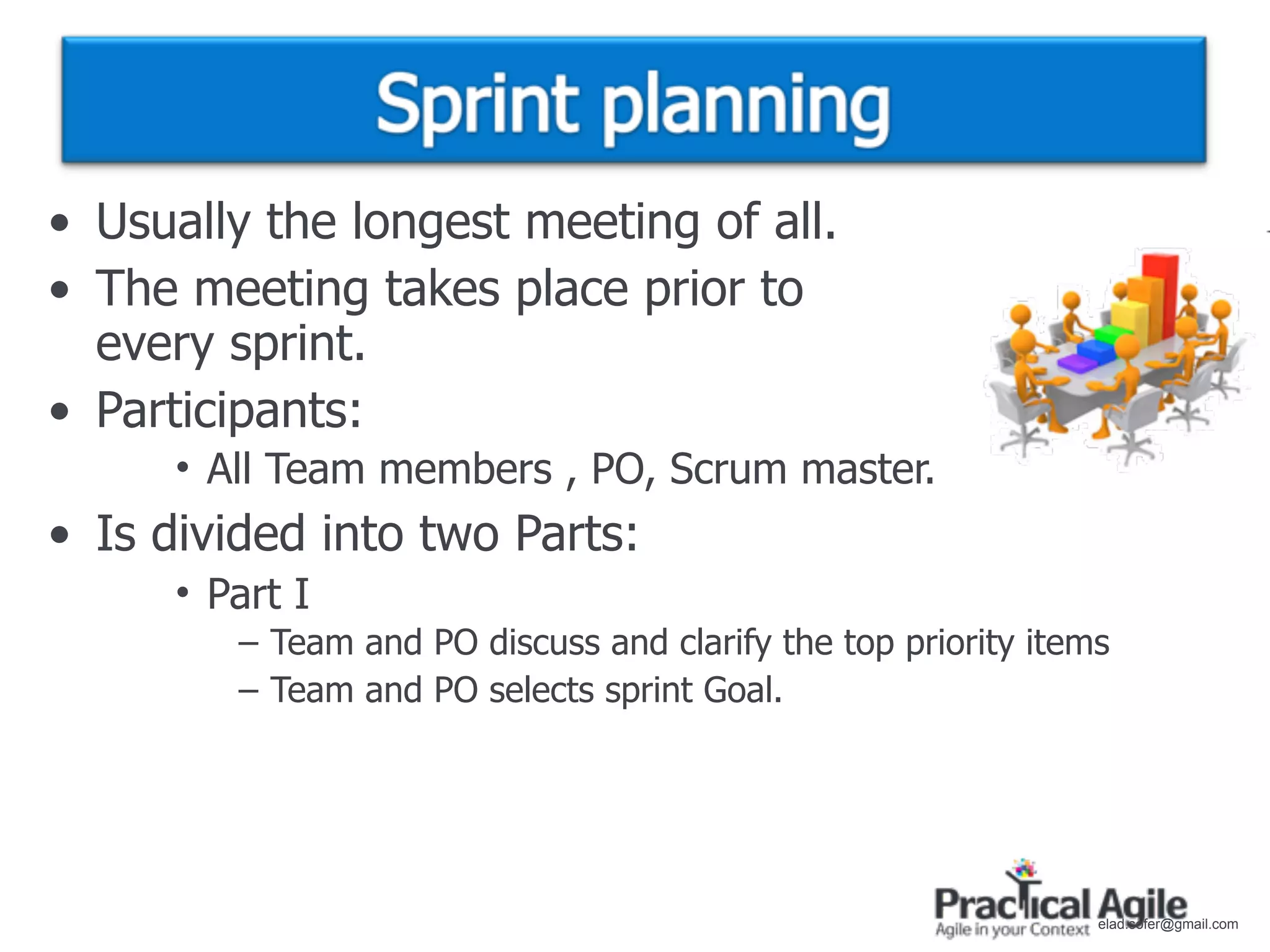
      • Part I
         – Team and PO discuss and clarify the top priority items
         – Team and PO selects sprint Goal.


                                                                elad.sofer@gmail.com
• Usually the longest meeting of all.
• The meeting takes place prior to
  every sprint.
• Participants:
      • All Team members , PO, Scrum master.
• Is divided into two Parts:
      • Part I
         – Team and PO discuss and clarify the top priority items
         – Team and PO selects sprint Goal.
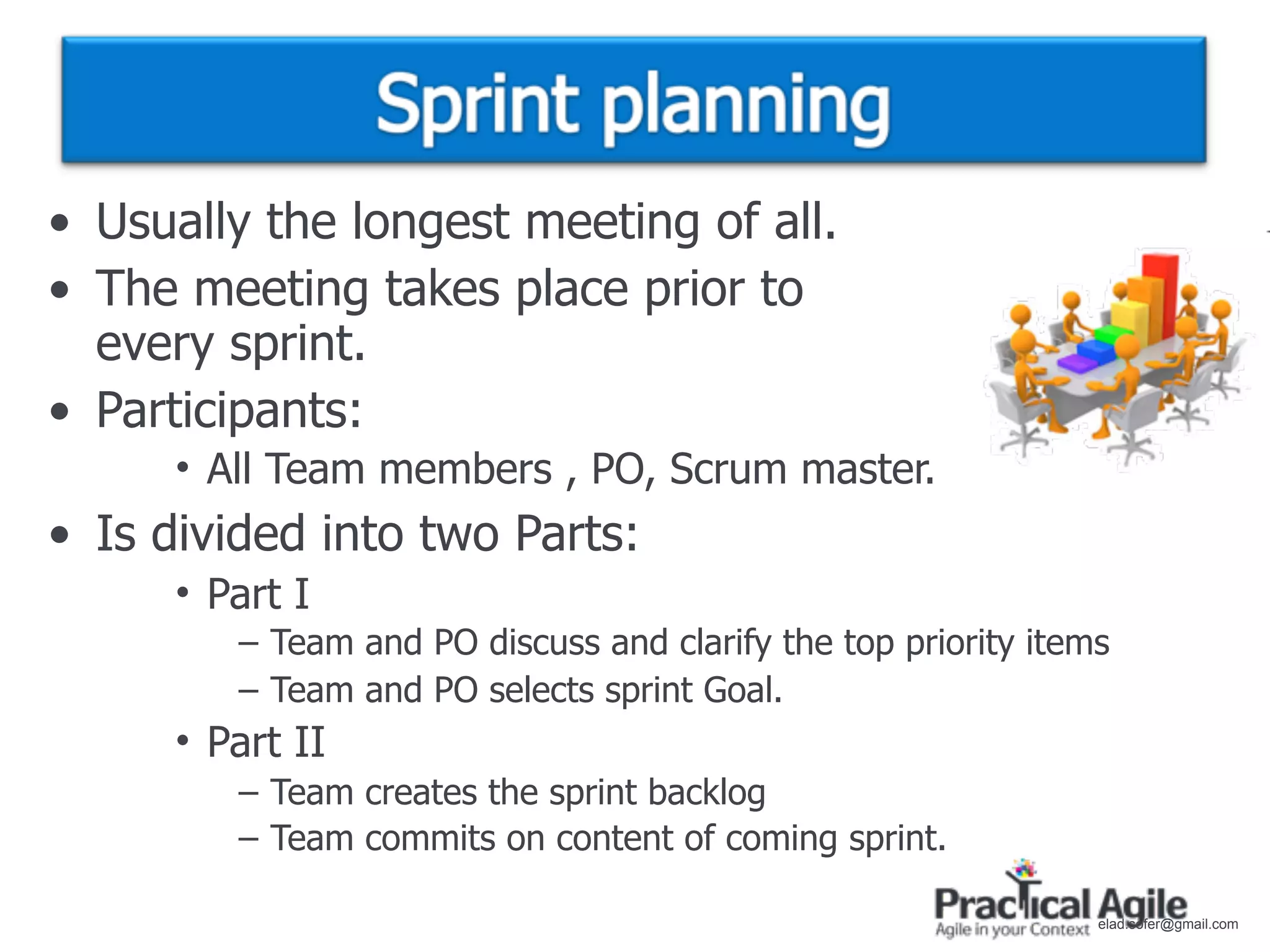
      • Part II
         – Team creates the sprint backlog
         – Team commits on content of coming sprint.

                                                                elad.sofer@gmail.com
elad.sofer@gmail.com
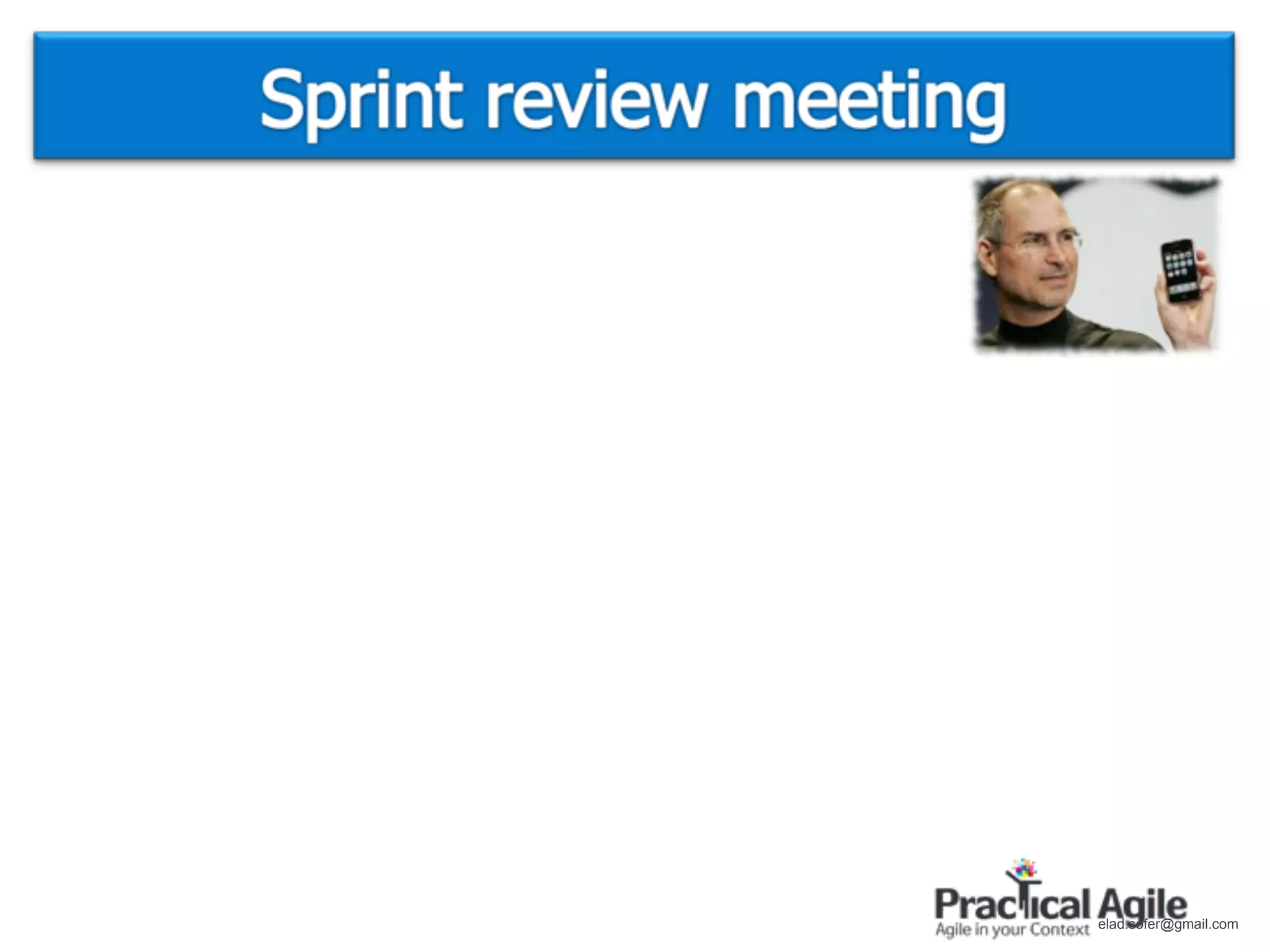
• At the end of each sprint there is a
  meeting called the sprint review.


                                         elad.sofer@gmail.com
• At the end of each sprint there is a
  meeting called the sprint review.
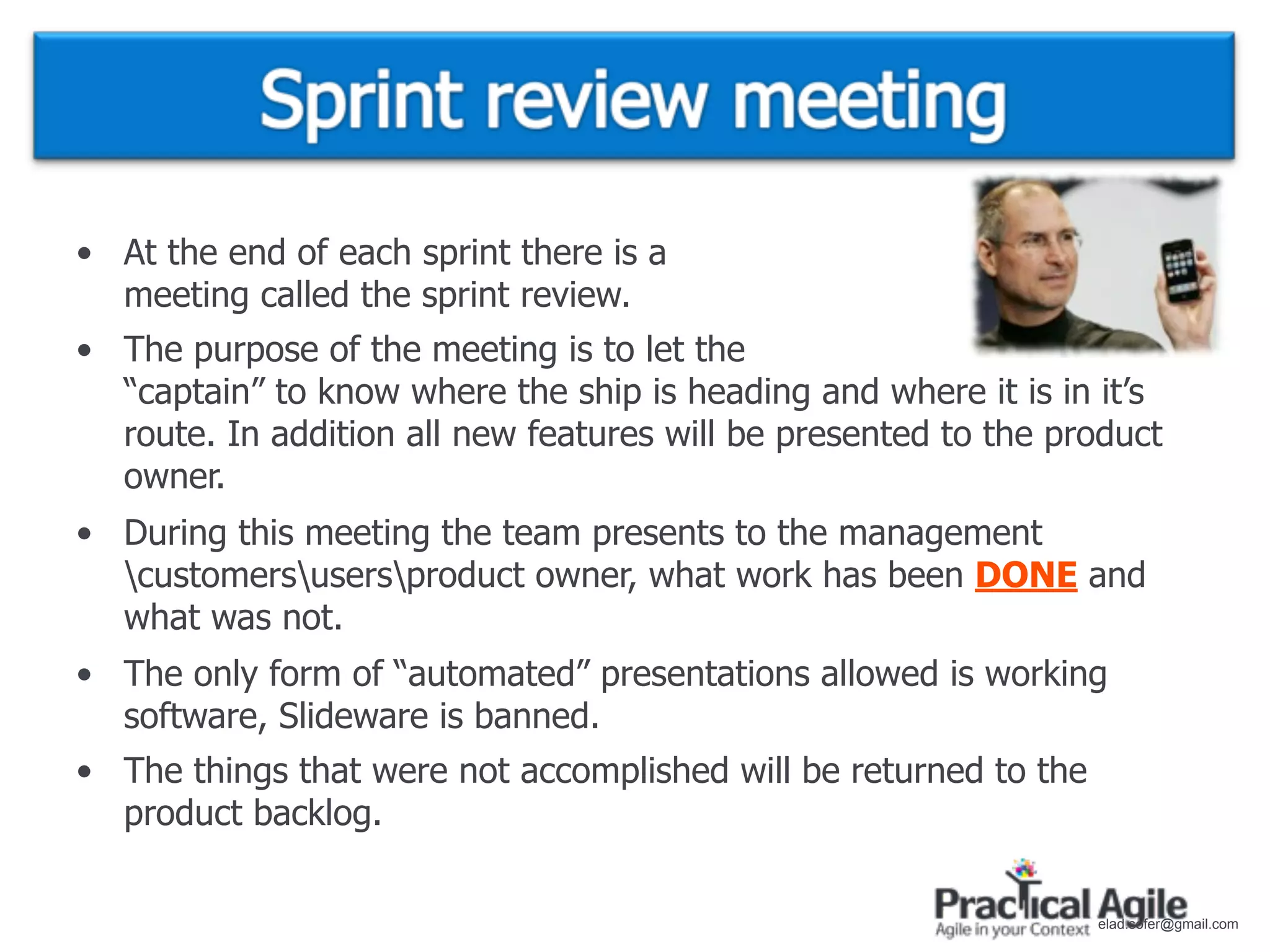
• The purpose of the meeting is to let the
  “captain” to know where the ship is heading and where it is in it’s
  route. In addition all new features will be presented to the product
  owner.


                                                                 elad.sofer@gmail.com
• At the end of each sprint there is a
  meeting called the sprint review.
• The purpose of the meeting is to let the
  “captain” to know where the ship is heading and where it is in it’s
  route. In addition all new features will be presented to the product
  owner.
• During this meeting the team presents to the management
  customersusersproduct owner, what work has been DONE and
  what was not.


                                                                 elad.sofer@gmail.com
• At the end of each sprint there is a
  meeting called the sprint review.
• The purpose of the meeting is to let the
  “captain” to know where the ship is heading and where it is in it’s
  route. In addition all new features will be presented to the product
  owner.
• During this meeting the team presents to the management
  customersusersproduct owner, what work has been DONE and
  what was not.
• The only form of “automated” presentations allowed is working
  software, Slideware is banned.


                                                                 elad.sofer@gmail.com
• At the end of each sprint there is a
  meeting called the sprint review.
• The purpose of the meeting is to let the
  “captain” to know where the ship is heading and where it is in it’s
  route. In addition all new features will be presented to the product
  owner.
• During this meeting the team presents to the management
  customersusersproduct owner, what work has been DONE and
  what was not.
• The only form of “automated” presentations allowed is working
  software, Slideware is banned.
• The things that were not accomplished will be returned to the
  product backlog.

                                                                  elad.sofer@gmail.com
• We have in Scrum – DOD – Definition of
  Done.
• Terms of satisfaction of the PO
• Only DONE items count
• Success is well defined
• Example:
    • Unit tested, Verification,
      Documented, deployed.

                                      elad.sofer@gmail.com
elad.sofer@gmail.com
•   A meeting that occurs daily at the same time.
    anyone who wants attend , can do so.


                                                    elad.sofer@gmail.com
•   A meeting that occurs daily at the same time.
    anyone who wants attend , can do so.
•   Each of the team members needs to answer
    briefly these three questions:
    1.   What have you done since the last daily scrum?
    2.   What will you do until the next daily scrum?
    3.   What got in your way of doing work?


                                                          elad.sofer@gmail.com
•   A meeting that occurs daily at the same time.
    anyone who wants attend , can do so.
•   Each of the team members needs to answer
    briefly these three questions:
    1.   What have you done since the last daily scrum?
    2.   What will you do until the next daily scrum?
    3.   What got in your way of doing work?
•   The team does not report to anyone but the team.


                                                          elad.sofer@gmail.com
•   A meeting that occurs daily at the same time.
    anyone who wants attend , can do so.
•   Each of the team members needs to answer
    briefly these three questions:
    1.   What have you done since the last daily scrum?
    2.   What will you do until the next daily scrum?
    3.   What got in your way of doing work?
•   The team does not report to anyone but the team.
•   During the meeting only one of the team members is allowed to
    speak, others should keep quiet.


                                                              elad.sofer@gmail.com
•   A meeting that occurs daily at the same time.
    anyone who wants attend , can do so.
•   Each of the team members needs to answer
    briefly these three questions:
    1.   What have you done since the last daily scrum?
    2.   What will you do until the next daily scrum?
    3.   What got in your way of doing work?
•   The team does not report to anyone but the team.
•   During the meeting only one of the team members is allowed to
    speak, others should keep quiet.
•   All of problems raised in the meeting should be written down and
    resolved by the scrum masterteam.


                                                                elad.sofer@gmail.com
•   A meeting that occurs daily at the same time.
    anyone who wants attend , can do so.
•   Each of the team members needs to answer
    briefly these three questions:
    1.   What have you done since the last daily scrum?
    2.   What will you do until the next daily scrum?
    3.   What got in your way of doing work?
•   The team does not report to anyone but the team.
•   During the meeting only one of the team members is allowed to
    speak, others should keep quiet.
•   All of problems raised in the meeting should be written down and
    resolved by the scrum masterteam.
•   The daily scrum is not a technical meeting.

                                                                elad.sofer@gmail.com
elad.sofer@gmail.com
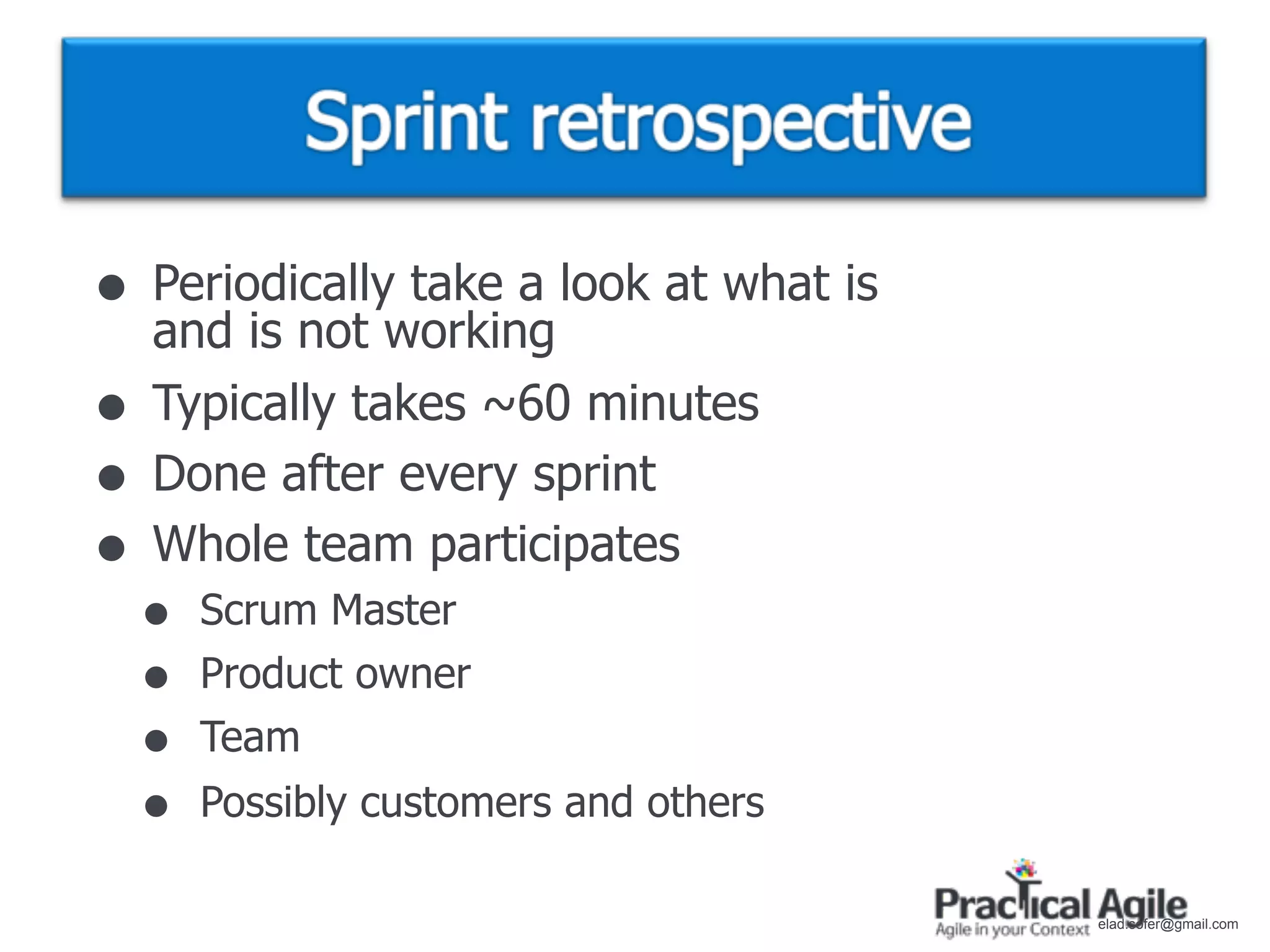
• Periodically take a look at what is
  and is not working


                                        elad.sofer@gmail.com
• Periodically take a look at what is
    and is not working
•   Typically takes ~60 minutes


                                        elad.sofer@gmail.com
• Periodically take a look at what is
    and is not working
•   Typically takes ~60 minutes
•   Done after every sprint


                                        elad.sofer@gmail.com
• Periodically take a look at what is
    and is not working
•   Typically takes ~60 minutes
•   Done after every sprint
•   Whole team participates
    •   Scrum Master
    •   Product owner
    •   Team
    •   Possibly customers and others

                                        elad.sofer@gmail.com
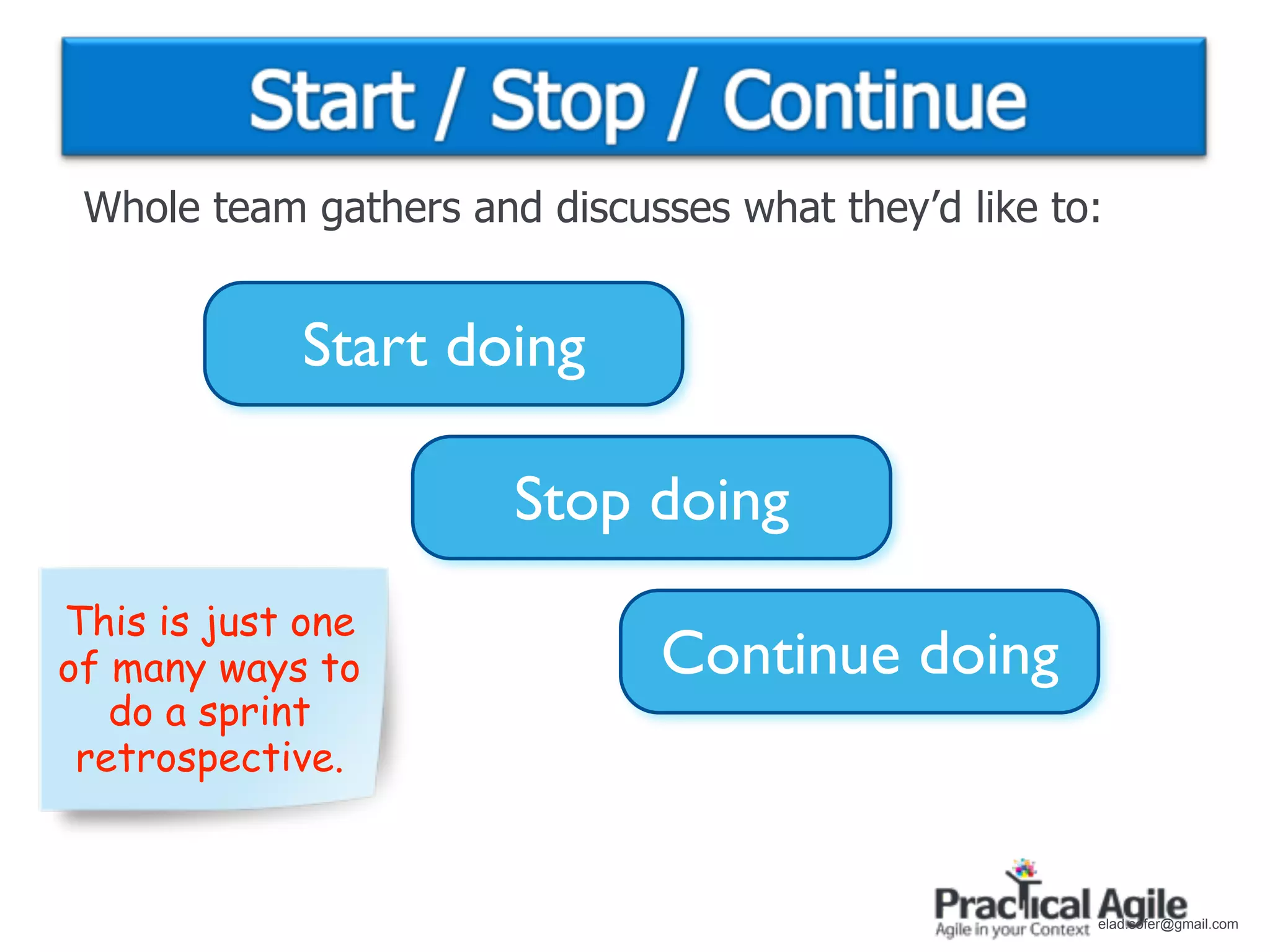
Whole team gathers and discusses what they’d like to:


                                                    elad.sofer@gmail.com
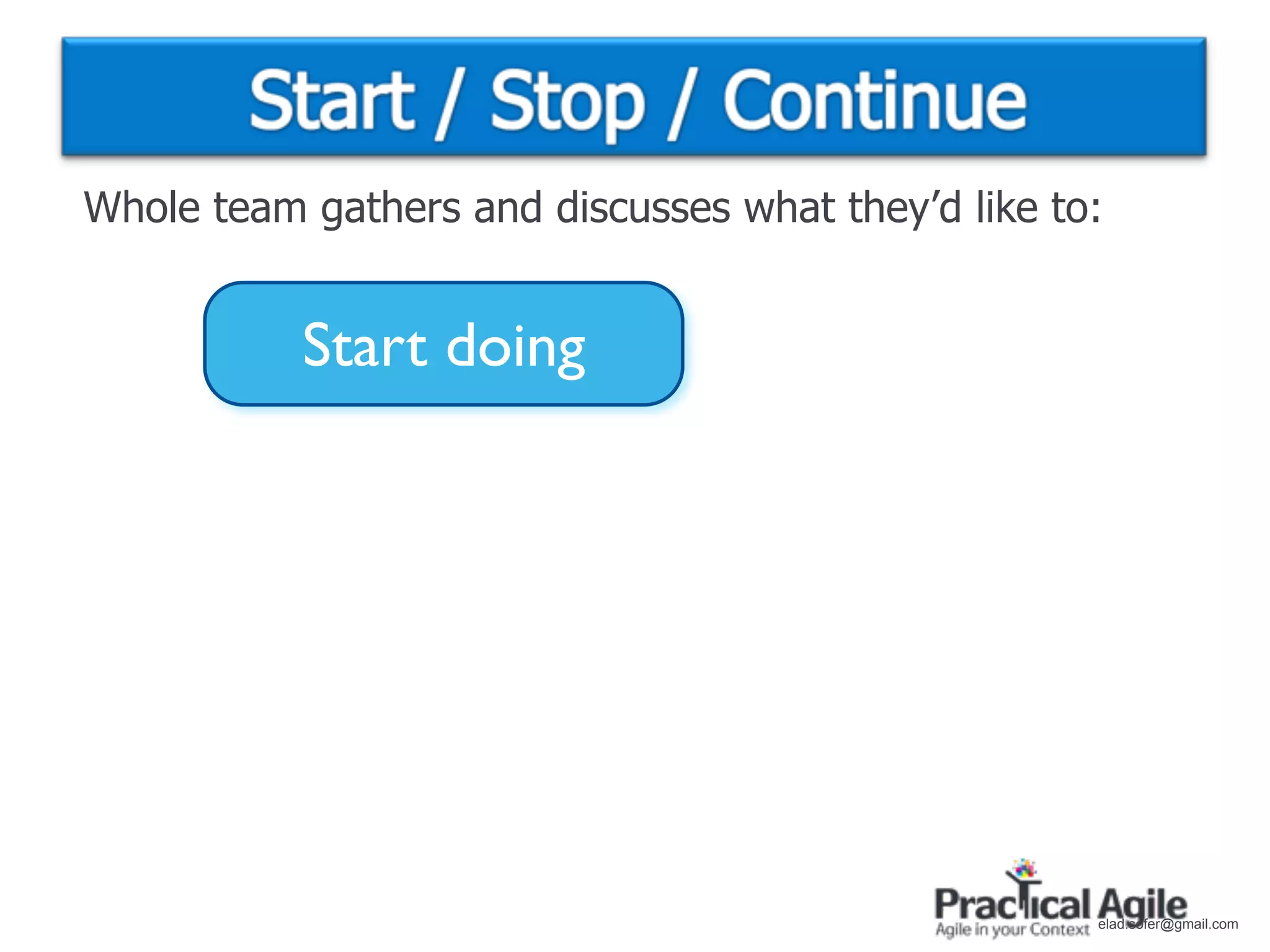
Whole team gathers and discusses what they’d like to:


           Start doing


                                                    elad.sofer@gmail.com
Whole team gathers and discusses what they’d like to:


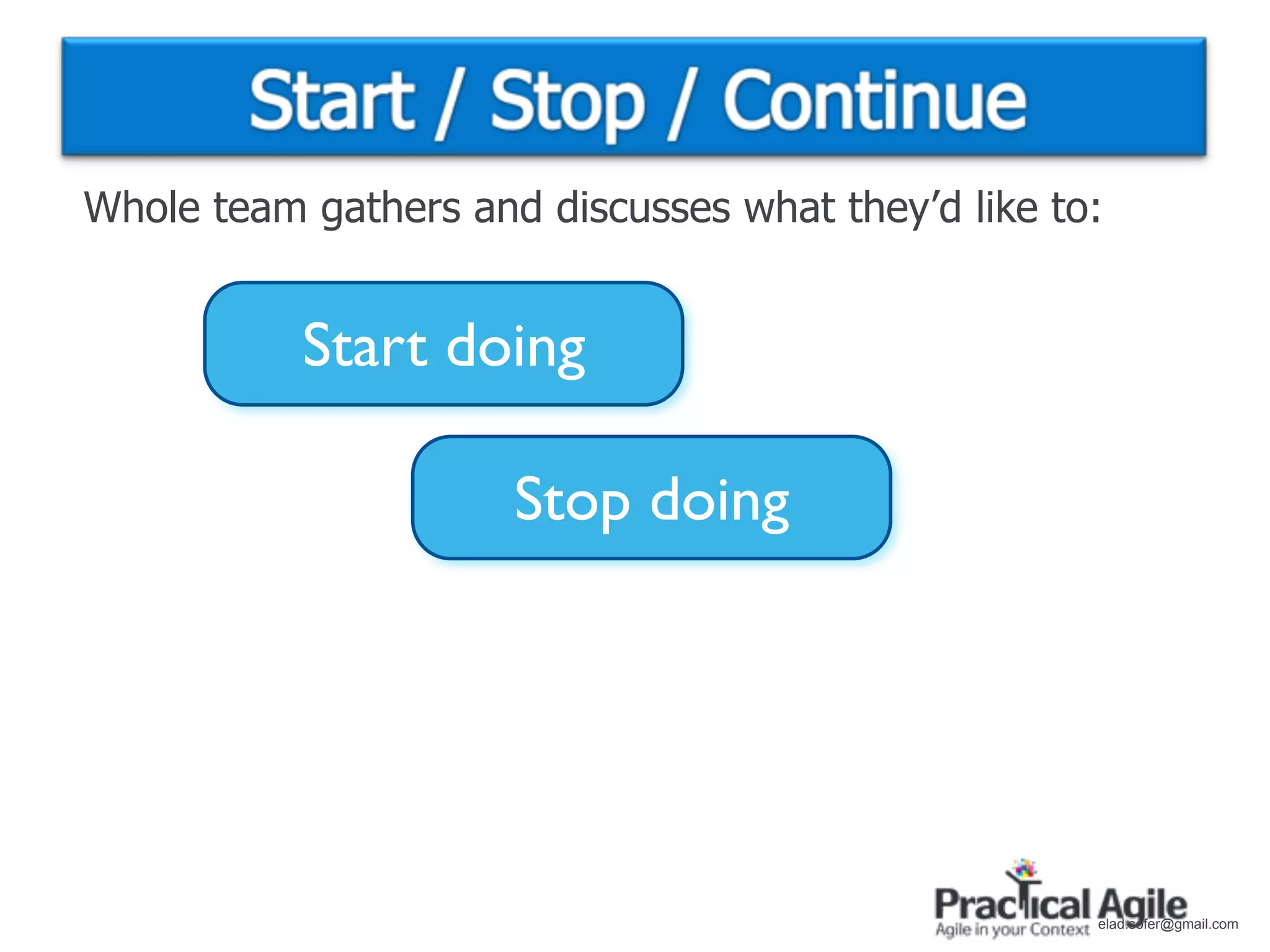
           Start doing

                      Stop doing


                                                    elad.sofer@gmail.com
Whole team gathers and discusses what they’d like to:


            Start doing

                       Stop doing
This is just one
of many ways to               Continue doing
   do a sprint
 retrospective.


                                                     elad.sofer@gmail.com
elad.sofer@gmail.com
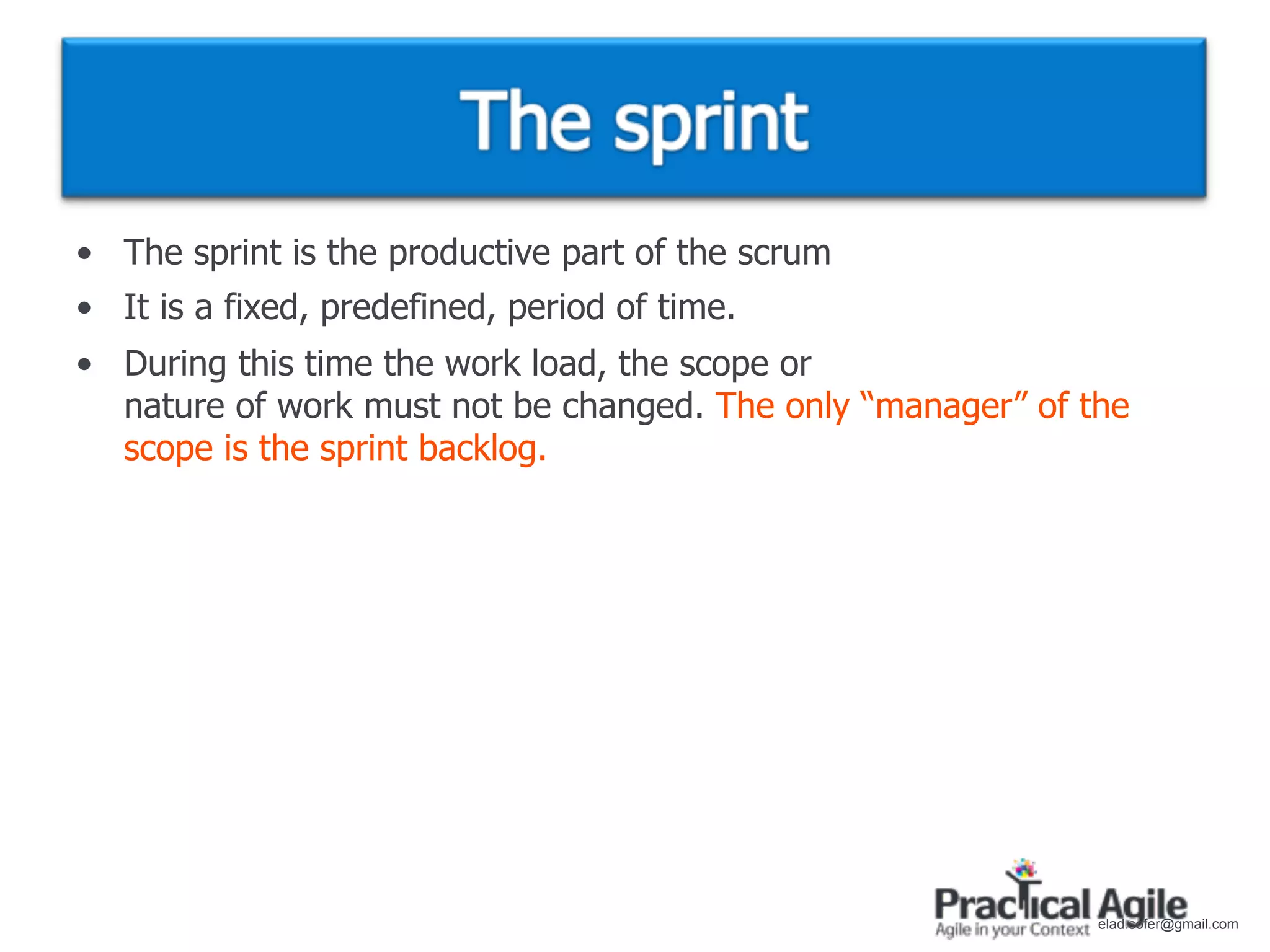
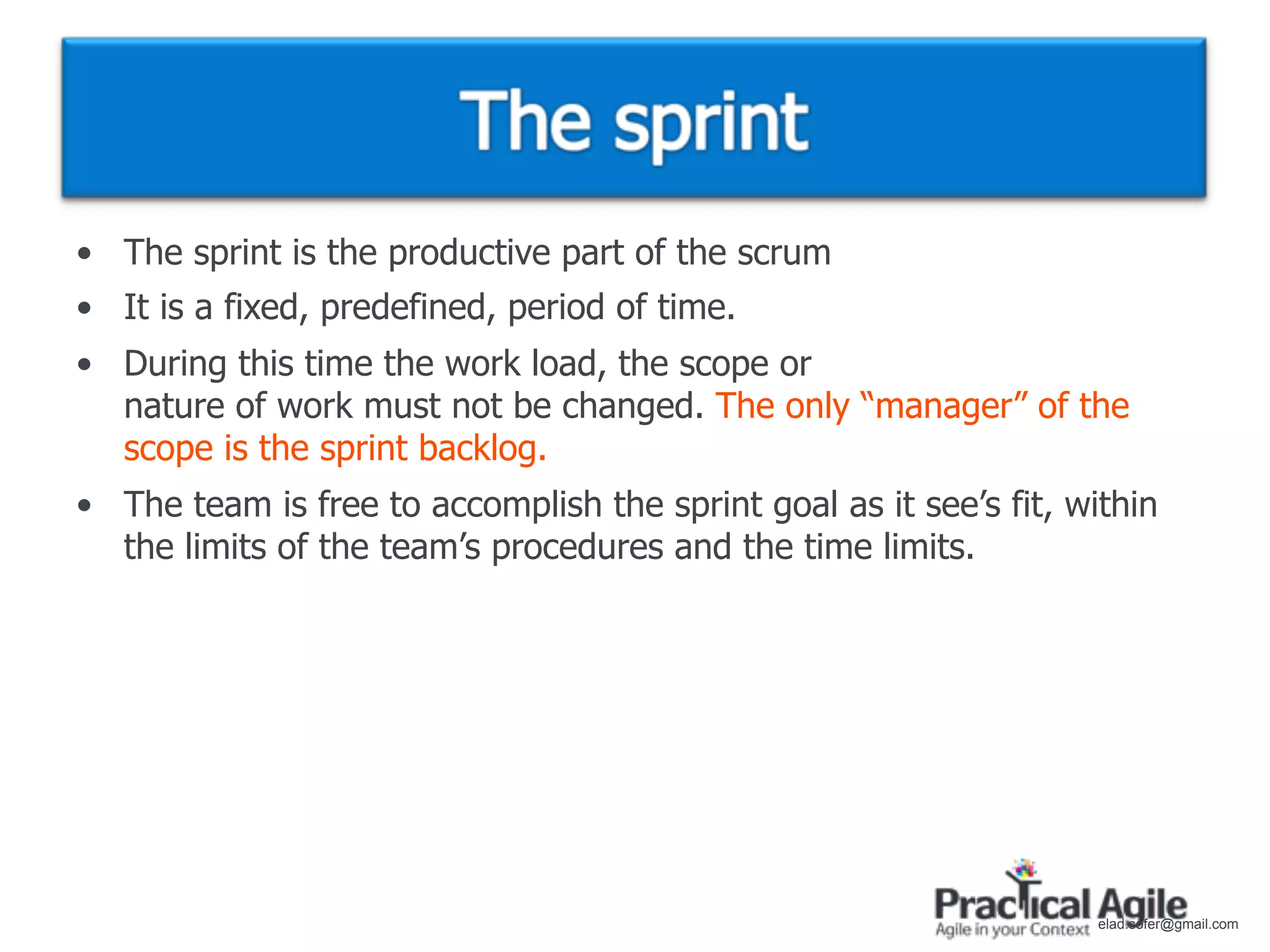
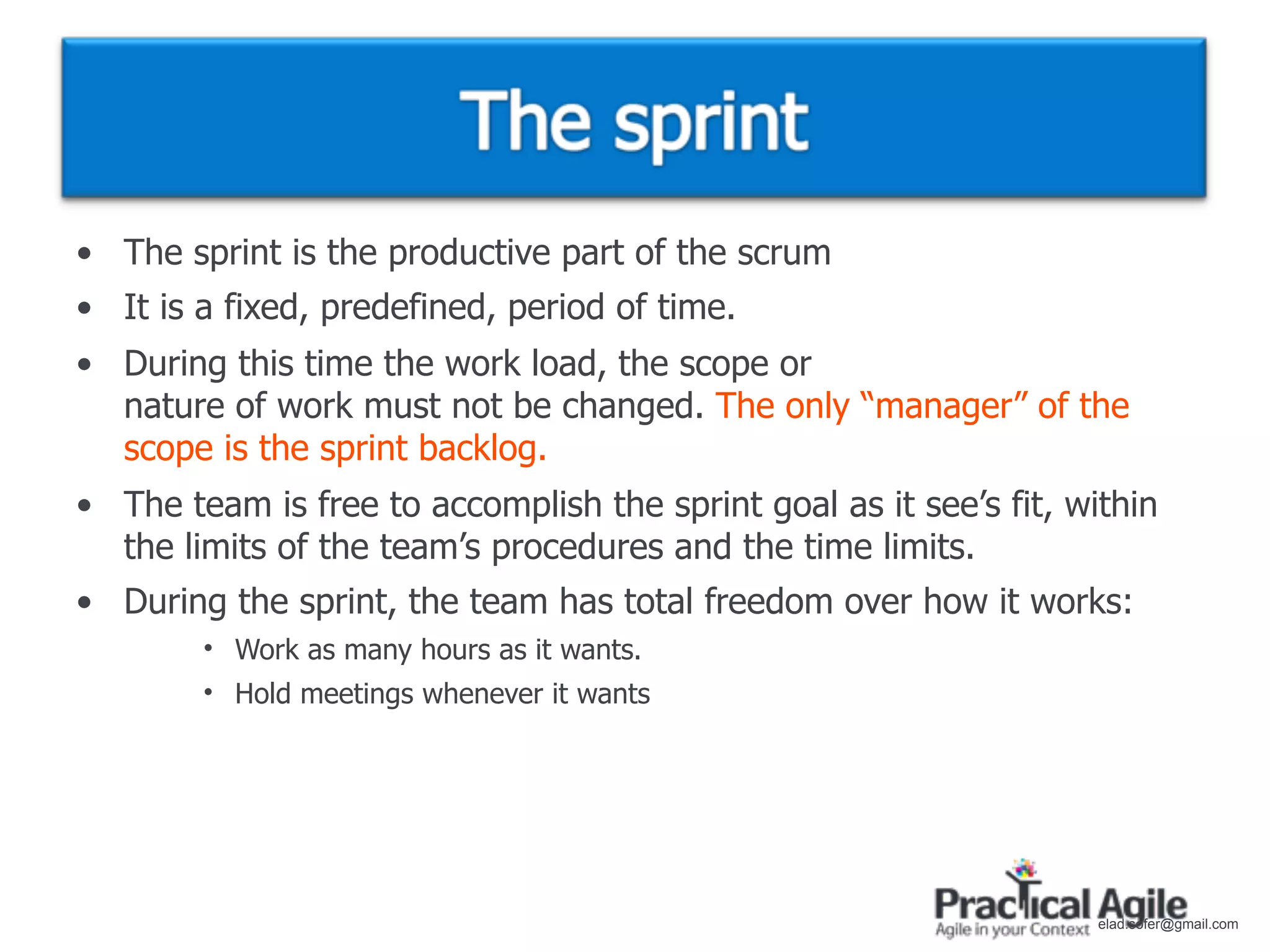
• The sprint is the productive part of the scrum


                                                   elad.sofer@gmail.com
• The sprint is the productive part of the scrum
• It is a fixed, predefined, period of time.


                                                   elad.sofer@gmail.com
• The sprint is the productive part of the scrum
• It is a fixed, predefined, period of time.
• During this time the work load, the scope or
  nature of work must not be changed. The only “manager” of the
  scope is the sprint backlog.


                                                             elad.sofer@gmail.com
• The sprint is the productive part of the scrum
• It is a fixed, predefined, period of time.
• During this time the work load, the scope or
  nature of work must not be changed. The only “manager” of the
  scope is the sprint backlog.
• The team is free to accomplish the sprint goal as it see’s fit, within
  the limits of the team’s procedures and the time limits.


                                                                    elad.sofer@gmail.com
• The sprint is the productive part of the scrum
• It is a fixed, predefined, period of time.
• During this time the work load, the scope or
  nature of work must not be changed. The only “manager” of the
  scope is the sprint backlog.
• The team is free to accomplish the sprint goal as it see’s fit, within
  the limits of the team’s procedures and the time limits.
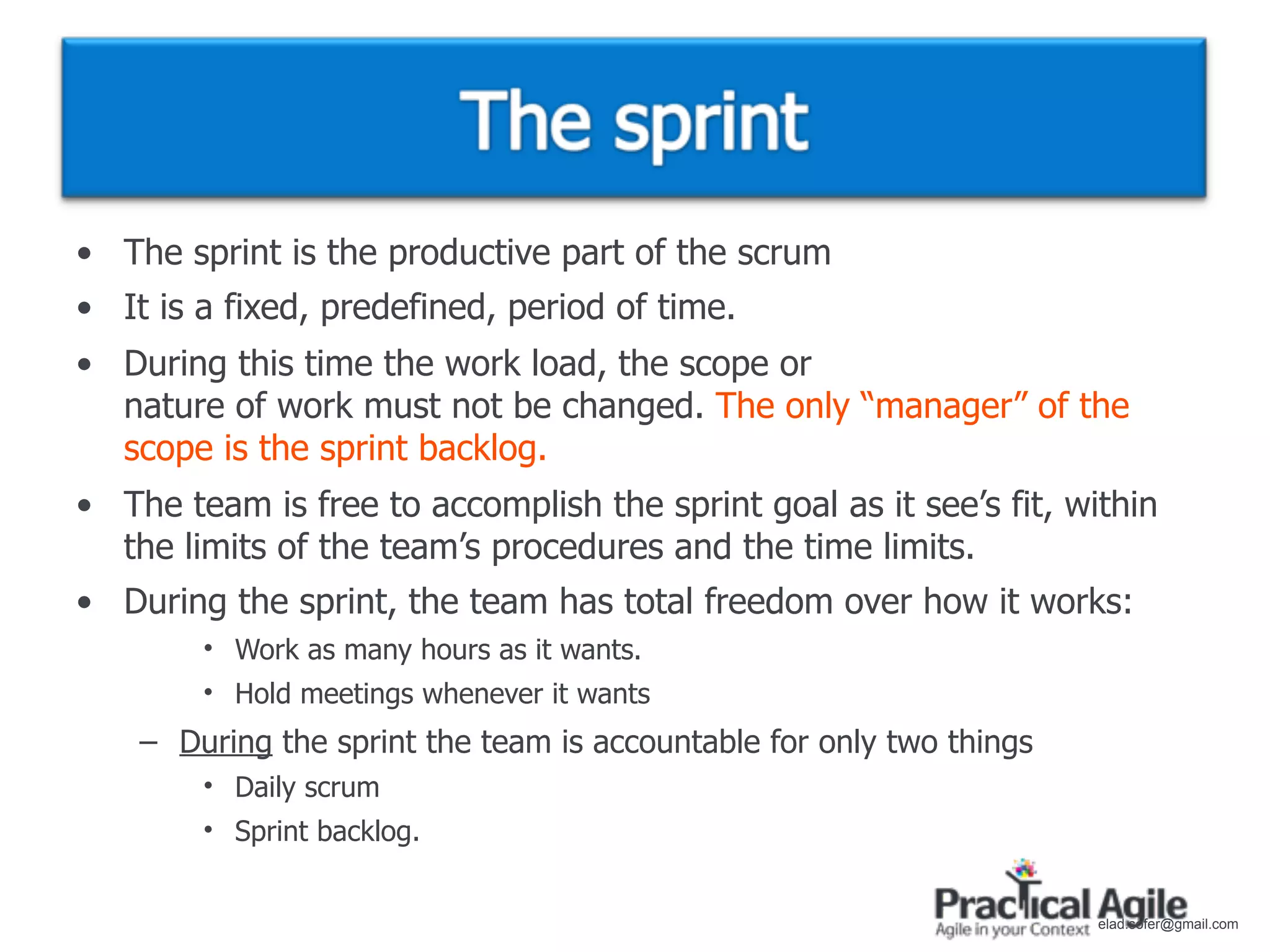
• During the sprint, the team has total freedom over how it works:
        • Work as many hours as it wants.
        • Hold meetings whenever it wants


                                                                    elad.sofer@gmail.com
• The sprint is the productive part of the scrum
• It is a fixed, predefined, period of time.
• During this time the work load, the scope or
  nature of work must not be changed. The only “manager” of the
  scope is the sprint backlog.
• The team is free to accomplish the sprint goal as it see’s fit, within
  the limits of the team’s procedures and the time limits.
• During the sprint, the team has total freedom over how it works:
        • Work as many hours as it wants.
        • Hold meetings whenever it wants
    – During the sprint the team is accountable for only two things
        • Daily scrum
        • Sprint backlog.


                                                                      elad.sofer@gmail.com
elad.sofer@gmail.com
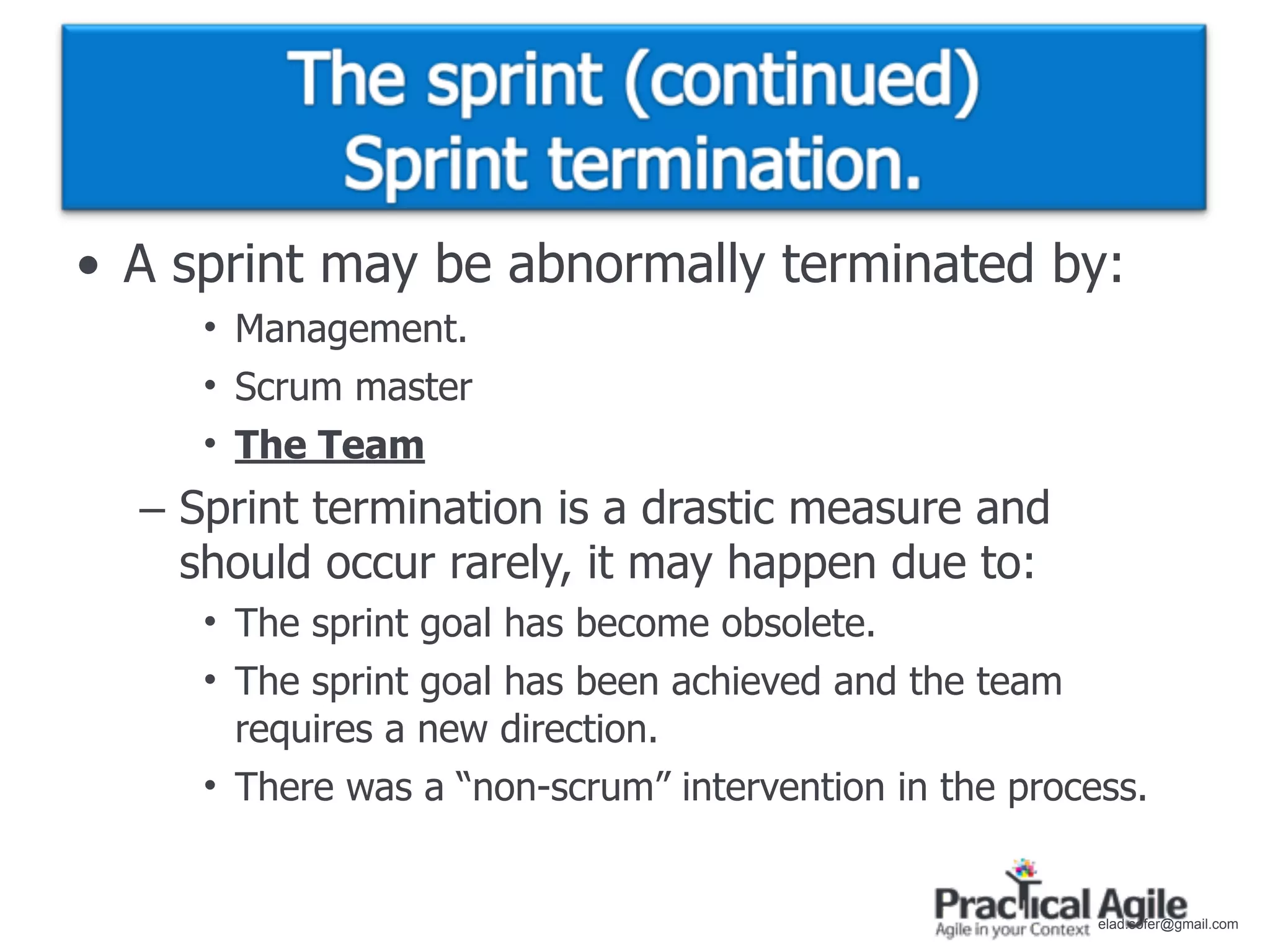
• A sprint may be abnormally terminated by:
     • Management.
     • Scrum master
     • The Team
  – Sprint termination is a drastic measure and
    should occur rarely, it may happen due to:
     • The sprint goal has become obsolete.
     • The sprint goal has been achieved and the team
       requires a new direction.
     • There was a “non-scrum” intervention in the process.


                                                        elad.sofer@gmail.com
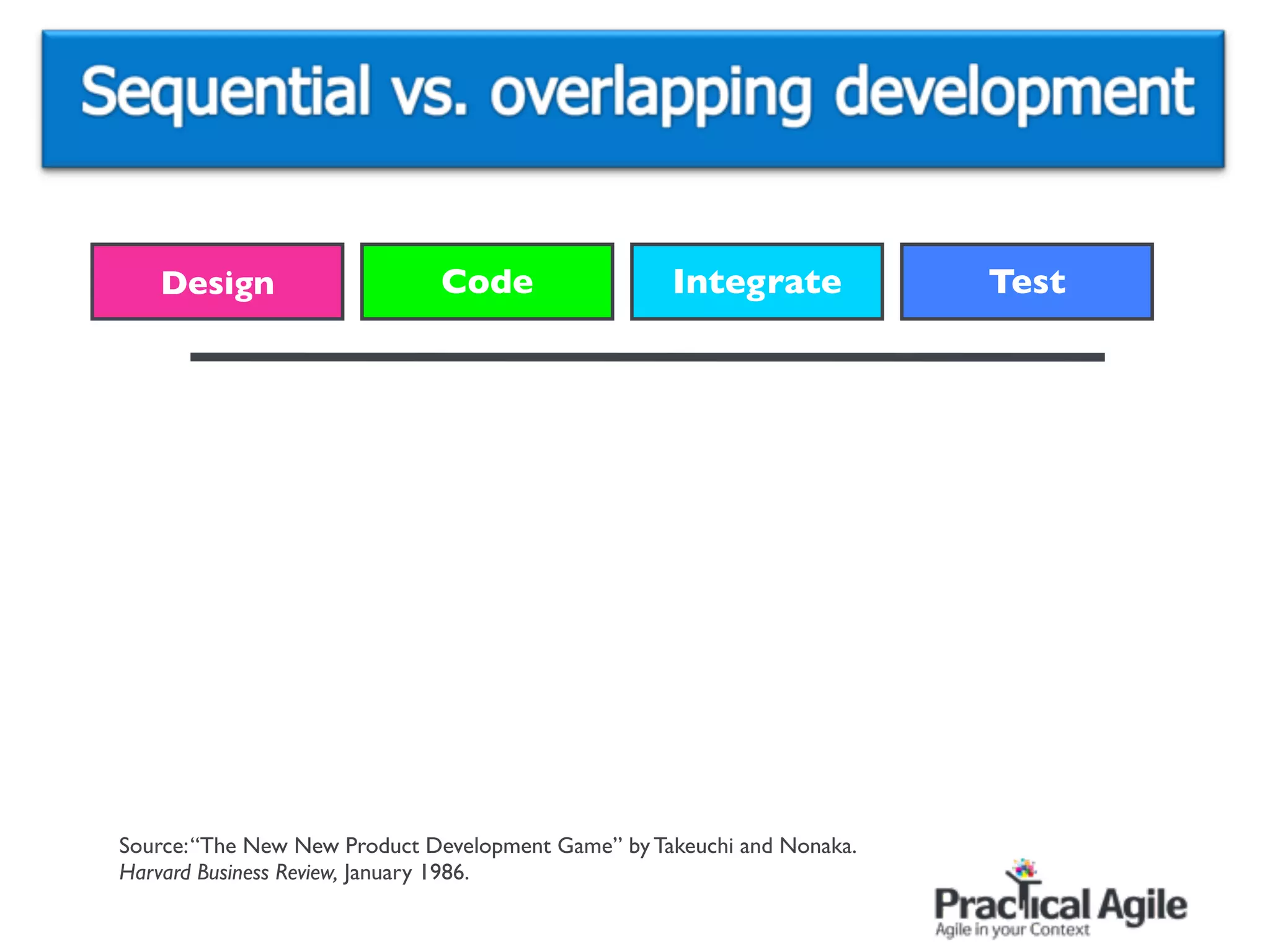
Design                     Code                  Integrate            Test


Source: “The New New Product Development Game” by Takeuchi and Nonaka.
Harvard Business Review, January 1986.
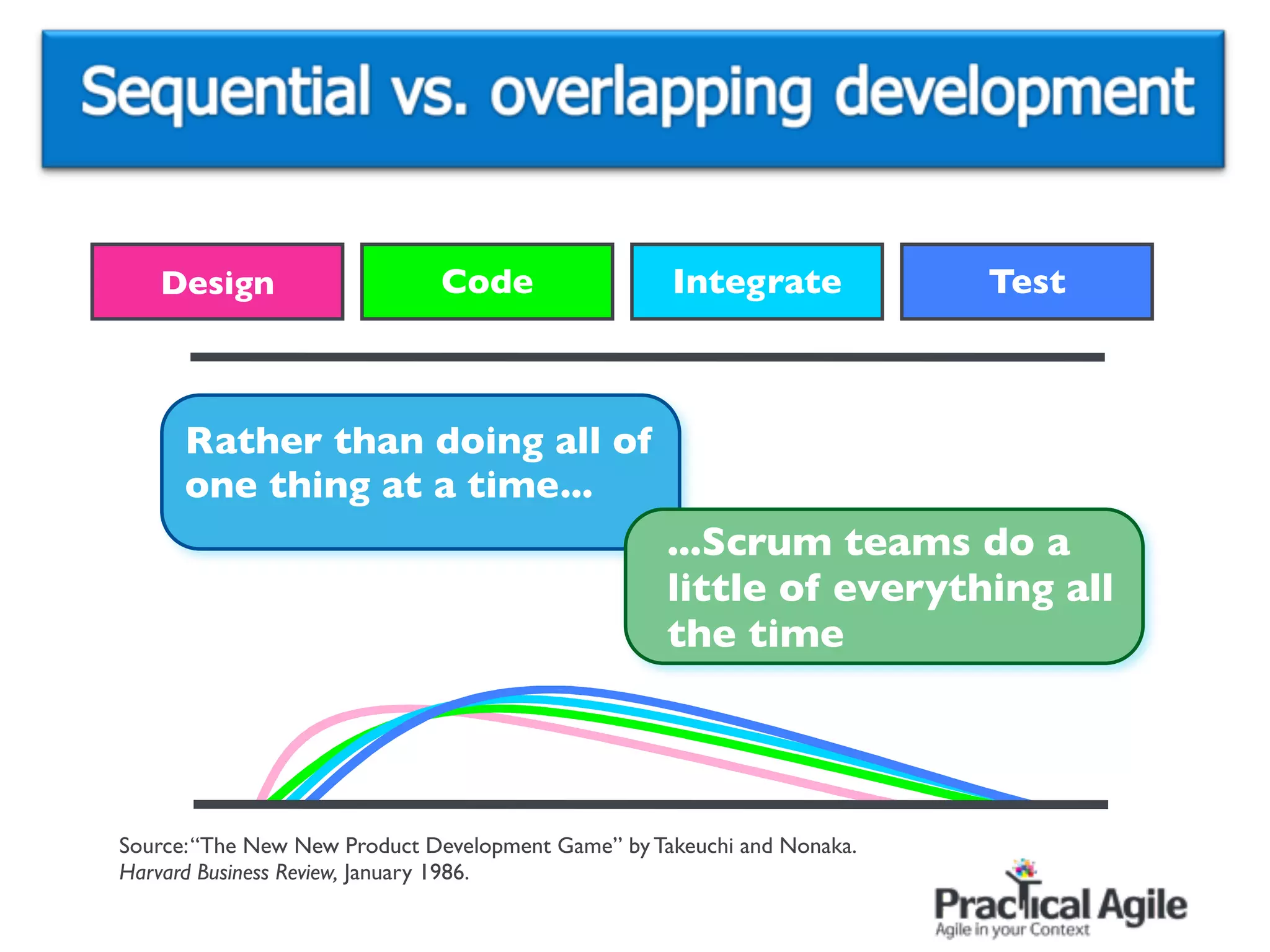
Design                     Code                  Integrate            Test


      Rather than doing all of
      one thing at a time...
                                                   ...Scrum teams do a
                                                   little of everything all
                                                   the time


Source: “The New New Product Development Game” by Takeuchi and Nonaka.
Harvard Business Review, January 1986.
elad.sofer@gmail.com
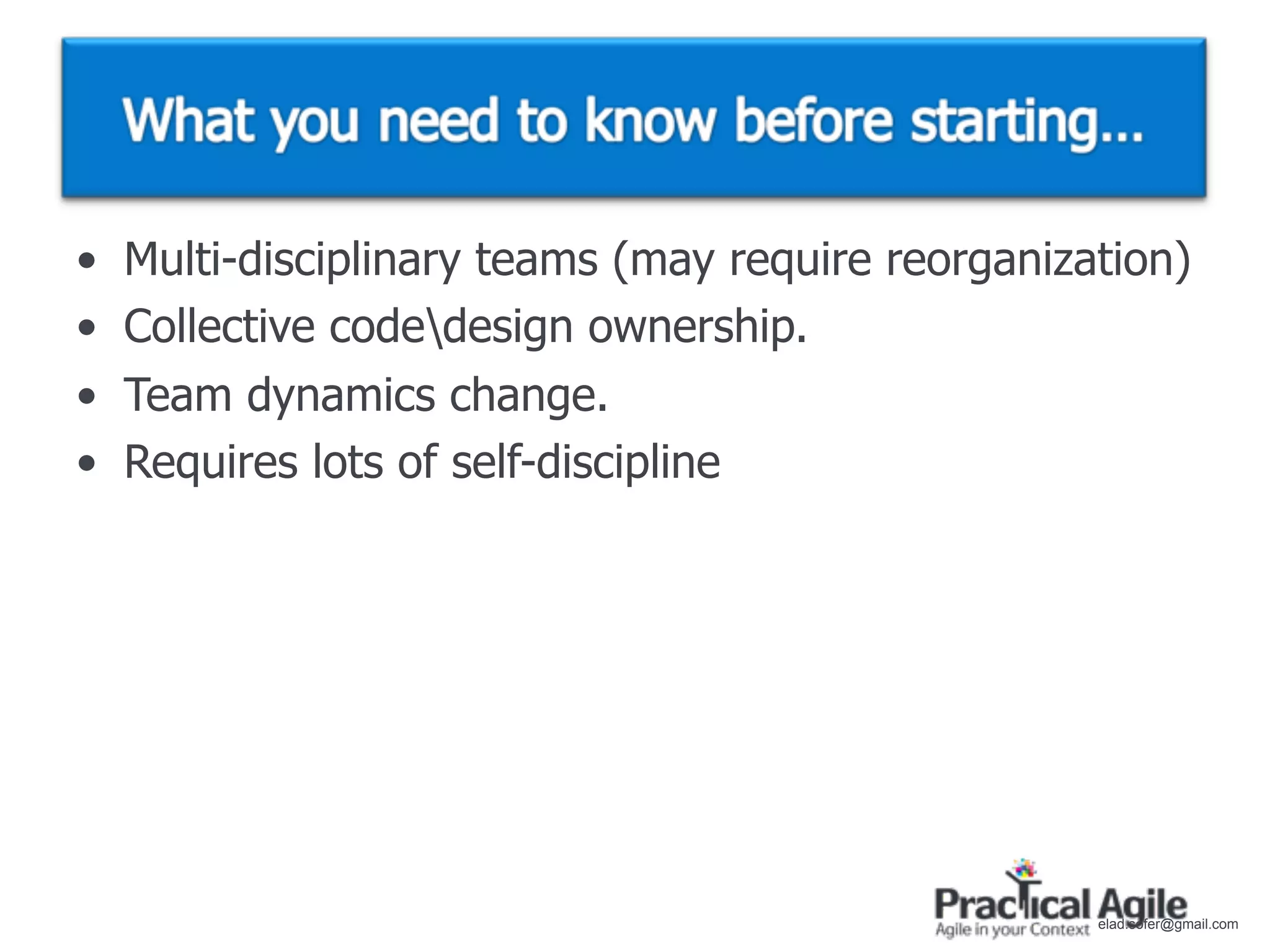
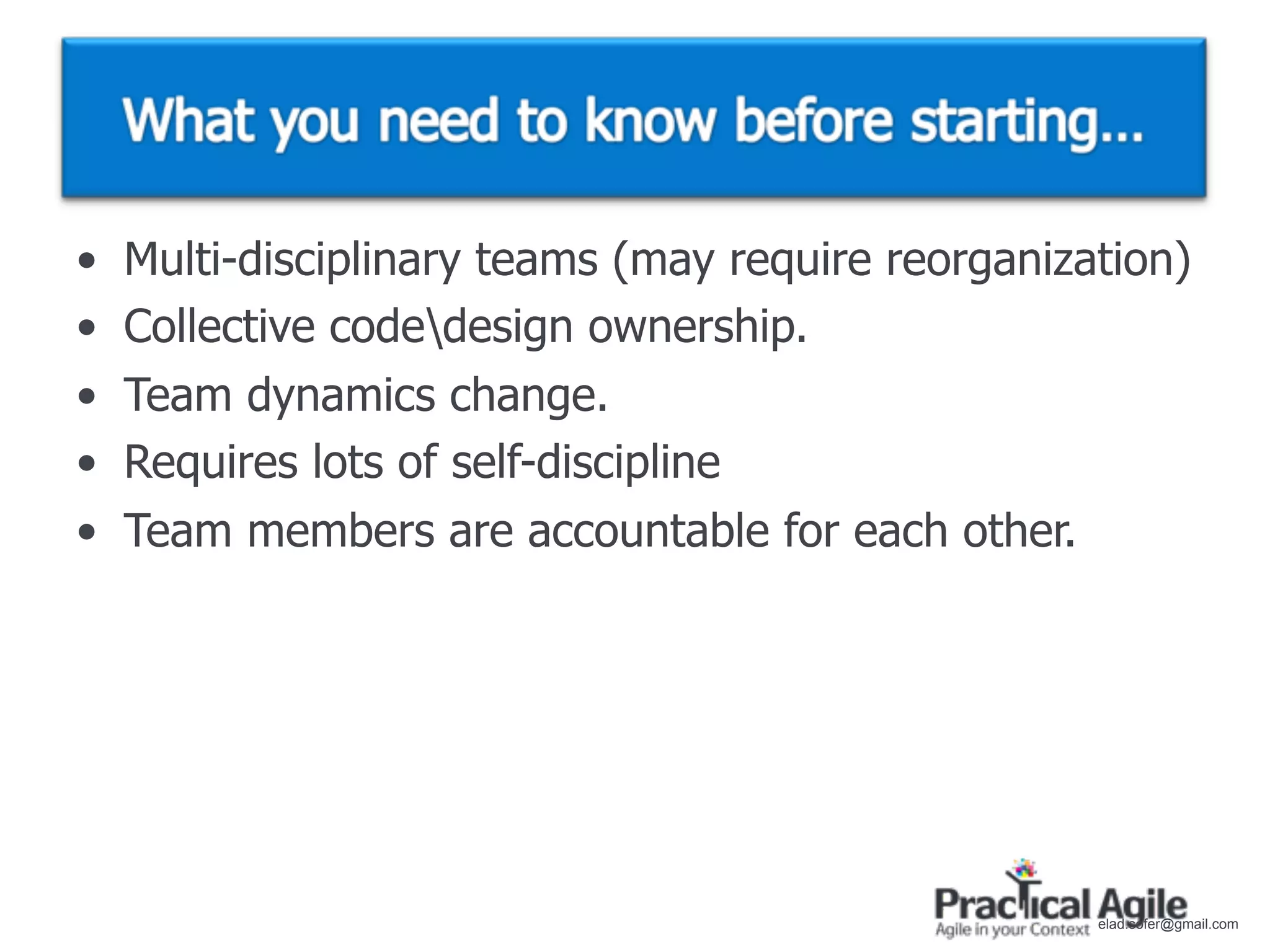
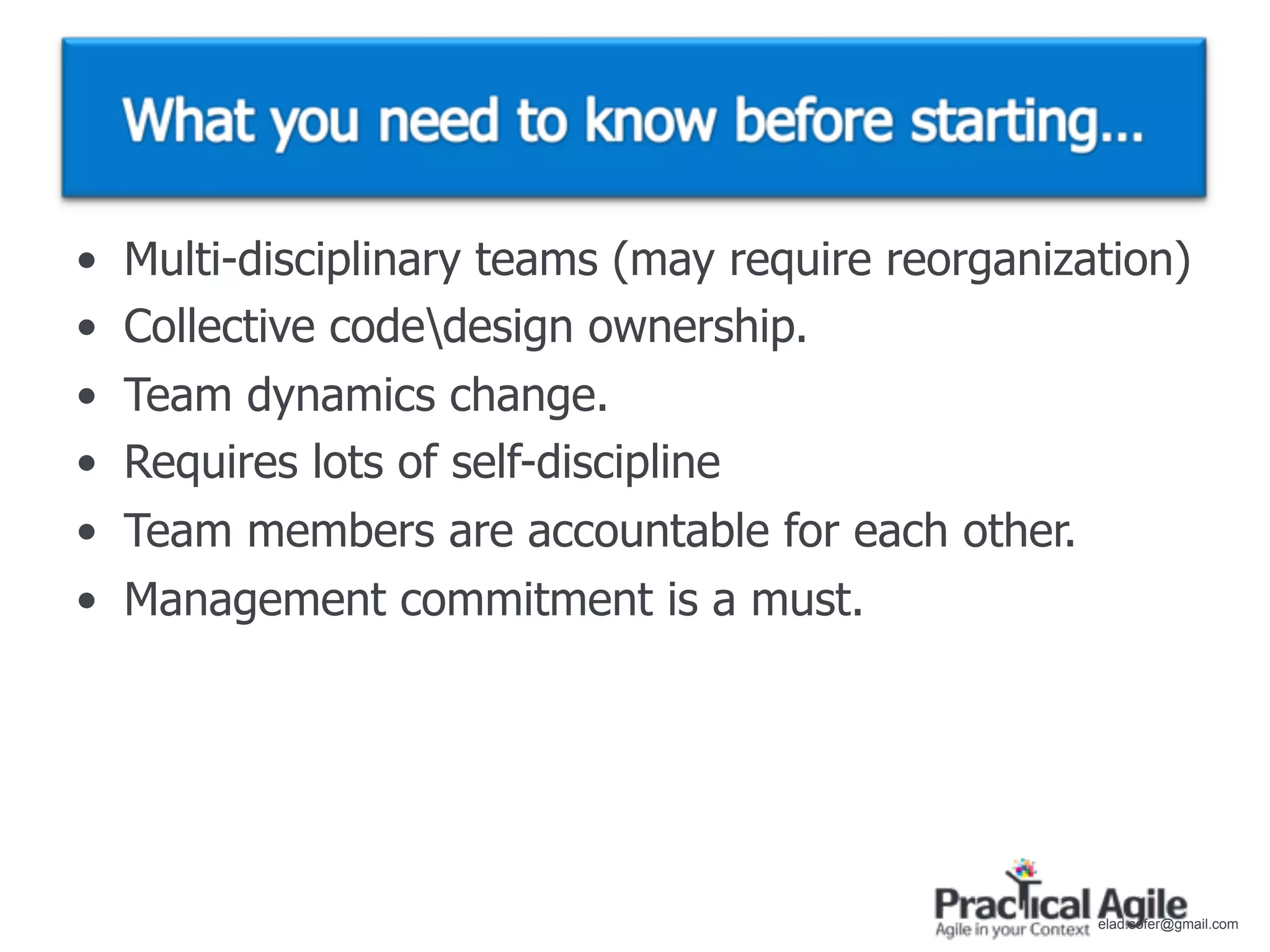
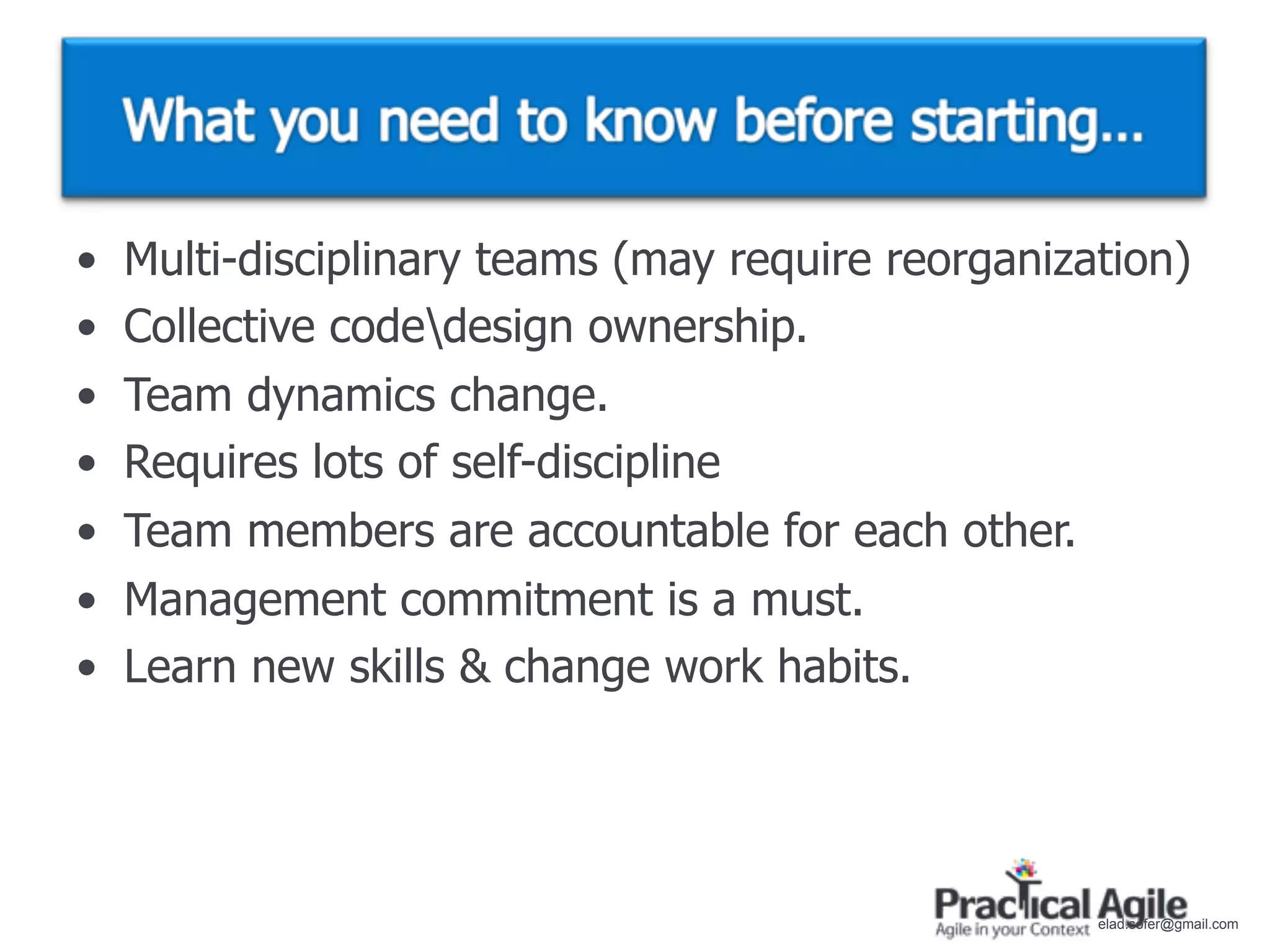
• Multi-disciplinary teams (may require reorganization)


                                                  elad.sofer@gmail.com
• Multi-disciplinary teams (may require reorganization)
• Collective codedesign ownership.


                                                  elad.sofer@gmail.com
• Multi-disciplinary teams (may require reorganization)
• Collective codedesign ownership.
• Team dynamics change.


                                                  elad.sofer@gmail.com
•   Multi-disciplinary teams (may require reorganization)
•   Collective codedesign ownership.
•   Team dynamics change.
•   Requires lots of self-discipline


                                                    elad.sofer@gmail.com
•   Multi-disciplinary teams (may require reorganization)
•   Collective codedesign ownership.
•   Team dynamics change.
•   Requires lots of self-discipline
•   Team members are accountable for each other.


                                                    elad.sofer@gmail.com
•   Multi-disciplinary teams (may require reorganization)
•   Collective codedesign ownership.
•   Team dynamics change.
•   Requires lots of self-discipline
•   Team members are accountable for each other.
•   Management commitment is a must.


                                                    elad.sofer@gmail.com
•   Multi-disciplinary teams (may require reorganization)
•   Collective codedesign ownership.
•   Team dynamics change.
•   Requires lots of self-discipline
•   Team members are accountable for each other.
•   Management commitment is a must.
•   Learn new skills & change work habits.


                                                    elad.sofer@gmail.com
•   Multi-disciplinary teams (may require reorganization)
•   Collective codedesign ownership.
•   Team dynamics change.
•   Requires lots of self-discipline
•   Team members are accountable for each other.
•   Management commitment is a must.
•   Learn new skills & change work habits.
•   Embrace new values.


                                                    elad.sofer@gmail.com
•   Multi-disciplinary teams (may require reorganization)
•   Collective codedesign ownership.
•   Team dynamics change.
•   Requires lots of self-discipline
•   Team members are accountable for each other.
•   Management commitment is a must.
•   Learn new skills & change work habits.
•   Embrace new values.
•   Success rates of Scrum adoption are ~40%

                                                    elad.sofer@gmail.com
Scrum will not
solve your problems...
Scrum will not
solve your problems...

  it will only
  make them
painfully visible
elad.sofer@gmail.com

Scrum intro ILTechTalks

  • 1.
    Elad Sofer -Agile Coach Co-Founder of Practical Agile Email : elad@practical-agile.com blog: www.thescrumster.com twitter: @eladsof elad.sofer@gmail.com
  • 2.
  • 4.
  • 5.
    Requirements Analysis
  • 6.
    Requirements Analysis Design
  • 7.
    Requirements Analysis Design Implement
  • 8.
    Requirements Analysis Design Implement Test
  • 9.
    Requirements Analysis Design Implement Test Acceptance
  • 10.
    Requirements Analysis Design Implement Test Acceptance Deliver
  • 12.
    The waterfall developmentmodel originates in the manufacturing and construction industries
  • 13.
    The waterfall developmentmodel originates in the manufacturing and construction industries The first description of waterfall is a 1970 article by Winston W. Royce
  • 14.
    The waterfall developmentmodel originates in the manufacturing and construction industries The first description of waterfall is a 1970 article by Winston W. Royce Royce presented this model as an example of a flawed, non-working model
  • 15.
    The waterfall developmentmodel originates in the manufacturing and construction industries The first description of waterfall is a 1970 article by Winston W. Royce Royce presented this model as an example of a flawed, non-working model "I believe in this concept, but the implementation described above is risky and invites failure" [Royce 1970]
  • 16.
    Wishful thinking No matterhow hard you try, it ain’t gonna work
  • 17.
  • 18.
  • 19.
    1. Our highest priority is to satisfy the customer through early and continuous delivery of valuable software elad.sofer@gmail.com
  • 20.
    1. Our highest priority is to satisfy the customer through early and continuous delivery of valuable software 2. Welcome changing requirements, even late in development. Agile processes harness change for the customer’s competitive advantage. elad.sofer@gmail.com
  • 21.
    1. Our highest priority is to satisfy the customer through early and continuous delivery of valuable software 2. Welcome changing requirements, even late in development. Agile processes harness change for the customer’s competitive advantage. 3. Deliver working software frequently, from a couple of weeks to a couple of months, with a preference to a shorter timescale. elad.sofer@gmail.com
  • 22.
    1. Our highest priority is to satisfy the customer through early and continuous delivery of valuable software 2. Welcome changing requirements, even late in development. Agile processes harness change for the customer’s competitive advantage. 3. Deliver working software frequently, from a couple of weeks to a couple of months, with a preference to a shorter timescale. 4. Business people and developers must work together daily throughout the project. elad.sofer@gmail.com
  • 23.
    1. Our highest priority is to satisfy the customer through early and continuous delivery of valuable software 2. Welcome changing requirements, even late in development. Agile processes harness change for the customer’s competitive advantage. 3. Deliver working software frequently, from a couple of weeks to a couple of months, with a preference to a shorter timescale. 4. Business people and developers must work together daily throughout the project. 5. Build project around motivated individuals. Give them the environment and support they need, and trust them to get the job done. elad.sofer@gmail.com
  • 24.
    1. Our highest priority is to satisfy the customer through early and continuous delivery of valuable software 2. Welcome changing requirements, even late in development. Agile processes harness change for the customer’s competitive advantage. 3. Deliver working software frequently, from a couple of weeks to a couple of months, with a preference to a shorter timescale. 4. Business people and developers must work together daily throughout the project. 5. Build project around motivated individuals. Give them the environment and support they need, and trust them to get the job done. 6. The most efficient and effective method of conveying information to and within development team is face-to-face conversation. elad.sofer@gmail.com
  • 25.
  • 26.
    7. Working software is the primary measure for progress. elad.sofer@gmail.com
  • 27.
    7. Working softwareis the primary measure for progress. 8. Agile processes promote sustainable development. The sponsors, developers, and users should be able to maintain a constant pace indefinitely. elad.sofer@gmail.com
  • 28.
    7. Working softwareis the primary measure for progress. 8. Agile processes promote sustainable development. The sponsors, developers, and users should be able to maintain a constant pace indefinitely. 9. Continuous attention to technical excellence and good design enhances agility. elad.sofer@gmail.com
  • 29.
    7. Working softwareis the primary measure for progress. 8. Agile processes promote sustainable development. The sponsors, developers, and users should be able to maintain a constant pace indefinitely. 9. Continuous attention to technical excellence and good design enhances agility. 10. Simplicity – the art of maximizing the amount of work not done – is essential. elad.sofer@gmail.com
  • 30.
    7. Working softwareis the primary measure for progress. 8. Agile processes promote sustainable development. The sponsors, developers, and users should be able to maintain a constant pace indefinitely. 9. Continuous attention to technical excellence and good design enhances agility. 10. Simplicity – the art of maximizing the amount of work not done – is essential. 11. The best architectures, requirements, and designs emerge from self-organizing teams. elad.sofer@gmail.com
  • 31.
    7. Working softwareis the primary measure for progress. 8. Agile processes promote sustainable development. The sponsors, developers, and users should be able to maintain a constant pace indefinitely. 9. Continuous attention to technical excellence and good design enhances agility. 10. Simplicity – the art of maximizing the amount of work not done – is essential. 11. The best architectures, requirements, and designs emerge from self-organizing teams. 12. At regular intervals, the team reflects on how to become more effective, then tunes and adjusts its behavior accordingly. elad.sofer@gmail.com
  • 32.
    "Scrum is ateam of eight individuals in Rugby. Everyone in the pack acts together with everyone else to move the ball down the field in small incremental steps. Teams work as tight, integrated units with whole team focusing on a single goal." elad.sofer@gmail.com
  • 33.
  • 34.
    • Understanding thatwe cannot predict the future. elad.sofer@gmail.com
  • 35.
    • Understanding thatwe cannot predict the future. • One size does not fit all. elad.sofer@gmail.com
  • 36.
    • Understanding thatwe cannot predict the future. • One size does not fit all. • Constant improvement. elad.sofer@gmail.com
  • 37.
    Understanding that we cannot predict the future. • One size does not fit all. • Constant improvement. • Transparency elad.sofer@gmail.com
  • 38.
    Understanding that we cannot predict the future. • One size does not fit all. • Constant improvement. • Transparency • Team work elad.sofer@gmail.com
  • 39.
    Understanding that we cannot predict the future. • One size does not fit all. • Constant improvement. • Transparency • Team work • As simple as possible & as little as possible. elad.sofer@gmail.com
  • 40.
    Understanding that we cannot predict the future. • One size does not fit all. • Constant improvement. • Transparency • Team work • As simple as possible & as little as possible. • Prioritizing – Industry statistics show: 65% of all features are rarelynever used. elad.sofer@gmail.com
  • 41.
    • Understanding thatwe cannot predict the future. • One size does not fit all. • Constant improvement. • Transparency • Team work • As simple as possible & as little as possible. • Prioritizing – Industry statistics show: 65% of all features are rarelynever used. • Empirical approach elad.sofer@gmail.com
  • 42.
    • Understanding thatwe cannot predict the future. • One size does not fit all. • Constant improvement. • Transparency • Team work • As simple as possible & as little as possible. • Prioritizing – Industry statistics show: 65% of all features are rarelynever used. • Empirical approach • Fun !!! elad.sofer@gmail.com
  • 43.
  • 44.
  • 45.
  • 46.
  • 47.
  • 48.
  • 49.
  • 50.
  • 51.
  • 52.
  • 53.
  • 54.
  • 55.
    Roles •Product owner •ScrumMaster •Team Artifacts •Product backlog •Sprint backlog •Burndown charts Ceremonies •Sprint planning •Sprint review •Sprint retrospective •Daily scrum meeting elad.sofer@gmail.com
  • 56.
    Roles •Product owner •ScrumMaster •Team Artifacts •Product backlog •Sprint backlog •Burndown charts Ceremonies •Sprint planning •Sprint review •Sprint retrospective •Daily scrum meeting elad.sofer@gmail.com
  • 57.
  • 58.
    • Defines thefeatures of the product elad.sofer@gmail.com
  • 59.
    • Defines thefeatures of the product • Defines release dates and content elad.sofer@gmail.com
  • 60.
    • Defines thefeatures of the product • Defines release dates and content • Responsible for ROI. elad.sofer@gmail.com
  • 61.
    Defines the features of the product • Defines release dates and content • Responsible for ROI. • Prioritizes feature according to value. elad.sofer@gmail.com
  • 62.
    Defines the features of the product • Defines release dates and content • Responsible for ROI. • Prioritizes feature according to value. • Can change features and priority once every predefined interval. elad.sofer@gmail.com
  • 63.
    • Defines thefeatures of the product • Defines release dates and content • Responsible for ROI. • Prioritizes feature according to value. • Can change features and priority once every predefined interval. • Decides what will be worked on in each iteration elad.sofer@gmail.com
  • 64.
    • Defines thefeatures of the product • Defines release dates and content • Responsible for ROI. • Prioritizes feature according to value. • Can change features and priority once every predefined interval. • Decides what will be worked on in each iteration • Accepts or rejects results. elad.sofer@gmail.com
  • 65.
  • 66.
    • Responsible forthe scrum process. elad.sofer@gmail.com
  • 67.
    • Responsible forthe scrum process. • Protects the team. elad.sofer@gmail.com
  • 68.
    • Responsible forthe scrum process. • Protects the team. • Helps removing impediments. elad.sofer@gmail.com
  • 69.
    Responsible for the scrum process. • Protects the team. • Helps removing impediments. • He is standing at the nexus between: • The product management that believes that any amount of work can be done. • Developer’s that have the willingness to cut quality to support the managements belief. elad.sofer@gmail.com
  • 70.
    Responsible for the scrum process. • Protects the team. • Helps removing impediments. • He is standing at the nexus between: • The product management that believes that any amount of work can be done. • Developer’s that have the willingness to cut quality to support the managements belief. • Probably the least loved person in the world. elad.sofer@gmail.com
  • 71.
    Work left 20 10 12 14 16 18 Time elad.sofer@gmail.com
  • 72.
    Work left 20 10 12 14 16 18 Time elad.sofer@gmail.com
  • 73.
    Work left 20 10 12 14 16 18 Time elad.sofer@gmail.com
  • 74.
    Work left 20 10 12 14 16 18 Time elad.sofer@gmail.com
  • 75.
    Work left 20 10 12 14 16 18 Time elad.sofer@gmail.com
  • 76.
    Work left 20 10 12 14 16 18 Time elad.sofer@gmail.com
  • 77.
  • 78.
    • Typically 5-9people elad.sofer@gmail.com
  • 79.
    • Typically 5-9people • Cross-functional: • “Architects”, Programmers, testers UI designers, etc. elad.sofer@gmail.com
  • 80.
    • Typically 5-9people • Cross-functional: • “Architects”, Programmers, testers UI designers, etc. • Members should be full-time • May be exceptions (e.g., database administrator) elad.sofer@gmail.com
  • 81.
    • Typically 5-9people • Cross-functional: • “Architects”, Programmers, testers UI designers, etc. • Members should be full-time • May be exceptions (e.g., database administrator) • Teams are self-organizing • Ideally, no titles but rarely a possibility elad.sofer@gmail.com
  • 82.
    • Typically 5-9people • Cross-functional: • “Architects”, Programmers, testers UI designers, etc. • Members should be full-time • May be exceptions (e.g., database administrator) • Teams are self-organizing • Ideally, no titles but rarely a possibility • Membership should change as little as possible • only between sprints elad.sofer@gmail.com
  • 83.
    Roles •Product owner •ScrumMaster •Team Artifacts •Product backlog •Sprint backlog •Burndown charts Ceremonies •Sprint planning •Sprint review •Sprint retrospective •Daily scrum meeting elad.sofer@gmail.com
  • 84.
  • 85.
    • List offeatures, Technology, issues. elad.sofer@gmail.com
  • 86.
    • List offeatures, Technology, issues. • Items should deliver value for customer. elad.sofer@gmail.com
  • 87.
    • List offeatures, Technology, issues. • Items should deliver value for customer. • Constantly prioritized & Estimated. elad.sofer@gmail.com
  • 88.
    List of features, Technology, issues. • Items should deliver value for customer. • Constantly prioritized & Estimated. • Anyone can contribute. elad.sofer@gmail.com
  • 89.
    List of features, Technology, issues. • Items should deliver value for customer. • Constantly prioritized & Estimated. • Anyone can contribute. • Visible to all. elad.sofer@gmail.com
  • 90.
    List of features, Technology, issues. • Items should deliver value for customer. • Constantly prioritized & Estimated. • Anyone can contribute. • Visible to all. • Derived from business plan, may be created together, with the customer. elad.sofer@gmail.com
  • 91.
    • List offeatures, Technology, issues. • Items should deliver value for customer. • Constantly prioritized & Estimated. • Anyone can contribute. • Visible to all. • Derived from business plan, may be created together, with the customer. • Can be changed every sprint!!! elad.sofer@gmail.com
  • 92.
    • List offeatures, Technology, issues. • Items should deliver value for customer. • Constantly prioritized & Estimated. • Anyone can contribute. • Visible to all. • Derived from business plan, may be created together, with the customer. • Can be changed every sprint!!! • Customer is not “programmed” to think of everything in advance. elad.sofer@gmail.com
  • 93.
    Backlog item Estimate As a user I would like to register 3 As a user I would like to login 5 As a buyer I would like to make a bid 3 As a buyer I would like to pay with a credit card 8 As a seller I would like to start an auction 8 ... … Test register feature 10 Create infrastructure for login 20 elad.sofer@gmail.com
  • 94.
    Backlog item Estimate As a user I would like to register 3 As a user I would like to login 5 As a buyer I would like to make a bid 3 As a buyer I would like to pay with a credit card 8 As a seller I would like to start an auction 8 ... … Test register feature 10 Create infrastructure for login 20 elad.sofer@gmail.com
  • 95.
  • 96.
    • The sprintbacklog is defined by understanding and agreeing on the sprint goal(s) and selecting the appropriate items from the product backlog. elad.sofer@gmail.com
  • 97.
    • The sprintbacklog is defined by understanding and agreeing on the sprint goal(s) and selecting the appropriate items from the product backlog. • The goal is determined by the customersproduct owner team. elad.sofer@gmail.com
  • 98.
    • The sprintbacklog is defined by understanding and agreeing on the sprint goal(s) and selecting the appropriate items from the product backlog. • The goal is determined by the customersproduct owner team. • The team compiles a list of tasks that are needed in order to complete the sprint goal(s). elad.sofer@gmail.com
  • 99.
    • The sprintbacklog is defined by understanding and agreeing on the sprint goal(s) and selecting the appropriate items from the product backlog. • The goal is determined by the customersproduct owner team. • The team compiles a list of tasks that are needed in order to complete the sprint goal(s). • A task should be as small as possible and should not exceed a time period of 2 days (time not effort). elad.sofer@gmail.com
  • 100.
    • The sprintbacklog is defined by understanding and agreeing on the sprint goal(s) and selecting the appropriate items from the product backlog. • The goal is determined by the customersproduct owner team. • The team compiles a list of tasks that are needed in order to complete the sprint goal(s). • A task should be as small as possible and should not exceed a time period of 2 days (time not effort). • If a task X can not be defined, there will be a task to define the task X. elad.sofer@gmail.com
  • 101.
    • The sprintbacklog is defined by understanding and agreeing on the sprint goal(s) and selecting the appropriate items from the product backlog. • The goal is determined by the customersproduct owner team. • The team compiles a list of tasks that are needed in order to complete the sprint goal(s). • A task should be as small as possible and should not exceed a time period of 2 days (time not effort). • If a task X can not be defined, there will be a task to define the task X. • The sprint backlog can be modified throughout the sprint. elad.sofer@gmail.com
  • 102.
    Code the Code the user middle tier interface (8 hours) (4) As a user I would like to register Write test Code the fixtures foo class (4) (6) Update e performanc tests (4) elad.sofer@gmail.com
  • 103.
  • 104.
    100 75 Effort remaining 50 25 0 1 2 3 4 5 6 7 8 Sprint elad.sofer@gmail.com
  • 105.
  • 106.
    Roles •Product owner •ScrumMaster •Team Artifacts •Product backlog •Sprint backlog •Burndown charts Ceremonies •Sprint planning •Sprint review •Sprint retrospective •Daily scrum meeting elad.sofer@gmail.com
  • 107.
  • 108.
    • Usually thelongest meeting of all. elad.sofer@gmail.com
  • 109.
    • Usually thelongest meeting of all. • The meeting takes place prior to every sprint. elad.sofer@gmail.com
  • 110.
    • Usually thelongest meeting of all. • The meeting takes place prior to every sprint. • Participants: • All Team members , PO, Scrum master. elad.sofer@gmail.com
  • 111.
    • Usually thelongest meeting of all. • The meeting takes place prior to every sprint. • Participants: • All Team members , PO, Scrum master. • Is divided into two Parts: elad.sofer@gmail.com
  • 112.
    • Usually thelongest meeting of all. • The meeting takes place prior to every sprint. • Participants: • All Team members , PO, Scrum master. • Is divided into two Parts: • Part I – Team and PO discuss and clarify the top priority items – Team and PO selects sprint Goal. elad.sofer@gmail.com
  • 113.
    • Usually thelongest meeting of all. • The meeting takes place prior to every sprint. • Participants: • All Team members , PO, Scrum master. • Is divided into two Parts: • Part I – Team and PO discuss and clarify the top priority items – Team and PO selects sprint Goal. • Part II – Team creates the sprint backlog – Team commits on content of coming sprint. elad.sofer@gmail.com
  • 114.
  • 115.
    • At theend of each sprint there is a meeting called the sprint review. elad.sofer@gmail.com
  • 116.
    • At theend of each sprint there is a meeting called the sprint review. • The purpose of the meeting is to let the “captain” to know where the ship is heading and where it is in it’s route. In addition all new features will be presented to the product owner. elad.sofer@gmail.com
  • 117.
    • At theend of each sprint there is a meeting called the sprint review. • The purpose of the meeting is to let the “captain” to know where the ship is heading and where it is in it’s route. In addition all new features will be presented to the product owner. • During this meeting the team presents to the management customersusersproduct owner, what work has been DONE and what was not. elad.sofer@gmail.com
  • 118.
    • At theend of each sprint there is a meeting called the sprint review. • The purpose of the meeting is to let the “captain” to know where the ship is heading and where it is in it’s route. In addition all new features will be presented to the product owner. • During this meeting the team presents to the management customersusersproduct owner, what work has been DONE and what was not. • The only form of “automated” presentations allowed is working software, Slideware is banned. elad.sofer@gmail.com
  • 119.
    • At theend of each sprint there is a meeting called the sprint review. • The purpose of the meeting is to let the “captain” to know where the ship is heading and where it is in it’s route. In addition all new features will be presented to the product owner. • During this meeting the team presents to the management customersusersproduct owner, what work has been DONE and what was not. • The only form of “automated” presentations allowed is working software, Slideware is banned. • The things that were not accomplished will be returned to the product backlog. elad.sofer@gmail.com
  • 120.
    • We havein Scrum – DOD – Definition of Done. • Terms of satisfaction of the PO • Only DONE items count • Success is well defined • Example: • Unit tested, Verification, Documented, deployed. elad.sofer@gmail.com
  • 121.
  • 122.
    A meeting that occurs daily at the same time. anyone who wants attend , can do so. elad.sofer@gmail.com
  • 123.
    A meeting that occurs daily at the same time. anyone who wants attend , can do so. • Each of the team members needs to answer briefly these three questions: 1. What have you done since the last daily scrum? 2. What will you do until the next daily scrum? 3. What got in your way of doing work? elad.sofer@gmail.com
  • 124.
    A meeting that occurs daily at the same time. anyone who wants attend , can do so. • Each of the team members needs to answer briefly these three questions: 1. What have you done since the last daily scrum? 2. What will you do until the next daily scrum? 3. What got in your way of doing work? • The team does not report to anyone but the team. elad.sofer@gmail.com
  • 125.
    A meeting that occurs daily at the same time. anyone who wants attend , can do so. • Each of the team members needs to answer briefly these three questions: 1. What have you done since the last daily scrum? 2. What will you do until the next daily scrum? 3. What got in your way of doing work? • The team does not report to anyone but the team. • During the meeting only one of the team members is allowed to speak, others should keep quiet. elad.sofer@gmail.com
  • 126.
    A meeting that occurs daily at the same time. anyone who wants attend , can do so. • Each of the team members needs to answer briefly these three questions: 1. What have you done since the last daily scrum? 2. What will you do until the next daily scrum? 3. What got in your way of doing work? • The team does not report to anyone but the team. • During the meeting only one of the team members is allowed to speak, others should keep quiet. • All of problems raised in the meeting should be written down and resolved by the scrum masterteam. elad.sofer@gmail.com
  • 127.
    A meeting that occurs daily at the same time. anyone who wants attend , can do so. • Each of the team members needs to answer briefly these three questions: 1. What have you done since the last daily scrum? 2. What will you do until the next daily scrum? 3. What got in your way of doing work? • The team does not report to anyone but the team. • During the meeting only one of the team members is allowed to speak, others should keep quiet. • All of problems raised in the meeting should be written down and resolved by the scrum masterteam. • The daily scrum is not a technical meeting. elad.sofer@gmail.com
  • 128.
  • 129.
    • Periodically takea look at what is and is not working elad.sofer@gmail.com
  • 130.
    • Periodically takea look at what is and is not working • Typically takes ~60 minutes elad.sofer@gmail.com
  • 131.
    • Periodically takea look at what is and is not working • Typically takes ~60 minutes • Done after every sprint elad.sofer@gmail.com
  • 132.
    • Periodically takea look at what is and is not working • Typically takes ~60 minutes • Done after every sprint • Whole team participates • Scrum Master • Product owner • Team • Possibly customers and others elad.sofer@gmail.com
  • 133.
    Whole team gathersand discusses what they’d like to: elad.sofer@gmail.com
  • 134.
    Whole team gathersand discusses what they’d like to: Start doing elad.sofer@gmail.com
  • 135.
    Whole team gathersand discusses what they’d like to: Start doing Stop doing elad.sofer@gmail.com
  • 136.
    Whole team gathersand discusses what they’d like to: Start doing Stop doing This is just one of many ways to Continue doing do a sprint retrospective. elad.sofer@gmail.com
  • 137.
  • 138.
    • The sprintis the productive part of the scrum elad.sofer@gmail.com
  • 139.
    • The sprintis the productive part of the scrum • It is a fixed, predefined, period of time. elad.sofer@gmail.com
  • 140.
    • The sprintis the productive part of the scrum • It is a fixed, predefined, period of time. • During this time the work load, the scope or nature of work must not be changed. The only “manager” of the scope is the sprint backlog. elad.sofer@gmail.com
  • 141.
    • The sprintis the productive part of the scrum • It is a fixed, predefined, period of time. • During this time the work load, the scope or nature of work must not be changed. The only “manager” of the scope is the sprint backlog. • The team is free to accomplish the sprint goal as it see’s fit, within the limits of the team’s procedures and the time limits. elad.sofer@gmail.com
  • 142.
    • The sprintis the productive part of the scrum • It is a fixed, predefined, period of time. • During this time the work load, the scope or nature of work must not be changed. The only “manager” of the scope is the sprint backlog. • The team is free to accomplish the sprint goal as it see’s fit, within the limits of the team’s procedures and the time limits. • During the sprint, the team has total freedom over how it works: • Work as many hours as it wants. • Hold meetings whenever it wants elad.sofer@gmail.com
  • 143.
    • The sprintis the productive part of the scrum • It is a fixed, predefined, period of time. • During this time the work load, the scope or nature of work must not be changed. The only “manager” of the scope is the sprint backlog. • The team is free to accomplish the sprint goal as it see’s fit, within the limits of the team’s procedures and the time limits. • During the sprint, the team has total freedom over how it works: • Work as many hours as it wants. • Hold meetings whenever it wants – During the sprint the team is accountable for only two things • Daily scrum • Sprint backlog. elad.sofer@gmail.com
  • 144.
  • 145.
    • A sprintmay be abnormally terminated by: • Management. • Scrum master • The Team – Sprint termination is a drastic measure and should occur rarely, it may happen due to: • The sprint goal has become obsolete. • The sprint goal has been achieved and the team requires a new direction. • There was a “non-scrum” intervention in the process. elad.sofer@gmail.com
  • 146.
    Design Code Integrate Test Source: “The New New Product Development Game” by Takeuchi and Nonaka. Harvard Business Review, January 1986.
  • 147.
    Design Code Integrate Test Rather than doing all of one thing at a time... ...Scrum teams do a little of everything all the time Source: “The New New Product Development Game” by Takeuchi and Nonaka. Harvard Business Review, January 1986.
  • 148.
  • 149.
    • Multi-disciplinary teams(may require reorganization) elad.sofer@gmail.com
  • 150.
    • Multi-disciplinary teams(may require reorganization) • Collective codedesign ownership. elad.sofer@gmail.com
  • 151.
    • Multi-disciplinary teams(may require reorganization) • Collective codedesign ownership. • Team dynamics change. elad.sofer@gmail.com
  • 152.
    Multi-disciplinary teams (may require reorganization) • Collective codedesign ownership. • Team dynamics change. • Requires lots of self-discipline elad.sofer@gmail.com
  • 153.
    Multi-disciplinary teams (may require reorganization) • Collective codedesign ownership. • Team dynamics change. • Requires lots of self-discipline • Team members are accountable for each other. elad.sofer@gmail.com
  • 154.
    Multi-disciplinary teams (may require reorganization) • Collective codedesign ownership. • Team dynamics change. • Requires lots of self-discipline • Team members are accountable for each other. • Management commitment is a must. elad.sofer@gmail.com
  • 155.
    Multi-disciplinary teams (may require reorganization) • Collective codedesign ownership. • Team dynamics change. • Requires lots of self-discipline • Team members are accountable for each other. • Management commitment is a must. • Learn new skills & change work habits. elad.sofer@gmail.com
  • 156.
    Multi-disciplinary teams (may require reorganization) • Collective codedesign ownership. • Team dynamics change. • Requires lots of self-discipline • Team members are accountable for each other. • Management commitment is a must. • Learn new skills & change work habits. • Embrace new values. elad.sofer@gmail.com
  • 157.
    Multi-disciplinary teams (may require reorganization) • Collective codedesign ownership. • Team dynamics change. • Requires lots of self-discipline • Team members are accountable for each other. • Management commitment is a must. • Learn new skills & change work habits. • Embrace new values. • Success rates of Scrum adoption are ~40% elad.sofer@gmail.com
  • 158.
    Scrum will not solveyour problems...
  • 159.
    Scrum will not solveyour problems... it will only make them painfully visible
  • 160.
  • 161.

Editor's Notes

  • #2 \n
  • #3 \n
  • #4 Scrum land? It's a magical place that exists beyond the waterfall – garganta del diablo – Greatest waterfall of the Iguasu river on the border of Brazil and argentina\n
  • #5 Scrum land? It's a magical place that exists beyond the waterfall – garganta del diablo – Greatest waterfall of the Iguasu river on the border of Brazil and argentina\n
  • #6 Scrum land? It's a magical place that exists beyond the waterfall – garganta del diablo – Greatest waterfall of the Iguasu river on the border of Brazil and argentina\n
  • #7 Scrum land? It's a magical place that exists beyond the waterfall – garganta del diablo – Greatest waterfall of the Iguasu river on the border of Brazil and argentina\n
  • #8 Scrum land? It's a magical place that exists beyond the waterfall – garganta del diablo – Greatest waterfall of the Iguasu river on the border of Brazil and argentina\n
  • #9 Scrum land? It's a magical place that exists beyond the waterfall – garganta del diablo – Greatest waterfall of the Iguasu river on the border of Brazil and argentina\n
  • #10 Scrum land? It's a magical place that exists beyond the waterfall – garganta del diablo – Greatest waterfall of the Iguasu river on the border of Brazil and argentina\n
  • #11 Scrum land? It's a magical place that exists beyond the waterfall – garganta del diablo – Greatest waterfall of the Iguasu river on the border of Brazil and argentina\n
  • #12 Scrum land? It's a magical place that exists beyond the waterfall – garganta del diablo – Greatest waterfall of the Iguasu river on the border of Brazil and argentina\n
  • #13 Scrum land? It's a magical place that exists beyond the waterfall – garganta del diablo – Greatest waterfall of the Iguasu river on the border of Brazil and argentina\n
  • #14 Scrum land? It's a magical place that exists beyond the waterfall – garganta del diablo – Greatest waterfall of the Iguasu river on the border of Brazil and argentina\n
  • #15 Scrum land? It's a magical place that exists beyond the waterfall – garganta del diablo – Greatest waterfall of the Iguasu river on the border of Brazil and argentina\n
  • #16 Scrum land? It's a magical place that exists beyond the waterfall – garganta del diablo – Greatest waterfall of the Iguasu river on the border of Brazil and argentina\n
  • #17 \n
  • #18 \n
  • #19 \n
  • #20 \n
  • #21 \n
  • #22 \n
  • #23 http://agilemanifesto.org/principles.html\n
  • #24 http://agilemanifesto.org/principles.html\n
  • #25 http://agilemanifesto.org/principles.html\n
  • #26 http://agilemanifesto.org/principles.html\n
  • #27 http://agilemanifesto.org/principles.html\n
  • #28 http://agilemanifesto.org/principles.html\n
  • #29 http://agilemanifesto.org/principles.html\n
  • #30 http://agilemanifesto.org/principles.html\n
  • #31 http://agilemanifesto.org/principles.html\n
  • #32 http://agilemanifesto.org/principles.html\n
  • #33 http://agilemanifesto.org/principles.html\n
  • #34 http://agilemanifesto.org/principles.html\n
  • #35 Quote style\nText size 32pt, reference text 12pt.\n
  • #36 \n
  • #37 \n
  • #38 \n
  • #39 \n
  • #40 \n
  • #41 \n
  • #42 \n
  • #43 \n
  • #44 \n
  • #45 \n
  • #46 \n
  • #47 \n
  • #48 \n
  • #49 \n
  • #50 \n
  • #51 \n
  • #52 \n
  • #53 \n
  • #54 \n
  • #55 \n
  • #56 \n
  • #57 \n
  • #58 \n
  • #59 \n
  • #60 \n
  • #61 \n
  • #62 \n
  • #63 \n
  • #64 \n
  • #65 \n
  • #66 \n
  • #67 \n
  • #68 \n
  • #69 \n
  • #70 \n
  • #71 \n
  • #72 \n
  • #73 \n
  • #74 \n
  • #75 \n
  • #76 \n
  • #77 \n
  • #78 \n
  • #79 \n
  • #80 \n
  • #81 \n
  • #82 \n
  • #83 \n
  • #84 \n
  • #85 \n
  • #86 \n
  • #87 \n
  • #88 \n
  • #89 \n
  • #90 \n
  • #91 \n
  • #92 \n
  • #93 \n
  • #94 \n
  • #95 \n
  • #96 \n
  • #97 \n
  • #98 \n
  • #99 \n
  • #100 \n
  • #101 \n
  • #102 \n
  • #103 \n
  • #104 \n
  • #105 \n
  • #106 \n
  • #107 \n
  • #108 \n
  • #109 \n
  • #110 \n
  • #111 \n
  • #112 \n
  • #113 \n
  • #114 \n
  • #115 \n
  • #116 \n
  • #117 \n
  • #118 \n
  • #119 \n
  • #120 \n
  • #121 \n
  • #122 \n
  • #123 \n
  • #124 \n
  • #125 \n
  • #126 \n
  • #127 \n
  • #128 \n
  • #129 \n
  • #130 \n
  • #131 \n
  • #132 \n
  • #133 \n
  • #134 \n
  • #135 \n
  • #136 \n
  • #137 \n
  • #138 \n
  • #139 \n
  • #140 \n
  • #141 \n
  • #142 \n
  • #143 \n
  • #144 \n
  • #145 \n
  • #146 \n
  • #147 \n
  • #148 \n
  • #149 \n
  • #150 \n
  • #151 \n
  • #152 \n
  • #153 \n
  • #154 \n
  • #155 \n
  • #156 \n
  • #157 \n
  • #158 \n
  • #159 \n
  • #160 \n
  • #161 Logo holding slide\nUsed at start and end of presentations\nNokia Siemens Networks is a white brand.\nLogo is aligned right to reflect the corporate stationery.\n
  • #162 \n
  • #163 \n