Ashley-Christian Hardy
The Sprint Review
The Product
Owners Meeting
Hi, I’m Ashley-Christian Hardy
In Progress…
full- stackagile.com
achardy@fullstackagile.com
@achardypm
facebook.com/ fullstackagile
medium.com/@achardypm
pinterest.com/achardypm
instagram.com/achardypm
linkedin.com/in/achardypm
“I love those who can smile in trouble, who can gather
strength from distress, and grow brave by reflection. ‘Tisthe
business of little minds to shrink, but they whose heart is
firm, and whose conscience approves their conduct, will
pursue their principles unto death.”
– Leonardo da Vinci
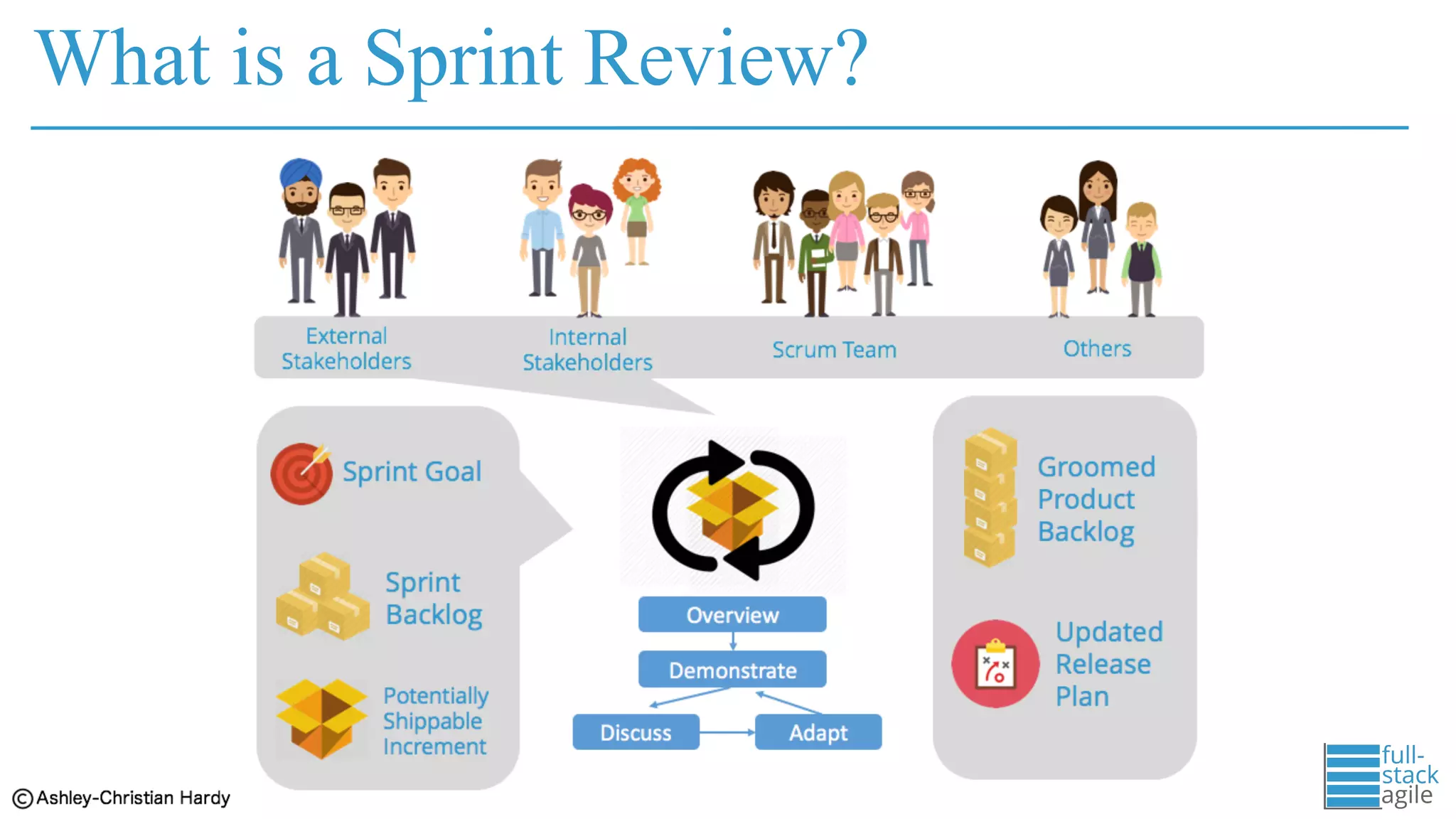
What is a Sprint Review?
Common Problems with Sprint Review
• It’s	the	first	time	the	Product	Owner	sees	the	use	stories
• Using	the	meeting	as	a	demo	only
• Only	user	stories	that	are	finished	are	demoed
• Its	only	used	as	a	meeting	to	see	what	work	has	been	completed
• All	user	stories	are	demoed
• The	overall	project	or	release	plan	is	not	discussed
• Its	made	mandatory	for	everyone
• The	team	only	demos	to	the	Product	Owner
• The	sprint	backlog	is	not	up	to	date
• Scrum	Master	leads	the	meeting	or	has	too	much	control
• The	product	owner	is	not	the	decision	maker
• Becomes	boring	and	mundane
• Confusing	the	Review	with	the	Retrospective,	or	the	meetings	are	merged.
• Stakeholders	expect	work	that	wasn’t	planned
• Estimates	are	considered	as	committed	time	frames
• Used	as	an	excuse	to	point	the	finger	or	blame
• Product	owner	does	not	care	about	the	product.
• The	product	owner	may	not	actually	care	about	the	product,	maybe	he	was	assigned	because	of	his	knowledge	or	they	are	a	
middle	man	for	an	actual	stakeholder.
Prerequisites for Effective Sprint Review
Understand	the	purpose	of	it	and	what	benefits	it	brings.	
Preparation	is	key	for	this	meeting.
Everyone	should	know	what	the	definition	of	done	is!	
Each sprint	review	will be	different,	with	different	stakeholders	and	different	
decisions	to	make,	make	sure	you	tailor	your	meetings	for	this. Have	an	agenda;	the	
meeting	should	be	quite	structured.
The	Scrum	Master	should	send	out	material	before	the	meeting,	information	on	the	
sprint,	how	it	went	and	some	facts	and	figures	to	that	everyone	is	on	the	same	page.
The	meeting	requires	a	good	facilitator,	and	the	Scrum	Master	needs	to	ensure	the	
meeting	stays	on	track	and	resolves	any	conflicts.
Make	sure	the	meeting	is	not	missed.	
Try	to	make	the	meeting	fun,	this	can	help	the	general	environment	and	actually	
make	people	want	to	join	the	meeting.
Meeting Format
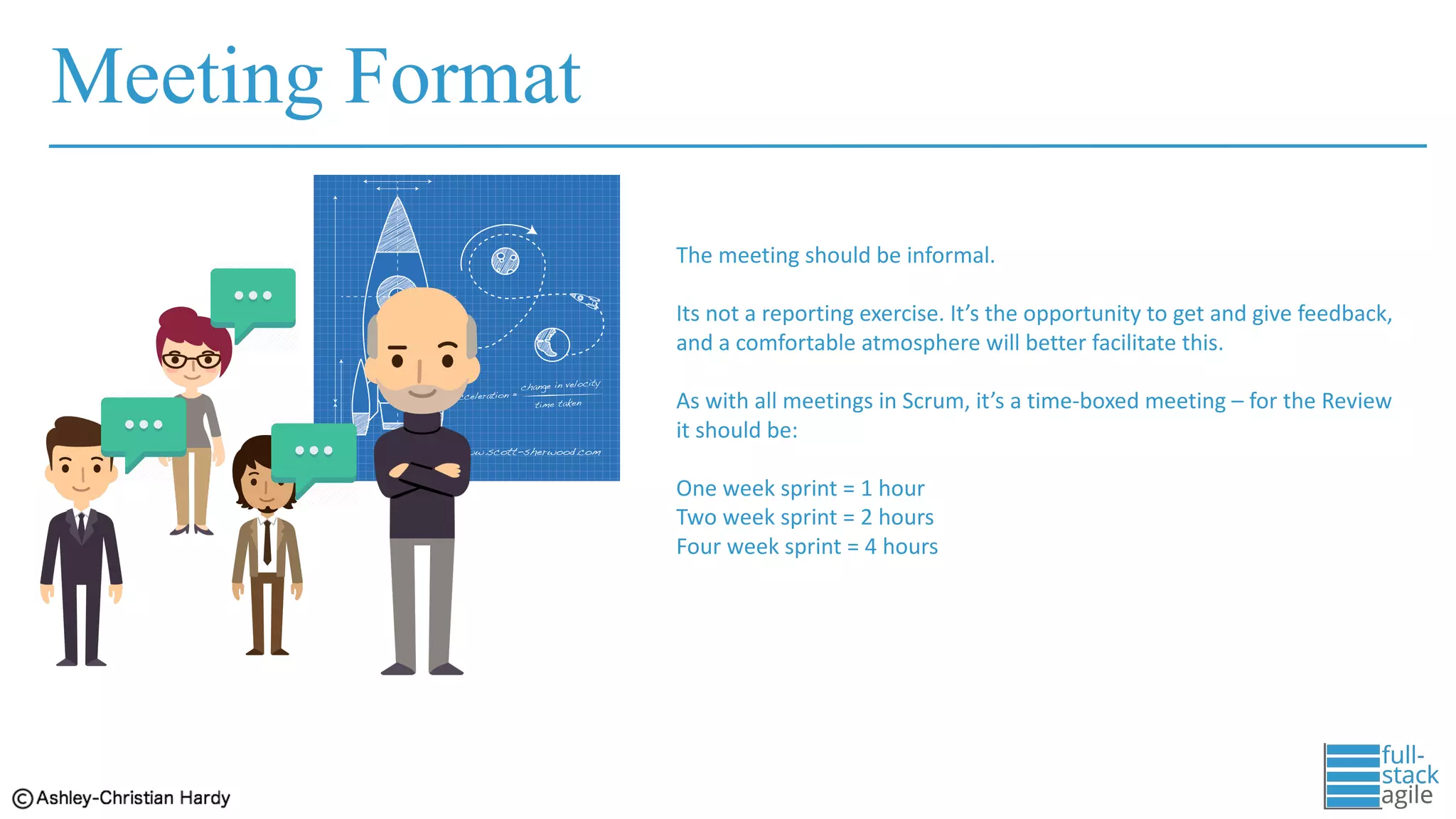
The	meeting	should	be	informal.	
Its	not	a	reporting	exercise.	It’s	the	opportunity	to	get	and	give	feedback,	
and	a	comfortable	atmosphere	will	better	facilitate	this.
As	with	all	meetings	in	Scrum,	it’s	a	time-boxed	meeting	– for	the	Review	
it	should	be:
One	week	sprint	=	1	hour
Two	week	sprint	=	2	hours
Four	week	sprint	=	4	hours
Meeting Format
The	meeting	should	be	‘led’	by	the	Product	Owner,	out	of	the	meeting	the	Product	Owner	should	have	a	more	refined	product	
backlog	and	an	updated	release	plan.	
All	feedback	should	be	welcome,	and	the	product	owner	should	try	and	get	out	as	much	as	possible	from	the	stakeholders.	
This	meeting	should	not	be	used	as	the	only	point	a	Product	Owner	sees	the	user	stories.	
The	team	should	not	only	demo	fully	working	or	complete	user	stories,	the	aim	is	to	get	feedback	– I	think	demoing	should	actually	
be	at	the	discretion	of	the	Product	Owner.	
The	meeting	should	be	engaging	and	valuable,	and	there	is	nothing	worse	than	stakeholders	not	engaged	or	motivated,	reviewing
user	stories	that	have	no	or	little	interest	for	them.	
The	product	owner	should	have	full	authority	over	the	product,	what	is	required	and	what	needs	to	be	done.	If	stakeholders	are	
invited	to	the	meeting	that	actually	make	the	decisions	(and	not	influence	them),	then	the	product	owner	role	becomes	redundant.
Meeting Format
This	meeting	should	not	be	used	as	the	only	point	a	Product	Owner	sees	the	user	stories.	
Remember,	Agile	is	about	collaboration,	and	the	PO	should	be	working	with	the	development	team	to	clarify	and	work	on	the	
product.	If	this	is	the	first	time	the	PO	is	seeing	a	user	story,	much	more	is	broken	than	your	Sprint	Review.	
It	also	reduces	risk	and	any	in-clarity	or	problems	are	found	early	on.	
The	team	should	not	only	demo	fully	working	or	complete	user	stories,	the	aim	is	to	get	feedback	– I	think	demoing	should	actually	
be	at	the	discretion	of	the	Product	Owner.	
If	he	feels	demoing	something	will	have	value	and	help	determine	the	next	actions,	its	should	be	discussed.	If	not,	then	don’t	waste	
time.	
The	meeting	should	be	engaging	and	valuable,	and	there	is	nothing	worse	than	stakeholders	not	engaged	or	motivated,	reviewing	
user	stories	that	have	no	or	little	interest	for	them.	Keep	the	meeting	relevant,	try	taking	a	break	mid-way	through	to	keep	the focus,	
allow	excecs to	catch	up	with	some	emails.
Finally,	the	product	owner	should	have	full	authority	over	the	product,	what	is	required	and	what	needs	to	be	done.	If	stakeholders	
are	invited	to	the	meeting	that	actually	make	the	decisions	(and	not	influence	them),	then	the	product	owner	role	becomes	
redundant.
Meeting Format
The	sprint	review	is	not	an	update	meeting,	or	an	opportunity	to	review	what	work	is	
completed.	A	good	collaborative	scrum	team	should	know	the	status	of	work	completed.	
If	not,	what	are	you	doing	in	your	daily	stand	ups?
I	also	noted	in	the	common	mistakes	that	the	meeting	is	made	mandatory.	
Such	constraints	as	meeting	rooms	(size	and	availability),	peoples	schedules	or	a	number	
of	other	issues	that	may	impact	the	meeting,	and	the	first	instinct	is	always	to	postpone.	I	
generally	don’t	like	this	approach,	because	once	you	postpone	once	and	get	out	of	
routine,	it	can	be	hard	to	get	the	meeting	back	up.	
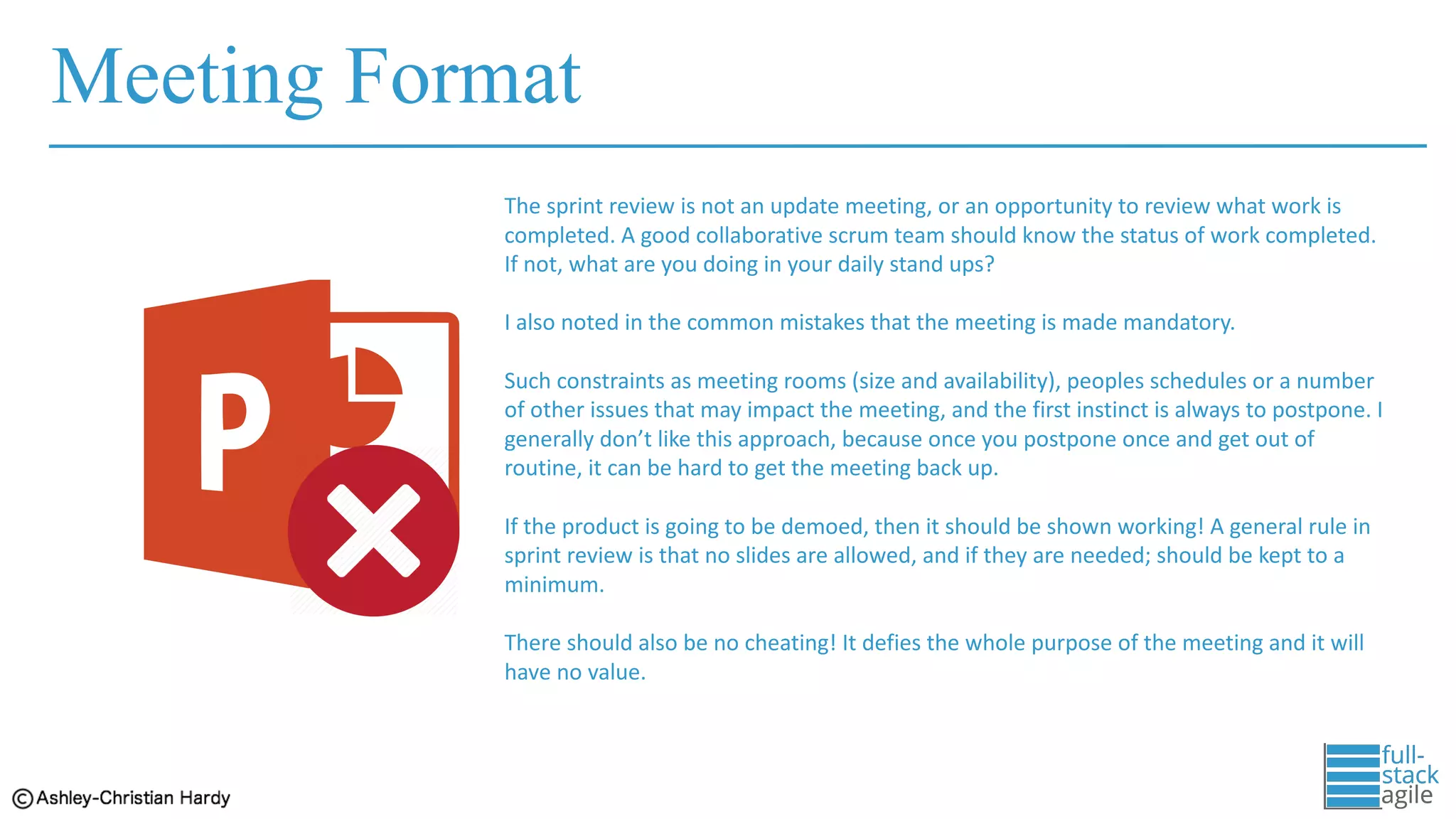
If	the	product	is	going	to	be	demoed,	then	it	should	be	shown	working!	A	general	rule	in	
sprint	review	is	that	no	slides	are	allowed,	and	if	they	are	needed;	should	be	kept	to	a	
minimum.	
There	should	also	be	no	cheating!	It	defies	the	whole	purpose	of	the	meeting	and	it	will	
have	no	value.
Meeting Format
Remember	its	important	to	show	useful	and	valuable	software,	and	also	provide	the	context,	you	can	even	role	play	as	the	user!	This	is	
great	for	use	involvement,	think	of	scenarios	and	fully	test	the	user	story.
Remember	its	not	a	Retrospectives,	so	discussion	should	not	start	to	center	around	process	improvements.	
This	method	is	about	the	WHAT,	Retrospectives	is	about	the	HOW.	
This	meeting	is	also	a	good	opportunity	to	identify	any	scope	creep,	was	anything	delivered	that	wasn’t	agreed	on	or	did	requirements
change	mid-way	through?	
My	last	point	is	regarding	the	environment;	the	atmosphere	is	very	important.	There	should	be	an	environment	of	trust.	The	team	
should	have	the	confidence	to	say	when	things	are	not	finished.	
Teams	might	see	this	as	a	failure	and	it	could	reduce	moral	and	leave	them	feeling	exposed.	This	should	not	be	the	case	as	you	will
quickly	find	that	your	products	quality	will	reduce	and	the	technical	debt	will	increase.
Ending the Meeting
I	think	its	super	important	that	the	overall	project	is	discussed,	and	
what	to	do	next.	
The	remaining	backlog	should	be	reviewed	and	discussed,	what’s	
missing	and	what	needs	to	be	adapted.
Some	teams	use	their	burn	down	or	burn	up	charts,	or	whatever	
project	status	recording	method utilized,	its	good	practice	and	allows	
the	
Product	Owner	to	make	more	informed	decisions	on	what	to	do	next.	
Review	the	product	backlog	and	even	let	the	stakeholders	give	their	
insights.
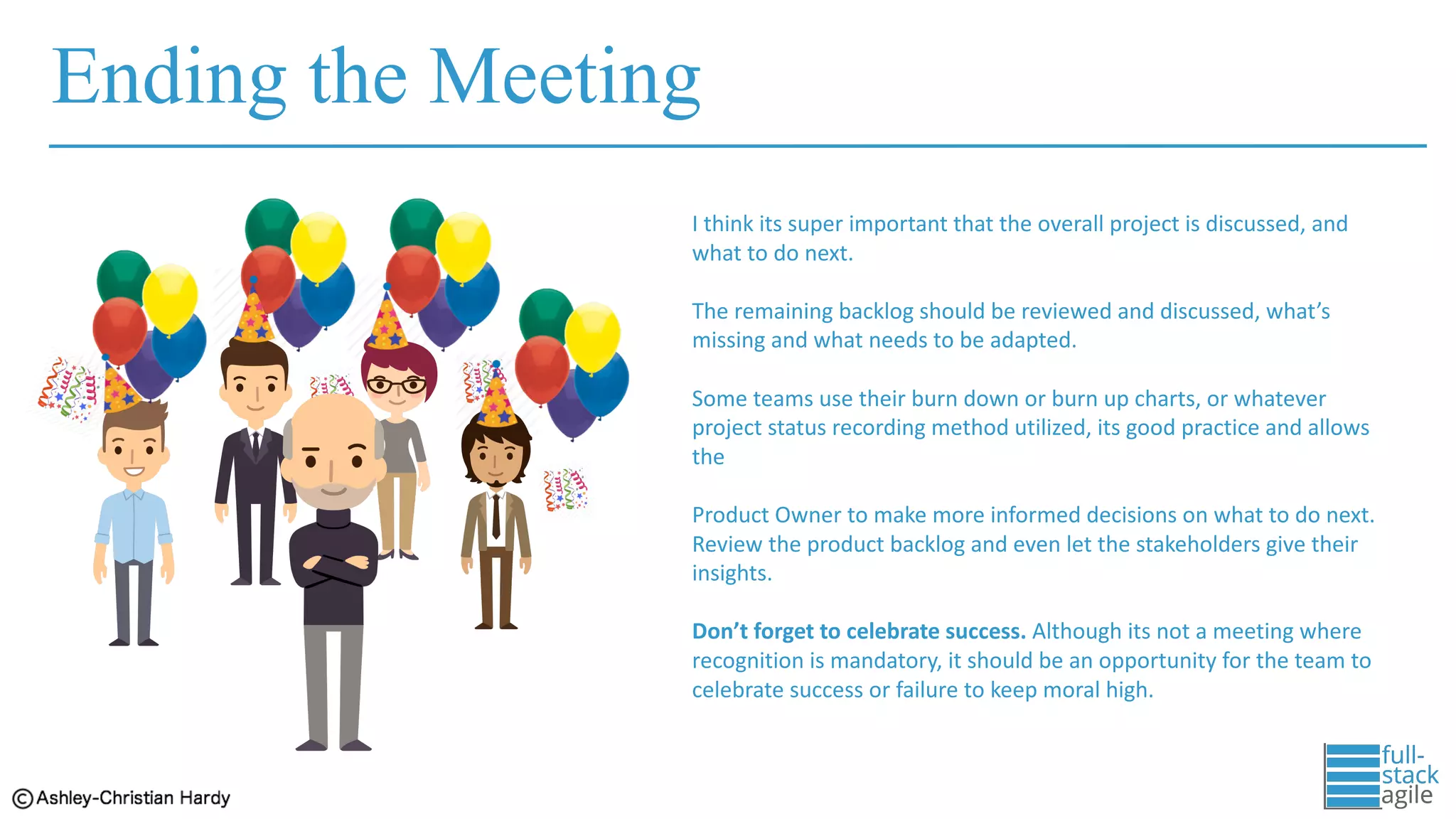
Don’t	forget	to	celebrate	success.	Although	its	not	a	meeting	where	
recognition	is	mandatory,	it	should	be	an	opportunity	for	the	team	to	
celebrate	success	or	failure	to	keep	moral	high.
Summary
In	summary,	the	clear	benefits	for	a	good	Sprint	Review	are:
• The	stakeholders	are	engaged	and	feedback	is	more	likely	to	be	valuable
• It’s	a	great	team	building	exercise	if	done	right,	and	can	improve	culture.
• It	puts	the	focus	on	quality
• Its	great	for	helping	people	learn	and	can	develop	some	skillsets.
“Remember,	the	meeting	is	about	the	Product,	not	the	people	
or	the	process.”
Thank you!
Full-stackagile.com
achardy@full-stackagile.com
@achardypm
facebook.com/ fullstackagile
medium.com/@achardypm
pinterest.com/achardypm
instagram.com/achardypm
linkedin.com/in/achardypm
slideshare.net/ ashlychrstn
tumblr.com/ blog/achardypm
https://plus.google.com/ achardypm

Full-Stack Agile - The Sprint Review (Scrum)