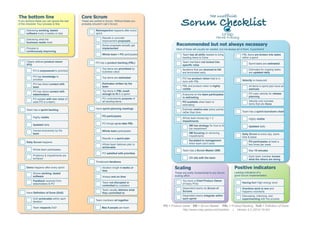
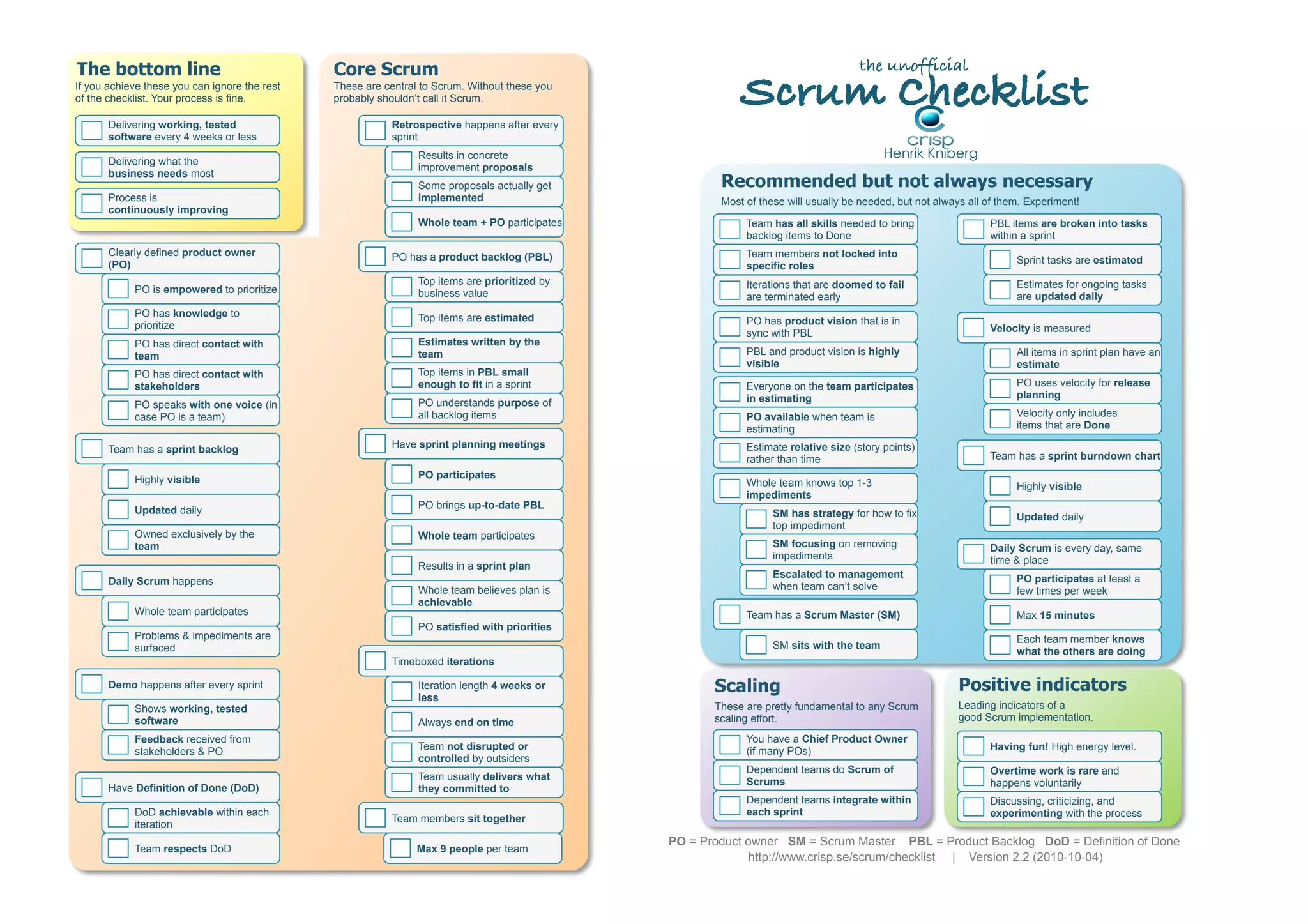
Process is
continuously improving
Have Definition of Done (DoD)
DoD achievable within each
iteration
Team respects DoD
The bottom line
Delivering working, tested
software every 4 weeks or less
Delivering what the
business needs most
Demo happens after every sprint
Shows working, tested
software
Feedback received from
stakeholders & PO
Retrospective happens after every
sprint
Results in concrete
improvement proposals
Some proposals actually get
implemented
Whole team + PO participates
Team has a sprint backlog
Highly visible
Updated daily
Owned exclusively by the
team
Have sprint planning meetings
PO participates
Whole team participates
Results in a sprint plan
Whole team believes plan is
achievable
PO satisfied with priorities
PO brings up-to-date PBL
Iteration length 4 weeks or
less
Always end on time
Team not disrupted or
controlled by outsiders
Timeboxed iterations
PO has a product backlog (PBL)
Top items are prioritized by
business value
Top items are estimated
PO understands purpose of
all backlog items
Top items in PBL small
enough to fit in a sprint
Estimates written by the
team
Clearly defined product owner
(PO)
PO is empowered to prioritize
PO has knowledge to
prioritize
PO has direct contact with
team
PO has direct contact with
stakeholders
PO speaks with one voice (in
case PO is a team)
Team members sit together
If you achieve these you can ignore the rest
of the checklist. Your process is fine.
These are central to Scrum. Without these you
probably shouldn’t call it Scrum.
Core Scrum
PO has product vision that is in
sync with PBL
PBL and product vision is highly
visible
Everyone on the team participates
in estimating
PO available when team is
estimating
Team members not locked into
specific roles
Team has all skills needed to bring
backlog items to Done
Team has a Scrum Master (SM)
Whole team knows top 1-3
impediments
SM has strategy for how to fix
top impediment
SM focusing on removing
impediments
Escalated to management
when team can’t solve
Velocity is measured
Velocity only includes
items that are Done
PO uses velocity for release
planning
Team has a sprint burndown chart
PBL items are broken into tasks
within a sprint
Estimates for ongoing tasks
are updated daily
Highly visible
Updated daily
PO participates at least a
few times per week
All items in sprint plan have an
estimate
SM sits with the team
Daily Scrum is every day, same
time & place
Sprint tasks are estimated
Estimate relative size (story points)
rather than time
Max 15 minutes
Each team member knows
what the others are doing
Most of these will usually be needed, but not always all of them. Experiment!
Recommended but not always necessary
Daily Scrum happens
Whole team participates
Problems & impediments are
surfaced
You have a Chief Product Owner
(if many POs)
Dependent teams do Scrum of
Scrums
Dependent teams integrate within
each sprint
Scaling
Having fun! High energy level.
Overtime work is rare and
happens voluntarily
Discussing, criticizing, and
experimenting with the process
Positive indicators
Scrum Checklist!
http://www.crisp.se/scrum/checklist | Version 2.2 (2010-10-04)
the unofficial!
Henrik Kniberg
PO = Product owner SM = Scrum Master PBL = Product Backlog DoD = Definition of Done
Team usually delivers what
they committed to
Leading indicators of a
good Scrum implementation.
These are pretty fundamental to any Scrum
scaling effort.
Max 9 people per team
Iterations that are doomed to fail
are terminated early
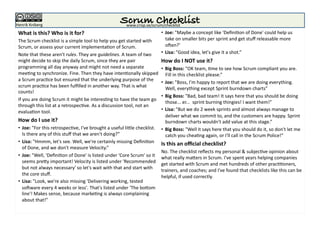
What	
  is	
  this?	
  Who	
  is	
  it	
  for?	
  
The	
  Scrum	
  checklist	
  is	
  a	
  simple	
  tool	
  to	
  help	
  you	
  get	
  started	
  with	
  
Scrum,	
  or	
  assess	
  your	
  current	
  implementa8on	
  of	
  Scrum.	
  
Note	
  that	
  these	
  aren't	
  rules.	
  They	
  are	
  guidelines.	
  A	
  team	
  of	
  two	
  
might	
  decide	
  to	
  skip	
  the	
  daily	
  Scrum,	
  since	
  they	
  are	
  pair	
  
programming	
  all	
  day	
  anyway	
  and	
  might	
  not	
  need	
  a	
  separate	
  
mee8ng	
  to	
  synchronize.	
  Fine.	
  Then	
  they	
  have	
  inten8onally	
  skipped	
  
a	
  Scrum	
  prac8ce	
  but	
  ensured	
  that	
  the	
  underlying	
  purpose	
  of	
  the	
  
scrum	
  prac8ce	
  has	
  been	
  fulfilled	
  in	
  another	
  way.	
  That	
  is	
  what	
  
counts!	
  
If	
  you	
  are	
  doing	
  Scrum	
  it	
  might	
  be	
  interes8ng	
  to	
  have	
  the	
  team	
  go	
  
through	
  this	
  list	
  at	
  a	
  retrospec8ve.	
  As	
  a	
  discussion	
  tool,	
  not	
  an	
  
evalua8on	
  tool.	
  
How	
  do	
  I	
  use	
  it?	
  
•  Joe:	
  "For	
  this	
  retrospec8ve,	
  I've	
  brought	
  a	
  useful	
  liFle	
  checklist.	
  
Is	
  there	
  any	
  of	
  this	
  stuff	
  that	
  we	
  aren't	
  doing?”	
  
•  Lisa:	
  "Hmmm,	
  let's	
  see.	
  Well,	
  we're	
  certainly	
  missing	
  Defini8on	
  
of	
  Done,	
  and	
  we	
  don't	
  measure	
  Velocity.”	
  
•  Joe:	
  "Well,	
  'Defini8on	
  of	
  Done'	
  is	
  listed	
  under	
  'Core	
  Scrum'	
  so	
  it	
  
seems	
  preFy	
  important!	
  Velocity	
  is	
  listed	
  under	
  'Recommended	
  
but	
  not	
  always	
  necessary'	
  so	
  let's	
  wait	
  with	
  that	
  and	
  start	
  with	
  
the	
  core	
  stuff.	
  
•  Lisa:	
  "Look,	
  we're	
  also	
  missing	
  'Delivering	
  working,	
  tested	
  
soQware	
  every	
  4	
  weeks	
  or	
  less'.	
  That's	
  listed	
  under	
  'The	
  boFom	
  
line'!	
  Makes	
  sense,	
  because	
  marke8ng	
  is	
  always	
  complaining	
  
about	
  that!”	
  
•  Joe:	
  "Maybe	
  a	
  concept	
  like	
  'Defini8on	
  of	
  Done'	
  could	
  help	
  us	
  
take	
  on	
  smaller	
  bits	
  per	
  sprint	
  and	
  get	
  stuff	
  releasable	
  more	
  
oQen?’	
  
•  Lisa:	
  "Good	
  idea,	
  let's	
  give	
  it	
  a	
  shot.”	
  
How	
  do	
  I	
  NOT	
  use	
  it?	
  
•  Big	
  Boss:	
  "OK	
  team,	
  8me	
  to	
  see	
  how	
  Scrum	
  compliant	
  you	
  are.	
  
Fill	
  in	
  this	
  checklist	
  please.”	
  
•  Joe:	
  "Boss,	
  I'm	
  happy	
  to	
  report	
  that	
  we	
  are	
  doing	
  everything.	
  
Well,	
  everything	
  except	
  Sprint	
  burndown	
  charts”	
  
•  Big	
  Boss:	
  "Bad,	
  bad	
  team!	
  It	
  says	
  here	
  that	
  you	
  should	
  be	
  doing	
  
those...	
  er...	
  	
  sprint	
  burning	
  thingies!	
  I	
  want	
  them!"	
  	
  
•  Lisa:	
  "But	
  we	
  do	
  2	
  week	
  sprints	
  and	
  almost	
  always	
  manage	
  to	
  
deliver	
  what	
  we	
  commit	
  to,	
  and	
  the	
  customers	
  are	
  happy.	
  Sprint	
  
burndown	
  charts	
  wouldn't	
  add	
  value	
  at	
  this	
  stage.”	
  
•  Big	
  Boss:	
  "Well	
  it	
  says	
  here	
  that	
  you	
  should	
  do	
  it,	
  so	
  don't	
  let	
  me	
  
catch	
  you	
  chea8ng	
  again,	
  or	
  I'll	
  call	
  in	
  the	
  Scrum	
  Police!”	
  
Is	
  this	
  an	
  official	
  checklist?	
  
No.	
  The	
  checklist	
  reflects	
  my	
  personal	
  &	
  subjec8ve	
  opinion	
  about	
  
what	
  really	
  maFers	
  in	
  Scrum.	
  I've	
  spent	
  years	
  helping	
  companies	
  
get	
  started	
  with	
  Scrum	
  and	
  met	
  hundreds	
  of	
  other	
  prac88oners,	
  
trainers,	
  and	
  coaches;	
  and	
  I've	
  found	
  that	
  checklists	
  like	
  this	
  can	
  be	
  
helpful,	
  if	
  used	
  correctly.	
  
Scrum Checklist!
Henrik	
  Kniberg	
   www.crisp.se/scrum/checklist	
  

Scrum checklist

  • 1.
    Process is continuously improving HaveDefinition of Done (DoD) DoD achievable within each iteration Team respects DoD The bottom line Delivering working, tested software every 4 weeks or less Delivering what the business needs most Demo happens after every sprint Shows working, tested software Feedback received from stakeholders & PO Retrospective happens after every sprint Results in concrete improvement proposals Some proposals actually get implemented Whole team + PO participates Team has a sprint backlog Highly visible Updated daily Owned exclusively by the team Have sprint planning meetings PO participates Whole team participates Results in a sprint plan Whole team believes plan is achievable PO satisfied with priorities PO brings up-to-date PBL Iteration length 4 weeks or less Always end on time Team not disrupted or controlled by outsiders Timeboxed iterations PO has a product backlog (PBL) Top items are prioritized by business value Top items are estimated PO understands purpose of all backlog items Top items in PBL small enough to fit in a sprint Estimates written by the team Clearly defined product owner (PO) PO is empowered to prioritize PO has knowledge to prioritize PO has direct contact with team PO has direct contact with stakeholders PO speaks with one voice (in case PO is a team) Team members sit together If you achieve these you can ignore the rest of the checklist. Your process is fine. These are central to Scrum. Without these you probably shouldn’t call it Scrum. Core Scrum PO has product vision that is in sync with PBL PBL and product vision is highly visible Everyone on the team participates in estimating PO available when team is estimating Team members not locked into specific roles Team has all skills needed to bring backlog items to Done Team has a Scrum Master (SM) Whole team knows top 1-3 impediments SM has strategy for how to fix top impediment SM focusing on removing impediments Escalated to management when team can’t solve Velocity is measured Velocity only includes items that are Done PO uses velocity for release planning Team has a sprint burndown chart PBL items are broken into tasks within a sprint Estimates for ongoing tasks are updated daily Highly visible Updated daily PO participates at least a few times per week All items in sprint plan have an estimate SM sits with the team Daily Scrum is every day, same time & place Sprint tasks are estimated Estimate relative size (story points) rather than time Max 15 minutes Each team member knows what the others are doing Most of these will usually be needed, but not always all of them. Experiment! Recommended but not always necessary Daily Scrum happens Whole team participates Problems & impediments are surfaced You have a Chief Product Owner (if many POs) Dependent teams do Scrum of Scrums Dependent teams integrate within each sprint Scaling Having fun! High energy level. Overtime work is rare and happens voluntarily Discussing, criticizing, and experimenting with the process Positive indicators Scrum Checklist! http://www.crisp.se/scrum/checklist | Version 2.2 (2010-10-04) the unofficial! Henrik Kniberg PO = Product owner SM = Scrum Master PBL = Product Backlog DoD = Definition of Done Team usually delivers what they committed to Leading indicators of a good Scrum implementation. These are pretty fundamental to any Scrum scaling effort. Max 9 people per team Iterations that are doomed to fail are terminated early
  • 2.
    What  is  this?  Who  is  it  for?   The  Scrum  checklist  is  a  simple  tool  to  help  you  get  started  with   Scrum,  or  assess  your  current  implementa8on  of  Scrum.   Note  that  these  aren't  rules.  They  are  guidelines.  A  team  of  two   might  decide  to  skip  the  daily  Scrum,  since  they  are  pair   programming  all  day  anyway  and  might  not  need  a  separate   mee8ng  to  synchronize.  Fine.  Then  they  have  inten8onally  skipped   a  Scrum  prac8ce  but  ensured  that  the  underlying  purpose  of  the   scrum  prac8ce  has  been  fulfilled  in  another  way.  That  is  what   counts!   If  you  are  doing  Scrum  it  might  be  interes8ng  to  have  the  team  go   through  this  list  at  a  retrospec8ve.  As  a  discussion  tool,  not  an   evalua8on  tool.   How  do  I  use  it?   •  Joe:  "For  this  retrospec8ve,  I've  brought  a  useful  liFle  checklist.   Is  there  any  of  this  stuff  that  we  aren't  doing?”   •  Lisa:  "Hmmm,  let's  see.  Well,  we're  certainly  missing  Defini8on   of  Done,  and  we  don't  measure  Velocity.”   •  Joe:  "Well,  'Defini8on  of  Done'  is  listed  under  'Core  Scrum'  so  it   seems  preFy  important!  Velocity  is  listed  under  'Recommended   but  not  always  necessary'  so  let's  wait  with  that  and  start  with   the  core  stuff.   •  Lisa:  "Look,  we're  also  missing  'Delivering  working,  tested   soQware  every  4  weeks  or  less'.  That's  listed  under  'The  boFom   line'!  Makes  sense,  because  marke8ng  is  always  complaining   about  that!”   •  Joe:  "Maybe  a  concept  like  'Defini8on  of  Done'  could  help  us   take  on  smaller  bits  per  sprint  and  get  stuff  releasable  more   oQen?’   •  Lisa:  "Good  idea,  let's  give  it  a  shot.”   How  do  I  NOT  use  it?   •  Big  Boss:  "OK  team,  8me  to  see  how  Scrum  compliant  you  are.   Fill  in  this  checklist  please.”   •  Joe:  "Boss,  I'm  happy  to  report  that  we  are  doing  everything.   Well,  everything  except  Sprint  burndown  charts”   •  Big  Boss:  "Bad,  bad  team!  It  says  here  that  you  should  be  doing   those...  er...    sprint  burning  thingies!  I  want  them!"     •  Lisa:  "But  we  do  2  week  sprints  and  almost  always  manage  to   deliver  what  we  commit  to,  and  the  customers  are  happy.  Sprint   burndown  charts  wouldn't  add  value  at  this  stage.”   •  Big  Boss:  "Well  it  says  here  that  you  should  do  it,  so  don't  let  me   catch  you  chea8ng  again,  or  I'll  call  in  the  Scrum  Police!”   Is  this  an  official  checklist?   No.  The  checklist  reflects  my  personal  &  subjec8ve  opinion  about   what  really  maFers  in  Scrum.  I've  spent  years  helping  companies   get  started  with  Scrum  and  met  hundreds  of  other  prac88oners,   trainers,  and  coaches;  and  I've  found  that  checklists  like  this  can  be   helpful,  if  used  correctly.   Scrum Checklist! Henrik  Kniberg   www.crisp.se/scrum/checklist