Scratchpads
The virtual research environment
for biodiversity data

Simon Rycroft, Dave Roberts, Vince Smith, Alice Heaton, Katherine Bouton,
Laurence Livermore, Dimitris Koureas, Ed Baker

Natural History Museum, London
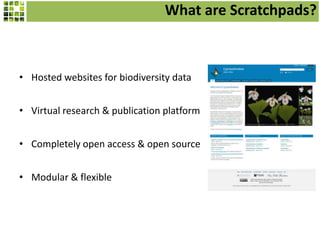
What are Scratchpads?

• Hosted websites for biodiversity data
• Virtual research & publication platform
• Completely open access & open source
• Modular & flexible
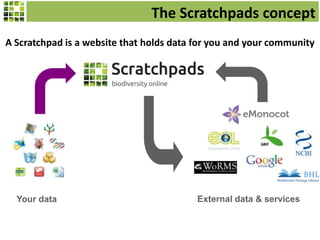
The Scratchpads concept
A Scratchpad is a website that holds data for you and your community

Your data

External data & services
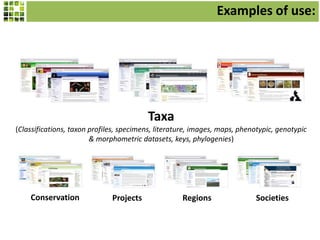
Examples of use:

Taxa
(Classifications, taxon profiles, specimens, literature, images, maps, phenotypic, genotypic
& morphometric datasets, keys, phylogenies)

Conservation

Projects

Regions

Societies
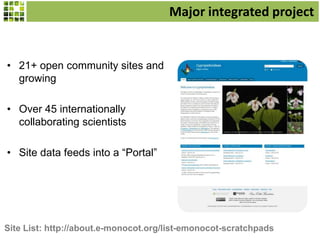
Major integrated project

• 21+ open community sites and
growing
• Over 45 internationally
collaborating scientists

• Site data feeds into a “Portal”

Site List: http://about.e-monocot.org/list-emonocot-scratchpads
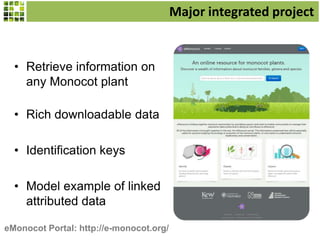
Major integrated project

• Retrieve information on
any Monocot plant
• Rich downloadable data

• Identification keys
• Model example of linked
attributed data
eMonocot Portal: http://e-monocot.org/
The main features
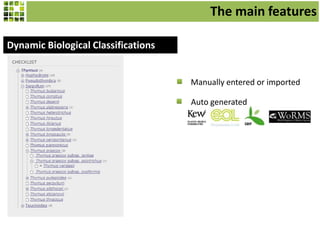
Dynamic Biological Classifications

Manually entered or imported

Auto generated
The main features
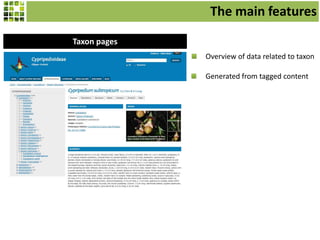
Taxon pages
Overview of data related to taxon

Generated from tagged content
The main features
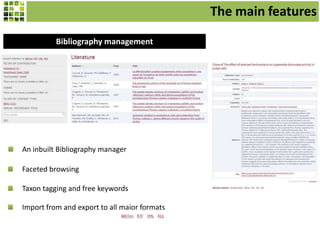
Bibliography management

An inbuilt Bibliography manager

Faceted browsing
Taxon tagging and free keywords
Import from and export to all major formats
The main features
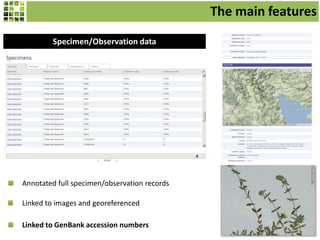
Specimen/Observation data

Annotated full specimen/observation records
Linked to images and georeferenced
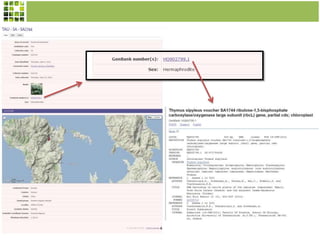
Linked to GenBank accession numbers
The main features
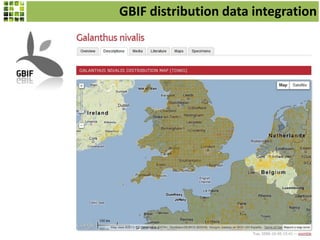
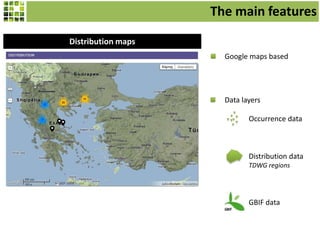
Distribution maps
Google maps based

Data layers
Occurrence data

Distribution data
TDWG regions

GBIF data
The main features

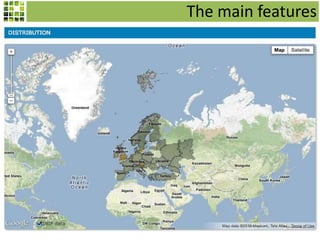
Example regional distribution
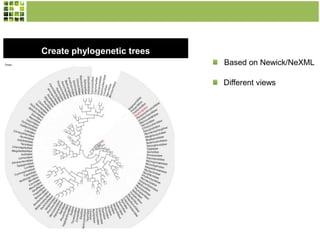
Create phylogenetic trees
Based on Newick/NeXML
Different views
The main features
Character matrices – Key construction

Quantitative or qualitative characters
Auto generation of keys
Taxon based matrices
[Specimens based character matrices]
The main features
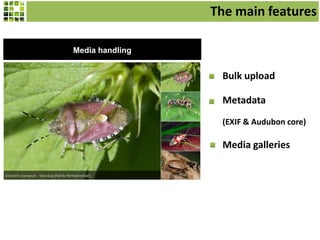
Media handling

Bulk upload
Metadata
(EXIF & Audubon core)

Media galleries
The main features
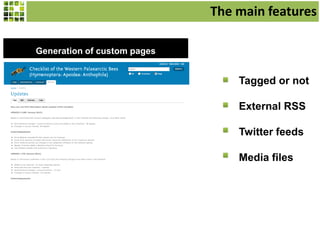
Generation of custom pages

Tagged or not
External RSS
Twitter feeds
Media files
The main features
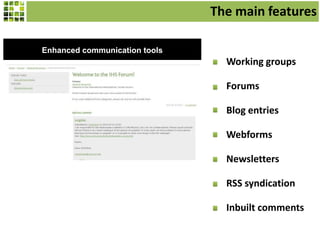
Enhanced communication tools

Working groups

Forums
Blog entries
Webforms
Newsletters
RSS syndication
Inbuilt comments
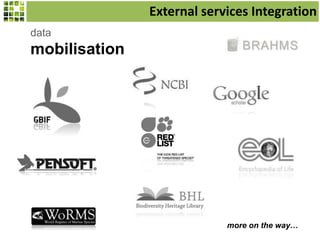
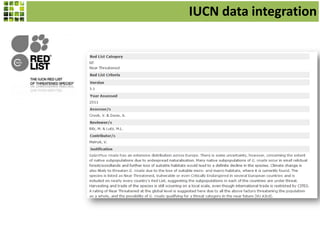
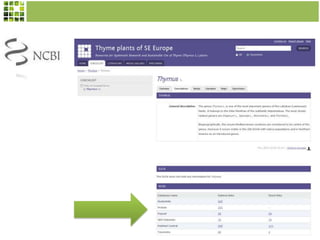
External services Integration
data

mobilisation

more on the way…
IUCN data integration
GBIF distribution data integration
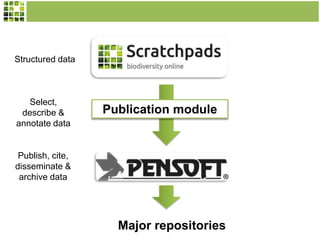
Structured data

Select,
describe &
annotate data

Publication module

Publish, cite,
disseminate &
archive data

Major repositories
Scratchpads Publication Module
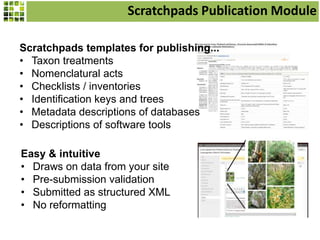
Scratchpads templates for publishing...
• Taxon treatments
• Nomenclatural acts
• Checklists / inventories
• Identification keys and trees
• Metadata descriptions of databases
• Descriptions of software tools
Easy & intuitive
• Draws on data from your site
• Pre-submission validation
• Submitted as structured XML
• No reformatting
Are Scratchpads sustainable?

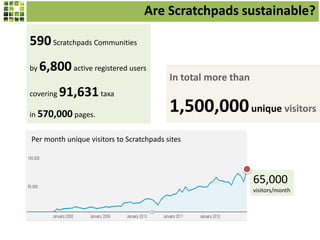
590 Scratchpads Communities
by

6,800 active registered users

covering

91,631 taxa

in 570,000 pages.

In total more than

1,500,000 unique visitors

Per month unique visitors to Scratchpads sites

65,000
visitors/month
Are Scratchpads sustainable?

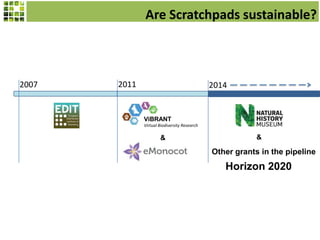
2007

2011

2014

ViBRANT
Virtual Biodiversity Research

&

&

Other grants in the pipeline

Horizon 2020
About
scratchpads.eu
Code
git.scratchpads.eu
Try
sandbox.scratchpads.eu

Scratchpads: the Virtual Research Environment for biodiversity data

Editor's Notes

  • #6 In the project there are more than 21 eMonocot Scratchpads which have over 45 international collaborating scientists.The eMonocot Scratchpads cover over 15 families with more planned with additional workshops which will take place this year at Monocots V in New York.The Scratchpad to eMonocot Portal link is now active and available for the public to browse all the Scratchpad data combined with other external monocot resources.
  • #7 All of the information is brought together in the eMonocot portal. The information presented here will be especially useful for anyone studying the ecology or evolution of the monocot plants, or who wants to understand monocot biodiversity and conservation.The portal provides taxon descriptions, distribution maps, taxonomies and keys, all of which are downloadable and attributed to the author and contributing site.
  • #9 Intuitive professional looking layout.Easy to compile taxon pages without any knowledge of web design.Taxonomy provides the crucial backbone, linking content together and is easily updateable.On this page you can see the classification browser in the side bar, detailed nomenclatural information, images and a diagnostic summary.
  • #24 The Scratchpad Publication Module fixes that by allowing you to select your structured data, describe it an annotate in an easy-to-use manuscript template and submit this to Pensoft Publishers for formal publication online as a peer-reviewed article.Your paper is then citable, widely disseminated to major services and data aggregators and all the data archived.
  • #25 The Scratchpads Publication Module