Scratch
Intuitive and Accessible Programming
What is Scratch?
What is Scratch?
Visual Programming Language
“Lets users create programs by
manipulating program elements
graphically rather than by specifying
them textually” - Wikipedia
What is Scratch?
“Three core design principles
for Scratch:
Make it more tinkerable, more
meaningful, and more social
than other programming
environments.”
- Mitchel Resnick et al.
What is Scratch?
 Developed at MIT by the
Lifelong Kindergarten Group,
led by Professor Mitchel Resnick
 First released 2002
 Website launched 2007
 Scratch 2.0 released 2013
What is Scratch?
 Designed for ages 8-16
 Most users are preteens and teens, but
user age ranges from 4 to 80
 Open source, free to use
 Can be used online or downloaded locally
 Available in more than 150 countries and
more than 40 languages
 South Sudan and Antarctica are the only
countries with no users
Technical Requirements for Scratch 2.0
 Mac, Linux, or Windows computer
 Adobe Flash Player (recent version)
 One of the latest two versions of
Chrome, Firefox, Safari, Edge, or
Internet Explorer 10+
 Otherwise, Scratch 1.4 can be
downloaded and used locally
How does
it work?
How does
it work?
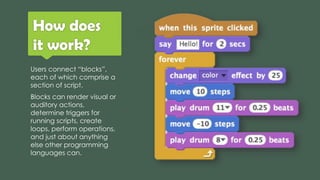
Users connect “blocks”,
each of which comprise a
section of script.
Blocks can render visual or
auditory actions,
determine triggers for
running scripts, create
loops, perform operations,
and just about anything
else other programming
languages can.
How does
it work?
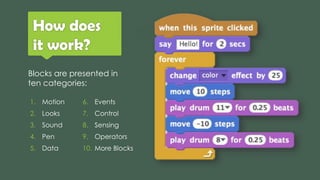
1. Motion
2. Looks
3. Sound
4. Pen
5. Data
6. Events
7. Control
8. Sensing
9. Operators
10. More Blocks
Blocks are presented in
ten categories:
How does
it work?
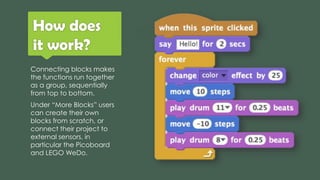
Connecting blocks makes
the functions run together
as a group, sequentially
from top to bottom.
Under “More Blocks” users
can create their own
blocks from scratch, or
connect their project to
external sensors, in
particular the Picoboard
and LEGO WeDo.
How does
it work?
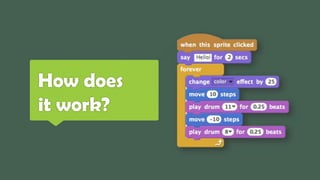
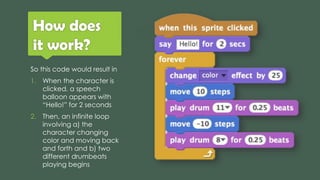
So this code would result in
1. When the character is
clicked, a speech
balloon appears with
“Hello!” for 2 seconds
2. Then, an infinite loop
involving a) the
character changing
color and moving back
and forth and b) two
different drumbeats
playing begins
What can
it make?
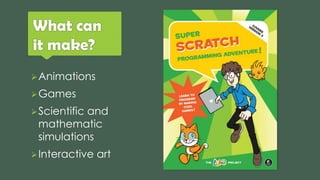
Animations
Games
Scientific and
mathematic
simulations
Interactive art
What can
it make?
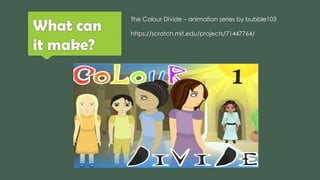
The Colour Divide – animation series by bubble103
https://scratch.mit.edu/projects/71447764/
What can
it make?
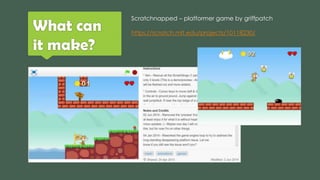
Scratchnapped – platformer game by griffpatch
https://scratch.mit.edu/projects/10118230/
Reception
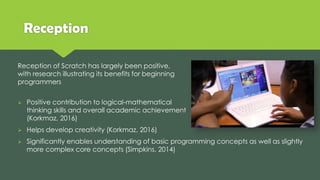
Reception of Scratch has largely been positive,
with research illustrating its benefits for beginning
programmers
 Positive contribution to logical-mathematical
thinking skills and overall academic achievement
(Korkmaz, 2016)
 Helps develop creativity (Korkmaz, 2016)
 Significantly enables understanding of basic programming concepts as well as slightly
more complex core concepts (Simpkins, 2014)
Reception
Reception of Scratch has largely been positive,
with research illustrating its benefits for beginning
programmers
 “Kelleher and Pausch [7] […] noted how systems can
make programming more accessible for novices
“by simplifying the mechanics of programming, by
providing support for learners, and by providing
students with motivation to learn to program” (p. 131).
We think that Scratch addresses all three of these
areas.” (Maloney et al., 2008)
 “Importantly, students report that they consider the transferability of the programming skills
they have learnt in a blocks environment to a traditional textual language as very
straightforward” (Simpkins, 2014)
Criticism & Controversy
The major criticisms of Scratch include
 Ultimately limiting in its programming capabilities
(Simpkins, 2014)
 However, Scratch is only intended as an introductory tool
 Technical requirements potentially exclude large
portions of people globally who do not have access
to the latest hardware and software
 Most users are in the US, UK, Australia, and Canada
Criticism & Controversy
Controversy with Apple (Chen, 2010)
 In 2010, Apple removed the Scratch app from iTunes
 “No interpreted code may be downloaded or used in
an Application except for code that is interpreted and
run by Apple’s Documented APIs and built-in
interpreter(s)” – developer agreement, clause 3.3.2
 “Scratch doesn’t seem like the sort of thing that one
could use to build software that’s even vaguely of the
caliber of native iPhone apps” - John Gruber
 The Scratch app has since returned to the App Store
Conclusions
Free, open source, and intuitive, Scratch
provides a much-needed first step into
programming concepts for beginners.
Scratch’s use in programming education, from
elementary school to universities to individuals
in their home, is a testament to its
effectiveness.
With over 15 million registered users, and
numbers of daily users and daily projects
posted at their peaks and rising, Scratch does
not show signs of slowing down.
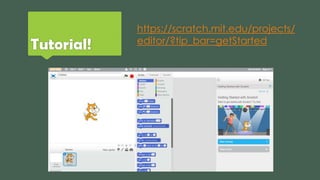
Tutorial!
https://scratch.mit.edu/projects/
editor/?tip_bar=getStarted
References &
Further Reading
Chen, B. X. (2010, April 20). Apple Rejects Kid-Friendly Programming App. Retrieved December 3, 2016,
from https://www.wired.com/2010/04/apple-scratch-app/
Harvard Graduate School of Education. (n.d.). [Scratch blocks]. Retrieved December 1, 2016, from
http://scratched.gse.harvard.edu/guide/Video
Korkmaz, Ö. (2016, October). The Effect of Scratch- and Lego Mindstorms Ev3-Based Programming
Activities on Academic Achievement, Problem-Solving Skills and Logical-Mathematical Thinking Skills of
Students. Malaysian Online Journal of Educational Sciences, 4(3), 73-88.
The LEAD Project. (2016). [Super Scratch Programming Adventure]. Retrieved December 3, 2016, from
https://www.nostarch.com/scratch
Lifelong Kindergarten Group. (n.d.). Scratch - Imagine, Program, Share. Retrieved November 29, 2016,
from https://scratch.mit.edu/
Lifelong Kindergarten Group. (n.d.). Scratch - Imagine, Program, Share. Retrieved December 3, 2016, from
https://scratch.mit.edu/statistics/
References &
Further Reading
Maloney, J. H., et al. (2008, March). Programming by choice: Urban youth learning
programming with Scratch. ACM SIGCSE Bulletin. doi:10.1145/1352322.1352260
Resnick, M., et al. (2009, November). Scratch: Programming for all. Communications of the
ACM, 52(11), 60-67. doi:10.1145/1592761.1592779
[Scratch logo and cat]. (2016). Retrieved December 1, 2016, from
http://www.romansrobots.com/courses/
Simpkins, N. K. (2014, July-September). I Scratch and Sense But Can I Program? International
Journal of Information and Communication Technology Education, 10(3), 87-116.
doi:10.4018/ijicte.2014070107
Visual programming language. (2016, November 2). Retrieved November 29, 2016, from
https://en.wikipedia.org/wiki/Visual_programming_language

Scratch - Intuitive and Accessible Programming

  • 1.
  • 2.
  • 3.
    What is Scratch? VisualProgramming Language “Lets users create programs by manipulating program elements graphically rather than by specifying them textually” - Wikipedia
  • 4.
    What is Scratch? “Threecore design principles for Scratch: Make it more tinkerable, more meaningful, and more social than other programming environments.” - Mitchel Resnick et al.
  • 5.
    What is Scratch? Developed at MIT by the Lifelong Kindergarten Group, led by Professor Mitchel Resnick  First released 2002  Website launched 2007  Scratch 2.0 released 2013
  • 6.
    What is Scratch? Designed for ages 8-16  Most users are preteens and teens, but user age ranges from 4 to 80  Open source, free to use  Can be used online or downloaded locally  Available in more than 150 countries and more than 40 languages  South Sudan and Antarctica are the only countries with no users
  • 7.
    Technical Requirements forScratch 2.0  Mac, Linux, or Windows computer  Adobe Flash Player (recent version)  One of the latest two versions of Chrome, Firefox, Safari, Edge, or Internet Explorer 10+  Otherwise, Scratch 1.4 can be downloaded and used locally
  • 8.
  • 9.
    How does it work? Usersconnect “blocks”, each of which comprise a section of script. Blocks can render visual or auditory actions, determine triggers for running scripts, create loops, perform operations, and just about anything else other programming languages can.
  • 10.
    How does it work? 1.Motion 2. Looks 3. Sound 4. Pen 5. Data 6. Events 7. Control 8. Sensing 9. Operators 10. More Blocks Blocks are presented in ten categories:
  • 11.
    How does it work? Connectingblocks makes the functions run together as a group, sequentially from top to bottom. Under “More Blocks” users can create their own blocks from scratch, or connect their project to external sensors, in particular the Picoboard and LEGO WeDo.
  • 12.
    How does it work? Sothis code would result in 1. When the character is clicked, a speech balloon appears with “Hello!” for 2 seconds 2. Then, an infinite loop involving a) the character changing color and moving back and forth and b) two different drumbeats playing begins
  • 13.
    What can it make? Animations Games Scientificand mathematic simulations Interactive art
  • 14.
    What can it make? TheColour Divide – animation series by bubble103 https://scratch.mit.edu/projects/71447764/
  • 15.
    What can it make? Scratchnapped– platformer game by griffpatch https://scratch.mit.edu/projects/10118230/
  • 16.
    Reception Reception of Scratchhas largely been positive, with research illustrating its benefits for beginning programmers  Positive contribution to logical-mathematical thinking skills and overall academic achievement (Korkmaz, 2016)  Helps develop creativity (Korkmaz, 2016)  Significantly enables understanding of basic programming concepts as well as slightly more complex core concepts (Simpkins, 2014)
  • 17.
    Reception Reception of Scratchhas largely been positive, with research illustrating its benefits for beginning programmers  “Kelleher and Pausch [7] […] noted how systems can make programming more accessible for novices “by simplifying the mechanics of programming, by providing support for learners, and by providing students with motivation to learn to program” (p. 131). We think that Scratch addresses all three of these areas.” (Maloney et al., 2008)  “Importantly, students report that they consider the transferability of the programming skills they have learnt in a blocks environment to a traditional textual language as very straightforward” (Simpkins, 2014)
  • 18.
    Criticism & Controversy Themajor criticisms of Scratch include  Ultimately limiting in its programming capabilities (Simpkins, 2014)  However, Scratch is only intended as an introductory tool  Technical requirements potentially exclude large portions of people globally who do not have access to the latest hardware and software  Most users are in the US, UK, Australia, and Canada
  • 19.
    Criticism & Controversy Controversywith Apple (Chen, 2010)  In 2010, Apple removed the Scratch app from iTunes  “No interpreted code may be downloaded or used in an Application except for code that is interpreted and run by Apple’s Documented APIs and built-in interpreter(s)” – developer agreement, clause 3.3.2  “Scratch doesn’t seem like the sort of thing that one could use to build software that’s even vaguely of the caliber of native iPhone apps” - John Gruber  The Scratch app has since returned to the App Store
  • 20.
    Conclusions Free, open source,and intuitive, Scratch provides a much-needed first step into programming concepts for beginners. Scratch’s use in programming education, from elementary school to universities to individuals in their home, is a testament to its effectiveness. With over 15 million registered users, and numbers of daily users and daily projects posted at their peaks and rising, Scratch does not show signs of slowing down.
  • 21.
  • 22.
    References & Further Reading Chen,B. X. (2010, April 20). Apple Rejects Kid-Friendly Programming App. Retrieved December 3, 2016, from https://www.wired.com/2010/04/apple-scratch-app/ Harvard Graduate School of Education. (n.d.). [Scratch blocks]. Retrieved December 1, 2016, from http://scratched.gse.harvard.edu/guide/Video Korkmaz, Ö. (2016, October). The Effect of Scratch- and Lego Mindstorms Ev3-Based Programming Activities on Academic Achievement, Problem-Solving Skills and Logical-Mathematical Thinking Skills of Students. Malaysian Online Journal of Educational Sciences, 4(3), 73-88. The LEAD Project. (2016). [Super Scratch Programming Adventure]. Retrieved December 3, 2016, from https://www.nostarch.com/scratch Lifelong Kindergarten Group. (n.d.). Scratch - Imagine, Program, Share. Retrieved November 29, 2016, from https://scratch.mit.edu/ Lifelong Kindergarten Group. (n.d.). Scratch - Imagine, Program, Share. Retrieved December 3, 2016, from https://scratch.mit.edu/statistics/
  • 23.
    References & Further Reading Maloney,J. H., et al. (2008, March). Programming by choice: Urban youth learning programming with Scratch. ACM SIGCSE Bulletin. doi:10.1145/1352322.1352260 Resnick, M., et al. (2009, November). Scratch: Programming for all. Communications of the ACM, 52(11), 60-67. doi:10.1145/1592761.1592779 [Scratch logo and cat]. (2016). Retrieved December 1, 2016, from http://www.romansrobots.com/courses/ Simpkins, N. K. (2014, July-September). I Scratch and Sense But Can I Program? International Journal of Information and Communication Technology Education, 10(3), 87-116. doi:10.4018/ijicte.2014070107 Visual programming language. (2016, November 2). Retrieved November 29, 2016, from https://en.wikipedia.org/wiki/Visual_programming_language