A guide to -
Scientific Writing in
the Biological
Sciences
By Nusrat Malik, Ph.D.
What is Scientific Writing
❖ The purpose of scientific writing is to inform its readers about scientific discoveries
revealed during the research project you carried out.
❖ Present the discoveries in a clear, concise and understandable manner.
❖ Convince the audience of the validity and importance of research being reported.
❖ Types of scientific writing formats.
❖ Conference abstract
❖ Dissertation
❖ Research paper.
❖ Research review.
❖ Research report.
❖ Grant application
What is not Scientific Writing
❖ A piece of fiction.
❖ An entertainment piece.
❖ A memoir.
Components of a Research
Paper
❖ Abstract
❖ Introduction
❖ Materials and Methods
❖ Results
❖ Discussion
❖ Bibliography
Components of a Research Paper-
Abstract
❖ Summary of the entire paper.
❖ Why the research was done, the main question
asked, how it was answered, what were the main
findings and a brief conclusion.
❖ Ideally written at the end.
Components of a Research Paper-
Introduction
❖ A brief background of what others have done before in the
field.
❖ What new question is being asked and how it will be
answered.
❖ The importance of the research being presented.
❖ The hypothesis.
❖ The experimental design.
❖ Use present tense.
Components of a Research Paper-Materials
and Methods
❖ Detailed description of how each experiment was carried out.
❖ Detailed information about the materials (Chemical supplier)
and equipment (Manufacturer) used.
❖ Should have enough information about the experimental
method so that the experiment can be replicated by another
researcher in another laboratory.
❖ Statistical methods used to analyse the data.
❖ Use past tense (the experiments have already been
performed).
Components of a Research Paper-
Results
❖ Present the results in a logical order.
❖ Results of each experiment (or related experiments) in a separate paragraph.
❖ Briefly describing the experiment, state the results obtained (commonly done
without interpretation).
❖ Note key points of the results (increase or decrease in the expression of a
particular protein).
❖ Include tables and figures to show large sets of data (refer to the tables and
figures while stating results).
❖ Connect each paragraph to the one before and after so the reader understand the
reasoning of the experiment.
❖ Use past tense, usually third person.
Components of a Research Paper-
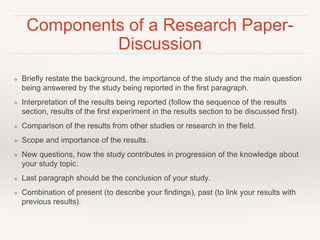
Discussion
❖ Briefly restate the background, the importance of the study and the main question
being answered by the study being reported in the first paragraph.
❖ Interpretation of the results being reported (follow the sequence of the results
section, results of the first experiment in the results section to be discussed first).
❖ Comparison of the results from other studies or research in the field.
❖ Scope and importance of the results.
❖ New questions, how the study contributes in progression of the knowledge about
your study topic.
❖ Last paragraph should be the conclusion of your study.
❖ Combination of present (to describe your findings), past (to link your results with
previous results).
Components of a Research Paper-
Bibliography
❖ Follow the format prescribed by the journal, the paper
will be submitted, each journal stipulates its own format.
Tips for a successful writing
experience!
❖ Read, read, and read some more!
❖ Revise.
❖ Spellcheck!
❖ Read a print out, don’t rely on computer screen to verify the
format and spelling.
❖ Get feedback.
❖ Take your time.
❖ Enjoy your writing.
Thank you!

Scientific writing paper

  • 1.
    A guide to- Scientific Writing in the Biological Sciences By Nusrat Malik, Ph.D.
  • 2.
    What is ScientificWriting ❖ The purpose of scientific writing is to inform its readers about scientific discoveries revealed during the research project you carried out. ❖ Present the discoveries in a clear, concise and understandable manner. ❖ Convince the audience of the validity and importance of research being reported. ❖ Types of scientific writing formats. ❖ Conference abstract ❖ Dissertation ❖ Research paper. ❖ Research review. ❖ Research report. ❖ Grant application
  • 3.
    What is notScientific Writing ❖ A piece of fiction. ❖ An entertainment piece. ❖ A memoir.
  • 4.
    Components of aResearch Paper ❖ Abstract ❖ Introduction ❖ Materials and Methods ❖ Results ❖ Discussion ❖ Bibliography
  • 5.
    Components of aResearch Paper- Abstract ❖ Summary of the entire paper. ❖ Why the research was done, the main question asked, how it was answered, what were the main findings and a brief conclusion. ❖ Ideally written at the end.
  • 6.
    Components of aResearch Paper- Introduction ❖ A brief background of what others have done before in the field. ❖ What new question is being asked and how it will be answered. ❖ The importance of the research being presented. ❖ The hypothesis. ❖ The experimental design. ❖ Use present tense.
  • 7.
    Components of aResearch Paper-Materials and Methods ❖ Detailed description of how each experiment was carried out. ❖ Detailed information about the materials (Chemical supplier) and equipment (Manufacturer) used. ❖ Should have enough information about the experimental method so that the experiment can be replicated by another researcher in another laboratory. ❖ Statistical methods used to analyse the data. ❖ Use past tense (the experiments have already been performed).
  • 8.
    Components of aResearch Paper- Results ❖ Present the results in a logical order. ❖ Results of each experiment (or related experiments) in a separate paragraph. ❖ Briefly describing the experiment, state the results obtained (commonly done without interpretation). ❖ Note key points of the results (increase or decrease in the expression of a particular protein). ❖ Include tables and figures to show large sets of data (refer to the tables and figures while stating results). ❖ Connect each paragraph to the one before and after so the reader understand the reasoning of the experiment. ❖ Use past tense, usually third person.
  • 9.
    Components of aResearch Paper- Discussion ❖ Briefly restate the background, the importance of the study and the main question being answered by the study being reported in the first paragraph. ❖ Interpretation of the results being reported (follow the sequence of the results section, results of the first experiment in the results section to be discussed first). ❖ Comparison of the results from other studies or research in the field. ❖ Scope and importance of the results. ❖ New questions, how the study contributes in progression of the knowledge about your study topic. ❖ Last paragraph should be the conclusion of your study. ❖ Combination of present (to describe your findings), past (to link your results with previous results).
  • 10.
    Components of aResearch Paper- Bibliography ❖ Follow the format prescribed by the journal, the paper will be submitted, each journal stipulates its own format.
  • 11.
    Tips for asuccessful writing experience! ❖ Read, read, and read some more! ❖ Revise. ❖ Spellcheck! ❖ Read a print out, don’t rely on computer screen to verify the format and spelling. ❖ Get feedback. ❖ Take your time. ❖ Enjoy your writing.
  • 12.