

Object Oriented
Design Heuristics
FROM: HAFIZ AMMAR SIDDIQUI – COURSE: OBJECT ORIENTED SOFTWARE ENGINEERING – INSTITUTE: BEACONHOUSE NATIONAL UNIVERSITY
Object Oriented Design Heuristics
■ Heuristics are techniques used for solving a problem
■ Coding and designing are different skills
■ Design principles are complicated and difficult to implement but design heuristics
are easier to learn and apply
■ Design heuristics are simple rules of thumb which help us avoid design pitfalls
– Heuristics help and identify where design can be improved
– Heuristics are not hard and fast rules
– Not all heuristics work together
– Some heuristics are opposite to each other
– There are always trade-offs in design depending on which heuristics are applied
– Sometimes heuristics are ignored in designs that are considered good
FROM: HAFIZ AMMAR SIDDIQUI – COURSE: OBJECT ORIENTED SOFTWARE ENGINEERING – INSTITUTE: BEACONHOUSE NATIONAL UNIVERSITY
Classes and Objects
FROM: HAFIZ AMMAR SIDDIQUI – COURSE: OBJECT ORIENTED SOFTWARE ENGINEERING – INSTITUTE: BEACONHOUSE NATIONAL UNIVERSITY
Classes and Objects
■ Hide data
– All data should be hidden within its class
■ No dependence on clients
– Users of a class must be dependent on its public interface, but a class should not
be dependent on its users
■ Minimize methods
– Minimize the number of messages in the protocol of a class
■ Minimal public interface
– Implement a minimal public interface which all classes understand
■ Avoid interface clutter
– Do not clutter the public interface of a class with things that users of that class are
not able to use or are not interested in using
FROM: HAFIZ AMMAR SIDDIQUI – COURSE: OBJECT ORIENTED SOFTWARE ENGINEERING – INSTITUTE: BEACONHOUSE NATIONAL UNIVERSITY
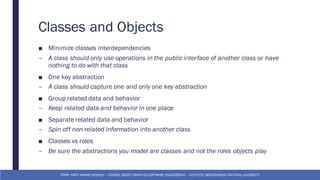
Classes and Objects
■ Minimize classes interdependencies
– A class should only use operations in the public interface of another class or have
nothing to do with that class
■ One key abstraction
– A class should capture one and only one key abstraction
■ Group related data and behavior
– Keep related data and behavior in one place
■ Separate related data and behavior
– Spin off non-related information into another class
■ Classes vs roles
– Be sure the abstractions you model are classes and not the roles objects play
FROM: HAFIZ AMMAR SIDDIQUI – COURSE: OBJECT ORIENTED SOFTWARE ENGINEERING – INSTITUTE: BEACONHOUSE NATIONAL UNIVERSITY
Topologies of Procedure vs Object
Oriented Applications
FROM: HAFIZ AMMAR SIDDIQUI – COURSE: OBJECT ORIENTED SOFTWARE ENGINEERING – INSTITUTE: BEACONHOUSE NATIONAL UNIVERSITY
Procedure vs Object Oriented Applications
■ Distribute system uniformly
– Distribute system intelligence horizontally as uniformly as possible, that is, the top-
level classes in a design should share the work uniformly
■ Avoid God classes
– Do not create god classes/objects (classes that control all other classes). Be very
suspicious of classes whose name contains Driver, Manager, System, Sub System
■ Avoid many accessors
– Beware of classes that have many accessor methods defined in their public
interface. May imply that data and behavior is not being kept at the same place
■ Avoid non-communicating behavior
– Beware of classes which have too much non-communicating behavior, i.e. methods
which operate on a proper subset of the data members of a class
FROM: HAFIZ AMMAR SIDDIQUI – COURSE: OBJECT ORIENTED SOFTWARE ENGINEERING – INSTITUTE: BEACONHOUSE NATIONAL UNIVERSITY
Relationships between Classes &
Objects
FROM: HAFIZ AMMAR SIDDIQUI – COURSE: OBJECT ORIENTED SOFTWARE ENGINEERING – INSTITUTE: BEACONHOUSE NATIONAL UNIVERSITY
Relationships between Classes & Objects
■ Minimize class collaborations
– Minimize the number of classes with which another class collaborates
■ Minimize message collaborations
– Minimize the number of message sends between a class and its collaborator
■ Containment rule
– If a class contains objects of another class, then the containing class should be
sending messages to the contained objects
■ Avoid contained objects relationships
– Objects which share lexical scope, i.e. those contained in the same containing
class, should not have uses relationships between them
FROM: HAFIZ AMMAR SIDDIQUI – COURSE: OBJECT ORIENTED SOFTWARE ENGINEERING – INSTITUTE: BEACONHOUSE NATIONAL UNIVERSITY
The Inheritance Relationship
FROM: HAFIZ AMMAR SIDDIQUI – COURSE: OBJECT ORIENTED SOFTWARE ENGINEERING – INSTITUTE: BEACONHOUSE NATIONAL UNIVERSITY
Inheritance Relationship
■ Inheritance for specialization
– Inheritance should only be used to model a specialization hierarchy
■ Dependency inversion rule
– Derived classes must have knowledge of their base class by definition, but base
classes should not know anything about their derived classes
■ Common data class
– If two or more classes only share common data (no common behavior) then that
common data should be placed in a class which will be contained by each sharing
class
■ Common base class
– If two or more classes have common data and behavior (i.e. methods) then those
classes should each inherit from a common base class which captures those data
and methods
FROM: HAFIZ AMMAR SIDDIQUI – COURSE: OBJECT ORIENTED SOFTWARE ENGINEERING – INSTITUTE: BEACONHOUSE NATIONAL UNIVERSITY
The Association Relationship
FROM: HAFIZ AMMAR SIDDIQUI – COURSE: OBJECT ORIENTED SOFTWARE ENGINEERING – INSTITUTE: BEACONHOUSE NATIONAL UNIVERSITY
Association Relationship
■ Containment vs association
– When given a choice in an object-oriented design between a containment
relationship and an association relationship, choose the containment relationship
FROM: HAFIZ AMMAR SIDDIQUI – COURSE: OBJECT ORIENTED SOFTWARE ENGINEERING – INSTITUTE: BEACONHOUSE NATIONAL UNIVERSITY
Reference
■ Object Oriented Design Heuristics by Arthur Riel, Addison-Wesley, 1996
FROM: HAFIZ AMMAR SIDDIQUI – COURSE: OBJECT ORIENTED SOFTWARE ENGINEERING – INSTITUTE: BEACONHOUSE NATIONAL UNIVERSITY

4-Object Oriented Design Heuristics (Object Oriented Software Engineering - BNU Spring 2017)

  • 1.
    Object Oriented Design Heuristics FROM:HAFIZ AMMAR SIDDIQUI – COURSE: OBJECT ORIENTED SOFTWARE ENGINEERING – INSTITUTE: BEACONHOUSE NATIONAL UNIVERSITY
  • 2.
    Object Oriented DesignHeuristics ■ Heuristics are techniques used for solving a problem ■ Coding and designing are different skills ■ Design principles are complicated and difficult to implement but design heuristics are easier to learn and apply ■ Design heuristics are simple rules of thumb which help us avoid design pitfalls – Heuristics help and identify where design can be improved – Heuristics are not hard and fast rules – Not all heuristics work together – Some heuristics are opposite to each other – There are always trade-offs in design depending on which heuristics are applied – Sometimes heuristics are ignored in designs that are considered good FROM: HAFIZ AMMAR SIDDIQUI – COURSE: OBJECT ORIENTED SOFTWARE ENGINEERING – INSTITUTE: BEACONHOUSE NATIONAL UNIVERSITY
  • 3.
    Classes and Objects FROM:HAFIZ AMMAR SIDDIQUI – COURSE: OBJECT ORIENTED SOFTWARE ENGINEERING – INSTITUTE: BEACONHOUSE NATIONAL UNIVERSITY
  • 4.
    Classes and Objects ■Hide data – All data should be hidden within its class ■ No dependence on clients – Users of a class must be dependent on its public interface, but a class should not be dependent on its users ■ Minimize methods – Minimize the number of messages in the protocol of a class ■ Minimal public interface – Implement a minimal public interface which all classes understand ■ Avoid interface clutter – Do not clutter the public interface of a class with things that users of that class are not able to use or are not interested in using FROM: HAFIZ AMMAR SIDDIQUI – COURSE: OBJECT ORIENTED SOFTWARE ENGINEERING – INSTITUTE: BEACONHOUSE NATIONAL UNIVERSITY
  • 5.
    Classes and Objects ■Minimize classes interdependencies – A class should only use operations in the public interface of another class or have nothing to do with that class ■ One key abstraction – A class should capture one and only one key abstraction ■ Group related data and behavior – Keep related data and behavior in one place ■ Separate related data and behavior – Spin off non-related information into another class ■ Classes vs roles – Be sure the abstractions you model are classes and not the roles objects play FROM: HAFIZ AMMAR SIDDIQUI – COURSE: OBJECT ORIENTED SOFTWARE ENGINEERING – INSTITUTE: BEACONHOUSE NATIONAL UNIVERSITY
  • 6.
    Topologies of Procedurevs Object Oriented Applications FROM: HAFIZ AMMAR SIDDIQUI – COURSE: OBJECT ORIENTED SOFTWARE ENGINEERING – INSTITUTE: BEACONHOUSE NATIONAL UNIVERSITY
  • 7.
    Procedure vs ObjectOriented Applications ■ Distribute system uniformly – Distribute system intelligence horizontally as uniformly as possible, that is, the top- level classes in a design should share the work uniformly ■ Avoid God classes – Do not create god classes/objects (classes that control all other classes). Be very suspicious of classes whose name contains Driver, Manager, System, Sub System ■ Avoid many accessors – Beware of classes that have many accessor methods defined in their public interface. May imply that data and behavior is not being kept at the same place ■ Avoid non-communicating behavior – Beware of classes which have too much non-communicating behavior, i.e. methods which operate on a proper subset of the data members of a class FROM: HAFIZ AMMAR SIDDIQUI – COURSE: OBJECT ORIENTED SOFTWARE ENGINEERING – INSTITUTE: BEACONHOUSE NATIONAL UNIVERSITY
  • 8.
    Relationships between Classes& Objects FROM: HAFIZ AMMAR SIDDIQUI – COURSE: OBJECT ORIENTED SOFTWARE ENGINEERING – INSTITUTE: BEACONHOUSE NATIONAL UNIVERSITY
  • 9.
    Relationships between Classes& Objects ■ Minimize class collaborations – Minimize the number of classes with which another class collaborates ■ Minimize message collaborations – Minimize the number of message sends between a class and its collaborator ■ Containment rule – If a class contains objects of another class, then the containing class should be sending messages to the contained objects ■ Avoid contained objects relationships – Objects which share lexical scope, i.e. those contained in the same containing class, should not have uses relationships between them FROM: HAFIZ AMMAR SIDDIQUI – COURSE: OBJECT ORIENTED SOFTWARE ENGINEERING – INSTITUTE: BEACONHOUSE NATIONAL UNIVERSITY
  • 10.
    The Inheritance Relationship FROM:HAFIZ AMMAR SIDDIQUI – COURSE: OBJECT ORIENTED SOFTWARE ENGINEERING – INSTITUTE: BEACONHOUSE NATIONAL UNIVERSITY
  • 11.
    Inheritance Relationship ■ Inheritancefor specialization – Inheritance should only be used to model a specialization hierarchy ■ Dependency inversion rule – Derived classes must have knowledge of their base class by definition, but base classes should not know anything about their derived classes ■ Common data class – If two or more classes only share common data (no common behavior) then that common data should be placed in a class which will be contained by each sharing class ■ Common base class – If two or more classes have common data and behavior (i.e. methods) then those classes should each inherit from a common base class which captures those data and methods FROM: HAFIZ AMMAR SIDDIQUI – COURSE: OBJECT ORIENTED SOFTWARE ENGINEERING – INSTITUTE: BEACONHOUSE NATIONAL UNIVERSITY
  • 12.
    The Association Relationship FROM:HAFIZ AMMAR SIDDIQUI – COURSE: OBJECT ORIENTED SOFTWARE ENGINEERING – INSTITUTE: BEACONHOUSE NATIONAL UNIVERSITY
  • 13.
    Association Relationship ■ Containmentvs association – When given a choice in an object-oriented design between a containment relationship and an association relationship, choose the containment relationship FROM: HAFIZ AMMAR SIDDIQUI – COURSE: OBJECT ORIENTED SOFTWARE ENGINEERING – INSTITUTE: BEACONHOUSE NATIONAL UNIVERSITY
  • 14.
    Reference ■ Object OrientedDesign Heuristics by Arthur Riel, Addison-Wesley, 1996 FROM: HAFIZ AMMAR SIDDIQUI – COURSE: OBJECT ORIENTED SOFTWARE ENGINEERING – INSTITUTE: BEACONHOUSE NATIONAL UNIVERSITY