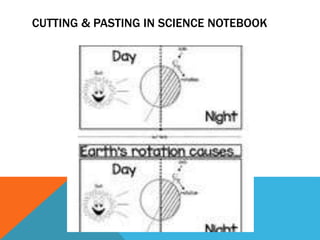
CUTTING & PASTING IN SCIENCE NOTEBOOK
YOU NEED TO KNOW:
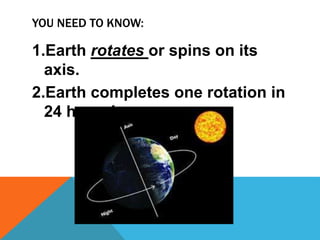
1.Earth rotates or spins on its
axis.
2.Earth completes one rotation in
24 hours!
SUNRISE AND SUNSET
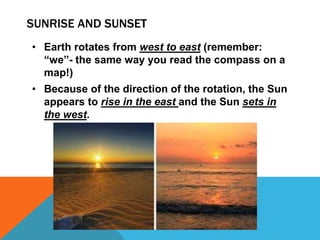
• Earth rotates from west to east (remember:
“we”- the same way you read the compass on a
map!)
• Because of the direction of the rotation, the Sun
appears to rise in the east and the Sun sets in
the west.
DAY AND NIGHT
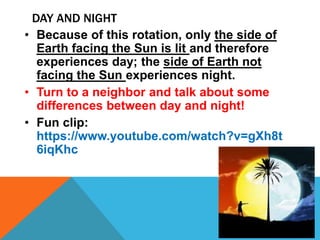
• Because of this rotation, only the side of
Earth facing the Sun is lit and therefore
experiences day; the side of Earth not
facing the Sun experiences night.
• Turn to a neighbor and talk about some
differences between day and night!
• Fun clip:
https://www.youtube.com/watch?v=gXh8t
6iqKhc
WHAT I NEED TO LEARN:
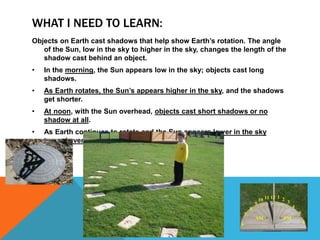
Objects on Earth cast shadows that help show Earth’s rotation. The angle
of the Sun, low in the sky to higher in the sky, changes the length of the
shadow cast behind an object.
• In the morning, the Sun appears low in the sky; objects cast long
shadows.
• As Earth rotates, the Sun’s appears higher in the sky, and the shadows
get shorter.
• At noon, with the Sun overhead, objects cast short shadows or no
shadow at all.
• As Earth continues to rotate and the Sun appears lower in the sky
toward evening, the shadows get longer again.
WHAT I NEED TO LEARN REVIEW:
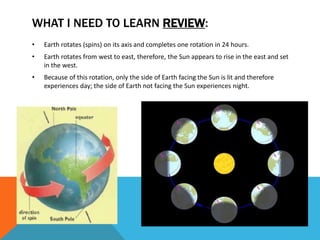
• Earth rotates (spins) on its axis and completes one rotation in 24 hours.
• Earth rotates from west to east, therefore, the Sun appears to rise in the east and set
in the west.
• Because of this rotation, only the side of Earth facing the Sun is lit and therefore
experiences day; the side of Earth not facing the Sun experiences night.
WHAT I NEED TO LEARN:
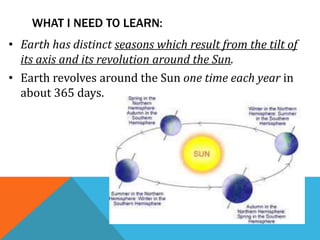
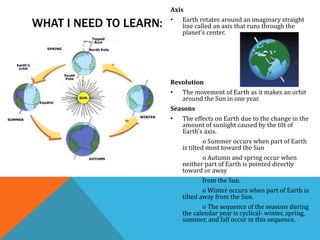
• Earth has distinct seasons which result from the tilt of
its axis and its revolution around the Sun.
• Earth revolves around the Sun one time each year in
about 365 days.
WHAT I NEED TO LEARN:
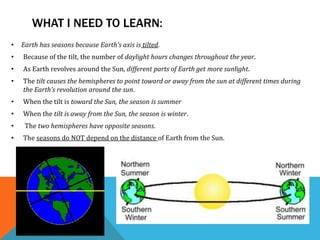
• Earth has seasons because Earth’s axis is tilted.
• Because of the tilt, the number of daylight hours changes throughout the year.
• As Earth revolves around the Sun, different parts of Earth get more sunlight.
• The tilt causes the hemispheres to point toward or away from the sun at different times during
the Earth’s revolution around the sun.
• When the tilt is toward the Sun, the season is summer
• When the tilt is away from the Sun, the season is winter.
• The two hemispheres have opposite seasons.
• The seasons do NOT depend on the distance of Earth from the Sun.
Axis
• Earth rotates around an imaginary straight
line called an axis that runs through the
planet’s center.
Revolution
• The movement of Earth as it makes an orbit
around the Sun in one year.
Seasons
• The effects on Earth due to the change in the
amount of sunlight caused by the tilt of
Earth’s axis.
o Summer occurs when part of Earth
is tilted most toward the Sun
o Autumn and spring occur when
neither part of Earth is pointed directly
toward or away
from the Sun.
o Winter occurs when part of Earth is
tilted away from the Sun.
o The sequence of the seasons during
the calendar year is cyclical- winter, spring,
summer, and fall occur in this sequence.
WHAT I NEED TO LEARN:
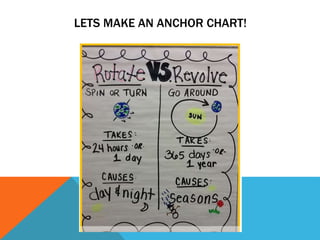
LETS MAKE AN ANCHOR CHART!
REMEMBER!
The Sun is the source of heat and light for Earth.
WHAT I NEED TO LEARN:
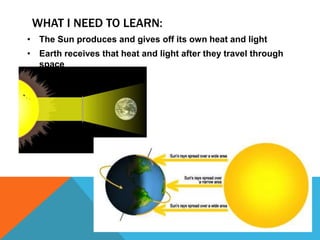
• The Sun produces and gives off its own heat and light
• Earth receives that heat and light after they travel through
space
WHAT I NEED TO LEARN:
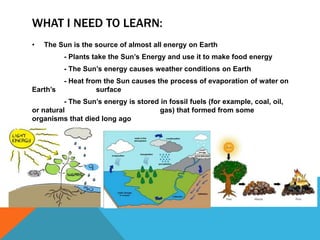
• The Sun is the source of almost all energy on Earth
- Plants take the Sun’s Energy and use it to make food energy
- The Sun’s energy causes weather conditions on Earth
- Heat from the Sun causes the process of evaporation of water on
Earth’s surface
- The Sun’s energy is stored in fossil fuels (for example, coal, oil,
or natural gas) that formed from some
organisms that died long ago
Rotation Revolution  Axis  and Shadows.pptx

Rotation Revolution Axis and Shadows.pptx

  • 2.
    CUTTING & PASTINGIN SCIENCE NOTEBOOK
  • 3.
    YOU NEED TOKNOW: 1.Earth rotates or spins on its axis. 2.Earth completes one rotation in 24 hours!
  • 4.
    SUNRISE AND SUNSET •Earth rotates from west to east (remember: “we”- the same way you read the compass on a map!) • Because of the direction of the rotation, the Sun appears to rise in the east and the Sun sets in the west.
  • 5.
    DAY AND NIGHT •Because of this rotation, only the side of Earth facing the Sun is lit and therefore experiences day; the side of Earth not facing the Sun experiences night. • Turn to a neighbor and talk about some differences between day and night! • Fun clip: https://www.youtube.com/watch?v=gXh8t 6iqKhc
  • 8.
    WHAT I NEEDTO LEARN: Objects on Earth cast shadows that help show Earth’s rotation. The angle of the Sun, low in the sky to higher in the sky, changes the length of the shadow cast behind an object. • In the morning, the Sun appears low in the sky; objects cast long shadows. • As Earth rotates, the Sun’s appears higher in the sky, and the shadows get shorter. • At noon, with the Sun overhead, objects cast short shadows or no shadow at all. • As Earth continues to rotate and the Sun appears lower in the sky toward evening, the shadows get longer again.
  • 10.
    WHAT I NEEDTO LEARN REVIEW: • Earth rotates (spins) on its axis and completes one rotation in 24 hours. • Earth rotates from west to east, therefore, the Sun appears to rise in the east and set in the west. • Because of this rotation, only the side of Earth facing the Sun is lit and therefore experiences day; the side of Earth not facing the Sun experiences night.
  • 11.
    WHAT I NEEDTO LEARN: • Earth has distinct seasons which result from the tilt of its axis and its revolution around the Sun. • Earth revolves around the Sun one time each year in about 365 days.
  • 12.
    WHAT I NEEDTO LEARN: • Earth has seasons because Earth’s axis is tilted. • Because of the tilt, the number of daylight hours changes throughout the year. • As Earth revolves around the Sun, different parts of Earth get more sunlight. • The tilt causes the hemispheres to point toward or away from the sun at different times during the Earth’s revolution around the sun. • When the tilt is toward the Sun, the season is summer • When the tilt is away from the Sun, the season is winter. • The two hemispheres have opposite seasons. • The seasons do NOT depend on the distance of Earth from the Sun.
  • 13.
    Axis • Earth rotatesaround an imaginary straight line called an axis that runs through the planet’s center. Revolution • The movement of Earth as it makes an orbit around the Sun in one year. Seasons • The effects on Earth due to the change in the amount of sunlight caused by the tilt of Earth’s axis. o Summer occurs when part of Earth is tilted most toward the Sun o Autumn and spring occur when neither part of Earth is pointed directly toward or away from the Sun. o Winter occurs when part of Earth is tilted away from the Sun. o The sequence of the seasons during the calendar year is cyclical- winter, spring, summer, and fall occur in this sequence. WHAT I NEED TO LEARN:
  • 15.
    LETS MAKE ANANCHOR CHART!
  • 17.
    REMEMBER! The Sun isthe source of heat and light for Earth.
  • 18.
    WHAT I NEEDTO LEARN: • The Sun produces and gives off its own heat and light • Earth receives that heat and light after they travel through space
  • 19.
    WHAT I NEEDTO LEARN: • The Sun is the source of almost all energy on Earth - Plants take the Sun’s Energy and use it to make food energy - The Sun’s energy causes weather conditions on Earth - Heat from the Sun causes the process of evaporation of water on Earth’s surface - The Sun’s energy is stored in fossil fuels (for example, coal, oil, or natural gas) that formed from some organisms that died long ago