CALDWELL ADVENTIST ACADEMY, INC
R.T. LIM BOULEVARD, ZAMBOANGA CITY
“The School for Future Leaders”
S.Y. 2023-2024
At the end of this unit, you should be able to
1. Explain how the respiratory and circulatory systems work together to transport nutrients, gases, and
other molecules to and from the different parts of the body by: (S9LT-la-b-26).
 Determining the parts and functions of the respiratory system.
 Determining the parts and functions of the circulatory system
Day 1: Capillaries, Arteries, and Veins
Day 2: Blood
Day 3: Activity
Day 4: Quiz
Day 1:
1.1 Description: Learning Discussion and Review
A. CAPILLARIES
 Body tissues contain a vast network of thin capillaries.
 Capillary walls are only one cell thick, allowing exchange of gases, nutrients, and
wastes.
 Capillaries are so fine that red blood cells must line up single-file to go through them.
Day 2:
2.1 Abstraction: Blood and Blood Group or Types
WEEKLY LEARNING PLAN IN SCIENCE 9
LEARNING OBJECTIVES
TOPICS
ACTIVITIES
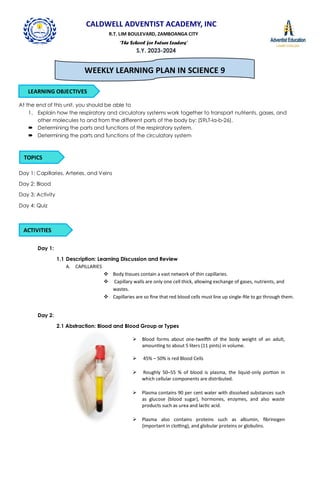
 Blood forms about one-twelfth of the body weight of an adult,
amounting to about 5 liters (11 pints) in volume.
 45% – 50% is red Blood Cells
 Roughly 50–55 % of blood is plasma, the liquid-only portion in
which cellular components are distributed.
 Plasma contains 90 per cent water with dissolved substances such
as glucose (blood sugar), hormones, enzymes, and also waste
products such as urea and lactic acid.
 Plasma also contains proteins such as albumin, fibrinogen
(important in clotting), and globular proteins or globulins.
A. RED BLOOD CELLS (ERYTHROCYTES)
B. WHITE BLOOD CELLS (LYMPHOCYTES)
C. PLATELETE
2.2 Four Blood Types
 The Rhesus (Rh) factor is an inherited protein found on the surface of red blood cells.
 If your blood has the protein, you're Rh positive.
 If your blood lacks the protein, you're Rh negative.
 Rh positive is the most common blood type.
There are four blood types. A, B, AB, and O.
1. A+, A-
2. B+, B-
3. 3. Ab+, Ab-
4. 4. 0+, O-
BLOOD PRESSURE - As blood is moved through your body, it exerts pressure against the walls of blood vessels.
Systolic Pressure: as your heart contracts to push blood into your arteries, your blood pressure is at its highest
point. Diastolic Pressure: As your heart relaxes to refill, blood pressure is at its lowest point.
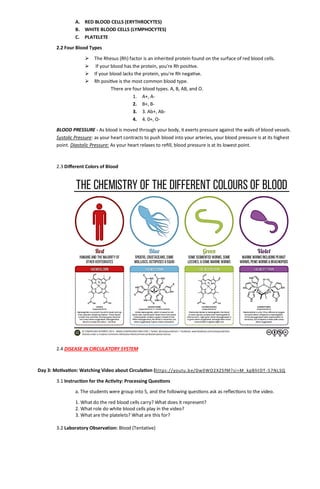
2.3 Different Colors of Blood
2.4 DISEASE IN CIRCULATORY SYSTEM
Day 3: Motivation: Watching Video about Circulation (https://youtu.be/Dw0WO2XZ5fM?si=M_kpBhtDT-57NLSQ
3.1 Instruction for the Activity: Processing Questions
a. The students were group into 5, and the following questions ask as reflections to the video.
1. What do the red blood cells carry? What does it represent?
2. What role do white blood cells play in the video?
3. What are the platelets? What are this for?
3.2 Laboratory Observation: Blood (Tentative)
Day 4: Quiz: Assessment
Lesson 9: Life, Death and Resurrection of Christ
The blood symbolizing life represents the great sacrifice of Jesus who in nature is 100% human and 100% God. In order to
save humanity, the savior willingly offers His own life were His blood was shed on the cross to give life eternal for mortals and bring
back the connection to God. (Gen. 3:15; Ps. 22:1; Isa. 53; John 3:16; 14:30; Rom. 1:4; 3:25; 4:25; 8:3, 4; 1 Cor. 15:3, 4, 20-22; 2 Cor.
5:14, 15, 19-21; Phil. 2:6-11; Col. 2:15; 1 Peter 2:21, 22; 1 John 2:2; 4:10.) The lessons about circulation reveals the cycle of life and
how God restore back the life to immortality. This circulation has wider connection to the Giver of life.
IFLL

SCIENCE Nine 0002 Lesson plan-WEEK 2.pdf

  • 1.
    CALDWELL ADVENTIST ACADEMY,INC R.T. LIM BOULEVARD, ZAMBOANGA CITY “The School for Future Leaders” S.Y. 2023-2024 At the end of this unit, you should be able to 1. Explain how the respiratory and circulatory systems work together to transport nutrients, gases, and other molecules to and from the different parts of the body by: (S9LT-la-b-26).  Determining the parts and functions of the respiratory system.  Determining the parts and functions of the circulatory system Day 1: Capillaries, Arteries, and Veins Day 2: Blood Day 3: Activity Day 4: Quiz Day 1: 1.1 Description: Learning Discussion and Review A. CAPILLARIES  Body tissues contain a vast network of thin capillaries.  Capillary walls are only one cell thick, allowing exchange of gases, nutrients, and wastes.  Capillaries are so fine that red blood cells must line up single-file to go through them. Day 2: 2.1 Abstraction: Blood and Blood Group or Types WEEKLY LEARNING PLAN IN SCIENCE 9 LEARNING OBJECTIVES TOPICS ACTIVITIES  Blood forms about one-twelfth of the body weight of an adult, amounting to about 5 liters (11 pints) in volume.  45% – 50% is red Blood Cells  Roughly 50–55 % of blood is plasma, the liquid-only portion in which cellular components are distributed.  Plasma contains 90 per cent water with dissolved substances such as glucose (blood sugar), hormones, enzymes, and also waste products such as urea and lactic acid.  Plasma also contains proteins such as albumin, fibrinogen (important in clotting), and globular proteins or globulins.
  • 2.
    A. RED BLOODCELLS (ERYTHROCYTES) B. WHITE BLOOD CELLS (LYMPHOCYTES) C. PLATELETE 2.2 Four Blood Types  The Rhesus (Rh) factor is an inherited protein found on the surface of red blood cells.  If your blood has the protein, you're Rh positive.  If your blood lacks the protein, you're Rh negative.  Rh positive is the most common blood type. There are four blood types. A, B, AB, and O. 1. A+, A- 2. B+, B- 3. 3. Ab+, Ab- 4. 4. 0+, O- BLOOD PRESSURE - As blood is moved through your body, it exerts pressure against the walls of blood vessels. Systolic Pressure: as your heart contracts to push blood into your arteries, your blood pressure is at its highest point. Diastolic Pressure: As your heart relaxes to refill, blood pressure is at its lowest point. 2.3 Different Colors of Blood 2.4 DISEASE IN CIRCULATORY SYSTEM Day 3: Motivation: Watching Video about Circulation (https://youtu.be/Dw0WO2XZ5fM?si=M_kpBhtDT-57NLSQ 3.1 Instruction for the Activity: Processing Questions a. The students were group into 5, and the following questions ask as reflections to the video. 1. What do the red blood cells carry? What does it represent? 2. What role do white blood cells play in the video? 3. What are the platelets? What are this for? 3.2 Laboratory Observation: Blood (Tentative)
  • 3.
    Day 4: Quiz:Assessment Lesson 9: Life, Death and Resurrection of Christ The blood symbolizing life represents the great sacrifice of Jesus who in nature is 100% human and 100% God. In order to save humanity, the savior willingly offers His own life were His blood was shed on the cross to give life eternal for mortals and bring back the connection to God. (Gen. 3:15; Ps. 22:1; Isa. 53; John 3:16; 14:30; Rom. 1:4; 3:25; 4:25; 8:3, 4; 1 Cor. 15:3, 4, 20-22; 2 Cor. 5:14, 15, 19-21; Phil. 2:6-11; Col. 2:15; 1 Peter 2:21, 22; 1 John 2:2; 4:10.) The lessons about circulation reveals the cycle of life and how God restore back the life to immortality. This circulation has wider connection to the Giver of life. IFLL