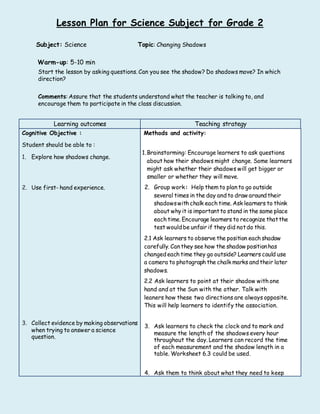
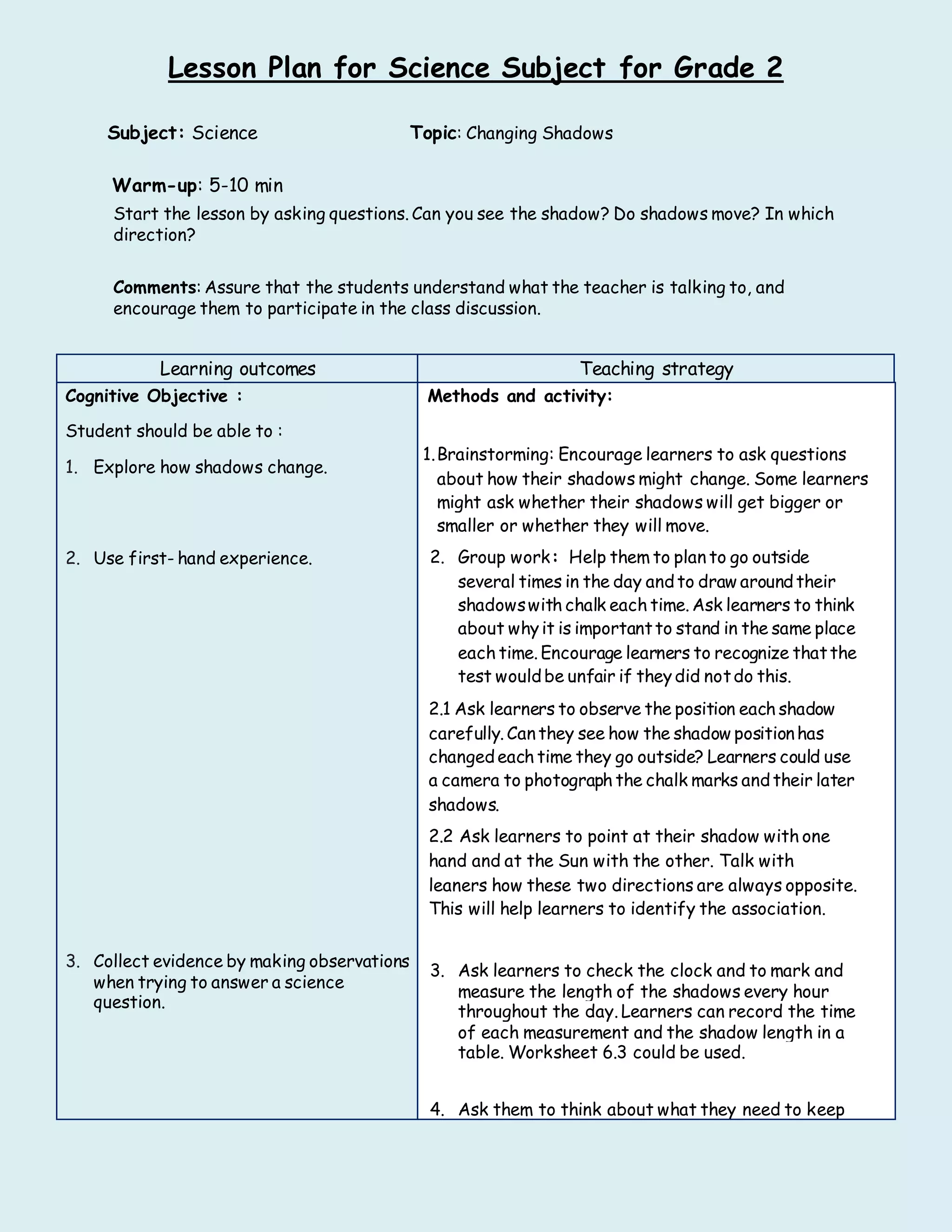






Lesson Plan for Science Subject for Grade 2
Subject: Science Topic: Changing Shadows
Warm-up: 5-10 min
Start the lesson by asking questions. Can you see the shadow? Do shadows move? In which
direction?
Comments: Assure that the students understand what the teacher is talking to, and
encourage them to participate in the class discussion.
Learning outcomes Teaching strategy
Cognitive Objective :
Student should be able to :
1. Explore how shadows change.
2. Use first- hand experience.
3. Collect evidence by making observations
when trying to answer a science
question.
Methods and activity:
1.Brainstorming: Encourage learners to ask questions
about how their shadows might change. Some learners
might ask whether their shadows will get bigger or
smaller or whether they will move.
2. Group work: Help them to plan to go outside
several times in the day andto draw aroundtheir
shadowswith chalk each time. Ask learners to think
about whyit is importantto stand in the same place
each time. Encourage learners to recognize thatthe
test wouldbe unfair if theydid notdo this.
2.1 Ask learners to observe the position each shadow
carefully. Canthey see how the shadow positionhas
changedeach time they go outside? Learners could use
a camera to photograph the chalk marks andtheir later
shadows.
2.2 Ask learners to point at their shadow with one
hand and at the Sun with the other. Talk with
leaners how these two directions are always opposite.
This will help learners to identify the association.
3. Ask learners to check the clock and to mark and
measure the length of the shadows every hour
throughout the day. Learners can record the time
of each measurement and the shadow length in a
table. Worksheet 6.3 could be used.
4. Ask them to think about what they need to keep
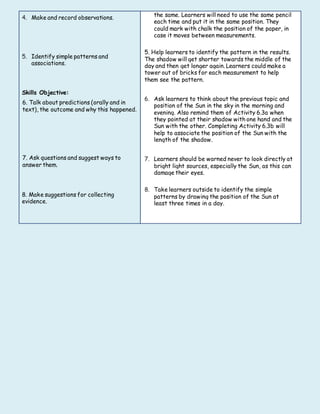
4. Make and record observations.
5. Identify simple patterns and
associations.
Skills Objective:
6. Talk about predictions (orally and in
text), the outcome and why this happened.
7. Ask questions and suggest ways to
answer them.
8. Make suggestions for collecting
evidence.
the same. Learners will need to use the same pencil
each time and put it in the same position. They
could mark with chalk the position of the paper, in
case it moves between measurements.
5. Help learners to identify the pattern in the results.
The shadow will get shorter towards the middle of the
day and then get longer again. Learners could make a
tower out of bricks for each measurement to help
them see the pattern.
6. Ask learners to think about the previous topic and
position of the Sun in the sky in the morning and
evening. Also remind them of Activity 6.3a when
they pointed at their shadow with one hand and the
Sun with the other. Completing Activity 6.3b will
help to associate the position of the Sun with the
length of the shadow.
7. Learners should be warned never to look directly at
bright light sources, especially the Sun, as this can
damage their eyes.
8. Take learners outside to identify the simple
patterns by drawing the position of the Sun at
least three times in a day.
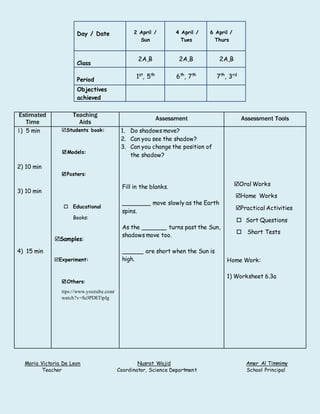
Day / Date 2 April /
Sun
4 April /
Tues
6 April /
Thurs
Class
2A,B 2A,B 2A,B
Period
1st
, 5th
6th
, 7th
7th
, 3rd
Objectives
achieved
Estimated
Time
Teaching
Aids
Assessment Assessment Tools
1) 5 min
2) 10 min
3) 10 min
4) 15 min
Students book:
Models:
Posters:
 Educational
Books:
Samples:
Experiment:
Others:
ttps://www.youtube.com/
watch?v=Sz3PDETipIg
1. Do shadows move?
2. Can you see the shadow?
3. Can you change the position of
the shadow?
Fill in the blanks.
________ move slowly as the Earth
spins.
As the _______ turns past the Sun,
shadows move too.
______ are short when the Sun is
high.
Oral Works
Home Works
Practical Activities
 Sort Questions
 Short Tests
Home Work:
1) Worksheet 6.3a
Maria Victoria De Leon Nusrat Wajid Amer Al Timmimy
Teacher Coordinator, Science Department School Principal







Science Learning Plan (Changing shadows)

  • 1.
    Lesson Plan forScience Subject for Grade 2 Subject: Science Topic: Changing Shadows Warm-up: 5-10 min Start the lesson by asking questions. Can you see the shadow? Do shadows move? In which direction? Comments: Assure that the students understand what the teacher is talking to, and encourage them to participate in the class discussion. Learning outcomes Teaching strategy Cognitive Objective : Student should be able to : 1. Explore how shadows change. 2. Use first- hand experience. 3. Collect evidence by making observations when trying to answer a science question. Methods and activity: 1.Brainstorming: Encourage learners to ask questions about how their shadows might change. Some learners might ask whether their shadows will get bigger or smaller or whether they will move. 2. Group work: Help them to plan to go outside several times in the day andto draw aroundtheir shadowswith chalk each time. Ask learners to think about whyit is importantto stand in the same place each time. Encourage learners to recognize thatthe test wouldbe unfair if theydid notdo this. 2.1 Ask learners to observe the position each shadow carefully. Canthey see how the shadow positionhas changedeach time they go outside? Learners could use a camera to photograph the chalk marks andtheir later shadows. 2.2 Ask learners to point at their shadow with one hand and at the Sun with the other. Talk with leaners how these two directions are always opposite. This will help learners to identify the association. 3. Ask learners to check the clock and to mark and measure the length of the shadows every hour throughout the day. Learners can record the time of each measurement and the shadow length in a table. Worksheet 6.3 could be used. 4. Ask them to think about what they need to keep
  • 2.
    4. Make andrecord observations. 5. Identify simple patterns and associations. Skills Objective: 6. Talk about predictions (orally and in text), the outcome and why this happened. 7. Ask questions and suggest ways to answer them. 8. Make suggestions for collecting evidence. the same. Learners will need to use the same pencil each time and put it in the same position. They could mark with chalk the position of the paper, in case it moves between measurements. 5. Help learners to identify the pattern in the results. The shadow will get shorter towards the middle of the day and then get longer again. Learners could make a tower out of bricks for each measurement to help them see the pattern. 6. Ask learners to think about the previous topic and position of the Sun in the sky in the morning and evening. Also remind them of Activity 6.3a when they pointed at their shadow with one hand and the Sun with the other. Completing Activity 6.3b will help to associate the position of the Sun with the length of the shadow. 7. Learners should be warned never to look directly at bright light sources, especially the Sun, as this can damage their eyes. 8. Take learners outside to identify the simple patterns by drawing the position of the Sun at least three times in a day.
  • 3.
    Day / Date2 April / Sun 4 April / Tues 6 April / Thurs Class 2A,B 2A,B 2A,B Period 1st , 5th 6th , 7th 7th , 3rd Objectives achieved Estimated Time Teaching Aids Assessment Assessment Tools 1) 5 min 2) 10 min 3) 10 min 4) 15 min Students book: Models: Posters:  Educational Books: Samples: Experiment: Others: ttps://www.youtube.com/ watch?v=Sz3PDETipIg 1. Do shadows move? 2. Can you see the shadow? 3. Can you change the position of the shadow? Fill in the blanks. ________ move slowly as the Earth spins. As the _______ turns past the Sun, shadows move too. ______ are short when the Sun is high. Oral Works Home Works Practical Activities  Sort Questions  Short Tests Home Work: 1) Worksheet 6.3a Maria Victoria De Leon Nusrat Wajid Amer Al Timmimy Teacher Coordinator, Science Department School Principal
  • 4.
  • 5.
  • 6.
  • 7.
  • 8.
  • 9.