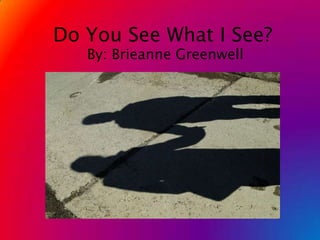
Do You See What I See?By: Brieanne Greenwell
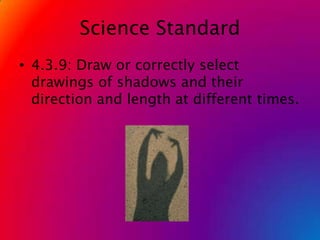
Science Standard4.3.9: Draw or correctly select drawings of shadows and their direction and length at different times.
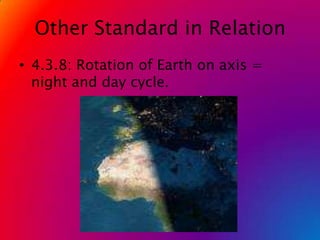
Other Standard in Relation4.3.8: Rotation of Earth on axis = night and day cycle.
Vocabulary WordsShadow: area where direct light from a light source cannot reach due to obstruction by an object.Reflection: the phenomenon of a propagating wave (light or sound) being thrown back from a surface.Propagating Wave: the way in which a wave can travel.
Background InformationHow are shadows formed?When an object is blocking the path of light it will leave the exact shape of the object which is known as the shadow.What has shadows?Any object that is blocking the path of a light wave. Examples: trees, humans, animals, vehicles, homes, etc…
Shadow ActivityYou will need 3 people to do this activity. The first person will need to hold the flashlight, the second person will be the drawer and the third person will be drawn.You need to place a piece of black construction paper on the board (being held by tape). Have someone stand in front of the black construction paper facing sideways and have the other person stand in front of them holding the flashlight . Have the third person trace the person standing there.Take turns until everyone has completed the activity.
Shadow Activity Cont.The flashlight will cast a shadow of the person standing there on the black construction paper.The flashlight acts like the sun wave and the object that blocks the flashlight (sun wave) is the person being drawn thus casting the shadow of the person (object) on the black construction paper.
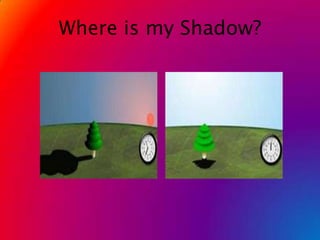
Where is my Shadow?
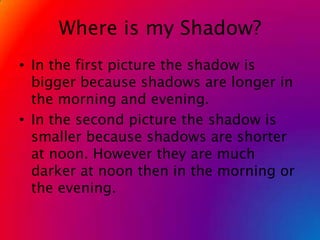
Where is my Shadow?In the first picture the shadow is bigger because shadows are longer in the morning and evening.In the second picture the shadow is smaller because shadows are shorter at noon. However they are much darker at noon then in the morning or the evening.
QuestionsOn a piece of paper answer the following questions:Where would your shadow be if it was 9 a.m? Describe what your shadow would look like.Where would your shadow be if it was 9 p.m? Describe what your shadow would look like.
Materials in the BoxBlack construction paperChalkFlashlight with batteriesTapeNotebook paperPowerPoint slidesPencils
Resourceshttp://dc.doe.in.gov/Standards/AcademicStandards/StandardSearch.aspxState standards and idea for activityhttp://www.goalfinder.com/product.asp?productid=43Pictures of different shadows

Shadow Activity

  • 1.
    Do You SeeWhat I See?By: Brieanne Greenwell
  • 2.
    Science Standard4.3.9: Drawor correctly select drawings of shadows and their direction and length at different times.
  • 3.
    Other Standard inRelation4.3.8: Rotation of Earth on axis = night and day cycle.
  • 4.
    Vocabulary WordsShadow: areawhere direct light from a light source cannot reach due to obstruction by an object.Reflection: the phenomenon of a propagating wave (light or sound) being thrown back from a surface.Propagating Wave: the way in which a wave can travel.
  • 5.
    Background InformationHow areshadows formed?When an object is blocking the path of light it will leave the exact shape of the object which is known as the shadow.What has shadows?Any object that is blocking the path of a light wave. Examples: trees, humans, animals, vehicles, homes, etc…
  • 6.
    Shadow ActivityYou willneed 3 people to do this activity. The first person will need to hold the flashlight, the second person will be the drawer and the third person will be drawn.You need to place a piece of black construction paper on the board (being held by tape). Have someone stand in front of the black construction paper facing sideways and have the other person stand in front of them holding the flashlight . Have the third person trace the person standing there.Take turns until everyone has completed the activity.
  • 7.
    Shadow Activity Cont.Theflashlight will cast a shadow of the person standing there on the black construction paper.The flashlight acts like the sun wave and the object that blocks the flashlight (sun wave) is the person being drawn thus casting the shadow of the person (object) on the black construction paper.
  • 8.
  • 9.
    Where is myShadow?In the first picture the shadow is bigger because shadows are longer in the morning and evening.In the second picture the shadow is smaller because shadows are shorter at noon. However they are much darker at noon then in the morning or the evening.
  • 10.
    QuestionsOn a pieceof paper answer the following questions:Where would your shadow be if it was 9 a.m? Describe what your shadow would look like.Where would your shadow be if it was 9 p.m? Describe what your shadow would look like.
  • 11.
    Materials in theBoxBlack construction paperChalkFlashlight with batteriesTapeNotebook paperPowerPoint slidesPencils
  • 12.
    Resourceshttp://dc.doe.in.gov/Standards/AcademicStandards/StandardSearch.aspxState standards andidea for activityhttp://www.goalfinder.com/product.asp?productid=43Pictures of different shadows