Communication for effective
learning
Level 6 Core Science
Aims
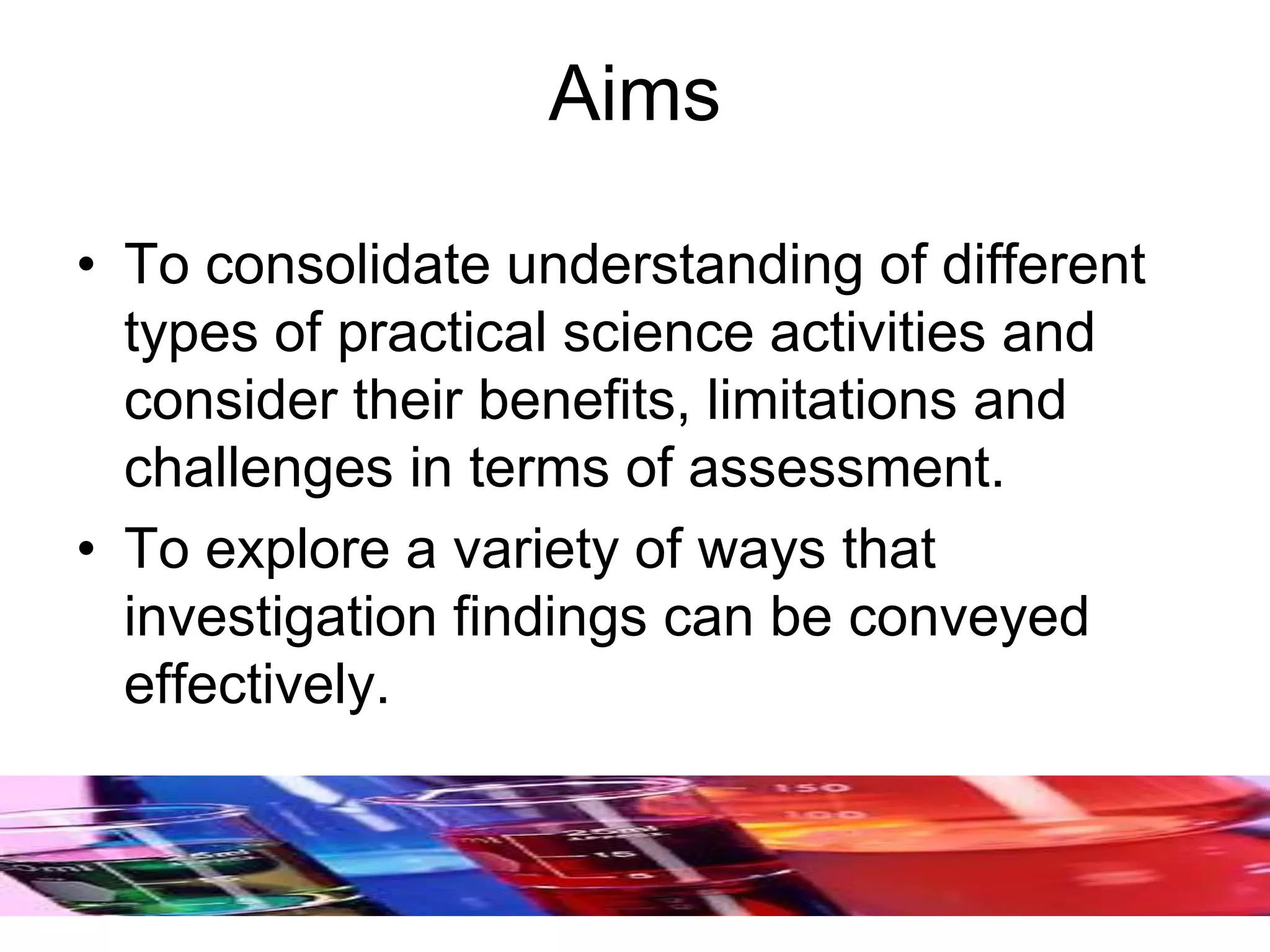
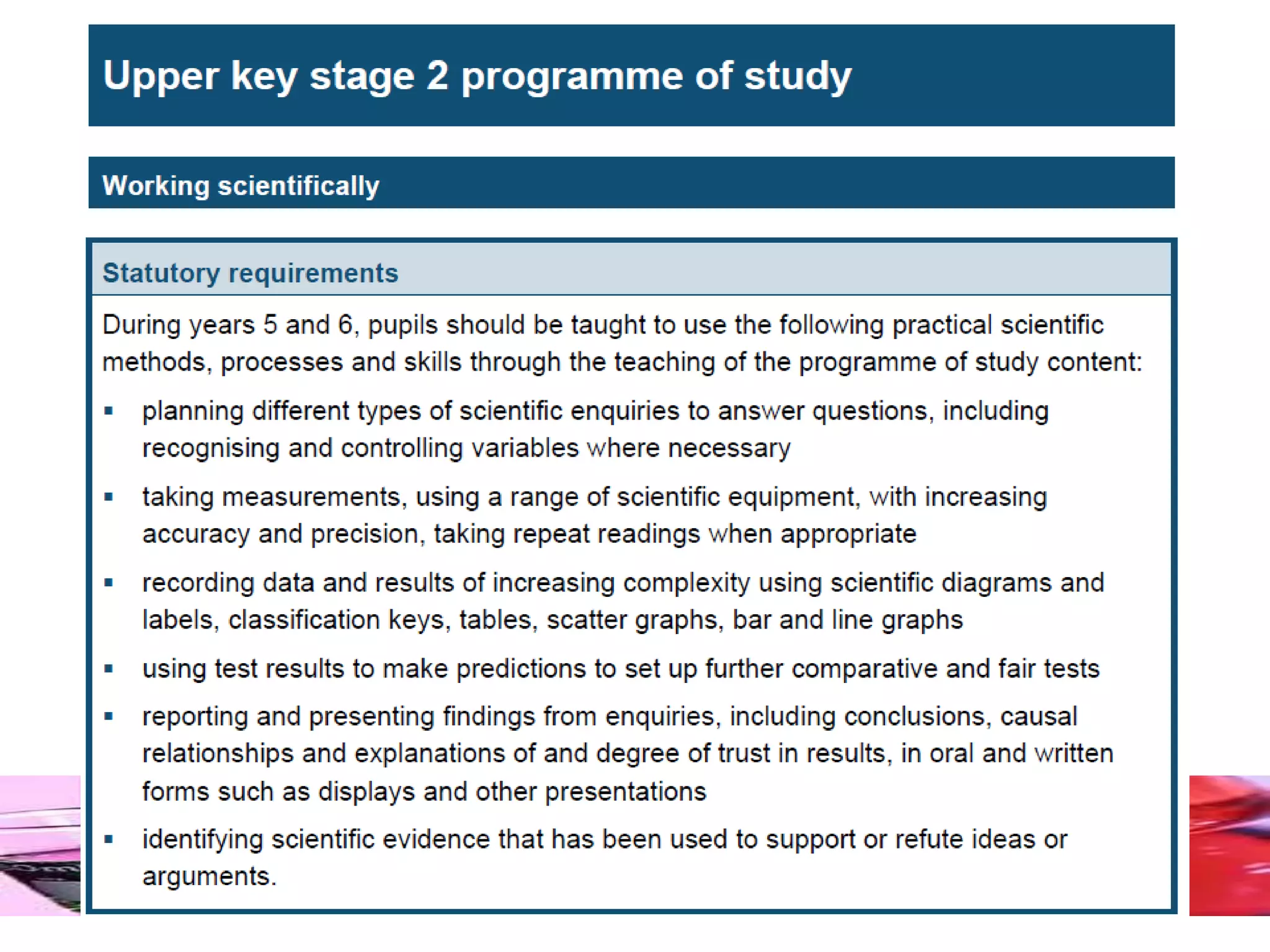
• To consolidate understanding of different
types of practical science activities and
consider their benefits, limitations and
challenges in terms of assessment.
• To explore a variety of ways that
investigation findings can be conveyed
effectively.
Types of investigations (AKSIS
Project)
• Fair test investigation
• Classifying
• Survey/Pattern seeking
• Exploring
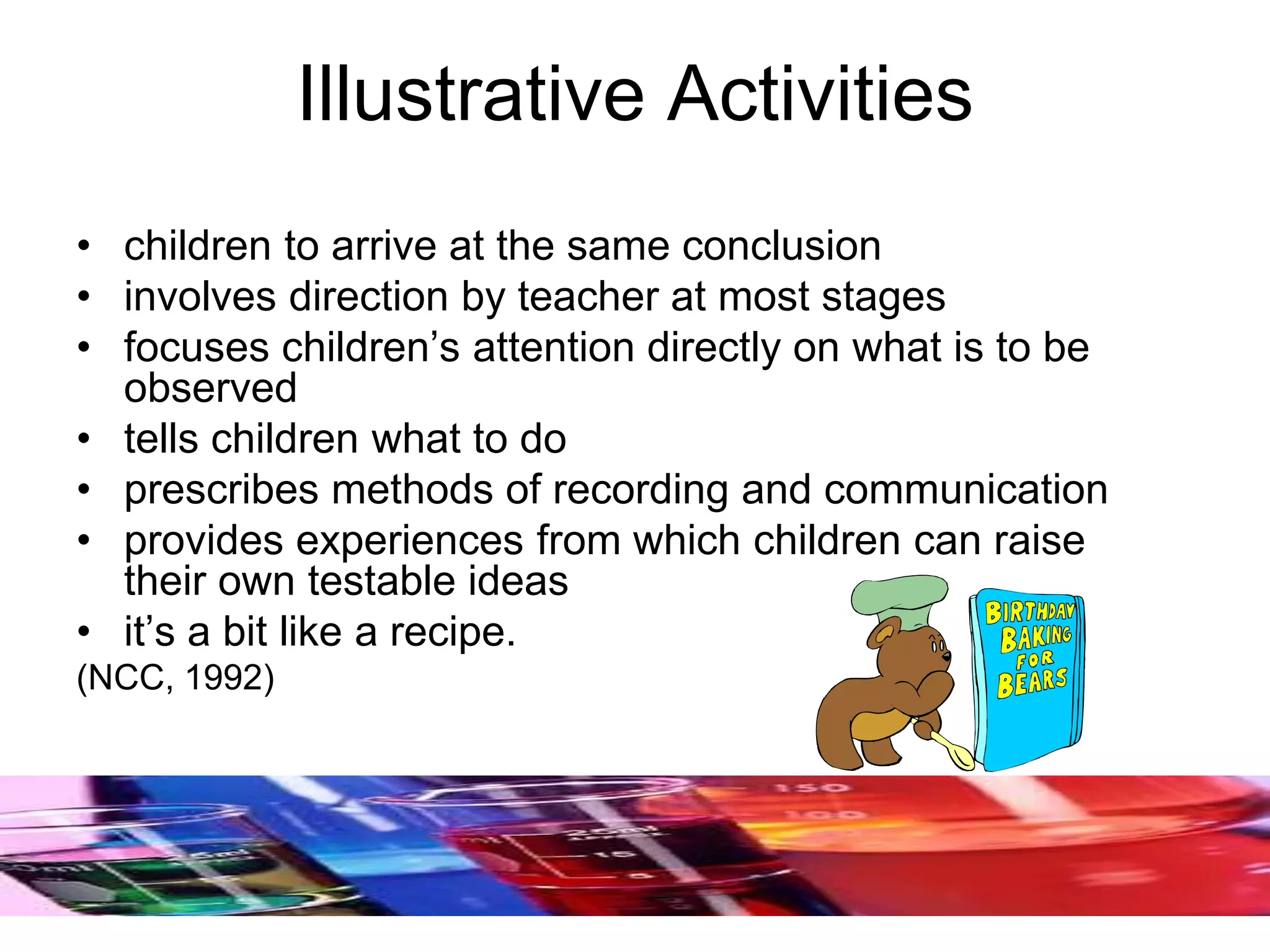
Illustrative Activities
• children to arrive at the same conclusion
• involves direction by teacher at most stages
• focuses children’s attention directly on what is to be
observed
• tells children what to do
• prescribes methods of recording and communication
• provides experiences from which children can raise
their own testable ideas
• it’s a bit like a recipe.
(NCC, 1992)
Investigations
• encourages children to raise their own questions, predictions and
statements
• allows children to plan for themselves how the investigation will
proceed
• allows children to work independently, making decisions for
themselves about what to change and what to measure
• allows children to select the most appropriate equipment for gathering
measurements
• encourages children to record and display their results in their own
way
• allows children to interpret their own data
• encourages further questions for investigation
• enables children to refine both concepts and procedures from their
own starting points.
(NCC, 1992)
Illustrative or Investigative?
Reading
Preparatory tasks
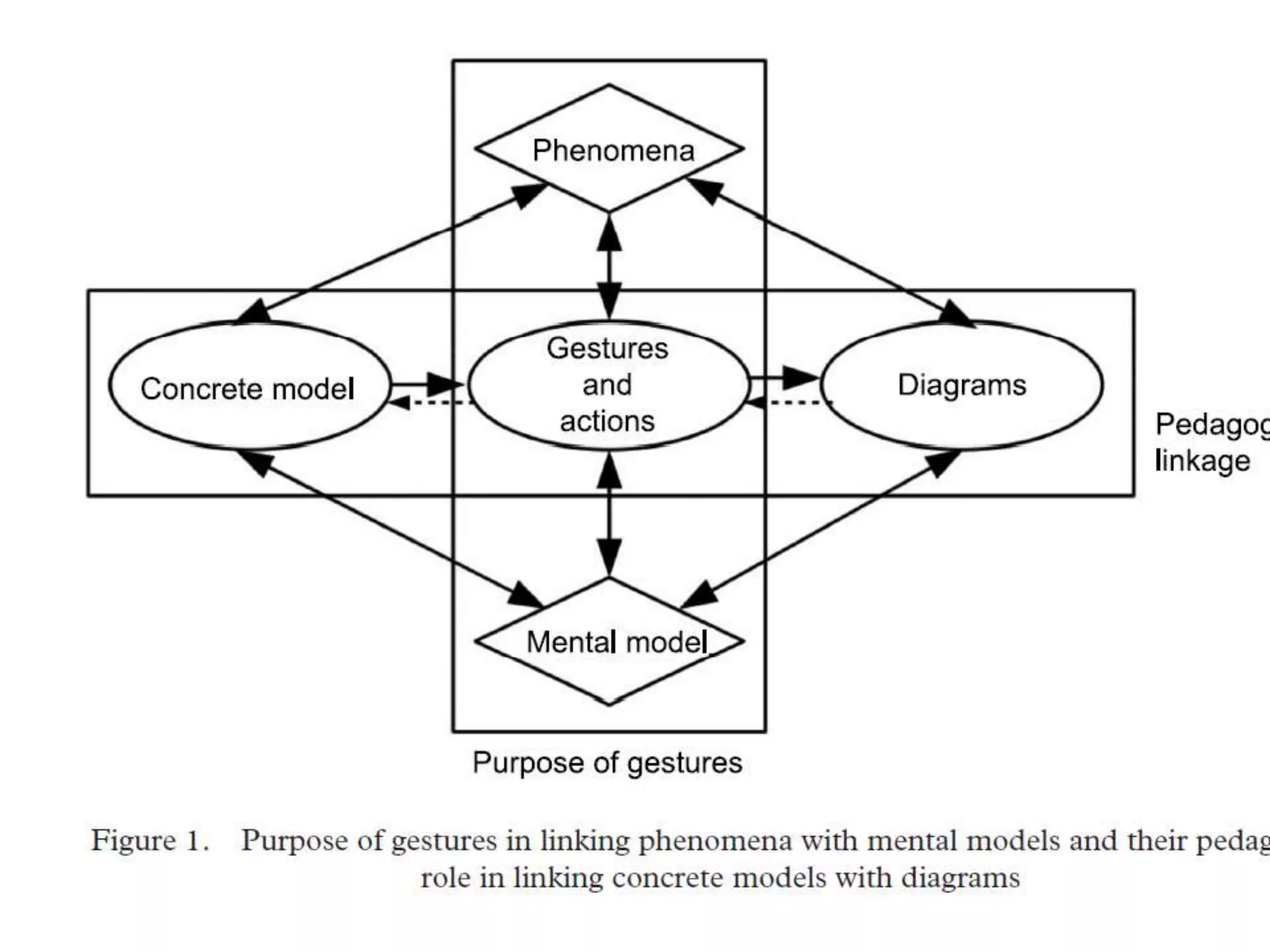
To read, Padalkar, Shamin ; Ramadas and
Jayashree (2011) Designed and Spontaneous
Gestures in Elementary Astronomy Education.
International Journal of Science Education,
2011, Vol.33(12), p.1703-1739
Available at:
http://www.tandfonline.com/doi/full/10.1080/095
00693.2010.520348
Earth and Space
and Communication
Part One
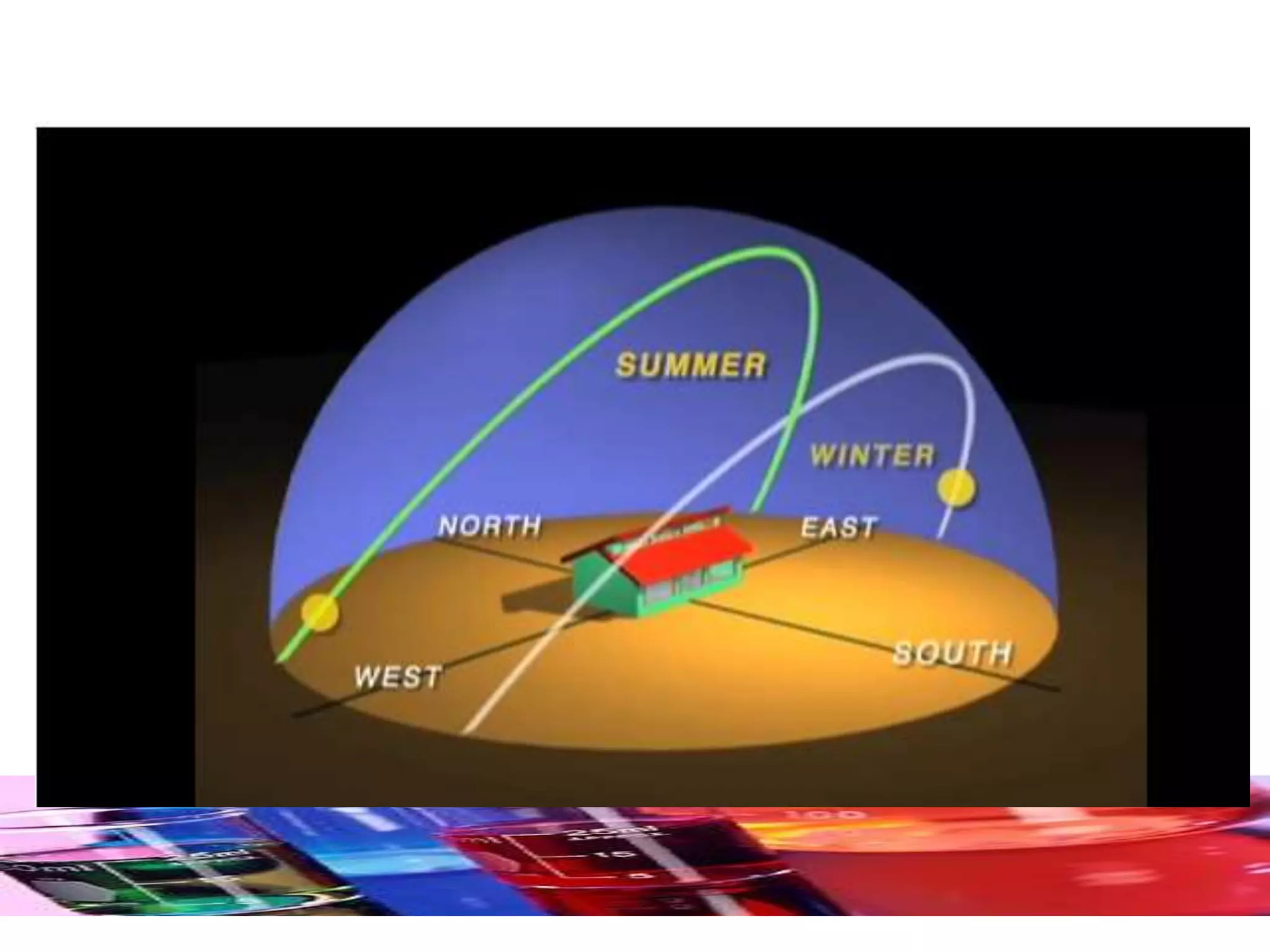
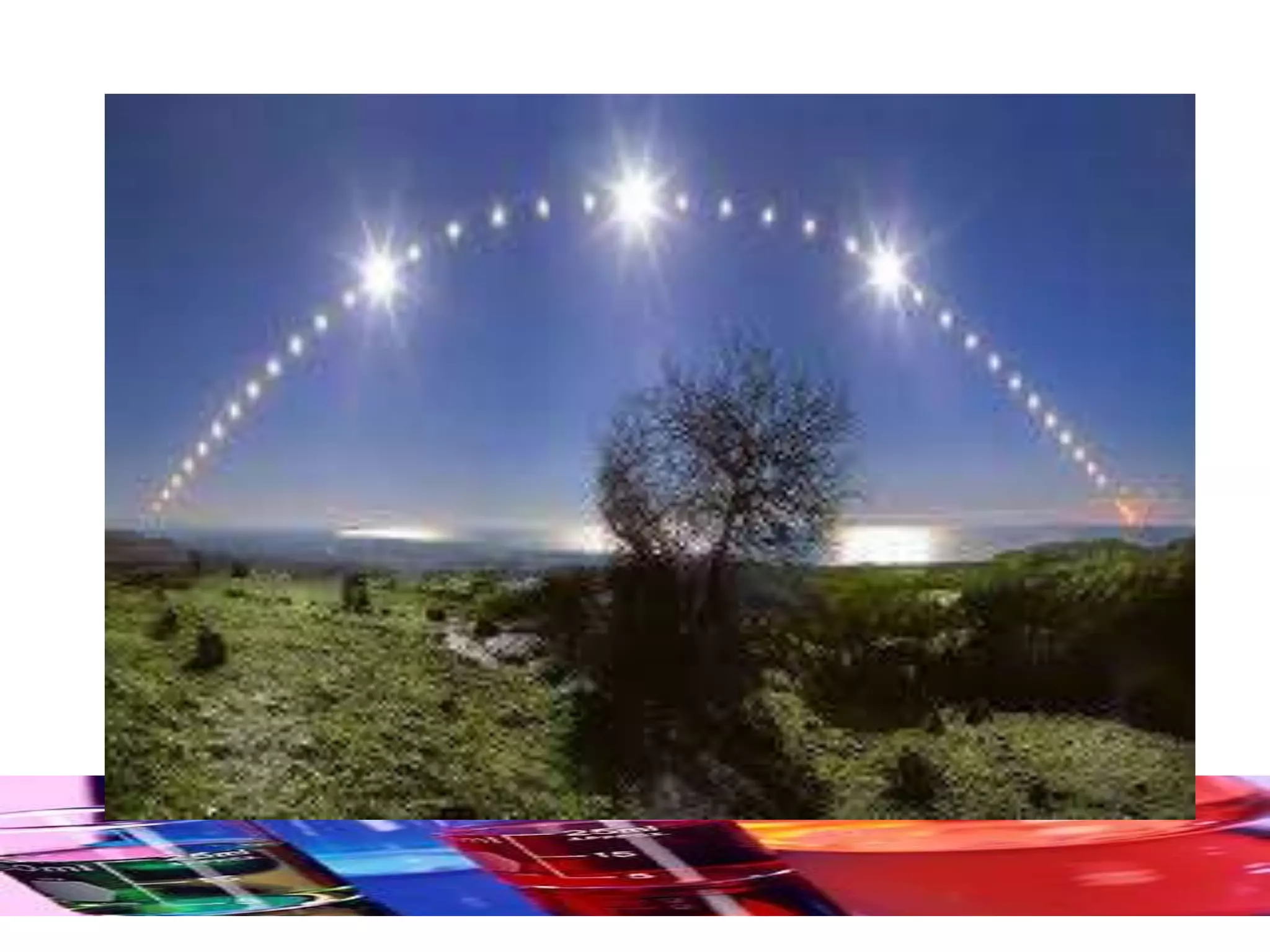
The passage of the sun through
the sky during the day
New NC Yr 5
• Earth and space
• Pupils should be taught to:
• describe the movement of the Earth and other
planets relative to the sun in the solar system
• describe the movement of the moon relative to the
Earth
• describe the sun, Earth and moon as approximately
spherical bodies
• use the idea of the Earth’s rotation to explain day
and night and the apparent
movement of the sun across the sky
• Notes and guidance (non-statutory)
• Pupils should be introduced to a model of the sun and Earth that enables them to
explain day and night. Pupils should learn that the sun is a star at the centre of our
solar system and that it has 8 planets: Mercury, Venus, Earth, Mars, Jupiter, Saturn,
Uranus and Neptune (Pluto was reclassified as a ‘dwarf planet’ in 2006). They should
understand that a moon is a celestial body that orbits a planet (Earth has 1 moon;
Jupiter has 4 large moons and numerous smaller ones).
Note: pupils should be warned that it is not safe to look directly at the sun, even when
wearing dark glasses.
Pupils should find out about the way that ideas about the solar system have
developed, understanding how the geocentric model of the solar system gave way to
the heliocentric model by considering the work of scientists such as Ptolemy, Alhazen
and Copernicus.
Pupils might work scientifically by: comparing the time of day at different places on
the Earth through internet links and direct communication; creating simple models of
the solar system; constructing simple shadow clocks and sundials, calibrated to show
midday and the start and end of the school day; finding out why some people think
that structures such as Stonehenge might have been used as astronomical clocks.
The Universe
• http://www.youtube.com/watch?v=RCUhm
63ioCU
• Planets around the Sun –rap
• http://www.youtube.com/watch?v=nQfJ7j2
UGGk
Survey/Pattern finding Investigation
In groups of 3 or 4:
Is there a relationship between the
position of the sun and the length of
the shadow?
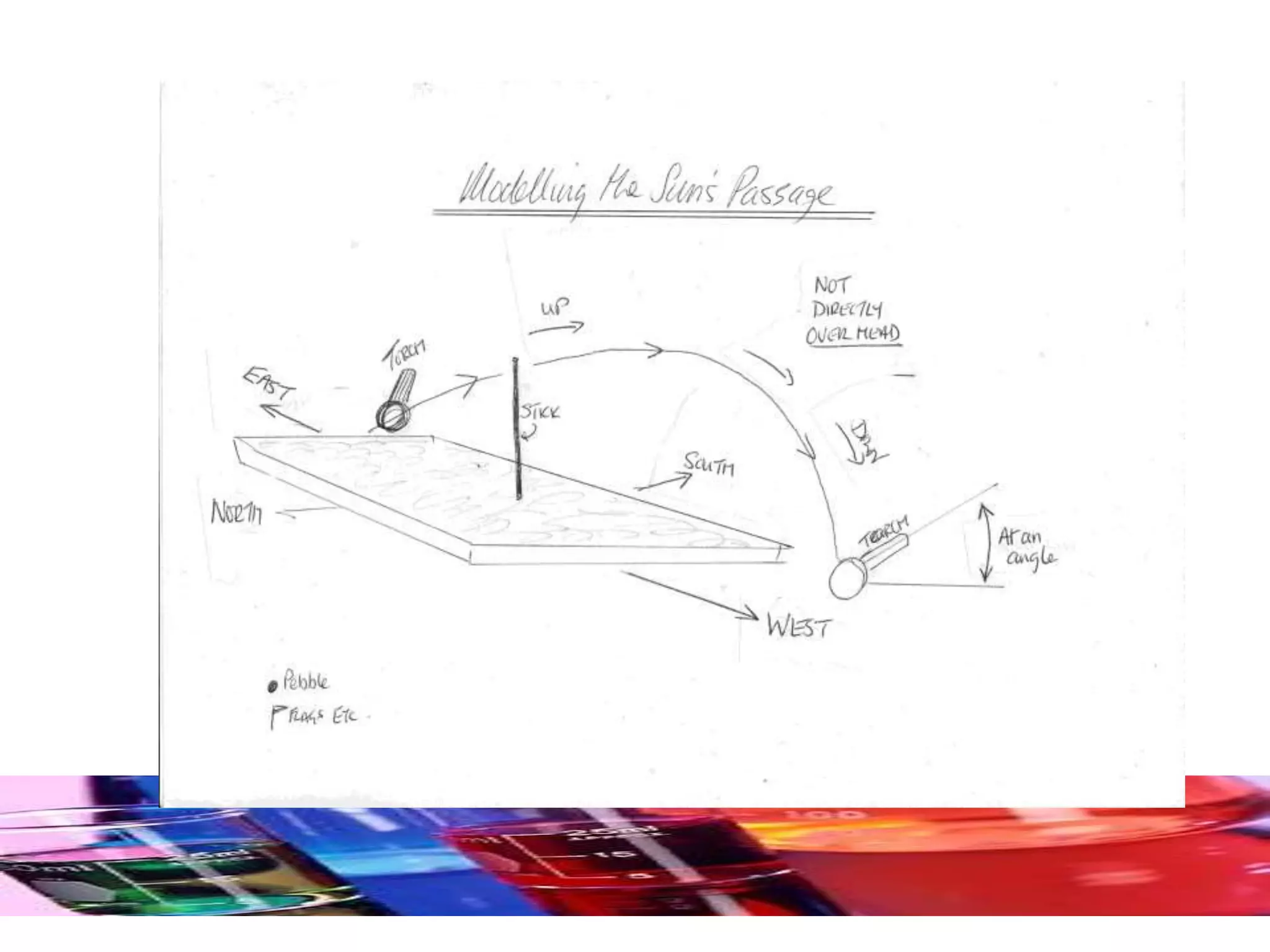
Modelling the sun’s passage
• Plot the shadows on the sand
• Measure the shadow lengths
• Plot a graph of the lengths in order
• What is significant about “one” shadow
and what does it tells you about direction
every time?
• What happens to this special shadow
during the year?
Making a Sundial
• This activity is to mirror what will happen
when children make a sundial using a stick
in a tray of sand and the sun’s light over a
period of time from morning to afternoon.
• They will observe, measure, tabulate, plot
and describe what they see. The activity is
dependant on the age, ability and prior
knowledge and experience of the
child/children.
The Sundial Activity
• Tray of sand, stick, string, ruler, markers
(cocktails sticks), torch.
• The torch rises in the East, rises over the stick
using a southern arc and sets in the West.
• Draw a sketch.
• 15 minute activity for you with this modelling,
how would you plan this with your children when
they have to record the shadow every 30 mins?
“Answers” to the activity!
http://www.youtube.com/watch?v=z
WueOSLpbbw
Sun Compass Southern Hemisphere
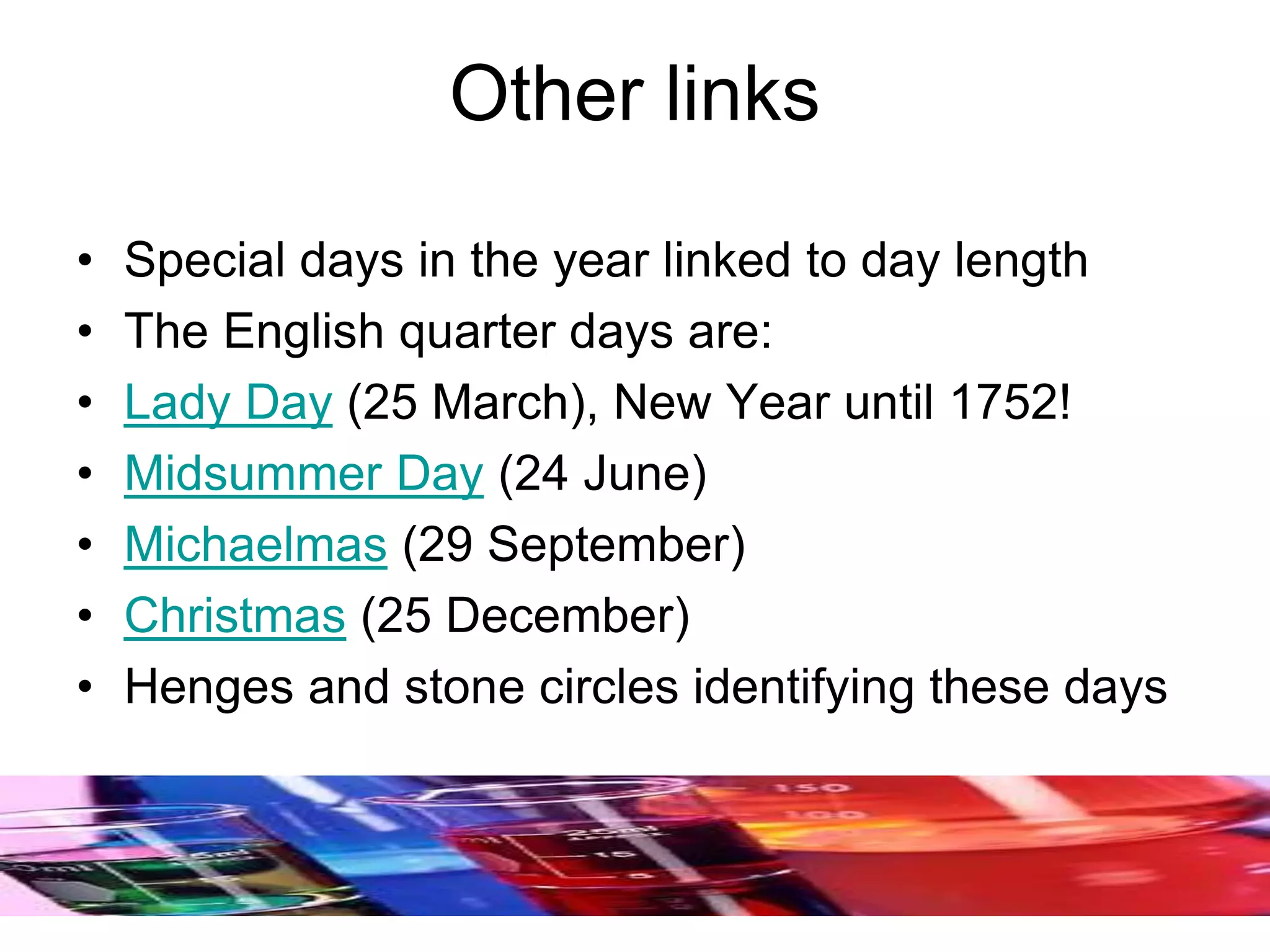
Other links
• Special days in the year linked to day length
• The English quarter days are:
• Lady Day (25 March), New Year until 1752!
• Midsummer Day (24 June)
• Michaelmas (29 September)
• Christmas (25 December)
• Henges and stone circles identifying these days
Real or Apparent Movement of the
Sun.
1. Discuss the Geocentric Model linking it to:
• Obvious but incorrect statement: rotation of the sun around
the earth
• The Church, the nature of creation, the earth at the centre of
the universe.
• All heavenly bodies revolve around the earth.
2. Copernicus and the alternative heretic mathematical model
with the sun at the centre. Denounced by the church.
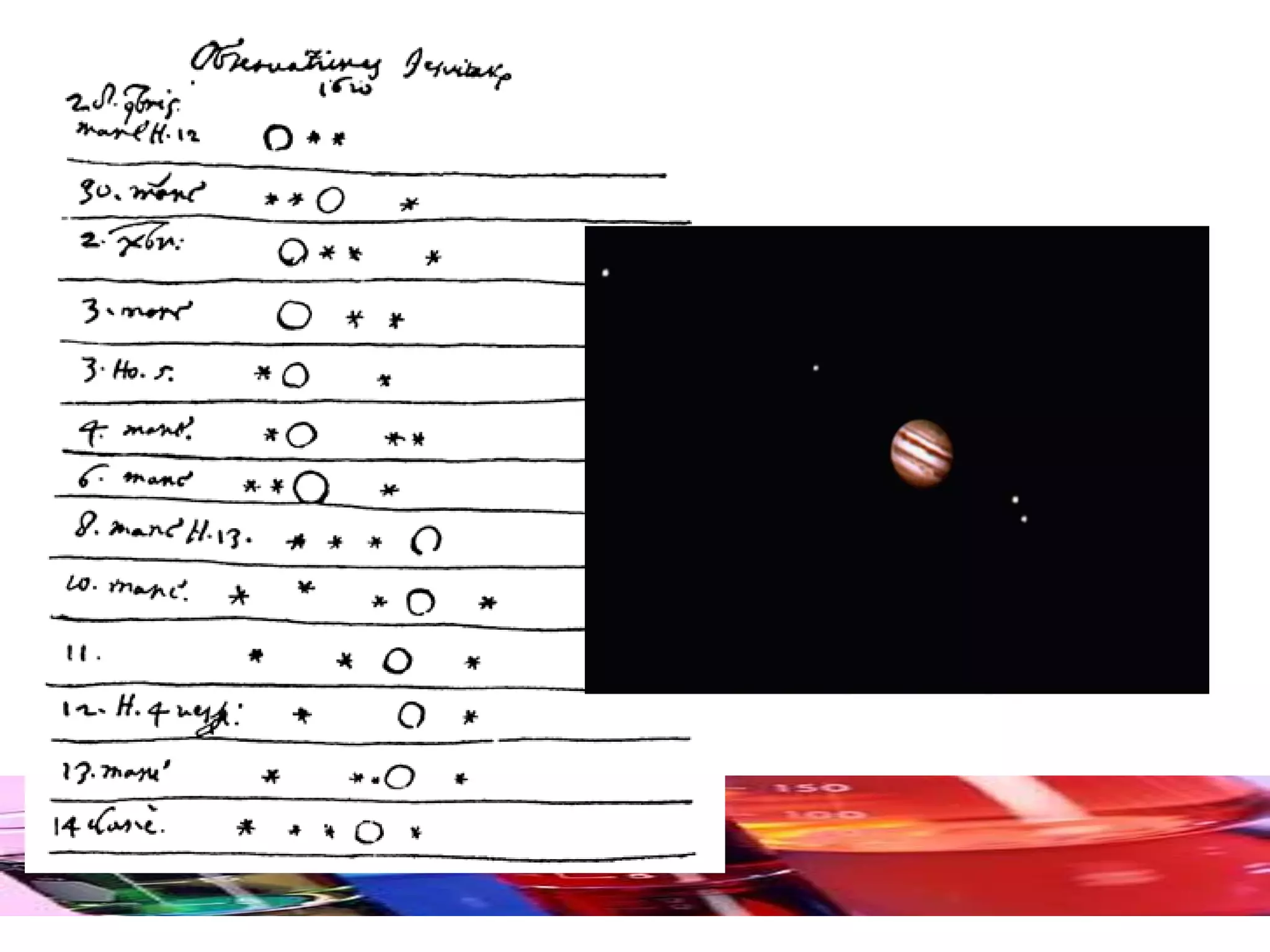
3. The new instrument, the telescope and the discovery that
there are moons that revolve around Saturn. See next slide
4. Suggestion of the heliocentric model. Only apparent
movement of the sun around the Earth
Real or Apparent Movement of the
Sun.
Can you design an investigation to model the
heliocentric and geocentric movement of the
Sun?
What type of investigation is this?
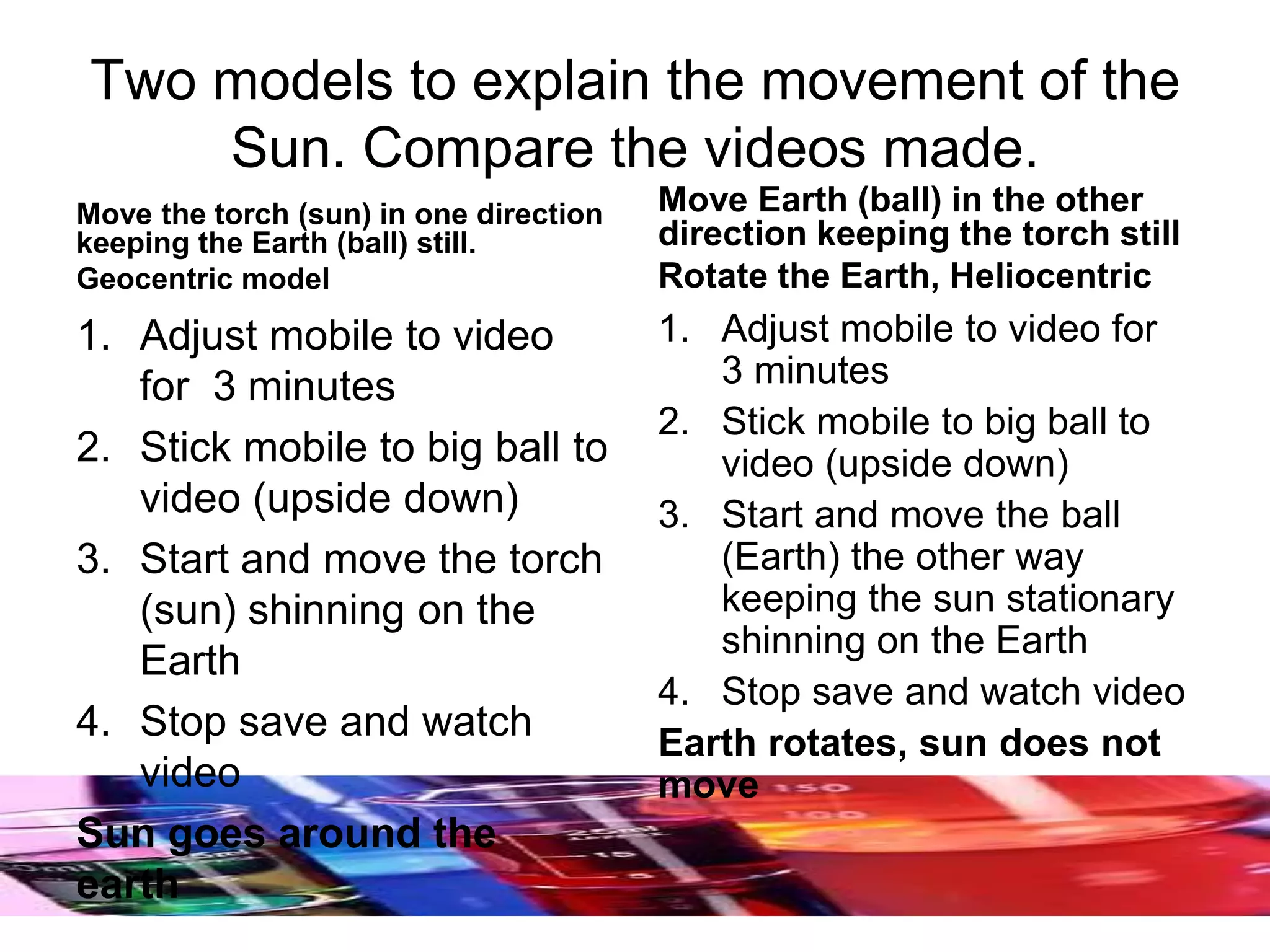
Two models to explain the movement of the
Sun. Compare the videos made.
Move the torch (sun) in one direction
keeping the Earth (ball) still.
Geocentric model
1. Adjust mobile to video
for 3 minutes
2. Stick mobile to big ball to
video (upside down)
3. Start and move the torch
(sun) shinning on the
Earth
4. Stop save and watch
video
Sun goes around the
earth
Move Earth (ball) in the other
direction keeping the torch still
Rotate the Earth, Heliocentric
1. Adjust mobile to video for
3 minutes
2. Stick mobile to big ball to
video (upside down)
3. Start and move the ball
(Earth) the other way
keeping the sun stationary
shinning on the Earth
4. Stop save and watch video
Earth rotates, sun does not
move
Earth and Space
Part three
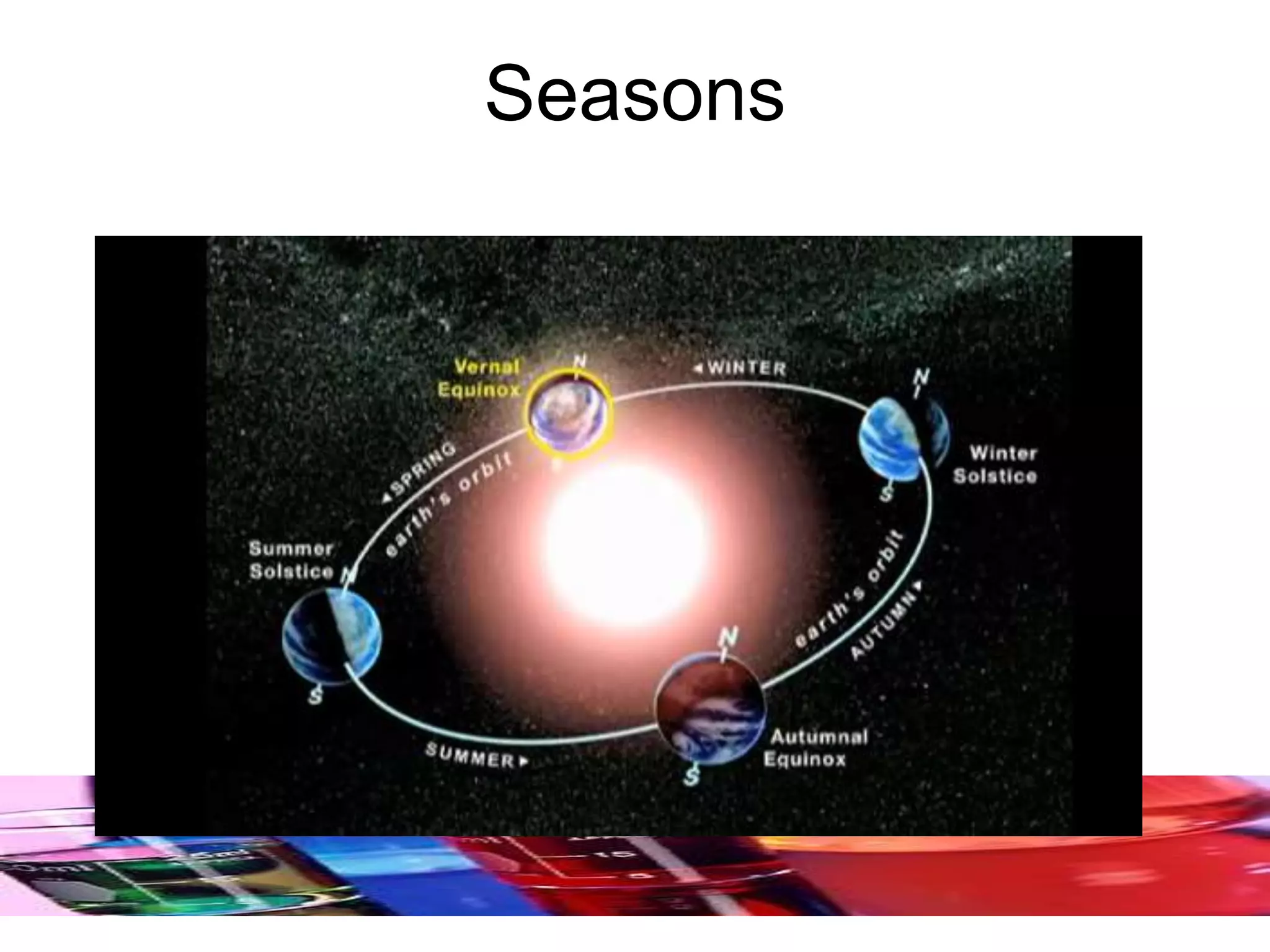
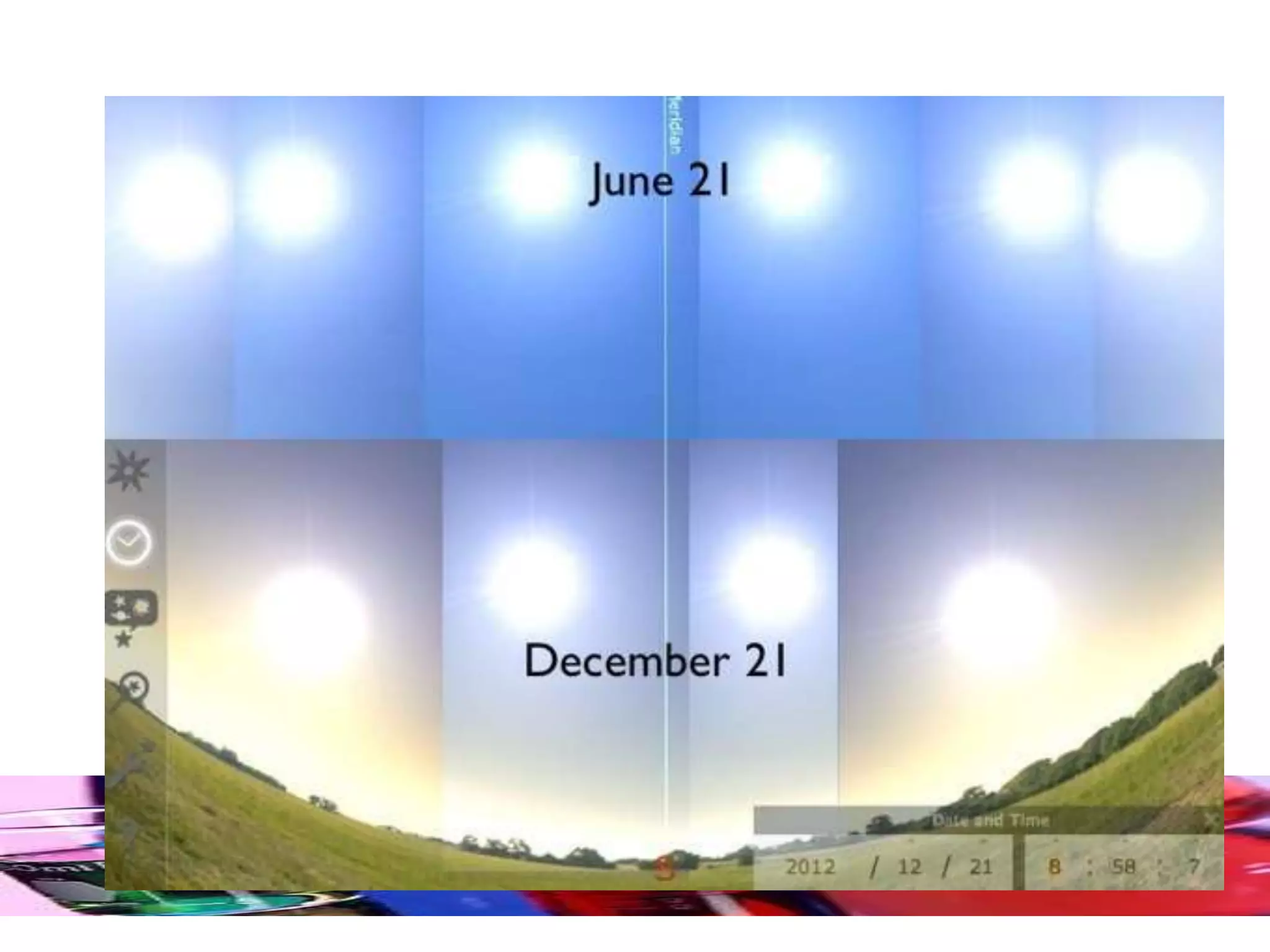
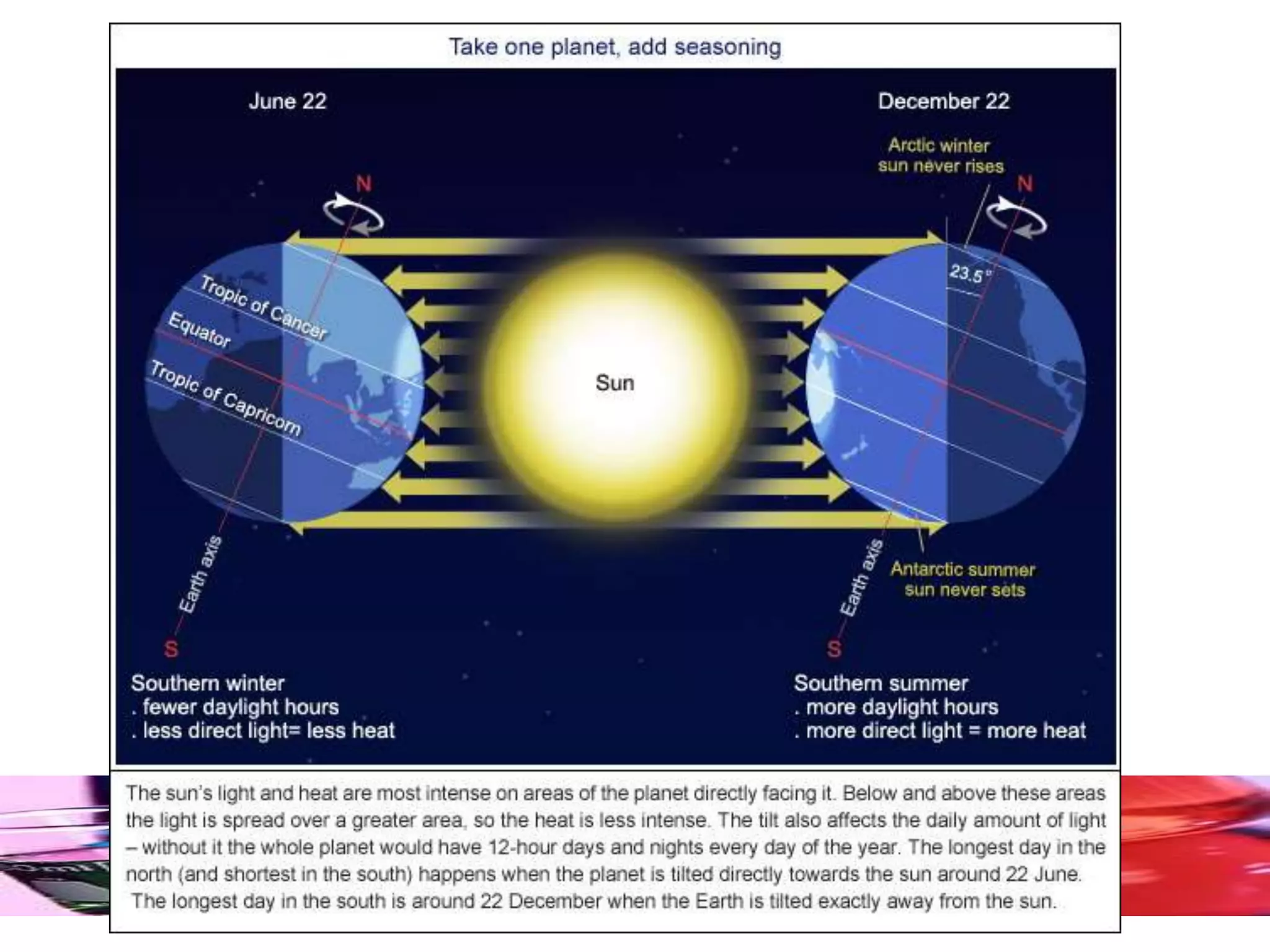
The sun at noon during the year;
seasons
Seasons
• http://www.youtube.com/watch?v=lmIFXIX
QQ_E
• “One year in 40 seconds” google video
• All the nights have been removed!
• Children to discuss and describe what
they see.
New NC Seasons Yr 1
• Seasonal changes
• Pupils should be taught to:
• observe changes across the 4 seasons
• observe and describe weather associated with the seasons and how day length varies
• Notes and guidance (non-statutory)
• Pupils should observe and talk about changes in the weather and the seasons.
• Note: pupils should be warned that it is not safe to look directly at the sun, even when
wearing dark glasses.
• Pupils might work scientifically by: making tables and charts about the weather; and
making displays of what happens in the world around them, including day length, as the
seasons change.
Seasons
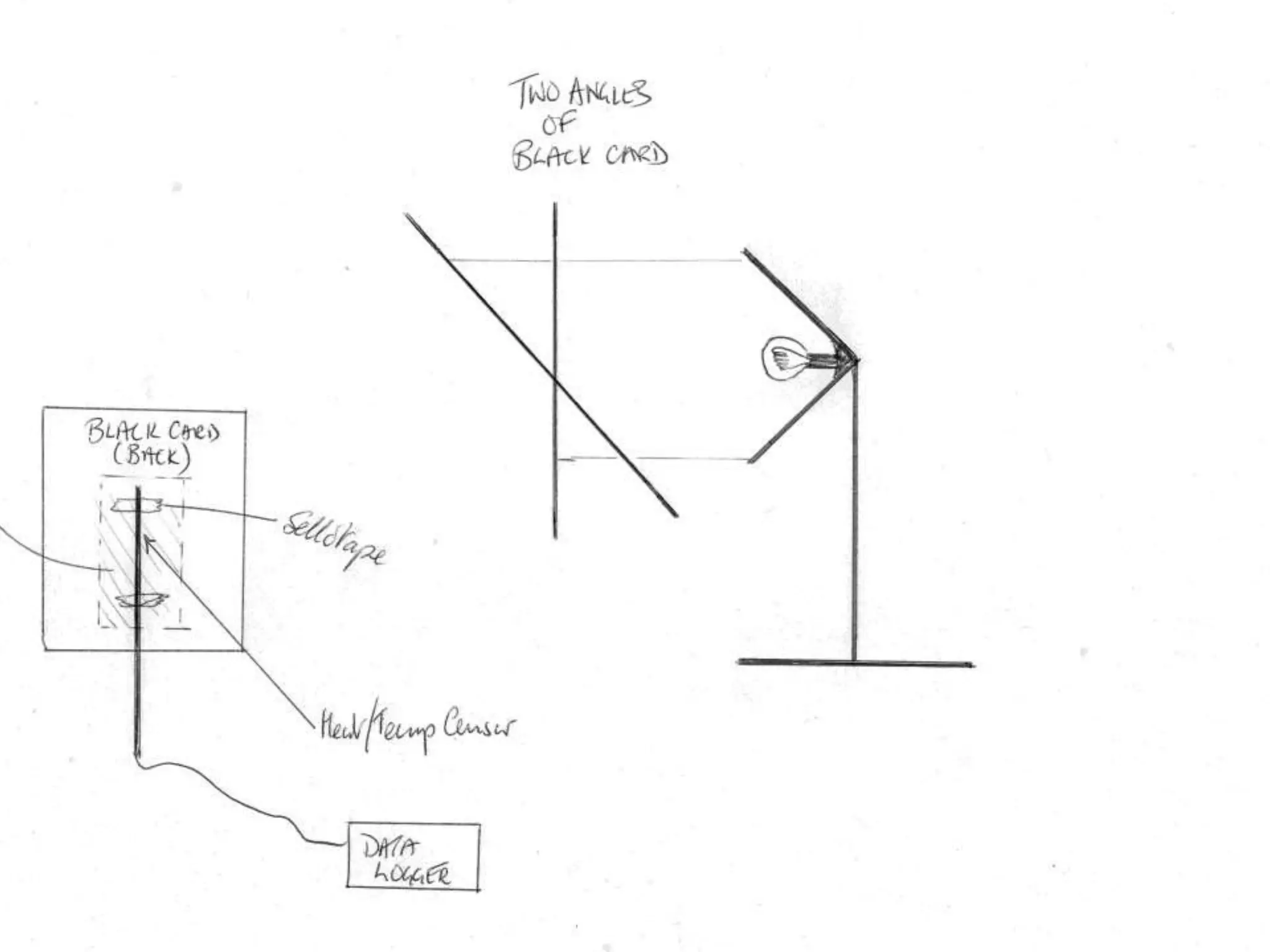
Incidental light practical
• Data loggers with heat censor under black
card with microscope lamps shining on the
card
• Track temperature change with time
• See sketch
Earth and Space
Part Four
Apparent movement of the stars.
Star movement
http://www.youtube.com/watch?v=
3V3rmDG5J8A
Phases of the MOON
• http://www.youtube.com/watch?v=bWeaQ
ctUp1c
• 6 mins 34 seconds
Directed task
a) Working in pairs: 1. Video 5-15 minutes of a clear night’s
sky and share in the session. 2. Collect or make a series of
panoramic pictures of the same view at hourly intervals
making sure it contains the sun. Try to start at sun rise and
end at sun set. (You could plot the apparent movement of
the sun ‘across a window’ and take a picture of the
plotting).
b) To make a collage of pictures from 10 places around the
world (all different countries, at least 1 from each
continent). The pictures taken at the same moment and
each picture have a caption containing the date and local
time.
Record your work
• Record your work in some way. Think
creatively!
• How could you communicate what you
have done and what you have found out
MOST effectively? Do you have to write?
Could you use another way?
Assess your performance
• What skills and/or concepts were you
practising in your activity?
• Look at AT1. What level were you working
at?
• What targets would you set for your future
practice?
• What questions followed from your initial
investigation?
Levelling
Self Assessment
• Using a copy of the Attainment Target for
Science 1 Scientific Enquiry .Identify the
skill level you have reached in today’s
investigation.
• Write down the next steps for your
progress in this aspect of science learning.
.
Mind Map to Concept Map
-the assessment of the
understanding of
vocabulary
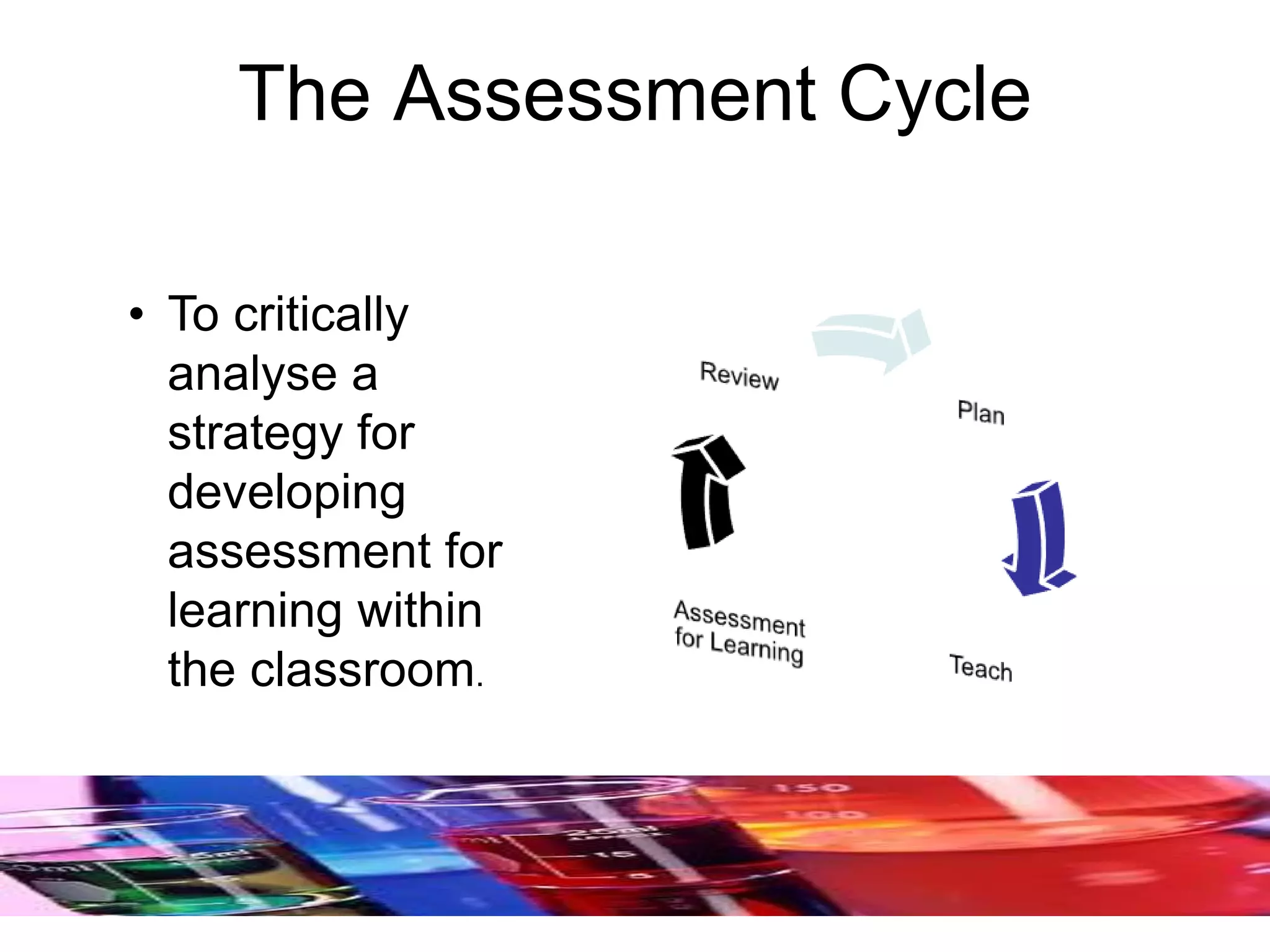
The Assessment Cycle
• To critically
analyse a
strategy for
developing
assessment for
learning within
the classroom.
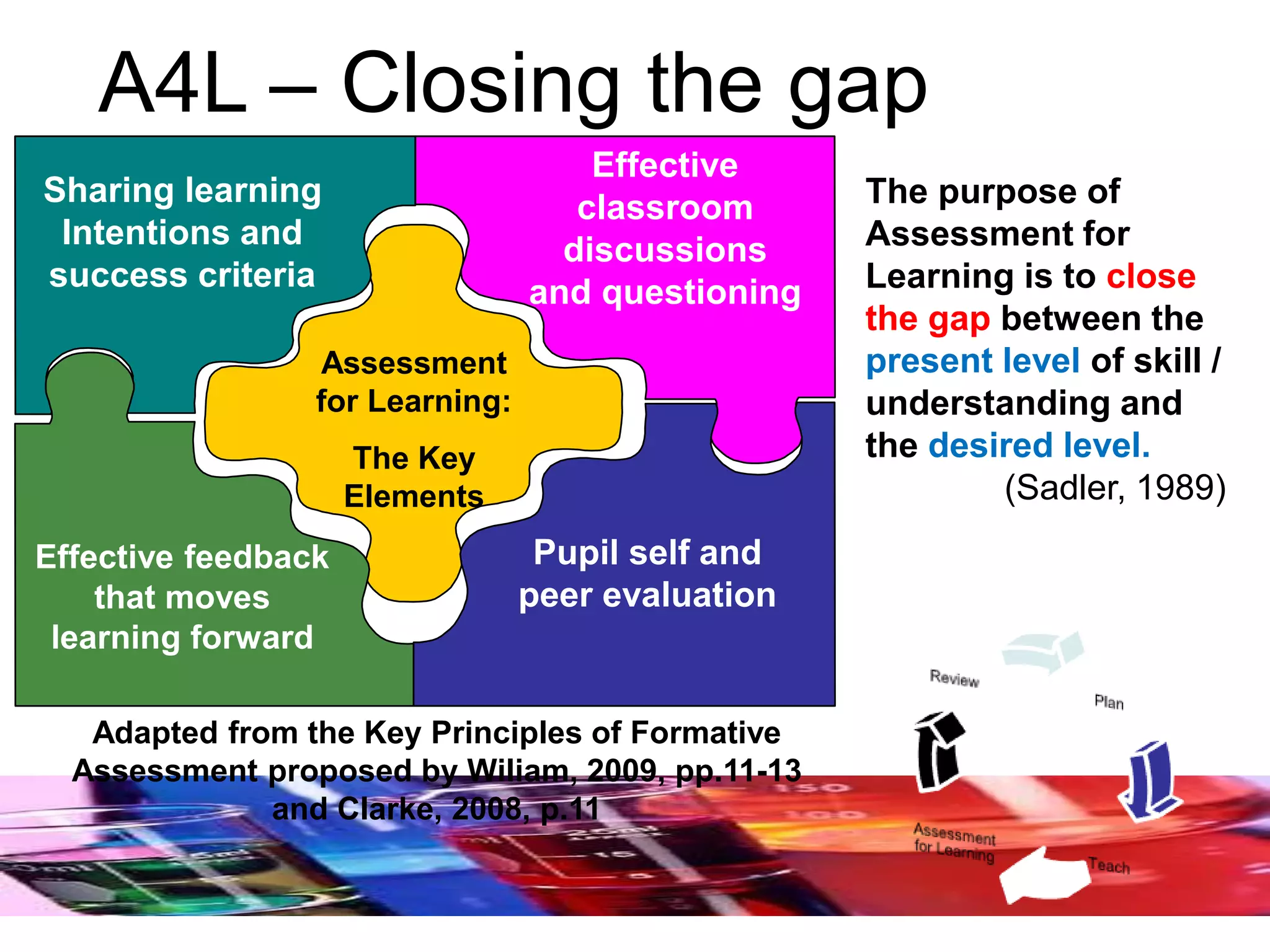
Assessment
for Learning:
The Key
Elements
Effective
classroom
discussions
and questioning
Sharing learning
Intentions and
success criteria
Effective feedback
that moves
learning forward
Pupil self and
peer evaluation
A4L – Closing the gap
Adapted from the Key Principles of Formative
Assessment proposed by Wiliam, 2009, pp.11-13
and Clarke, 2008, p.11
The purpose of
Assessment for
Learning is to close
the gap between the
present level of skill /
understanding and
the desired level.
(Sadler, 1989)
Effective
classroom
discussions
and
questioning
‘If you have to talk,
you have to
think…and I get to
learn things from
other people I didn’t
know’
5 year old
Generating quality
dialogue to support assessment
When planning, think carefully about
generating opportunities to assess
• Consider alternatives to I-R-F (Initiation-response-feedback)
• Talk partners – think, pair, share
• Try hands up after giving individual thinking time
• Scaffolded feedback expectancy – ‘it could be you!’ e.g. lolly
sticks
• Ask children to jot ideas on a whiteboard and share with
others first
• Avoid hands up altogether...there are many other ways
Effective
classroom
discussions
and
questioning
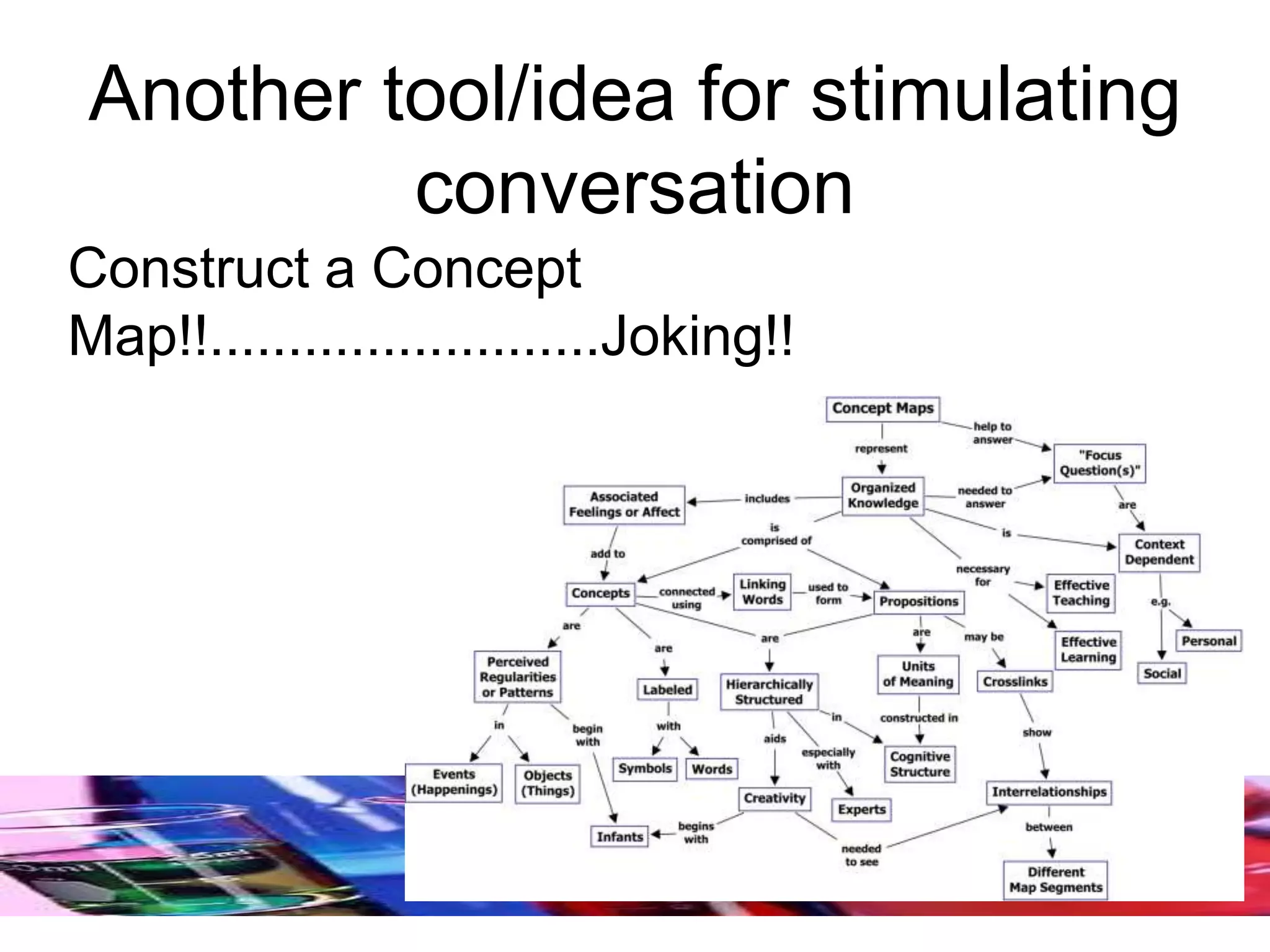
Another tool/idea for stimulating
conversation
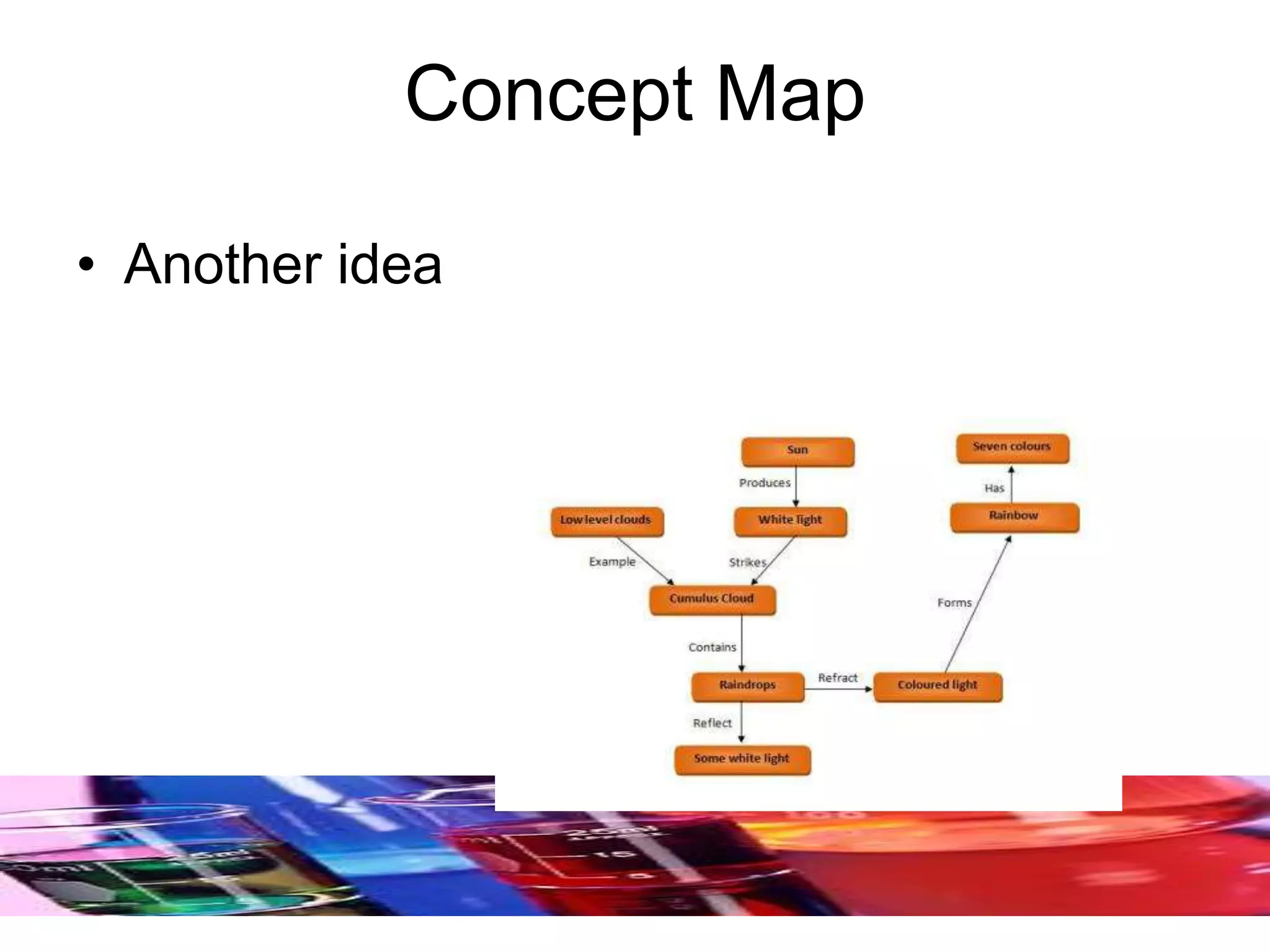
Construct a Concept
Map!!.........................Joking!!
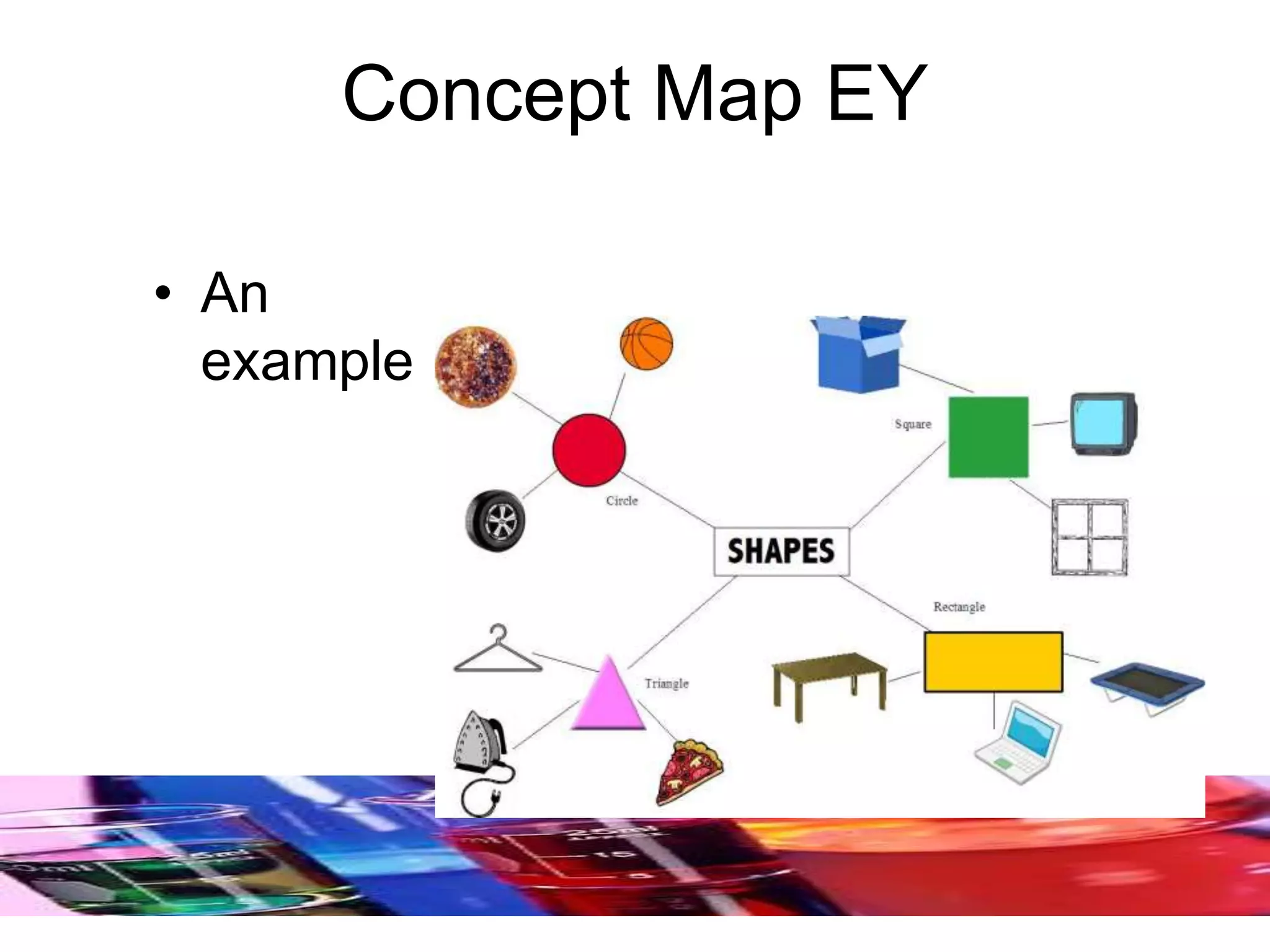
Concept Map EY
• An
example
Concept Map
• Another idea
Why is talk important?
• Vygotsky identifies language as the ‘tool of tools’
(Wells, 1999 p7 cited in Adey & Serret, 2010 p96),
comparing how manual labour is supported by
technical tools, with how mental activity is
supported by the psychological device of language
(Adey & Serret, 2010 p96).
• Adey, P. & Serret, N. (2010) ‘Science Teaching &
Cognitive Accelertion’, in Osborne, J. & Dillon
(2010) Good Practice in Science Teaching: What
research has to say (2nd edition). Maidenhead:
Open University Press, p82-107
Constructing Meaning
• Regarding the culture as that of the
scientific community in which the pupil
receives their science education, this
dictates that it is the role of the teacher to
‘introduce and explain this new vocabulary
; the challenge for the student is to
construct new meanings from such a
language’ (Evagorou and Osborne, 2010 p
136)
• Evagorou, M. & Osborne, J. ( 2010) ‘The
How will you do this?
• Your task is to work collaboratively in
order to construct a concept map that is
representative of your ability to think and
create new meaning building in order to
isolate the concepts that are relevant and
construct valid new schema (Novak, 2005
).
• Novak, J. (2005) ‘Results and Implications
of a 12-Year Longitudinal Study of Science
Theorists
• Piaget recognises that children must construct
mental structures for themselves and considered
that this was relevant to the developmental
stage.
• Vygotsky-start with what the child already
knows.
• Ausubel-unlike Piaget-considered that the
understanding is specific to the context-not the
developmental stage!
Why not just do a practical
investigation?
• Research suggests that educational artefacts i.e.
whether theoretical/conceptual or
practical/laboratory impose the same limitations.
• Karim Mikael Hamza & Per-Olof Wickman
(2012): ‘Student Engagement with Artefacts and
Scientific Ideas in a Laboratory and a Concept-
Mapping Activity’, International Journal of
Science Education, 1 (24) pp. 1-24

Uni session 2 communication for effective learning core level 6 clic(2)

  • 1.
  • 2.
    Aims • To consolidateunderstanding of different types of practical science activities and consider their benefits, limitations and challenges in terms of assessment. • To explore a variety of ways that investigation findings can be conveyed effectively.
  • 6.
    Types of investigations(AKSIS Project) • Fair test investigation • Classifying • Survey/Pattern seeking • Exploring
  • 7.
    Illustrative Activities • childrento arrive at the same conclusion • involves direction by teacher at most stages • focuses children’s attention directly on what is to be observed • tells children what to do • prescribes methods of recording and communication • provides experiences from which children can raise their own testable ideas • it’s a bit like a recipe. (NCC, 1992)
  • 8.
    Investigations • encourages childrento raise their own questions, predictions and statements • allows children to plan for themselves how the investigation will proceed • allows children to work independently, making decisions for themselves about what to change and what to measure • allows children to select the most appropriate equipment for gathering measurements • encourages children to record and display their results in their own way • allows children to interpret their own data • encourages further questions for investigation • enables children to refine both concepts and procedures from their own starting points. (NCC, 1992)
  • 9.
  • 10.
    Reading Preparatory tasks To read,Padalkar, Shamin ; Ramadas and Jayashree (2011) Designed and Spontaneous Gestures in Elementary Astronomy Education. International Journal of Science Education, 2011, Vol.33(12), p.1703-1739 Available at: http://www.tandfonline.com/doi/full/10.1080/095 00693.2010.520348
  • 12.
    Earth and Space andCommunication Part One The passage of the sun through the sky during the day
  • 13.
    New NC Yr5 • Earth and space • Pupils should be taught to: • describe the movement of the Earth and other planets relative to the sun in the solar system • describe the movement of the moon relative to the Earth • describe the sun, Earth and moon as approximately spherical bodies • use the idea of the Earth’s rotation to explain day and night and the apparent movement of the sun across the sky
  • 14.
    • Notes andguidance (non-statutory) • Pupils should be introduced to a model of the sun and Earth that enables them to explain day and night. Pupils should learn that the sun is a star at the centre of our solar system and that it has 8 planets: Mercury, Venus, Earth, Mars, Jupiter, Saturn, Uranus and Neptune (Pluto was reclassified as a ‘dwarf planet’ in 2006). They should understand that a moon is a celestial body that orbits a planet (Earth has 1 moon; Jupiter has 4 large moons and numerous smaller ones). Note: pupils should be warned that it is not safe to look directly at the sun, even when wearing dark glasses. Pupils should find out about the way that ideas about the solar system have developed, understanding how the geocentric model of the solar system gave way to the heliocentric model by considering the work of scientists such as Ptolemy, Alhazen and Copernicus. Pupils might work scientifically by: comparing the time of day at different places on the Earth through internet links and direct communication; creating simple models of the solar system; constructing simple shadow clocks and sundials, calibrated to show midday and the start and end of the school day; finding out why some people think that structures such as Stonehenge might have been used as astronomical clocks.
  • 15.
    The Universe • http://www.youtube.com/watch?v=RCUhm 63ioCU •Planets around the Sun –rap • http://www.youtube.com/watch?v=nQfJ7j2 UGGk
  • 16.
    Survey/Pattern finding Investigation Ingroups of 3 or 4: Is there a relationship between the position of the sun and the length of the shadow?
  • 17.
    Modelling the sun’spassage • Plot the shadows on the sand • Measure the shadow lengths • Plot a graph of the lengths in order • What is significant about “one” shadow and what does it tells you about direction every time? • What happens to this special shadow during the year?
  • 18.
    Making a Sundial •This activity is to mirror what will happen when children make a sundial using a stick in a tray of sand and the sun’s light over a period of time from morning to afternoon. • They will observe, measure, tabulate, plot and describe what they see. The activity is dependant on the age, ability and prior knowledge and experience of the child/children.
  • 19.
    The Sundial Activity •Tray of sand, stick, string, ruler, markers (cocktails sticks), torch. • The torch rises in the East, rises over the stick using a southern arc and sets in the West. • Draw a sketch. • 15 minute activity for you with this modelling, how would you plan this with your children when they have to record the shadow every 30 mins?
  • 22.
    “Answers” to theactivity! http://www.youtube.com/watch?v=z WueOSLpbbw Sun Compass Southern Hemisphere
  • 23.
    Other links • Specialdays in the year linked to day length • The English quarter days are: • Lady Day (25 March), New Year until 1752! • Midsummer Day (24 June) • Michaelmas (29 September) • Christmas (25 December) • Henges and stone circles identifying these days
  • 24.
    Real or ApparentMovement of the Sun. 1. Discuss the Geocentric Model linking it to: • Obvious but incorrect statement: rotation of the sun around the earth • The Church, the nature of creation, the earth at the centre of the universe. • All heavenly bodies revolve around the earth. 2. Copernicus and the alternative heretic mathematical model with the sun at the centre. Denounced by the church. 3. The new instrument, the telescope and the discovery that there are moons that revolve around Saturn. See next slide 4. Suggestion of the heliocentric model. Only apparent movement of the sun around the Earth
  • 26.
    Real or ApparentMovement of the Sun. Can you design an investigation to model the heliocentric and geocentric movement of the Sun? What type of investigation is this?
  • 27.
    Two models toexplain the movement of the Sun. Compare the videos made. Move the torch (sun) in one direction keeping the Earth (ball) still. Geocentric model 1. Adjust mobile to video for 3 minutes 2. Stick mobile to big ball to video (upside down) 3. Start and move the torch (sun) shinning on the Earth 4. Stop save and watch video Sun goes around the earth Move Earth (ball) in the other direction keeping the torch still Rotate the Earth, Heliocentric 1. Adjust mobile to video for 3 minutes 2. Stick mobile to big ball to video (upside down) 3. Start and move the ball (Earth) the other way keeping the sun stationary shinning on the Earth 4. Stop save and watch video Earth rotates, sun does not move
  • 28.
    Earth and Space Partthree The sun at noon during the year; seasons
  • 29.
    Seasons • http://www.youtube.com/watch?v=lmIFXIX QQ_E • “Oneyear in 40 seconds” google video • All the nights have been removed! • Children to discuss and describe what they see.
  • 30.
    New NC SeasonsYr 1 • Seasonal changes • Pupils should be taught to: • observe changes across the 4 seasons • observe and describe weather associated with the seasons and how day length varies • Notes and guidance (non-statutory) • Pupils should observe and talk about changes in the weather and the seasons. • Note: pupils should be warned that it is not safe to look directly at the sun, even when wearing dark glasses. • Pupils might work scientifically by: making tables and charts about the weather; and making displays of what happens in the world around them, including day length, as the seasons change.
  • 31.
  • 34.
    Incidental light practical •Data loggers with heat censor under black card with microscope lamps shining on the card • Track temperature change with time • See sketch
  • 37.
    Earth and Space PartFour Apparent movement of the stars.
  • 38.
  • 39.
    Phases of theMOON • http://www.youtube.com/watch?v=bWeaQ ctUp1c • 6 mins 34 seconds
  • 40.
    Directed task a) Workingin pairs: 1. Video 5-15 minutes of a clear night’s sky and share in the session. 2. Collect or make a series of panoramic pictures of the same view at hourly intervals making sure it contains the sun. Try to start at sun rise and end at sun set. (You could plot the apparent movement of the sun ‘across a window’ and take a picture of the plotting). b) To make a collage of pictures from 10 places around the world (all different countries, at least 1 from each continent). The pictures taken at the same moment and each picture have a caption containing the date and local time.
  • 41.
    Record your work •Record your work in some way. Think creatively! • How could you communicate what you have done and what you have found out MOST effectively? Do you have to write? Could you use another way?
  • 42.
    Assess your performance •What skills and/or concepts were you practising in your activity? • Look at AT1. What level were you working at? • What targets would you set for your future practice? • What questions followed from your initial investigation?
  • 43.
    Levelling Self Assessment • Usinga copy of the Attainment Target for Science 1 Scientific Enquiry .Identify the skill level you have reached in today’s investigation. • Write down the next steps for your progress in this aspect of science learning. .
  • 44.
    Mind Map toConcept Map -the assessment of the understanding of vocabulary
  • 45.
    The Assessment Cycle •To critically analyse a strategy for developing assessment for learning within the classroom.
  • 46.
    Assessment for Learning: The Key Elements Effective classroom discussions andquestioning Sharing learning Intentions and success criteria Effective feedback that moves learning forward Pupil self and peer evaluation A4L – Closing the gap Adapted from the Key Principles of Formative Assessment proposed by Wiliam, 2009, pp.11-13 and Clarke, 2008, p.11 The purpose of Assessment for Learning is to close the gap between the present level of skill / understanding and the desired level. (Sadler, 1989)
  • 47.
    Effective classroom discussions and questioning ‘If you haveto talk, you have to think…and I get to learn things from other people I didn’t know’ 5 year old
  • 48.
    Generating quality dialogue tosupport assessment When planning, think carefully about generating opportunities to assess • Consider alternatives to I-R-F (Initiation-response-feedback) • Talk partners – think, pair, share • Try hands up after giving individual thinking time • Scaffolded feedback expectancy – ‘it could be you!’ e.g. lolly sticks • Ask children to jot ideas on a whiteboard and share with others first • Avoid hands up altogether...there are many other ways Effective classroom discussions and questioning
  • 49.
    Another tool/idea forstimulating conversation Construct a Concept Map!!.........................Joking!!
  • 50.
  • 51.
  • 52.
    Why is talkimportant? • Vygotsky identifies language as the ‘tool of tools’ (Wells, 1999 p7 cited in Adey & Serret, 2010 p96), comparing how manual labour is supported by technical tools, with how mental activity is supported by the psychological device of language (Adey & Serret, 2010 p96). • Adey, P. & Serret, N. (2010) ‘Science Teaching & Cognitive Accelertion’, in Osborne, J. & Dillon (2010) Good Practice in Science Teaching: What research has to say (2nd edition). Maidenhead: Open University Press, p82-107
  • 53.
    Constructing Meaning • Regardingthe culture as that of the scientific community in which the pupil receives their science education, this dictates that it is the role of the teacher to ‘introduce and explain this new vocabulary ; the challenge for the student is to construct new meanings from such a language’ (Evagorou and Osborne, 2010 p 136) • Evagorou, M. & Osborne, J. ( 2010) ‘The
  • 54.
    How will youdo this? • Your task is to work collaboratively in order to construct a concept map that is representative of your ability to think and create new meaning building in order to isolate the concepts that are relevant and construct valid new schema (Novak, 2005 ). • Novak, J. (2005) ‘Results and Implications of a 12-Year Longitudinal Study of Science
  • 55.
    Theorists • Piaget recognisesthat children must construct mental structures for themselves and considered that this was relevant to the developmental stage. • Vygotsky-start with what the child already knows. • Ausubel-unlike Piaget-considered that the understanding is specific to the context-not the developmental stage!
  • 56.
    Why not justdo a practical investigation? • Research suggests that educational artefacts i.e. whether theoretical/conceptual or practical/laboratory impose the same limitations. • Karim Mikael Hamza & Per-Olof Wickman (2012): ‘Student Engagement with Artefacts and Scientific Ideas in a Laboratory and a Concept- Mapping Activity’, International Journal of Science Education, 1 (24) pp. 1-24