
SCIENCE &
TECHNOLOGY
FOR
SPECIALLY
ABLED
PERSONS
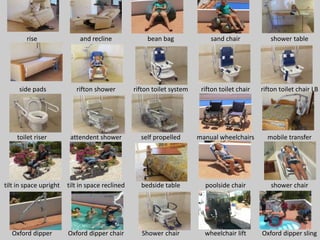
rise and recline bean bag sand chair shower table
side pads rifton shower rifton toilet system rifton toilet chair rifton toilet chair LB
toilet riser attendent shower self propelled manual wheelchairs mobile transfer
tilt in space upright tilt in space reclined bedside table poolside chair shower chair
Oxford dipper Oxford dipper chair Shower chair wheelchair lift Oxford dipper sling
E.HARSHITHA
IX-A
KV,UOH
INTRODUCTION
• In today’s world everybody seems to be so much
preoccupied that there is no time to think about other
people.
• We forget about the differently abled people, the difficult
task that they face in doing day to day activities.
• This is all because today’s world doesn’t care about them.
Nothing here is designed for them. So thinking of those
people here is a technology that will help them and us also
to understand them better.
INTRODUCTION
In today’s world there are about 10 billion who
are deaf dumb and blind. They face very
hardships in life, to do day to day activities and
to communicate with each other and normal
people. They face very difficulty in conveying
their thoughts. They use sign language to
communicate with people. There are different
hand gestures for different words, letters. The
blind read through Braille script. But the
problem is that not all the books are translated
in the Braille form. So through this technology
we can help the differently abled to easily
communicate with us.
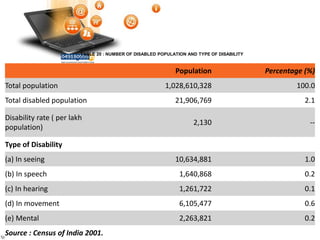
Population Percentage (%)
Total population 1,028,610,328 100.0
Total disabled population 21,906,769 2.1
Disability rate ( per lakh
population)
2,130 --
Type of Disability
(a) In seeing 10,634,881 1.0
(b) In speech 1,640,868 0.2
(c) In hearing 1,261,722 0.1
(d) In movement 6,105,477 0.6
(e) Mental 2,263,821 0.2
Source : Census of India 2001.
TABLE 20 : NUMBER OF DISABLED POPULATION AND TYPE OF DISABILITY
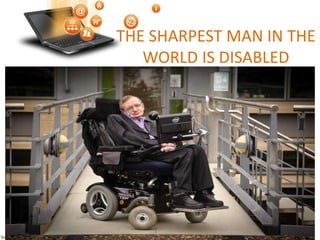
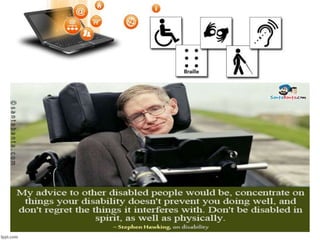
THE SHARPEST MAN IN THE
WORLD IS DISABLED
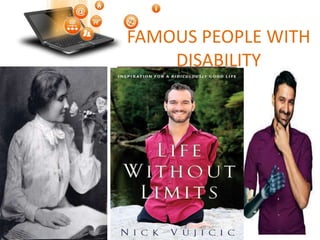
FAMOUS PEOPLE WITH
DISABILITY
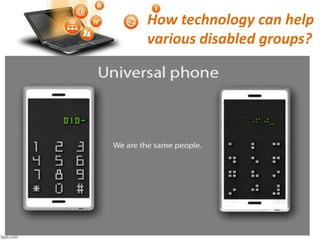
How technology can help
various disabled groups?
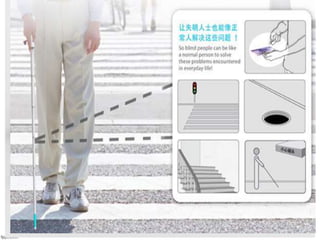
Visual Impairments: Technology can help people with visual
impairments to a greater extent by developing voice control
navigation systems or smart voice recognizers such as Nuance’
that converts text into speech that can help visually impaired
people suffering from low vision or total blindness.
Visually impaired people are the ones who need maximum
assistance. As and when the technology can serve as a solution
to this, one can self assist themselves with the help of guiding
tools like the sensors in the walking stick that can sense bumps
or uneven levels or obstructions that can safeguard the one with
low or no vision.
How technology can help
various disabled groups?
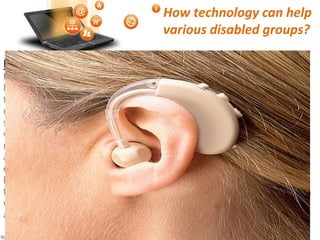
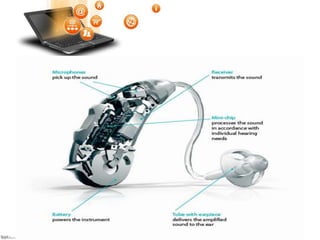
Hearing/Speech Impairments: Amplified sound travels through
the loop and creates an electromagnetic field that is picked up directly
by a hearing loop receiver or a telecoil, a miniature wireless receiver
that is built into many hearing aids. To receive the signal, a listener
must be wearing the receiver and be within or near the loop. As the
sound is taken up directly by the receiver, the sound is much clearer,
without as much of the competing background noise associated with
many listening spaces. Some loop systems are portable, making it
accessible for people with hearing loss to improve their hearing
environments, as required, as they proceed with their daily agenda’s. A
hearing loop can also be connected to a public service system, a
television, or any other audio source that produces sound. Hearing aids
with embedded systems of tele coils or portable loop receivers are also
available that gives a choice of selection for the users.
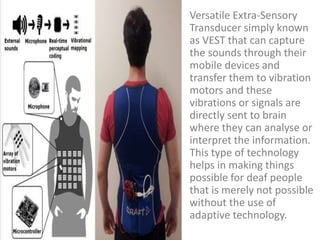
Versatile Extra-Sensory
Transducer simply known
as VEST that can capture
the sounds through their
mobile devices and
transfer them to vibration
motors and these
vibrations or signals are
directly sent to brain
where they can analyse or
interpret the information.
This type of technology
helps in making things
possible for deaf people
that is merely not possible
without the use of
adaptive technology.
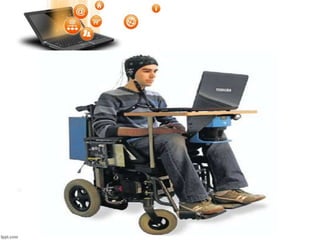
Mobility Impairments: It isn’t a new phenomenon to help
people using technology from the advent of speech
recognitions, to mobilize wheel chairs, to any hearing assistive
technology. The use of adaptive technology can help
providing mobility access to various places, plays a key role in
creating a social status to those with semi ambulatory or
ambulatory impairments
When a person on wheel chair had to move around a space,
he needs navigation control, direction check, obstacles
sensors, gripped breaks, ergonomic design of wheel chair.
When all these are embedded in one wheel chair, it would
definitely help the persons with mobility impairments to have
an easy and comfortable access without any self distinction.
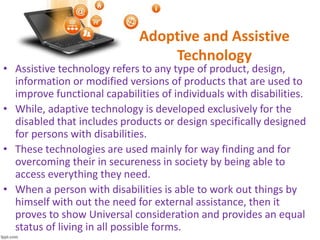
Adoptive and Assistive
Technology
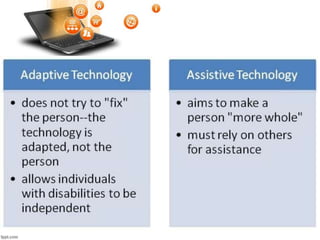
• Assistive technology refers to any type of product, design,
information or modified versions of products that are used to
improve functional capabilities of individuals with disabilities.
• While, adaptive technology is developed exclusively for the
disabled that includes products or design specifically designed
for persons with disabilities.
• These technologies are used mainly for way finding and for
overcoming their in secureness in society by being able to
access everything they need.
• When a person with disabilities is able to work out things by
himself with out the need for external assistance, then it
proves to show Universal consideration and provides an equal
status of living in all possible forms.
CONCLUSION
•Disability is a phase in everyone’s life which can be a parent
with a pram, a person with an injured leg, a child in his
infant age, the elderly people or any disability by birth.
•Treating the problems of all and giving solutions to it in the
form of technological innovations, it would tend to provide a
platform for the disabled to feel normal.
•This particular aspect has to be ensured to make anything
Universal.
• Developing technology that can help the people with
disabilities means giving them a new life or a better life
which they once lived.
SCIENCE AND TECHNOLOGY FOR SPECIALLY ABLED PERSONS-E.HARSHITHA

SCIENCE AND TECHNOLOGY FOR SPECIALLY ABLED PERSONS-E.HARSHITHA

  • 1.
  • 2.
    rise and reclinebean bag sand chair shower table side pads rifton shower rifton toilet system rifton toilet chair rifton toilet chair LB toilet riser attendent shower self propelled manual wheelchairs mobile transfer tilt in space upright tilt in space reclined bedside table poolside chair shower chair Oxford dipper Oxford dipper chair Shower chair wheelchair lift Oxford dipper sling
  • 3.
  • 5.
    INTRODUCTION • In today’sworld everybody seems to be so much preoccupied that there is no time to think about other people. • We forget about the differently abled people, the difficult task that they face in doing day to day activities. • This is all because today’s world doesn’t care about them. Nothing here is designed for them. So thinking of those people here is a technology that will help them and us also to understand them better.
  • 7.
    INTRODUCTION In today’s worldthere are about 10 billion who are deaf dumb and blind. They face very hardships in life, to do day to day activities and to communicate with each other and normal people. They face very difficulty in conveying their thoughts. They use sign language to communicate with people. There are different hand gestures for different words, letters. The blind read through Braille script. But the problem is that not all the books are translated in the Braille form. So through this technology we can help the differently abled to easily communicate with us.
  • 8.
    Population Percentage (%) Totalpopulation 1,028,610,328 100.0 Total disabled population 21,906,769 2.1 Disability rate ( per lakh population) 2,130 -- Type of Disability (a) In seeing 10,634,881 1.0 (b) In speech 1,640,868 0.2 (c) In hearing 1,261,722 0.1 (d) In movement 6,105,477 0.6 (e) Mental 2,263,821 0.2 Source : Census of India 2001. TABLE 20 : NUMBER OF DISABLED POPULATION AND TYPE OF DISABILITY
  • 9.
    THE SHARPEST MANIN THE WORLD IS DISABLED
  • 10.
  • 11.
    How technology canhelp various disabled groups? Visual Impairments: Technology can help people with visual impairments to a greater extent by developing voice control navigation systems or smart voice recognizers such as Nuance’ that converts text into speech that can help visually impaired people suffering from low vision or total blindness. Visually impaired people are the ones who need maximum assistance. As and when the technology can serve as a solution to this, one can self assist themselves with the help of guiding tools like the sensors in the walking stick that can sense bumps or uneven levels or obstructions that can safeguard the one with low or no vision.
  • 13.
    How technology canhelp various disabled groups? Hearing/Speech Impairments: Amplified sound travels through the loop and creates an electromagnetic field that is picked up directly by a hearing loop receiver or a telecoil, a miniature wireless receiver that is built into many hearing aids. To receive the signal, a listener must be wearing the receiver and be within or near the loop. As the sound is taken up directly by the receiver, the sound is much clearer, without as much of the competing background noise associated with many listening spaces. Some loop systems are portable, making it accessible for people with hearing loss to improve their hearing environments, as required, as they proceed with their daily agenda’s. A hearing loop can also be connected to a public service system, a television, or any other audio source that produces sound. Hearing aids with embedded systems of tele coils or portable loop receivers are also available that gives a choice of selection for the users.
  • 15.
    Versatile Extra-Sensory Transducer simplyknown as VEST that can capture the sounds through their mobile devices and transfer them to vibration motors and these vibrations or signals are directly sent to brain where they can analyse or interpret the information. This type of technology helps in making things possible for deaf people that is merely not possible without the use of adaptive technology.
  • 16.
    Mobility Impairments: Itisn’t a new phenomenon to help people using technology from the advent of speech recognitions, to mobilize wheel chairs, to any hearing assistive technology. The use of adaptive technology can help providing mobility access to various places, plays a key role in creating a social status to those with semi ambulatory or ambulatory impairments When a person on wheel chair had to move around a space, he needs navigation control, direction check, obstacles sensors, gripped breaks, ergonomic design of wheel chair. When all these are embedded in one wheel chair, it would definitely help the persons with mobility impairments to have an easy and comfortable access without any self distinction.
  • 18.
    Adoptive and Assistive Technology •Assistive technology refers to any type of product, design, information or modified versions of products that are used to improve functional capabilities of individuals with disabilities. • While, adaptive technology is developed exclusively for the disabled that includes products or design specifically designed for persons with disabilities. • These technologies are used mainly for way finding and for overcoming their in secureness in society by being able to access everything they need. • When a person with disabilities is able to work out things by himself with out the need for external assistance, then it proves to show Universal consideration and provides an equal status of living in all possible forms.
  • 22.
    CONCLUSION •Disability is aphase in everyone’s life which can be a parent with a pram, a person with an injured leg, a child in his infant age, the elderly people or any disability by birth. •Treating the problems of all and giving solutions to it in the form of technological innovations, it would tend to provide a platform for the disabled to feel normal. •This particular aspect has to be ensured to make anything Universal. • Developing technology that can help the people with disabilities means giving them a new life or a better life which they once lived.