S E C A R E A N U C R I S T I N A
B U R G H E L E A A N D R E I
Assistive technology
In what refers the term Assistive Technology?
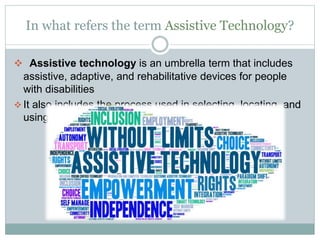
 Assistive technology is an umbrella term that includes
assistive, adaptive, and rehabilitative devices for people
with disabilities
 It also includes the process used in selecting, locating, and
using them.
 It promotes greater independence by enabling people to
perform tasks that they were formerly unable to accomplish,
or had great difficulty accomplishing, by providing
enhancements to, or changing methods of interacting with,
the technology needed to accomplish such tasks.
Classification
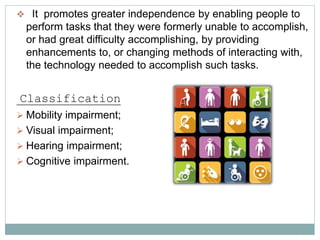
 Mobility impairment;
 Visual impairment;
 Hearing impairment;
 Cognitive impairment.
Mobility impairment
Wheelchairs
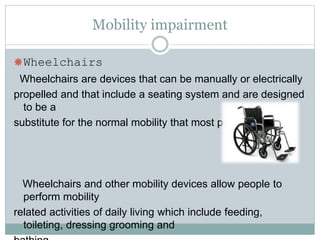
Wheelchairs are devices that can be manually or electrically
propelled and that include a seating system and are designed
to be a
substitute for the normal mobility that most people enjoy.
Wheelchairs and other mobility devices allow people to
perform mobility
related activities of daily living which include feeding,
toileting, dressing grooming and
The devices comes in a number of variations where they can
be propelled either by hand or by motors where the occupant
uses electrical controls to manage motors and seating control
actuators through a joystick, sip-and-puff control, or other input
devices.
Walkers
A walker or walking frame is a tool for disabled people who
need additional support to maintain balance or stability while
walking.
It consists of a frame that is about waist high,
approximately twelve inches deep and slightly wider than the
user. Walkers are also available in other sizes, such as for
children, or for heavy people. Modern walkers are height-
adjustable.
Visual impairment
 Many people with serious visual impairments live
independently, using a wide range of tools and
techniques.
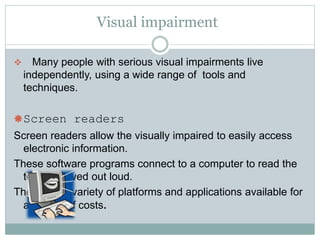
Screen readers
Screen readers allow the visually impaired to easily access
electronic information.
These software programs connect to a computer to read the
text displayed out loud.
There are a variety of platforms and applications available for
a variety of costs.
Braille and braille embossers
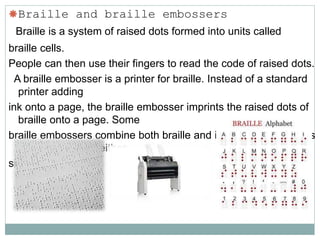
Braille is a system of raised dots formed into units called
braille cells.
People can then use their fingers to read the code of raised dots.
A braille embosser is a printer for braille. Instead of a standard
printer adding
ink onto a page, the braille embosser imprints the raised dots of
braille onto a page. Some
braille embossers combine both braille and ink so the documents
can be read with either
sight or touch.
Hearing impairment
 Individuals who are deaf or hard of hearing utilize a variety of
assistive technologies
that provide them with improved accessibility to information in
numerous
environments.Most devices either provide amplified sound or
alternate ways to
access information through vision and/or vibration.
 Hearing aids
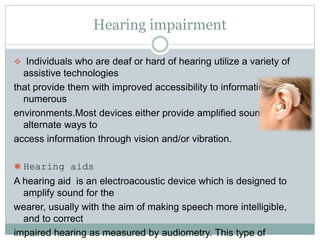
A hearing aid is an electroacoustic device which is designed to
amplify sound for the
wearer, usually with the aim of making speech more intelligible,
and to correct
impaired hearing as measured by audiometry. This type of
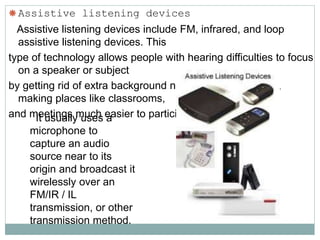
 Assistive listening devices
Assistive listening devices include FM, infrared, and loop
assistive listening devices. This
type of technology allows people with hearing difficulties to focus
on a speaker or subject
by getting rid of extra background noises and distractions,
making places like classrooms,
and meetings much easier to participate in.It usually uses a
microphone to
capture an audio
source near to its
origin and broadcast it
wirelessly over an
FM/IR / IL
transmission, or other
transmission method.
Cognitive impairment
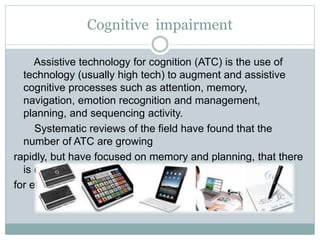
Assistive technology for cognition (ATC) is the use of
technology (usually high tech) to augment and assistive
cognitive processes such as attention, memory,
navigation, emotion recognition and management,
planning, and sequencing activity.
Systematic reviews of the field have found that the
number of ATC are growing
rapidly, but have focused on memory and planning, that there
is emerging evidence
for efficacy, that a lot of scope exists to develop new ATC.
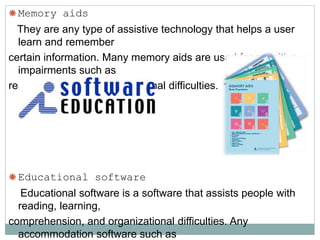
 Memory aids
They are any type of assistive technology that helps a user
learn and remember
certain information. Many memory aids are used for cognitive
impairments such as
reading, writing, or organizational difficulties.
 Educational software
Educational software is a software that assists people with
reading, learning,
comprehension, and organizational difficulties. Any
accommodation software such as
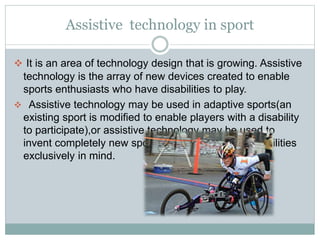
Assistive technology in sport
 It is an area of technology design that is growing. Assistive
technology is the array of new devices created to enable
sports enthusiasts who have disabilities to play.
 Assistive technology may be used in adaptive sports(an
existing sport is modified to enable players with a disability
to participate),or assistive technology may be used to
invent completely new sports with athletes with disabilities
exclusively in mind.
 An increasing number of people with disabilities are
participating in sports.
 Assistive technology devices can be simple(low-tech), or
they may use highly advanced technology, with some even
using computers.
 Assistive technology for sports may also be simple, or
advanced. Accordingly, it can be found in sports ranging
from local community recreation to the elite Paralympic
Games.
 More complex assistive technology devices have been
developed over time, and as a result, sports for people with
disabilities "have changed from being a clinical therapeutic
tool to an increasingly competition-oriented activity".
Assistive Technologies Worldwide
 The United Nations (UN) and the World Health
Organization (WHO) are champions for the international
rights and worldwide dignity of individuals with disability
and impairment.
 UN is an international organization of over 192 member
states, organized for the purpose of furthering worldwide
economic development, human rights, international law,
international security, social progress and world peace.
 WHO is a branch of the UN charged with directing and
coordinating health initiatives within the UN.
 These two entities understand the global magnitude of
health, prevention, rehabilitation, and equal opportunity for
those with disability. They encourage research, public policy,
health services, community education, technology, and
support services geared toward inclusion. They underscore
the cost to society of exclusion and emphasize the benefit of
inclusive environments.
 WHO defines disability as a complex phenomenon that
involves the interaction between an individual with impairment
and the societal environment in which he or she lives.
Word Programme of Action Concerning
Disabled Persons
 By adopting the World Programme of Action Concerning
Disabled Persons on December 3, 1982, the United
Nations initiated a global strategy to enhance disability
prevention, optimize rehabilitation, and equalize
opportunities for persons with disabilities. This program
addressed disability from a human rights perspective.
 It advocates three defined areas for action:
1. Prevention – measures to prevent the onset of mental,
physical and sensory
impairment. When impairment occurs, prevent the
impairment from having a negative
physical, psychological, or social consequence.
2. Rehabilitation – providing a goal-oriented and time-limited
process to enable the
person with impairment to reach an optimum mental, physical,
and social functioning level.
This involves exposing the individual to methods of
compensating or navigating limitations
or restrictions in order to help facilitate adjustment.
3. Equalization of opportunities – changing societal and
environmental elements to
accommodate the physical and cultural environment towards
inclusion. Inclusion strategies
are focused on designing equal opportunity access to housing,
transportation, social
environments, health services, education, public gathering
spaces, recreation, and work
Impacts of assistive technology
 Overall, assistive technology aims to allow people with
disabilities to participate more fully in all aspects of life
(home, school and community) and increases their
opportunities for education, social interactions, and
potential for meaningful employment.It creates greater
independence and control for disabled individuals. For
example, in one study of 1,342 infants, toddlers and
preschoolers, all with some kind of developmental,
physical, sensory, or cognitive disability, the use of assistive
technology created improvements in child
development.These included improvements in cognitive,
social, communication, literacy, motor, adaptive, and
increases in engagement in learning activities.It has been
found to lighten caregiver load.
Sources
 https://en.wikipedia.org/wiki/Assistive_technology
 http://www.cerebralpalsy.org/information/assistive
-technology/global

Assistive technology project #scichallenge2017

  • 1.
    S E CA R E A N U C R I S T I N A B U R G H E L E A A N D R E I Assistive technology
  • 2.
    In what refersthe term Assistive Technology?  Assistive technology is an umbrella term that includes assistive, adaptive, and rehabilitative devices for people with disabilities  It also includes the process used in selecting, locating, and using them.
  • 3.
     It promotesgreater independence by enabling people to perform tasks that they were formerly unable to accomplish, or had great difficulty accomplishing, by providing enhancements to, or changing methods of interacting with, the technology needed to accomplish such tasks. Classification  Mobility impairment;  Visual impairment;  Hearing impairment;  Cognitive impairment.
  • 4.
    Mobility impairment Wheelchairs Wheelchairs aredevices that can be manually or electrically propelled and that include a seating system and are designed to be a substitute for the normal mobility that most people enjoy. Wheelchairs and other mobility devices allow people to perform mobility related activities of daily living which include feeding, toileting, dressing grooming and
  • 5.
    The devices comesin a number of variations where they can be propelled either by hand or by motors where the occupant uses electrical controls to manage motors and seating control actuators through a joystick, sip-and-puff control, or other input devices. Walkers A walker or walking frame is a tool for disabled people who need additional support to maintain balance or stability while walking. It consists of a frame that is about waist high, approximately twelve inches deep and slightly wider than the user. Walkers are also available in other sizes, such as for children, or for heavy people. Modern walkers are height- adjustable.
  • 6.
    Visual impairment  Manypeople with serious visual impairments live independently, using a wide range of tools and techniques. Screen readers Screen readers allow the visually impaired to easily access electronic information. These software programs connect to a computer to read the text displayed out loud. There are a variety of platforms and applications available for a variety of costs.
  • 7.
    Braille and brailleembossers Braille is a system of raised dots formed into units called braille cells. People can then use their fingers to read the code of raised dots. A braille embosser is a printer for braille. Instead of a standard printer adding ink onto a page, the braille embosser imprints the raised dots of braille onto a page. Some braille embossers combine both braille and ink so the documents can be read with either sight or touch.
  • 8.
    Hearing impairment  Individualswho are deaf or hard of hearing utilize a variety of assistive technologies that provide them with improved accessibility to information in numerous environments.Most devices either provide amplified sound or alternate ways to access information through vision and/or vibration.  Hearing aids A hearing aid is an electroacoustic device which is designed to amplify sound for the wearer, usually with the aim of making speech more intelligible, and to correct impaired hearing as measured by audiometry. This type of
  • 9.
     Assistive listeningdevices Assistive listening devices include FM, infrared, and loop assistive listening devices. This type of technology allows people with hearing difficulties to focus on a speaker or subject by getting rid of extra background noises and distractions, making places like classrooms, and meetings much easier to participate in.It usually uses a microphone to capture an audio source near to its origin and broadcast it wirelessly over an FM/IR / IL transmission, or other transmission method.
  • 10.
    Cognitive impairment Assistive technologyfor cognition (ATC) is the use of technology (usually high tech) to augment and assistive cognitive processes such as attention, memory, navigation, emotion recognition and management, planning, and sequencing activity. Systematic reviews of the field have found that the number of ATC are growing rapidly, but have focused on memory and planning, that there is emerging evidence for efficacy, that a lot of scope exists to develop new ATC.
  • 11.
     Memory aids Theyare any type of assistive technology that helps a user learn and remember certain information. Many memory aids are used for cognitive impairments such as reading, writing, or organizational difficulties.  Educational software Educational software is a software that assists people with reading, learning, comprehension, and organizational difficulties. Any accommodation software such as
  • 12.
    Assistive technology insport  It is an area of technology design that is growing. Assistive technology is the array of new devices created to enable sports enthusiasts who have disabilities to play.  Assistive technology may be used in adaptive sports(an existing sport is modified to enable players with a disability to participate),or assistive technology may be used to invent completely new sports with athletes with disabilities exclusively in mind.
  • 13.
     An increasingnumber of people with disabilities are participating in sports.  Assistive technology devices can be simple(low-tech), or they may use highly advanced technology, with some even using computers.  Assistive technology for sports may also be simple, or advanced. Accordingly, it can be found in sports ranging from local community recreation to the elite Paralympic Games.  More complex assistive technology devices have been developed over time, and as a result, sports for people with disabilities "have changed from being a clinical therapeutic tool to an increasingly competition-oriented activity".
  • 14.
    Assistive Technologies Worldwide The United Nations (UN) and the World Health Organization (WHO) are champions for the international rights and worldwide dignity of individuals with disability and impairment.  UN is an international organization of over 192 member states, organized for the purpose of furthering worldwide economic development, human rights, international law, international security, social progress and world peace.  WHO is a branch of the UN charged with directing and coordinating health initiatives within the UN.
  • 15.
     These twoentities understand the global magnitude of health, prevention, rehabilitation, and equal opportunity for those with disability. They encourage research, public policy, health services, community education, technology, and support services geared toward inclusion. They underscore the cost to society of exclusion and emphasize the benefit of inclusive environments.  WHO defines disability as a complex phenomenon that involves the interaction between an individual with impairment and the societal environment in which he or she lives.
  • 16.
    Word Programme ofAction Concerning Disabled Persons  By adopting the World Programme of Action Concerning Disabled Persons on December 3, 1982, the United Nations initiated a global strategy to enhance disability prevention, optimize rehabilitation, and equalize opportunities for persons with disabilities. This program addressed disability from a human rights perspective.  It advocates three defined areas for action: 1. Prevention – measures to prevent the onset of mental, physical and sensory impairment. When impairment occurs, prevent the impairment from having a negative physical, psychological, or social consequence.
  • 17.
    2. Rehabilitation –providing a goal-oriented and time-limited process to enable the person with impairment to reach an optimum mental, physical, and social functioning level. This involves exposing the individual to methods of compensating or navigating limitations or restrictions in order to help facilitate adjustment. 3. Equalization of opportunities – changing societal and environmental elements to accommodate the physical and cultural environment towards inclusion. Inclusion strategies are focused on designing equal opportunity access to housing, transportation, social environments, health services, education, public gathering spaces, recreation, and work
  • 19.
    Impacts of assistivetechnology  Overall, assistive technology aims to allow people with disabilities to participate more fully in all aspects of life (home, school and community) and increases their opportunities for education, social interactions, and potential for meaningful employment.It creates greater independence and control for disabled individuals. For example, in one study of 1,342 infants, toddlers and preschoolers, all with some kind of developmental, physical, sensory, or cognitive disability, the use of assistive technology created improvements in child development.These included improvements in cognitive, social, communication, literacy, motor, adaptive, and increases in engagement in learning activities.It has been found to lighten caregiver load.
  • 20.