With Ma'am Aiza
Quarter 3
 Identify the parts of an
electromagnet
 List down the parts of an
electromagnet
 Appreciate the usefulness
of an electromagnet
Directions: Put a check (/) if it is an advantage
of a parallel circuit and cross (x)if not.
1. The other paths are not affected even if
there is a break in one path.
2. Each path has its own switch.
3. There is only one pathway of electricity.
4. It can help save electricity because every
load has its own switch.
5. If there is a break in one path, other
pathway will not work.
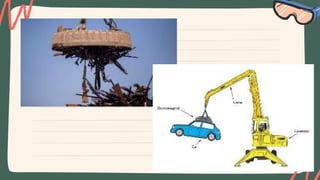
Electromagnet consists of wire coiled around
a core. It is a temporary magnet that
operates only when there is a flow of
electricity through a coil of wire wrapped
around an iron core. It consists of dry cell,
coil of wire and an iron core. Since an
electromagnet will not work without
electricity, we need a power source such as
a battery. The power source provides the
electricity to charge an electromagnet into
action. Power runs through the wire, around
the coil, and back to the battery to
Group Activity
1.What are the parts of
electromagnet?
2. How do you describe each part?
3. How does electromagnet works?
In an open circuit, what happens to the light bulb
when you switch it on?
When we switch on the light bulb in an open
circuit, what happens to the flow of current?
In a closed circuit, what happens to the light
bulb when you switch it on?
When we switch on the light bulb in closed
circuit, what happens to the flow of current?
Directions: Write True if the statement is correct and
False if it is not.
____ 1. In an open circuit, the flow of electricity is
continuous while in closed circuit, the flow of electricity is
not continuous.
____ 2. It is safe to touch an open circuit while it is
dangerous to touch a closed circuit.
____ 3. The bulb will light up as you switch it on in a
closed circuit while the bulb will not light up as you switch
it on in an open circuit.
____ 4. There is a continuous flow of electrons in an open
circuit while there is no flow of electrons in closed circuit.
____ 5. The circuit is complete n an open circuit while the
circuit is incomplete in a closed circuit.
Closed Circuit
An electric circuit through which current can
flow in an uninterrupted path. It is the kind of
circuit that makes the light bulb up because the
path of electricity is complete.
Open Circuit
Electricity does not flow in this kind of circuit
because there is a gap or no complete path from
one end of the circuit to the other end.
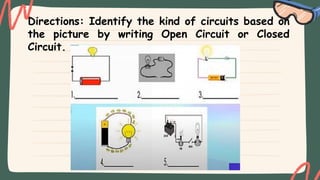
Directions: Identify the kind of circuits based on
the picture by writing Open Circuit or Closed
Circuit.
Read the questions. Then choose the letter of
the correct answer.
1.The _______________ is a device that uses
electricity.
A. source
B. resistance/load
C. Switch
D. Connecting wire
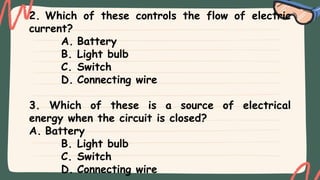
2. Which of these controls the flow of electric
current?
A. Battery
B. Light bulb
C. Switch
D. Connecting wire
3. Which of these is a source of electrical
energy when the circuit is closed?
A. Battery
B. Light bulb
C. Switch
D. Connecting wire
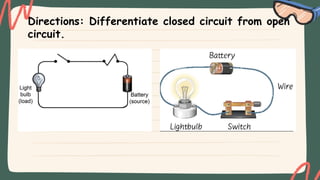
Directions: Differentiate closed circuit from open
circuit.
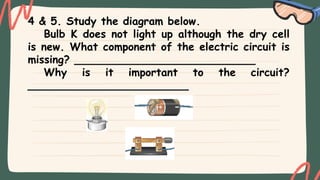
4 & 5. Study the diagram below.
Bulb K does not light up although the dry cell
is new. What component of the electric circuit is
missing? ___________________________
Why is it important to the circuit?
________________________
Closed Circuit
An electric circuit through which current can flow in an
uninterrupted path. It is the kind of circuit that makes
the light bulb up because the path of electricity is
complete.
Open Circuit
Electricity does not flow in this kind of circuit because
there is a gap or no complete path from one end of the
circuit to the other end.
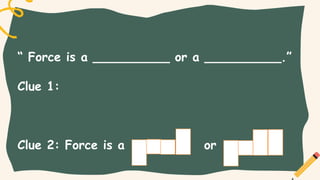
“ Force is a __________ or a __________.”
Clue 1:
Clue 2: Force is a or
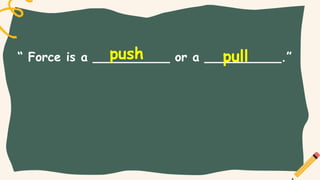
“ Force is a __________ or a __________.”
push pull
Friction plays a vital role in our everyday life. Whatever
we do, wherever we go, friction is present. Even when we
are sitting down , standing or holding a bottle or any
object, friction affects us.
Friction occurs between the surfaces of two objects in
contact, rubbing or sliding against one another. It
sometimes considered undesirable, yet it plays an important
role in our daily activities.
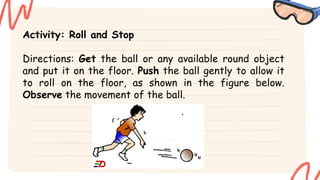
Activity: Roll and Stop
Directions: Get the ball or any available round object
and put it on the floor. Push the ball gently to allow it
to roll on the floor, as shown in the figure below.
Observe the movement of the ball.
Based on your observation, answer the following questions.
1. What happened to the ball after it was pushed?
To answer this question, arranged the following events
according to which happened first to last. Put the number
1 (first), 2, and 3 (last) on the blank before the sentence.
___ The ball slows down.
___ The ball stopped.
___ The ball rolled on the floor.
1
2
3
2. What caused the stopping of the ball?
3. Which of the following statements is/are TRUE
about friction? Choose from the given statements
below.
A. Friction is produced by a single object.
B. Friction is a force that opposes motion.
C. Friction is an energy that moves the object.
D. Friction acts opposite to the direction of an
object’s motion.
E. Friction exists between the surfaces of two
objects rubbing against each other.
Friction is a force that opposes an object’s motion
resulting in the slowing down even stopping the moving
object.
In the activity, when the ball was pushed, it rolled on
the floor and stopped after a few seconds. It is the
friction between the ball and the floor that caused
the stopping of the ball. But how does friction occur?
While the ball is rolling on the floor, the surface of
the rolling ball rubs against the surface of the floor.
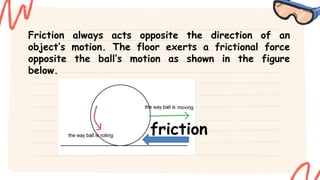
Friction always acts opposite the direction of an
object’s motion. The floor exerts a frictional force
opposite the ball’s motion as shown in the figure
below.
friction
Friction does not only occur on the surfaces of solid
objects rubbing against one another, but it also
occurs when air particles rub against objects falling
down, thrown upward and flying airplanes and kites.
Friction have uses on Earth, friction is very helpful.
Without friction, you would not be able to slow down
once in motion.
Without friction we wouldn’t be able to walk, sit in a
chair or drive safely. Everything would keep sliding
and falling over.
We need friction between our feet and the ground or
we would not be able to stand up.
Sometimes friction is not helpful. For example, metals
parts in a car’s engine are always touching. Too much
friction between the metal parts wear them out and
overheats the engine.
Directions: Read the following items carefully and tell whether
the statements are True or False.
________1. Friction acts in a direction the same as the
direction of the object’s motion.
________2. Friction occurs when the surfaces of the two
objects rub against each other.
________3. Friction causes moving objects to stop.
________4. Friction is produced by a single object.
________5. Friction opposes motion of objects.
B. Directions: Put a check (/) to all the activities
that we can do when there is friction and cross (X)
if not.
______ 1. Listening to a radio
______ 2. Speaking a phone
______ 3. Walking properly
______ 4. Holding an apple
______ 5. Sitting on a chair
Identify the following uses of friction if it is helpful
or not helpful. Write H f the statement is helpful
and NH if the statement is not helpful.
_____ 1. Friction helps stop items, like cars, trains
and walking.
_____ 2. Metal parts in a car engine are always
touching.
_____ 3. When you ride a bike, friction keeps bike in
motion.
_____ 4. Mountain climber did not use climbing shoes
made from special rubber in rock climbing.
_____ 5. The tires on the racing car will often
replace as friction wears them down.
Directions: Answer the following questions carefully
by choose the letter of your choice.
1. A ball rolled after being kicked and slowed down
until it stopped. Which of the following forces caused
the ball to slow down?
A. electrical
B. friction
C. gravity
D. magnetic
2. Is friction between the floor and a cabinet
present when a person pushes the cabinet?
A. Yes, because the bottom surface of the
cabinet is in contact with the floor.
B. Yes, because the bottom surface of the
cabinet does not rub against the floor.
C. No, because the bottom surface of the cabinet
has nothing to do with the floor.
D. No, because the bottom surface of the cabinet
is only rubbing against the floor.
3. Which of the following is NOT TRUE about
friction?
A. Friction opposes motion of objects.
B. Friction occurs between non-rubbing surfaces.
C. Friction causes moving objects to slow down and
stop.
D. Friction acts in a direction opposite to the
direction of an object’s motion.
4. Which of the following can friction do to a glass
of water on a table?
A. It moves the glass.
B. It allows the glass to slide.
C. It does not affect the glass.
D. It prevents the glass from sliding.
5. All of these are good uses of frictions except one,
Which is it?
A. stops objects C. tires are worn out
B. hold objects D. gives energy
6. Which of the following statements about uses of
frictions shows helpful in our daily life?
A. walking C. writing
B. skating D. All of the above
7. Which of the following actions is difficult to do
with friction?
A. writing on a paper
B. holding a banana
C. playing basketball
D. pushing a heavy cabinet
8. Which of the following statements is TRUE?
A. Friction makes objects move.
B. Friction stops moving objects.
C. Friction has no effect on moving objects.
D. Friction allows moving object to continue
moving.
9. Which of the following statements describe
friction?
A. It slows down motion.
B. It pulls objects downward.
C. It does not oppose motion.
D. It moves along with the object.
10.Which force is present when two objects rub
against each other?
A. friction C. magnetic
B. gravity D. motion
See you in the next class!

Science 5 Quarter 3 Week 7 Electromagnet.pptx

  • 1.
  • 5.
     Identify theparts of an electromagnet  List down the parts of an electromagnet  Appreciate the usefulness of an electromagnet
  • 7.
    Directions: Put acheck (/) if it is an advantage of a parallel circuit and cross (x)if not. 1. The other paths are not affected even if there is a break in one path. 2. Each path has its own switch. 3. There is only one pathway of electricity. 4. It can help save electricity because every load has its own switch. 5. If there is a break in one path, other pathway will not work.
  • 9.
    Electromagnet consists ofwire coiled around a core. It is a temporary magnet that operates only when there is a flow of electricity through a coil of wire wrapped around an iron core. It consists of dry cell, coil of wire and an iron core. Since an electromagnet will not work without electricity, we need a power source such as a battery. The power source provides the electricity to charge an electromagnet into action. Power runs through the wire, around the coil, and back to the battery to
  • 10.
  • 11.
    1.What are theparts of electromagnet? 2. How do you describe each part? 3. How does electromagnet works?
  • 12.
    In an opencircuit, what happens to the light bulb when you switch it on? When we switch on the light bulb in an open circuit, what happens to the flow of current? In a closed circuit, what happens to the light bulb when you switch it on? When we switch on the light bulb in closed circuit, what happens to the flow of current?
  • 13.
    Directions: Write Trueif the statement is correct and False if it is not. ____ 1. In an open circuit, the flow of electricity is continuous while in closed circuit, the flow of electricity is not continuous. ____ 2. It is safe to touch an open circuit while it is dangerous to touch a closed circuit. ____ 3. The bulb will light up as you switch it on in a closed circuit while the bulb will not light up as you switch it on in an open circuit. ____ 4. There is a continuous flow of electrons in an open circuit while there is no flow of electrons in closed circuit. ____ 5. The circuit is complete n an open circuit while the circuit is incomplete in a closed circuit.
  • 14.
    Closed Circuit An electriccircuit through which current can flow in an uninterrupted path. It is the kind of circuit that makes the light bulb up because the path of electricity is complete. Open Circuit Electricity does not flow in this kind of circuit because there is a gap or no complete path from one end of the circuit to the other end.
  • 15.
    Directions: Identify thekind of circuits based on the picture by writing Open Circuit or Closed Circuit.
  • 16.
    Read the questions.Then choose the letter of the correct answer. 1.The _______________ is a device that uses electricity. A. source B. resistance/load C. Switch D. Connecting wire
  • 17.
    2. Which ofthese controls the flow of electric current? A. Battery B. Light bulb C. Switch D. Connecting wire 3. Which of these is a source of electrical energy when the circuit is closed? A. Battery B. Light bulb C. Switch D. Connecting wire
  • 18.
    Directions: Differentiate closedcircuit from open circuit.
  • 19.
    4 & 5.Study the diagram below. Bulb K does not light up although the dry cell is new. What component of the electric circuit is missing? ___________________________ Why is it important to the circuit? ________________________
  • 20.
    Closed Circuit An electriccircuit through which current can flow in an uninterrupted path. It is the kind of circuit that makes the light bulb up because the path of electricity is complete. Open Circuit Electricity does not flow in this kind of circuit because there is a gap or no complete path from one end of the circuit to the other end.
  • 21.
    “ Force isa __________ or a __________.” Clue 1: Clue 2: Force is a or
  • 22.
    “ Force isa __________ or a __________.” push pull
  • 23.
    Friction plays avital role in our everyday life. Whatever we do, wherever we go, friction is present. Even when we are sitting down , standing or holding a bottle or any object, friction affects us. Friction occurs between the surfaces of two objects in contact, rubbing or sliding against one another. It sometimes considered undesirable, yet it plays an important role in our daily activities.
  • 24.
    Activity: Roll andStop Directions: Get the ball or any available round object and put it on the floor. Push the ball gently to allow it to roll on the floor, as shown in the figure below. Observe the movement of the ball.
  • 25.
    Based on yourobservation, answer the following questions. 1. What happened to the ball after it was pushed? To answer this question, arranged the following events according to which happened first to last. Put the number 1 (first), 2, and 3 (last) on the blank before the sentence. ___ The ball slows down. ___ The ball stopped. ___ The ball rolled on the floor. 1 2 3
  • 26.
    2. What causedthe stopping of the ball? 3. Which of the following statements is/are TRUE about friction? Choose from the given statements below. A. Friction is produced by a single object. B. Friction is a force that opposes motion. C. Friction is an energy that moves the object. D. Friction acts opposite to the direction of an object’s motion. E. Friction exists between the surfaces of two objects rubbing against each other.
  • 27.
    Friction is aforce that opposes an object’s motion resulting in the slowing down even stopping the moving object. In the activity, when the ball was pushed, it rolled on the floor and stopped after a few seconds. It is the friction between the ball and the floor that caused the stopping of the ball. But how does friction occur? While the ball is rolling on the floor, the surface of the rolling ball rubs against the surface of the floor.
  • 28.
    Friction always actsopposite the direction of an object’s motion. The floor exerts a frictional force opposite the ball’s motion as shown in the figure below. friction
  • 29.
    Friction does notonly occur on the surfaces of solid objects rubbing against one another, but it also occurs when air particles rub against objects falling down, thrown upward and flying airplanes and kites. Friction have uses on Earth, friction is very helpful. Without friction, you would not be able to slow down once in motion. Without friction we wouldn’t be able to walk, sit in a chair or drive safely. Everything would keep sliding and falling over.
  • 30.
    We need frictionbetween our feet and the ground or we would not be able to stand up. Sometimes friction is not helpful. For example, metals parts in a car’s engine are always touching. Too much friction between the metal parts wear them out and overheats the engine.
  • 31.
    Directions: Read thefollowing items carefully and tell whether the statements are True or False. ________1. Friction acts in a direction the same as the direction of the object’s motion. ________2. Friction occurs when the surfaces of the two objects rub against each other. ________3. Friction causes moving objects to stop. ________4. Friction is produced by a single object. ________5. Friction opposes motion of objects.
  • 32.
    B. Directions: Puta check (/) to all the activities that we can do when there is friction and cross (X) if not. ______ 1. Listening to a radio ______ 2. Speaking a phone ______ 3. Walking properly ______ 4. Holding an apple ______ 5. Sitting on a chair
  • 33.
    Identify the followinguses of friction if it is helpful or not helpful. Write H f the statement is helpful and NH if the statement is not helpful. _____ 1. Friction helps stop items, like cars, trains and walking. _____ 2. Metal parts in a car engine are always touching. _____ 3. When you ride a bike, friction keeps bike in motion. _____ 4. Mountain climber did not use climbing shoes made from special rubber in rock climbing. _____ 5. The tires on the racing car will often replace as friction wears them down.
  • 35.
    Directions: Answer thefollowing questions carefully by choose the letter of your choice. 1. A ball rolled after being kicked and slowed down until it stopped. Which of the following forces caused the ball to slow down? A. electrical B. friction C. gravity D. magnetic
  • 36.
    2. Is frictionbetween the floor and a cabinet present when a person pushes the cabinet? A. Yes, because the bottom surface of the cabinet is in contact with the floor. B. Yes, because the bottom surface of the cabinet does not rub against the floor. C. No, because the bottom surface of the cabinet has nothing to do with the floor. D. No, because the bottom surface of the cabinet is only rubbing against the floor.
  • 37.
    3. Which ofthe following is NOT TRUE about friction? A. Friction opposes motion of objects. B. Friction occurs between non-rubbing surfaces. C. Friction causes moving objects to slow down and stop. D. Friction acts in a direction opposite to the direction of an object’s motion.
  • 38.
    4. Which ofthe following can friction do to a glass of water on a table? A. It moves the glass. B. It allows the glass to slide. C. It does not affect the glass. D. It prevents the glass from sliding. 5. All of these are good uses of frictions except one, Which is it? A. stops objects C. tires are worn out B. hold objects D. gives energy
  • 39.
    6. Which ofthe following statements about uses of frictions shows helpful in our daily life? A. walking C. writing B. skating D. All of the above 7. Which of the following actions is difficult to do with friction? A. writing on a paper B. holding a banana C. playing basketball D. pushing a heavy cabinet
  • 40.
    8. Which ofthe following statements is TRUE? A. Friction makes objects move. B. Friction stops moving objects. C. Friction has no effect on moving objects. D. Friction allows moving object to continue moving.
  • 41.
    9. Which ofthe following statements describe friction? A. It slows down motion. B. It pulls objects downward. C. It does not oppose motion. D. It moves along with the object. 10.Which force is present when two objects rub against each other? A. friction C. magnetic B. gravity D. motion
  • 42.
    See you inthe next class!