E V A L U A T I N G
N A R R A T I V E S B A S E D
O N H O W T H E A U T H O R
D E V E L O P E D T H E
E L E M E N T S : T H E M E ;
P O I N T O F V I E W
THEME
WHAT IS THEME?
refers to the underlying insight, the
moral idea that the writer is expressing
through the story.
It is often thought as the message of the
story.
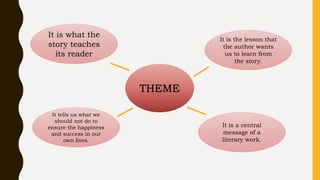
THEME
It is what the
story teaches
its reader
It is a central
message of a
literary work.
It is the lesson that
the author wants
us to learn from
the story.
It tells us what we
should not do to
ensure the happiness
and success in our
own lives.
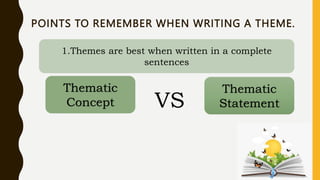
POINTS TO REMEMBER WHEN WRITING A THEME.
1.Themes are best when written in a complete
sentences
Thematic
Concept
Thematic
Statement
VS
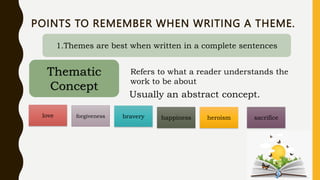
POINTS TO REMEMBER WHEN WRITING A THEME.
1.Themes are best when written in a complete sentences
Thematic
Concept
Refers to what a reader understands the
work to be about
Usually an abstract concept.
love forgiveness bravery happiness heroism sacrifice
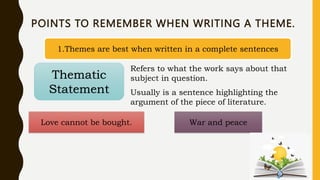
POINTS TO REMEMBER WHEN WRITING A THEME.
1.Themes are best when written in a complete sentences
Thematic
Statement
Refers to what the work says about that
subject in question.
Usually is a sentence highlighting the
argument of the piece of literature.
Love cannot be bought. War and peace
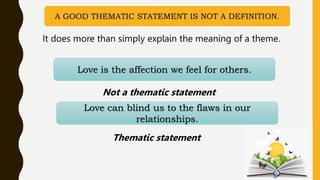
A GOOD THEMATIC STATEMENT IS NOT A DEFINITION.
Love is the affection we feel for others.
It does more than simply explain the meaning of a theme.
Not a thematic statement
Love can blind us to the flaws in our
relationships.
Thematic statement
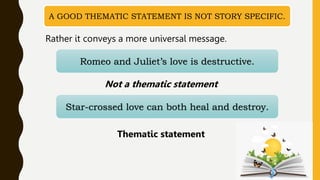
A GOOD THEMATIC STATEMENT IS NOT STORY SPECIFIC.
Romeo and Juliet’s love is destructive.
Rather it conveys a more universal message.
Not a thematic statement
Star-crossed love can both heal and destroy.
Thematic statement
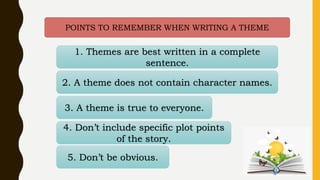
POINTS TO REMEMBER WHEN WRITING A THEME
1. Themes are best written in a complete
sentence.
2. A theme does not contain character names.
3. A theme is true to everyone.
4. Don’t include specific plot points
of the story.
5. Don’t be obvious.
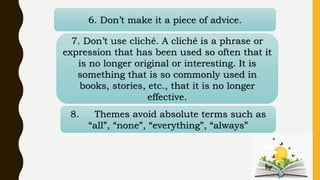
6. Don’t make it a piece of advice.
7. Don’t use cliché. A cliché is a phrase or
expression that has been used so often that it
is no longer original or interesting. It is
something that is so commonly used in
books, stories, etc., that it is no longer
effective.
8. Themes avoid absolute terms such as
“all”, “none”, “everything”, “always”
POINT OF
VIEW
WHAT IS POINT OF VIEW?
Is the mode of narration that an author employs to let the
readers “hear” and “see” what takes place in a story, poem or
essay.
Refers to the perspective that the narrator holds in
relation to the events of the story.
WHAT IS POINT OF VIEW?
NARRATOR
is the person telling a story.
He is the one describing what is happening or
what goes into a scene of the story.
Three Main Types Of Point Of View
1. FIRST PERSON
 the author is involved in the story.
 he or she may be the main
character or one of the characters.
 the pronouns I and we
are used.
Three Main Types Of Point Of View
1. FIRST PERSON
Examples:
1. I was crying one morning when
Mother asked, “What’s happening
you?”
Three Main Types Of Point Of View
1. FIRST PERSON
Examples:
2. He came out of nowhere! Too
for him, though I only had five
dollars in my bag.
Three Main Types Of Point Of View
1. FIRST PERSON
Examples:
3. I was desperate for somthing to
eat. Judging by her expensive
looking shoes. I figured she could
afford to part with her purse.
Three Main Types Of Point Of View
2. SECOND PERSON
It is commonly used in instructional writing.
Places the reader “on the playing field” by
putting them in the position of the
protagonist.
Three Main Types Of Point Of View
2. SECOND PERSON
It doesnt allow the narrator as much
freedom as first and third person.
The pronoun you is used.
Three Main Types Of Point Of View
2. SECOND PERSON
Examples:
1.You should pack lightly when you
backpacking. You
will have a good trip if you are
of the safety precautions.
Three Main Types Of Point Of View
2. SECOND PERSON
Examples:
2. You have friends who actually care about
you and speak the language of the inner
You have avoided them of late. Your soul is
dishelved as your apartment and until you
clean it up a little you dont want to invite
anyone inside.
Three Main Types Of Point Of View
3. THIRD PERSON
The author or narrator is not involved in the
story.
 He or she is only a witness.
He or she knows the thoughts and feelings of
the characters.
The pronouns he, she, it, and they are used.
Three Main Types Of Point Of View
3. THIRD PERSON
Examples:
Jayson felt like he has done something good
others. He wanted to do more to give
to those who are in need.
THEME
The underlying insight, the moral or idea that the
writer is expressing through the story.
POINT OF
VIEW
The perspective that the narrator holds in relation
to the events of the story.
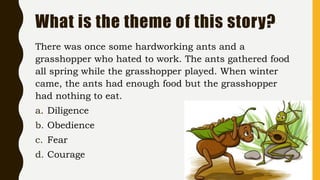
What is the theme of this story?
There was once some hardworking ants and a
grasshopper who hated to work. The ants gathered food
all spring while the grasshopper played. When winter
came, the ants had enough food but the grasshopper
had nothing to eat.
a. Diligence
b. Obedience
c. Fear
d. Courage
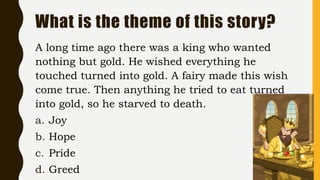
What is the theme of this story?
A long time ago there was a king who wanted
nothing but gold. He wished everything he
touched turned into gold. A fairy made this wish
come true. Then anything he tried to eat turned
into gold, so he starved to death.
a. Joy
b. Hope
c. Pride
d. Greed
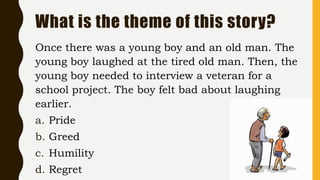
What is the theme of this story?
Once there was a young boy and an old man. The
young boy laughed at the tired old man. Then, the
young boy needed to interview a veteran for a
school project. The boy felt bad about laughing
earlier.
a. Pride
b. Greed
c. Humility
d. Regret
What is the theme of this story?
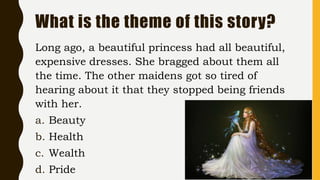
Long ago, a beautiful princess had all beautiful,
expensive dresses. She bragged about them all
the time. The other maidens got so tired of
hearing about it that they stopped being friends
with her.
a. Beauty
b. Health
c. Wealth
d. Pride
VIDEOKIE TIME!
EVERYBODY SING 
ACTIVITY NO.1
STOP THE BOX 
ACTIVITY NO.2
GROUPINGS
ACTIVITY NO.3
You need to make/construct a
poem with your own theme with
free verse/rhyme scheme using
1st person point of view.
GROUP 1 
You will write a short story with
2 paragraphs with your own
theme/original concept using 2nd
person pint of view.
GROUP 2 
You will compose a jingle with
your own theme/original concept
using the 3rd person point of
view.
GROUP 3 
Let’s check your understanding.
1. What is a theme?
a.a summary of the story
b. never heard of it
c. the message or lesson in a story.
2.Which of these things is not related to
the theme in a story?
a.How character feels.
b.A “life lesson” the main character
learns.
c.A big idea that people from any
culture or any place understand.
d.The moral of the story.
3.“There was once an ugly duckling. The other
ducks laughed at her and she felt ashamed.
she grew up. It turned out that she was actually
swan and she was beautiful.” What is the theme
the story?
a.Dont steal.
b.Dont judge others.You dont know what they are
capable of.
c.Being beautiful is the most important thing.
d.Swan are prettier than ducks.
4. “Long ago, a beautiful princess had all
beautiful, expensive dresses. She bragged about
them all the time. The other maidens got so
hearing about it that they stopped being friends
with her.” What is the theme of the story?
a.Eat your vegetables.
b.Dont brag. Be modest.
c.Dont talk to stangers.
d.What does the fox say?
5. Which of the following is an example of
theme?
a.Carry your laptops with two hands at all
times.
b.Cereal is the healthiest food you can eat.
c.How much wood a woodchuch could
chuck if a woodchuck could chuck wood.
d.Life is short, make the most of it.
6.Which point of view do you see
these signal words you, your?
a.1st person
b.2nd person
c.3rd person
7. Which point of view do you see
these signal words I, me, my,
we, us?
a. 1st person
b. 2rd person
c. 3rd person
8. The man sat alone in his house. As the
hours went by, he grew lonelier. The
woman, on the hand, kept walking her
footsteps loud and fast. She had’nt felt
angry in a long time.
a.1st person
b.2rd person
c.3rd person
9. What point of view is the following:
Cathy leaned into her computer screen
with big eyes. She couldnt believe it she
had finally gotten a 100 on her math
She knew her parents would be proud of
her.
a.1st person
b.2rd person
c.3rd person
10. What point of view is the following? The
lights in the mall were beautiful. There were
green and gold decorations everywhere. I
couldnt wait to start shopping for presents
my friends. “Are you ready to go? Dad asked.
I exclaimed. Let’s shop.
a.1st person
b.2rd person
c.3rd person

Evaluating Narratives Based on How the Author Developed.pptx

  • 2.
    E V AL U A T I N G N A R R A T I V E S B A S E D O N H O W T H E A U T H O R D E V E L O P E D T H E E L E M E N T S : T H E M E ; P O I N T O F V I E W
  • 3.
  • 4.
    WHAT IS THEME? refersto the underlying insight, the moral idea that the writer is expressing through the story. It is often thought as the message of the story.
  • 5.
    THEME It is whatthe story teaches its reader It is a central message of a literary work. It is the lesson that the author wants us to learn from the story. It tells us what we should not do to ensure the happiness and success in our own lives.
  • 6.
    POINTS TO REMEMBERWHEN WRITING A THEME. 1.Themes are best when written in a complete sentences Thematic Concept Thematic Statement VS
  • 7.
    POINTS TO REMEMBERWHEN WRITING A THEME. 1.Themes are best when written in a complete sentences Thematic Concept Refers to what a reader understands the work to be about Usually an abstract concept. love forgiveness bravery happiness heroism sacrifice
  • 8.
    POINTS TO REMEMBERWHEN WRITING A THEME. 1.Themes are best when written in a complete sentences Thematic Statement Refers to what the work says about that subject in question. Usually is a sentence highlighting the argument of the piece of literature. Love cannot be bought. War and peace
  • 9.
    A GOOD THEMATICSTATEMENT IS NOT A DEFINITION. Love is the affection we feel for others. It does more than simply explain the meaning of a theme. Not a thematic statement Love can blind us to the flaws in our relationships. Thematic statement
  • 10.
    A GOOD THEMATICSTATEMENT IS NOT STORY SPECIFIC. Romeo and Juliet’s love is destructive. Rather it conveys a more universal message. Not a thematic statement Star-crossed love can both heal and destroy. Thematic statement
  • 11.
    POINTS TO REMEMBERWHEN WRITING A THEME 1. Themes are best written in a complete sentence. 2. A theme does not contain character names. 3. A theme is true to everyone. 4. Don’t include specific plot points of the story. 5. Don’t be obvious.
  • 12.
    6. Don’t makeit a piece of advice. 7. Don’t use cliché. A cliché is a phrase or expression that has been used so often that it is no longer original or interesting. It is something that is so commonly used in books, stories, etc., that it is no longer effective. 8. Themes avoid absolute terms such as “all”, “none”, “everything”, “always”
  • 13.
  • 14.
    WHAT IS POINTOF VIEW? Is the mode of narration that an author employs to let the readers “hear” and “see” what takes place in a story, poem or essay. Refers to the perspective that the narrator holds in relation to the events of the story.
  • 15.
    WHAT IS POINTOF VIEW? NARRATOR is the person telling a story. He is the one describing what is happening or what goes into a scene of the story.
  • 16.
    Three Main TypesOf Point Of View 1. FIRST PERSON  the author is involved in the story.  he or she may be the main character or one of the characters.  the pronouns I and we are used.
  • 17.
    Three Main TypesOf Point Of View 1. FIRST PERSON Examples: 1. I was crying one morning when Mother asked, “What’s happening you?”
  • 18.
    Three Main TypesOf Point Of View 1. FIRST PERSON Examples: 2. He came out of nowhere! Too for him, though I only had five dollars in my bag.
  • 19.
    Three Main TypesOf Point Of View 1. FIRST PERSON Examples: 3. I was desperate for somthing to eat. Judging by her expensive looking shoes. I figured she could afford to part with her purse.
  • 20.
    Three Main TypesOf Point Of View 2. SECOND PERSON It is commonly used in instructional writing. Places the reader “on the playing field” by putting them in the position of the protagonist.
  • 21.
    Three Main TypesOf Point Of View 2. SECOND PERSON It doesnt allow the narrator as much freedom as first and third person. The pronoun you is used.
  • 22.
    Three Main TypesOf Point Of View 2. SECOND PERSON Examples: 1.You should pack lightly when you backpacking. You will have a good trip if you are of the safety precautions.
  • 23.
    Three Main TypesOf Point Of View 2. SECOND PERSON Examples: 2. You have friends who actually care about you and speak the language of the inner You have avoided them of late. Your soul is dishelved as your apartment and until you clean it up a little you dont want to invite anyone inside.
  • 24.
    Three Main TypesOf Point Of View 3. THIRD PERSON The author or narrator is not involved in the story.  He or she is only a witness. He or she knows the thoughts and feelings of the characters. The pronouns he, she, it, and they are used.
  • 25.
    Three Main TypesOf Point Of View 3. THIRD PERSON Examples: Jayson felt like he has done something good others. He wanted to do more to give to those who are in need.
  • 26.
    THEME The underlying insight,the moral or idea that the writer is expressing through the story. POINT OF VIEW The perspective that the narrator holds in relation to the events of the story.
  • 27.
    What is thetheme of this story? There was once some hardworking ants and a grasshopper who hated to work. The ants gathered food all spring while the grasshopper played. When winter came, the ants had enough food but the grasshopper had nothing to eat. a. Diligence b. Obedience c. Fear d. Courage
  • 28.
    What is thetheme of this story? A long time ago there was a king who wanted nothing but gold. He wished everything he touched turned into gold. A fairy made this wish come true. Then anything he tried to eat turned into gold, so he starved to death. a. Joy b. Hope c. Pride d. Greed
  • 29.
    What is thetheme of this story? Once there was a young boy and an old man. The young boy laughed at the tired old man. Then, the young boy needed to interview a veteran for a school project. The boy felt bad about laughing earlier. a. Pride b. Greed c. Humility d. Regret
  • 30.
    What is thetheme of this story? Long ago, a beautiful princess had all beautiful, expensive dresses. She bragged about them all the time. The other maidens got so tired of hearing about it that they stopped being friends with her. a. Beauty b. Health c. Wealth d. Pride
  • 31.
  • 32.
    STOP THE BOX ACTIVITY NO.2
  • 33.
  • 34.
    You need tomake/construct a poem with your own theme with free verse/rhyme scheme using 1st person point of view. GROUP 1 
  • 35.
    You will writea short story with 2 paragraphs with your own theme/original concept using 2nd person pint of view. GROUP 2 
  • 36.
    You will composea jingle with your own theme/original concept using the 3rd person point of view. GROUP 3 
  • 37.
    Let’s check yourunderstanding. 1. What is a theme? a.a summary of the story b. never heard of it c. the message or lesson in a story.
  • 38.
    2.Which of thesethings is not related to the theme in a story? a.How character feels. b.A “life lesson” the main character learns. c.A big idea that people from any culture or any place understand. d.The moral of the story.
  • 39.
    3.“There was oncean ugly duckling. The other ducks laughed at her and she felt ashamed. she grew up. It turned out that she was actually swan and she was beautiful.” What is the theme the story? a.Dont steal. b.Dont judge others.You dont know what they are capable of. c.Being beautiful is the most important thing. d.Swan are prettier than ducks.
  • 40.
    4. “Long ago,a beautiful princess had all beautiful, expensive dresses. She bragged about them all the time. The other maidens got so hearing about it that they stopped being friends with her.” What is the theme of the story? a.Eat your vegetables. b.Dont brag. Be modest. c.Dont talk to stangers. d.What does the fox say?
  • 41.
    5. Which ofthe following is an example of theme? a.Carry your laptops with two hands at all times. b.Cereal is the healthiest food you can eat. c.How much wood a woodchuch could chuck if a woodchuck could chuck wood. d.Life is short, make the most of it.
  • 42.
    6.Which point ofview do you see these signal words you, your? a.1st person b.2nd person c.3rd person
  • 43.
    7. Which pointof view do you see these signal words I, me, my, we, us? a. 1st person b. 2rd person c. 3rd person
  • 44.
    8. The mansat alone in his house. As the hours went by, he grew lonelier. The woman, on the hand, kept walking her footsteps loud and fast. She had’nt felt angry in a long time. a.1st person b.2rd person c.3rd person
  • 45.
    9. What pointof view is the following: Cathy leaned into her computer screen with big eyes. She couldnt believe it she had finally gotten a 100 on her math She knew her parents would be proud of her. a.1st person b.2rd person c.3rd person
  • 46.
    10. What pointof view is the following? The lights in the mall were beautiful. There were green and gold decorations everywhere. I couldnt wait to start shopping for presents my friends. “Are you ready to go? Dad asked. I exclaimed. Let’s shop. a.1st person b.2rd person c.3rd person