7
Lesson Exemplar for
Science
Week
5
Lesson 1
Quarter 3
Lesson Exemplar for Science Grade 7
Quarter 3: Lesson 5 (Week 5)
SY 2024-2025
This material is intended exclusively for the use of teachers participating in the pilot implementation of the MATATAG K to 10 Curriculum during the
School Year 2024-2025. It aims to assist in delivering the curriculum content, standards, and lesson competencies. Any unauthorized reproduction, distribution,
modification, or utilization of this material beyond the designated scope is strictly prohibited and may result in appropriate legal actions and disciplinary measures.
Borrowed content included in this material are owned by their respective copyright holders. Every effort has been made to locate and obtain permission
to use these materials from their respective copyright owners. The publisher and development team do not represent nor claim ownership over them.
Every care has been taken to ensure the accuracy of the information provided in this material. For inquiries or feedback, please write or call the Office
of the Director of the Bureau of Learning Resources via telephone numbers (02) 8634-1072 and 8631-6922 or by email at blr.od@deped.gov.ph.
Development Team
Writer:
• Al B. Besmonte, PhD (Bicol University)
Validator:
• Donna Marie DM. Gonong, PhD (Philippine Normal University)
Management Team
Philippine Normal University
Research Institute for Teacher Quality
SiMERR National Research Centre
1
SCIENCE (PHYSICS) /QUARTER 3/ GRADE 7
I. CURRICULUM CONTENT, STANDARDS, AND LESSON COMPETENCIES
A. Content
Standards
1. Scientists and engineers analyze forces to predict their effects on movement.
2. Vectors differentiate the concepts of speed and velocity.
3. Graphing motion provides more accurate predictions about speed and velocity.
4. The particle model explains natural systems and processes.
5. Scientists and engineers conduct innovative research to find solutions to the current global energy crisis by
seeking renewable energy
B. Performance
Standards
By the end of the Quarter, learners employ scientific techniques, concepts, and models to investigate forces and motion
and represent their understanding using scientific language, force diagrams, and distance-time graphs. They use their
curiosity, knowledge and understanding, and skills to propose solutions to problems related to motion and energy.
They explore how modern technologies might be used to overcome current global energy concerns.
C. Learning
Competencies
and Objectives
Learning Competency
1. Explain the difference between distance and displacement in everyday situations in relation to a reference point;
Lesson Objective 1: Describe the motion of an object in terms of distance and displacement
2. Distinguish between speed and velocity using the concept of vectors;
Lesson Objective 1: Differentiate speed from velocity and solve problems involving speed and velocity
3. Describe uniform velocity and represent it using distance-time graphs;
D. Content Motion: Displacement and Velocity
Displacement-Time Graph
Distance, Displacement, Speed, and Velocity:
a. Distance: The total length of the path traveled by an object, regardless of direction.
b. Displacement: The change in position of an object in a particular direction. It has both magnitude and
direction.
c. Velocity: The rate of change of displacement concerning time. It is a vector quantity, indicating both speed and
direction.
Uniform velocity
2
E. Integration GIS Mapping in distance and displacement
Values Education to follow the road regulations by not taking shortcut (displacement)
II. LEARNING RESOURCES
FuseSchool - Global Education. (2019, November 17). Displacement Time Graphs | Forces & Motion | Physics | FuseSchool [Video]. YouTube.
https://www.youtube.com/watch?v=TG2Y2MDx-zE
Infinity Learn NEET. (2017, May 4). Motion | Distance and Displacement | Physics | Infinity Learn [Video]. YouTube.
https://www.youtube.com/watch?v=21BwUNDOQno
Infinity Learn NEET. (2017b, May 11). What is Velocity? - Full Concept of Velocity - Physics | Infinity Learn [Video]. YouTube.
https://www.youtube.com/watch?v=apewLkLAR-U
Infinity Learn NEET. (2017c, May 18). Physics - What is Acceleration | Motion | Velocity | Infinity Learn NEET [Video]. YouTube.
https://www.youtube.com/watch?v=vxFYfumAAlY
Infinity Learn NEET. (2018, November 8). What is Speed? | Motion and Time | Don’t Memorise [Video]. YouTube.
https://www.youtube.com/watch?v=S9Z1a3sZfHY
Ltd, I. B. J. E. (n.d.). The displacement-time graph game. eChalk.
https://www.echalk.co.uk/Science/physics/motion/dispGame/displacementGame.html
Speed velocity acceleration wild taxi. (n.d.).
https://reviewgamezone.com/games4/taxi.php?test_id=14406&title=Speed%20Velocity%20%20Acceleration
III. TEACHING AND LEARNING PROCEDURE NOTES TO TEACHERS
A. Activating Prior
Knowledge
1. Short Review (DAY 1)
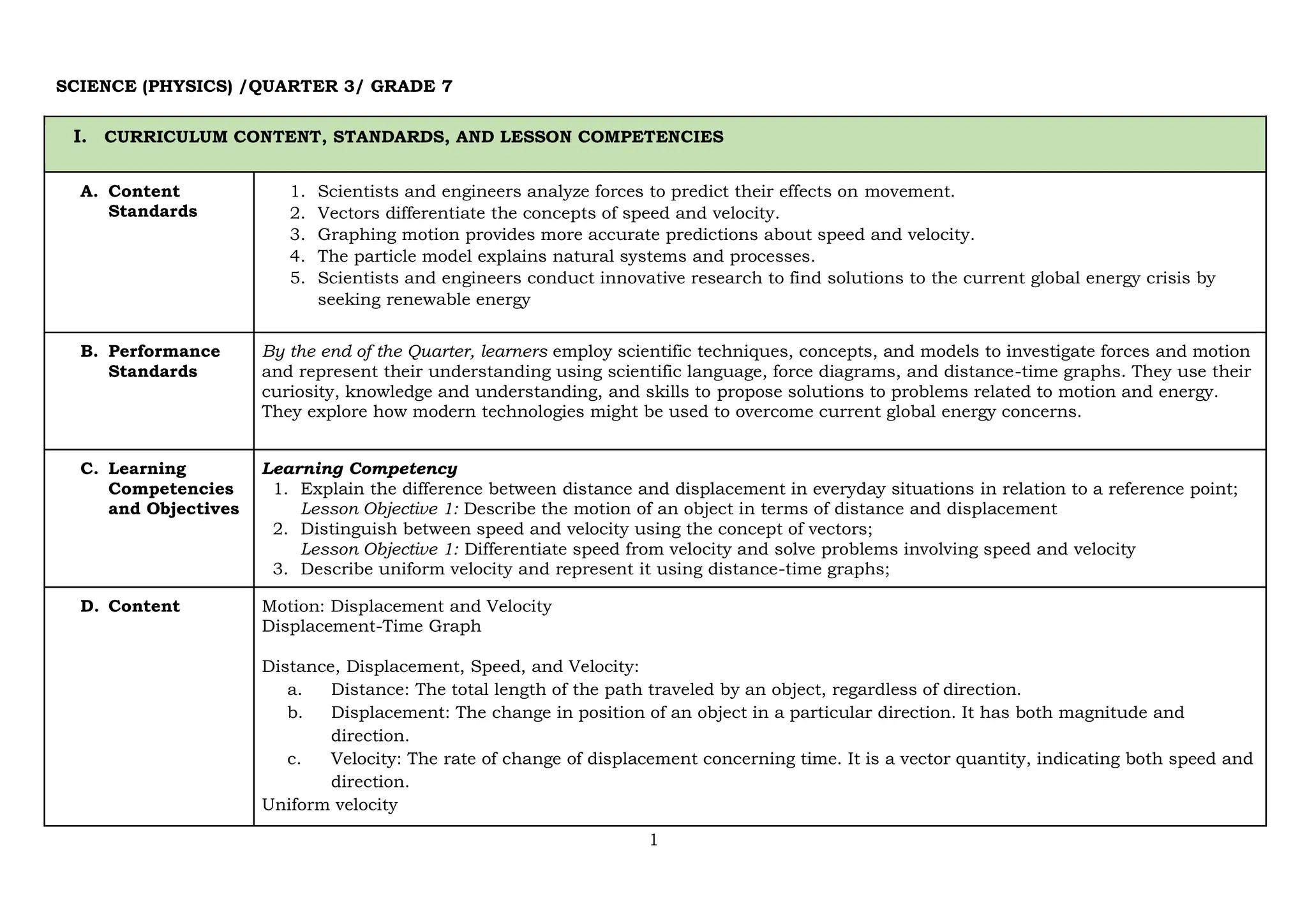
Which of the following animals: dog, cheetah, and lion, travel the fastest?
To begin the lesson, ask this question:
Which of the following animals: dog,
cheetah, and lion, travel the fastest?
Explain.
3
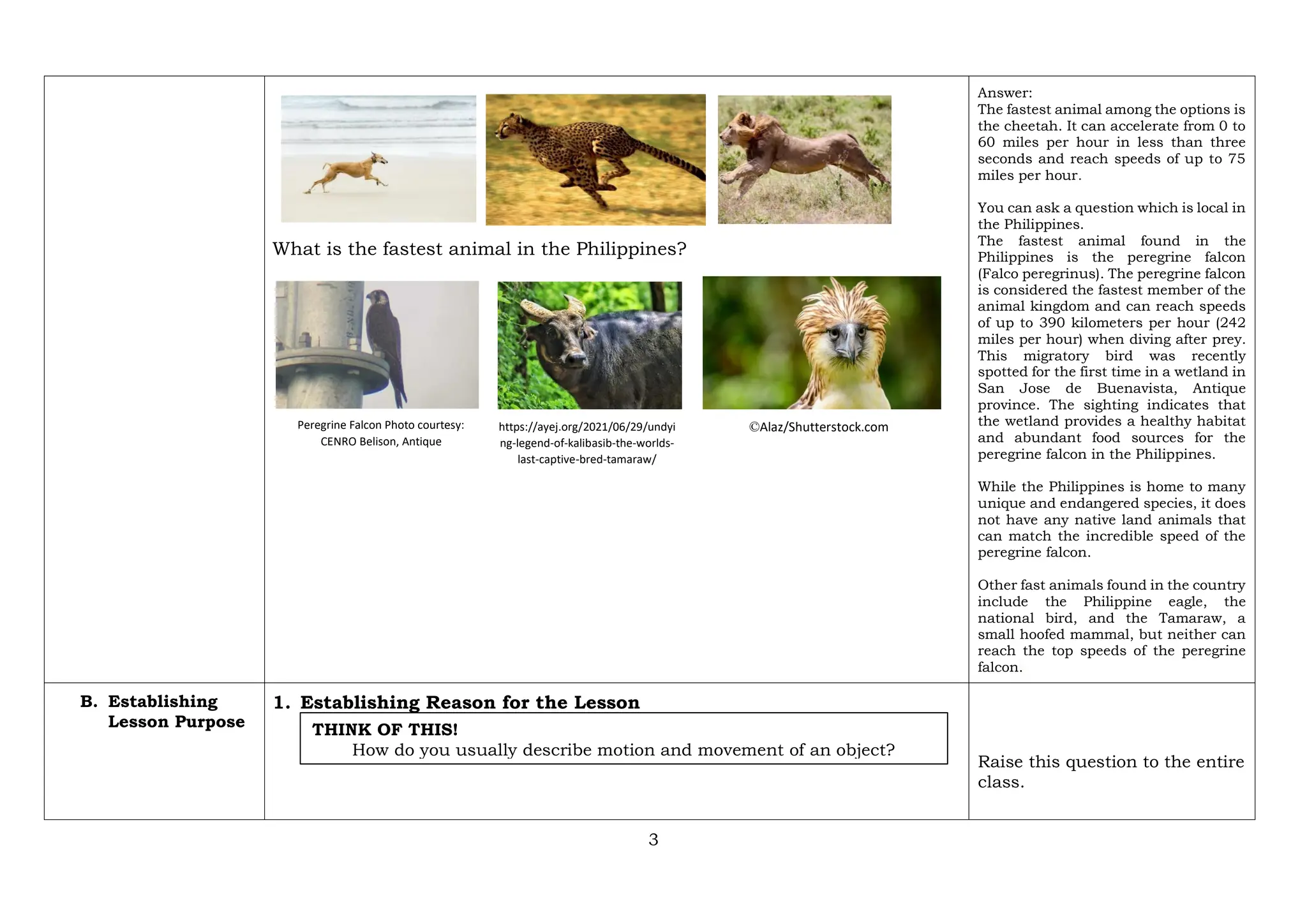
What is the fastest animal in the Philippines?
Answer:
The fastest animal among the options is
the cheetah. It can accelerate from 0 to
60 miles per hour in less than three
seconds and reach speeds of up to 75
miles per hour.
You can ask a question which is local in
the Philippines.
The fastest animal found in the
Philippines is the peregrine falcon
(Falco peregrinus). The peregrine falcon
is considered the fastest member of the
animal kingdom and can reach speeds
of up to 390 kilometers per hour (242
miles per hour) when diving after prey.
This migratory bird was recently
spotted for the first time in a wetland in
San Jose de Buenavista, Antique
province. The sighting indicates that
the wetland provides a healthy habitat
and abundant food sources for the
peregrine falcon in the Philippines.
While the Philippines is home to many
unique and endangered species, it does
not have any native land animals that
can match the incredible speed of the
peregrine falcon.
Other fast animals found in the country
include the Philippine eagle, the
national bird, and the Tamaraw, a
small hoofed mammal, but neither can
reach the top speeds of the peregrine
falcon.
B. Establishing
Lesson Purpose
1. Establishing Reason for the Lesson
Raise this question to the entire
class.
THINK OF THIS!
How do you usually describe motion and movement of an object?
Peregrine Falcon Photo courtesy:
CENRO Belison, Antique
©Alaz/Shutterstock.com
https://ayej.org/2021/06/29/undyi
ng-legend-of-kalibasib-the-worlds-
last-captive-bred-tamaraw/
4
An object’s motion is usually described in terms of how fast or how
slow it is moving. If a person is jogging, we can say that the motion is
slow, but if the person is running, the motion is fast.
2. Unlocking Vocabulary Content
Using the given clues, determine the
following terms:
1. DEEPS
2. EAEVAGR DPSEE
3. TCLVEOIY
4. VAGREAE VEOIYTCL
5. ETNTNISAANOUS TCLVEOIY
C. Developing and
Deepening
Understanding
SUBTOPIC: Speed and Velocity
1. Explicitation (DAY 2)
Activity 5.1 How fast can you run?
Use the worksheet for this activity (see page 1 and 2).
KEY to Guide Questions:
1. The winning team is the group with the greatest average speed.
2. (a) Yes
(b) Yes / No (depends on the students understanding)
(c) to determine the appropriate average speed
2. Worked Example (60 mins) (Day 3)
There are different types of
speed. An object that is moving in
a specific direction at a constant
speed is called Uniform Motion
After the short introduction of
the lesson, the students can do
Activity 5.1.
The teacher should require his/
her students to wear PE uniform
and rubber shoes during the
conduct of this activity.
The proper warm-up (stretching,
joint mobility exercises, etc.) of
about 5 minutes should be done
by each group before they
participate in the activity.
Activity data may vary.
CLUES:
1. Measure of how fast an object is moving
2. the total distance traveled by the object
in a particular time interval.
3. Speed in a particular direction
4. The ratio of displacement and time
5. How fast an object is moving at a
moment.
5
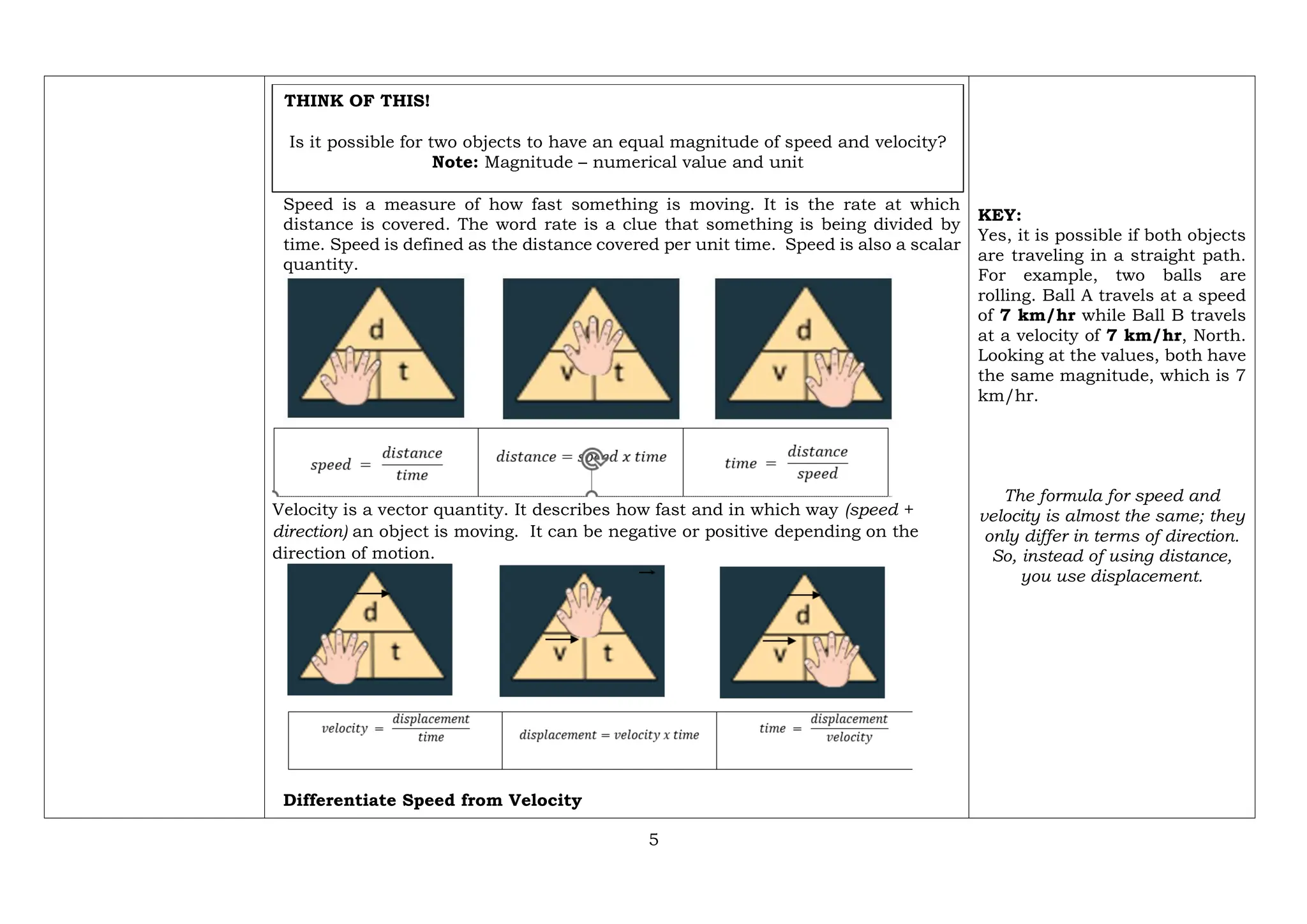
Speed is a measure of how fast something is moving. It is the rate at which
distance is covered. The word rate is a clue that something is being divided by
time. Speed is defined as the distance covered per unit time. Speed is also a scalar
quantity.
Velocity is a vector quantity. It describes how fast and in which way (speed +
direction) an object is moving. It can be negative or positive depending on the
direction of motion.
Differentiate Speed from Velocity
KEY:
Yes, it is possible if both objects
are traveling in a straight path.
For example, two balls are
rolling. Ball A travels at a speed
of 7 km/hr while Ball B travels
at a velocity of 7 km/hr, North.
Looking at the values, both have
the same magnitude, which is 7
km/hr.
The formula for speed and
velocity is almost the same; they
only differ in terms of direction.
So, instead of using distance,
you use displacement.
THINK OF THIS!
Is it possible for two objects to have an equal magnitude of speed and velocity?
Note: Magnitude – numerical value and unit
6
Sample Problem:
1. A car moves at a velocity of 60 km/hr, West for 5 hours, how far will it go?
Given:
velocity - 60 km/hr, W
time – 5 hrs
Required:
displacement
Formula:
displacement
= velocity x time
= velocity x time
Solution:
displacement=60 km/hr,West x 5 hrs
displacement = 300 km/ West
The car will reach 300 km, West at a velocity of 60 km/hr.
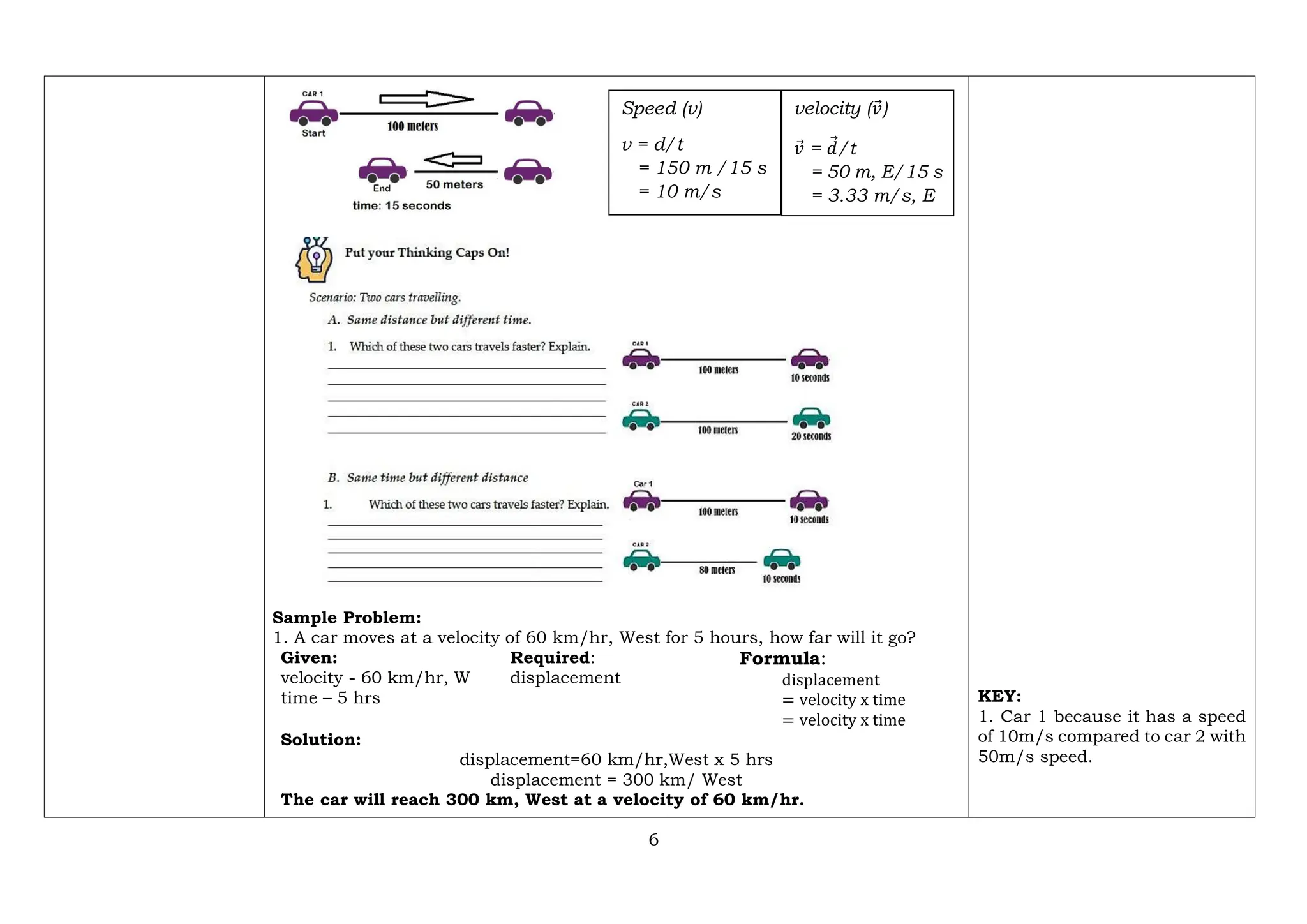
KEY:
1. Car 1 because it has a speed
of 10m/s compared to car 2 with
50m/s speed.
Speed (v)
v = d/t
= 150 m /15 s
= 10 m/s
velocity (𝑣
Ԧ)
𝑣
Ԧ = 𝑑
Ԧ/t
= 50 m, E/15 s
= 3.33 m/s, E
7
2. A train needs to travel a distance of 30 miles at a speed of 10 mi/hr. How long
will it take the train to reach its destination?
Given:
distance – 30 mi
speed – 10 mi/hr
Required:
time
Formula:
Time =
(distance/speed)
Solution:
Time = 30 mi/ 10 mi/hr
It will take 3 hrs for the train to travel a distance of 30 miles
3. Lesson Activity
Activity 5.2 Speed/ Velocity Calculations
Use the worksheet for this activity (see pages 3 and 4).
SUBTOPIC 2: Average Speed/Velocity, and Instantaneous Speed & Velocity
1. Explicitation (DAY 4)
Use the worksheet for this activity (see pages 5 and 6).
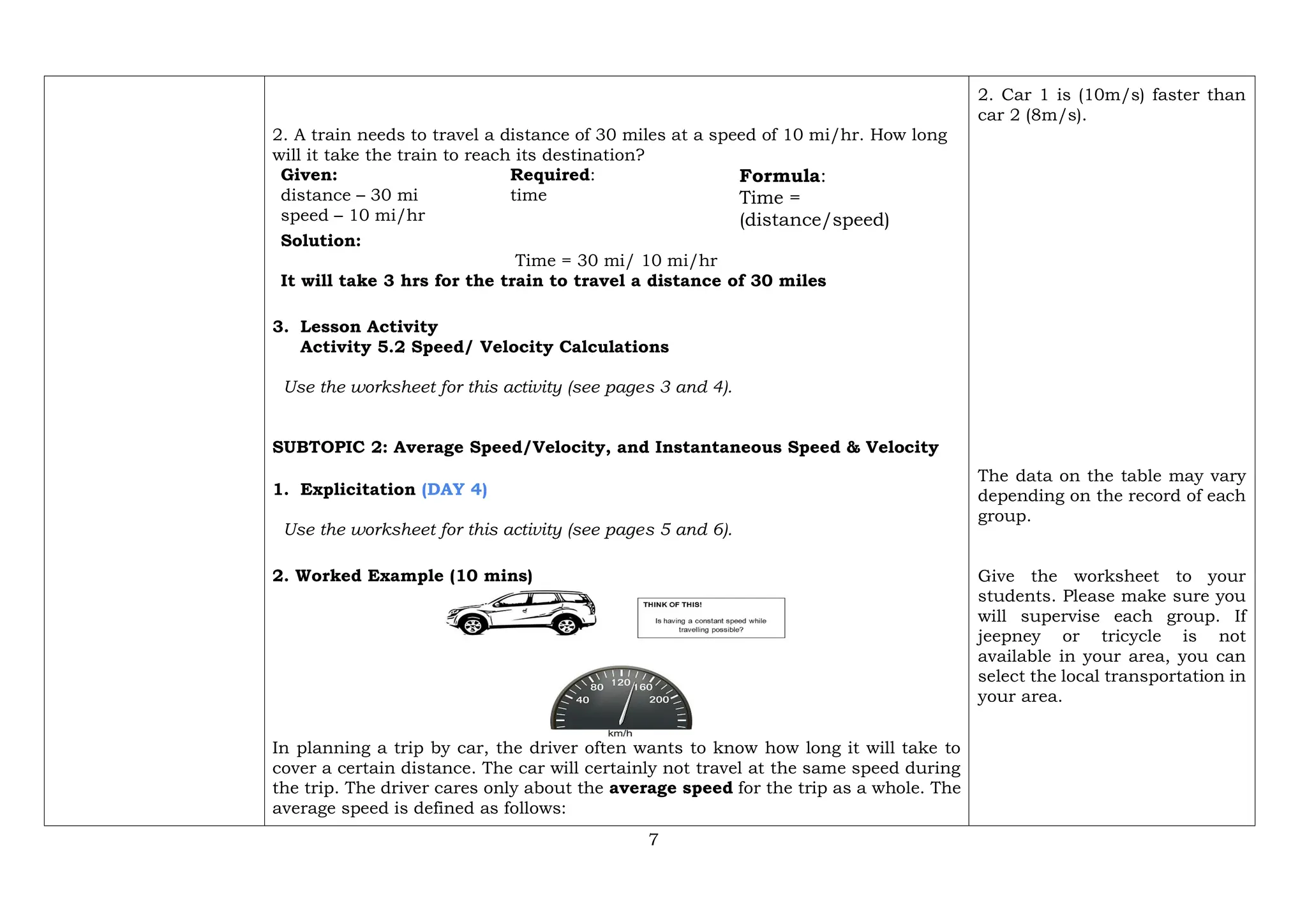
2. Worked Example (10 mins)
In planning a trip by car, the driver often wants to know how long it will take to
cover a certain distance. The car will certainly not travel at the same speed during
the trip. The driver cares only about the average speed for the trip as a whole. The
average speed is defined as follows:
2. Car 1 is (10m/s) faster than
car 2 (8m/s).
The data on the table may vary
depending on the record of each
group.
Give the worksheet to your
students. Please make sure you
will supervise each group. If
jeepney or tricycle is not
available in your area, you can
select the local transportation in
your area.
8
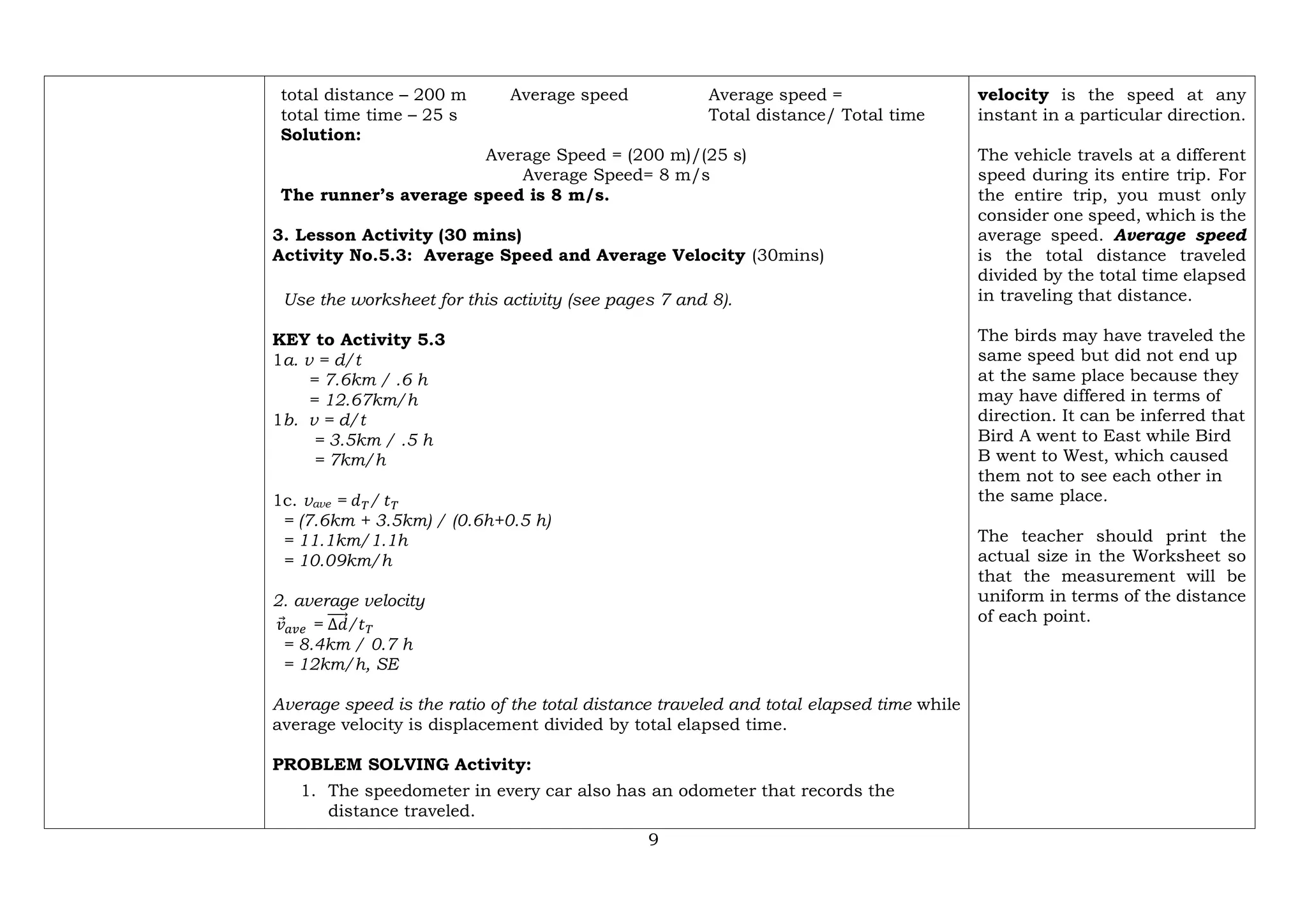
Average speed can be calculated rather easily. For example, if we drive a distance
of 60 kilometers during a time of 1 hour, we say our average speed is 60 kilometers
per hour (60km/h). Or, if we travel 240 kilometers in 4 hours.
Note that when a distance if in kilometers (km) is divided by a time in hours (h), the
answer is in kilometer per hour (km/h)
Average Velocity is the ratio of the displacement and total elapsed time. For
example, if we drive a distance of 60 kilometers, East during a time of 1 hour, we
say our average speed is 60 kilometers per hour (60km/h). Or, if we travel 240
kilometers, East in 4 hours,
If the car returned to its initial position, traveling 240 m, Wes, the displacement
becomes zero, thus the average velocity is also zero.
Sample Problem:
A runner does one lap around a 200 m track in a time of 25 s. What was the
runner's average speed?
Given: Required: Formula:
1. The speed of different vehicle
varies.
2. Vehicle can have greater or
lesser average speed depending
on the data gathered.
3. Answer may vary depending
on the gathered data.
4. Answer may vary depending
on the gathered data.
Experience tells you that a
vehicle rarely travels at a
constant speed, especially in
heavy traffic. You can tell the
speed of a vehicle at any instant
by looking at the vehicle’s
speedometer. The speed at any
instant is called instantaneous
speed. You will notice that a
vehicle may travel down a street
at 50 km/hr in open stretches
while overtaking other vehicles,
slow down at 30 km/h because
of traffic, or come to a stop at the
red light. The instantaneous
9
total distance – 200 m
total time time – 25 s
Average speed Average speed =
Total distance/ Total time
Solution:
Average Speed = (200 m)/(25 s)
Average Speed= 8 m/s
The runner’s average speed is 8 m/s.
3. Lesson Activity (30 mins)
Activity No.5.3: Average Speed and Average Velocity (30mins)
Use the worksheet for this activity (see pages 7 and 8).
KEY to Activity 5.3
1a. v = d/t
= 7.6km / .6 h
= 12.67km/h
1b. v = d/t
= 3.5km / .5 h
= 7km/h
1c. vave = 𝑑𝑇/ 𝑡𝑇
= (7.6km + 3.5km) / (0.6h+0.5 h)
= 11.1km/1.1h
= 10.09km/h
2. average velocity
𝑣
Ԧ𝑎𝑣𝑒 = ∆𝑑
⃗⃗⃗⃗⃗Ԧ/𝑡𝑇
= 8.4km / 0.7 h
= 12km/h, SE
Average speed is the ratio of the total distance traveled and total elapsed time while
average velocity is displacement divided by total elapsed time.
PROBLEM SOLVING Activity:
1. The speedometer in every car also has an odometer that records the
distance traveled.
velocity is the speed at any
instant in a particular direction.
The vehicle travels at a different
speed during its entire trip. For
the entire trip, you must only
consider one speed, which is the
average speed. Average speed
is the total distance traveled
divided by the total time elapsed
in traveling that distance.
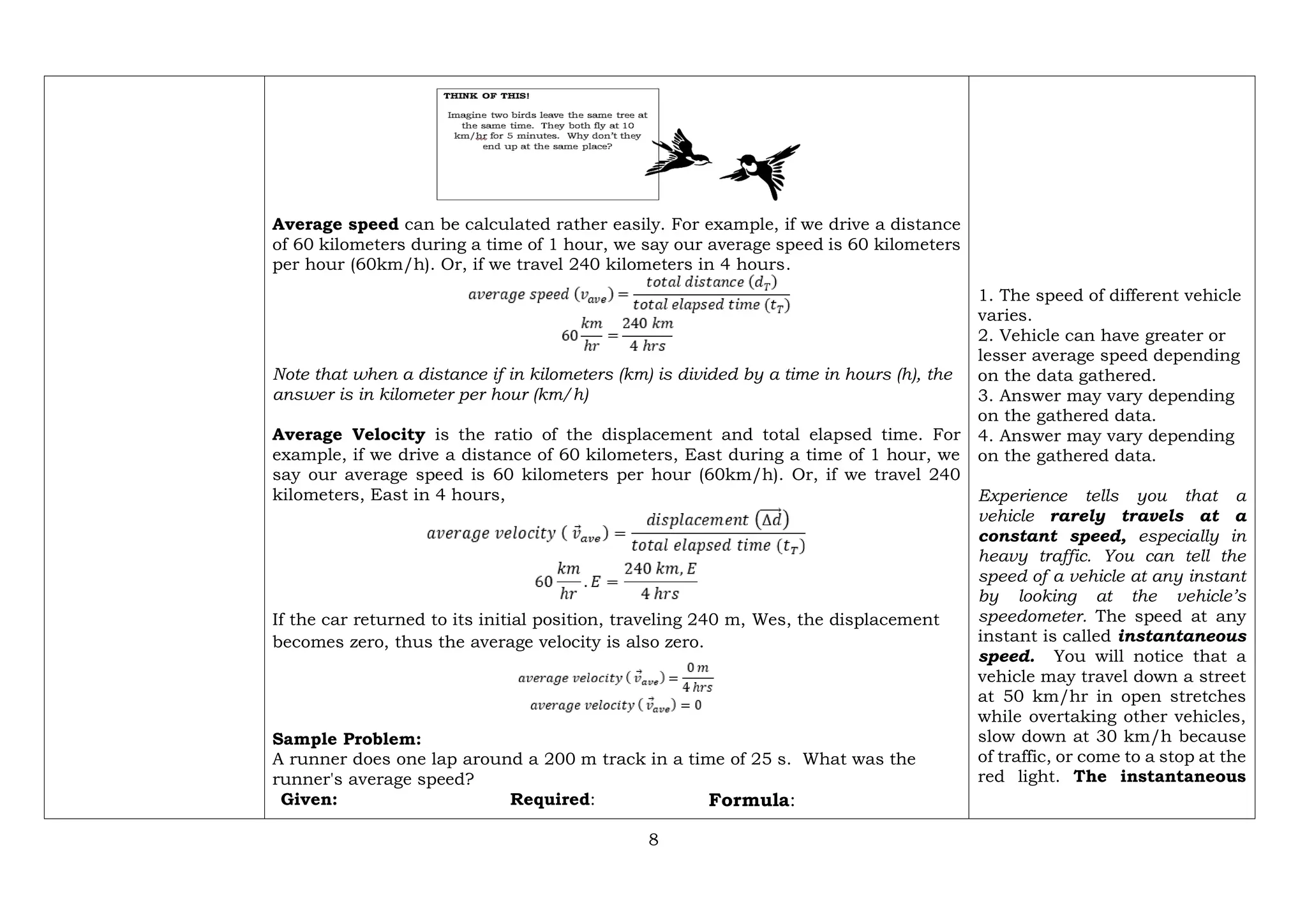
The birds may have traveled the
same speed but did not end up
at the same place because they
may have differed in terms of
direction. It can be inferred that
Bird A went to East while Bird
B went to West, which caused
them not to see each other in
the same place.
The teacher should print the
actual size in the Worksheet so
that the measurement will be
uniform in terms of the distance
of each point.
10
a. If the odometer reads zero at the beginning of a trip and 35km a half
hour later, what is the average speed?
b. Would it be possible to attain this average speed and never exceed a
reading of 70km/h on the speedometer?
c. If a cheetah can maintain a constant speed of 25m/s, it will cover 25
meters every second. At this rate, how far will it travel in 10
seconds? In 1 minute?
KEY to Probem Solving Activity
Problem 1
a. vave = 35km/0.5h = 70km/h
b. NO, not if the trip started from rest and ended at rest, because any intervals with
an instantaneous speed less than 70km/h would have to be compensated with
instantaneous speeds greater than 70km/h to yield an average of 70km/h. In
practice, average speeds are usually appreciably less than peak instantaneous
speeds.
Problem 2
In 10s the cheetah will cover 250 m, and in 1 minute (60 s) it will cover 1500m,
more than 15 football fields. If we know the average speed and the time of travel,
then the distance covered is:
d = vave x time interval
d = (25m/s) x (10s) = 250m
d = (25 m/s) x (60s) = 1500m
C. Making
Generalizations
1. Learners’ Takeaways
Color or box the emoji that describes your emotion during your journey in this
lesson. In the space provided below, briefly explain what made you feel that way.
Answers may vary regarding the
given question about Life’s
Journey to different
destinations.
11
Reflection on Learning
12
IV. EVALUATING LEARNING: FORMATIVE ASSESSMENT AND TEACHER’S REFLECTION NOTES TO TEACHERS
A. Evaluating
Learning
1. Formative Assessment
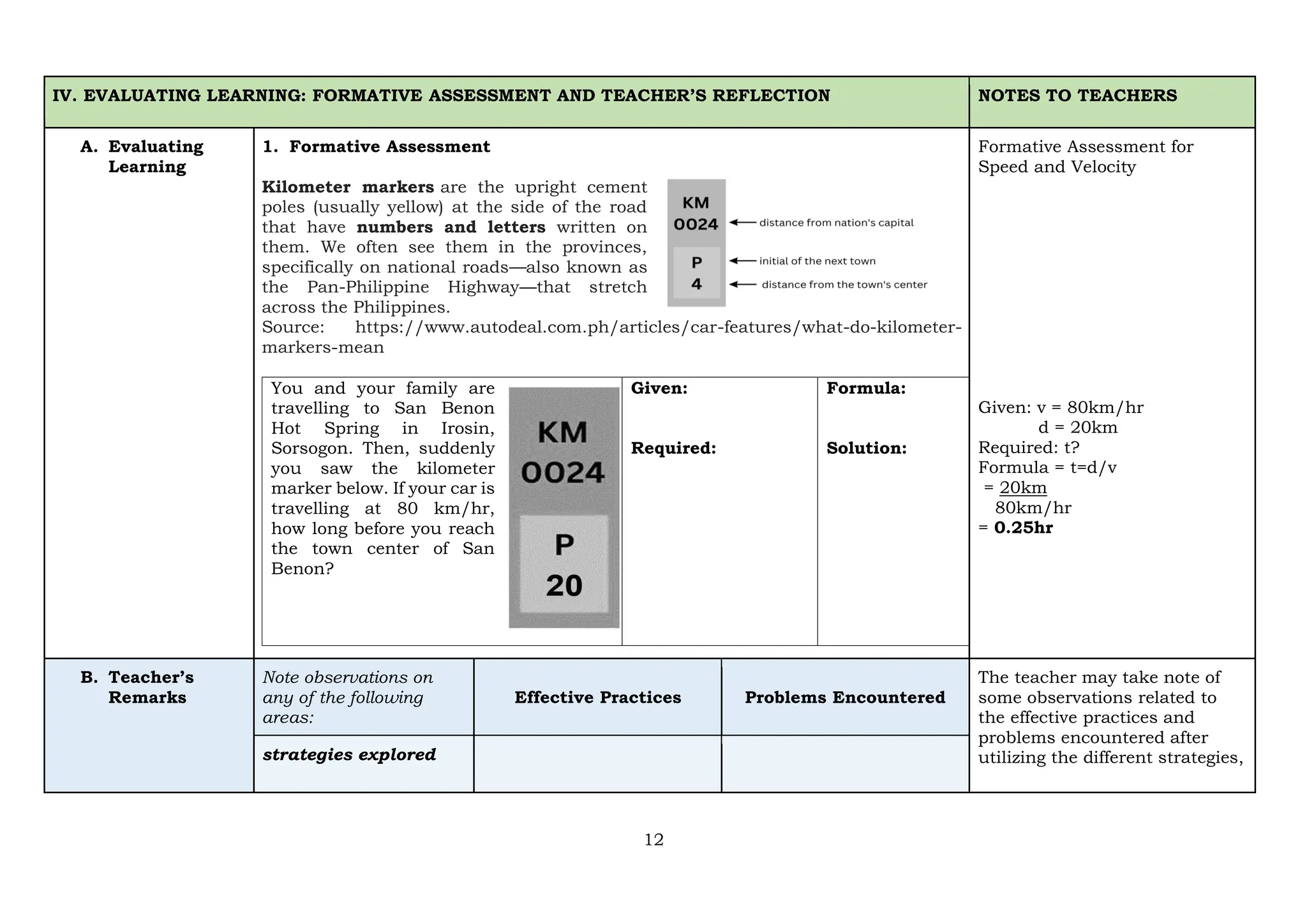
Kilometer markers are the upright cement
poles (usually yellow) at the side of the road
that have numbers and letters written on
them. We often see them in the provinces,
specifically on national roads—also known as
the Pan-Philippine Highway—that stretch
across the Philippines.
Source: https://www.autodeal.com.ph/articles/car-features/what-do-kilometer-
markers-mean
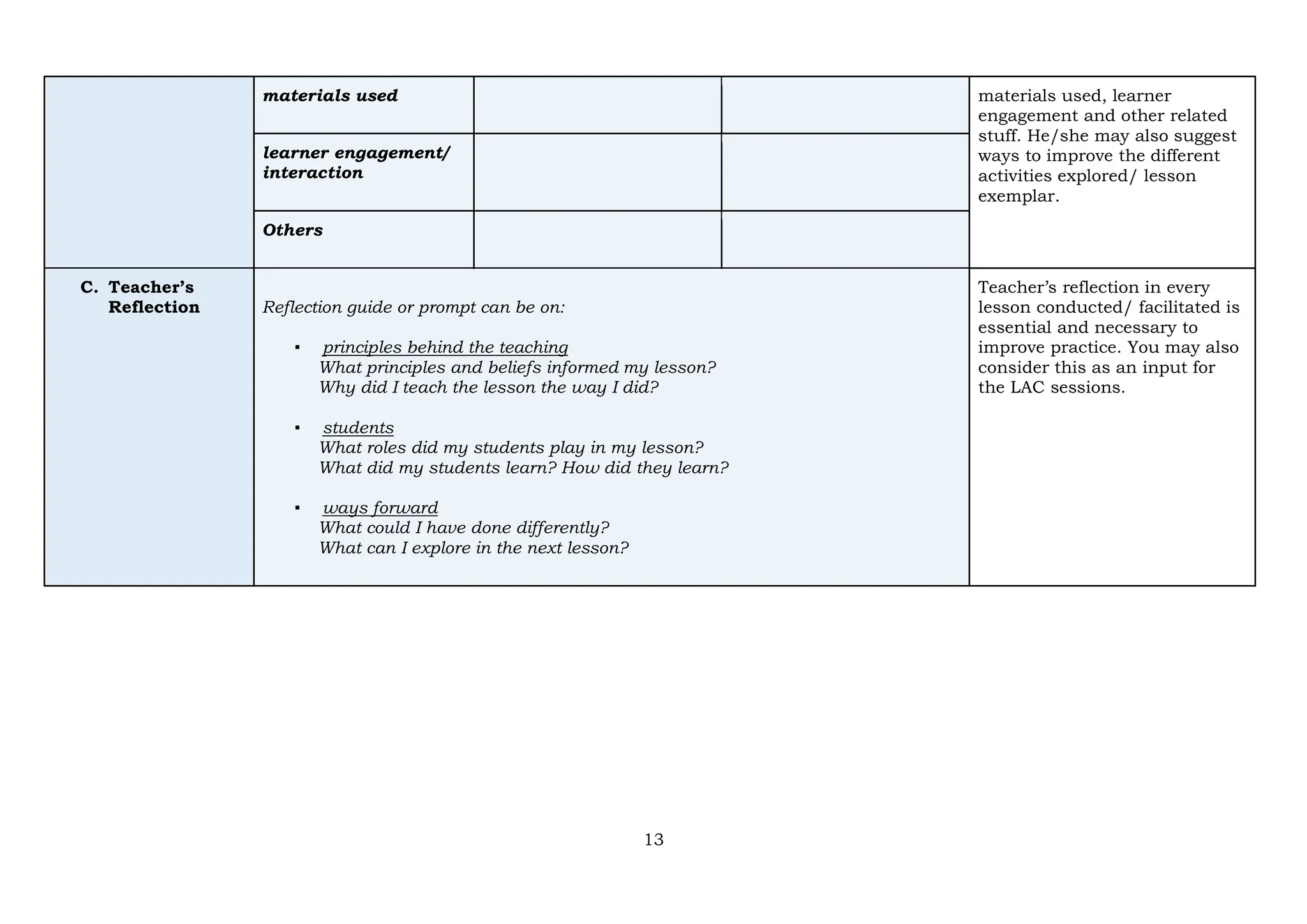
You and your family are
travelling to San Benon
Hot Spring in Irosin,
Sorsogon. Then, suddenly
you saw the kilometer
marker below. If your car is
travelling at 80 km/hr,
how long before you reach
the town center of San
Benon?
Given:
Required:
Formula:
Solution:
Formative Assessment for
Speed and Velocity
Given: v = 80km/hr
d = 20km
Required: t?
Formula = t=d/v
= 20km
80km/hr
= 0.25hr
B. Teacher’s
Remarks
Note observations on
any of the following
areas:
Effective Practices Problems Encountered
The teacher may take note of
some observations related to
the effective practices and
problems encountered after
utilizing the different strategies,
strategies explored
13
materials used materials used, learner
engagement and other related
stuff. He/she may also suggest
ways to improve the different
activities explored/ lesson
exemplar.
learner engagement/
interaction
Others
C. Teacher’s
Reflection Reflection guide or prompt can be on:
▪ principles behind the teaching
What principles and beliefs informed my lesson?
Why did I teach the lesson the way I did?
▪ students
What roles did my students play in my lesson?
What did my students learn? How did they learn?
▪ ways forward
What could I have done differently?
What can I explore in the next lesson?
Teacher’s reflection in every
lesson conducted/ facilitated is
essential and necessary to
improve practice. You may also
consider this as an input for
the LAC sessions.

Q3_LE_Science 7_Lesson 5_Week number5.pdf

  • 1.
  • 2.
    Lesson Exemplar forScience Grade 7 Quarter 3: Lesson 5 (Week 5) SY 2024-2025 This material is intended exclusively for the use of teachers participating in the pilot implementation of the MATATAG K to 10 Curriculum during the School Year 2024-2025. It aims to assist in delivering the curriculum content, standards, and lesson competencies. Any unauthorized reproduction, distribution, modification, or utilization of this material beyond the designated scope is strictly prohibited and may result in appropriate legal actions and disciplinary measures. Borrowed content included in this material are owned by their respective copyright holders. Every effort has been made to locate and obtain permission to use these materials from their respective copyright owners. The publisher and development team do not represent nor claim ownership over them. Every care has been taken to ensure the accuracy of the information provided in this material. For inquiries or feedback, please write or call the Office of the Director of the Bureau of Learning Resources via telephone numbers (02) 8634-1072 and 8631-6922 or by email at blr.od@deped.gov.ph. Development Team Writer: • Al B. Besmonte, PhD (Bicol University) Validator: • Donna Marie DM. Gonong, PhD (Philippine Normal University) Management Team Philippine Normal University Research Institute for Teacher Quality SiMERR National Research Centre
  • 3.
    1 SCIENCE (PHYSICS) /QUARTER3/ GRADE 7 I. CURRICULUM CONTENT, STANDARDS, AND LESSON COMPETENCIES A. Content Standards 1. Scientists and engineers analyze forces to predict their effects on movement. 2. Vectors differentiate the concepts of speed and velocity. 3. Graphing motion provides more accurate predictions about speed and velocity. 4. The particle model explains natural systems and processes. 5. Scientists and engineers conduct innovative research to find solutions to the current global energy crisis by seeking renewable energy B. Performance Standards By the end of the Quarter, learners employ scientific techniques, concepts, and models to investigate forces and motion and represent their understanding using scientific language, force diagrams, and distance-time graphs. They use their curiosity, knowledge and understanding, and skills to propose solutions to problems related to motion and energy. They explore how modern technologies might be used to overcome current global energy concerns. C. Learning Competencies and Objectives Learning Competency 1. Explain the difference between distance and displacement in everyday situations in relation to a reference point; Lesson Objective 1: Describe the motion of an object in terms of distance and displacement 2. Distinguish between speed and velocity using the concept of vectors; Lesson Objective 1: Differentiate speed from velocity and solve problems involving speed and velocity 3. Describe uniform velocity and represent it using distance-time graphs; D. Content Motion: Displacement and Velocity Displacement-Time Graph Distance, Displacement, Speed, and Velocity: a. Distance: The total length of the path traveled by an object, regardless of direction. b. Displacement: The change in position of an object in a particular direction. It has both magnitude and direction. c. Velocity: The rate of change of displacement concerning time. It is a vector quantity, indicating both speed and direction. Uniform velocity
  • 4.
    2 E. Integration GISMapping in distance and displacement Values Education to follow the road regulations by not taking shortcut (displacement) II. LEARNING RESOURCES FuseSchool - Global Education. (2019, November 17). Displacement Time Graphs | Forces & Motion | Physics | FuseSchool [Video]. YouTube. https://www.youtube.com/watch?v=TG2Y2MDx-zE Infinity Learn NEET. (2017, May 4). Motion | Distance and Displacement | Physics | Infinity Learn [Video]. YouTube. https://www.youtube.com/watch?v=21BwUNDOQno Infinity Learn NEET. (2017b, May 11). What is Velocity? - Full Concept of Velocity - Physics | Infinity Learn [Video]. YouTube. https://www.youtube.com/watch?v=apewLkLAR-U Infinity Learn NEET. (2017c, May 18). Physics - What is Acceleration | Motion | Velocity | Infinity Learn NEET [Video]. YouTube. https://www.youtube.com/watch?v=vxFYfumAAlY Infinity Learn NEET. (2018, November 8). What is Speed? | Motion and Time | Don’t Memorise [Video]. YouTube. https://www.youtube.com/watch?v=S9Z1a3sZfHY Ltd, I. B. J. E. (n.d.). The displacement-time graph game. eChalk. https://www.echalk.co.uk/Science/physics/motion/dispGame/displacementGame.html Speed velocity acceleration wild taxi. (n.d.). https://reviewgamezone.com/games4/taxi.php?test_id=14406&title=Speed%20Velocity%20%20Acceleration III. TEACHING AND LEARNING PROCEDURE NOTES TO TEACHERS A. Activating Prior Knowledge 1. Short Review (DAY 1) Which of the following animals: dog, cheetah, and lion, travel the fastest? To begin the lesson, ask this question: Which of the following animals: dog, cheetah, and lion, travel the fastest? Explain.
  • 5.
    3 What is thefastest animal in the Philippines? Answer: The fastest animal among the options is the cheetah. It can accelerate from 0 to 60 miles per hour in less than three seconds and reach speeds of up to 75 miles per hour. You can ask a question which is local in the Philippines. The fastest animal found in the Philippines is the peregrine falcon (Falco peregrinus). The peregrine falcon is considered the fastest member of the animal kingdom and can reach speeds of up to 390 kilometers per hour (242 miles per hour) when diving after prey. This migratory bird was recently spotted for the first time in a wetland in San Jose de Buenavista, Antique province. The sighting indicates that the wetland provides a healthy habitat and abundant food sources for the peregrine falcon in the Philippines. While the Philippines is home to many unique and endangered species, it does not have any native land animals that can match the incredible speed of the peregrine falcon. Other fast animals found in the country include the Philippine eagle, the national bird, and the Tamaraw, a small hoofed mammal, but neither can reach the top speeds of the peregrine falcon. B. Establishing Lesson Purpose 1. Establishing Reason for the Lesson Raise this question to the entire class. THINK OF THIS! How do you usually describe motion and movement of an object? Peregrine Falcon Photo courtesy: CENRO Belison, Antique ©Alaz/Shutterstock.com https://ayej.org/2021/06/29/undyi ng-legend-of-kalibasib-the-worlds- last-captive-bred-tamaraw/
  • 6.
    4 An object’s motionis usually described in terms of how fast or how slow it is moving. If a person is jogging, we can say that the motion is slow, but if the person is running, the motion is fast. 2. Unlocking Vocabulary Content Using the given clues, determine the following terms: 1. DEEPS 2. EAEVAGR DPSEE 3. TCLVEOIY 4. VAGREAE VEOIYTCL 5. ETNTNISAANOUS TCLVEOIY C. Developing and Deepening Understanding SUBTOPIC: Speed and Velocity 1. Explicitation (DAY 2) Activity 5.1 How fast can you run? Use the worksheet for this activity (see page 1 and 2). KEY to Guide Questions: 1. The winning team is the group with the greatest average speed. 2. (a) Yes (b) Yes / No (depends on the students understanding) (c) to determine the appropriate average speed 2. Worked Example (60 mins) (Day 3) There are different types of speed. An object that is moving in a specific direction at a constant speed is called Uniform Motion After the short introduction of the lesson, the students can do Activity 5.1. The teacher should require his/ her students to wear PE uniform and rubber shoes during the conduct of this activity. The proper warm-up (stretching, joint mobility exercises, etc.) of about 5 minutes should be done by each group before they participate in the activity. Activity data may vary. CLUES: 1. Measure of how fast an object is moving 2. the total distance traveled by the object in a particular time interval. 3. Speed in a particular direction 4. The ratio of displacement and time 5. How fast an object is moving at a moment.
  • 7.
    5 Speed is ameasure of how fast something is moving. It is the rate at which distance is covered. The word rate is a clue that something is being divided by time. Speed is defined as the distance covered per unit time. Speed is also a scalar quantity. Velocity is a vector quantity. It describes how fast and in which way (speed + direction) an object is moving. It can be negative or positive depending on the direction of motion. Differentiate Speed from Velocity KEY: Yes, it is possible if both objects are traveling in a straight path. For example, two balls are rolling. Ball A travels at a speed of 7 km/hr while Ball B travels at a velocity of 7 km/hr, North. Looking at the values, both have the same magnitude, which is 7 km/hr. The formula for speed and velocity is almost the same; they only differ in terms of direction. So, instead of using distance, you use displacement. THINK OF THIS! Is it possible for two objects to have an equal magnitude of speed and velocity? Note: Magnitude – numerical value and unit
  • 8.
    6 Sample Problem: 1. Acar moves at a velocity of 60 km/hr, West for 5 hours, how far will it go? Given: velocity - 60 km/hr, W time – 5 hrs Required: displacement Formula: displacement = velocity x time = velocity x time Solution: displacement=60 km/hr,West x 5 hrs displacement = 300 km/ West The car will reach 300 km, West at a velocity of 60 km/hr. KEY: 1. Car 1 because it has a speed of 10m/s compared to car 2 with 50m/s speed. Speed (v) v = d/t = 150 m /15 s = 10 m/s velocity (𝑣 Ԧ) 𝑣 Ԧ = 𝑑 Ԧ/t = 50 m, E/15 s = 3.33 m/s, E
  • 9.
    7 2. A trainneeds to travel a distance of 30 miles at a speed of 10 mi/hr. How long will it take the train to reach its destination? Given: distance – 30 mi speed – 10 mi/hr Required: time Formula: Time = (distance/speed) Solution: Time = 30 mi/ 10 mi/hr It will take 3 hrs for the train to travel a distance of 30 miles 3. Lesson Activity Activity 5.2 Speed/ Velocity Calculations Use the worksheet for this activity (see pages 3 and 4). SUBTOPIC 2: Average Speed/Velocity, and Instantaneous Speed & Velocity 1. Explicitation (DAY 4) Use the worksheet for this activity (see pages 5 and 6). 2. Worked Example (10 mins) In planning a trip by car, the driver often wants to know how long it will take to cover a certain distance. The car will certainly not travel at the same speed during the trip. The driver cares only about the average speed for the trip as a whole. The average speed is defined as follows: 2. Car 1 is (10m/s) faster than car 2 (8m/s). The data on the table may vary depending on the record of each group. Give the worksheet to your students. Please make sure you will supervise each group. If jeepney or tricycle is not available in your area, you can select the local transportation in your area.
  • 10.
    8 Average speed canbe calculated rather easily. For example, if we drive a distance of 60 kilometers during a time of 1 hour, we say our average speed is 60 kilometers per hour (60km/h). Or, if we travel 240 kilometers in 4 hours. Note that when a distance if in kilometers (km) is divided by a time in hours (h), the answer is in kilometer per hour (km/h) Average Velocity is the ratio of the displacement and total elapsed time. For example, if we drive a distance of 60 kilometers, East during a time of 1 hour, we say our average speed is 60 kilometers per hour (60km/h). Or, if we travel 240 kilometers, East in 4 hours, If the car returned to its initial position, traveling 240 m, Wes, the displacement becomes zero, thus the average velocity is also zero. Sample Problem: A runner does one lap around a 200 m track in a time of 25 s. What was the runner's average speed? Given: Required: Formula: 1. The speed of different vehicle varies. 2. Vehicle can have greater or lesser average speed depending on the data gathered. 3. Answer may vary depending on the gathered data. 4. Answer may vary depending on the gathered data. Experience tells you that a vehicle rarely travels at a constant speed, especially in heavy traffic. You can tell the speed of a vehicle at any instant by looking at the vehicle’s speedometer. The speed at any instant is called instantaneous speed. You will notice that a vehicle may travel down a street at 50 km/hr in open stretches while overtaking other vehicles, slow down at 30 km/h because of traffic, or come to a stop at the red light. The instantaneous
  • 11.
    9 total distance –200 m total time time – 25 s Average speed Average speed = Total distance/ Total time Solution: Average Speed = (200 m)/(25 s) Average Speed= 8 m/s The runner’s average speed is 8 m/s. 3. Lesson Activity (30 mins) Activity No.5.3: Average Speed and Average Velocity (30mins) Use the worksheet for this activity (see pages 7 and 8). KEY to Activity 5.3 1a. v = d/t = 7.6km / .6 h = 12.67km/h 1b. v = d/t = 3.5km / .5 h = 7km/h 1c. vave = 𝑑𝑇/ 𝑡𝑇 = (7.6km + 3.5km) / (0.6h+0.5 h) = 11.1km/1.1h = 10.09km/h 2. average velocity 𝑣 Ԧ𝑎𝑣𝑒 = ∆𝑑 ⃗⃗⃗⃗⃗Ԧ/𝑡𝑇 = 8.4km / 0.7 h = 12km/h, SE Average speed is the ratio of the total distance traveled and total elapsed time while average velocity is displacement divided by total elapsed time. PROBLEM SOLVING Activity: 1. The speedometer in every car also has an odometer that records the distance traveled. velocity is the speed at any instant in a particular direction. The vehicle travels at a different speed during its entire trip. For the entire trip, you must only consider one speed, which is the average speed. Average speed is the total distance traveled divided by the total time elapsed in traveling that distance. The birds may have traveled the same speed but did not end up at the same place because they may have differed in terms of direction. It can be inferred that Bird A went to East while Bird B went to West, which caused them not to see each other in the same place. The teacher should print the actual size in the Worksheet so that the measurement will be uniform in terms of the distance of each point.
  • 12.
    10 a. If theodometer reads zero at the beginning of a trip and 35km a half hour later, what is the average speed? b. Would it be possible to attain this average speed and never exceed a reading of 70km/h on the speedometer? c. If a cheetah can maintain a constant speed of 25m/s, it will cover 25 meters every second. At this rate, how far will it travel in 10 seconds? In 1 minute? KEY to Probem Solving Activity Problem 1 a. vave = 35km/0.5h = 70km/h b. NO, not if the trip started from rest and ended at rest, because any intervals with an instantaneous speed less than 70km/h would have to be compensated with instantaneous speeds greater than 70km/h to yield an average of 70km/h. In practice, average speeds are usually appreciably less than peak instantaneous speeds. Problem 2 In 10s the cheetah will cover 250 m, and in 1 minute (60 s) it will cover 1500m, more than 15 football fields. If we know the average speed and the time of travel, then the distance covered is: d = vave x time interval d = (25m/s) x (10s) = 250m d = (25 m/s) x (60s) = 1500m C. Making Generalizations 1. Learners’ Takeaways Color or box the emoji that describes your emotion during your journey in this lesson. In the space provided below, briefly explain what made you feel that way. Answers may vary regarding the given question about Life’s Journey to different destinations.
  • 13.
  • 14.
    12 IV. EVALUATING LEARNING:FORMATIVE ASSESSMENT AND TEACHER’S REFLECTION NOTES TO TEACHERS A. Evaluating Learning 1. Formative Assessment Kilometer markers are the upright cement poles (usually yellow) at the side of the road that have numbers and letters written on them. We often see them in the provinces, specifically on national roads—also known as the Pan-Philippine Highway—that stretch across the Philippines. Source: https://www.autodeal.com.ph/articles/car-features/what-do-kilometer- markers-mean You and your family are travelling to San Benon Hot Spring in Irosin, Sorsogon. Then, suddenly you saw the kilometer marker below. If your car is travelling at 80 km/hr, how long before you reach the town center of San Benon? Given: Required: Formula: Solution: Formative Assessment for Speed and Velocity Given: v = 80km/hr d = 20km Required: t? Formula = t=d/v = 20km 80km/hr = 0.25hr B. Teacher’s Remarks Note observations on any of the following areas: Effective Practices Problems Encountered The teacher may take note of some observations related to the effective practices and problems encountered after utilizing the different strategies, strategies explored
  • 15.
    13 materials used materialsused, learner engagement and other related stuff. He/she may also suggest ways to improve the different activities explored/ lesson exemplar. learner engagement/ interaction Others C. Teacher’s Reflection Reflection guide or prompt can be on: ▪ principles behind the teaching What principles and beliefs informed my lesson? Why did I teach the lesson the way I did? ▪ students What roles did my students play in my lesson? What did my students learn? How did they learn? ▪ ways forward What could I have done differently? What can I explore in the next lesson? Teacher’s reflection in every lesson conducted/ facilitated is essential and necessary to improve practice. You may also consider this as an input for the LAC sessions.