SCOTLAND






Scotland is a country that is part of the United
KingdomOccupying the northern third of the island
of Great Britain,
it shares a border with England to the south and is
bounded by theNorth Sea to the east, the Atlantic
Ocean to the north and west, and the North
Channel and Irish Sea to the southwest.
In addition to the mainland, Scotland is made up of
more than 790 islands. including the Northern
Isles and the Hebrides.




Edinburgh, the country's capital and second-largest city, is
one of Europe's largest financial centres. Edinburgh was
the hub of the Scottish Enlightenment of the 18th century,
which transformed Scotland into one of the commercial,
intellectual, and industrial powerhouses of Europe.
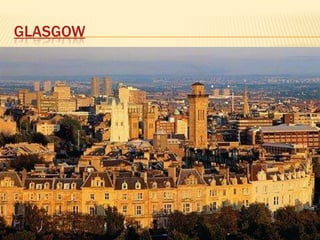
Glasgow, Scotland's largest city,[ was once one of the
world's leading industrial cities and now lies at the centre
of the Greater Glasgow conurbation. Scottish
waters consist of a large sector[ of the North Atlantic and
the North Sea,
containing the largest oil reserves in the European Union.
This has given Aberdeen, the third-largest city in
Scotland, the title of Europe's oil capital.
EDINBURGH
GLASGOW
ABERDEEN
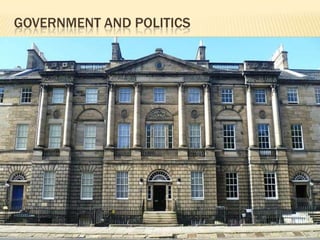
GOVERNMENT AND POLITICS
Scotland's head of state is the monarch of the
United Kingdom, currently Queen Elizabeth
II (since 1952). The regnal numbering "Elizabeth
II" caused controversyaround the time of the
Queen's coronation because there had never
been an Elizabeth I in Scotland.
 A legal action, MacCormick v. Lord
Advocate (1953 SC 396), was brought to
contest the right of the Queen to entitle
herself Elizabeth II within Scotland, arguing that
this was a breach of Article 1 of the Treaty of
Union.





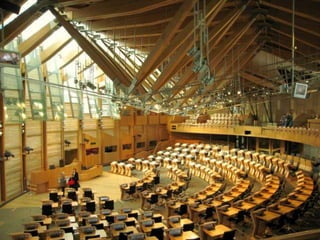
Scotland has limited self-government within the
United Kingdom as well as representation in the UK
Parliament. Executive and legislative powers have
been devolved to, respectively, the Scottish
Government and the Scottish
Parliament at Holyrood in Edinburgh.
The United Kingdom Parliament retains power over a
set list of areas explicitly specified in the Scotland Act
1998 as reserved matters, including, for example,
levels of UK taxes, social
security, defence, international
relations and broadcasting.
LAW AND CRIMINAL JUSTICE
Scots law has a basis derived from Roman
law,[134] combining features of both
uncodified civil law, dating back to the Corpus
Juris Civilis, and common law with medieval
sources.
 The terms of the Treaty of Union with England in
1707 guaranteed the continued existence of a
separate legal system in Scotland from that of
England and Wales.[135]



ADMINISTRATIVE SUBDIVISIONS




Historical subdivisions of Scotland included
the mormaerdom, stewartry, earldom, burgh,
parish, county and regions and districts. Some of
these names are still sometimes used as
geographical descriptors.
Modern Scotland is subdivided in various ways
depending on the purpose. In local government, there
have been 32 council areassince 1996,whose
councils are unitary authorities responsible for the
provision of all local government
services. Community councils are informal
organisations that represent specific sub-divisions of
a council area.
CLIMATE




The climate of Scotland is temperate and oceanic,
and tends to be very changeable. As it is warmed by
the Gulf Stream from theAtlantic, it has much milder
winters (but cooler, wetter summers) than areas on
similar latitudes, for example Labrador,
southernScandinavia, the Moscow region in Russia,
and the Kamchatka Peninsula on the opposite side
of Eurasia.
However, temperatures are generally lower than in
the rest of the UK, with the coldest ever UK
temperature of −27.2 °C (−17.0 °F) recorded
at Braemar in the Grampian Mountains, on 11
February 1895.[153] Winter maxima average 6
FLORA AND FAUNA




Scotland's wildlife is typical of the north west of Europe, although several of
the larger mammals such as the lynx, brown bear, wolf,elk and walrus were
hunted to extinction in historic times. There are important populations
of seals and internationally significant nesting grounds for a variety
of seabirds such as gannets. The golden eagle is something of a national
icon.
On the high mountain tops species including ptarmigan, mountain
hare and stoat can be seen in their white colour phase during winter
months. Remnants of the native Scots pine forest exist and within these
areas the Scottish crossbill, the UK's onlyendemic bird species
and vertebrate, can be found alongside capercaillie, wildcat, red
squirrel and pine marten.[1 In recent years various animals have been reintroduced, including the white-tailed sea eagle in 1975, the red kite in the
1980s, and more recently there have been experimental projects involving
the beaver and wild boar. Today, much of the remaining native Caledonian
Forest lies within the Cairngorms National Park and remnants of the forest
remain at 84 locations across Scotland. On
LYNX
BROWN BEAR
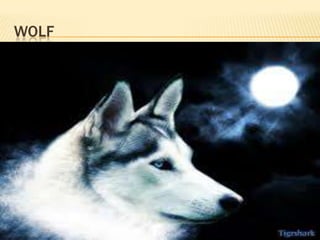
WOLF
ECONOMY AND INFRASTRUCTURE


Scotland has a western style open mixed
economy closely linked with the rest of
Europe and the wider world. Traditionally, the
Scottish economy has been dominated
by heavy industry underpinned
by shipbuilding in Glasgow, coal mining
and steel industries. Petroleum related
industries associated with the extraction
of North Sea oil have also been important
employers from the 1970s, especially in the
north east of Scotland.




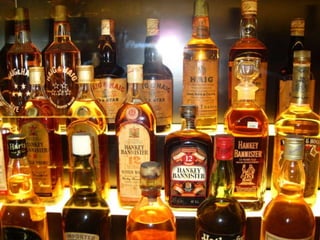
Whisky is probably the best known of Scotland's
manufactured products. Exports have increased by
87% in the past decade and it contributes over
£4.25billion to the UK economy, making up a quarter
of all its food and drink revenues. It is also one of the
UK's overall top five manufacturing export earners
and it supports around 35,000 jobs.
Tourism is also widely recognised as a key
contributor to the Scottish economy. A briefing
published in 2002 by the Scottish Parliament
Information Centre (SPICe) for the Scottish
Parliament's Enterprise and Life Long Learning
Committee stated that tourism accounted for up to
5% of GDP and 7.5% of employment.
DEMOGRAPHY




The population of Scotland in the 2001 Census was
5,062,011. This has risen to 5,295,400, the highest
ever, according to the first results of the 2011
Census.[3
This would make Scotland the 113th largest country
by population if it were a sovereign state.
Although Edinburgh is the capital of Scotland it is not
the largest city. With a population of just over
584,000, this honour falls to Glasgow. The Greater
Glasgow conurbation, with a population of almost
1.2 million, is home to nearly a quarter of Scotland's
population.
RELIGION





Just over two-thirds (67%) of the Scottish population
reported having a religion in 2001, with Christianity
representing all but 2% of these.[230] By contrast, 28% of
the population reported having no religious adherence.
Since the Scottish Reformation of 1560, the national
church (the Church of Scotland, also known as The Kirk)
has been Protestant and Reformed in theology. Since
1689 it has had a Presbyterian system of church
government, and enjoys independence from the
state.[20] About 12% of the population are currently
members of the Church of Scotland, with 40% claiming
affinity. The Church operates a territorial parish structure,
with every community in Scotland having a local
congregation.
CULTURE


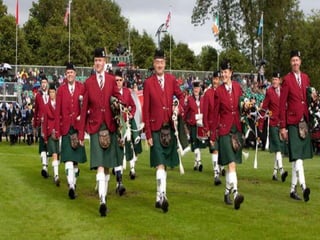
Scottish music is a significant aspect of the
nation's culture, with both traditional and
modern influences. A famous traditional Scottish
instrument is the Great Highland Bagpipe, a
wind instrument consisting of three drones and
a melody pipe (called the chanter), which are
fed continuously by a reservoir of air in a
bag. Bagpipe bands, featuring bagpipes and
various types of drums, and showcasing
Scottish music styles while creating new ones,
have spread throughout the world.


ALEV AY

Scotland

  • 1.
  • 3.
       Scotland is acountry that is part of the United KingdomOccupying the northern third of the island of Great Britain, it shares a border with England to the south and is bounded by theNorth Sea to the east, the Atlantic Ocean to the north and west, and the North Channel and Irish Sea to the southwest. In addition to the mainland, Scotland is made up of more than 790 islands. including the Northern Isles and the Hebrides.
  • 5.
      Edinburgh, the country'scapital and second-largest city, is one of Europe's largest financial centres. Edinburgh was the hub of the Scottish Enlightenment of the 18th century, which transformed Scotland into one of the commercial, intellectual, and industrial powerhouses of Europe. Glasgow, Scotland's largest city,[ was once one of the world's leading industrial cities and now lies at the centre of the Greater Glasgow conurbation. Scottish waters consist of a large sector[ of the North Atlantic and the North Sea, containing the largest oil reserves in the European Union. This has given Aberdeen, the third-largest city in Scotland, the title of Europe's oil capital.
  • 6.
  • 7.
  • 8.
  • 9.
  • 10.
    Scotland's head ofstate is the monarch of the United Kingdom, currently Queen Elizabeth II (since 1952). The regnal numbering "Elizabeth II" caused controversyaround the time of the Queen's coronation because there had never been an Elizabeth I in Scotland.  A legal action, MacCormick v. Lord Advocate (1953 SC 396), was brought to contest the right of the Queen to entitle herself Elizabeth II within Scotland, arguing that this was a breach of Article 1 of the Treaty of Union. 
  • 12.
      Scotland has limitedself-government within the United Kingdom as well as representation in the UK Parliament. Executive and legislative powers have been devolved to, respectively, the Scottish Government and the Scottish Parliament at Holyrood in Edinburgh. The United Kingdom Parliament retains power over a set list of areas explicitly specified in the Scotland Act 1998 as reserved matters, including, for example, levels of UK taxes, social security, defence, international relations and broadcasting.
  • 13.
    LAW AND CRIMINALJUSTICE Scots law has a basis derived from Roman law,[134] combining features of both uncodified civil law, dating back to the Corpus Juris Civilis, and common law with medieval sources.  The terms of the Treaty of Union with England in 1707 guaranteed the continued existence of a separate legal system in Scotland from that of England and Wales.[135]  
  • 15.
    ADMINISTRATIVE SUBDIVISIONS   Historical subdivisionsof Scotland included the mormaerdom, stewartry, earldom, burgh, parish, county and regions and districts. Some of these names are still sometimes used as geographical descriptors. Modern Scotland is subdivided in various ways depending on the purpose. In local government, there have been 32 council areassince 1996,whose councils are unitary authorities responsible for the provision of all local government services. Community councils are informal organisations that represent specific sub-divisions of a council area.
  • 17.
    CLIMATE   The climate ofScotland is temperate and oceanic, and tends to be very changeable. As it is warmed by the Gulf Stream from theAtlantic, it has much milder winters (but cooler, wetter summers) than areas on similar latitudes, for example Labrador, southernScandinavia, the Moscow region in Russia, and the Kamchatka Peninsula on the opposite side of Eurasia. However, temperatures are generally lower than in the rest of the UK, with the coldest ever UK temperature of −27.2 °C (−17.0 °F) recorded at Braemar in the Grampian Mountains, on 11 February 1895.[153] Winter maxima average 6
  • 20.
    FLORA AND FAUNA   Scotland'swildlife is typical of the north west of Europe, although several of the larger mammals such as the lynx, brown bear, wolf,elk and walrus were hunted to extinction in historic times. There are important populations of seals and internationally significant nesting grounds for a variety of seabirds such as gannets. The golden eagle is something of a national icon. On the high mountain tops species including ptarmigan, mountain hare and stoat can be seen in their white colour phase during winter months. Remnants of the native Scots pine forest exist and within these areas the Scottish crossbill, the UK's onlyendemic bird species and vertebrate, can be found alongside capercaillie, wildcat, red squirrel and pine marten.[1 In recent years various animals have been reintroduced, including the white-tailed sea eagle in 1975, the red kite in the 1980s, and more recently there have been experimental projects involving the beaver and wild boar. Today, much of the remaining native Caledonian Forest lies within the Cairngorms National Park and remnants of the forest remain at 84 locations across Scotland. On
  • 21.
  • 22.
  • 23.
  • 24.
    ECONOMY AND INFRASTRUCTURE  Scotlandhas a western style open mixed economy closely linked with the rest of Europe and the wider world. Traditionally, the Scottish economy has been dominated by heavy industry underpinned by shipbuilding in Glasgow, coal mining and steel industries. Petroleum related industries associated with the extraction of North Sea oil have also been important employers from the 1970s, especially in the north east of Scotland.
  • 25.
      Whisky is probablythe best known of Scotland's manufactured products. Exports have increased by 87% in the past decade and it contributes over £4.25billion to the UK economy, making up a quarter of all its food and drink revenues. It is also one of the UK's overall top five manufacturing export earners and it supports around 35,000 jobs. Tourism is also widely recognised as a key contributor to the Scottish economy. A briefing published in 2002 by the Scottish Parliament Information Centre (SPICe) for the Scottish Parliament's Enterprise and Life Long Learning Committee stated that tourism accounted for up to 5% of GDP and 7.5% of employment.
  • 27.
    DEMOGRAPHY   The population ofScotland in the 2001 Census was 5,062,011. This has risen to 5,295,400, the highest ever, according to the first results of the 2011 Census.[3 This would make Scotland the 113th largest country by population if it were a sovereign state. Although Edinburgh is the capital of Scotland it is not the largest city. With a population of just over 584,000, this honour falls to Glasgow. The Greater Glasgow conurbation, with a population of almost 1.2 million, is home to nearly a quarter of Scotland's population.
  • 28.
    RELIGION   Just over two-thirds(67%) of the Scottish population reported having a religion in 2001, with Christianity representing all but 2% of these.[230] By contrast, 28% of the population reported having no religious adherence. Since the Scottish Reformation of 1560, the national church (the Church of Scotland, also known as The Kirk) has been Protestant and Reformed in theology. Since 1689 it has had a Presbyterian system of church government, and enjoys independence from the state.[20] About 12% of the population are currently members of the Church of Scotland, with 40% claiming affinity. The Church operates a territorial parish structure, with every community in Scotland having a local congregation.
  • 31.
    CULTURE  Scottish music isa significant aspect of the nation's culture, with both traditional and modern influences. A famous traditional Scottish instrument is the Great Highland Bagpipe, a wind instrument consisting of three drones and a melody pipe (called the chanter), which are fed continuously by a reservoir of air in a bag. Bagpipe bands, featuring bagpipes and various types of drums, and showcasing Scottish music styles while creating new ones, have spread throughout the world.
  • 34.