SCHOOL
HEALTH
SERVICES
BY: TARUN DHYANI
LECTURER, NCON
JEOLIKOTE, NAINITAL
(UK)
INTRODUCTION
❖ School health is an important branch of community
health.
❖ School health service is an economical and
powerful means of raising community health, and more
important, in future generations.
HEALTH PROBLEMS OF THE
SCHOOL CHILD
❖Malnutrition
❖Infectious diseases
❖Intestinal parasites
❖Diseases of skin, eye and ear
❖Dental caries.
DEFINITION OF SCHOOL
HEALTH
❖ School health refers to a state of complete physical, mental,
social and spiritual well being and not merely the absence of
disease or infirmity among pupils, teachers and other school
personnel.
DEFINITION OF SCHOOL
HEALTH SERVICES
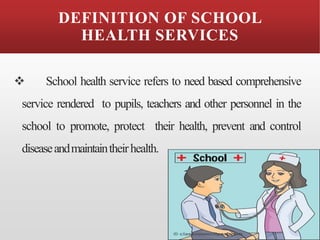
❖ School health service refers to need based comprehensive
service rendered to pupils, teachers and other personnel in the
school to promote, protect their health, prevent and control
diseaseandmaintaintheirhealth.
AIM
❖The ultimate aim ofschool health services is to promote, protect
and maintain health of school children and reduce morbidity and
mortalityin them.
OBJECTIVES OF SCHOOL
HEALTH SEVICES
❖ The promotion of positive health.
❖ The prevention of diseases.
❖ Early diagnosis, treatment and follow-up of defects.
❖ Awakening health consciousness in children.
❖ The provision of healthful environment.
NEED FOR SCHOOL HEALTH
SEVICES
❖School children constitute a vital and substantial segment of
population.
❖Schoolchildren are vulnerable section of population by
virtue of their physical, mental, emotional and social
growthanddevelopmentduringthis period.
❖Schoolchildrenareexpressedto variousstressfulsituations.
NEED FOR SCHOOL HEALTH
SEVICES
❖Children coming to school belong to different socio economic
andcultural backgroundwhichaffect theirhealthandnutritional
status and require help and guidance in promoting, protecting
and maintaining their health and nutritional status.
❖Children in school age are prone to get specific health
problems.
PRINCIPLES OF SCHOOL
HEALTH SEVICES
❖Itis based onhealthneeds of school children.
❖It is planned in co-ordination with school health personnel,
parentsandcommunitypeople.
❖It emphasize on health education to promote, protect, improve
and maintainhealth of childrenandstaff.
❖Itemphasizeonpromotiveandpreventiveaspects.
PRINCIPLES OF SCHOOL
HEALTH SEVICES
❖It emphasizeon healtheducationto promote,protect, improve and
maintainhealth of childrenandstaff.
❖Itemphasizeonlearningthroughactiveanddesirable participation.
❖Itisanongoingandcontinuousprogram.
❖Ithas an effectivesystem of recordkeepingand reporting.
ASPECTS/COMPONENTS OF
SCHOOL HEALTH SERVICE
1. Health appraisal of school children and school
personnel.
2. Remedial measures and follow-up.
3. Prevention of communicable diseases.
4. Healthful school environment.
5. Nutritional services.
6. First-aid and emergency care.
ASPECTS/COMPONENTS OF
SCHOOL HEALTH SERVICE
7. Mental health.
8. Dental health.
9. Eye health.
10. Health education.
11. Education of handicapped children.
12. Proper maintenance and use of school health records.
1. HEALTH APPRAISAL
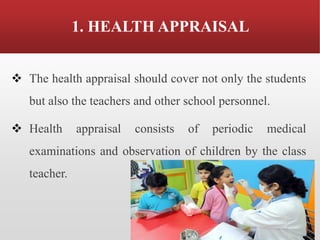
❖ The health appraisal should cover not only the students
but also the teachers and other school personnel.
❖ Health appraisal consists of periodic medical
examinations and observation of children by the class
teacher.
1. HEALTH APPRAISAL
(a) Periodic Medical Examination: The school health
committee (1961) in India recommended medical
examination of children at the time of entry and
thereafter every 4 years.
The initial examination should include a careful
history and physical examination of the child, with
tests for vision, hearing and speech. A routine
examination of blood and urine should be carried out.
1. HEALTH APPRAISAL
(b) School Personnel: Medical examination should be
given to teachers and other school personnel as they
form part of the environment to which the child is
exposed.
1. HEALTH APPRAISAL
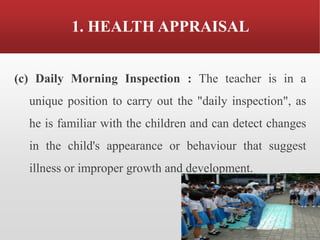
(c) Daily Morning Inspection : The teacher is in a
unique position to carry out the "daily inspection", as
he is familiar with the children and can detect changes
in the child's appearance or behaviour that suggest
illness or improper growth and development.
2. REMEDIAL MEASURES AND
FOLLOW-UP
❖ Medical examinations are not an end in themselves, they
should be followed by appropriate treatment and follow-
up.
❖ Special clinics should be conducted exclusively for school
children.
❖ There should be provision for beds in the existing referral
hospitals for the children to be admitted for investigation
and treatment as and when required.
3. PREVENTION OF
COMMUNICABLE DISEASES
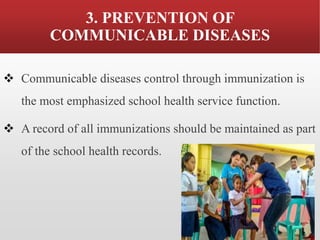
❖ Communicable diseases control through immunization is
the most emphasized school health service function.
❖ A record of all immunizations should be maintained as part
of the school health records.
3. PREVENTION OF
COMMUNICABLE DISEASES
❖ Communicable diseases control through immunization is
the most emphasized school health service function.
❖ Protection of all school going children against
preventable disease by immunization according to the
National Immunization Schedule.
❖ A record of all immunizations should be maintained as
part of the school health records.
4. HEALTHFUL SCHOOL
ENVIRONMENT
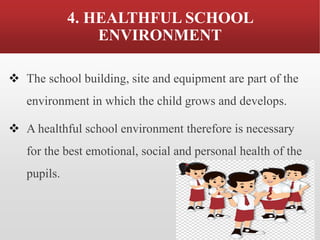
❖ The school building, site and equipment are part of the
environment in which the child grows and develops.
❖ A healthful school environment therefore is necessary
for the best emotional, social and personal health of the
pupils.
5. NUTRITIONAL SERVICES
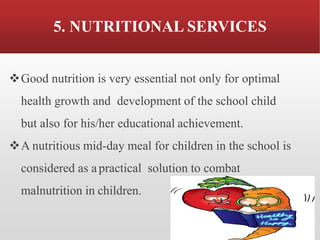
❖Good nutrition is very essential not only for optimal
health growth and development of the school child
but also for his/her educational achievement.
❖A nutritious mid-day meal for children in the school is
considered as a practical solution to combat
malnutrition in children.
6. FIRST-AID AND EMERGENCY
CARE
❖The school must have an arrangement for providing first
aid and emergency care to children who get injured or
sick at the school.
❖The teachers should receive adequate training during
teacher training programor in service training programs
to prepare themselves to carry out this obligation.
7. MENTAL HEALTH
❖ The mental health of the child affects his physical
health and the learning process.
❖ Juvenile delinquency, maladjustment and drug
addiction are becoming problems among school
children.
❖ The school is the most strategic place for shaping the
child's behaviour and promoting mental health.
7. MENTAL HEALTH
❖ Teachers need to plan and organize well-balanced
curricular activities so that students are not over
burdened and have sufficient relaxation and
recreation, etc.
❖ The school teacher has both a positive and preventive
role.
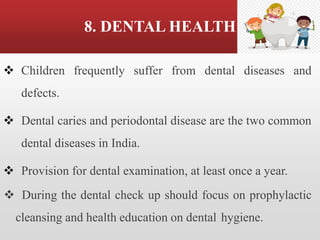
8. DENTAL HEALTH
❖ Children frequently suffer from dental diseases and
defects.
❖ Dental caries and periodontal disease are the two common
dental diseases in India.
❖ Provision for dental examination, at least once a year.
❖ During the dental check up should focus on prophylactic
cleansing and health education on dental hygiene.
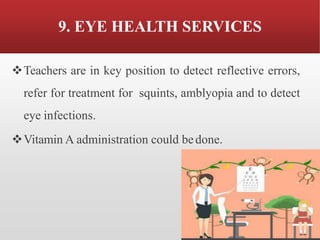
9. EYE HEALTH SERVICES
❖Teachers are in key position to detect reflective errors,
refer for treatment for squints, amblyopia and to detect
eye infections.
❖Vitamin A administration could bedone.
10. HEALTH EDUCATION
❖The most important element of the school health
programme is health education. The goal of health
education should be to bring about desirable changes in
health knowledge, in attitudes and in practice, and not
merely to teach the children a set of rules of hygiene.
❖Health education content areas include personal hygiene,
environmental health, nutrition, prevention and control
of communicable and non-communicable diseases.
11. EDUCATION OF
HANDICAPPED CHILDREN
❖The ultimate goal is to assist the handicapped child and
his family so that the child will be able to reach his
maximum potential, to lead as normal a life as possible,
to become as independent as possible, and to become a
productive and self-supporting member of society.
12. SCHOOL HEALTH RECORDS
❖A cumulative health record of each student should be
maintained.
❖ The purpose of maintaining school health records is to
have cumulative information on the health aspects of
school children in order to give continuing intelligent
health supervision.
SCHOOL HEALTH TEAM
❖Theschool principal
❖Theschool teacher
❖The parents
❖The community
❖The children
❖Themedical officer
❖TheSchoolHealthNurse/CommunityHealthNurse
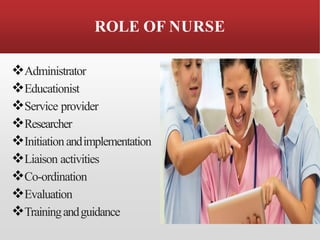
ROLE OF NURSE
❖Administrator
❖Educationist
❖Service provider
❖Researcher
❖Initiationandimplementation
❖Liaison activities
❖Co-ordination
❖Evaluation
❖Trainingandguidance
School health services

School health services

  • 1.
  • 2.
    INTRODUCTION ❖ School healthis an important branch of community health. ❖ School health service is an economical and powerful means of raising community health, and more important, in future generations.
  • 3.
    HEALTH PROBLEMS OFTHE SCHOOL CHILD ❖Malnutrition ❖Infectious diseases ❖Intestinal parasites ❖Diseases of skin, eye and ear ❖Dental caries.
  • 4.
    DEFINITION OF SCHOOL HEALTH ❖School health refers to a state of complete physical, mental, social and spiritual well being and not merely the absence of disease or infirmity among pupils, teachers and other school personnel.
  • 5.
    DEFINITION OF SCHOOL HEALTHSERVICES ❖ School health service refers to need based comprehensive service rendered to pupils, teachers and other personnel in the school to promote, protect their health, prevent and control diseaseandmaintaintheirhealth.
  • 6.
    AIM ❖The ultimate aimofschool health services is to promote, protect and maintain health of school children and reduce morbidity and mortalityin them.
  • 7.
    OBJECTIVES OF SCHOOL HEALTHSEVICES ❖ The promotion of positive health. ❖ The prevention of diseases. ❖ Early diagnosis, treatment and follow-up of defects. ❖ Awakening health consciousness in children. ❖ The provision of healthful environment.
  • 8.
    NEED FOR SCHOOLHEALTH SEVICES ❖School children constitute a vital and substantial segment of population. ❖Schoolchildren are vulnerable section of population by virtue of their physical, mental, emotional and social growthanddevelopmentduringthis period. ❖Schoolchildrenareexpressedto variousstressfulsituations.
  • 9.
    NEED FOR SCHOOLHEALTH SEVICES ❖Children coming to school belong to different socio economic andcultural backgroundwhichaffect theirhealthandnutritional status and require help and guidance in promoting, protecting and maintaining their health and nutritional status. ❖Children in school age are prone to get specific health problems.
  • 10.
    PRINCIPLES OF SCHOOL HEALTHSEVICES ❖Itis based onhealthneeds of school children. ❖It is planned in co-ordination with school health personnel, parentsandcommunitypeople. ❖It emphasize on health education to promote, protect, improve and maintainhealth of childrenandstaff. ❖Itemphasizeonpromotiveandpreventiveaspects.
  • 11.
    PRINCIPLES OF SCHOOL HEALTHSEVICES ❖It emphasizeon healtheducationto promote,protect, improve and maintainhealth of childrenandstaff. ❖Itemphasizeonlearningthroughactiveanddesirable participation. ❖Itisanongoingandcontinuousprogram. ❖Ithas an effectivesystem of recordkeepingand reporting.
  • 12.
    ASPECTS/COMPONENTS OF SCHOOL HEALTHSERVICE 1. Health appraisal of school children and school personnel. 2. Remedial measures and follow-up. 3. Prevention of communicable diseases. 4. Healthful school environment. 5. Nutritional services. 6. First-aid and emergency care.
  • 13.
    ASPECTS/COMPONENTS OF SCHOOL HEALTHSERVICE 7. Mental health. 8. Dental health. 9. Eye health. 10. Health education. 11. Education of handicapped children. 12. Proper maintenance and use of school health records.
  • 14.
    1. HEALTH APPRAISAL ❖The health appraisal should cover not only the students but also the teachers and other school personnel. ❖ Health appraisal consists of periodic medical examinations and observation of children by the class teacher.
  • 15.
    1. HEALTH APPRAISAL (a)Periodic Medical Examination: The school health committee (1961) in India recommended medical examination of children at the time of entry and thereafter every 4 years. The initial examination should include a careful history and physical examination of the child, with tests for vision, hearing and speech. A routine examination of blood and urine should be carried out.
  • 16.
    1. HEALTH APPRAISAL (b)School Personnel: Medical examination should be given to teachers and other school personnel as they form part of the environment to which the child is exposed.
  • 17.
    1. HEALTH APPRAISAL (c)Daily Morning Inspection : The teacher is in a unique position to carry out the "daily inspection", as he is familiar with the children and can detect changes in the child's appearance or behaviour that suggest illness or improper growth and development.
  • 18.
    2. REMEDIAL MEASURESAND FOLLOW-UP ❖ Medical examinations are not an end in themselves, they should be followed by appropriate treatment and follow- up. ❖ Special clinics should be conducted exclusively for school children. ❖ There should be provision for beds in the existing referral hospitals for the children to be admitted for investigation and treatment as and when required.
  • 19.
    3. PREVENTION OF COMMUNICABLEDISEASES ❖ Communicable diseases control through immunization is the most emphasized school health service function. ❖ A record of all immunizations should be maintained as part of the school health records.
  • 20.
    3. PREVENTION OF COMMUNICABLEDISEASES ❖ Communicable diseases control through immunization is the most emphasized school health service function. ❖ Protection of all school going children against preventable disease by immunization according to the National Immunization Schedule. ❖ A record of all immunizations should be maintained as part of the school health records.
  • 21.
    4. HEALTHFUL SCHOOL ENVIRONMENT ❖The school building, site and equipment are part of the environment in which the child grows and develops. ❖ A healthful school environment therefore is necessary for the best emotional, social and personal health of the pupils.
  • 22.
    5. NUTRITIONAL SERVICES ❖Goodnutrition is very essential not only for optimal health growth and development of the school child but also for his/her educational achievement. ❖A nutritious mid-day meal for children in the school is considered as a practical solution to combat malnutrition in children.
  • 23.
    6. FIRST-AID ANDEMERGENCY CARE ❖The school must have an arrangement for providing first aid and emergency care to children who get injured or sick at the school. ❖The teachers should receive adequate training during teacher training programor in service training programs to prepare themselves to carry out this obligation.
  • 24.
    7. MENTAL HEALTH ❖The mental health of the child affects his physical health and the learning process. ❖ Juvenile delinquency, maladjustment and drug addiction are becoming problems among school children. ❖ The school is the most strategic place for shaping the child's behaviour and promoting mental health.
  • 25.
    7. MENTAL HEALTH ❖Teachers need to plan and organize well-balanced curricular activities so that students are not over burdened and have sufficient relaxation and recreation, etc. ❖ The school teacher has both a positive and preventive role.
  • 26.
    8. DENTAL HEALTH ❖Children frequently suffer from dental diseases and defects. ❖ Dental caries and periodontal disease are the two common dental diseases in India. ❖ Provision for dental examination, at least once a year. ❖ During the dental check up should focus on prophylactic cleansing and health education on dental hygiene.
  • 27.
    9. EYE HEALTHSERVICES ❖Teachers are in key position to detect reflective errors, refer for treatment for squints, amblyopia and to detect eye infections. ❖Vitamin A administration could bedone.
  • 28.
    10. HEALTH EDUCATION ❖Themost important element of the school health programme is health education. The goal of health education should be to bring about desirable changes in health knowledge, in attitudes and in practice, and not merely to teach the children a set of rules of hygiene. ❖Health education content areas include personal hygiene, environmental health, nutrition, prevention and control of communicable and non-communicable diseases.
  • 29.
    11. EDUCATION OF HANDICAPPEDCHILDREN ❖The ultimate goal is to assist the handicapped child and his family so that the child will be able to reach his maximum potential, to lead as normal a life as possible, to become as independent as possible, and to become a productive and self-supporting member of society.
  • 30.
    12. SCHOOL HEALTHRECORDS ❖A cumulative health record of each student should be maintained. ❖ The purpose of maintaining school health records is to have cumulative information on the health aspects of school children in order to give continuing intelligent health supervision.
  • 31.
    SCHOOL HEALTH TEAM ❖Theschoolprincipal ❖Theschool teacher ❖The parents ❖The community ❖The children ❖Themedical officer ❖TheSchoolHealthNurse/CommunityHealthNurse
  • 32.
    ROLE OF NURSE ❖Administrator ❖Educationist ❖Serviceprovider ❖Researcher ❖Initiationandimplementation ❖Liaison activities ❖Co-ordination ❖Evaluation ❖Trainingandguidance