INTERNET
ADDICTION
B Y: L AVA S H A S H E R M A N
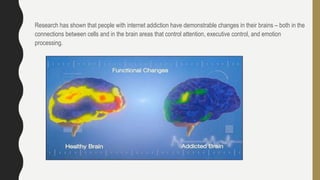
Research has shown that people with internet addiction have demonstrable changes in their brains – both in the
connections between cells and in the brain areas that control attention, executive control, and emotion
processing.
BABY BOOMERS VS. MILLENNIALS
INTERNET OBSESSION
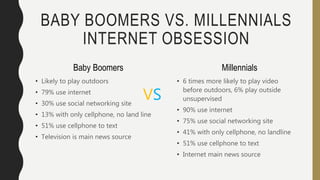
• Likely to play outdoors
• 79% use internet
• 30% use social networking site
• 13% with only cellphone, no land line
• 51% use cellphone to text
• Television is main news source
• 6 times more likely to play video
before outdoors, 6% play outside
unsupervised
• 90% use internet
• 75% use social networking site
• 41% with only cellphone, no landline
• 51% use cellphone to text
• Internet main news source
Baby Boomers Millennials
VS
WHAT IS INTERNET ADDICTION?
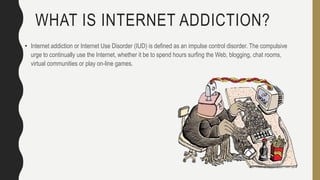
• Internet addiction or Internet Use Disorder (IUD) is defined as an impulse control disorder. The compulsive
urge to continually use the Internet, whether it be to spend hours surfing the Web, blogging, chat rooms,
virtual communities or play on-line games.
WARNING SIGNS OF INTERNET
ADDICTION
• Preoccupation with the Internet. (Thoughts about previous on-line activity or anticipation of the next
on-line session.)
• Use of the Internet in increasing amounts of time in order to achieve satisfaction.
• Repeated, unsuccessful efforts to control, cut back or stop Internet use.
• Feelings of restlessness, moodiness, depression, or irritability when attempting to cut down use of the
Internet.
• On-line longer than originally intended.
• Jeopardized or risked loss of significant relationships, job, educational or career opportunities because
of Internet use.
• Lies to family members, therapists, or others to conceal the extent of involvement with the Internet.
• Use of the Internet is a way to escape from problems or to relieve a dysphoric mood. (e.g. Feelings of
hopelessness, guilt, anxiety, depression.)
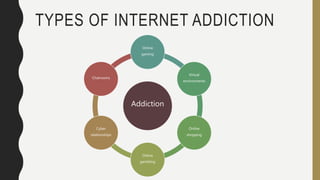
TYPES OF INTERNET ADDICTION
Addiction
Online
gaming
Virtual
environments
Online
shopping
Online
gambling
Cyber
relationships
Chatrooms
CAUSES OF INTERNET ADDICTION
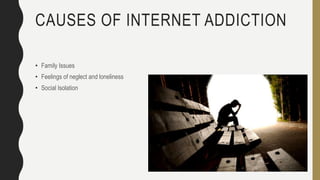
• Family Issues
• Feelings of neglect and loneliness
• Social Isolation
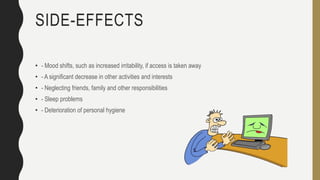
SIDE-EFFECTS
• - Mood shifts, such as increased irritability, if access is taken away
• - A significant decrease in other activities and interests
• - Neglecting friends, family and other responsibilities
• - Sleep problems
• - Deterioration of personal hygiene
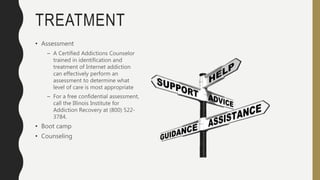
TREATMENT
• Assessment
– A Certified Addictions Counselor
trained in identification and
treatment of Internet addiction
can effectively perform an
assessment to determine what
level of care is most appropriate
– For a free confidential assessment,
call the Illinois Institute for
Addiction Recovery at (800) 522-
3784.
• Boot camp
• Counseling
REFERENCES
• Brown, M. (2014). Online gaming addictions: sundance films explore a darker side of the internet. Retrieved from
http://national.deseretnews.com/article/884/online-gaming-addictions-sundance-films-explore-a
-darker-side-of-the-internet.html
• Gumbrecht, J. (2016). Boot camp for the internet-addicted. Retrieved from http://www.cnn.com/2016/04/26/health/cnnphotos
-internet-addiction-china-boot-camp/
• Healthy Living Editors. (2013). Baby boomers vs. millennials: how internet-obsessed are you?. Retrieved from
http://www.care2.com/greenliving/babyboomers-vs-millennials-how-internet-savvy-are-you-infographic.html
• Miller, T. (2013). Video game addiction and other internet compulsive disorders mask depression, anxiety, learning disabilities.
Retrieved from http://www.nydailynews.com/life-style/health/kids-addicted-video-games-violent-experts-article-1.1298338
• Nguyen, C. (2015). Inside a Chinese internet addiction rehab center. Retrieved from
http://motherboard.vice.com/read/inside-a-chinese-internet- addiction-rehab-center
• Walton, A.G. (2012). Internet addiction: the new mental health disorder?. Retrieved from
http://www.forbes.com/sites/alicegwalton/2012/10/02/the-new-mental-health-disorder-internet-addiction/#378357eb5230

Internet Addiction

  • 1.
    INTERNET ADDICTION B Y: LAVA S H A S H E R M A N
  • 2.
    Research has shownthat people with internet addiction have demonstrable changes in their brains – both in the connections between cells and in the brain areas that control attention, executive control, and emotion processing.
  • 3.
    BABY BOOMERS VS.MILLENNIALS INTERNET OBSESSION • Likely to play outdoors • 79% use internet • 30% use social networking site • 13% with only cellphone, no land line • 51% use cellphone to text • Television is main news source • 6 times more likely to play video before outdoors, 6% play outside unsupervised • 90% use internet • 75% use social networking site • 41% with only cellphone, no landline • 51% use cellphone to text • Internet main news source Baby Boomers Millennials VS
  • 4.
    WHAT IS INTERNETADDICTION? • Internet addiction or Internet Use Disorder (IUD) is defined as an impulse control disorder. The compulsive urge to continually use the Internet, whether it be to spend hours surfing the Web, blogging, chat rooms, virtual communities or play on-line games.
  • 5.
    WARNING SIGNS OFINTERNET ADDICTION • Preoccupation with the Internet. (Thoughts about previous on-line activity or anticipation of the next on-line session.) • Use of the Internet in increasing amounts of time in order to achieve satisfaction. • Repeated, unsuccessful efforts to control, cut back or stop Internet use. • Feelings of restlessness, moodiness, depression, or irritability when attempting to cut down use of the Internet. • On-line longer than originally intended. • Jeopardized or risked loss of significant relationships, job, educational or career opportunities because of Internet use. • Lies to family members, therapists, or others to conceal the extent of involvement with the Internet. • Use of the Internet is a way to escape from problems or to relieve a dysphoric mood. (e.g. Feelings of hopelessness, guilt, anxiety, depression.)
  • 6.
    TYPES OF INTERNETADDICTION Addiction Online gaming Virtual environments Online shopping Online gambling Cyber relationships Chatrooms
  • 7.
    CAUSES OF INTERNETADDICTION • Family Issues • Feelings of neglect and loneliness • Social Isolation
  • 8.
    SIDE-EFFECTS • - Moodshifts, such as increased irritability, if access is taken away • - A significant decrease in other activities and interests • - Neglecting friends, family and other responsibilities • - Sleep problems • - Deterioration of personal hygiene
  • 9.
    TREATMENT • Assessment – ACertified Addictions Counselor trained in identification and treatment of Internet addiction can effectively perform an assessment to determine what level of care is most appropriate – For a free confidential assessment, call the Illinois Institute for Addiction Recovery at (800) 522- 3784. • Boot camp • Counseling
  • 10.
    REFERENCES • Brown, M.(2014). Online gaming addictions: sundance films explore a darker side of the internet. Retrieved from http://national.deseretnews.com/article/884/online-gaming-addictions-sundance-films-explore-a -darker-side-of-the-internet.html • Gumbrecht, J. (2016). Boot camp for the internet-addicted. Retrieved from http://www.cnn.com/2016/04/26/health/cnnphotos -internet-addiction-china-boot-camp/ • Healthy Living Editors. (2013). Baby boomers vs. millennials: how internet-obsessed are you?. Retrieved from http://www.care2.com/greenliving/babyboomers-vs-millennials-how-internet-savvy-are-you-infographic.html • Miller, T. (2013). Video game addiction and other internet compulsive disorders mask depression, anxiety, learning disabilities. Retrieved from http://www.nydailynews.com/life-style/health/kids-addicted-video-games-violent-experts-article-1.1298338 • Nguyen, C. (2015). Inside a Chinese internet addiction rehab center. Retrieved from http://motherboard.vice.com/read/inside-a-chinese-internet- addiction-rehab-center • Walton, A.G. (2012). Internet addiction: the new mental health disorder?. Retrieved from http://www.forbes.com/sites/alicegwalton/2012/10/02/the-new-mental-health-disorder-internet-addiction/#378357eb5230