Schizophrenia
* Schizophrenia is a group of disorders
characterized by perturbations in language ,
perception , cognition and behavior .
*Common symptoms include false beliefs, unclear
or confused thinking, hearing voices that others
do not, reduced social engagement and
emotional expression, and a lack of motivation.
Etiology
• A number Of factors have been identified that
predispose to, or precipitate, or sustain
schizophrenia they are :-
• Schizophrenia can be transmitted genetically .
• Family environment can influence the course of
illness .
• A highly emotional family environment
contributes to relapses.
• Psychological stresses like adverse life events.
Etiology
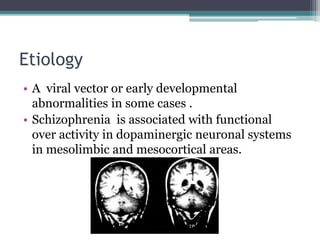
• A viral vector or early developmental
abnormalities in some cases .
• Schizophrenia is associated with functional
over activity in dopaminergic neuronal systems
in mesolimbic and mesocortical areas.
symptomatic schizophrenia
• Schizophrenia syndrome can be associated with
temporal lobe epilepsy , Huntington’s chorea ,
cerebral tumors and demyelinating diseases
known as symptomatic schizophrenia
Types of schizophrenia
• There are four major types disorders :-
1. Catatonic
2. Disorganized
3. Paranoid
4. Undifferentiated
Schizophrenia …
Patient also classified as Type-1 and Type-2
 Type-1 patients have predominance of
“positive” symptoms , normal ventricular size
and a good response to anti-psychotic drugs.
 Type-2 patients have a predominance of
“Negative” symptoms , increased ventricular size
and a poor response to anti-psychotic drugs.
Clinical features
• Clinical manifestations can
consider under three heading ;
1. The first rank symptoms (which strongly
suggest a diagnosis of schizophrenia)
2. Other symptoms ( lower diagnostic)
3. Negative symptoms
Clinical features
First rank symptoms
Thought insertions
Thought broadcasting
Passivity feelings
Auditory hallucinations
Delusional perceptions
Clinical features
Other symptoms
Catatonia
Thought disorder
Neologisms
Delusions- grandiose, paranoid, sexual or
religious
Visual tactile olfactory or gustatory
hallucinations
Affective change
Clinical features
Negative symptoms
Social withdrawal
Poverty of speech
Flatness of effect
Management
Social measures:
• These patient do best in an environment that has
a regular and predictable routine .
• Positive symptoms are exacerbated in highly
charged emotional situations .
• Negative symptoms are induced in
environments that are under stimulating .
Management
Neuroleptic drugs
(Antipsychotic drugs) block both D1 and D2
(dopamine) groups receptors , adrenergic and
cholinergic receptors.
• chlorpromazine 100mg thrice a day
(max.1500mg until symptoms subside )
• fluphenazine 20-100 mg od in 2 weeks i.m
• Newer clozpine , risperidone and olanzapine
Thank you for attention
By : Ravinder Kumar

Schizophrenia

  • 2.
    Schizophrenia * Schizophrenia isa group of disorders characterized by perturbations in language , perception , cognition and behavior . *Common symptoms include false beliefs, unclear or confused thinking, hearing voices that others do not, reduced social engagement and emotional expression, and a lack of motivation.
  • 3.
    Etiology • A numberOf factors have been identified that predispose to, or precipitate, or sustain schizophrenia they are :- • Schizophrenia can be transmitted genetically . • Family environment can influence the course of illness . • A highly emotional family environment contributes to relapses. • Psychological stresses like adverse life events.
  • 4.
    Etiology • A viralvector or early developmental abnormalities in some cases . • Schizophrenia is associated with functional over activity in dopaminergic neuronal systems in mesolimbic and mesocortical areas.
  • 5.
    symptomatic schizophrenia • Schizophreniasyndrome can be associated with temporal lobe epilepsy , Huntington’s chorea , cerebral tumors and demyelinating diseases known as symptomatic schizophrenia
  • 6.
    Types of schizophrenia •There are four major types disorders :- 1. Catatonic 2. Disorganized 3. Paranoid 4. Undifferentiated
  • 7.
    Schizophrenia … Patient alsoclassified as Type-1 and Type-2  Type-1 patients have predominance of “positive” symptoms , normal ventricular size and a good response to anti-psychotic drugs.  Type-2 patients have a predominance of “Negative” symptoms , increased ventricular size and a poor response to anti-psychotic drugs.
  • 8.
    Clinical features • Clinicalmanifestations can consider under three heading ; 1. The first rank symptoms (which strongly suggest a diagnosis of schizophrenia) 2. Other symptoms ( lower diagnostic) 3. Negative symptoms
  • 9.
    Clinical features First ranksymptoms Thought insertions Thought broadcasting Passivity feelings Auditory hallucinations Delusional perceptions
  • 10.
    Clinical features Other symptoms Catatonia Thoughtdisorder Neologisms Delusions- grandiose, paranoid, sexual or religious Visual tactile olfactory or gustatory hallucinations Affective change
  • 11.
    Clinical features Negative symptoms Socialwithdrawal Poverty of speech Flatness of effect
  • 12.
    Management Social measures: • Thesepatient do best in an environment that has a regular and predictable routine . • Positive symptoms are exacerbated in highly charged emotional situations . • Negative symptoms are induced in environments that are under stimulating .
  • 13.
    Management Neuroleptic drugs (Antipsychotic drugs)block both D1 and D2 (dopamine) groups receptors , adrenergic and cholinergic receptors. • chlorpromazine 100mg thrice a day (max.1500mg until symptoms subside ) • fluphenazine 20-100 mg od in 2 weeks i.m • Newer clozpine , risperidone and olanzapine
  • 14.
    Thank you forattention By : Ravinder Kumar