
SCHEDULE Y
Presented by:
Mr. Sonwane Shrinath A.
(Roll no: 307)
Under the Guidence of
Mr. Mahale Sir
Presentation Outline:
 Introduction
 Content
1. Application to permission
2. Clinical trial
3. Studies in special population
4. Post marketing survelliance
5. Special studies-BA/BE
 Conclusion
 Reference
INTRODUCTION
What is Schedule Y?
 Requirements and guidelines for permission to import and/or manufacture of
new drugs for sale or to undertake clinical trials.
Purpose of Schedule Y
 To frame guidelines for conduct of clinical research
 Control and regulation for new drugs
 CDSCO and DTAB formulated GCP under schedule Y in 2005
Why India
 Large patient pool
 Well trained and experienced Investigators.
 Considerable low per patient trial cost, as compared to developed countries.
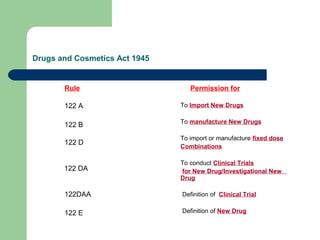
Drugs and Cosmetics Act 1945
Rule
122 A
122 B
122 D
122 DA
122DAA
122 E
Permission for
To Import New Drugs
To manufacture New Drugs
To import or manufacture fixed dose
Combinations
To conduct Clinical Trials
for New Drug/Investigational New
Drug
Definition of Clinical Trial
Definition of New Drug
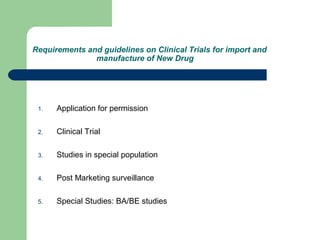
Requirements and guidelines on Clinical Trials for import and
manufacture of New Drug
1. Application for permission
2. Clinical Trial
3. Studies in special population
4. Post Marketing surveillance
5. Special Studies: BA/BE studies
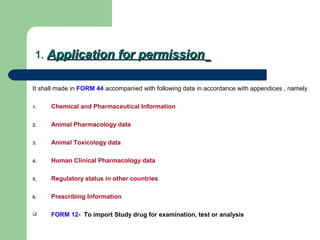
1. Application for permissionApplication for permission
It shall made in FORM 44 accompanied with following data in accordance with appendices , namely
1. Chemical and Pharmaceutical Information
2. Animal Pharmacology data
3. Animal Toxicology data
4. Human Clinical Pharmacology data
5. Regulatory status in other countries
6. Prescribing Information
 FORM 12- To import Study drug for examination, test or analysis
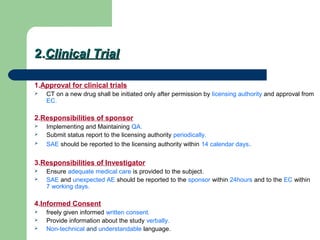
2.2.Clinical TrialClinical Trial
1.Approval for clinical trials
 CT on a new drug shall be initiated only after permission by licensing authority and approval from
EC.
2.Responsibilities of sponsor
 Implementing and Maintaining QA.
 Submit status report to the licensing authority periodically.
 SAE should be reported to the licensing authority within 14 calendar days.
3.Responsibilities of Investigator
 Ensure adequate medical care is provided to the subject.
 SAE and unexpected AE should be reported to the sponsor within 24hours and to the EC within
7 working days.
4.Informed Consent
 freely given informed written consent.
 Provide information about the study verbally.
 Non-technical and understandable language.
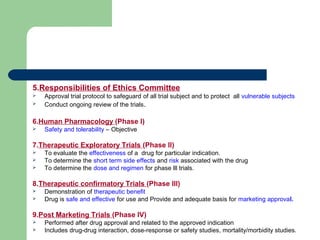
5.Responsibilities of Ethics Committee
 Approval trial protocol to safeguard of all trial subject and to protect all vulnerable subjects
 Conduct ongoing review of the trials.
6.Human Pharmacology (Phase l)
 Safety and tolerability – Objective
7.Therapeutic Exploratory Trials (Phase ll)
 To evaluate the effectiveness of a drug for particular indication.
 To determine the short term side effects and risk associated with the drug
 To determine the dose and regimen for phase lll trials.
8.Therapeutic confirmatory Trials (Phase lll)
 Demonstration of therapeutic benefit
 Drug is safe and effective for use and Provide and adequate basis for marketing approval.
9.Post Marketing Trials (Phase lV)
 Performed after drug approval and related to the approved indication
 Includes drug-drug interaction, dose-response or safety studies, mortality/morbidity studies.
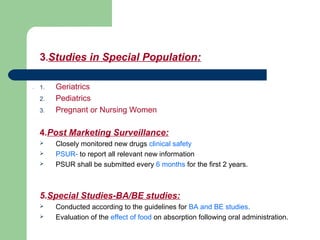
3.Studies in Special Population:
. 1. Geriatrics
2. Pediatrics
3. Pregnant or Nursing Women
4.Post Marketing Surveillance:
 Closely monitored new drugs clinical safety
 PSUR- to report all relevant new information
 PSUR shall be submitted every 6 months for the first 2 years.
5.Special Studies-BA/BE studies:
 Conducted according to the guidelines for BA and BE studies.
 Evaluation of the effect of food on absorption following oral administration.
Conclusion:Conclusion:
With the Schedule Y, efforts are aligned in a single
direction to ensure that irrespective of the Country,
the data generated is of good quality & Standard
which can be accepted Worldwide.
ReferenceReference:
1. Dr. B.S.Kuchekar, A.M.Khadatare, Sachin C. Itkar,
Forensic Pharmacy, Nirali Prakashan, Pg.no:5.270-
5.279.
THANK YOU

Schedule Y Summary

  • 1.
    SCHEDULE Y Presented by: Mr.Sonwane Shrinath A. (Roll no: 307) Under the Guidence of Mr. Mahale Sir
  • 2.
    Presentation Outline:  Introduction Content 1. Application to permission 2. Clinical trial 3. Studies in special population 4. Post marketing survelliance 5. Special studies-BA/BE  Conclusion  Reference
  • 3.
    INTRODUCTION What is ScheduleY?  Requirements and guidelines for permission to import and/or manufacture of new drugs for sale or to undertake clinical trials. Purpose of Schedule Y  To frame guidelines for conduct of clinical research  Control and regulation for new drugs  CDSCO and DTAB formulated GCP under schedule Y in 2005 Why India  Large patient pool  Well trained and experienced Investigators.  Considerable low per patient trial cost, as compared to developed countries.
  • 4.
    Drugs and CosmeticsAct 1945 Rule 122 A 122 B 122 D 122 DA 122DAA 122 E Permission for To Import New Drugs To manufacture New Drugs To import or manufacture fixed dose Combinations To conduct Clinical Trials for New Drug/Investigational New Drug Definition of Clinical Trial Definition of New Drug
  • 5.
    Requirements and guidelineson Clinical Trials for import and manufacture of New Drug 1. Application for permission 2. Clinical Trial 3. Studies in special population 4. Post Marketing surveillance 5. Special Studies: BA/BE studies
  • 6.
    1. Application forpermissionApplication for permission It shall made in FORM 44 accompanied with following data in accordance with appendices , namely 1. Chemical and Pharmaceutical Information 2. Animal Pharmacology data 3. Animal Toxicology data 4. Human Clinical Pharmacology data 5. Regulatory status in other countries 6. Prescribing Information  FORM 12- To import Study drug for examination, test or analysis
  • 7.
    2.2.Clinical TrialClinical Trial 1.Approvalfor clinical trials  CT on a new drug shall be initiated only after permission by licensing authority and approval from EC. 2.Responsibilities of sponsor  Implementing and Maintaining QA.  Submit status report to the licensing authority periodically.  SAE should be reported to the licensing authority within 14 calendar days. 3.Responsibilities of Investigator  Ensure adequate medical care is provided to the subject.  SAE and unexpected AE should be reported to the sponsor within 24hours and to the EC within 7 working days. 4.Informed Consent  freely given informed written consent.  Provide information about the study verbally.  Non-technical and understandable language.
  • 8.
    5.Responsibilities of EthicsCommittee  Approval trial protocol to safeguard of all trial subject and to protect all vulnerable subjects  Conduct ongoing review of the trials. 6.Human Pharmacology (Phase l)  Safety and tolerability – Objective 7.Therapeutic Exploratory Trials (Phase ll)  To evaluate the effectiveness of a drug for particular indication.  To determine the short term side effects and risk associated with the drug  To determine the dose and regimen for phase lll trials. 8.Therapeutic confirmatory Trials (Phase lll)  Demonstration of therapeutic benefit  Drug is safe and effective for use and Provide and adequate basis for marketing approval. 9.Post Marketing Trials (Phase lV)  Performed after drug approval and related to the approved indication  Includes drug-drug interaction, dose-response or safety studies, mortality/morbidity studies.
  • 9.
    3.Studies in SpecialPopulation: . 1. Geriatrics 2. Pediatrics 3. Pregnant or Nursing Women 4.Post Marketing Surveillance:  Closely monitored new drugs clinical safety  PSUR- to report all relevant new information  PSUR shall be submitted every 6 months for the first 2 years. 5.Special Studies-BA/BE studies:  Conducted according to the guidelines for BA and BE studies.  Evaluation of the effect of food on absorption following oral administration.
  • 10.
    Conclusion:Conclusion: With the ScheduleY, efforts are aligned in a single direction to ensure that irrespective of the Country, the data generated is of good quality & Standard which can be accepted Worldwide.
  • 11.
    ReferenceReference: 1. Dr. B.S.Kuchekar,A.M.Khadatare, Sachin C. Itkar, Forensic Pharmacy, Nirali Prakashan, Pg.no:5.270- 5.279.
  • 12.