SCENARIO ANALYSIS/PLANNING
FOR COMMAND RESPONSIBILITY IN NIGERIA
BY
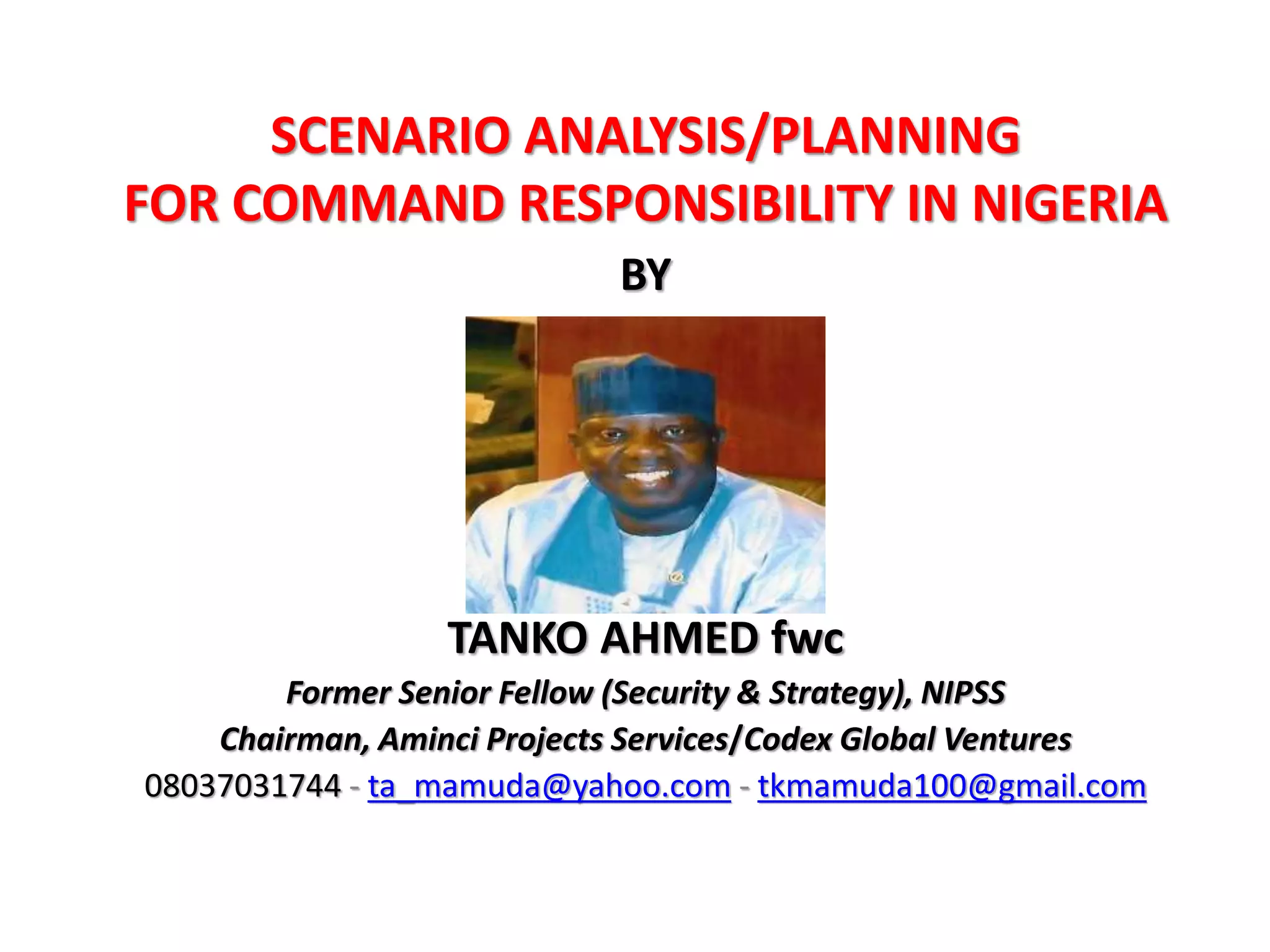
TANKO AHMED fwc
Former Senior Fellow (Security & Strategy), NIPSS
Chairman, Aminci Projects Services/Codex Global Ventures
08037031744 - ta_mamuda@yahoo.com - tkmamuda100@gmail.com
A Paper Presented to Participants of the NIPSS
Strategy Course for Command Responsibility
(19-30 August 2019)
Friday, 23 August 2019
Preamble
• Scenario analysis/planning contemplates on
possible events that could take place in the
future by considering various feasible results
or outcomes.
• It is an integral part of strategic management
or planning process
• It defines focal issues, raise questions, and
contributes to decision-making
• It drives time-framed relevant moves in
realisation of objectives
INTRODUCTION
The Golden Rule of Investigation
Before Solution
You cannot proffer solution to a problem
you are yet to comprehend.
The cracks in your knowledge will create
gaps in the solutions.
– Ahmad Salkida, August 16, 2019
Background
• The formulation of scenarios involves
creative and system thinking
• Known facts are blended with the unknown,
to produce futuristic trends for action.
• Commanders use scenarios to translate an
attain set objectives under the environmental
influence
• Scenarios collapse strategy, operation and
tactics in an instance.
General Literature on Scenario
• Literature on strategy and management
tend to project scenario
analysis/planning as decision support
tool.
• Scenario is “… known to influence and
facilitate decision-making through the
thoughtful construction of the decision
environment” (Gong, et al. 2017:3)
Literature Thrust on Scenario
• Scenarios provide commonly used and
intuitively appealing means to communicate
and characterize uncertainty in many
decision support applications (Bryant & Lempert,
2010)
• Scenarios are however known to fall short of
their potential, especially when used in
broad public debates among participants
with diverse interests and values.
Scenario Theories and Models
• Scenario analysis or planning exhibits
widening complexity in theory and modeling
due to disparaging units
• Several tools are therefore deployed
including strategic planning, open system
planning, integrated change and trans-
organisational development
• These tools share focus on “… effective
method for examining uncertainties and
investigating assumptions …” (Chermack, 2005:59)
Theoretical Framework
• The theory of strategic planning
contains scenarios identification,
environmental learning, mental models,
decision making, and performance
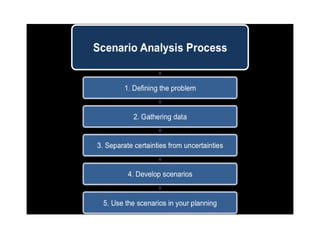
• This structurally corresponds with the
scenario analysis process.
• This paper adopts this theoretical
framework corresponding with the
structure of scenario analysis process.
CONCEPTUAL FRAMEWORK
What is Scenario
• Any possible situation or imagined
sequence of events or circumstances;
• Generally understood as situation, set
up, consequence, or state of affairs
• Scenario is based on certain
assumptions, observed factors and
calculated expectations
Scenario Analysis or Planning
• Scenario analysis/planning or scenario
thinking is a strategic planning method
used in making flexible plans
• It is usually seen in military intelligence
operations in which assumptions on
enemies moves are constructed to
determine best and worst cases,
moderated by reasonable forecast.
Scenario Method
• The scenario method contains the set of
assumptions, rules, and tools,
• It includes, but not limited to, the process
outline, which govern scenario planning.
• It describes the basic assumptions and process
model, how the future is to be captured in
the scenarios.
• It is the method through which scenarios are
formed, including the recommended support
systems, modeling techniques, and data sources.
UNDERSTANDING
COMMAND RESPONSIBILITY
Command Responsibility
• Signifies effective control, not just a
formal rank;
• It involves a superior-subordinate
organisational relationship;
• The Commander issues orders which are
to be obeyed; and
• The Commander must possess capacity
and power to influence.
Nature of Command Responsibility
• Command Responsibility comes in
various forms and levels
• From the smallest tactical unit to
medium operational sectors, to larger
policy and strategic central commands
• It ranges from a patrol or action units, to
area or zonal formation, to highest
responsibilities of the C-in-C
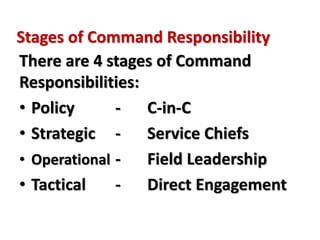
Stages of Command Responsibility
There are 4 stages of Command
Responsibilities:
• Policy - C-in-C
• Strategic - Service Chiefs
• Operational - Field Leadership
• Tactical - Direct Engagement
Elements of Command Responsibility
• Command responsibility is a volatile
undertaking;
• Often unstable and potentially dangerous,
unpredictable and changeable, with short-
lived tendency;
• Impulsive, capricious and precarious;
• Likened to a condition of molten silver or
silver water
The Nigerian Situation
• Nigerian situation likens to a Silver
Water Environment in which
anything goes in uncertainty of the
highest order
• The Nigerian situation is equally
arduous and so ambiguous,
particularly for Command
Responsibility
THE SCENARIO DILEMMA
IN
COMMAND RESPONSIBILITY
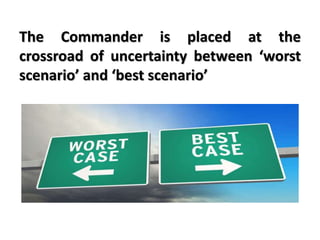
The Commander is placed at the
crossroad of uncertainty between ‘worst
scenario’ and ‘best scenario’
The Commander must decide,
very fast, among so many paths or
options - ALONE
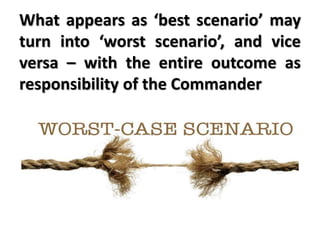
What appears as ‘best scenario’ may
turn into ‘worst scenario’, and vice
versa – with the entire outcome as
responsibility of the Commander
Whichever way to go, the
Commander must make a move
– or else -
NEED FOR
SCENARIO-BASED LEARNING
Scenario-Based Learning
• Training on Scenario Analysis comes
as important and necessary
• Scenario-based learning greatly
improves strategic thinking, decision
making and crisis management in
uncertain environments
Ex-Forest Sentinel Scenario
• Reference to solutions rendered in the
previous exercise on Strategic
Management
• Course Participants are require to
conduct Scenario Analysis/Planning
based on Situation
Report/Recommendations
• Each Group to report to the Whole
House

SCENARIO ANALYSIS/PLANNING FOR COMMAND RESPONSIBILITY IN NIGERIA

  • 1.
    SCENARIO ANALYSIS/PLANNING FOR COMMANDRESPONSIBILITY IN NIGERIA BY TANKO AHMED fwc Former Senior Fellow (Security & Strategy), NIPSS Chairman, Aminci Projects Services/Codex Global Ventures 08037031744 - ta_mamuda@yahoo.com - tkmamuda100@gmail.com
  • 2.
    A Paper Presentedto Participants of the NIPSS Strategy Course for Command Responsibility (19-30 August 2019) Friday, 23 August 2019
  • 4.
    Preamble • Scenario analysis/planningcontemplates on possible events that could take place in the future by considering various feasible results or outcomes. • It is an integral part of strategic management or planning process • It defines focal issues, raise questions, and contributes to decision-making • It drives time-framed relevant moves in realisation of objectives
  • 5.
  • 6.
    The Golden Ruleof Investigation Before Solution You cannot proffer solution to a problem you are yet to comprehend. The cracks in your knowledge will create gaps in the solutions. – Ahmad Salkida, August 16, 2019
  • 7.
    Background • The formulationof scenarios involves creative and system thinking • Known facts are blended with the unknown, to produce futuristic trends for action. • Commanders use scenarios to translate an attain set objectives under the environmental influence • Scenarios collapse strategy, operation and tactics in an instance.
  • 8.
    General Literature onScenario • Literature on strategy and management tend to project scenario analysis/planning as decision support tool. • Scenario is “… known to influence and facilitate decision-making through the thoughtful construction of the decision environment” (Gong, et al. 2017:3)
  • 9.
    Literature Thrust onScenario • Scenarios provide commonly used and intuitively appealing means to communicate and characterize uncertainty in many decision support applications (Bryant & Lempert, 2010) • Scenarios are however known to fall short of their potential, especially when used in broad public debates among participants with diverse interests and values.
  • 10.
    Scenario Theories andModels • Scenario analysis or planning exhibits widening complexity in theory and modeling due to disparaging units • Several tools are therefore deployed including strategic planning, open system planning, integrated change and trans- organisational development • These tools share focus on “… effective method for examining uncertainties and investigating assumptions …” (Chermack, 2005:59)
  • 11.
    Theoretical Framework • Thetheory of strategic planning contains scenarios identification, environmental learning, mental models, decision making, and performance • This structurally corresponds with the scenario analysis process. • This paper adopts this theoretical framework corresponding with the structure of scenario analysis process.
  • 13.
  • 14.
    What is Scenario •Any possible situation or imagined sequence of events or circumstances; • Generally understood as situation, set up, consequence, or state of affairs • Scenario is based on certain assumptions, observed factors and calculated expectations
  • 15.
    Scenario Analysis orPlanning • Scenario analysis/planning or scenario thinking is a strategic planning method used in making flexible plans • It is usually seen in military intelligence operations in which assumptions on enemies moves are constructed to determine best and worst cases, moderated by reasonable forecast.
  • 16.
    Scenario Method • Thescenario method contains the set of assumptions, rules, and tools, • It includes, but not limited to, the process outline, which govern scenario planning. • It describes the basic assumptions and process model, how the future is to be captured in the scenarios. • It is the method through which scenarios are formed, including the recommended support systems, modeling techniques, and data sources.
  • 17.
  • 18.
    Command Responsibility • Signifieseffective control, not just a formal rank; • It involves a superior-subordinate organisational relationship; • The Commander issues orders which are to be obeyed; and • The Commander must possess capacity and power to influence.
  • 19.
    Nature of CommandResponsibility • Command Responsibility comes in various forms and levels • From the smallest tactical unit to medium operational sectors, to larger policy and strategic central commands • It ranges from a patrol or action units, to area or zonal formation, to highest responsibilities of the C-in-C
  • 20.
    Stages of CommandResponsibility There are 4 stages of Command Responsibilities: • Policy - C-in-C • Strategic - Service Chiefs • Operational - Field Leadership • Tactical - Direct Engagement
  • 21.
    Elements of CommandResponsibility • Command responsibility is a volatile undertaking; • Often unstable and potentially dangerous, unpredictable and changeable, with short- lived tendency; • Impulsive, capricious and precarious; • Likened to a condition of molten silver or silver water
  • 22.
    The Nigerian Situation •Nigerian situation likens to a Silver Water Environment in which anything goes in uncertainty of the highest order • The Nigerian situation is equally arduous and so ambiguous, particularly for Command Responsibility
  • 23.
  • 24.
    The Commander isplaced at the crossroad of uncertainty between ‘worst scenario’ and ‘best scenario’
  • 25.
    The Commander mustdecide, very fast, among so many paths or options - ALONE
  • 26.
    What appears as‘best scenario’ may turn into ‘worst scenario’, and vice versa – with the entire outcome as responsibility of the Commander
  • 27.
    Whichever way togo, the Commander must make a move – or else -
  • 28.
  • 29.
    Scenario-Based Learning • Trainingon Scenario Analysis comes as important and necessary • Scenario-based learning greatly improves strategic thinking, decision making and crisis management in uncertain environments
  • 30.
    Ex-Forest Sentinel Scenario •Reference to solutions rendered in the previous exercise on Strategic Management • Course Participants are require to conduct Scenario Analysis/Planning based on Situation Report/Recommendations • Each Group to report to the Whole House