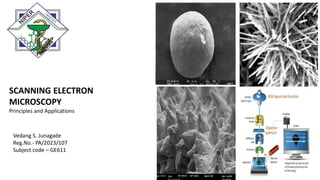
SCANNING ELECTRON
MICROSCOPY
Principles and Applications
Vedang S. Junagade
Reg.No.- PA/2023/107
Subject code – GE611
1
Flow of Contents
Generation of
Secondary Electrons
Generation of Back-
Scattered Electrons
Components of SEM-
Electron Gun
Components of SEM-
Detection system
Components of SEM-
Scan Coils
Components of SEM-
Electromagnetic
Lenses
Applications in
Biological Science,
Geology and
Pharmaceuticals
Factors affecting Image
Quality
Case Study
2
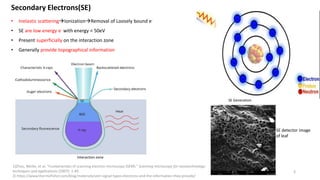
Secondary Electrons(SE)
• Inelastic scatteringIonizationRemoval of Loosely bound e-
• SE are low energy e- with energy < 50eV
• Present superficially on the interaction zone
• Generally provide topographical information
1)Zhou, Weilie, et al. "Fundamentals of scanning electron microscopy (SEM)." Scanning microscopy for nanotechnology:
techniques and applications (2007): 1-40.
2) https://www.thermofisher.com/blog/materials/sem-signal-types-electrons-and-the-information-they-provide/
3
SE detector image
of leaf
SE Generation
Interaction zone
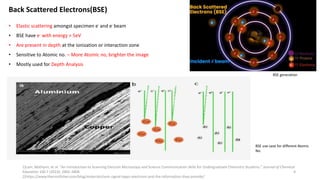
Back Scattered Electrons(BSE)
• Elastic scattering amongst specimen e- and e- beam
• BSE have e- with energy > 5eV
• Are present in depth at the ionization or interaction zone
• Sensitive to Atomic no. – More Atomic no, brighter the image
• Mostly used for Depth Analysis
1)Lam, Matilynn, et al. "An Introduction to Scanning Electron Microscopy and Science Communication Skills for Undergraduate Chemistry Students." Journal of Chemical
Education 100.7 (2023): 2802-2808.
2)https://www.thermofisher.com/blog/materials/sem-signal-types-electrons-and-the-information-they-provide/
4
BSE generation
BSE use case for different Atomic
No.
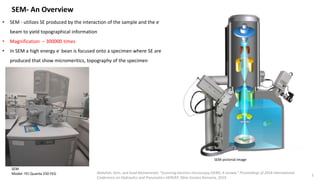
SEM- An Overview
• SEM - utilizes SE produced by the interaction of the sample and the e-
beam to yield topographical information
• Magnification – 300000 times
• In SEM a high energy e- bean is focused onto a specimen where SE are
produced that show micromeritics, topography of the specimen
SEM
Model- FEI Quanta 250 FEG Abdullah, Avin, and Azad Mohammed. "Scanning electron microscopy (SEM): A review." Proceedings of 2018 International
Conference on Hydraulics and Pneumatics-HERVEX. Băile Govora Romania, 2019.
5
SEM pictorial image
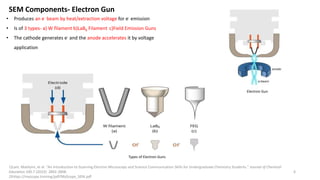
SEM Components- Electron Gun
• Produces an e- beam by heat/extraction voltage for e- emission
• Is of 3 types- a) W filament b)LaB6 Filament c)Field Emission Guns
• The cathode generates e- and the anode accelerates it by voltage
application
1)Lam, Matilynn, et al. "An Introduction to Scanning Electron Microscopy and Science Communication Skills for Undergraduate Chemistry Students." Journal of Chemical
Education 100.7 (2023): 2802-2808.
2)https://myscope.training/pdf/MyScope_SEM.pdf
6
Types of Electron Guns
Electron Gun
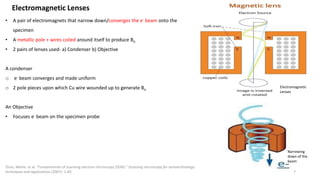
Electromagnetic Lenses
• A pair of electromagnets that narrow down/converges the e- beam onto the
specimen
• A metallic pole + wires coiled around itself to produce Bo
• 2 pairs of lenses used- a) Condenser b) Objective
A condenser
o e- beam converges and made uniform
o 2 pole pieces upon which Cu wire wounded up to generate Bo
An Objective
• Focuses e- beam on the specimen probe
Zhou, Weilie, et al. "Fundamentals of scanning electron microscopy (SEM)." Scanning microscopy for nanotechnology:
techniques and applications (2007): 1-40. 7
Electromagnetic
Lenses
Narrowing
down of the
beam
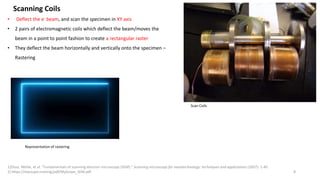
Scanning Coils
• Deflect the e- beam, and scan the specimen in XY axis
• 2 pairs of electromagnetic coils which deflect the beam/moves the
beam in a point to point fashion to create a rectangular raster
• They deflect the beam horizontally and vertically onto the specimen –
Rastering
1)Zhou, Weilie, et al. "Fundamentals of scanning electron microscopy (SEM)." Scanning microscopy for nanotechnology: techniques and applications (2007): 1-40.
2) https://myscope.training/pdf/MyScope_SEM.pdf 8
Scan Coils
Representation of rastering
Detection Systems
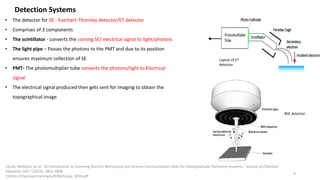
• The detector for SE - Everhart-Thornley detector/ET detector
• Comprises of 3 components
• The scintillator - converts the coming SE/ electrical signal to light/photons
• The light pipe – Passes the photons to the PMT and due to its position
ensures maximum collection of SE
• PMT- The photomultiplier tube converts the photons/light to Electrical
signal
• The electrical signal produced then gets sent for imaging to obtain the
topographical image
1)Lam, Matilynn, et al. "An Introduction to Scanning Electron Microscopy and Science Communication Skills for Undergraduate Chemistry Students." Journal of Chemical
Education 100.7 (2023): 2802-2808.
2)https://myscope.training/pdf/MyScope_SEM.pdf
9
Layout of ET
detector
BSE detector
Vacuum Systems
• Indispensable part of SEM, prevents unwanted scattering of e- and other
contamination
• 2 commonly used pumps- a)Mechanical Pump b) Diffusion Pumps
Mechanical Pump
o A motor driven rotor that compresses High vol. of gas and increases the
overall compressed gas pressure
o When the compressed gas pressure reaches a certain threshold it gets
expelled out
o Vacuum achieved- 5 x 10⁻⁵ Torr
Zhou, Weilie, et al. "Fundamentals of scanning electron microscopy (SEM)." Scanning microscopy for nanotechnology: techniques and applications (2007): 1-40.
10
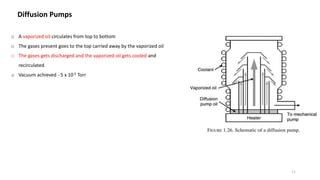
Diffusion Pumps
o A vaporized oil circulates from top to bottom
o The gases present goes to the top carried away by the vaporized oil
o The gases gets discharged and the vaporized oil gets cooled and
recirculated
o Vacuum achieved - 5 x 10⁻⁵ Torr
11
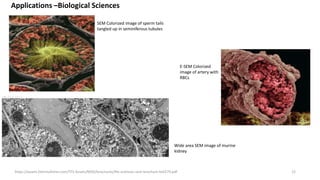
Applications –Biological Sciences
SEM Colorized image of sperm tails
tangled up in seminiferous tubules
E-SEM Colorized
image of artery with
RBCs
Wide area SEM image of murine
kidney
https://assets.thermofisher.com/TFS-Assets/MSD/brochures/life-sciences-sem-brochure-br0179.pdf 12
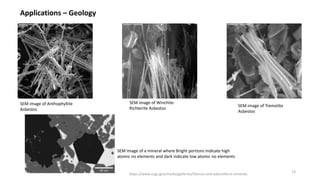
Applications – Geology
SEM image of Anthophyllite
Asbestos
SEM image of Winchite-
Richterite Asbestos
SEM image of Tremolite
Asbestos
SEM image of a mineral where Bright portions indicate high
atomic no elements and dark indicate low atomic no elements
https://www.usgs.gov/media/galleries/fibrous-and-asbestiform-minerals
13
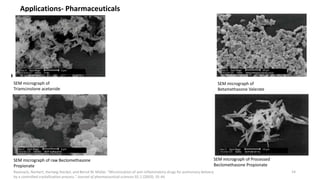
Applications- Pharmaceuticals
SEM micrograph of
Triamcinolone acetanide
SEM micrograph of
Betamethasone Valerate
SEM micrograph of raw Beclomethasone
Propionate
SEM micrograph of Processed
Beclomethasone Propionate
Rasenack, Norbert, Hartwig Steckel, and Bernd W. Müller. "Micronization of anti-inflammatory drugs for pulmonary delivery
by a controlled crystallization process." Journal of pharmaceutical sciences 92.1 (2003): 35-44.
14
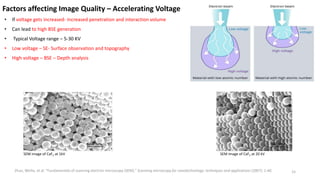
Factors affecting Image Quality – Accelerating Voltage
• If voltage gets increased- Increased penetration and interaction volume
• Can lead to high BSE generation
• Typical Voltage range – 5-30 KV
• Low voltage – SE- Surface observation and topography
• High voltage – BSE – Depth analysis
15
SEM image of CaF2 at 1kV SEM image of CaF2 at 20 kV
Zhou, Weilie, et al. "Fundamentals of scanning electron microscopy (SEM)." Scanning microscopy for nanotechnology: techniques and applications (2007): 1-40.
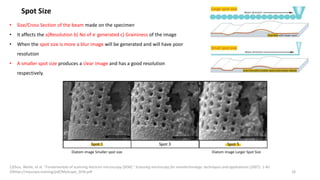
Spot Size
• Size/Cross Section of the beam made on the specimen
• It affects the a)Resolution b) No of e- generated c) Graininess of the image
• When the spot size is more a blur image will be generated and will have poor
resolution
• A smaller spot size produces a clear image and has a good resolution
respectively.
1)Zhou, Weilie, et al. "Fundamentals of scanning electron microscopy (SEM)." Scanning microscopy for nanotechnology: techniques and applications (2007): 1-40.
2)https://myscope.training/pdf/MyScope_SEM.pdf 16
Diatom image Smaller spot size Diatom image Larger Spot Size
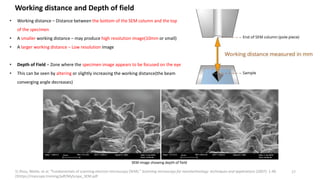
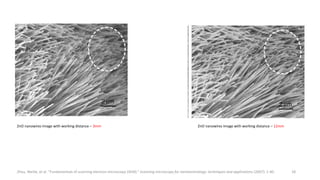
Working distance and Depth of field
• Working distance – Distance between the bottom of the SEM column and the top
of the specimen
• A smaller working distance – may produce high resolution image(10mm or small)
• A larger working distance – Low resolution image
• Depth of Field – Zone where the specimen image appears to be focused on the eye
• This can be seen by altering or slightly increasing the working distance(the beam
converging angle decreases)
1) Zhou, Weilie, et al. "Fundamentals of scanning electron microscopy (SEM)." Scanning microscopy for nanotechnology: techniques and applications (2007): 1-40.
2)https://myscope.training/pdf/MyScope_SEM.pdf
17
SEM image showing depth of field
18
ZnO nanowires Image with working distance – 3mm ZnO nanowires Image with working distance – 12mm
Zhou, Weilie, et al. "Fundamentals of scanning electron microscopy (SEM)." Scanning microscopy for nanotechnology: techniques and applications (2007): 1-40.
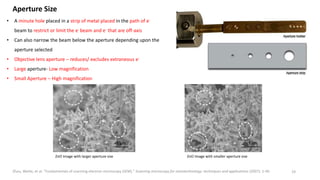
Aperture Size
• A minute hole placed in a strip of metal placed in the path of e-
beam to restrict or limit the e- beam and e- that are off-axis
• Can also narrow the beam below the aperture depending upon the
aperture selected
• Objective lens aperture – reduces/ excludes extraneous e-
• Large aperture- Low magnification
• Small Aperture – High magnification
Zhou, Weilie, et al. "Fundamentals of scanning electron microscopy (SEM)." Scanning microscopy for nanotechnology: techniques and applications (2007): 1-40. 19
ZnO Image with larger aperture size ZnO Image with smaller aperture size
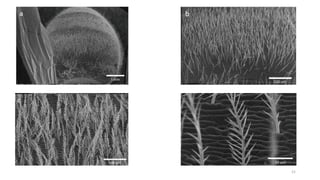
Magnification
• Magnification refers to enlargement of image/ a particular portion of the
image
• In SEM achieved by scanning a smaller area
• A scale bar present on the image- Gives the unit of distance on the image
• Magnification adjusted by the scanning coils
20
Zhou, Weilie, et al. "Fundamentals of scanning electron microscopy (SEM)." Scanning microscopy for nanotechnology: techniques and applications (2007): 1-40.
21
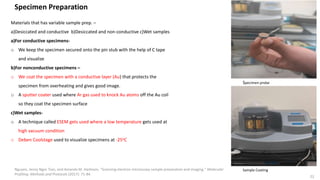
Specimen Preparation
Materials that has variable sample prep. –
a)Desiccated and conductive b)Desiccated and non-conductive c)Wet samples
a)For conductive specimens-
o We keep the specimen secured onto the pin stub with the help of C tape
and visualize
b)For nonconductive specimens –
o We coat the specimen with a conductive layer (Au) that protects the
specimen from overheating and gives good image.
o A sputter coater used where Ar gas used to knock Au atoms off the Au coil
so they coat the specimen surface
c)Wet samples-
o A technique called ESEM gets used where a low temperature gets used at
high vacuum condition
o Deben Coolstage used to visualize specimens at -25oC
Nguyen, Jenny Ngoc Tran, and Amanda M. Harbison. "Scanning electron microscopy sample preparation and imaging." Molecular
Profiling: Methods and Protocols (2017): 71-84.
22
Specimen probe
Sample Coating
Application- Case Study
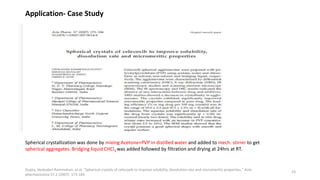
Spherical crystallization was done by mixing Acetone+PVP in distilled water and added to mech. stirrer to get
spherical aggregates. Bridging liquid CHCl3 was added followed by filtration and drying at 24hrs at RT.
Gupta, Venkadari Rammohan, et al. "Spherical crystals of celecoxib to improve solubility, dissolution rate and micromeritic properties." Acta
pharmaceutica 57.2 (2007): 173-184.
23
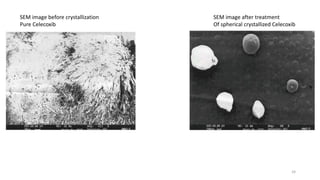
SEM image before crystallization
Pure Celecoxib
SEM image after treatment
Of spherical crystallized Celecoxib
24
THANK YOU
25

Scanning electron microscopy- principles and applications

  • 1.
    SCANNING ELECTRON MICROSCOPY Principles andApplications Vedang S. Junagade Reg.No.- PA/2023/107 Subject code – GE611 1
  • 2.
    Flow of Contents Generationof Secondary Electrons Generation of Back- Scattered Electrons Components of SEM- Electron Gun Components of SEM- Detection system Components of SEM- Scan Coils Components of SEM- Electromagnetic Lenses Applications in Biological Science, Geology and Pharmaceuticals Factors affecting Image Quality Case Study 2
  • 3.
    Secondary Electrons(SE) • InelasticscatteringIonizationRemoval of Loosely bound e- • SE are low energy e- with energy < 50eV • Present superficially on the interaction zone • Generally provide topographical information 1)Zhou, Weilie, et al. "Fundamentals of scanning electron microscopy (SEM)." Scanning microscopy for nanotechnology: techniques and applications (2007): 1-40. 2) https://www.thermofisher.com/blog/materials/sem-signal-types-electrons-and-the-information-they-provide/ 3 SE detector image of leaf SE Generation Interaction zone
  • 4.
    Back Scattered Electrons(BSE) •Elastic scattering amongst specimen e- and e- beam • BSE have e- with energy > 5eV • Are present in depth at the ionization or interaction zone • Sensitive to Atomic no. – More Atomic no, brighter the image • Mostly used for Depth Analysis 1)Lam, Matilynn, et al. "An Introduction to Scanning Electron Microscopy and Science Communication Skills for Undergraduate Chemistry Students." Journal of Chemical Education 100.7 (2023): 2802-2808. 2)https://www.thermofisher.com/blog/materials/sem-signal-types-electrons-and-the-information-they-provide/ 4 BSE generation BSE use case for different Atomic No.
  • 5.
    SEM- An Overview •SEM - utilizes SE produced by the interaction of the sample and the e- beam to yield topographical information • Magnification – 300000 times • In SEM a high energy e- bean is focused onto a specimen where SE are produced that show micromeritics, topography of the specimen SEM Model- FEI Quanta 250 FEG Abdullah, Avin, and Azad Mohammed. "Scanning electron microscopy (SEM): A review." Proceedings of 2018 International Conference on Hydraulics and Pneumatics-HERVEX. Băile Govora Romania, 2019. 5 SEM pictorial image
  • 6.
    SEM Components- ElectronGun • Produces an e- beam by heat/extraction voltage for e- emission • Is of 3 types- a) W filament b)LaB6 Filament c)Field Emission Guns • The cathode generates e- and the anode accelerates it by voltage application 1)Lam, Matilynn, et al. "An Introduction to Scanning Electron Microscopy and Science Communication Skills for Undergraduate Chemistry Students." Journal of Chemical Education 100.7 (2023): 2802-2808. 2)https://myscope.training/pdf/MyScope_SEM.pdf 6 Types of Electron Guns Electron Gun
  • 7.
    Electromagnetic Lenses • Apair of electromagnets that narrow down/converges the e- beam onto the specimen • A metallic pole + wires coiled around itself to produce Bo • 2 pairs of lenses used- a) Condenser b) Objective A condenser o e- beam converges and made uniform o 2 pole pieces upon which Cu wire wounded up to generate Bo An Objective • Focuses e- beam on the specimen probe Zhou, Weilie, et al. "Fundamentals of scanning electron microscopy (SEM)." Scanning microscopy for nanotechnology: techniques and applications (2007): 1-40. 7 Electromagnetic Lenses Narrowing down of the beam
  • 8.
    Scanning Coils • Deflectthe e- beam, and scan the specimen in XY axis • 2 pairs of electromagnetic coils which deflect the beam/moves the beam in a point to point fashion to create a rectangular raster • They deflect the beam horizontally and vertically onto the specimen – Rastering 1)Zhou, Weilie, et al. "Fundamentals of scanning electron microscopy (SEM)." Scanning microscopy for nanotechnology: techniques and applications (2007): 1-40. 2) https://myscope.training/pdf/MyScope_SEM.pdf 8 Scan Coils Representation of rastering
  • 9.
    Detection Systems • Thedetector for SE - Everhart-Thornley detector/ET detector • Comprises of 3 components • The scintillator - converts the coming SE/ electrical signal to light/photons • The light pipe – Passes the photons to the PMT and due to its position ensures maximum collection of SE • PMT- The photomultiplier tube converts the photons/light to Electrical signal • The electrical signal produced then gets sent for imaging to obtain the topographical image 1)Lam, Matilynn, et al. "An Introduction to Scanning Electron Microscopy and Science Communication Skills for Undergraduate Chemistry Students." Journal of Chemical Education 100.7 (2023): 2802-2808. 2)https://myscope.training/pdf/MyScope_SEM.pdf 9 Layout of ET detector BSE detector
  • 10.
    Vacuum Systems • Indispensablepart of SEM, prevents unwanted scattering of e- and other contamination • 2 commonly used pumps- a)Mechanical Pump b) Diffusion Pumps Mechanical Pump o A motor driven rotor that compresses High vol. of gas and increases the overall compressed gas pressure o When the compressed gas pressure reaches a certain threshold it gets expelled out o Vacuum achieved- 5 x 10⁻⁵ Torr Zhou, Weilie, et al. "Fundamentals of scanning electron microscopy (SEM)." Scanning microscopy for nanotechnology: techniques and applications (2007): 1-40. 10
  • 11.
    Diffusion Pumps o Avaporized oil circulates from top to bottom o The gases present goes to the top carried away by the vaporized oil o The gases gets discharged and the vaporized oil gets cooled and recirculated o Vacuum achieved - 5 x 10⁻⁵ Torr 11
  • 12.
    Applications –Biological Sciences SEMColorized image of sperm tails tangled up in seminiferous tubules E-SEM Colorized image of artery with RBCs Wide area SEM image of murine kidney https://assets.thermofisher.com/TFS-Assets/MSD/brochures/life-sciences-sem-brochure-br0179.pdf 12
  • 13.
    Applications – Geology SEMimage of Anthophyllite Asbestos SEM image of Winchite- Richterite Asbestos SEM image of Tremolite Asbestos SEM image of a mineral where Bright portions indicate high atomic no elements and dark indicate low atomic no elements https://www.usgs.gov/media/galleries/fibrous-and-asbestiform-minerals 13
  • 14.
    Applications- Pharmaceuticals SEM micrographof Triamcinolone acetanide SEM micrograph of Betamethasone Valerate SEM micrograph of raw Beclomethasone Propionate SEM micrograph of Processed Beclomethasone Propionate Rasenack, Norbert, Hartwig Steckel, and Bernd W. Müller. "Micronization of anti-inflammatory drugs for pulmonary delivery by a controlled crystallization process." Journal of pharmaceutical sciences 92.1 (2003): 35-44. 14
  • 15.
    Factors affecting ImageQuality – Accelerating Voltage • If voltage gets increased- Increased penetration and interaction volume • Can lead to high BSE generation • Typical Voltage range – 5-30 KV • Low voltage – SE- Surface observation and topography • High voltage – BSE – Depth analysis 15 SEM image of CaF2 at 1kV SEM image of CaF2 at 20 kV Zhou, Weilie, et al. "Fundamentals of scanning electron microscopy (SEM)." Scanning microscopy for nanotechnology: techniques and applications (2007): 1-40.
  • 16.
    Spot Size • Size/CrossSection of the beam made on the specimen • It affects the a)Resolution b) No of e- generated c) Graininess of the image • When the spot size is more a blur image will be generated and will have poor resolution • A smaller spot size produces a clear image and has a good resolution respectively. 1)Zhou, Weilie, et al. "Fundamentals of scanning electron microscopy (SEM)." Scanning microscopy for nanotechnology: techniques and applications (2007): 1-40. 2)https://myscope.training/pdf/MyScope_SEM.pdf 16 Diatom image Smaller spot size Diatom image Larger Spot Size
  • 17.
    Working distance andDepth of field • Working distance – Distance between the bottom of the SEM column and the top of the specimen • A smaller working distance – may produce high resolution image(10mm or small) • A larger working distance – Low resolution image • Depth of Field – Zone where the specimen image appears to be focused on the eye • This can be seen by altering or slightly increasing the working distance(the beam converging angle decreases) 1) Zhou, Weilie, et al. "Fundamentals of scanning electron microscopy (SEM)." Scanning microscopy for nanotechnology: techniques and applications (2007): 1-40. 2)https://myscope.training/pdf/MyScope_SEM.pdf 17 SEM image showing depth of field
  • 18.
    18 ZnO nanowires Imagewith working distance – 3mm ZnO nanowires Image with working distance – 12mm Zhou, Weilie, et al. "Fundamentals of scanning electron microscopy (SEM)." Scanning microscopy for nanotechnology: techniques and applications (2007): 1-40.
  • 19.
    Aperture Size • Aminute hole placed in a strip of metal placed in the path of e- beam to restrict or limit the e- beam and e- that are off-axis • Can also narrow the beam below the aperture depending upon the aperture selected • Objective lens aperture – reduces/ excludes extraneous e- • Large aperture- Low magnification • Small Aperture – High magnification Zhou, Weilie, et al. "Fundamentals of scanning electron microscopy (SEM)." Scanning microscopy for nanotechnology: techniques and applications (2007): 1-40. 19 ZnO Image with larger aperture size ZnO Image with smaller aperture size
  • 20.
    Magnification • Magnification refersto enlargement of image/ a particular portion of the image • In SEM achieved by scanning a smaller area • A scale bar present on the image- Gives the unit of distance on the image • Magnification adjusted by the scanning coils 20 Zhou, Weilie, et al. "Fundamentals of scanning electron microscopy (SEM)." Scanning microscopy for nanotechnology: techniques and applications (2007): 1-40.
  • 21.
  • 22.
    Specimen Preparation Materials thathas variable sample prep. – a)Desiccated and conductive b)Desiccated and non-conductive c)Wet samples a)For conductive specimens- o We keep the specimen secured onto the pin stub with the help of C tape and visualize b)For nonconductive specimens – o We coat the specimen with a conductive layer (Au) that protects the specimen from overheating and gives good image. o A sputter coater used where Ar gas used to knock Au atoms off the Au coil so they coat the specimen surface c)Wet samples- o A technique called ESEM gets used where a low temperature gets used at high vacuum condition o Deben Coolstage used to visualize specimens at -25oC Nguyen, Jenny Ngoc Tran, and Amanda M. Harbison. "Scanning electron microscopy sample preparation and imaging." Molecular Profiling: Methods and Protocols (2017): 71-84. 22 Specimen probe Sample Coating
  • 23.
    Application- Case Study Sphericalcrystallization was done by mixing Acetone+PVP in distilled water and added to mech. stirrer to get spherical aggregates. Bridging liquid CHCl3 was added followed by filtration and drying at 24hrs at RT. Gupta, Venkadari Rammohan, et al. "Spherical crystals of celecoxib to improve solubility, dissolution rate and micromeritic properties." Acta pharmaceutica 57.2 (2007): 173-184. 23
  • 24.
    SEM image beforecrystallization Pure Celecoxib SEM image after treatment Of spherical crystallized Celecoxib 24
  • 25.

Editor's Notes

  • #4 Inelastic scattering- Loss of KE when e- interacts with atoms e-. Energy given to e- to get out and become SE have less KE
  • #5 Elastic scatteing- e- beam deflected without KE loss. E- deflected >90 its BSE and retain much of KE.
  • #6 Resolution- 1nm, sensitivity-depends upon various factors like intensity of e-, volatage applied, spot size etc
  • #7 First two heated till 2700 and then they emit. A voltage applied connected to earth that acceletes e-. Arou 5kv-30kv
  • #8 Metal- fe or any ferromagnetic material. Condesor position can adjust the spot size. The current applied at Condesnor can either +/- the spot size.
  • #9 Scan coils aid in magnification control.
  • #10 The scintillator has a bias of 10kv that casues photons formed of + density which will be enough to generate image.
  • #11 First diffusion and then mechanical
  • #13 Colorized by dye application or by software
  • #14 Anthophyllite, winchite richterite are minerals that can form asbestoss, minerals known for heat resistance and fibrous in nature
  • #15 SEM final image can also be called as micrograph and also SEM image.
  • #16 1kv delicate 5kv biological 20kv physical scinecne
  • #17 Spot size controlled by condesor, aperture size and majorly the application of current/Bo generated by Electromagnets.
  • #20 30um smallest- max resolution, low current high depth field, 110um largest- low resolution, high current, low depth field
  • #23 For hydrates and solvates, cryosem or esem used.
  • #25 SEM disadvantages – most images are greyscale images, SE SEM image- intensity of SE reaching the detector, at small size roughness cant be calculated.sub surface imaging touch.
  • #26 Comparison to TEM, smaller resolution, emitted e-, large sample in comparison, for surface and depth analysis, gives 3d image, comparatively lower magnification