1
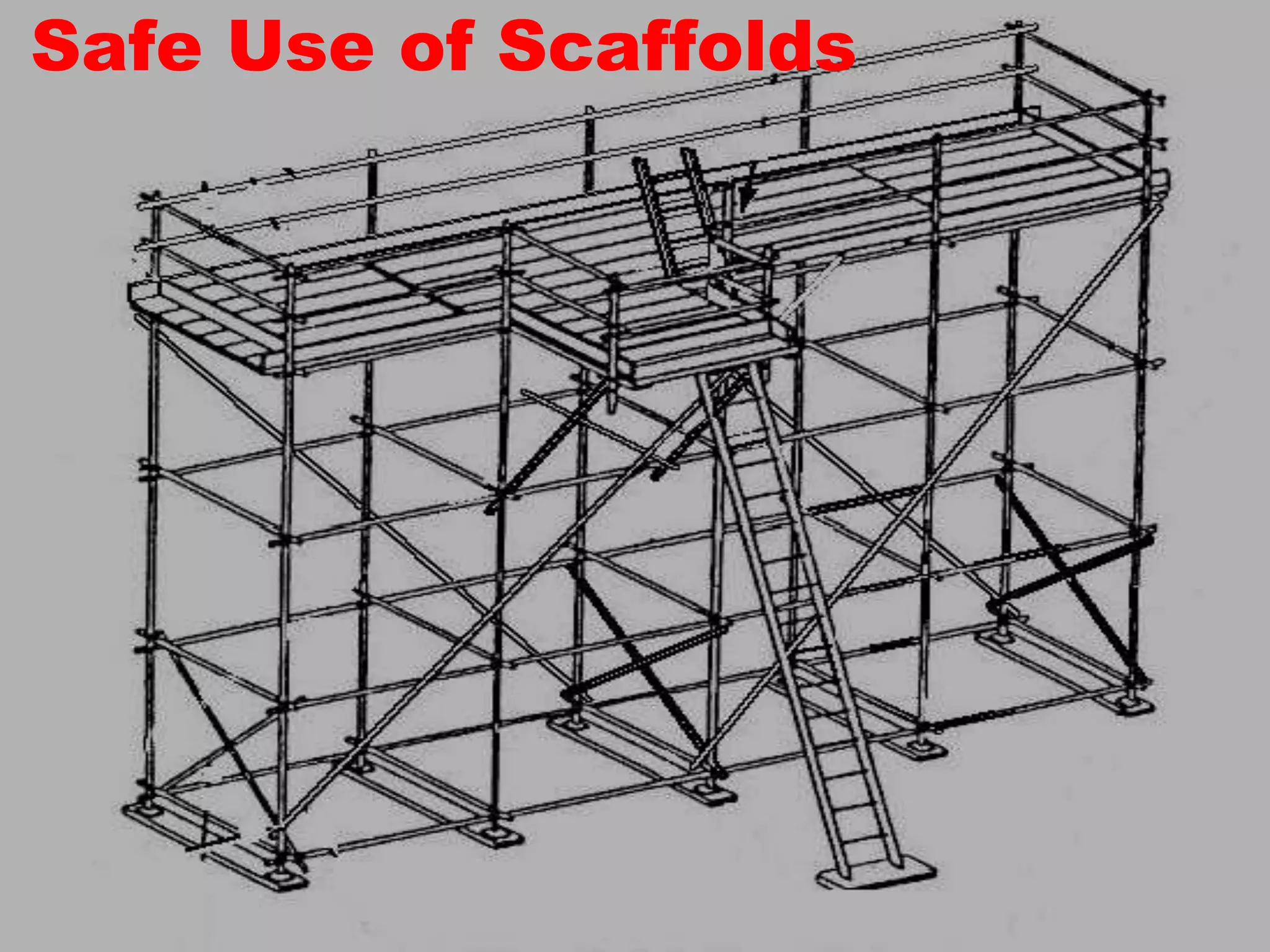
Safe Use of Scaffolds
2
GENERAL REQUIREMENTS
Scaffolds should be constructed and
loaded in accordance with the approved
drawing and design of a qualified person
with a safety factor of 4:1
3
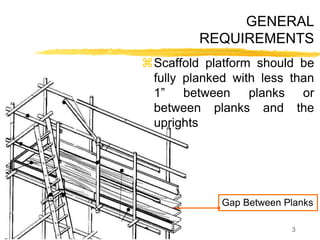
Gap Between Planks
GENERAL
REQUIREMENTS
Scaffold platform should be
fully planked with less than
1” between planks or
between planks and the
uprights
4
GENERAL
REQUIREMENTS
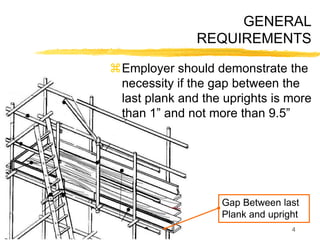
Gap Between last
Plank and upright
Employer should demonstrate the
necessity if the gap between the
last plank and the uprights is more
than 1” and not more than 9.5”
5
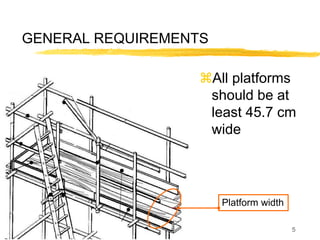
All platforms
should be at
least 45.7 cm
wide
GENERAL REQUIREMENTS
Platform width
6
GENERAL REQUIREMENTS
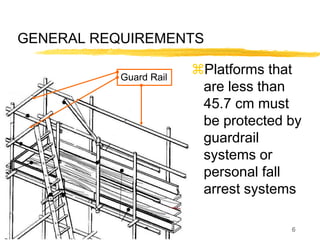
Platforms that
are less than
45.7 cm must
be protected by
guardrail
systems or
personal fall
arrest systems
Guard Rail
7
GENERAL REQUIREMENTS
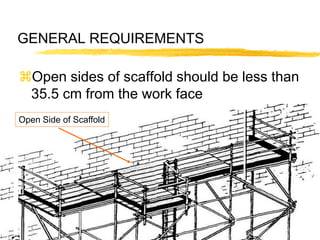
Open sides of scaffold should be less than
35.5 cm from the work face
Open Side of Scaffold
8
GENERAL REQUIREMENTS
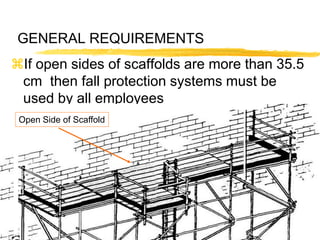
If open sides of scaffolds are more than 35.5
cm then fall protection systems must be
used by all employees
Open Side of Scaffold
9
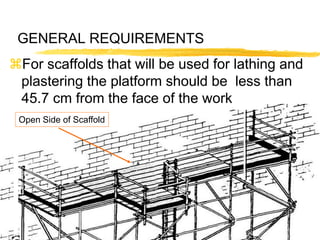
GENERAL REQUIREMENTS
Open Side of Scaffold
For scaffolds that will be used for lathing and
plastering the platform should be less than
45.7 cm from the face of the work
10
GENERAL REQUIREMENTS
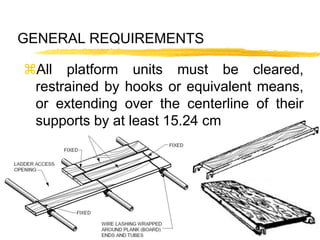
All platform units must be cleared,
restrained by hooks or equivalent means,
or extending over the centerline of their
supports by at least 15.24 cm
11
GENERAL REQUIREMENTS
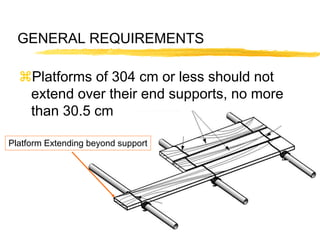
Platform Extending beyond support
Platforms of 304 cm or less should not
extend over their end supports, no more
than 30.5 cm
12
GENERAL REQUIREMENTS
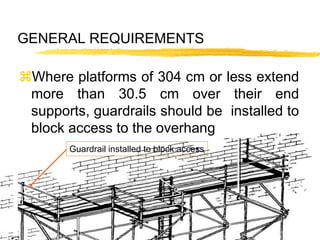
Guardrail installed to block access
Where platforms of 304 cm or less extend
more than 30.5 cm over their end
supports, guardrails should be installed to
block access to the overhang
13
GENERAL REQUIREMENTS
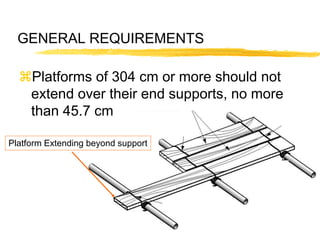
Platform Extending beyond support
Platforms of 304 cm or more should not
extend over their end supports, no more
than 45.7 cm
14
GENERAL REQUIREMENTS
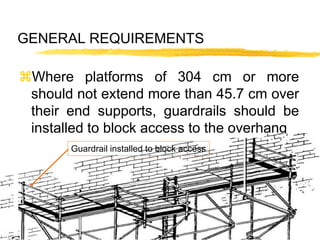
Where platforms of 304 cm or more
should not extend more than 45.7 cm over
their end supports, guardrails should be
installed to block access to the overhang
Guardrail installed to block access
15
GENERAL REQUIREMENTS
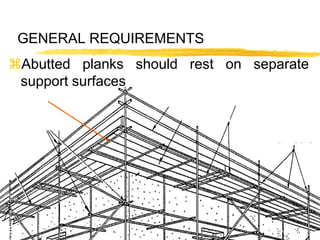
Abutted planks should rest on separate
support surfaces
16
GENERAL REQUIREMENTS
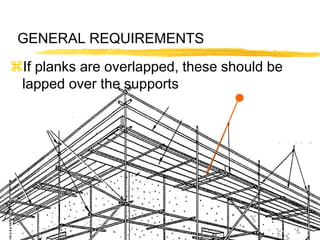
If planks are overlapped, these should be
lapped over the supports
17
GENERAL REQUIREMENTS
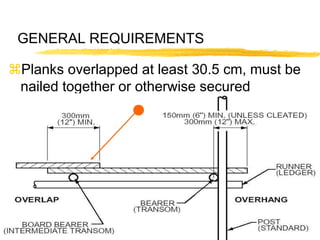
Planks overlapped at least 30.5 cm, must be
nailed together or otherwise secured
18
GENERAL REQUIREMENTS
Planks that rest on the bearer at other
than a 90-degree angle should be laid first
19
GENERAL REQUIREMENTS
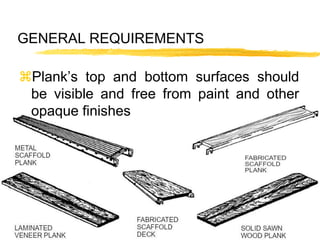
Plank’s top and bottom surfaces should
be visible and free from paint and other
opaque finishes
20
GENERAL REQUIREMENTS
If scaffold components of different
manufacturers are used, they should fit
together without force and has a
competent person determined that they
are safe for use
21
GENERAL REQUIREMENTS
Before use of dissimilar metals (if any), a
competent person must evaluate them
22
CRITERIA FOR SUPPORTED SCAFFOLDS
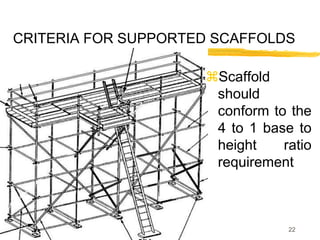
Scaffold
should
conform to the
4 to 1 base to
height ratio
requirement
23
CRITERIA FOR
SUPPORTED SCAFFOLDS
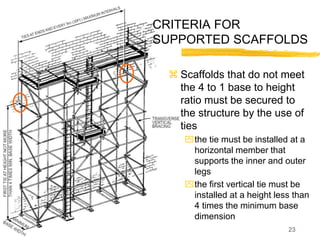
 Scaffolds that do not meet
the 4 to 1 base to height
ratio must be secured to
the structure by the use of
ties
the tie must be installed at a
horizontal member that
supports the inner and outer
legs
the first vertical tie must be
installed at a height less than
4 times the minimum base
dimension
24
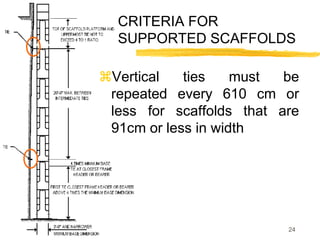
CRITERIA FOR
SUPPORTED SCAFFOLDS
Vertical ties must be
repeated every 610 cm or
less for scaffolds that are
91cm or less in width
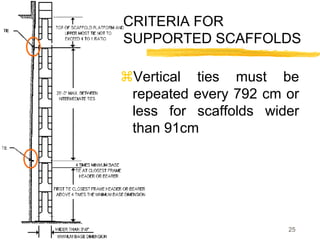
25
CRITERIA FOR
SUPPORTED SCAFFOLDS
Vertical ties must be
repeated every 792 cm or
less for scaffolds wider
than 91cm
26
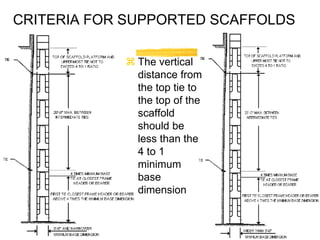
CRITERIA FOR SUPPORTED SCAFFOLDS
 The vertical
distance from
the top tie to
the top of the
scaffold
should be
less than the
4 to 1
minimum
base
dimension
27
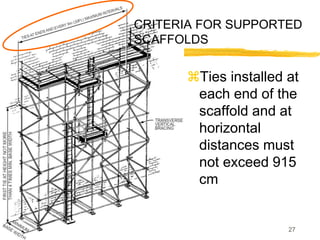
Ties installed at
each end of the
scaffold and at
horizontal
distances must
not exceed 915
cm
CRITERIA FOR SUPPORTED
SCAFFOLDS
28
CRITERIA FOR SUPPORTED SCAFFOLDS
Where eccentric loads are imposed, ties
should be installed to counter- act these
loads.
29
CRITERIA FOR SUPPORTED SCAFFOLDS
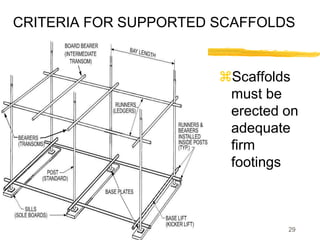
Scaffolds
must be
erected on
adequate
firm
footings
30
CRITERIA FOR SUPPORTED SCAFFOLDS
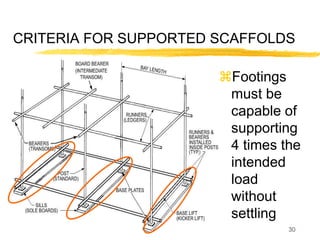
Footings
must be
capable of
supporting
4 times the
intended
load
without
settling
31
CRITERIA FOR SUPPORTED SCAFFOLDS
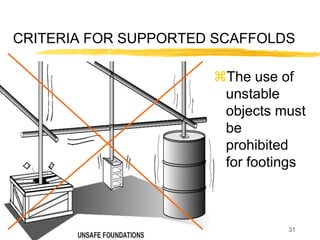
The use of
unstable
objects must
be
prohibited
for footings
32
CRITERIA FOR SUPPORTED SCAFFOLDS
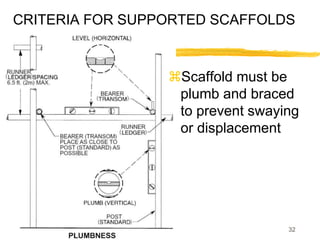
Scaffold must be
plumb and braced
to prevent swaying
or displacement
33
SCAFFOLD ACCESS
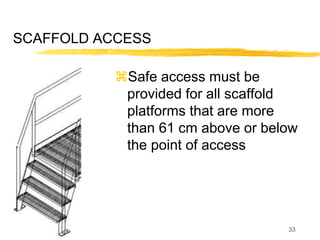
Safe access must be
provided for all scaffold
platforms that are more
than 61 cm above or below
the point of access
34
SCAFFOLD ACCESS
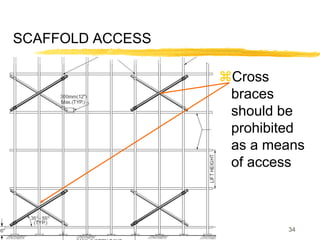
Cross
braces
should be
prohibited
as a means
of access
35
SCAFFOLD ACCESS
Ladders must be positioned so as not to
tip the scaffold
36
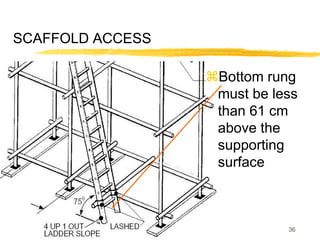
SCAFFOLD ACCESS
Bottom rung
must be less
than 61 cm
above the
supporting
surface
37
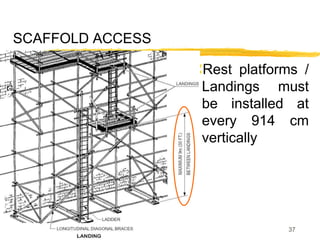
SCAFFOLD ACCESS
Rest platforms /
Landings must
be installed at
every 914 cm
vertically
38
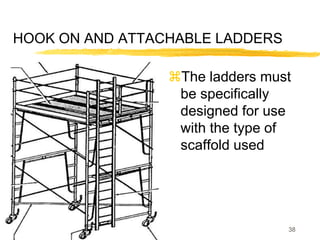
HOOK ON AND ATTACHABLE LADDERS
The ladders must
be specifically
designed for use
with the type of
scaffold used
39
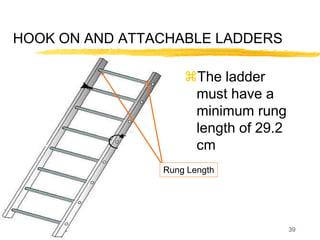
HOOK ON AND ATTACHABLE LADDERS
The ladder
must have a
minimum rung
length of 29.2
cm
Rung Length
40
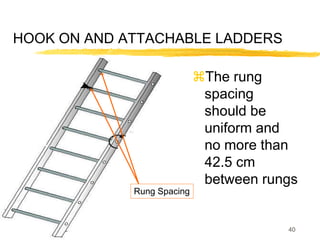
HOOK ON AND ATTACHABLE LADDERS
The rung
spacing
should be
uniform and
no more than
42.5 cm
between rungs
Rung Spacing
41
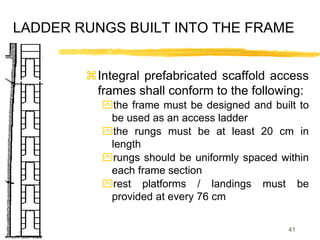
LADDER RUNGS BUILT INTO THE FRAME
Integral prefabricated scaffold access
frames shall conform to the following:
the frame must be designed and built to
be used as an access ladder
the rungs must be at least 20 cm in
length
rungs should be uniformly spaced within
each frame section
rest platforms / landings must be
provided at every 76 cm
42
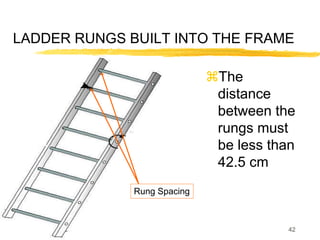
LADDER RUNGS BUILT INTO THE FRAME
The
distance
between the
rungs must
be less than
42.5 cm
Rung Spacing
43
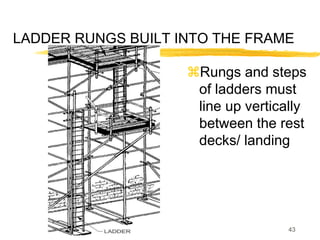
LADDER RUNGS BUILT INTO THE FRAME
Rungs and steps
of ladders must
line up vertically
between the rest
decks/ landing
44
LADDER RUNGS BUILT INTO THE FRAME
Direct access from other structures must be
prohibited when that distance is more than 61 cm
vertically or 36 cm horizontally
45
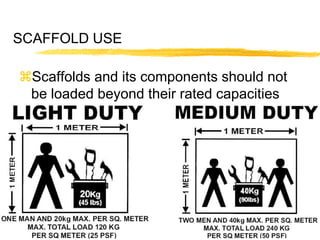
SCAFFOLD USE
Scaffolds and its components should not
be loaded beyond their rated capacities
46
SCAFFOLD USE
The use of shore or lean to scaffolds must
be prohibited
47
SCAFFOLD USE
The scaffolds should be inspected by a
competent person as required
48
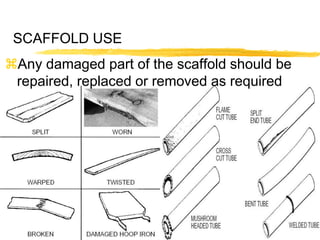
SCAFFOLD USE
Any damaged part of the scaffold should be
repaired, replaced or removed as required
49
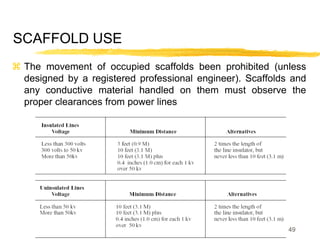
SCAFFOLD USE
 The movement of occupied scaffolds been prohibited (unless
designed by a registered professional engineer). Scaffolds and
any conductive material handled on them must observe the
proper clearances from power lines
50
SCAFFOLD USE
Slippery conditions should be removed as
soon as possible
51
SCAFFOLD USE
Tag lines must be used to control loads
being hoisted onto or near scaffolds
52
SCAFFOLD USE
If storms or high winds are present
competent person be consulted and wind
screens or personal fall arrest must be
used
53
SCAFFOLD USE
Tools, material, and debris should be
removed from scaffold to prevent an
accumulation
54
SCAFFOLD USE
The use of make-shift devices to increase
the working level height must be
prohibited
55
SCAFFOLD USE
Ladders on top of scaffold decks must be
prohibited
56
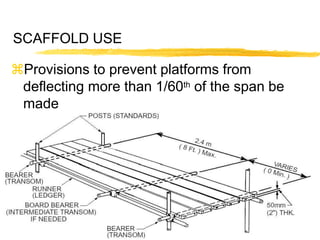
SCAFFOLD USE
Provisions to prevent platforms from
deflecting more than 1/60th of the span be
made
57
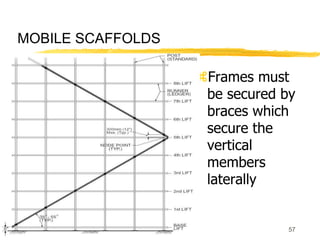
MOBILE SCAFFOLDS
Frames must
be secured by
braces which
secure the
vertical
members
laterally
58
MOBILE SCAFFOLDS
All brace connections must be secured
59
MOBILE SCAFFOLDS
Scaffolds constructed of tube and clamp
must meet the requirements of that type of
scaffold
60
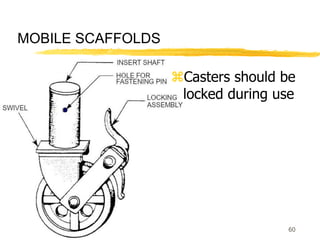
MOBILE SCAFFOLDS
Casters should be
locked during use
61
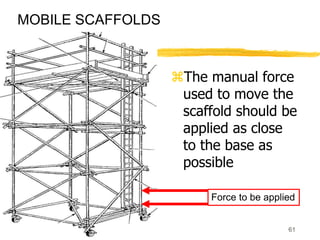
MOBILE SCAFFOLDS
The manual force
used to move the
scaffold should be
applied as close
to the base as
possible
Force to be applied
62
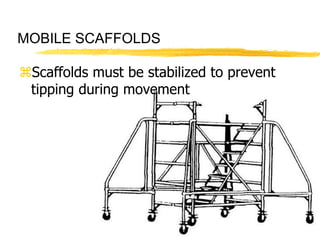
MOBILE SCAFFOLDS
Scaffolds must be stabilized to prevent
tipping during movement
63
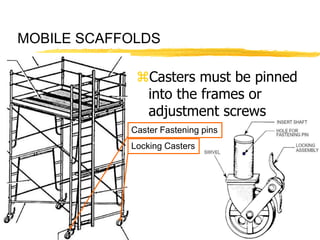
MOBILE SCAFFOLDS
Casters must be pinned
into the frames or
adjustment screws
Locking Casters
Caster Fastening pins
64
MOBILE SCAFFOLDS
If rolling scaffolds are being moved with
employees on board, all the safety criteria
must be met

Scaffold Safety Presentation.ppt