SC2218: Anthropology and the Human Condition Lecture 10: Anthropology, Ethnography and  the Crisis of Representation Eric C. Thompson Semester 1, 2010/2011
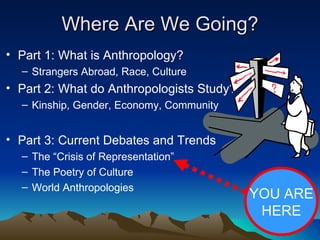
Where Are We Going? Part 1: What is Anthropology? Strangers Abroad, Race, Culture Part 2: What do Anthropologists Study? Kinship, Gender, Economy, Community Part 3: Current Debates and Trends The “Crisis of Representation” The Poetry of Culture World Anthropologies YOU ARE HERE
To Summarize… Domains Anthropologists Study: Kinship: Cultural concepts for organizing social relationships based on family ties. Gender: Cultural concepts for organizing social relationships based on sex. Economy: Cultural concepts for organizing social relationships of exchange. Community: Cultural processes for imagining group identities.
From Domains of Study to Questions of Representation In this module, we have looked at… Part 1: Foundations of Modern Anthropology Part 2: Domains Anthropologists Study Part 3: How is Anthropology Changing (from the 20 th  century into the 21 st  century)? Issues of  representation   Issues of  reflexivity Example: Consider issues of how  nations   and other  communities  are represented (America, Singapore, etc.)
In This Lecture… Anthropology c.1960-1980 What is the “Crisis of Representation” in anthropology? Writing Culture / Critiquing Ethnography What is the basis of Questioning Anthropological Representations? Gender Ethnicity, Race Revisiting and Revising Ethnography Ongoing Debates…
Anthropology c.1960-1980 Scientific, Structural-Functional Approach Cultural Relativism; Non-hierarchical (no culture is better than another; they are just different) Non-evolutionary (rejection of unilinear evolution of cultural ‘stages’ from 19 th  c.) Societies and Cultures seen as “Whole”, functional, equilibrium systems (structures) of thought and behavior Most anthropologists are white (European / American) men doing research in the “Third World”.
Challenges c.1960-1980 If cultures are whole, equilibrium systems, how does one account for change? Entry of larger numbers women and non-Europeans into anthropology, began to question male and Euro-centric biases. Critique of Ethnography: Representations of “Others” by Europeans for Europeans Critique of Colonialism, Anthropology’s Role Globalization, Urbanization, Rapid Change
“ Sight Unseen” (An Example of “New” Ethnography) The film compares points of view of members of a Balinese family with those of visitors to Bali. What different points-of-view are emphasized? What examples does the film provide? What counter-examples are in the film? What does the film mean about “mistaking a process for a product”? What is the point of the guy walking around with the ice cream cart???
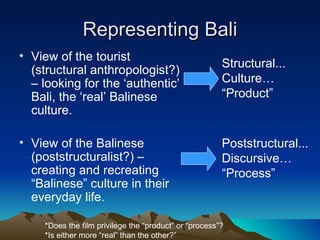
Representing Bali View of the tourist (structural anthropologist?) – looking for the ‘authentic’ Bali, the ‘real’ Balinese culture. View of the Balinese (poststructuralist?) – creating and recreating “Balinese” culture in their everyday life. Structural... Culture… “Product” Poststructural... Discursive… “Process” *Does the film privilege the “product” or “process”? *Is either more “real” than the other?”
The “Crisis of Representation” How have anthropologists represented the people they study? How and why are these representations problematic? Issues from the reflexive “Writing Culture” movement of the 1980s & 1990s.* *Reflexive – an action directed or turned back on the agent of that action; marked by or capable of reflection
Contributing to the “Crisis”… Critiques of Ethnography Feminist Standpoint Epistemology De-Colonization; Association of Anthropology with Colonialism Shift from studying Culture to studying Power
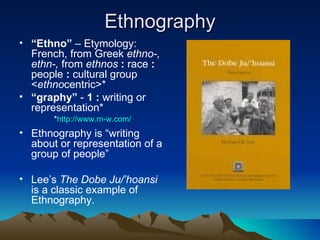
Ethnography “ Ethno”  – Etymology: French, from Greek  ethno-, ethn-,  from  ethnos  :  race  :  people  :  cultural group < ethno centric>* “ graphy”  -  1   :  writing or representation* Ethnography is “writing about or representation of a group of people” Lee’s  The Dobe Ju/’hoansi  is a classic example of Ethnography. * http://www.m-w.com/
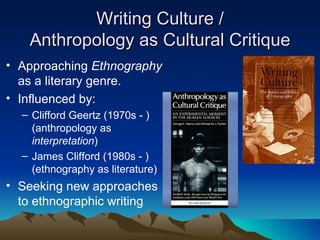
Writing Culture / Anthropology as Cultural Critique Approaching  Ethnography  as a literary genre. Influenced by: Clifford Geertz (1970s - ) (anthropology as  interpretation ) James Clifford (1980s - ) (ethnography as literature) Seeking new approaches to ethnographic writing
Power & Politics of Representation Representations are cultural – they are models  of the world  and models  for the world . (They shape how we think and act.) Gender and Racial/Ethnic representations shape our beliefs of ourselves and others. Ethnographic representations shape our understanding of peoples represented. Does it matter who does the representing?* Does it matter who the author is? *The argument that it does matter is sometimes called  standpoint epistemology ; i.e. knowledge is not neutral, but depends on your point of view (or ‘standpoint’)
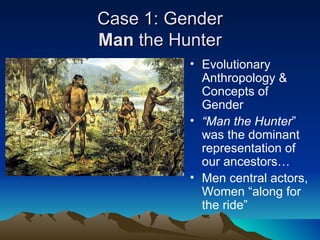
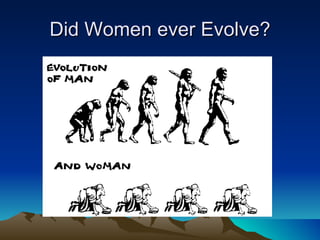
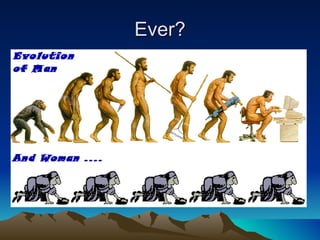
Case 1: Gender Man  the Hunter Evolutionary Anthropology & Concepts of Gender “ Man the Hunter ” was the dominant representation of our ancestors… Men central actors, Women “along for the ride”
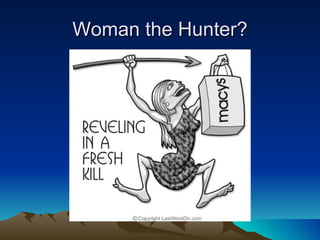
Woman the Hunter?
Did Women ever Evolve?
Ever?
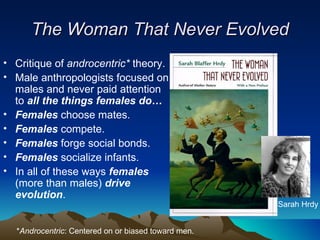
The Woman That Never Evolved Critique of  androcentric*  theory. Male anthropologists focused on males and never paid attention to  all the things females do… Females   choose mates. Females  compete. Females  forge social bonds. Females   socialize infants. In all of these ways  females  (more than males)  drive evolution . Sarah Hrdy * Androcentric : Centered on or biased toward men.
“ Feminist Standpoint Epistemology” Epistemology – Knowledge Standpoint – Point of view; position Feminism – Taking women seriously The idea that knowledge is never completely neutral or objective; knowledge is always produced from a particular standpoint… in social science, traditionally from the standpoint of affluent, heterosexual, European men.
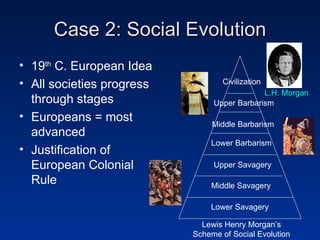
Case 2: Social Evolution 19 th  C. European Idea All societies progress through stages Europeans = most advanced Justification of European Colonial Rule Lower Savagery Middle Savagery Upper Savagery Lower Barbarism Middle Barbarism Upper Barbarism Civilization Lewis Henry Morgan’s Scheme of Social Evolution L.H. Morgan
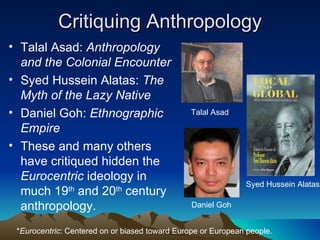
Critiquing Anthropology Talal Asad:  Anthropology and the Colonial Encounter Syed Hussein Alatas:  The Myth of the Lazy Native Daniel Goh:  Ethnographic Empire These and many others have critiqued hidden the  Eurocentric  ideology in much 19 th  and 20 th  century anthropology. Talal Asad Daniel Goh Syed Hussein Alatas * Eurocentric : Centered on or biased toward Europe or European people.
“ On Cannibalism” To what sort of representations is the narrator reacting? What is at stake in these representations?
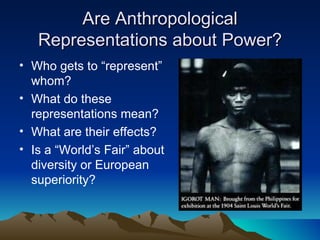
Are Anthropological Representations about Power? Who gets to “represent” whom? What do these representations mean? What are their effects? Is a “World’s Fair” about diversity or European superiority?
Ethno… (a group of people) graphy… (writing about or of) Revisited and Revised…
“ These peoples (foragers) , despite their cultural and geographic diversity, have a  core of features in common , and this core of features represents the  basic human adaptation stripped of  the accretions and complications brought about by agriculture, urbanization, advanced technology, and national and class conflict – all of  the “advances” of the last few thousand years .”   (Lee 2003: 3) Echoes of 19 th  Century Social Evolution in Lee’s  Dobe Ju/’hoansi
A “Land Filled with Flies”* Wilmsen: Critique of Lee and others. !Kung-San (incl. Dobe Ju/’hoansi) foragers are  made to  represent a earlier stage in human evolution. But this is inaccurate. Foragers have a history, including a history of pastoralism (cattle herding). Foraging is an effect of politics, marginalization and impoverishment; NOT  a reflection of our evolutionary past.  *The land is “filled with flies because of cattle. Many San people are now and in the past were cattle herders.
“ I  no longer believe  that  studies of contemporary hunter-gatherers  are primarily a tool for  understanding the evolution of human behavior . Understanding hunter-gatherer ecology, however important, is not enough. One has to both build on it and transcend it by looking at adaptation in a much broader sense, including the  internal dynamics of foragers  and their  articulation with wider political economies .”  (Lee 2003: 195) Lee Revised (in response to criticisms)
Ongoing Debates… Who is “representing” whom? Who has the  power  (political, social, economic, cultural capital) to produce representations? What are the effects of the representations we produce? Should people only represent  themselves  and not “others”? If so, who counts as “us” (selves) and “them” (others)? Does this just  reinforce  racism, sexism, nationalism, ethnocentrism?
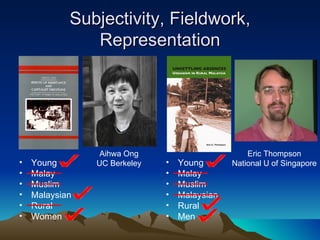
Subjectivity, Fieldwork, Representation Young Malay Muslim Malaysian Rural Women Young Malay Muslim Malaysian Rural Men Aihwa Ong UC Berkeley Eric Thompson National U of Singapore
Ongoing Debates… The  critique  of anthropology has resulted in a “crisis of representation”… Do we  stop  doing anthropology, ethnography, cross-cultural research? Or do we do it  differently , more  reflexively , perhaps even….  better ?* *Many postmodernists do not believe in “better”… but that is another story  
Final Thoughts… How are different groups of people represented in Singapore? Who creates or controls these representations? Who are the “others” against which you have learned to think about who you are? What sort of ideological work does this do; what kind of systems of power does it support? Anthropologists think about these questions  both  in reflecting on their own writings and within the societies they study.

Sc2218 lecture 10 (2010)

  • 1.
    SC2218: Anthropology andthe Human Condition Lecture 10: Anthropology, Ethnography and the Crisis of Representation Eric C. Thompson Semester 1, 2010/2011
  • 2.
    Where Are WeGoing? Part 1: What is Anthropology? Strangers Abroad, Race, Culture Part 2: What do Anthropologists Study? Kinship, Gender, Economy, Community Part 3: Current Debates and Trends The “Crisis of Representation” The Poetry of Culture World Anthropologies YOU ARE HERE
  • 3.
    To Summarize… DomainsAnthropologists Study: Kinship: Cultural concepts for organizing social relationships based on family ties. Gender: Cultural concepts for organizing social relationships based on sex. Economy: Cultural concepts for organizing social relationships of exchange. Community: Cultural processes for imagining group identities.
  • 4.
    From Domains ofStudy to Questions of Representation In this module, we have looked at… Part 1: Foundations of Modern Anthropology Part 2: Domains Anthropologists Study Part 3: How is Anthropology Changing (from the 20 th century into the 21 st century)? Issues of representation Issues of reflexivity Example: Consider issues of how nations and other communities are represented (America, Singapore, etc.)
  • 5.
    In This Lecture…Anthropology c.1960-1980 What is the “Crisis of Representation” in anthropology? Writing Culture / Critiquing Ethnography What is the basis of Questioning Anthropological Representations? Gender Ethnicity, Race Revisiting and Revising Ethnography Ongoing Debates…
  • 6.
    Anthropology c.1960-1980 Scientific,Structural-Functional Approach Cultural Relativism; Non-hierarchical (no culture is better than another; they are just different) Non-evolutionary (rejection of unilinear evolution of cultural ‘stages’ from 19 th c.) Societies and Cultures seen as “Whole”, functional, equilibrium systems (structures) of thought and behavior Most anthropologists are white (European / American) men doing research in the “Third World”.
  • 7.
    Challenges c.1960-1980 Ifcultures are whole, equilibrium systems, how does one account for change? Entry of larger numbers women and non-Europeans into anthropology, began to question male and Euro-centric biases. Critique of Ethnography: Representations of “Others” by Europeans for Europeans Critique of Colonialism, Anthropology’s Role Globalization, Urbanization, Rapid Change
  • 8.
    “ Sight Unseen”(An Example of “New” Ethnography) The film compares points of view of members of a Balinese family with those of visitors to Bali. What different points-of-view are emphasized? What examples does the film provide? What counter-examples are in the film? What does the film mean about “mistaking a process for a product”? What is the point of the guy walking around with the ice cream cart???
  • 9.
    Representing Bali Viewof the tourist (structural anthropologist?) – looking for the ‘authentic’ Bali, the ‘real’ Balinese culture. View of the Balinese (poststructuralist?) – creating and recreating “Balinese” culture in their everyday life. Structural... Culture… “Product” Poststructural... Discursive… “Process” *Does the film privilege the “product” or “process”? *Is either more “real” than the other?”
  • 10.
    The “Crisis ofRepresentation” How have anthropologists represented the people they study? How and why are these representations problematic? Issues from the reflexive “Writing Culture” movement of the 1980s & 1990s.* *Reflexive – an action directed or turned back on the agent of that action; marked by or capable of reflection
  • 11.
    Contributing to the“Crisis”… Critiques of Ethnography Feminist Standpoint Epistemology De-Colonization; Association of Anthropology with Colonialism Shift from studying Culture to studying Power
  • 12.
    Ethnography “ Ethno” – Etymology: French, from Greek ethno-, ethn-, from ethnos : race : people : cultural group < ethno centric>* “ graphy” - 1 : writing or representation* Ethnography is “writing about or representation of a group of people” Lee’s The Dobe Ju/’hoansi is a classic example of Ethnography. * http://www.m-w.com/
  • 13.
    Writing Culture /Anthropology as Cultural Critique Approaching Ethnography as a literary genre. Influenced by: Clifford Geertz (1970s - ) (anthropology as interpretation ) James Clifford (1980s - ) (ethnography as literature) Seeking new approaches to ethnographic writing
  • 14.
    Power & Politicsof Representation Representations are cultural – they are models of the world and models for the world . (They shape how we think and act.) Gender and Racial/Ethnic representations shape our beliefs of ourselves and others. Ethnographic representations shape our understanding of peoples represented. Does it matter who does the representing?* Does it matter who the author is? *The argument that it does matter is sometimes called standpoint epistemology ; i.e. knowledge is not neutral, but depends on your point of view (or ‘standpoint’)
  • 15.
    Case 1: GenderMan the Hunter Evolutionary Anthropology & Concepts of Gender “ Man the Hunter ” was the dominant representation of our ancestors… Men central actors, Women “along for the ride”
  • 16.
  • 17.
  • 18.
  • 19.
    The Woman ThatNever Evolved Critique of androcentric* theory. Male anthropologists focused on males and never paid attention to all the things females do… Females choose mates. Females compete. Females forge social bonds. Females socialize infants. In all of these ways females (more than males) drive evolution . Sarah Hrdy * Androcentric : Centered on or biased toward men.
  • 20.
    “ Feminist StandpointEpistemology” Epistemology – Knowledge Standpoint – Point of view; position Feminism – Taking women seriously The idea that knowledge is never completely neutral or objective; knowledge is always produced from a particular standpoint… in social science, traditionally from the standpoint of affluent, heterosexual, European men.
  • 21.
    Case 2: SocialEvolution 19 th C. European Idea All societies progress through stages Europeans = most advanced Justification of European Colonial Rule Lower Savagery Middle Savagery Upper Savagery Lower Barbarism Middle Barbarism Upper Barbarism Civilization Lewis Henry Morgan’s Scheme of Social Evolution L.H. Morgan
  • 22.
    Critiquing Anthropology TalalAsad: Anthropology and the Colonial Encounter Syed Hussein Alatas: The Myth of the Lazy Native Daniel Goh: Ethnographic Empire These and many others have critiqued hidden the Eurocentric ideology in much 19 th and 20 th century anthropology. Talal Asad Daniel Goh Syed Hussein Alatas * Eurocentric : Centered on or biased toward Europe or European people.
  • 23.
    “ On Cannibalism”To what sort of representations is the narrator reacting? What is at stake in these representations?
  • 24.
    Are Anthropological Representationsabout Power? Who gets to “represent” whom? What do these representations mean? What are their effects? Is a “World’s Fair” about diversity or European superiority?
  • 25.
    Ethno… (a groupof people) graphy… (writing about or of) Revisited and Revised…
  • 26.
    “ These peoples(foragers) , despite their cultural and geographic diversity, have a core of features in common , and this core of features represents the basic human adaptation stripped of the accretions and complications brought about by agriculture, urbanization, advanced technology, and national and class conflict – all of the “advances” of the last few thousand years .” (Lee 2003: 3) Echoes of 19 th Century Social Evolution in Lee’s Dobe Ju/’hoansi
  • 27.
    A “Land Filledwith Flies”* Wilmsen: Critique of Lee and others. !Kung-San (incl. Dobe Ju/’hoansi) foragers are made to represent a earlier stage in human evolution. But this is inaccurate. Foragers have a history, including a history of pastoralism (cattle herding). Foraging is an effect of politics, marginalization and impoverishment; NOT a reflection of our evolutionary past. *The land is “filled with flies because of cattle. Many San people are now and in the past were cattle herders.
  • 28.
    “ I no longer believe that studies of contemporary hunter-gatherers are primarily a tool for understanding the evolution of human behavior . Understanding hunter-gatherer ecology, however important, is not enough. One has to both build on it and transcend it by looking at adaptation in a much broader sense, including the internal dynamics of foragers and their articulation with wider political economies .” (Lee 2003: 195) Lee Revised (in response to criticisms)
  • 29.
    Ongoing Debates… Whois “representing” whom? Who has the power (political, social, economic, cultural capital) to produce representations? What are the effects of the representations we produce? Should people only represent themselves and not “others”? If so, who counts as “us” (selves) and “them” (others)? Does this just reinforce racism, sexism, nationalism, ethnocentrism?
  • 30.
    Subjectivity, Fieldwork, RepresentationYoung Malay Muslim Malaysian Rural Women Young Malay Muslim Malaysian Rural Men Aihwa Ong UC Berkeley Eric Thompson National U of Singapore
  • 31.
    Ongoing Debates… The critique of anthropology has resulted in a “crisis of representation”… Do we stop doing anthropology, ethnography, cross-cultural research? Or do we do it differently , more reflexively , perhaps even…. better ?* *Many postmodernists do not believe in “better”… but that is another story 
  • 32.
    Final Thoughts… Howare different groups of people represented in Singapore? Who creates or controls these representations? Who are the “others” against which you have learned to think about who you are? What sort of ideological work does this do; what kind of systems of power does it support? Anthropologists think about these questions both in reflecting on their own writings and within the societies they study.