How	
  to	
  Make	
  School	
  
Libraries	
  Work	
  (even)	
  Better	
  
 Jeanne	
  Conte	
  (PDSB)	
  	
  
 Ruth	
  Hall	
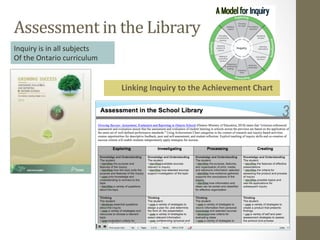
  (TDSB)	
  
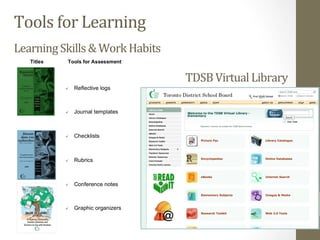
 Phillip	
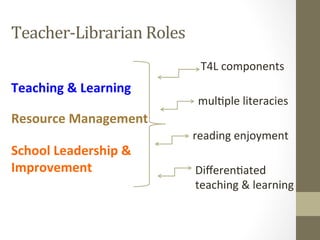
  Jeffrey	
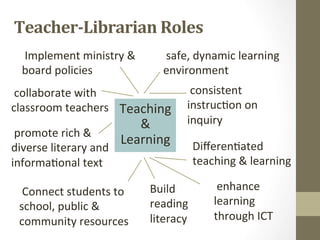
  (HWCDSB)	
  
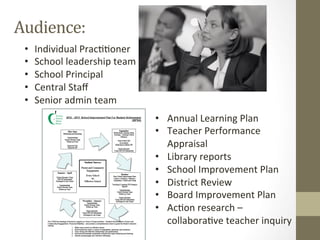
 Cindy	
  Ma=hews	
  (TDSB)	


 Session	
  1203,	
  OLA	
  Super	
  Conference	
  
 February	
  1,	
  2013,	
  2:10	
  pm	
  
How	
  to	
  Make	
  School	
  
Libraries	
  Work	
  (even)	
  Better	
  
                     R	
  David	
  Lankes,	
  University	
  of	
  Syracuse	


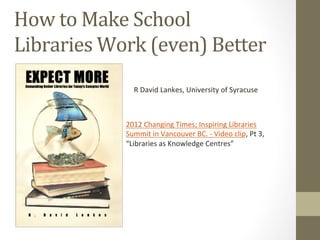
                 2012	
  Changing	
  Times;	
  Inspiring	
  Libraries	
  
                 Summit	
  in	
  Vancouver	
  BC.	
  -­‐	
  Video	
  clip,	
  Pt	
  3,	
  
                 “Libraries	
  as	
  Knowledge	
  Centres”	
  
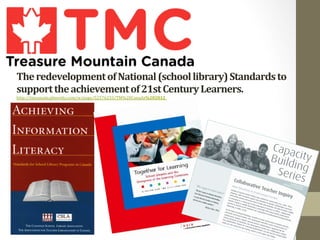
The	
  redevelopment	
  of	
  National	
  (school	
  library)	
  Standards	
  to	
  
support	
  the	
  achievement	
  of	
  21st	
  Century	
  Learners.	
  
http://tmcanada.pbworks.com/w/page/52576233/TM%20Canada%202012 	
  
Library	
  Review	
  Process	
  Transformations	
  
Towards	
  the	
  Learning	
  Commons	
  :	
  Identifying,	
  
Sharing	
  and	
  Supporting	
  Best	
  Practices	


     Began	
  in	
  2011/12	
  school	
  year	
  ;	
  con[nuing	
  in	
  2012/13.	
  Report	
  
       in	
  May	
  2013?	
  
       Approaches	
  &	
  Focus	
  :	
  	
  
       •                 Strategic	
  -­‐	
  	
  Learning	
  Commons	
  and	
  its	
  role	
  in	
  Student	


  Achievement;	


       •                Iden[fica[on	
  of	
  	
  Shi_s,	
  Efficiencies,	
  Best	
  Prac[ces;	


       • 	


  Sharing	
  and	
  	
  Suppor[ng	
  Best	
  Prac[ces	


Learning	
  Commons	
  and	
  its	
  role	
  in	
  
Student	
   	
  Achievement	
  
• Within	
  the	
  Literacy	
  System	
  Goal	
  of	
  the	
  HWCDSB	
  ‘s	
  Board	
  
Improvement	
  Plan	
  (BIP)….	
  
• “	
  2.4	
  :	
  Develop	
  the	
  Learning	
  Commons	
  in	
  each	
  school	
  to	
  promote	
  
and	
  teach	
  inquiry-­‐based	
  learning	
  through	
  cross-­‐curricular	
  
connec[ons,	
  mul[ple	
  literacies,	
  digital	
  learning,	
  and	
  collabora[on	
  
(connected	
  to	
  the	
  Ontario	
  Catholic	
  School	
  Graduate	
  
Expecta[ons)”	
  
• 	
  TL’s	
  leadership	
  role	
  in	
  the	
  school	
  includes	
  being	
  part	
  of	
  the	
  
School	
  Improvement	
  Team…	
  par[cipa[on	
  in	
  TLCPs,	
  modeling	
  
technology	
  use	
  and	
  integra[on,	
  collabora[ve	
  program	
  planning,	
  
etc.	
  
• Student	
  Improvement	
  	
  (Support	
  )	
  Visits	
  –	
  provide	
  opportuni[es	
  
for	
  sharing	
  prac[ces;	
  Principal’s	
  suppor[ng	
  role	
  iden[fied.	
   HWCDSB	
  
Shifts,	
  EfRiciencies,	
  Best	
  Practices…1	
  
SCHOOL	
  LIBRARIES	
  	
  TO	
  LEARNING	
  COMMONS	
  
	
  (From	
  Working	
  Document	
  –	
  “Shi_ing	
  Our	
  Focus”)	
  
From	
  responsible	
  ci[zenship	
  to	
  →	
  	
  include	
  responsibility	
  and	
  
ethical	
  use	
  of	
  digital	
  resources	
  and	
  tools	
  
From	
  stagnant	
  spaces	
  to	
  	
  →	
  	
  virtual	
  spaces	
  with	
  24/7	
  access	
  
which	
  means	
  equitable	
  access	
  for	
  all	
  
From	
  sta[c	
  collec[ons	
  to	
  	
  →	
  	
  dynamic,	
  online,	
  mul[-­‐modal	
  
collec[ons	
  which	
  promote	
  mul[ple	
  literacies	
  
From	
  closed	
  spaces	
  to	
  	
  →	
  	
  open,	
  flexible,	
  welcoming	
  spaces	
  
which	
  are	
  hubs	
  of	
  the	
  school	
  and	
  central	
  to	
  deep	
  learning	
  and	
  
inquiry	
  
	
                                                                                       HWCDSB	
  
Shifts,	
  EfRiciencies,	
  Best	
  Practices…2	
  
	
  LIBRARY	
  PROGRAMMING	
  
	
  (From	
  Working	
  Document	
  –	
  “Shi_ing	
  Our	
  Focus”)	
  
• 	
  From	
  tradi[onal	
  ac[vi[es	
  to	
  	
  →	
  	
  engaging	
  tasks	
  that	
  reflect	
  
the	
  learning	
  needs	
  and	
  modali[es	
  of	
  today’s	
  learners	
  	
  
• From	
  isolated	
  project-­‐based	
  assignments	
  to	
  	
  →	
  	
  rich	
  
research,	
  student-­‐generated	
  inquiry	
  connected	
  to	
  the	
  Big	
  
Ideas	
  of	
  curriculum	
  
• From	
  teacher-­‐directed	
  to	
  	
  →	
  	
  student-­‐directed	
  inquiry,	
  
explora[on	
  and	
  discovery	
  
• From	
  technology	
  in	
  isola[on	
  to	
  	
  →	
  	
  integra[on	
  of	
  
technology	
  for	
  innova[on,	
  crea[vity	
  and	
  to	
  especially	
  
enhance	
  student	
  engagement	
  
• From	
  management	
  of	
  collec[ons	
  and	
  facili[es	
  to	
  	
  →	
  	
  a	
  focus	
  
on	
  teaching	
  and	
  learning	
  that	
  impacts	
  student	
  achievement	
  
	
                                                                                     HWCDSB	
  
Shifts,	
  EfRiciencies,	
  Best	
  Practices…3	


Reading	
  Engagement…	
  aligned	
  with	
  	
  SIPs/TLCPs…	
  going	
  
beyond	
  the	
  TL’s	
  ‘Resource	
  role’…	
  Reading	
  responses	
  …	
  
(Through	
  interac[ve	
  and	
  mobile	
  compu[ng	
  features	
  of	
  
the	
  Des[ny	
  Library	
  System	
  in	
  all	
  schools)	
  …	
  Students	
  are	
  
Ra[ng	
  books…	
  Sharing	
  responses/Reviews	
  with	
  ‘Friends’…	
  
opportuni[es	
  to	
  teach	
  Digital	
  Ci[zenship…Social	
  
Networking	
  …	
  	
  
Guided	
  Inquiry…	
  developed	
  collabora[vely	
  in	
  wikispaces,	
  
shared	
  by	
  TLs	
  ,	
  	
  project-­‐based	
  and	
  linked	
  to	
  curriculum	
  
expecta[ons	
  and	
  current	
  teaching	
  prac[ces…	
  
System	
  –sponsored	
  Guided	
  Inquiry.	
  The	
  Bruce	
  Trail	
  
Project	
  (Sept	
  to	
  Oct	
  2012)	
  
                                                                              HWCDSB	
  
Sample	
  Indicators	
  …	
  

• There	
  is	
  evidence	
  of	
  student	
  inquiry	
  	
  and	
  staff	
  
collabora[on	
  through	
  research	
  projects	
  in	
  the	
  
Learning	
  Commons.	
  Ac[vi[es	
  	
  include	
  the	
  use	
  of	
  
new	
  technology	
  as	
  well	
  as	
  print	
  resources	
  to	
  meet	
  
cross-­‐curricula	
  expecta[ons.	
  
• Evidence	
  of	
  a	
  collabora[ve	
  culture	
  	
  were	
  a	
  variety	
  
of	
  media	
  has	
  been	
  created	
  and	
  u[lized	
  to	
  enhance	
  
student	
  learning.	


                                                                         HWCDSB	
  
 
       SUMMARY	
  &	
  NEXT	
  STEPS	
  	
  
• Con[nue	
  to	
  posi[on	
  the	
  	
  transforma[on	
  to	
  
Learning	
  Commons	
  as	
  a	
  strategic	
  process…	
  where	
  
the	
  TL	
  is	
  a	
  change	
  agent.	
  
• Finalise	
  	
  the	
  indicators	
  for	
  measuring	
  the	
  
successful	
  implementa[on	
  of	
  the	
  Learning	
  
Commons	
  in	
  schools.	
  
• Increase	
  and	
  deepen	
  Inquiry-­‐Based	
  and	
  	
  
Collabora[ve	
  Approaches	
  to	
  Align	
  with	
  Ministry’s	
  
philosophy.	
  
• Model	
  the	
  use	
  of	
  Technology	
  to	
  engage	
  students	
  
in	
  literature	
  ac[vi[es.	
  
                                                                    HWCDSB	
  
Expected	
  Practice	
  Series	


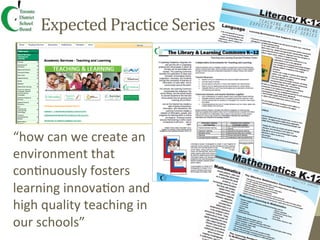
“how	
  can	
  we	
  create	
  an	
  
environment	
  that	
  
con[nuously	
  fosters	
  
learning	
  innova[on	
  and	
  
high	
  quality	
  teaching	
  in	
  
our	
  schools”	
  	
  
Ontario School Library Association


FRAMEWORK	
                                                           Information Studies
                                                                      Kindergarten to Grade 12


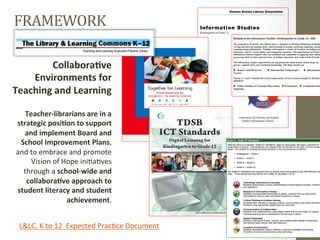
         CollaboraEve	
  
    Environments	
  for	
  
Teaching	
  and	
  Learning	
  

    Teacher-­‐librarians	
  are	
  in	
  a	
                                                           Curriculum for Schools and School

 strategic	
  posiEon	
  to	
  support	
                              1999                               Library Information Centres


    and	
  implement	
  Board	
  and	
  
  School	
  Improvement	
  Plans,	
  
 and	
  to	
  embrace	
  and	
  promote	
  
        Vision	
  of	
  Hope	
  ini[a[ves	
  
   through	
  a	
  school-­‐wide	
  and	
  
    collaboraEve	
  approach	
  to	
  
 student	
  literacy	
  and	
  student	
  
                         achievement.	


  L&LC,	
  K	
  to	
  12	
  	
  Expected	
  Prac[ce	
  Document	
  
Assessment	
  in	
  the	
  Library	
  
Inquiry	
  is	
  in	
  all	
  subjects	
  
Of	
  the	
  Ontario	
  curriculum	


                                             Linking	
  Inquiry	
  to	
  the	
  Achievement	
  Chart	
  
Tools	
  for	
  Learning	
  
Learning	
  Skills	
  &	
  Work	
  Habits	
  

                                                TDSB	
  Virtual	
  Library	
  

                                                  ADD	
  Virtual	
  
                                                  Library	
  
Teacher-­‐Librarian	
  Roles	


  T4L	
  components	
  
Teaching	
  &	
  Learning	
  
                                    	
  mul[ple	
  literacies	
  
Resource	
  Management	
  
                                   	
  reading	
  enjoyment	
  
School	
  Leadership	
  &	
  
Improvement	
                       Differen[ated	
  
                                    teaching	
  &	
  learning	
  
Teacher-­‐Librarian	
  Roles	


  Implement	
  ministry	
  &	


  safe,	
  dynamic	
  learning	
  
  board	
  policies	
                     environment	
  
	
  collaborate	
  with	
                        	
  consistent	
  
classroom	
  teachers Teaching	
                 instruc[on	
  on	


          &	
            inquiry	
  
	
  promote	
  rich	
  &	
  
                               Learning	
             Differen[ated	
  
diverse	
  literary	
  and	
  
informa[onal	
  text	
                                teaching	
  &	
  learning	


  Connect	
  students	
  to	
      Build	
              	
  enhance	
  
  school,	
  public	
  &	
             reading	
            learning	
  
  community	
  resources	
             literacy	
           through	
  ICT	
  
Audience:	
  
 •    Individual	
  Prac[[oner	
  
 •    School	
  leadership	
  team	
  
 •    School	
  Principal	
  
 •    Central	
  Staff	
  
 •    Senior	
  admin	
  team	
  
                                         •  Annual	
  Learning	
  Plan	
  
                                         •  Teacher	
  Performance	
  
                                            Appraisal	
  
                                         •  Library	
  reports	
  
                                         •  School	
  Improvement	
  Plan	
  
                                         •  District	
  Review	
  
                                         •  Board	
  Improvement	
  Plan	
  
                                         •  Ac[on	
  research	
  –	
  
                                            collabora[ve	
  teacher	
  inquiry	


Collaborative	
  Teacher	
  Inquiry	
  
            CollaboraEve	
  and	
  Learning	
  Networks	
  

 Ministry	
  focus	
  to	
  drive	
  new	
  direc[ons	
  in	
  professional	
  prac[ce	
  
“When	
  educators	
  work	
  together	
  to	
  inquire	
  about	
  their	
  students’	
  
learning	
  and	
  engagement,	
  they	
  embrace	
  this	
  complexity	
  as	
  an	
  
opportunity	
  for	
  further	
  understanding	
  rather	
  than	
  something	
  to	
  
simplify	
  (MOE.	
  (2010).	
  Collabora[ve	
  teacher	
  inquiry.	
  Capacity	
  Building	
  Series,	
  
Secretariat	
  Special	
  Edi[on	
  #16,	
  3.)	
  
 Power	
  of	
  Collabora[on	
  –working	
  together	
  to	
  engage,	
  not	
  only	
  our	
  
students,	
  but	
  ourselves	
  as	
  teachers	
  who	
  are	
  also	
  learners	
  in	
  inquiry	
  
related	
  to	
  our	
  teaching	
  prac[ce	


Collaborative	
  Teacher	
  Inquiry	
  (PDSB)	
  
             CollaboraEve	
  and	
  Learning	
  Networks	
  2011	
  -­‐2012	
  

 South	
  Field	
  Office	
  –elementary	
  TL’s	
  –focus	
  on	
  tying	
  their	
  work	
  to	
  
Growing	
  Success	
  and	
  Together	
  for	
  Learning	
  
 South	
  Field	
  Office	
  –secondary	
  TL’s–exploring	
  impact	
  that	
  co-­‐
planning,	
  co-­‐teaching	
  and	
  co-­‐assessing	
  might	
  have	
  on	
  teaching	
  and	
  
learning	
  
 Mississauga	
  West	
  Field	
  Office	
  –elementary	
  TL’s	
  &	
  classroom	
  
teacher	
  partners–collaborated	
  with	
  teachers	
  to	
  provide	
  direct	
  
support	
  	
  related	
  to	
  TLCP	
  work	
  of	
  their	
  schools	
  
 North	
  Field	
  Office	
  –elementary	
  TL’s–worked	
  as	
  a	
  commi=ee	
  in	
  
co-­‐construc[ng	
  rich	
  tasks	
  to	
  support	
  teaching	
  and	
  learning	
  through	
  
the	
  use	
  of	
  peer	
  reviewed	
  picture	
  books	
  
 ESL/TL	
  Network	
  –intermediate	
  TL’s	
  &	
  ESL	
  teacher	
  partners	
  –focus	
  
on	
  suppor[ng	
  ELL’s	
  in	
  small	
  group	
  and	
  integrated	
  classroom	
  
seqngs	
  
Collaborative	
  Teacher	
  Inquiry	
  (PDSB)	
  
            ESL/TL	
  Intermediate	
  CollaboraEve	
  Inquiry	
  
Learning	
  Goals:	
  
 To	
  facilitate	
  collabora[ve	
  prac[ce	
  between	
  intermediate	
  TL’s	
  and	
  
ESL/ELD	
  teachers	
  to	
  support	
  increased	
  academic	
  achievement	
  of	
  
ELL’s	
  
 To	
  make	
  connec[ons	
  through	
  adapted	
  programs	
  and	
  culturally	
  
responsive	
  resources	
  to	
  current	
  ini[a[ves	
  in	
  schools,	
  i.e.	
  
Collabora[ve	
  Inquiry,	
  current	
  Ministry	
  Equity	
  Policy	
  Documents,	
  
Growing	
  Success,	
  Together	
  for	
  Learning	
  
 To	
  explore	
  rich	
  tasks,	
  differen[ated	
  instruc[on,	
  and	
  current	
  
resources	
  that	
  support	
  ELL’s	
  academic	
  achievement	
  
Collaborative	
  Teacher	
  Inquiry	
  (PDSB)	
  
                   ESL/TL	
  Intermediate	
  CollaboraEve	
  Inquiry	
  

Overall	
  Structure	
  (two	
  days	
  of	
  release)	
  
Day	
  1	
  	
  
 Morning	
  of	
  facilitated	
  professional	
  learning	
  led	
  by	
  library	
  
coordinator,	
  ESL	
  coordinator	
  &	
  resource	
  teacher	
  
 A_ernoon	
  devoted	
  to	
  planning	
  an	
  ac[vity	
  to	
  implement	
  in	
  
schools	
  that	
  incorporates	
  new	
  learning	
  and	
  resources	
  provided	
  
Day	
  2	
  
 Morning	
  of	
  facilitated	
  learning	
  going	
  deeper	
  with	
  learning	
  from	
  
Day	
  1	
  and	
  making	
  new	
  connec[ons	
  base	
  on	
  their	
  work	
  together	
  
 Second	
  half	
  of	
  morning	
  and	
  a_ernoon	
  devoted	
  to	
  carousel	
  
format	
  sharing	
  of	
  work	
  and	
  ac[vi[es	
  students	
  engaged	
  in	
  related	
  
to	
  planning	
  from	
  Day	
  1	
  
Collaborative	
  Teacher	
  Inquiry	
  (PDSB)	
  
              ESL/TL	
  Intermediate	
  CollaboraEve	
  Inquiry	
  

Supports:	
  
 Board	
  paid	
  	
  for	
  release	
  [me	
  for	
  one	
  of	
  the	
  2	
  partners	
  (schools	
  
covered	
  the	
  2nd)	
  –ran	
  over	
  two	
  years	
  to	
  extend	
  learning	
  and	
  model	
  
gradual	
  release	
  responsibility	
  
 Copy	
  of	
  teacher	
  resource	
  English	
  Learners	
  Academic	
  Literacy	
  and	
  
Thinking;	
  Learning	
  in	
  the	
  Challenge	
  Zone	
  by	
  Pauline	
  Gibbons	
  (one	
  
per	
  teacher	
  
 Copy	
  of	
  picture	
  book	
  Mirror	
  by	
  Jeannie	
  Baker	
  (one	
  per	
  school)	
  
 Copy	
  of	
  Together	
  for	
  Learning:	
  school	
  libraries	
  and	
  the	
  
emergence	
  of	
  the	
  learning	
  commons	
  (one	
  per	
  school)	
  
 Copies	
  of	
  nonfic[on	
  picture	
  book	
  Canada	
  from	
  Above	
  by	
  Heather	
  
Pa=erson	
  and	
  copy	
  of	
  Maria	
  G.	
  Dove’s	
  CollaboraDon	
  and	
  Co-­‐
teaching	
  Strategies	
  for	
  English	
  Language	
  Learners	
  in	
  year	
  2	
  
Collaborative	
  Teacher	
  Inquiry	
  (PDSB)	
  
               ESL/TL	
  Intermediate	
  CollaboraEve	
  Inquiry	
  
Feedback	
  from	
  Teachers:	
  
 Grateful	
  for	
  opportuni[es	
  to	
  explore	
  an	
  “unlikely”	
  partnership	
  
Teacher-­‐librarian	
  –”I	
  don’t	
  know	
  why	
  it	
  had	
  never	
  occurred	
  to	
  me	
  
to	
  collaborate	
  with	
  the	
  ESL	
  teacher;	
  now	
  it	
  seems	
  like	
  a	
  natural	
  
partnership”	
  
 Grateful	
  for	
  the	
  gi_	
  of	
  [me	
  to	
  ini[ate	
  the	
  plan	
  
ESL	
  Teacher	
  –”Once	
  we	
  had	
  the	
  ini[al	
  planning	
  in	
  place,	
  it	
  was	
  
easier	
  to	
  find	
  [me	
  to	
  meet	
  to	
  advance	
  our	
  plans	
  and	
  implement	
  
the	
  work	
  with	
  students”	
  
“Key	
  to	
  an	
  exemplary	
  school	
  library	
  program	
  is	
  the	
  teacher-­‐
librarian’s	
  ability	
  to	
  be	
  an	
  effec[ve	
  teacher,	
  providing	
  educa[onal	
  
support	
  and	
  leadership	
  through	
  partnering	
  and	
  collabora[on,	
  while	
  
finding	
  opportuni[es	
  for	
  integra[on	
  and	
  cross-­‐curricular	
  
connec[ons.”	
  (Klinger,	
  D.A.,	
  Stephenson,	
  G.,	
  Deluca,	
  C.	
  Luu,	
  K,.	
  (2009).	
  
Exemplary	
  School	
  Libraries	
  in	
  Ontario.	
  Toronto:	
  Ontario	
  School	
  Library	
  Associa[on.	
  
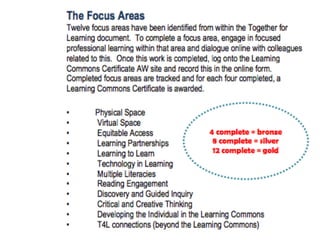
Learning	
  Commons	
  
CertiRicate	
  Program	
  
(LCCP)	
  
Library	
  and	
  Learning	
  Resources	
  &	
  Interdisciplinary	
  Studies	
  
Department,	
  Toronto	
  District	
  School	
  Board	
  
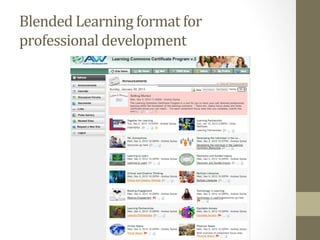
Blended	
  Learning	
  format	
  for	
  
professional	
  development	
  
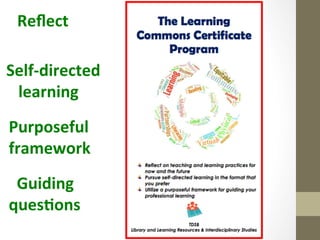
Reflect	
  

Self-­‐directed	


  learning	
  
Purposeful	
  	
  
framework	


  Guiding	
  	
  
quesEons	
  
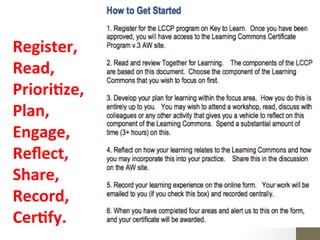
Register,	
  
Read,	
  
PrioriEze,	
  
Plan,	
  
Engage,	
  
Reflect,	
  
Share,	
  
Record,	
  
CerEfy.	
  
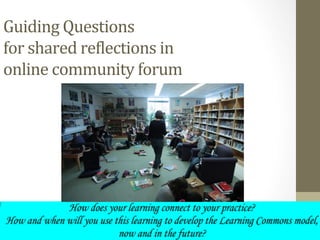
Guiding	
  Questions	
  	
  
for	
  shared	
  reRlections	
  in	
  	
  
online	
  community	
  forum	
  
Questions?	
  Information?	
  
Jeanne	
  Conte	
  -­‐	
  jeanne.conte@peelsb.com	
  
Ruth	
  Hall	
  –	
  ruth.hall@tdsb.on.ca	
  
Phillip	
  G.	
  Jeffrey	
  -­‐	
  jeffreyp@fc.hwcdsb.ca	
  
Cindy	
  Ma=hews	
  –	
  Cindy.Ma=hews@tdsb.on.ca	
  
RESOURCES:	


Brooks-­‐Kirkland,	
  Anita	
  “Ac[on	
  is	
  Eloquence:	
  Advocacy	
  Advice	
  for	
  School	
  
Libraries”.	
  SLIC	
  30-­‐1	


Collabora[ve	
  Teacher	
  Inquiry:	
  Capacity	
  Building	
  Series.	
  Ontario	
  Ministry	
  of	
  
Educa[on.	
  2010.	
  h=p://www.edu.gov.on.ca/eng/literacynumeracy/inspire/research/capacityBuilding.htm	


Crowley,	
  John.	
  Developing	
  a	
  Vision	
  :	
  Strategic	
  Planning	
  for	
  the	
  School	
  Librarian	
  
in	
  the	
  21st	
  Century(	
  Libraries	
  Unlimited,	
  2011)	


Questions?	
  Information?	
  
Jeanne	
  Conte	
  -­‐	
  jeanne.conte@peelsb.com	
  
Ruth	
  Hall	
  –	
  ruth.hall@tdsb.on.ca	
  
Phillip	
  G.	
  Jeffrey	
  -­‐	
  jeffreyp@fc.hwcdsb.ca	
  
Cindy	
  Ma=hews	
  –	
  Cindy.Ma=hews@tdsb.on.ca	
  

RESOURCES	
  con’t:	


OSLA.	
  Together	
  for	
  Learning.	
  2010.	
  
h=p://www.accessola.org/OLAWEB/Together_for_Learning/Welcome/OLAWEB/OSLA/Together_for_Learning/
Together_for_Learning.aspx?hkey=844d0926-­‐a451-­‐4a8b-­‐a004-­‐413f8047cee5.	


TDSB.	
  The	
  Library	
  &	
  Learning	
  Commons,	
  K	
  to	
  12.	
  Expected	
  Prac[ce	
  Series,	
  
Teaching	
  &	
  Learning	
  Department,	
  November	
  2012.	


TDSB.	
  ICT	
  Standards:	
  Digital	
  Learning	
  for	
  Kindergarten	
  to	
  Grade	
  12.	
  2011.	


Making School Libraries (Evan) Better: OLA Super Conference session1203 Fe…

  • 1.
    How  to  Make  School   Libraries  Work  (even)  Better   Jeanne  Conte  (PDSB)     Ruth  Hall  (TDSB)   Phillip  Jeffrey  (HWCDSB)   Cindy  Ma=hews  (TDSB)     Session  1203,  OLA  Super  Conference   February  1,  2013,  2:10  pm  
  • 2.
    How  to  Make  School   Libraries  Work  (even)  Better   R  David  Lankes,  University  of  Syracuse     2012  Changing  Times;  Inspiring  Libraries   Summit  in  Vancouver  BC.  -­‐  Video  clip,  Pt  3,   “Libraries  as  Knowledge  Centres”  
  • 3.
    The  redevelopment  of  National  (school  library)  Standards  to   support  the  achievement  of  21st  Century  Learners.   http://tmcanada.pbworks.com/w/page/52576233/TM%20Canada%202012  
  • 4.
    Library  Review  Process  Transformations   Towards  the  Learning  Commons  :  Identifying,   Sharing  and  Supporting  Best  Practices       Began  in  2011/12  school  year  ;  con[nuing  in  2012/13.  Report   in  May  2013?   Approaches  &  Focus  :     •  Strategic  -­‐    Learning  Commons  and  its  role  in  Student      Achievement;       •  Iden[fica[on  of    Shi_s,  Efficiencies,  Best  Prac[ces;       •                         Sharing  and    Suppor[ng  Best  Prac[ces        
  • 5.
    Learning  Commons  and  its  role  in   Student    Achievement   • Within  the  Literacy  System  Goal  of  the  HWCDSB  ‘s  Board   Improvement  Plan  (BIP)….   • “  2.4  :  Develop  the  Learning  Commons  in  each  school  to  promote   and  teach  inquiry-­‐based  learning  through  cross-­‐curricular   connec[ons,  mul[ple  literacies,  digital  learning,  and  collabora[on   (connected  to  the  Ontario  Catholic  School  Graduate   Expecta[ons)”   •   TL’s  leadership  role  in  the  school  includes  being  part  of  the   School  Improvement  Team…  par[cipa[on  in  TLCPs,  modeling   technology  use  and  integra[on,  collabora[ve  program  planning,   etc.   • Student  Improvement    (Support  )  Visits  –  provide  opportuni[es   for  sharing  prac[ces;  Principal’s  suppor[ng  role  iden[fied.   HWCDSB  
  • 6.
    Shifts,  EfRiciencies,  Best  Practices…1   SCHOOL  LIBRARIES    TO  LEARNING  COMMONS    (From  Working  Document  –  “Shi_ing  Our  Focus”)   From  responsible  ci[zenship  to  →    include  responsibility  and   ethical  use  of  digital  resources  and  tools   From  stagnant  spaces  to    →    virtual  spaces  with  24/7  access   which  means  equitable  access  for  all   From  sta[c  collec[ons  to    →    dynamic,  online,  mul[-­‐modal   collec[ons  which  promote  mul[ple  literacies   From  closed  spaces  to    →    open,  flexible,  welcoming  spaces   which  are  hubs  of  the  school  and  central  to  deep  learning  and   inquiry     HWCDSB  
  • 7.
    Shifts,  EfRiciencies,  Best  Practices…2    LIBRARY  PROGRAMMING    (From  Working  Document  –  “Shi_ing  Our  Focus”)   •   From  tradi[onal  ac[vi[es  to    →    engaging  tasks  that  reflect   the  learning  needs  and  modali[es  of  today’s  learners     • From  isolated  project-­‐based  assignments  to    →    rich   research,  student-­‐generated  inquiry  connected  to  the  Big   Ideas  of  curriculum   • From  teacher-­‐directed  to    →    student-­‐directed  inquiry,   explora[on  and  discovery   • From  technology  in  isola[on  to    →    integra[on  of   technology  for  innova[on,  crea[vity  and  to  especially   enhance  student  engagement   • From  management  of  collec[ons  and  facili[es  to    →    a  focus   on  teaching  and  learning  that  impacts  student  achievement     HWCDSB  
  • 8.
    Shifts,  EfRiciencies,  Best  Practices…3     Reading  Engagement…  aligned  with    SIPs/TLCPs…  going   beyond  the  TL’s  ‘Resource  role’…  Reading  responses  …   (Through  interac[ve  and  mobile  compu[ng  features  of   the  Des[ny  Library  System  in  all  schools)  …  Students  are   Ra[ng  books…  Sharing  responses/Reviews  with  ‘Friends’…   opportuni[es  to  teach  Digital  Ci[zenship…Social   Networking  …     Guided  Inquiry…  developed  collabora[vely  in  wikispaces,   shared  by  TLs  ,    project-­‐based  and  linked  to  curriculum   expecta[ons  and  current  teaching  prac[ces…   System  –sponsored  Guided  Inquiry.  The  Bruce  Trail   Project  (Sept  to  Oct  2012)   HWCDSB  
  • 9.
    Sample  Indicators  …   • There  is  evidence  of  student  inquiry    and  staff   collabora[on  through  research  projects  in  the   Learning  Commons.  Ac[vi[es    include  the  use  of   new  technology  as  well  as  print  resources  to  meet   cross-­‐curricula  expecta[ons.   • Evidence  of  a  collabora[ve  culture    were  a  variety   of  media  has  been  created  and  u[lized  to  enhance   student  learning.     HWCDSB  
  • 10.
      SUMMARY  &  NEXT  STEPS     • Con[nue  to  posi[on  the    transforma[on  to   Learning  Commons  as  a  strategic  process…  where   the  TL  is  a  change  agent.   • Finalise    the  indicators  for  measuring  the   successful  implementa[on  of  the  Learning   Commons  in  schools.   • Increase  and  deepen  Inquiry-­‐Based  and     Collabora[ve  Approaches  to  Align  with  Ministry’s   philosophy.   • Model  the  use  of  Technology  to  engage  students   in  literature  ac[vi[es.   HWCDSB  
  • 11.
    Expected  Practice  Series   “how  can  we  create  an   environment  that   con[nuously  fosters   learning  innova[on  and   high  quality  teaching  in   our  schools”    
  • 12.
    Ontario School LibraryAssociation FRAMEWORK   Information Studies Kindergarten to Grade 12 CollaboraEve   Environments  for   Teaching  and  Learning   Teacher-­‐librarians  are  in  a   Curriculum for Schools and School strategic  posiEon  to  support   1999 Library Information Centres and  implement  Board  and   School  Improvement  Plans,   and  to  embrace  and  promote   Vision  of  Hope  ini[a[ves   through  a  school-­‐wide  and   collaboraEve  approach  to   student  literacy  and  student   achievement.   L&LC,  K  to  12    Expected  Prac[ce  Document  
  • 13.
    Assessment  in  the  Library   Inquiry  is  in  all  subjects   Of  the  Ontario  curriculum   Linking  Inquiry  to  the  Achievement  Chart  
  • 14.
    Tools  for  Learning   Learning  Skills  &  Work  Habits   TDSB  Virtual  Library   ADD  Virtual   Library  
  • 15.
    Teacher-­‐Librarian  Roles        T4L  components   Teaching  &  Learning    mul[ple  literacies   Resource  Management    reading  enjoyment   School  Leadership  &   Improvement   Differen[ated   teaching  &  learning  
  • 16.
    Teacher-­‐Librarian  Roles      Implement  ministry  &      safe,  dynamic  learning   board  policies   environment    collaborate  with    consistent   classroom  teachers Teaching   instruc[on  on         &   inquiry    promote  rich  &   Learning   Differen[ated   diverse  literary  and   informa[onal  text   teaching  &  learning    Connect  students  to   Build    enhance   school,  public  &   reading   learning   community  resources   literacy   through  ICT  
  • 17.
    Audience:   •  Individual  Prac[[oner   •  School  leadership  team   •  School  Principal   •  Central  Staff   •  Senior  admin  team   •  Annual  Learning  Plan   •  Teacher  Performance   Appraisal   •  Library  reports   •  School  Improvement  Plan   •  District  Review   •  Board  Improvement  Plan   •  Ac[on  research  –   collabora[ve  teacher  inquiry    
  • 18.
    Collaborative  Teacher  Inquiry   CollaboraEve  and  Learning  Networks    Ministry  focus  to  drive  new  direc[ons  in  professional  prac[ce   “When  educators  work  together  to  inquire  about  their  students’   learning  and  engagement,  they  embrace  this  complexity  as  an   opportunity  for  further  understanding  rather  than  something  to   simplify  (MOE.  (2010).  Collabora[ve  teacher  inquiry.  Capacity  Building  Series,   Secretariat  Special  Edi[on  #16,  3.)    Power  of  Collabora[on  –working  together  to  engage,  not  only  our   students,  but  ourselves  as  teachers  who  are  also  learners  in  inquiry   related  to  our  teaching  prac[ce    
  • 19.
    Collaborative  Teacher  Inquiry  (PDSB)   CollaboraEve  and  Learning  Networks  2011  -­‐2012    South  Field  Office  –elementary  TL’s  –focus  on  tying  their  work  to   Growing  Success  and  Together  for  Learning    South  Field  Office  –secondary  TL’s–exploring  impact  that  co-­‐ planning,  co-­‐teaching  and  co-­‐assessing  might  have  on  teaching  and   learning    Mississauga  West  Field  Office  –elementary  TL’s  &  classroom   teacher  partners–collaborated  with  teachers  to  provide  direct   support    related  to  TLCP  work  of  their  schools    North  Field  Office  –elementary  TL’s–worked  as  a  commi=ee  in   co-­‐construc[ng  rich  tasks  to  support  teaching  and  learning  through   the  use  of  peer  reviewed  picture  books    ESL/TL  Network  –intermediate  TL’s  &  ESL  teacher  partners  –focus   on  suppor[ng  ELL’s  in  small  group  and  integrated  classroom   seqngs  
  • 20.
    Collaborative  Teacher  Inquiry  (PDSB)   ESL/TL  Intermediate  CollaboraEve  Inquiry   Learning  Goals:    To  facilitate  collabora[ve  prac[ce  between  intermediate  TL’s  and   ESL/ELD  teachers  to  support  increased  academic  achievement  of   ELL’s    To  make  connec[ons  through  adapted  programs  and  culturally   responsive  resources  to  current  ini[a[ves  in  schools,  i.e.   Collabora[ve  Inquiry,  current  Ministry  Equity  Policy  Documents,   Growing  Success,  Together  for  Learning    To  explore  rich  tasks,  differen[ated  instruc[on,  and  current   resources  that  support  ELL’s  academic  achievement  
  • 21.
    Collaborative  Teacher  Inquiry  (PDSB)   ESL/TL  Intermediate  CollaboraEve  Inquiry   Overall  Structure  (two  days  of  release)   Day  1      Morning  of  facilitated  professional  learning  led  by  library   coordinator,  ESL  coordinator  &  resource  teacher    A_ernoon  devoted  to  planning  an  ac[vity  to  implement  in   schools  that  incorporates  new  learning  and  resources  provided   Day  2    Morning  of  facilitated  learning  going  deeper  with  learning  from   Day  1  and  making  new  connec[ons  base  on  their  work  together    Second  half  of  morning  and  a_ernoon  devoted  to  carousel   format  sharing  of  work  and  ac[vi[es  students  engaged  in  related   to  planning  from  Day  1  
  • 22.
    Collaborative  Teacher  Inquiry  (PDSB)   ESL/TL  Intermediate  CollaboraEve  Inquiry   Supports:    Board  paid    for  release  [me  for  one  of  the  2  partners  (schools   covered  the  2nd)  –ran  over  two  years  to  extend  learning  and  model   gradual  release  responsibility    Copy  of  teacher  resource  English  Learners  Academic  Literacy  and   Thinking;  Learning  in  the  Challenge  Zone  by  Pauline  Gibbons  (one   per  teacher    Copy  of  picture  book  Mirror  by  Jeannie  Baker  (one  per  school)    Copy  of  Together  for  Learning:  school  libraries  and  the   emergence  of  the  learning  commons  (one  per  school)    Copies  of  nonfic[on  picture  book  Canada  from  Above  by  Heather   Pa=erson  and  copy  of  Maria  G.  Dove’s  CollaboraDon  and  Co-­‐ teaching  Strategies  for  English  Language  Learners  in  year  2  
  • 23.
    Collaborative  Teacher  Inquiry  (PDSB)   ESL/TL  Intermediate  CollaboraEve  Inquiry   Feedback  from  Teachers:    Grateful  for  opportuni[es  to  explore  an  “unlikely”  partnership   Teacher-­‐librarian  –”I  don’t  know  why  it  had  never  occurred  to  me   to  collaborate  with  the  ESL  teacher;  now  it  seems  like  a  natural   partnership”    Grateful  for  the  gi_  of  [me  to  ini[ate  the  plan   ESL  Teacher  –”Once  we  had  the  ini[al  planning  in  place,  it  was   easier  to  find  [me  to  meet  to  advance  our  plans  and  implement   the  work  with  students”   “Key  to  an  exemplary  school  library  program  is  the  teacher-­‐ librarian’s  ability  to  be  an  effec[ve  teacher,  providing  educa[onal   support  and  leadership  through  partnering  and  collabora[on,  while   finding  opportuni[es  for  integra[on  and  cross-­‐curricular   connec[ons.”  (Klinger,  D.A.,  Stephenson,  G.,  Deluca,  C.  Luu,  K,.  (2009).   Exemplary  School  Libraries  in  Ontario.  Toronto:  Ontario  School  Library  Associa[on.  
  • 24.
    Learning  Commons   CertiRicate  Program   (LCCP)   Library  and  Learning  Resources  &  Interdisciplinary  Studies   Department,  Toronto  District  School  Board  
  • 25.
    Blended  Learning  format  for   professional  development  
  • 26.
    Reflect   Self-­‐directed          learning   Purposeful     framework      Guiding     quesEons  
  • 27.
    Register,   Read,   PrioriEze,   Plan,   Engage,   Reflect,   Share,   Record,   CerEfy.  
  • 32.
    Guiding  Questions     for  shared  reRlections  in     online  community  forum  
  • 33.
    Questions?  Information?   Jeanne  Conte  -­‐  jeanne.conte@peelsb.com   Ruth  Hall  –  ruth.hall@tdsb.on.ca   Phillip  G.  Jeffrey  -­‐  jeffreyp@fc.hwcdsb.ca   Cindy  Ma=hews  –  Cindy.Ma=hews@tdsb.on.ca   RESOURCES:     Brooks-­‐Kirkland,  Anita  “Ac[on  is  Eloquence:  Advocacy  Advice  for  School   Libraries”.  SLIC  30-­‐1     Collabora[ve  Teacher  Inquiry:  Capacity  Building  Series.  Ontario  Ministry  of   Educa[on.  2010.  h=p://www.edu.gov.on.ca/eng/literacynumeracy/inspire/research/capacityBuilding.htm     Crowley,  John.  Developing  a  Vision  :  Strategic  Planning  for  the  School  Librarian   in  the  21st  Century(  Libraries  Unlimited,  2011)      
  • 34.
    Questions?  Information?   Jeanne  Conte  -­‐  jeanne.conte@peelsb.com   Ruth  Hall  –  ruth.hall@tdsb.on.ca   Phillip  G.  Jeffrey  -­‐  jeffreyp@fc.hwcdsb.ca   Cindy  Ma=hews  –  Cindy.Ma=hews@tdsb.on.ca   RESOURCES  con’t:     OSLA.  Together  for  Learning.  2010.   h=p://www.accessola.org/OLAWEB/Together_for_Learning/Welcome/OLAWEB/OSLA/Together_for_Learning/ Together_for_Learning.aspx?hkey=844d0926-­‐a451-­‐4a8b-­‐a004-­‐413f8047cee5.     TDSB.  The  Library  &  Learning  Commons,  K  to  12.  Expected  Prac[ce  Series,   Teaching  &  Learning  Department,  November  2012.     TDSB.  ICT  Standards:  Digital  Learning  for  Kindergarten  to  Grade  12.  2011.