Chattanooga School for the Arts and
            Sciences


              Jenny Wells
               Librarian
                 2012
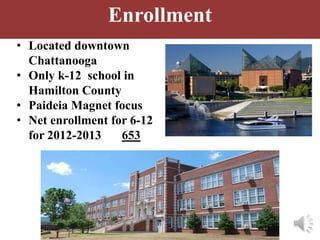
Enrollment
• Located downtown
  Chattanooga
• Only k-12 school in
  Hamilton County
• Paideia Magnet focus
• Net enrollment for 6-12
  for 2012-2013    653
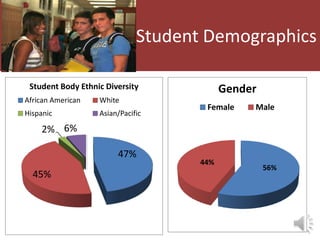
Student Demographics

 Student Body Ethnic Diversity             Gender
African American   White
                                      Female    Male
Hispanic           Asian/Pacific

    2% 6%

                        47%
                                     44%
                                                    56%
  45%
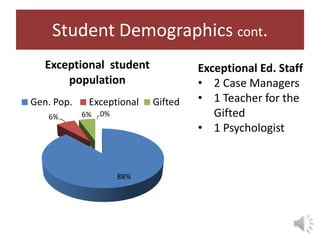
Student Demographics cont.
   Exceptional student               Exceptional Ed. Staff
       population                    • 2 Case Managers
Gen. Pop.    Exceptional    Gifted   • 1 Teacher for the
   6%       6%   0%                     Gifted
                                     • 1 Psychologist


                      88%
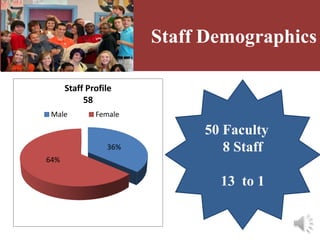
Staff Demographics

      Staff Profile
           58
 Male         Female

                            50 Faculty
                 36%           8 Staff
64%

                              13 to 1
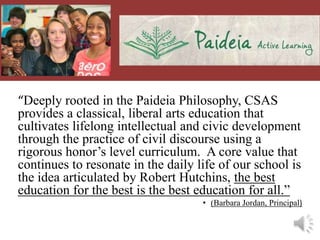
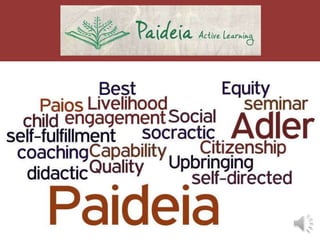
“Deeply rooted in the Paideia Philosophy, CSAS
provides a classical, liberal arts education that
cultivates lifelong intellectual and civic development
through the practice of civil discourse using a
rigorous honor’s level curriculum. A core value that
continues to resonate in the daily life of our school is
the idea articulated by Robert Hutchins, the best
education for the best is the best education for all.”
                                    • (Barbara Jordan, Principal)
Mission Statement

The mission of Chattanooga School for the Arts and
Sciences “is to impart to all our students the skills they
need to learn and the inspiration to continue learning.
We will strive to create a climate of respect that will
give all students the confidence in their abilities to
reason, to question, and to learn.”
                                  (mycsas.com)
L       Library Mission Statement


Library/Media Center of CSAS will strive to be
an integral part of the curricular program, by
providing students and staff with the best
resources and services, so that they are equipped
as effective user of information.
                               (Created by Jenny Wells 2012)
Library’s Current Status


      Play

AASL: 5.4. Strategic Planning and Assessment. Candidates communicate with
students, teachers, administrators, and community members to develop a library media
program that aligns resources, services, and standards with the school’s mission. Candidates
make effective use of data and information to asses s how the library media program
addresses the needs of their diverse communities.
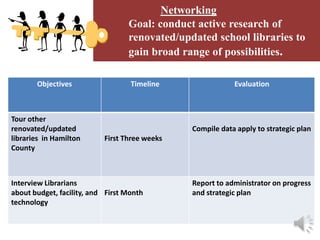
Networking
                                  Goal: conduct active research of
                                  renovated/updated school libraries to
                                  gain broad range of possibilities.

       Objectives                  Timeline                Evaluation


Tour other
renovated/updated                              Compile data apply to strategic plan
libraries in Hamilton      First Three weeks
County


Interview Librarians                           Report to administrator on progress
about budget, facility, and First Month        and strategic plan
technology
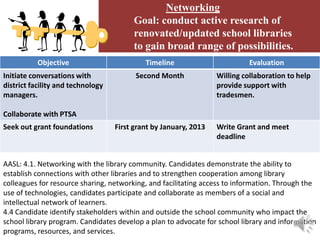
Networking
                                        Goal: conduct active research of
                                        renovated/updated school libraries
                                        to gain broad range of possibilities.
           Objective                        Timeline                        Evaluation
Initiate conversations with              Second Month             Willing collaboration to help
district facility and technology                                  provide support with
managers.                                                         tradesmen.

Collaborate with PTSA
Seek out grant foundations         First grant by January, 2013   Write Grant and meet
                                                                  deadline


AASL: 4.1. Networking with the library community. Candidates demonstrate the ability to
establish connections with other libraries and to strengthen cooperation among library
colleagues for resource sharing, networking, and facilitating access to information. Through the
use of technologies, candidates participate and collaborate as members of a social and
intellectual network of learners.
4.4 Candidate identify stakeholders within and outside the school community who impact the
school library program. Candidates develop a plan to advocate for school library and information
programs, resources, and services.
.
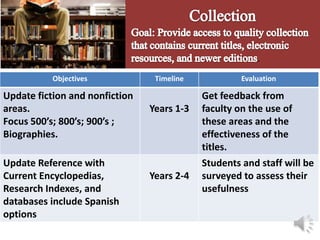
           Objectives            Timeline            Evaluation

Update fiction and nonfiction               Get feedback from
areas.                          Years 1-3   faculty on the use of
Focus 500’s; 800’s; 900’s ;                 these areas and the
Biographies.                                effectiveness of the
                                            titles.
Update Reference with                       Students and staff will be
Current Encyclopedias,          Years 2-4   surveyed to assess their
Research Indexes, and                       usefulness
databases include Spanish
options
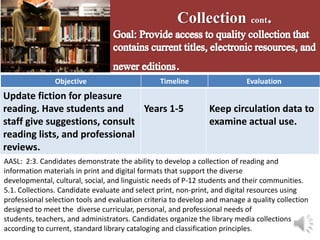
Collection cont.

                                                     .
               Objective                        Timeline                   Evaluation
Update fiction for pleasure
reading. Have students and      Years 1-5                       Keep circulation data to
staff give suggestions, consult                                 examine actual use.
reading lists, and professional
reviews.
AASL: 2:3. Candidates demonstrate the ability to develop a collection of reading and
information materials in print and digital formats that support the diverse
developmental, cultural, social, and linguistic needs of P-12 students and their communities.
5.1. Collections. Candidate evaluate and select print, non-print, and digital resources using
professional selection tools and evaluation criteria to develop and manage a quality collection
designed to meet the diverse curricular, personal, and professional needs of
students, teachers, and administrators. Candidates organize the library media collections
according to current, standard library cataloging and classification principles.
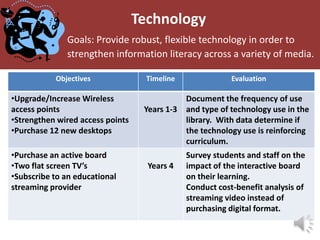
Technology
              Goals: Provide robust, flexible technology in order to
              strengthen information literacy across a variety of media.

           Objectives               Timeline               Evaluation

•Upgrade/Increase Wireless                     Document the frequency of use
access points                      Years 1-3   and type of technology use in the
•Strengthen wired access points                library. With data determine if
•Purchase 12 new desktops                      the technology use is reinforcing
                                               curriculum.
•Purchase an active board                      Survey students and staff on the
•Two flat screen TV’s               Years 4    impact of the interactive board
•Subscribe to an educational                   on their learning.
streaming provider                             Conduct cost-benefit analysis of
                                               streaming video instead of
                                               purchasing digital format.
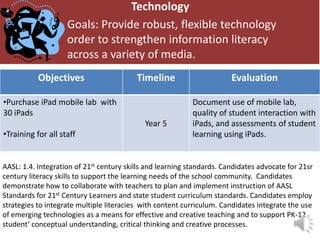
Technology
                    Goals: Provide robust, flexible technology
          in        order to strengthen information literacy
                    across a variety of media.
           Objectives                     Timeline                      Evaluation

•Purchase iPad mobile lab with                              Document use of mobile lab,
30 iPads                                                    quality of student interaction with
                                             Year 5         iPads, and assessments of student
•Training for all staff                                     learning using iPads.


AASL: 1.4. Integration of 21st century skills and learning standards. Candidates advocate for 21sr
century literacy skills to support the learning needs of the school community. Candidates
demonstrate how to collaborate with teachers to plan and implement instruction of AASL
Standards for 21st Century Learners and state student curriculum standards. Candidates employ
strategies to integrate multiple literacies with content curriculum. Candidates integrate the use
of emerging technologies as a means for effective and creative teaching and to support PK-12
student’ conceptual understanding, critical thinking and creative processes.
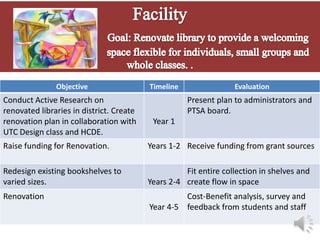
Objective                  Timeline                Evaluation
Conduct Active Research on                           Present plan to administrators and
renovated libraries in district. Create              PTSA board.
renovation plan in collaboration with      Year 1
UTC Design class and HCDE.
Raise funding for Renovation.             Years 1-2 Receive funding from grant sources

Redesign existing bookshelves to                    Fit entire collection in shelves and
varied sizes.                             Years 2-4 create flow in space
Renovation                                         Cost-Benefit analysis, survey and
                                          Year 4-5 feedback from students and staff
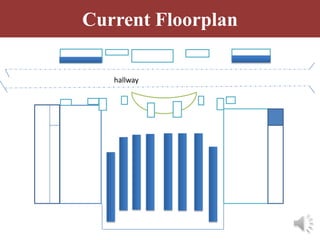
Current Floorplan

   hallway
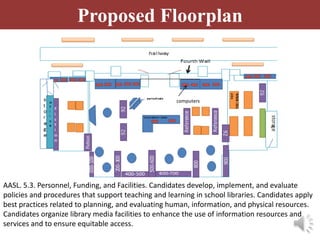
Proposed Floorplan


                                                     computers


AASL. 5.3. Personnel, Funding, and Facilities. Candidates develop, implement, and evaluate
policies and procedures that support teaching and learning in school libraries. Candidates apply
best practices related to planning, and evaluating human, information, and physical resources.
Candidates organize library media facilities to enhance the use of information resources and
services and to ensure equitable access.
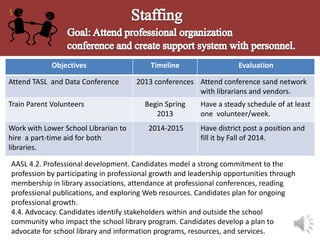
Objectives                   Timeline                   Evaluation

Attend TASL and Data Conference       2013 conferences Attend conference sand network
                                                       with librarians and vendors.
Train Parent Volunteers                 Begin Spring     Have a steady schedule of at least
                                           2013          one volunteer/week.
Work with Lower School Librarian to       2014-2015      Have district post a position and
hire a part-time aid for both                            fill it by Fall of 2014.
libraries.

AASL 4.2. Professional development. Candidates model a strong commitment to the
profession by participating in professional growth and leadership opportunities through
membership in library associations, attendance at professional conferences, reading
professional publications, and exploring Web resources. Candidates plan for ongoing
professional growth.
4.4. Advocacy. Candidates identify stakeholders within and outside the school
community who impact the school library program. Candidates develop a plan to
advocate for school library and information programs, resources, and services.
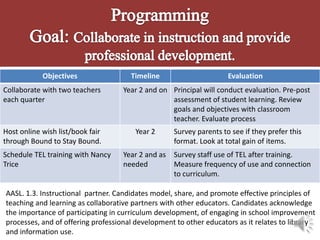
Objectives                Timeline                       Evaluation
Collaborate with two teachers       Year 2 and on Principal will conduct evaluation. Pre-post
each quarter                                      assessment of student learning. Review
                                                  goals and objectives with classroom
                                                  teacher. Evaluate process
Host online wish list/book fair        Year 2       Survey parents to see if they prefer this
through Bound to Stay Bound.                        format. Look at total gain of items.
Schedule TEL training with Nancy    Year 2 and as   Survey staff use of TEL after training.
Trice                               needed          Measure frequency of use and connection
                                                    to curriculum.

AASL. 1.3. Instructional partner. Candidates model, share, and promote effective principles of
teaching and learning as collaborative partners with other educators. Candidates acknowledge
the importance of participating in curriculum development, of engaging in school improvement
processes, and of offering professional development to other educators as it relates to library
and information use.
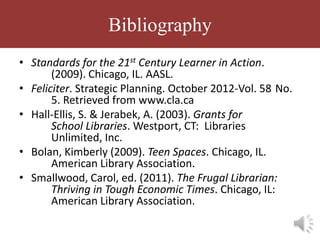
Bibliography
• Standards for the 21st Century Learner in Action.
       (2009). Chicago, IL. AASL.
• Feliciter. Strategic Planning. October 2012-Vol. 58 No.
       5. Retrieved from www.cla.ca
• Hall-Ellis, S. & Jerabek, A. (2003). Grants for
       School Libraries. Westport, CT: Libraries
       Unlimited, Inc.
• Bolan, Kimberly (2009). Teen Spaces. Chicago, IL.
       American Library Association.
• Smallwood, Carol, ed. (2011). The Frugal Librarian:
       Thriving in Tough Economic Times. Chicago, IL:
       American Library Association.

Chattanooga school for the arts and sciences

  • 1.
    Chattanooga School forthe Arts and Sciences Jenny Wells Librarian 2012
  • 2.
    Enrollment • Located downtown Chattanooga • Only k-12 school in Hamilton County • Paideia Magnet focus • Net enrollment for 6-12 for 2012-2013 653
  • 3.
    Student Demographics StudentBody Ethnic Diversity Gender African American White Female Male Hispanic Asian/Pacific 2% 6% 47% 44% 56% 45%
  • 4.
    Student Demographics cont. Exceptional student Exceptional Ed. Staff population • 2 Case Managers Gen. Pop. Exceptional Gifted • 1 Teacher for the 6% 6% 0% Gifted • 1 Psychologist 88%
  • 5.
    Staff Demographics Staff Profile 58 Male Female 50 Faculty 36% 8 Staff 64% 13 to 1
  • 6.
    “Deeply rooted inthe Paideia Philosophy, CSAS provides a classical, liberal arts education that cultivates lifelong intellectual and civic development through the practice of civil discourse using a rigorous honor’s level curriculum. A core value that continues to resonate in the daily life of our school is the idea articulated by Robert Hutchins, the best education for the best is the best education for all.” • (Barbara Jordan, Principal)
  • 8.
    Mission Statement The missionof Chattanooga School for the Arts and Sciences “is to impart to all our students the skills they need to learn and the inspiration to continue learning. We will strive to create a climate of respect that will give all students the confidence in their abilities to reason, to question, and to learn.” (mycsas.com)
  • 9.
    L Library Mission Statement Library/Media Center of CSAS will strive to be an integral part of the curricular program, by providing students and staff with the best resources and services, so that they are equipped as effective user of information. (Created by Jenny Wells 2012)
  • 10.
    Library’s Current Status Play AASL: 5.4. Strategic Planning and Assessment. Candidates communicate with students, teachers, administrators, and community members to develop a library media program that aligns resources, services, and standards with the school’s mission. Candidates make effective use of data and information to asses s how the library media program addresses the needs of their diverse communities.
  • 11.
    Networking Goal: conduct active research of renovated/updated school libraries to gain broad range of possibilities. Objectives Timeline Evaluation Tour other renovated/updated Compile data apply to strategic plan libraries in Hamilton First Three weeks County Interview Librarians Report to administrator on progress about budget, facility, and First Month and strategic plan technology
  • 12.
    Networking Goal: conduct active research of renovated/updated school libraries to gain broad range of possibilities. Objective Timeline Evaluation Initiate conversations with Second Month Willing collaboration to help district facility and technology provide support with managers. tradesmen. Collaborate with PTSA Seek out grant foundations First grant by January, 2013 Write Grant and meet deadline AASL: 4.1. Networking with the library community. Candidates demonstrate the ability to establish connections with other libraries and to strengthen cooperation among library colleagues for resource sharing, networking, and facilitating access to information. Through the use of technologies, candidates participate and collaborate as members of a social and intellectual network of learners. 4.4 Candidate identify stakeholders within and outside the school community who impact the school library program. Candidates develop a plan to advocate for school library and information programs, resources, and services.
  • 13.
    . Objectives Timeline Evaluation Update fiction and nonfiction Get feedback from areas. Years 1-3 faculty on the use of Focus 500’s; 800’s; 900’s ; these areas and the Biographies. effectiveness of the titles. Update Reference with Students and staff will be Current Encyclopedias, Years 2-4 surveyed to assess their Research Indexes, and usefulness databases include Spanish options
  • 14.
    Collection cont. . Objective Timeline Evaluation Update fiction for pleasure reading. Have students and Years 1-5 Keep circulation data to staff give suggestions, consult examine actual use. reading lists, and professional reviews. AASL: 2:3. Candidates demonstrate the ability to develop a collection of reading and information materials in print and digital formats that support the diverse developmental, cultural, social, and linguistic needs of P-12 students and their communities. 5.1. Collections. Candidate evaluate and select print, non-print, and digital resources using professional selection tools and evaluation criteria to develop and manage a quality collection designed to meet the diverse curricular, personal, and professional needs of students, teachers, and administrators. Candidates organize the library media collections according to current, standard library cataloging and classification principles.
  • 15.
    Technology Goals: Provide robust, flexible technology in order to strengthen information literacy across a variety of media. Objectives Timeline Evaluation •Upgrade/Increase Wireless Document the frequency of use access points Years 1-3 and type of technology use in the •Strengthen wired access points library. With data determine if •Purchase 12 new desktops the technology use is reinforcing curriculum. •Purchase an active board Survey students and staff on the •Two flat screen TV’s Years 4 impact of the interactive board •Subscribe to an educational on their learning. streaming provider Conduct cost-benefit analysis of streaming video instead of purchasing digital format.
  • 16.
    Technology Goals: Provide robust, flexible technology in order to strengthen information literacy across a variety of media. Objectives Timeline Evaluation •Purchase iPad mobile lab with Document use of mobile lab, 30 iPads quality of student interaction with Year 5 iPads, and assessments of student •Training for all staff learning using iPads. AASL: 1.4. Integration of 21st century skills and learning standards. Candidates advocate for 21sr century literacy skills to support the learning needs of the school community. Candidates demonstrate how to collaborate with teachers to plan and implement instruction of AASL Standards for 21st Century Learners and state student curriculum standards. Candidates employ strategies to integrate multiple literacies with content curriculum. Candidates integrate the use of emerging technologies as a means for effective and creative teaching and to support PK-12 student’ conceptual understanding, critical thinking and creative processes.
  • 17.
    Objective Timeline Evaluation Conduct Active Research on Present plan to administrators and renovated libraries in district. Create PTSA board. renovation plan in collaboration with Year 1 UTC Design class and HCDE. Raise funding for Renovation. Years 1-2 Receive funding from grant sources Redesign existing bookshelves to Fit entire collection in shelves and varied sizes. Years 2-4 create flow in space Renovation Cost-Benefit analysis, survey and Year 4-5 feedback from students and staff
  • 18.
  • 19.
    Proposed Floorplan computers AASL. 5.3. Personnel, Funding, and Facilities. Candidates develop, implement, and evaluate policies and procedures that support teaching and learning in school libraries. Candidates apply best practices related to planning, and evaluating human, information, and physical resources. Candidates organize library media facilities to enhance the use of information resources and services and to ensure equitable access.
  • 20.
    Objectives Timeline Evaluation Attend TASL and Data Conference 2013 conferences Attend conference sand network with librarians and vendors. Train Parent Volunteers Begin Spring Have a steady schedule of at least 2013 one volunteer/week. Work with Lower School Librarian to 2014-2015 Have district post a position and hire a part-time aid for both fill it by Fall of 2014. libraries. AASL 4.2. Professional development. Candidates model a strong commitment to the profession by participating in professional growth and leadership opportunities through membership in library associations, attendance at professional conferences, reading professional publications, and exploring Web resources. Candidates plan for ongoing professional growth. 4.4. Advocacy. Candidates identify stakeholders within and outside the school community who impact the school library program. Candidates develop a plan to advocate for school library and information programs, resources, and services.
  • 21.
    Objectives Timeline Evaluation Collaborate with two teachers Year 2 and on Principal will conduct evaluation. Pre-post each quarter assessment of student learning. Review goals and objectives with classroom teacher. Evaluate process Host online wish list/book fair Year 2 Survey parents to see if they prefer this through Bound to Stay Bound. format. Look at total gain of items. Schedule TEL training with Nancy Year 2 and as Survey staff use of TEL after training. Trice needed Measure frequency of use and connection to curriculum. AASL. 1.3. Instructional partner. Candidates model, share, and promote effective principles of teaching and learning as collaborative partners with other educators. Candidates acknowledge the importance of participating in curriculum development, of engaging in school improvement processes, and of offering professional development to other educators as it relates to library and information use.
  • 22.
    Bibliography • Standards forthe 21st Century Learner in Action. (2009). Chicago, IL. AASL. • Feliciter. Strategic Planning. October 2012-Vol. 58 No. 5. Retrieved from www.cla.ca • Hall-Ellis, S. & Jerabek, A. (2003). Grants for School Libraries. Westport, CT: Libraries Unlimited, Inc. • Bolan, Kimberly (2009). Teen Spaces. Chicago, IL. American Library Association. • Smallwood, Carol, ed. (2011). The Frugal Librarian: Thriving in Tough Economic Times. Chicago, IL: American Library Association.