Defending our
    libraries
Presentation by:
Billie McCarron
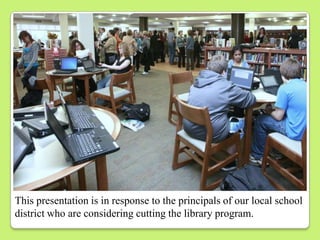
This presentation is in response to the principals of our local school
district who are considering cutting the library program.
School library programs, according to the informational brief written in 2011
by the New York Comprehensive Center, are often the first to be sacrificed
when schools are faced with budget cuts. However, according to the NYCC
     extensive research shows that schools that have relied on
     their libraries to support student growth, specifically in the
     areas of literacy, information literacy, technological skills,
     and access to resources and equipment, have seen increased
     motivation, higher assessment scores, and ultimately higher
     graduation rates.
I would like to explain how library media specialists play an essential role in
the academic community. Not only do they collaborate with teachers , but
they ensure that the library is a welcoming place and that students become
effective users of the information available to them.
The Role and Traits of an Effective Librarian
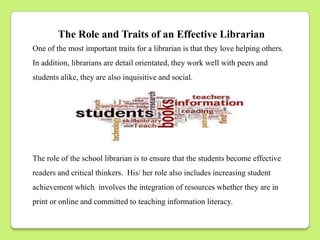
One of the most important traits for a librarian is that they love helping others.
In addition, librarians are detail orientated, they work well with peers and
students alike, they are also inquisitive and social.


The role of the school librarian is to ensure that the students become effective
readers and critical thinkers. His/ her role also includes increasing student
achievement which involves the integration of resources whether they are in
print or online and committed to teaching information literacy.
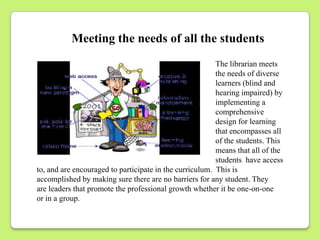
Meeting the needs of all the students
                                                         The librarian meets
                                                         the needs of diverse
                                                         learners (blind and
                                                         hearing impaired) by
                                                         implementing a
                                                         comprehensive
                                                         design for learning
                                                         that encompasses all
                                                         of the students. This
                                                         means that all of the
                                                         students have access
to, and are encouraged to participate in the curriculum. This is
accomplished by making sure there are no barriers for any student. They
are leaders that promote the professional growth whether it be one-on-one
or in a group.
How the librarian helps the students make
                         use of technology
As an information specialist, it is the librarians job to make sure that each
student can navigate safely on the World Wide Web. By providing students with
the expertise that we possess, they can learn to become effective researchers.
They need to know how to select accurate, current, unbiased information, and to
use that information without plagiarizing. By focusing on the students needs, a
librarian can help make each student a competent reader. This is done by
coupling printed material with digital information. All of this adds up to
providing instruction with higher expectations in order to increase student
achievement. The librarian is able to arm students with information literacy
skills that will enable them to be critical thinkers and successful in a
technological society.
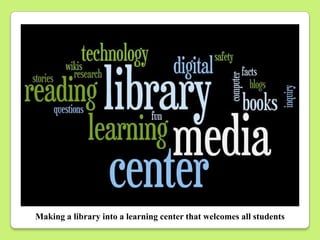
Making a library into a learning center that welcomes all students
School library media centers in the 21st century should be the hub for
increased student achievement, not just during school hours, but 24/7.
Allowing students to access instructional technology from anywhere and at
anytime will accomplish this. A good librarian will turn the library into an
active learning center within each school in the district as well as a place
where the student feel safe. He/she will do this by connecting our students
through wikis, library webpages, blogs and all while managing the
complexity of the library media center. With the addition of computers,
cafes, and movable shelving the librarians who sat quietly behind the
circulation desk are gone Today they are knowledgeable, interactive and
willing to teach all what that they have learned. All of this adds up to
producing students who are well informed and lifelong learners.
Resources:

Bidd, D. (2003). [Responding to "why do we need a teacher librarian or school library when
    have the internet?”]. The Medium, 43 (2), 5-5. Retrieved from
     http://search. Proquest.
Wools, B. (2008). The school library media manager (4th ed.). Westport, CT: Libraries
    Unlimited.
Smith, K. (n.d). Building student learning through school
    Retrieved from http://www.laurabushfoundation.org/Smith.pdf
Informational Brief: Impact of School Libraries on Student Achievement. (2011, October).
     New York Comprehensive Center. Retrieved January 26, 2013, from
     http://www.nysl.nysed.gov/libdev/nyla/nycc_school_library_brief.pdf

Edu 367 assignment 3

  • 1.
    Defending our libraries Presentation by: Billie McCarron
  • 2.
    This presentation isin response to the principals of our local school district who are considering cutting the library program.
  • 3.
    School library programs,according to the informational brief written in 2011 by the New York Comprehensive Center, are often the first to be sacrificed when schools are faced with budget cuts. However, according to the NYCC extensive research shows that schools that have relied on their libraries to support student growth, specifically in the areas of literacy, information literacy, technological skills, and access to resources and equipment, have seen increased motivation, higher assessment scores, and ultimately higher graduation rates. I would like to explain how library media specialists play an essential role in the academic community. Not only do they collaborate with teachers , but they ensure that the library is a welcoming place and that students become effective users of the information available to them.
  • 4.
    The Role andTraits of an Effective Librarian One of the most important traits for a librarian is that they love helping others. In addition, librarians are detail orientated, they work well with peers and students alike, they are also inquisitive and social. The role of the school librarian is to ensure that the students become effective readers and critical thinkers. His/ her role also includes increasing student achievement which involves the integration of resources whether they are in print or online and committed to teaching information literacy.
  • 5.
    Meeting the needsof all the students The librarian meets the needs of diverse learners (blind and hearing impaired) by implementing a comprehensive design for learning that encompasses all of the students. This means that all of the students have access to, and are encouraged to participate in the curriculum. This is accomplished by making sure there are no barriers for any student. They are leaders that promote the professional growth whether it be one-on-one or in a group.
  • 6.
    How the librarianhelps the students make use of technology As an information specialist, it is the librarians job to make sure that each student can navigate safely on the World Wide Web. By providing students with the expertise that we possess, they can learn to become effective researchers. They need to know how to select accurate, current, unbiased information, and to use that information without plagiarizing. By focusing on the students needs, a librarian can help make each student a competent reader. This is done by coupling printed material with digital information. All of this adds up to providing instruction with higher expectations in order to increase student achievement. The librarian is able to arm students with information literacy skills that will enable them to be critical thinkers and successful in a technological society.
  • 7.
    Making a libraryinto a learning center that welcomes all students
  • 8.
    School library mediacenters in the 21st century should be the hub for increased student achievement, not just during school hours, but 24/7. Allowing students to access instructional technology from anywhere and at anytime will accomplish this. A good librarian will turn the library into an active learning center within each school in the district as well as a place where the student feel safe. He/she will do this by connecting our students through wikis, library webpages, blogs and all while managing the complexity of the library media center. With the addition of computers, cafes, and movable shelving the librarians who sat quietly behind the circulation desk are gone Today they are knowledgeable, interactive and willing to teach all what that they have learned. All of this adds up to producing students who are well informed and lifelong learners.
  • 9.
    Resources: Bidd, D. (2003).[Responding to "why do we need a teacher librarian or school library when have the internet?”]. The Medium, 43 (2), 5-5. Retrieved from http://search. Proquest. Wools, B. (2008). The school library media manager (4th ed.). Westport, CT: Libraries Unlimited. Smith, K. (n.d). Building student learning through school Retrieved from http://www.laurabushfoundation.org/Smith.pdf Informational Brief: Impact of School Libraries on Student Achievement. (2011, October). New York Comprehensive Center. Retrieved January 26, 2013, from http://www.nysl.nysed.gov/libdev/nyla/nycc_school_library_brief.pdf