A Linear Pentapeptide Is a Quorum-
Sensing Factor Required for mazEF-
Mediated Cell Death in Escherichia coli
Ilana Kolodkin-Gal,1
Ronen Hazan,1
* Ariel Gaathon,2
Shmuel Carmeli,3
Hanna Engelberg-Kulka1
†
mazEF is a toxin-antitoxin module located on many bacterial chromosomes, including those of
pathogens. Here, we report that Escherichia coli mazEF-mediated cell death is a population
phenomenon requiring a quorum-sensing molecule that we call the extracellular death factor
(EDF). Structural analysis revealed that EDF is a linear pentapeptide, Asn-Asn-Trp-Asn-Asn. Each of
the five amino acids of EDF is important for its activity.
P
rogrammed cell death (PCD) is generally
associated with eukaryotic multicellular
organisms (1, 2). However PCD systems
have also been observed in bacteria (3–11).
One of these systems is mediated by the toxin-
antitoxin module (mazEF) located in many bac-
terial chromosomes (11–13) and mainly studied
in Escherichia coli (3, 10, 11). E. coli mazF
encodes a stable toxin, MazF (3), which is a
sequence-specific endoribonuclease that prefer-
entially cleaves single-stranded mRNAs at ACA
sequences (14). mazE encodes a labile antitoxin,
MazE, that counteracts the action of MazF (3).
E. coli mazEF is a stress-induced toxin-antitoxin
module. Thus, any stressful condition that pre-
vents the expression of mazEF will lead to a
reduction of MazE levels in the cell, permitting
the MazF toxin to act. Such stresses include the
transient inhibition of transcription and/or trans-
lation by antibiotics such as rifampicin, chlor-
amphenicol, and spectinomycin, as well as DNA
damagecausedbythyminestarvation,mitomycinC,
nalidixic acid, and ultraviolet irradiation (15, 16).
We previously suggested that E. coli mazEF-
mediated cell death is a population phenomenon
(11). Here we confirm that E. coli mazEF-
mediated cell death was dependent on the density
of the bacterial population (fig. S1). Adding
rifampicin for a short period to inhibit transcrip-
tion led to mazEF-mediated cell death at densities
of 3 × 10⁸
or 3 × 10⁷
cells/ml, but not at 3 × 10⁵
or
3 × 10⁴
cells/ml (fig. S1). Consequently, we ex-
amined whether the supernatant of a dense
culture could restore mazEF-mediated cell death
in a diluted culture. To this end, we added the
supernatant of a dense culture to a diluted culture
and then induced mazEF-mediated cell death by
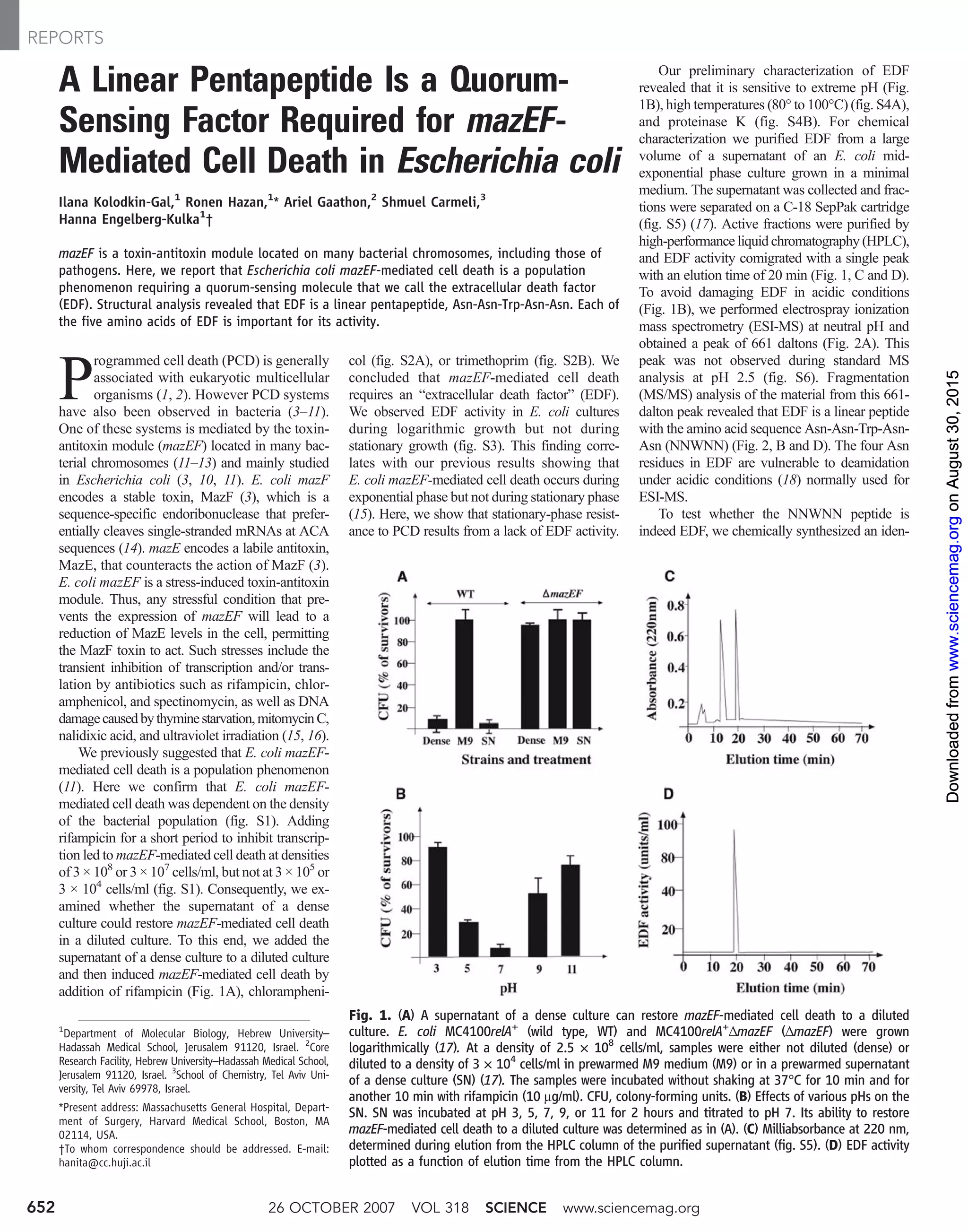
addition of rifampicin (Fig. 1A), chlorampheni-
col (fig. S2A), or trimethoprim (fig. S2B). We
concluded that mazEF-mediated cell death
requires an “extracellular death factor” (EDF).
We observed EDF activity in E. coli cultures
during logarithmic growth but not during
stationary growth (fig. S3). This finding corre-
lates with our previous results showing that
E. coli mazEF-mediated cell death occurs during
exponential phase but not during stationary phase
(15). Here, we show that stationary-phase resist-
ance to PCD results from a lack of EDF activity.
Our preliminary characterization of EDF
revealed that it is sensitive to extreme pH (Fig.
1B), high temperatures (80° to 100°C) (fig. S4A),
and proteinase K (fig. S4B). For chemical
characterization we purified EDF from a large
volume of a supernatant of an E. coli mid-
exponential phase culture grown in a minimal
medium. The supernatant was collected and frac-
tions were separated on a C-18 SepPak cartridge
(fig. S5) (17). Active fractions were purified by
high-performance liquid chromatography (HPLC),
and EDF activity comigrated with a single peak
with an elution time of 20 min (Fig. 1, C and D).
To avoid damaging EDF in acidic conditions
(Fig. 1B), we performed electrospray ionization
mass spectrometry (ESI-MS) at neutral pH and
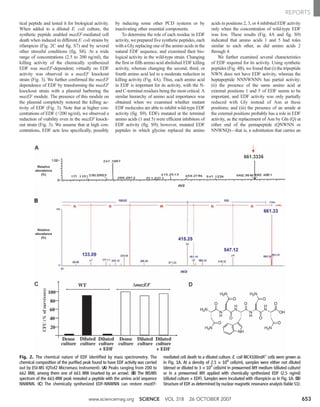
obtained a peak of 661 daltons (Fig. 2A). This
peak was not observed during standard MS
analysis at pH 2.5 (fig. S6). Fragmentation
(MS/MS) analysis of the material from this 661-
dalton peak revealed that EDF is a linear peptide
with the amino acid sequence Asn-Asn-Trp-Asn-
Asn (NNWNN) (Fig. 2, B and D). The four Asn
residues in EDF are vulnerable to deamidation
under acidic conditions (18) normally used for
ESI-MS.
To test whether the NNWNN peptide is
indeed EDF, we chemically synthesized an iden-
1
Department of Molecular Biology, Hebrew University–
Hadassah Medical School, Jerusalem 91120, Israel. 2
Core
Research Facility, Hebrew University–Hadassah Medical School,
Jerusalem 91120, Israel. 3
School of Chemistry, Tel Aviv Uni-
versity, Tel Aviv 69978, Israel.
*Present address: Massachusetts General Hospital, Depart-
ment of Surgery, Harvard Medical School, Boston, MA
02114, USA.
†To whom correspondence should be addressed. E-mail:
hanita@cc.huji.ac.il
Fig. 1. (A) A supernatant of a dense culture can restore mazEF-mediated cell death to a diluted
culture. E. coli MC4100relA+
(wild type, WT) and MC4100relA+
∆mazEF (∆mazEF) were grown
logarithmically (17). At a density of 2.5 × 10⁸
cells/ml, samples were either not diluted (dense) or
diluted to a density of 3 × 10⁴
cells/ml in prewarmed M9 medium (M9) or in a prewarmed supernatant
of a dense culture (SN) (17). The samples were incubated without shaking at 37°C for 10 min and for
another 10 min with rifampicin (10 mg/ml). CFU, colony-forming units. (B) Effects of various pHs on the
SN. SN was incubated at pH 3, 5, 7, 9, or 11 for 2 hours and titrated to pH 7. Its ability to restore
mazEF-mediated cell death to a diluted culture was determined as in (A). (C) Milliabsorbance at 220 nm,
determined during elution from the HPLC column of the purified supernatant (fig. S5). (D) EDF activity
plotted as a function of elution time from the HPLC column.
26 OCTOBER 2007 VOL 318 SCIENCE www.sciencemag.org652
REPORTS
onAugust30,2015www.sciencemag.orgDownloadedfromonAugust30,2015www.sciencemag.orgDownloadedfromonAugust30,2015www.sciencemag.orgDownloadedfromonAugust30,2015www.sciencemag.orgDownloadedfrom
tical peptide and tested it for biological activity.
When added to a diluted E. coli culture, the
synthetic peptide enabled mazEF-mediated cell
death when induced in different E. coli strains by
rifampicin (Fig. 2C and fig. S7) and by several
other stressful conditions (fig. S8). At a wide
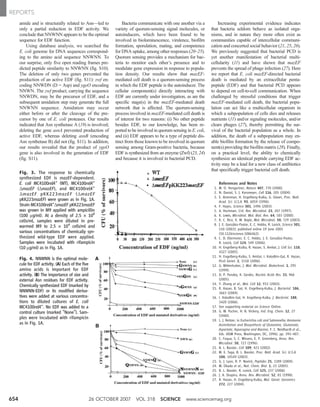
range of concentrations (2.5 to 200 ng/ml), the
killing activity of the chemically synthesized
EDF was mazEF-dependent; virtually no EDF
activity was observed in a mazEF knockout
strain (Fig. 3). We further confirmed the mazEF
dependence of EDF by transforming the mazEF
knockout strain with a plasmid harboring the
mazEF module. The presence of this module on
the plasmid completely restored the killing ac-
tivity of EDF (Fig. 3). Note that at higher con-
centrations of EDF (>200 ng/ml), we observed a
reduction of viability even in the mazEF knock-
out strain (Fig. 3). We assume that at high con-
centrations, EDF acts less specifically, possibly
by inducing some other PCD systems or by
inactivating other essential components.
To determine the role of each residue in EDF
activity, we prepared five synthetic peptides, each
with a Gly replacing one of the amino acids in the
natural EDF sequence, and examined their bio-
logical activity in the wild-type strain. Changing
the first or fifth amino acid abolished EDF killing
activity, whereas changing the second, third, or
fourth amino acid led to a moderate reduction in
killing activity (Fig. 4A). Thus, each amino acid
in EDF is important for its activity, with the N-
and C-terminal residues being the most critical. A
similar hierarchy of amino acid importance was
obtained when we examined whether mutant
EDF molecules are able to inhibit wild-type EDF
activity (fig. S9). EDFs mutated at the terminal
amino acids (1 and 5) were efficient inhibitors of
EDF activity (fig. S9); however, mutated EDF
peptides in which glycine replaced the amino
acids in positions 2, 3, or 4 inhibited EDF activity
only when the concentration of wild-type EDF
was low. These results (Fig. 4A and fig. S9)
indicated that amino acids 1 and 5 had roles
similar to each other, as did amino acids 2
through 4.
We further examined several characteristics
of EDF required for its activity. Using synthetic
peptides (Fig. 4B), we found that (i) the tripeptide
NWN does not have EDF activity, whereas the
heptapeptide NNNWNNN has partial activity;
(ii) the presence of the same amino acid at
external positions 1 and 5 of EDF seems to be
important, and EDF activity was only partially
reduced with Gly instead of Asn at these
positions; and (iii) the presence of an amide at
the external positions probably has a role in EDF
activity, as the replacement of Asn by Gln (Q) at
either end of the pentapeptide (QNWNN or
NNWNQ)—that is, a substitution that carries an
Fig. 2. The chemical nature of EDF identified by mass spectrometry. The
chemical composition of the purified peak found to have EDF activity was carried
out by ESI-MS (QTof2 Micromass instrument). (A) Peaks ranging from 200 to
662 MW, among them one of 661 MW (marked by an arrow). (B) The MS/MS
spectrum of the 661-MW peak revealed a peptide with the amino acid sequence
NNWNN. (C) The chemically synthesized EDF-NNWNN can restore mazEF-
mediated cell death to a diluted culture. E. coli MC4100relA+
cells were grown as
in Fig. 1A. At a density of 2.5 × 10⁸
cells/ml, samples were either not diluted
(dense) or diluted to 3 × 10⁴
cells/ml in prewarmed M9 medium (diluted culture)
or in a prewarmed M9 applied with chemically synthesized EDF (2.5 ng/ml)
(diluted culture + EDF). Samples were incubated with rifampicin as in Fig. 1A. (D)
Structure of EDF as determined by nuclear magnetic resonance analysis (table S1).
www.sciencemag.org SCIENCE VOL 318 26 OCTOBER 2007 653
REPORTS
amide and is structurally related to Asn—led to
only a partial reduction in EDF activity. We
conclude that NNWNN appears to be the optimal
sequence for EDF function.
Using database analysis, we searched the
E. coli genome for DNA sequences correspond-
ing to the amino acid sequence NNWNN. To
our surprise, only five open reading frames pre-
dicted peptide similarity to NNWNN (fig. S10).
The deletion of only two genes prevented the
production of an active EDF (fig. S11): zwf en-
coding NNWDN (D = Asp) and ygeO encoding
NNWN. The zwf product, carrying the sequence
NNWDN, may be the precursor of EDF, and a
subsequent amidation step may generate the full
NNWNN sequence. Amidation may occur
either before or after the cleavage of the pre-
cursor by one of E. coli proteases. Our results
indicated that Asn synthetase A (19) is involved;
deleting the gene asnA prevented production of
active EDF, whereas deleting asnB (encoding
Asn synthetase B) did not (fig. S11). In addition,
our results revealed that the product of ygeO
gene is also involved in the generation of EDF
(fig. S11).
Bacteria communicate with one another via a
variety of quorum-sensing signal molecules, or
autoinducers, which have been found to be
involved in bioluminescence, virulence, biofilm
formation, sporulation, mating, and competence
for DNA uptake, among other responses (20–25).
Quorum sensing provides a mechanism for bac-
teria to monitor each other’s presence and to
modulate gene expression in response to popula-
tion density. Our results show that mazEF-
mediated cell death is a quorum-sensing process
in which the EDF peptide is the autoinducer. The
cellular component(s) directly interacting with
EDF are currently under investigation, as are the
specific stage(s) in the mazEF-mediated death
network that is affected. The quorum-sensing
process involved in mazEF-mediated cell death is
of interest for two reasons: (i) No other peptide
besides EDF, to our knowledge, has been re-
ported to be involved in quorum sensing in E. coli,
and (ii) EDF appears to be a type of peptide dis-
tinct from those known to be involved in quorum
sensing among Gram-positive bacteria, because
EDF is synthesized from an enzyme (Zwf) (23, 24)
and because it is involved in bacterial PCD.
Increasing experimental evidence indicates
that bacteria seldom behave as isolated orga-
nisms, and in nature they more often exist as
communities capable of intercellular communi-
cation and concerted social behavior (21, 25, 26).
We previously suggested that bacterial PCD is
yet another manifestation of bacterial multi-
cellularity (11) and have shown that mazEF
prevents the spread of phage infection (27). Here
we report that E. coli mazEF-directed bacterial
death is mediated by an extracellular penta-
peptide (EDF) and that bacterial PCD appears
to depend on cell-to-cell communication. When
challenged by stressful conditions that trigger
mazEF-mediated cell death, the bacterial popu-
lation can act like a multicellular organism in
which a subpopulation of cells dies and releases
nutrients (11) and/or signaling molecules, and/or
clears phages (27), thereby permitting the sur-
vival of the bacterial population as a whole. In
addition, the death of a subpopulation may en-
able biofilm formation by the release of compo-
nent(s) providing the biofilm matrix (28). Finally,
on a practical level, the ability to chemically
synthesize an identical peptide carrying EDF ac-
tivity may be a lead for a new class of antibiotics
that specifically trigger bacterial cell death.
References and Notes
1. M. O. Hengartner, Nature 407, 770 (2000).
2. N. Danial, S. J. Korsmeyer, Cell 116, 205 (2004).
3. E. Aizenman, H. Engelberg-Kulka, G. Glaser, Proc. Natl.
Acad. Sci. U.S.A. 93, 6059 (1996).
4. F. Hayes, Science 301, 1496 (2003).
5. A. Hochman, Crit. Rev. Microbiol. 23, 207 (1997).
6. K. Lewis, Microbiol. Mol. Biol. Rev. 64, 503 (2000).
7. K. C. Rice, K. W. Bayle, Mol. Microbiol. 50, 729 (2003).
8. J. E. González-Pastor, E. C. Hobbs, R. Losick, Science 301,
510 (2003); published online 19 June 2003
(10.1126/science.1086462).
9. C. D. Ellermeier, E. C. Hobbs, J. E. González-Pastor,
R. Losick, Cell 124, 549 (2006).
10. H. Engelberg-Kulka, R. Hazan, S. Amitai, J. Cell Sci. 118,
4327 (2005).
11. H. Engelberg-Kulka, S. Amitai, I. Kolodkin-Gal, R. Hazan,
PLoS Genet. 2, 1518 (2006).
12. G. Mittenhuber, J. Mol. Microbiol. Biotechnol. 1, 295
(1999).
13. D. P. Pandey, K. Gerdes, Nucleic Acids Res. 33, 966
(2005).
14. Y. Zhang et al., Mol. Cell 12, 913 (2003).
15. R. Hazan, B. Sat, H. Engelberg-Kulka, J. Bacteriol. 186,
3663 (2004).
16. I. Kolodkin-Gal, H. Engelberg-Kulka, J. Bacteriol. 188,
3420 (2006).
17. See supporting material on Science Online.
18. G. W. Pucher, H. B. Vickery, Ind. Eng. Chem. 12, 27
(1940).
19. L. J. Reitzer, in Escherichia coli and Salmonella: Ammonia
Assimilation and Biosynthesis of Glutamine, Glutamate,
Aspartate, Asparagine and Alanine, F. C. Neidhardt et al.,
Eds. (ASM Press, Washington, DC, 1996), pp. 391–407.
20. C. Fuqua, S. C. Winans, E. P. Greenberg, Annu. Rev.
Microbiol. 50, 727 (1996).
21. B. L. Bassler, Cell 109, 421 (2002).
22. M. E. Taga, B. L. Bassler, Proc. Natl. Acad. Sci. U.S.A.
100, 14549 (2003).
23. G. J. Lyon, R. P. Novick, Peptides 25, 1389 (2004).
24. M. Okada et al., Nat. Chem. Biol. 1, 23 (2005).
25. B. L. Bassler, R. Losick, Cell 125, 237 (2006).
26. J. A. Shapiro, Annu. Rev. Microbiol. 52, 81 (1998).
27. R. Hazan, H. Engelberg-Kulka, Mol. Genet. Genomics
272, 227 (2004).
Fig. 3. The response to chemically
synthesized EDF is mazEF-dependent.
E. coli MC4100relA+
(WT), MC4100relA+
∆mazEF (∆mazEF), and MC4100relA+
∆mazEF pKK223mazEF (∆mazEF
pKK223mazEF) were grown as in Fig. 1A.
Strain MC4100relA+
∆mazEF pKK223mazEF
was grown in M9 applied with ampicillin
(100 mg/ml). At a density of 2.5 × 10⁸
cells/ml, samples were diluted in pre-
warmed M9 to 2.5 × 10⁴
cells/ml and
various concentrations of chemically syn-
thesized wild-type EDF were applied.
Samples were incubated with rifampicin
(10 mg/ml) as in Fig. 1A.
Fig. 4. NNWNN is the optimal mole-
cule for EDF activity. (A) Each of the five
amino acids is important for EDF
activity. (B) The importance of size and
external Asn residues for EDF activity.
Chemically synthesized EDF (marked by
NNWNN-EDF) or its modified deriva-
tives were added at various concentra-
tions to diluted cultures of E. coli
MC4100relA+
. No EDF was added to a
control culture (marked “None”). Sam-
ples were incubated with rifampicin
as in Fig. 1A.
26 OCTOBER 2007 VOL 318 SCIENCE www.sciencemag.org654
REPORTS
28. K. C. Rice et al., Proc. Natl. Acad. Sci. U.S.A. 104, 8113
(2007).
29. We thank F. R. Warshaw-Dadon for her critical reading of
the manuscript, B. Chait for his helpful advice, and
T. Kahan for her help in bioinformatics studies. Supported
by Israel Science Foundation grant 938/04 (administrated
by the Israel Academy of Science and Humanities),
United States–Israel Binational Science Foundation grant
2005029, and NIH grant GM069509.
Supporting Online Material
www.sciencemag.org/cgi/content/full/318/5850/652/DC1
Materials and Methods
SOM Text
Figs. S1 to S11
Table S1
References
2 July 2007; accepted 28 August 2007
10.1126/science.1147248
Inactivation of the Interoceptive
Insula Disrupts Drug Craving and
Malaise Induced by Lithium
Marco Contreras, Francisco Ceric, Fernando Torrealba*
Addiction profoundly alters motivational circuits so that drugs become powerful reinforcers of behavior.
The interoceptive system continuously updates homeostatic and emotional information that are
important elements in motivational decisions. We tested the idea that interoceptive information is
essential in drug craving and in the behavioral signs of malaise. We inactivated the primary
interoceptive cortex in amphetamine-experienced rats, which prevented the urge to seek amphetamine
in a place preference task. Interoceptive insula inactivation also blunted the signs of malaise induced by
acute lithium administration. Drug-seeking and malaise both induced Fos expression, a marker of
neuronal activation, in the insula. We conclude that the insular cortex is a key structure in the
perception of bodily needs that provides direction to motivated behaviors.
A
n important factor that contributes to
drug-seeking in addicted individuals is
the negative affective state that results
from abstinence, described as increased anxiety,
irritability, and sadness (1). Also important, at
least at initial stages of addiction, are the bodily
changes underlying the reinforcing properties of
drugs. We hypothesized that affective states are
monitored by the interoceptive system and par-
ticularly by the insular cortex, known to process
homeostatic and emotional information (2, 3). To
test this idea, we reversibly inactivated the pri-
mary insular cortex in amphetamine-experienced
rats and tested them with the place preference
paradigm. We also injected naïve rats with
malaise-inducing LiCl injections, monitored be-
havioral measures of malaise, and reversed those
signs by inactivating the insula. A preliminary
account has been presented (4).
Place preference tests (PPTs) used a two-
compartment biased apparatus (5, 6), with one
white compartment paired with amphetamine (or
saline) administration, connected by a brown al-
ley to a black compartment paired with saline.
Rats were placed in the connecting alley at the
beginning of each 10-min session. The procedure
took 30 days (Fig. 1A). Drug-naïve rats (all rats at
PPT1, Fig. 1B) and rats treated with saline in the
white compartment (fig. S1) spent more time in
the black compartment, following their innate
preference for darker places. Amphetamine-
treated rats considerably increased the time spent
in the white compartment on PPT2. One hour
later, they received bilateral injections of a Na+
channel blocker (2% lidocaine, 1 ml per side) that
is effective to reversibly block cortical structures
for about 20 min (7). Insular cortex inactivation
changed the place preference back to the black
compartment (Fig. 1B, PPT3) while producing
no effects on general ambulation (fig. S2). The
effect of insular cortex inactivation was revers-
ible, because amphetamine-treated rats chose the
white compartment on PPT4. The specificity of
insular cortex inactivation was demonstrated by
bilateral injections of lidocaine into the adjacent
primary somatosensory cortex or by saline injec-
tion into the insular cortex of amphetamine-
experienced rats. These rats significantly preferred
the white compartment paired with amphetamine
(Fig. 1B, PPT3). Amphetamine-experienced rats
showed behavioral sensitization, a neural conse-
quence of repeated psychostimulant exposure
(fig. S3).
Place conditioning to amphetamine was par-
alleled by increased Fos immunoreactivity (Fos-
ir), a marker of neuronal activation, in the insular
cortex (Fig. 2, A and B). In contrast, the primary
somatosensory cortex showed no significant ac-
tivation in amphetamine-experienced compared
with saline-treated rats (fig. S4). In addition,
amphetamine-experienced rats showed increased
Fos-ir in lateral hypothalamic area (LHA) orexin
neurons 1 hour after PPT2, as previously dem-
onstrated for cocaine and morphine (8) (Fig. 2,
C and D).
If the inactivation of the insula disrupted the
interoceptive feelings associated with drug clues,
then its inactivation should also blunt the be-
havioral effects of a well-known malaise-inducing
agent like LiCl (9). To test this idea, we bilaterally
injected lidocaine into the insular cortex 5 min
before administration of LiCl (0.15 M; 5 ml/kg
intraperitoneally). Behavioral assessment started
immediately and lasted for 30 min.
Rats injected with saline into the insular
cortex or with lidocaine into the primary somato-
sensory cortex (Fig. 3) before the LiCl injection
showed evident signs of malaise (10). They
quickly laid on their bellies (Fig. 3, A and B), a
postural index of malaise, dramatically decreased
ambulation, and failed to respond with attentive
movements when their cage was tapped. In con-
trast, the inactivation of the insular cortex blunted
the behavioral consequences of LiCl administra-
tion (Fig. 3, A and B) for 15 min, a temporal
course compatible with the inactivating effect of
lidocaine at the dose we used (7).
To further evaluate the participation of the
insular cortex in the responses to LiCl, we studied
Fos-ir in a different group of rats killed 1 hour
after LiCl or saline intraperitoneal injections. We
found that LiCl administration induced a signif-
icant increase in Fos-ir in the anterior (bregma
0.95 to –0.51) insular cortex (Fig. 3C). In hu-
mans, the anterior insula is activated by the feel-
ing of disgust induced by certain odors and
during the observation of disgusted faces in others
(11, 12). Also, electrical stimulation of the insula
frequently elicited upsetting gastrointestinal
feelings, often associated with nausea (13).
The guide cannulae were aimed at the pri-
mary interoceptive cortex, located in the posterior
granular insular cortex (7, 14–16) (Fig. 4A). To
confirm that we inactivated this cortical area, in
addition to a cytoarchitectonic analysis of the
cannulae tracks, we microinjected a different
group of rats with the anterograde axonal tracer
biotinylated dextran amine (BDA) or the retro-
grade tracer cholera toxin (CtB) into the same
coordinates as the cannula placement (Fig. 4B).
These tracer injections were restricted to the pos-
terior granular insular cortex (14) and labeled
axon terminals (BDA) or cell bodies (CtB) in the
visceral thalamic nucleus, VPLpc, indicating that
we were inactivating the primary interoceptive
cortex (15). This interoceptive information is
then distributed through more rostral and ventral
insular cortices to prefrontal cortices, as well as to
limbic structures (17, 18).
Withdrawal symptoms vary a great deal
across different drugs, but negative affect symp-
toms like anxiety, irritability, and sadness are
common to all drugs (1). A recent study reported
that patients with damage to the insular cortex
could easily quit smoking because they lost the
Departamento de Fisiología, Facultad de Ciencias Biológicas,
Pontificia Universidad Católica de Chile, Santiago 6513677,
Chile.
*To whom correspondence should be addressed. E-mail:
ftorrealba@bio.puc.cl
www.sciencemag.org SCIENCE VOL 318 26 OCTOBER 2007 655
REPORTS
DOI: 10.1126/science.1147248
, 652 (2007);318Science
et al.Ilana Kolodkin-Gal
Escherichia coli-Mediated Cell Death inmazEF
A Linear Pentapeptide Is a Quorum-Sensing Factor Required for
This copy is for your personal, non-commercial use only.
clicking here.colleagues, clients, or customers by
, you can order high-quality copies for yourIf you wish to distribute this article to others
here.following the guidelines
can be obtained byPermission to republish or repurpose articles or portions of articles
):August 30, 2015www.sciencemag.org (this information is current as of
The following resources related to this article are available online at
http://www.sciencemag.org/content/318/5850/652.full.html
version of this article at:
including high-resolution figures, can be found in the onlineUpdated information and services,
http://www.sciencemag.org/content/suppl/2007/10/25/318.5850.652.DC1.html
can be found at:Supporting Online Material
http://www.sciencemag.org/content/318/5850/652.full.html#related
found at:
can berelated to this articleA list of selected additional articles on the Science Web sites
http://www.sciencemag.org/content/318/5850/652.full.html#ref-list-1
, 10 of which can be accessed free:cites 26 articlesThis article
43 article(s) on the ISI Web of Sciencecited byThis article has been
http://www.sciencemag.org/content/318/5850/652.full.html#related-urls
46 articles hosted by HighWire Press; see:cited byThis article has been
http://www.sciencemag.org/cgi/collection/microbio
Microbiology
subject collections:This article appears in the following
registered trademark of AAAS.
is aScience2007 by the American Association for the Advancement of Science; all rights reserved. The title
CopyrightAmerican Association for the Advancement of Science, 1200 New York Avenue NW, Washington, DC 20005.
(print ISSN 0036-8075; online ISSN 1095-9203) is published weekly, except the last week in December, by theScience
onAugust30,2015www.sciencemag.orgDownloadedfrom

Science-2007-Kolodkin-Gal-652-5

  • 1.
    A Linear PentapeptideIs a Quorum- Sensing Factor Required for mazEF- Mediated Cell Death in Escherichia coli Ilana Kolodkin-Gal,1 Ronen Hazan,1 * Ariel Gaathon,2 Shmuel Carmeli,3 Hanna Engelberg-Kulka1 † mazEF is a toxin-antitoxin module located on many bacterial chromosomes, including those of pathogens. Here, we report that Escherichia coli mazEF-mediated cell death is a population phenomenon requiring a quorum-sensing molecule that we call the extracellular death factor (EDF). Structural analysis revealed that EDF is a linear pentapeptide, Asn-Asn-Trp-Asn-Asn. Each of the five amino acids of EDF is important for its activity. P rogrammed cell death (PCD) is generally associated with eukaryotic multicellular organisms (1, 2). However PCD systems have also been observed in bacteria (3–11). One of these systems is mediated by the toxin- antitoxin module (mazEF) located in many bac- terial chromosomes (11–13) and mainly studied in Escherichia coli (3, 10, 11). E. coli mazF encodes a stable toxin, MazF (3), which is a sequence-specific endoribonuclease that prefer- entially cleaves single-stranded mRNAs at ACA sequences (14). mazE encodes a labile antitoxin, MazE, that counteracts the action of MazF (3). E. coli mazEF is a stress-induced toxin-antitoxin module. Thus, any stressful condition that pre- vents the expression of mazEF will lead to a reduction of MazE levels in the cell, permitting the MazF toxin to act. Such stresses include the transient inhibition of transcription and/or trans- lation by antibiotics such as rifampicin, chlor- amphenicol, and spectinomycin, as well as DNA damagecausedbythyminestarvation,mitomycinC, nalidixic acid, and ultraviolet irradiation (15, 16). We previously suggested that E. coli mazEF- mediated cell death is a population phenomenon (11). Here we confirm that E. coli mazEF- mediated cell death was dependent on the density of the bacterial population (fig. S1). Adding rifampicin for a short period to inhibit transcrip- tion led to mazEF-mediated cell death at densities of 3 × 10⁸ or 3 × 10⁷ cells/ml, but not at 3 × 10⁵ or 3 × 10⁴ cells/ml (fig. S1). Consequently, we ex- amined whether the supernatant of a dense culture could restore mazEF-mediated cell death in a diluted culture. To this end, we added the supernatant of a dense culture to a diluted culture and then induced mazEF-mediated cell death by addition of rifampicin (Fig. 1A), chlorampheni- col (fig. S2A), or trimethoprim (fig. S2B). We concluded that mazEF-mediated cell death requires an “extracellular death factor” (EDF). We observed EDF activity in E. coli cultures during logarithmic growth but not during stationary growth (fig. S3). This finding corre- lates with our previous results showing that E. coli mazEF-mediated cell death occurs during exponential phase but not during stationary phase (15). Here, we show that stationary-phase resist- ance to PCD results from a lack of EDF activity. Our preliminary characterization of EDF revealed that it is sensitive to extreme pH (Fig. 1B), high temperatures (80° to 100°C) (fig. S4A), and proteinase K (fig. S4B). For chemical characterization we purified EDF from a large volume of a supernatant of an E. coli mid- exponential phase culture grown in a minimal medium. The supernatant was collected and frac- tions were separated on a C-18 SepPak cartridge (fig. S5) (17). Active fractions were purified by high-performance liquid chromatography (HPLC), and EDF activity comigrated with a single peak with an elution time of 20 min (Fig. 1, C and D). To avoid damaging EDF in acidic conditions (Fig. 1B), we performed electrospray ionization mass spectrometry (ESI-MS) at neutral pH and obtained a peak of 661 daltons (Fig. 2A). This peak was not observed during standard MS analysis at pH 2.5 (fig. S6). Fragmentation (MS/MS) analysis of the material from this 661- dalton peak revealed that EDF is a linear peptide with the amino acid sequence Asn-Asn-Trp-Asn- Asn (NNWNN) (Fig. 2, B and D). The four Asn residues in EDF are vulnerable to deamidation under acidic conditions (18) normally used for ESI-MS. To test whether the NNWNN peptide is indeed EDF, we chemically synthesized an iden- 1 Department of Molecular Biology, Hebrew University– Hadassah Medical School, Jerusalem 91120, Israel. 2 Core Research Facility, Hebrew University–Hadassah Medical School, Jerusalem 91120, Israel. 3 School of Chemistry, Tel Aviv Uni- versity, Tel Aviv 69978, Israel. *Present address: Massachusetts General Hospital, Depart- ment of Surgery, Harvard Medical School, Boston, MA 02114, USA. †To whom correspondence should be addressed. E-mail: hanita@cc.huji.ac.il Fig. 1. (A) A supernatant of a dense culture can restore mazEF-mediated cell death to a diluted culture. E. coli MC4100relA+ (wild type, WT) and MC4100relA+ ∆mazEF (∆mazEF) were grown logarithmically (17). At a density of 2.5 × 10⁸ cells/ml, samples were either not diluted (dense) or diluted to a density of 3 × 10⁴ cells/ml in prewarmed M9 medium (M9) or in a prewarmed supernatant of a dense culture (SN) (17). The samples were incubated without shaking at 37°C for 10 min and for another 10 min with rifampicin (10 mg/ml). CFU, colony-forming units. (B) Effects of various pHs on the SN. SN was incubated at pH 3, 5, 7, 9, or 11 for 2 hours and titrated to pH 7. Its ability to restore mazEF-mediated cell death to a diluted culture was determined as in (A). (C) Milliabsorbance at 220 nm, determined during elution from the HPLC column of the purified supernatant (fig. S5). (D) EDF activity plotted as a function of elution time from the HPLC column. 26 OCTOBER 2007 VOL 318 SCIENCE www.sciencemag.org652 REPORTS onAugust30,2015www.sciencemag.orgDownloadedfromonAugust30,2015www.sciencemag.orgDownloadedfromonAugust30,2015www.sciencemag.orgDownloadedfromonAugust30,2015www.sciencemag.orgDownloadedfrom
  • 2.
    tical peptide andtested it for biological activity. When added to a diluted E. coli culture, the synthetic peptide enabled mazEF-mediated cell death when induced in different E. coli strains by rifampicin (Fig. 2C and fig. S7) and by several other stressful conditions (fig. S8). At a wide range of concentrations (2.5 to 200 ng/ml), the killing activity of the chemically synthesized EDF was mazEF-dependent; virtually no EDF activity was observed in a mazEF knockout strain (Fig. 3). We further confirmed the mazEF dependence of EDF by transforming the mazEF knockout strain with a plasmid harboring the mazEF module. The presence of this module on the plasmid completely restored the killing ac- tivity of EDF (Fig. 3). Note that at higher con- centrations of EDF (>200 ng/ml), we observed a reduction of viability even in the mazEF knock- out strain (Fig. 3). We assume that at high con- centrations, EDF acts less specifically, possibly by inducing some other PCD systems or by inactivating other essential components. To determine the role of each residue in EDF activity, we prepared five synthetic peptides, each with a Gly replacing one of the amino acids in the natural EDF sequence, and examined their bio- logical activity in the wild-type strain. Changing the first or fifth amino acid abolished EDF killing activity, whereas changing the second, third, or fourth amino acid led to a moderate reduction in killing activity (Fig. 4A). Thus, each amino acid in EDF is important for its activity, with the N- and C-terminal residues being the most critical. A similar hierarchy of amino acid importance was obtained when we examined whether mutant EDF molecules are able to inhibit wild-type EDF activity (fig. S9). EDFs mutated at the terminal amino acids (1 and 5) were efficient inhibitors of EDF activity (fig. S9); however, mutated EDF peptides in which glycine replaced the amino acids in positions 2, 3, or 4 inhibited EDF activity only when the concentration of wild-type EDF was low. These results (Fig. 4A and fig. S9) indicated that amino acids 1 and 5 had roles similar to each other, as did amino acids 2 through 4. We further examined several characteristics of EDF required for its activity. Using synthetic peptides (Fig. 4B), we found that (i) the tripeptide NWN does not have EDF activity, whereas the heptapeptide NNNWNNN has partial activity; (ii) the presence of the same amino acid at external positions 1 and 5 of EDF seems to be important, and EDF activity was only partially reduced with Gly instead of Asn at these positions; and (iii) the presence of an amide at the external positions probably has a role in EDF activity, as the replacement of Asn by Gln (Q) at either end of the pentapeptide (QNWNN or NNWNQ)—that is, a substitution that carries an Fig. 2. The chemical nature of EDF identified by mass spectrometry. The chemical composition of the purified peak found to have EDF activity was carried out by ESI-MS (QTof2 Micromass instrument). (A) Peaks ranging from 200 to 662 MW, among them one of 661 MW (marked by an arrow). (B) The MS/MS spectrum of the 661-MW peak revealed a peptide with the amino acid sequence NNWNN. (C) The chemically synthesized EDF-NNWNN can restore mazEF- mediated cell death to a diluted culture. E. coli MC4100relA+ cells were grown as in Fig. 1A. At a density of 2.5 × 10⁸ cells/ml, samples were either not diluted (dense) or diluted to 3 × 10⁴ cells/ml in prewarmed M9 medium (diluted culture) or in a prewarmed M9 applied with chemically synthesized EDF (2.5 ng/ml) (diluted culture + EDF). Samples were incubated with rifampicin as in Fig. 1A. (D) Structure of EDF as determined by nuclear magnetic resonance analysis (table S1). www.sciencemag.org SCIENCE VOL 318 26 OCTOBER 2007 653 REPORTS
  • 3.
    amide and isstructurally related to Asn—led to only a partial reduction in EDF activity. We conclude that NNWNN appears to be the optimal sequence for EDF function. Using database analysis, we searched the E. coli genome for DNA sequences correspond- ing to the amino acid sequence NNWNN. To our surprise, only five open reading frames pre- dicted peptide similarity to NNWNN (fig. S10). The deletion of only two genes prevented the production of an active EDF (fig. S11): zwf en- coding NNWDN (D = Asp) and ygeO encoding NNWN. The zwf product, carrying the sequence NNWDN, may be the precursor of EDF, and a subsequent amidation step may generate the full NNWNN sequence. Amidation may occur either before or after the cleavage of the pre- cursor by one of E. coli proteases. Our results indicated that Asn synthetase A (19) is involved; deleting the gene asnA prevented production of active EDF, whereas deleting asnB (encoding Asn synthetase B) did not (fig. S11). In addition, our results revealed that the product of ygeO gene is also involved in the generation of EDF (fig. S11). Bacteria communicate with one another via a variety of quorum-sensing signal molecules, or autoinducers, which have been found to be involved in bioluminescence, virulence, biofilm formation, sporulation, mating, and competence for DNA uptake, among other responses (20–25). Quorum sensing provides a mechanism for bac- teria to monitor each other’s presence and to modulate gene expression in response to popula- tion density. Our results show that mazEF- mediated cell death is a quorum-sensing process in which the EDF peptide is the autoinducer. The cellular component(s) directly interacting with EDF are currently under investigation, as are the specific stage(s) in the mazEF-mediated death network that is affected. The quorum-sensing process involved in mazEF-mediated cell death is of interest for two reasons: (i) No other peptide besides EDF, to our knowledge, has been re- ported to be involved in quorum sensing in E. coli, and (ii) EDF appears to be a type of peptide dis- tinct from those known to be involved in quorum sensing among Gram-positive bacteria, because EDF is synthesized from an enzyme (Zwf) (23, 24) and because it is involved in bacterial PCD. Increasing experimental evidence indicates that bacteria seldom behave as isolated orga- nisms, and in nature they more often exist as communities capable of intercellular communi- cation and concerted social behavior (21, 25, 26). We previously suggested that bacterial PCD is yet another manifestation of bacterial multi- cellularity (11) and have shown that mazEF prevents the spread of phage infection (27). Here we report that E. coli mazEF-directed bacterial death is mediated by an extracellular penta- peptide (EDF) and that bacterial PCD appears to depend on cell-to-cell communication. When challenged by stressful conditions that trigger mazEF-mediated cell death, the bacterial popu- lation can act like a multicellular organism in which a subpopulation of cells dies and releases nutrients (11) and/or signaling molecules, and/or clears phages (27), thereby permitting the sur- vival of the bacterial population as a whole. In addition, the death of a subpopulation may en- able biofilm formation by the release of compo- nent(s) providing the biofilm matrix (28). Finally, on a practical level, the ability to chemically synthesize an identical peptide carrying EDF ac- tivity may be a lead for a new class of antibiotics that specifically trigger bacterial cell death. References and Notes 1. M. O. Hengartner, Nature 407, 770 (2000). 2. N. Danial, S. J. Korsmeyer, Cell 116, 205 (2004). 3. E. Aizenman, H. Engelberg-Kulka, G. Glaser, Proc. Natl. Acad. Sci. U.S.A. 93, 6059 (1996). 4. F. Hayes, Science 301, 1496 (2003). 5. A. Hochman, Crit. Rev. Microbiol. 23, 207 (1997). 6. K. Lewis, Microbiol. Mol. Biol. Rev. 64, 503 (2000). 7. K. C. Rice, K. W. Bayle, Mol. Microbiol. 50, 729 (2003). 8. J. E. González-Pastor, E. C. Hobbs, R. Losick, Science 301, 510 (2003); published online 19 June 2003 (10.1126/science.1086462). 9. C. D. Ellermeier, E. C. Hobbs, J. E. González-Pastor, R. Losick, Cell 124, 549 (2006). 10. H. Engelberg-Kulka, R. Hazan, S. Amitai, J. Cell Sci. 118, 4327 (2005). 11. H. Engelberg-Kulka, S. Amitai, I. Kolodkin-Gal, R. Hazan, PLoS Genet. 2, 1518 (2006). 12. G. Mittenhuber, J. Mol. Microbiol. Biotechnol. 1, 295 (1999). 13. D. P. Pandey, K. Gerdes, Nucleic Acids Res. 33, 966 (2005). 14. Y. Zhang et al., Mol. Cell 12, 913 (2003). 15. R. Hazan, B. Sat, H. Engelberg-Kulka, J. Bacteriol. 186, 3663 (2004). 16. I. Kolodkin-Gal, H. Engelberg-Kulka, J. Bacteriol. 188, 3420 (2006). 17. See supporting material on Science Online. 18. G. W. Pucher, H. B. Vickery, Ind. Eng. Chem. 12, 27 (1940). 19. L. J. Reitzer, in Escherichia coli and Salmonella: Ammonia Assimilation and Biosynthesis of Glutamine, Glutamate, Aspartate, Asparagine and Alanine, F. C. Neidhardt et al., Eds. (ASM Press, Washington, DC, 1996), pp. 391–407. 20. C. Fuqua, S. C. Winans, E. P. Greenberg, Annu. Rev. Microbiol. 50, 727 (1996). 21. B. L. Bassler, Cell 109, 421 (2002). 22. M. E. Taga, B. L. Bassler, Proc. Natl. Acad. Sci. U.S.A. 100, 14549 (2003). 23. G. J. Lyon, R. P. Novick, Peptides 25, 1389 (2004). 24. M. Okada et al., Nat. Chem. Biol. 1, 23 (2005). 25. B. L. Bassler, R. Losick, Cell 125, 237 (2006). 26. J. A. Shapiro, Annu. Rev. Microbiol. 52, 81 (1998). 27. R. Hazan, H. Engelberg-Kulka, Mol. Genet. Genomics 272, 227 (2004). Fig. 3. The response to chemically synthesized EDF is mazEF-dependent. E. coli MC4100relA+ (WT), MC4100relA+ ∆mazEF (∆mazEF), and MC4100relA+ ∆mazEF pKK223mazEF (∆mazEF pKK223mazEF) were grown as in Fig. 1A. Strain MC4100relA+ ∆mazEF pKK223mazEF was grown in M9 applied with ampicillin (100 mg/ml). At a density of 2.5 × 10⁸ cells/ml, samples were diluted in pre- warmed M9 to 2.5 × 10⁴ cells/ml and various concentrations of chemically syn- thesized wild-type EDF were applied. Samples were incubated with rifampicin (10 mg/ml) as in Fig. 1A. Fig. 4. NNWNN is the optimal mole- cule for EDF activity. (A) Each of the five amino acids is important for EDF activity. (B) The importance of size and external Asn residues for EDF activity. Chemically synthesized EDF (marked by NNWNN-EDF) or its modified deriva- tives were added at various concentra- tions to diluted cultures of E. coli MC4100relA+ . No EDF was added to a control culture (marked “None”). Sam- ples were incubated with rifampicin as in Fig. 1A. 26 OCTOBER 2007 VOL 318 SCIENCE www.sciencemag.org654 REPORTS
  • 4.
    28. K. C.Rice et al., Proc. Natl. Acad. Sci. U.S.A. 104, 8113 (2007). 29. We thank F. R. Warshaw-Dadon for her critical reading of the manuscript, B. Chait for his helpful advice, and T. Kahan for her help in bioinformatics studies. Supported by Israel Science Foundation grant 938/04 (administrated by the Israel Academy of Science and Humanities), United States–Israel Binational Science Foundation grant 2005029, and NIH grant GM069509. Supporting Online Material www.sciencemag.org/cgi/content/full/318/5850/652/DC1 Materials and Methods SOM Text Figs. S1 to S11 Table S1 References 2 July 2007; accepted 28 August 2007 10.1126/science.1147248 Inactivation of the Interoceptive Insula Disrupts Drug Craving and Malaise Induced by Lithium Marco Contreras, Francisco Ceric, Fernando Torrealba* Addiction profoundly alters motivational circuits so that drugs become powerful reinforcers of behavior. The interoceptive system continuously updates homeostatic and emotional information that are important elements in motivational decisions. We tested the idea that interoceptive information is essential in drug craving and in the behavioral signs of malaise. We inactivated the primary interoceptive cortex in amphetamine-experienced rats, which prevented the urge to seek amphetamine in a place preference task. Interoceptive insula inactivation also blunted the signs of malaise induced by acute lithium administration. Drug-seeking and malaise both induced Fos expression, a marker of neuronal activation, in the insula. We conclude that the insular cortex is a key structure in the perception of bodily needs that provides direction to motivated behaviors. A n important factor that contributes to drug-seeking in addicted individuals is the negative affective state that results from abstinence, described as increased anxiety, irritability, and sadness (1). Also important, at least at initial stages of addiction, are the bodily changes underlying the reinforcing properties of drugs. We hypothesized that affective states are monitored by the interoceptive system and par- ticularly by the insular cortex, known to process homeostatic and emotional information (2, 3). To test this idea, we reversibly inactivated the pri- mary insular cortex in amphetamine-experienced rats and tested them with the place preference paradigm. We also injected naïve rats with malaise-inducing LiCl injections, monitored be- havioral measures of malaise, and reversed those signs by inactivating the insula. A preliminary account has been presented (4). Place preference tests (PPTs) used a two- compartment biased apparatus (5, 6), with one white compartment paired with amphetamine (or saline) administration, connected by a brown al- ley to a black compartment paired with saline. Rats were placed in the connecting alley at the beginning of each 10-min session. The procedure took 30 days (Fig. 1A). Drug-naïve rats (all rats at PPT1, Fig. 1B) and rats treated with saline in the white compartment (fig. S1) spent more time in the black compartment, following their innate preference for darker places. Amphetamine- treated rats considerably increased the time spent in the white compartment on PPT2. One hour later, they received bilateral injections of a Na+ channel blocker (2% lidocaine, 1 ml per side) that is effective to reversibly block cortical structures for about 20 min (7). Insular cortex inactivation changed the place preference back to the black compartment (Fig. 1B, PPT3) while producing no effects on general ambulation (fig. S2). The effect of insular cortex inactivation was revers- ible, because amphetamine-treated rats chose the white compartment on PPT4. The specificity of insular cortex inactivation was demonstrated by bilateral injections of lidocaine into the adjacent primary somatosensory cortex or by saline injec- tion into the insular cortex of amphetamine- experienced rats. These rats significantly preferred the white compartment paired with amphetamine (Fig. 1B, PPT3). Amphetamine-experienced rats showed behavioral sensitization, a neural conse- quence of repeated psychostimulant exposure (fig. S3). Place conditioning to amphetamine was par- alleled by increased Fos immunoreactivity (Fos- ir), a marker of neuronal activation, in the insular cortex (Fig. 2, A and B). In contrast, the primary somatosensory cortex showed no significant ac- tivation in amphetamine-experienced compared with saline-treated rats (fig. S4). In addition, amphetamine-experienced rats showed increased Fos-ir in lateral hypothalamic area (LHA) orexin neurons 1 hour after PPT2, as previously dem- onstrated for cocaine and morphine (8) (Fig. 2, C and D). If the inactivation of the insula disrupted the interoceptive feelings associated with drug clues, then its inactivation should also blunt the be- havioral effects of a well-known malaise-inducing agent like LiCl (9). To test this idea, we bilaterally injected lidocaine into the insular cortex 5 min before administration of LiCl (0.15 M; 5 ml/kg intraperitoneally). Behavioral assessment started immediately and lasted for 30 min. Rats injected with saline into the insular cortex or with lidocaine into the primary somato- sensory cortex (Fig. 3) before the LiCl injection showed evident signs of malaise (10). They quickly laid on their bellies (Fig. 3, A and B), a postural index of malaise, dramatically decreased ambulation, and failed to respond with attentive movements when their cage was tapped. In con- trast, the inactivation of the insular cortex blunted the behavioral consequences of LiCl administra- tion (Fig. 3, A and B) for 15 min, a temporal course compatible with the inactivating effect of lidocaine at the dose we used (7). To further evaluate the participation of the insular cortex in the responses to LiCl, we studied Fos-ir in a different group of rats killed 1 hour after LiCl or saline intraperitoneal injections. We found that LiCl administration induced a signif- icant increase in Fos-ir in the anterior (bregma 0.95 to –0.51) insular cortex (Fig. 3C). In hu- mans, the anterior insula is activated by the feel- ing of disgust induced by certain odors and during the observation of disgusted faces in others (11, 12). Also, electrical stimulation of the insula frequently elicited upsetting gastrointestinal feelings, often associated with nausea (13). The guide cannulae were aimed at the pri- mary interoceptive cortex, located in the posterior granular insular cortex (7, 14–16) (Fig. 4A). To confirm that we inactivated this cortical area, in addition to a cytoarchitectonic analysis of the cannulae tracks, we microinjected a different group of rats with the anterograde axonal tracer biotinylated dextran amine (BDA) or the retro- grade tracer cholera toxin (CtB) into the same coordinates as the cannula placement (Fig. 4B). These tracer injections were restricted to the pos- terior granular insular cortex (14) and labeled axon terminals (BDA) or cell bodies (CtB) in the visceral thalamic nucleus, VPLpc, indicating that we were inactivating the primary interoceptive cortex (15). This interoceptive information is then distributed through more rostral and ventral insular cortices to prefrontal cortices, as well as to limbic structures (17, 18). Withdrawal symptoms vary a great deal across different drugs, but negative affect symp- toms like anxiety, irritability, and sadness are common to all drugs (1). A recent study reported that patients with damage to the insular cortex could easily quit smoking because they lost the Departamento de Fisiología, Facultad de Ciencias Biológicas, Pontificia Universidad Católica de Chile, Santiago 6513677, Chile. *To whom correspondence should be addressed. E-mail: ftorrealba@bio.puc.cl www.sciencemag.org SCIENCE VOL 318 26 OCTOBER 2007 655 REPORTS
  • 5.
    DOI: 10.1126/science.1147248 , 652(2007);318Science et al.Ilana Kolodkin-Gal Escherichia coli-Mediated Cell Death inmazEF A Linear Pentapeptide Is a Quorum-Sensing Factor Required for This copy is for your personal, non-commercial use only. clicking here.colleagues, clients, or customers by , you can order high-quality copies for yourIf you wish to distribute this article to others here.following the guidelines can be obtained byPermission to republish or repurpose articles or portions of articles ):August 30, 2015www.sciencemag.org (this information is current as of The following resources related to this article are available online at http://www.sciencemag.org/content/318/5850/652.full.html version of this article at: including high-resolution figures, can be found in the onlineUpdated information and services, http://www.sciencemag.org/content/suppl/2007/10/25/318.5850.652.DC1.html can be found at:Supporting Online Material http://www.sciencemag.org/content/318/5850/652.full.html#related found at: can berelated to this articleA list of selected additional articles on the Science Web sites http://www.sciencemag.org/content/318/5850/652.full.html#ref-list-1 , 10 of which can be accessed free:cites 26 articlesThis article 43 article(s) on the ISI Web of Sciencecited byThis article has been http://www.sciencemag.org/content/318/5850/652.full.html#related-urls 46 articles hosted by HighWire Press; see:cited byThis article has been http://www.sciencemag.org/cgi/collection/microbio Microbiology subject collections:This article appears in the following registered trademark of AAAS. is aScience2007 by the American Association for the Advancement of Science; all rights reserved. The title CopyrightAmerican Association for the Advancement of Science, 1200 New York Avenue NW, Washington, DC 20005. (print ISSN 0036-8075; online ISSN 1095-9203) is published weekly, except the last week in December, by theScience onAugust30,2015www.sciencemag.orgDownloadedfrom