SBIR/STTR:
GETTING STARTED,
GETTING FUNDED
SBIR/STTR Mission

Supporting scientific excellence
 and technological innovation
 through the investment of Federal
 research funds in critical
 American priorities to build a
 strong national economy one
 small business at a time.
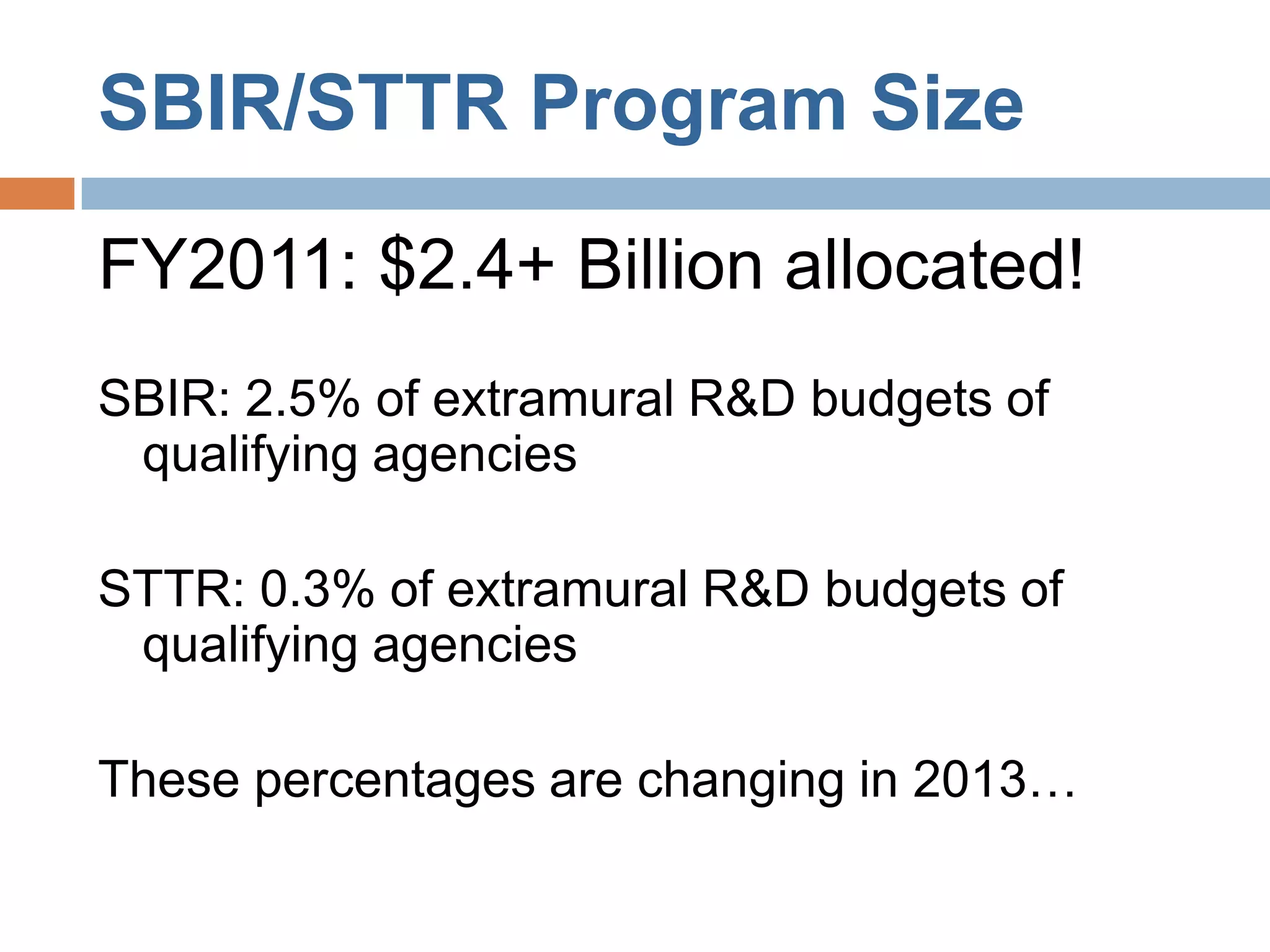
SBIR/STTR Program Size

FY2011: $2.4+ Billion allocated!
SBIR: 2.5% of extramural R&D budgets of
 qualifying agencies

STTR: 0.3% of extramural R&D budgets of
 qualifying agencies

These percentages are changing in 2013…
SBIR funding is accessible to a wide
range of innovators


    Small US-citizen owned company or start-up
     with new IP
    Researcher* with an applied technology but
     no funding to create a prototype
    Inventor with concept funded out of your
     own pocket
 *Restrictions apply
Grants are an overlooked source of
early stage funding

   Federal SBIR/STTR grants to build and test
    innovative new products
   State NYSERDA PONS—energy-related R&D
   TIP, ARPA-e…
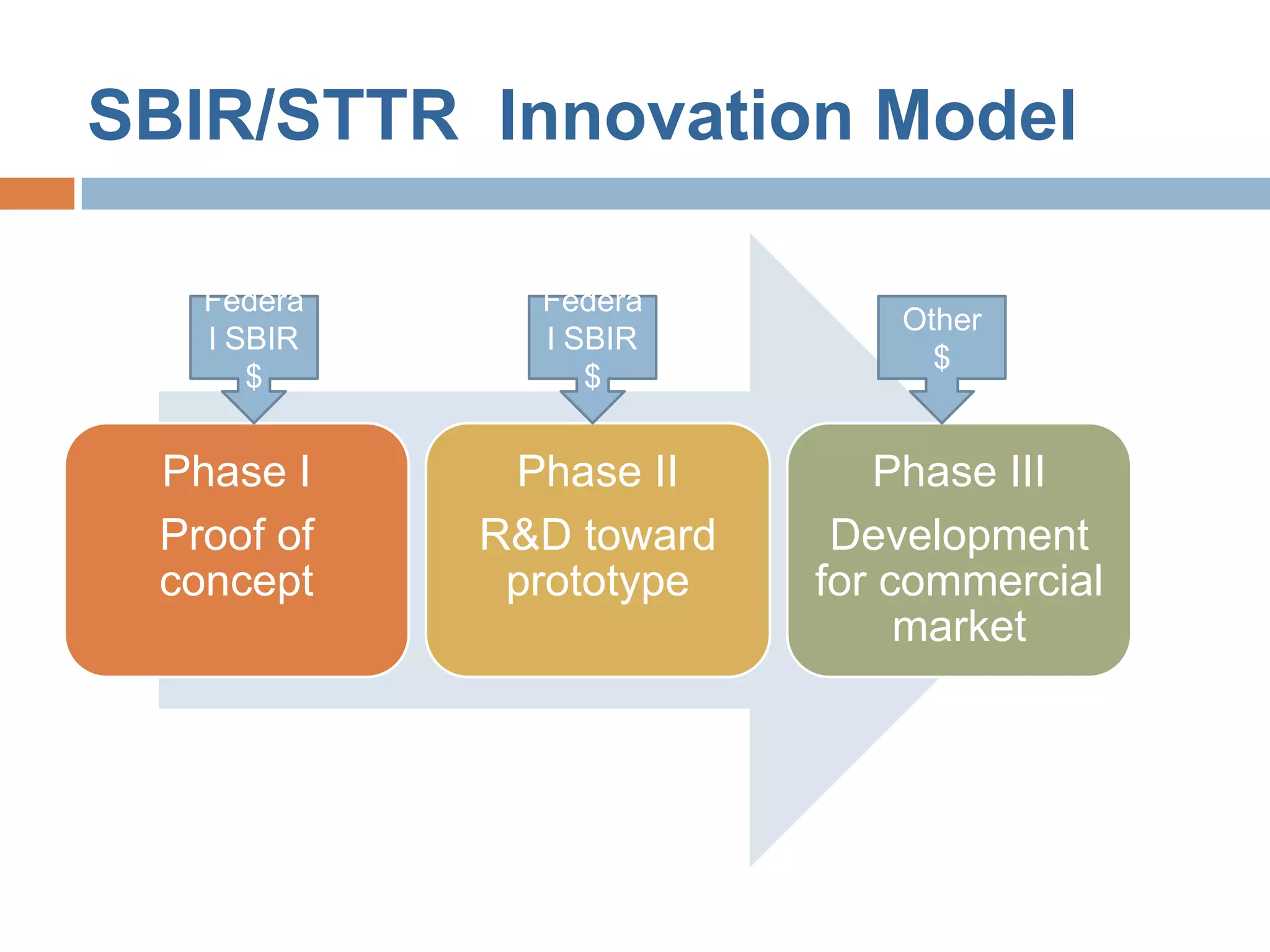
SBIR/STTR Innovation Model

   Federa     Federa
                             Other
   l SBIR     l SBIR
                               $
      $          $


 Phase I     Phase II       Phase III
 Proof of   R&D toward    Development
 concept     prototype   for commercial
                              market
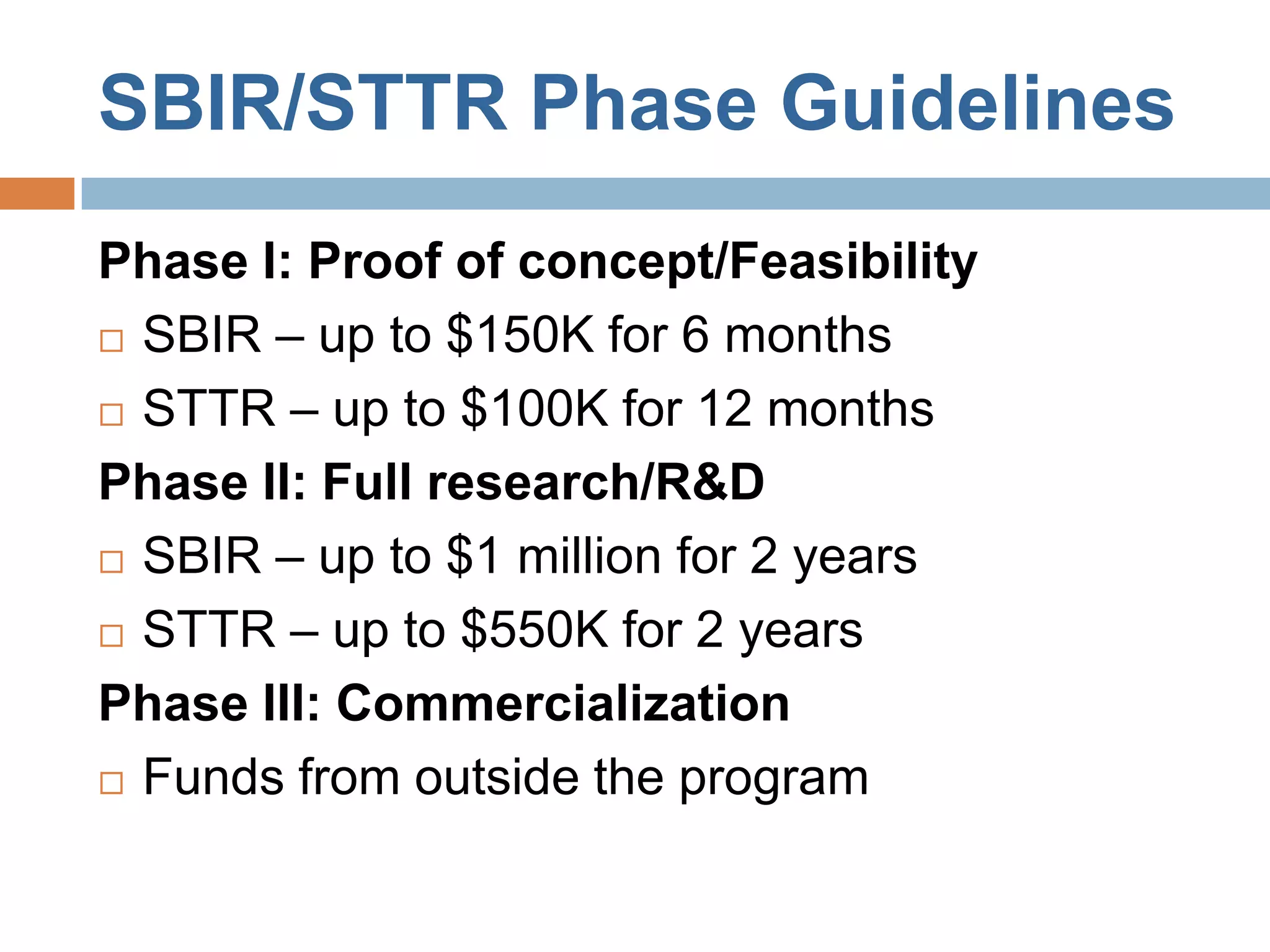
SBIR/STTR Phase Guidelines
Phase I: Proof of concept/Feasibility
 SBIR – up to $150K for 6 months

 STTR – up to $100K for 12 months

Phase II: Full research/R&D
 SBIR – up to $1 million for 2 years

 STTR – up to $550K for 2 years

Phase III: Commercialization
 Funds from outside the program
SBIR Innovation

The SBIR program provides small
 businesses the opportunity to
 propose innovative ideas that
 meet federal R&D needs.
STTR—Partnership Required
The STTR (Small Business
Technology Transfer) Program is
SBIR’s sister program, encouraging
cooperative R&D between small
businesses and research
institutions.
SBIR/STTR allows you to test the
feasibility of ideas with commercial
potential
   Congress has mandated that agencies with
    significant external R&D budgets reserve a
    percentage for SBIR and STTR
   SBIR permits research institution partners
   STTR requires research institution partners
SBIR provides funding for high-risk R&D
and enables you to prove your concept


    First level of investment
    Verification of your innovative technology
    Peer-reviewed
    Reduces technological risk for investors
     (angels/VCs will NOT fund R&D)
    Has grown increasingly competitive
SBIR builds value in your business
for the owners of your business

    Not dilutive like equity investment
    No future debt accrued
    Inventors retain 100% intellectual property
     and commercialization rights
    Licensing and royalties=future revenue
     streams
SBIR and STTR fund direct project
    work in several areas


   Exploitation of scientific breakthroughs
   Innovative use of emerging technologies
   New application or major improvements to
    existing technologies
   Commoditized technology won’t be accepted
Eleven agencies host SBIR
programs, and six host STTR
programs

   Agriculture
   Commerce
   Defense - also STTR
   Education
   Energy - also STTR
   EPA
   Health and Human Services -
     National Institutes of Health - also STTR
     Health Care Financing Administration
   Homeland Security
   Transportation
   National Aeronautics and Space Administration - also STTR
   National Science Foundation - also STTR
SBIR/STTR Eligibility


   For-profit firm with fewer than 500 employees
   US-owned and independently operated
   Not dominant in the proposed field of operation
   PI employed by the business over 50% time (no
    other organization can claim them as FTE)
     For   SBIR; STTR depends upon the agency
   Research direction must be controlled by the
    SBIR grantee
Start with a multi-agency search
    Using search portals, identify the
    topics that relate to your company’s
    R&D interests by keyword.

 www.zyn.com/sbir/
   (newsletter also)
 www.sbir.gov
Next step—do your homework
   The second step is to review solicitation
    information for the opportunities you have
    selected
   Pre-solicitation announcements
   Guidelines
     Requirements  - technical and personnel
     Award amounts

     Application and submission details

   Research funded in the past
   Be careful about ‘sample’ or ‘model’ proposals
Third step—contact the agency

   Learn why the agency is funding your topic
   Research each agency to understand their
    mission and culture
   Be sure you understand release date
    communications blackouts
   Research previous awards made in your
    category
Be tactical: you have to plan to
win


   Have a clear vision of your first customer
   Leverage federal and state resources
   Leverage relationships with outside
    organizations
   Consider the use of subject-matter experts
   Leverage personal resources
   Ask for letters from potential customers
You must be prepared to sell the
value of your idea

   An investor is an investor
   Evaluate how you fit the funder’s needs
   Understand the funder’s motives and values
   Be able to articulate how your approach is
    different from competing technologies
   Show that you know your market
The proposal will require more than
‘filling out a form’—write for your
reader!

   Proposal quality is key
   The text should be engaging and easy to
    read, but avoid marketing-speak
   Don’t make the reader dig for information;
    highlight key points
   Use pictures, tables and figures
Deal-breakers for your proposal…


   Unclear writing, including ESL issues—get
    readers!
   Failure to demonstrate your ability to
    commercialize (Bigger issue than ever!)
   Lack of a truly qualified Principal Investigator.
   Application errors like wrong checkboxes!
   No clear difference from the herd.
   Not a ‘real business’ with a physical home
    (esp. NIH).
Let’s talk about reauthorization…

   SIX MORE YEARS!! This is such great news,
    but…
   SBA went through through MILES of
    legislation to give the agencies the ground
    rules going forward.
     SBA   SBIR Policy Directive
   Tough new guidelines are unfolding
   Don’t go it alone—nobody should pretend that
    the new landscape is simple for companies to
    understand .
   Read everything twice—the rules are shifting.
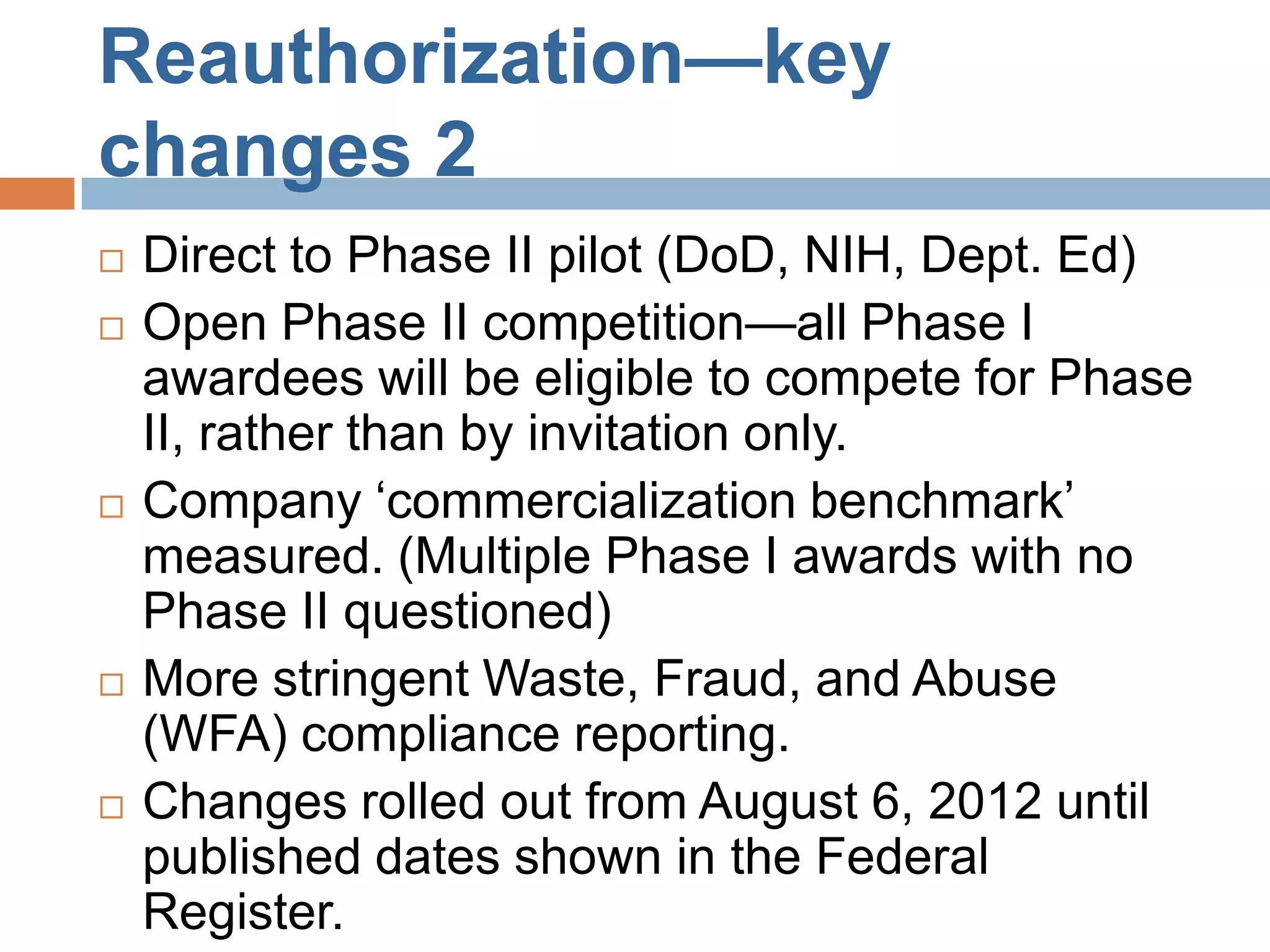
Reauthorization—key
changes 1
   Set-aside percentages will increase gradually.
   Agencies may be able to add more support
    and technical assistance to
    applicants/awardees.
   Venture Capital majority-owned companies
    can play, but details expected early 2013.
   Companies will be required to register with
    www.sbir.gov
   Possibility of cross-program and cross-agency
    awards
Reauthorization—key
changes 2
   Direct to Phase II pilot (DoD, NIH, Dept. Ed)
   Open Phase II competition—all Phase I
    awardees will be eligible to compete for Phase
    II, rather than by invitation only.
   Company ‘commercialization benchmark’
    measured. (Multiple Phase I awards with no
    Phase II questioned)
   More stringent Waste, Fraud, and Abuse
    (WFA) compliance reporting.
   Changes rolled out from August 6, 2012 until
    published dates shown in the Federal
    Register.
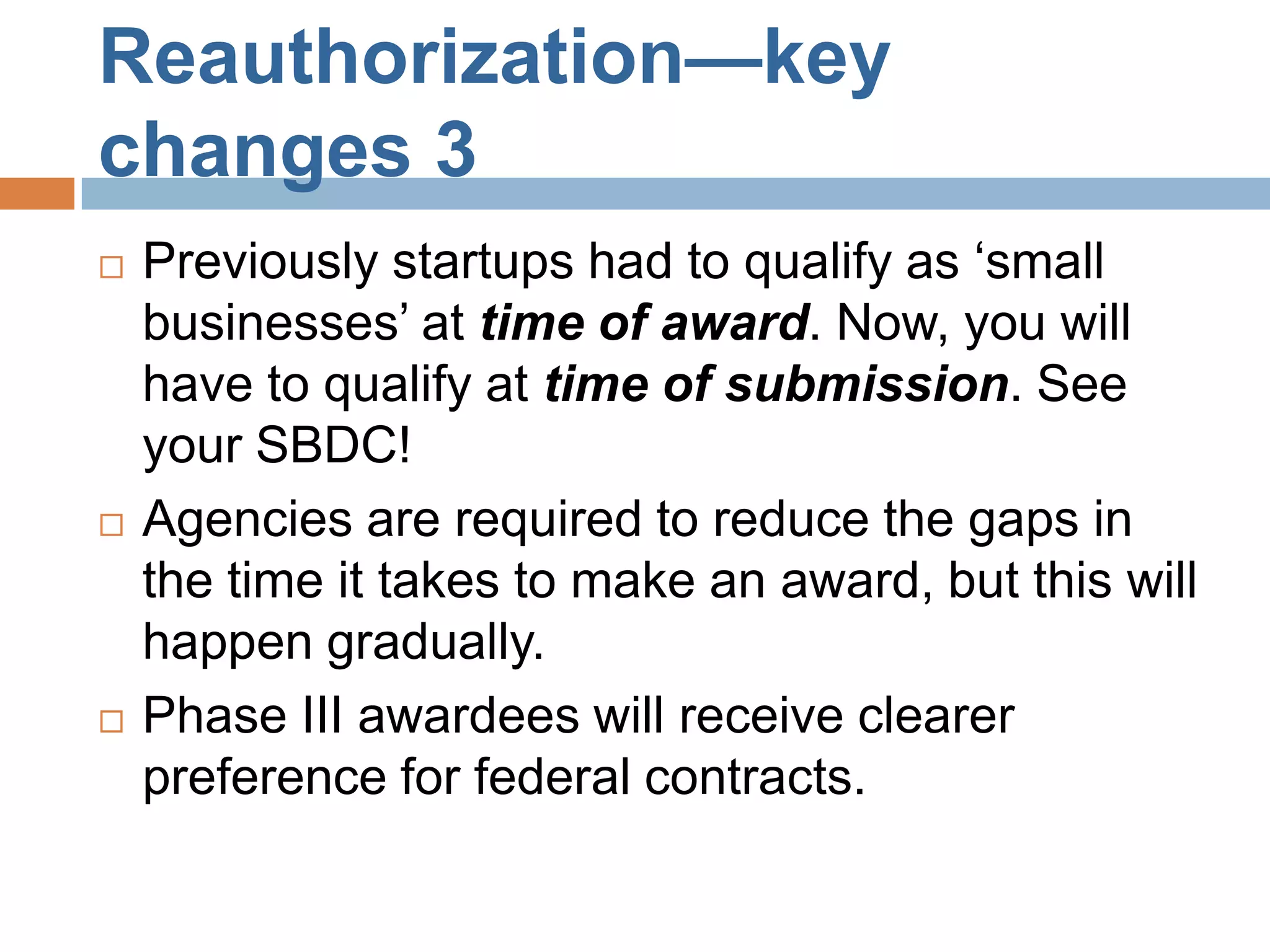
Reauthorization—key
changes 3
   Previously startups had to qualify as ‘small
    businesses’ at time of award. Now, you will
    have to qualify at time of submission. See
    your SBDC!
   Agencies are required to reduce the gaps in
    the time it takes to make an award, but this will
    happen gradually.
   Phase III awardees will receive clearer
    preference for federal contracts.
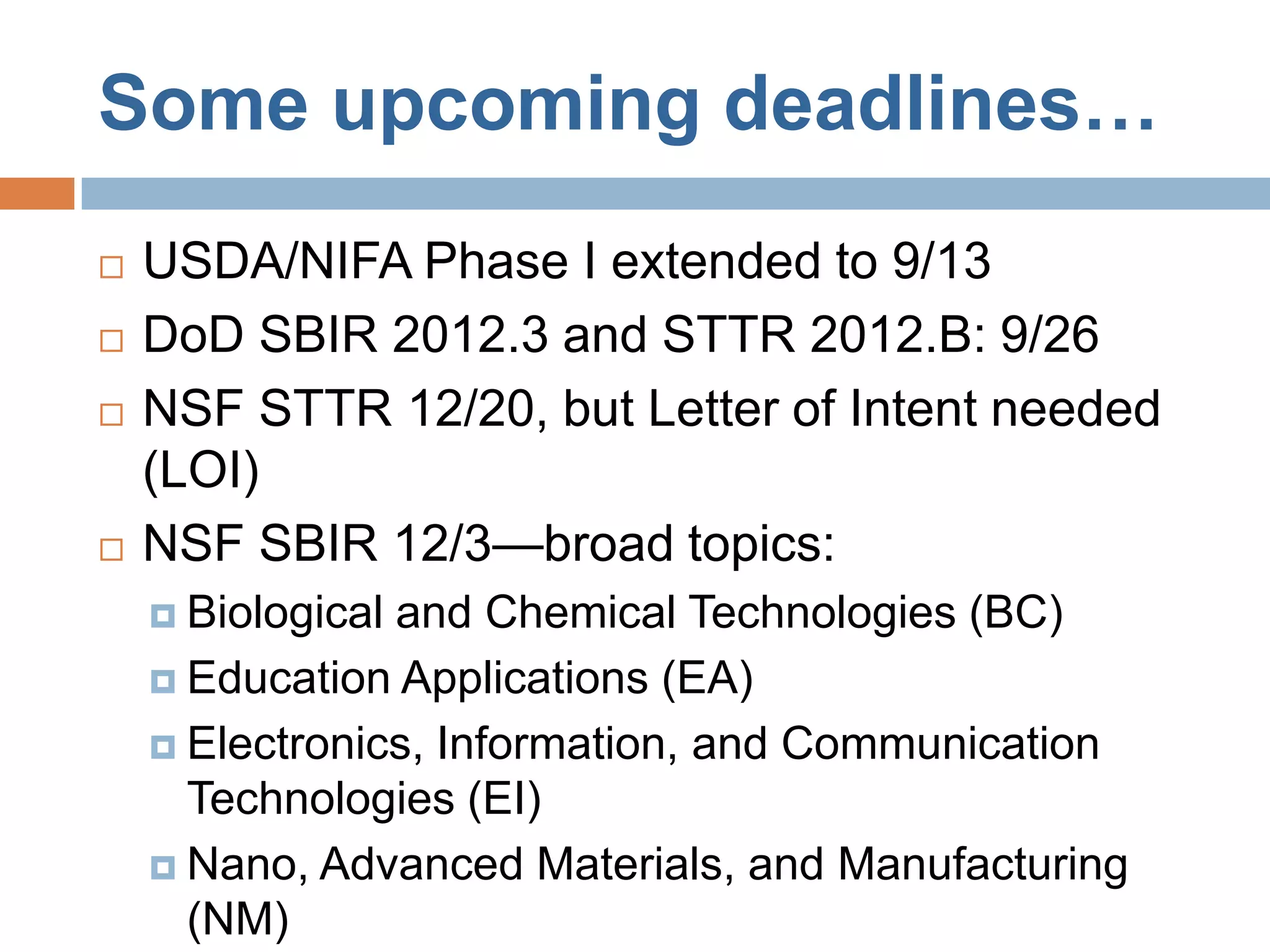
Some upcoming deadlines…
   USDA/NIFA Phase I extended to 9/13
   DoD SBIR 2012.3 and STTR 2012.B: 9/26
   NSF STTR 12/20, but Letter of Intent needed
    (LOI)
   NSF SBIR 12/3—broad topics:
     Biologicaland Chemical Technologies (BC)
     Education Applications (EA)

     Electronics, Information, and Communication
      Technologies (EI)
     Nano, Advanced Materials, and Manufacturing
      (NM)
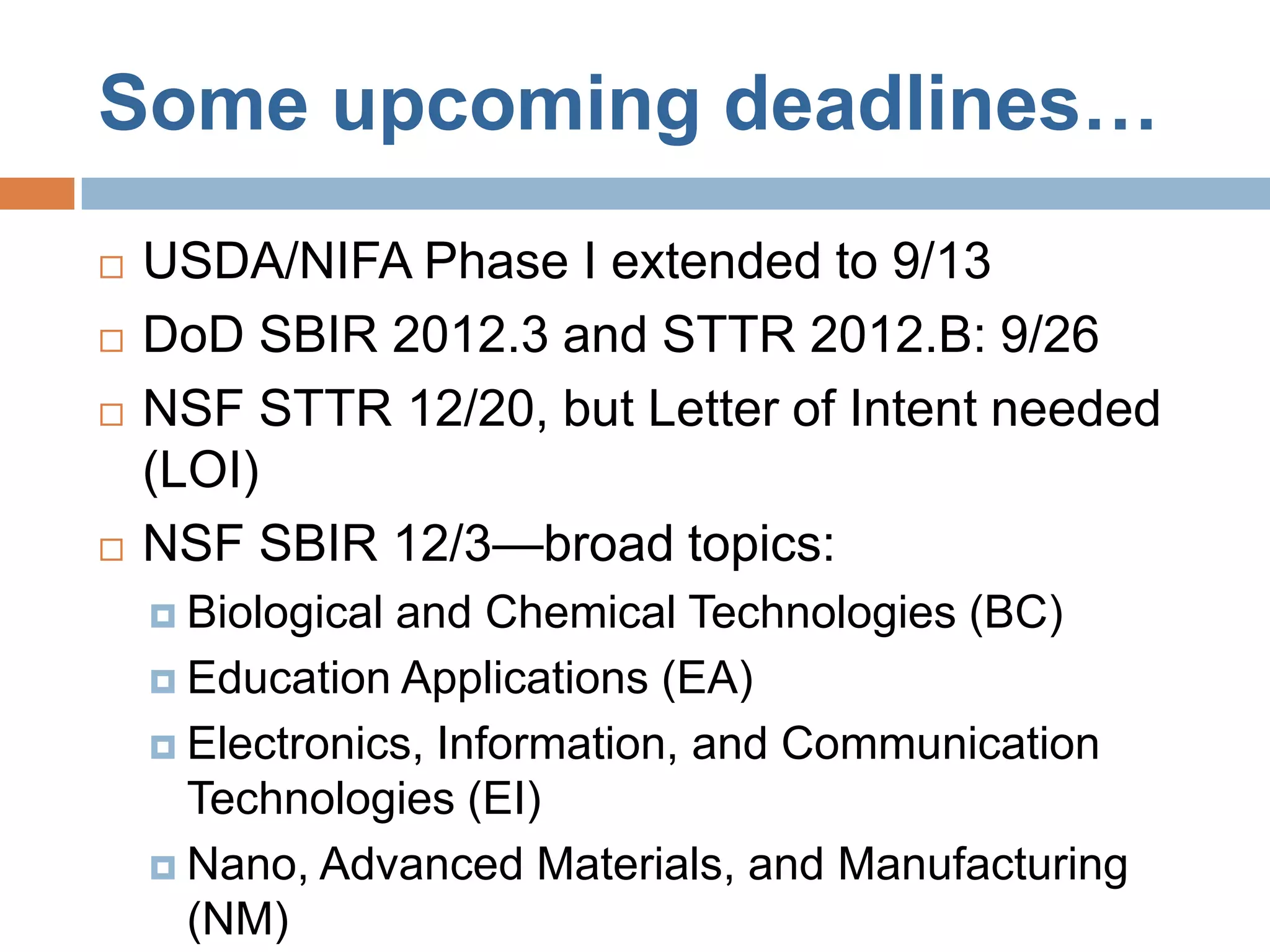
Some upcoming deadlines…
   USDA/NIFA Phase I extended to 9/13
   DoD SBIR 2012.3 and STTR 2012.B: 9/26
   NSF STTR 12/20, but Letter of Intent needed
    (LOI)
   NSF SBIR 12/3—broad topics:
     Biologicaland Chemical Technologies (BC)
     Education Applications (EA)

     Electronics, Information, and Communication
      Technologies (EI)
     Nano, Advanced Materials, and Manufacturing
      (NM)
New York State SBIR
Outreach
   10 Regional Technology Development Centers
    (RTDCs) in NY State
     These centers are members of the NIST-funded
      Manufacturing Extension Partnership network for
      New York State, NYMEP. NYMEP is coordinated by
      NYSTAR.
     Three SBIR/STTR regional specialists cover 10
      regions.
   New York State has provided SBIR outreach
    since 1988 through NYSTAR, now under Empire
    State Development.
NYS SBIR specialists can lead you
through the SBIR/STTR maze

We can:
   Help you find the right opportunity
   Match you with a research lab partner

   Match you with a small business

   Advise you on proposal strategy

   Read your proposal with comments

We can’t:
     Write the proposal for you
THANK YOU, AND FEEL FREE TO
CONTACT ME WITH ANY
QUESTIONS
Colleen Gibney
SBIR Program Director
Technology Consultant
 ITAC

CGibney@ITAC.org


Presentation content credit and special thanks to:
Marcene Sonneborn, CNY-TDO, SBIR Specialist

SBIR: Get Started, Get Funded

  • 1.
  • 2.
    SBIR/STTR Mission Supporting scientificexcellence and technological innovation through the investment of Federal research funds in critical American priorities to build a strong national economy one small business at a time.
  • 3.
    SBIR/STTR Program Size FY2011:$2.4+ Billion allocated! SBIR: 2.5% of extramural R&D budgets of qualifying agencies STTR: 0.3% of extramural R&D budgets of qualifying agencies These percentages are changing in 2013…
  • 4.
    SBIR funding isaccessible to a wide range of innovators  Small US-citizen owned company or start-up with new IP  Researcher* with an applied technology but no funding to create a prototype  Inventor with concept funded out of your own pocket *Restrictions apply
  • 5.
    Grants are anoverlooked source of early stage funding  Federal SBIR/STTR grants to build and test innovative new products  State NYSERDA PONS—energy-related R&D  TIP, ARPA-e…
  • 6.
    SBIR/STTR Innovation Model Federa Federa Other l SBIR l SBIR $ $ $ Phase I Phase II Phase III Proof of R&D toward Development concept prototype for commercial market
  • 7.
    SBIR/STTR Phase Guidelines PhaseI: Proof of concept/Feasibility  SBIR – up to $150K for 6 months  STTR – up to $100K for 12 months Phase II: Full research/R&D  SBIR – up to $1 million for 2 years  STTR – up to $550K for 2 years Phase III: Commercialization  Funds from outside the program
  • 8.
    SBIR Innovation The SBIRprogram provides small businesses the opportunity to propose innovative ideas that meet federal R&D needs.
  • 9.
    STTR—Partnership Required The STTR(Small Business Technology Transfer) Program is SBIR’s sister program, encouraging cooperative R&D between small businesses and research institutions.
  • 10.
    SBIR/STTR allows youto test the feasibility of ideas with commercial potential  Congress has mandated that agencies with significant external R&D budgets reserve a percentage for SBIR and STTR  SBIR permits research institution partners  STTR requires research institution partners
  • 11.
    SBIR provides fundingfor high-risk R&D and enables you to prove your concept  First level of investment  Verification of your innovative technology  Peer-reviewed  Reduces technological risk for investors (angels/VCs will NOT fund R&D)  Has grown increasingly competitive
  • 12.
    SBIR builds valuein your business for the owners of your business  Not dilutive like equity investment  No future debt accrued  Inventors retain 100% intellectual property and commercialization rights  Licensing and royalties=future revenue streams
  • 13.
    SBIR and STTRfund direct project work in several areas  Exploitation of scientific breakthroughs  Innovative use of emerging technologies  New application or major improvements to existing technologies  Commoditized technology won’t be accepted
  • 14.
    Eleven agencies hostSBIR programs, and six host STTR programs  Agriculture  Commerce  Defense - also STTR  Education  Energy - also STTR  EPA  Health and Human Services -  National Institutes of Health - also STTR  Health Care Financing Administration  Homeland Security  Transportation  National Aeronautics and Space Administration - also STTR  National Science Foundation - also STTR
  • 15.
    SBIR/STTR Eligibility  For-profit firm with fewer than 500 employees  US-owned and independently operated  Not dominant in the proposed field of operation  PI employed by the business over 50% time (no other organization can claim them as FTE)  For SBIR; STTR depends upon the agency  Research direction must be controlled by the SBIR grantee
  • 16.
    Start with amulti-agency search Using search portals, identify the topics that relate to your company’s R&D interests by keyword.  www.zyn.com/sbir/  (newsletter also)  www.sbir.gov
  • 17.
    Next step—do yourhomework  The second step is to review solicitation information for the opportunities you have selected  Pre-solicitation announcements  Guidelines  Requirements - technical and personnel  Award amounts  Application and submission details  Research funded in the past  Be careful about ‘sample’ or ‘model’ proposals
  • 18.
    Third step—contact theagency  Learn why the agency is funding your topic  Research each agency to understand their mission and culture  Be sure you understand release date communications blackouts  Research previous awards made in your category
  • 19.
    Be tactical: youhave to plan to win  Have a clear vision of your first customer  Leverage federal and state resources  Leverage relationships with outside organizations  Consider the use of subject-matter experts  Leverage personal resources  Ask for letters from potential customers
  • 20.
    You must beprepared to sell the value of your idea  An investor is an investor  Evaluate how you fit the funder’s needs  Understand the funder’s motives and values  Be able to articulate how your approach is different from competing technologies  Show that you know your market
  • 21.
    The proposal willrequire more than ‘filling out a form’—write for your reader!  Proposal quality is key  The text should be engaging and easy to read, but avoid marketing-speak  Don’t make the reader dig for information; highlight key points  Use pictures, tables and figures
  • 22.
    Deal-breakers for yourproposal…  Unclear writing, including ESL issues—get readers!  Failure to demonstrate your ability to commercialize (Bigger issue than ever!)  Lack of a truly qualified Principal Investigator.  Application errors like wrong checkboxes!  No clear difference from the herd.  Not a ‘real business’ with a physical home (esp. NIH).
  • 23.
    Let’s talk aboutreauthorization…  SIX MORE YEARS!! This is such great news, but…  SBA went through through MILES of legislation to give the agencies the ground rules going forward.  SBA SBIR Policy Directive  Tough new guidelines are unfolding  Don’t go it alone—nobody should pretend that the new landscape is simple for companies to understand .  Read everything twice—the rules are shifting.
  • 24.
    Reauthorization—key changes 1  Set-aside percentages will increase gradually.  Agencies may be able to add more support and technical assistance to applicants/awardees.  Venture Capital majority-owned companies can play, but details expected early 2013.  Companies will be required to register with www.sbir.gov  Possibility of cross-program and cross-agency awards
  • 25.
    Reauthorization—key changes 2  Direct to Phase II pilot (DoD, NIH, Dept. Ed)  Open Phase II competition—all Phase I awardees will be eligible to compete for Phase II, rather than by invitation only.  Company ‘commercialization benchmark’ measured. (Multiple Phase I awards with no Phase II questioned)  More stringent Waste, Fraud, and Abuse (WFA) compliance reporting.  Changes rolled out from August 6, 2012 until published dates shown in the Federal Register.
  • 26.
    Reauthorization—key changes 3  Previously startups had to qualify as ‘small businesses’ at time of award. Now, you will have to qualify at time of submission. See your SBDC!  Agencies are required to reduce the gaps in the time it takes to make an award, but this will happen gradually.  Phase III awardees will receive clearer preference for federal contracts.
  • 27.
    Some upcoming deadlines…  USDA/NIFA Phase I extended to 9/13  DoD SBIR 2012.3 and STTR 2012.B: 9/26  NSF STTR 12/20, but Letter of Intent needed (LOI)  NSF SBIR 12/3—broad topics:  Biologicaland Chemical Technologies (BC)  Education Applications (EA)  Electronics, Information, and Communication Technologies (EI)  Nano, Advanced Materials, and Manufacturing (NM)
  • 28.
    Some upcoming deadlines…  USDA/NIFA Phase I extended to 9/13  DoD SBIR 2012.3 and STTR 2012.B: 9/26  NSF STTR 12/20, but Letter of Intent needed (LOI)  NSF SBIR 12/3—broad topics:  Biologicaland Chemical Technologies (BC)  Education Applications (EA)  Electronics, Information, and Communication Technologies (EI)  Nano, Advanced Materials, and Manufacturing (NM)
  • 29.
    New York StateSBIR Outreach  10 Regional Technology Development Centers (RTDCs) in NY State  These centers are members of the NIST-funded Manufacturing Extension Partnership network for New York State, NYMEP. NYMEP is coordinated by NYSTAR.  Three SBIR/STTR regional specialists cover 10 regions.  New York State has provided SBIR outreach since 1988 through NYSTAR, now under Empire State Development.
  • 30.
    NYS SBIR specialistscan lead you through the SBIR/STTR maze We can:  Help you find the right opportunity  Match you with a research lab partner  Match you with a small business  Advise you on proposal strategy  Read your proposal with comments We can’t:  Write the proposal for you
  • 31.
    THANK YOU, ANDFEEL FREE TO CONTACT ME WITH ANY QUESTIONS Colleen Gibney SBIR Program Director Technology Consultant ITAC CGibney@ITAC.org Presentation content credit and special thanks to: Marcene Sonneborn, CNY-TDO, SBIR Specialist