SBIR 101:
Funding Critical Innovations
SBIR funding is accessible to a
wide range of innovators
 • Small US-citizen owned company or
   start-up with new IP
 • Researcher* with an applied technology
   but no funding to create a prototype
 • Inventor with concept funded out of your
   own pocket
 *Restrictions apply
Grants are an overlooked source of
early stage funding


• Federal SBIR/STTR grants to build and
  test innovative new products
• State NYSERDA grants—energy-related
• TIP, ARPA-e…
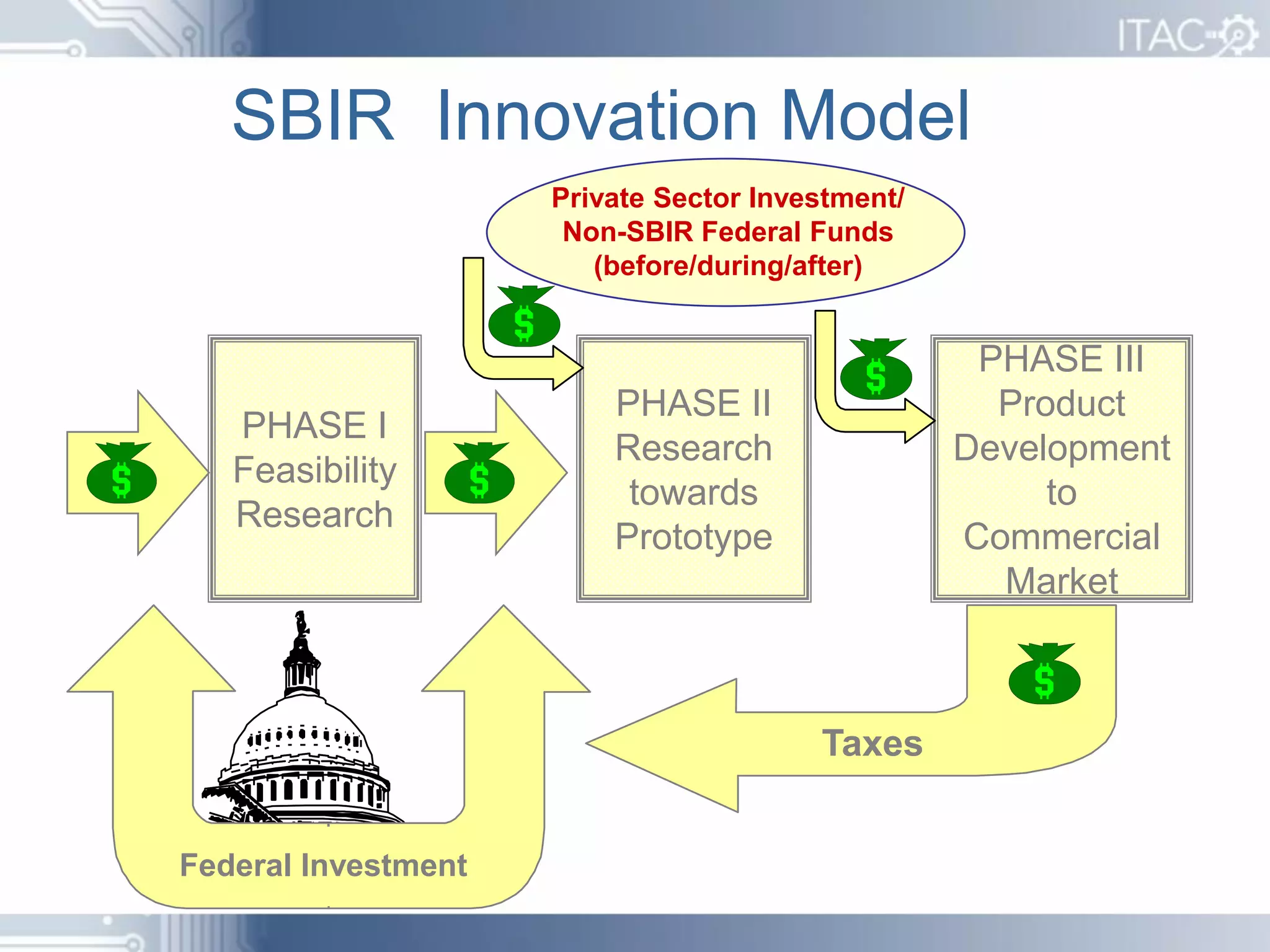
SBIR Innovation Model
                     Private Sector Investment/
                      Non-SBIR Federal Funds
                        (before/during/after)


                                                   PHASE III
                         PHASE II                   Product
   PHASE I
                         Research                 Development
   Feasibility
                          towards                      to
   Research
                         Prototype                Commercial
                                                    Market


                                        Taxes


Federal Investment
The SBIR program provides small
businesses the opportunity to
propose innovative ideas that
meet federal R&D needs
•   Small Business Innovation Research
•   Highly competitive
•   Three-phase award system
•   The Government is your customer for now
The STTR program is SBIR’s sister
program, encouraging cooperative
R&D between small businesses
and research institutions
• Small Business Technology Transfer
 Program
• Works like SBIR, but a research partner is
 required
Both SBIR and STTR allow you to
test the feasibility of ideas with
commercial potential
• Congress has mandated that agencies
  with significant external R&D budgets
  reserve a percentage for SBIR and STTR
• SBIR permits research institution partners
• STTR requires research institution
  partners
SBIR provides funding for high-risk
R&D and enables you to prove your
concept
 • First level of investment
 • Verification of your innovative technology
 • Peer-reviewed
 • Reduces technological risk for investors
   (angels/VCs will NOT fund R&D)
 • Has grown increasingly competitive
 • Under a CR; rules may change in 2011
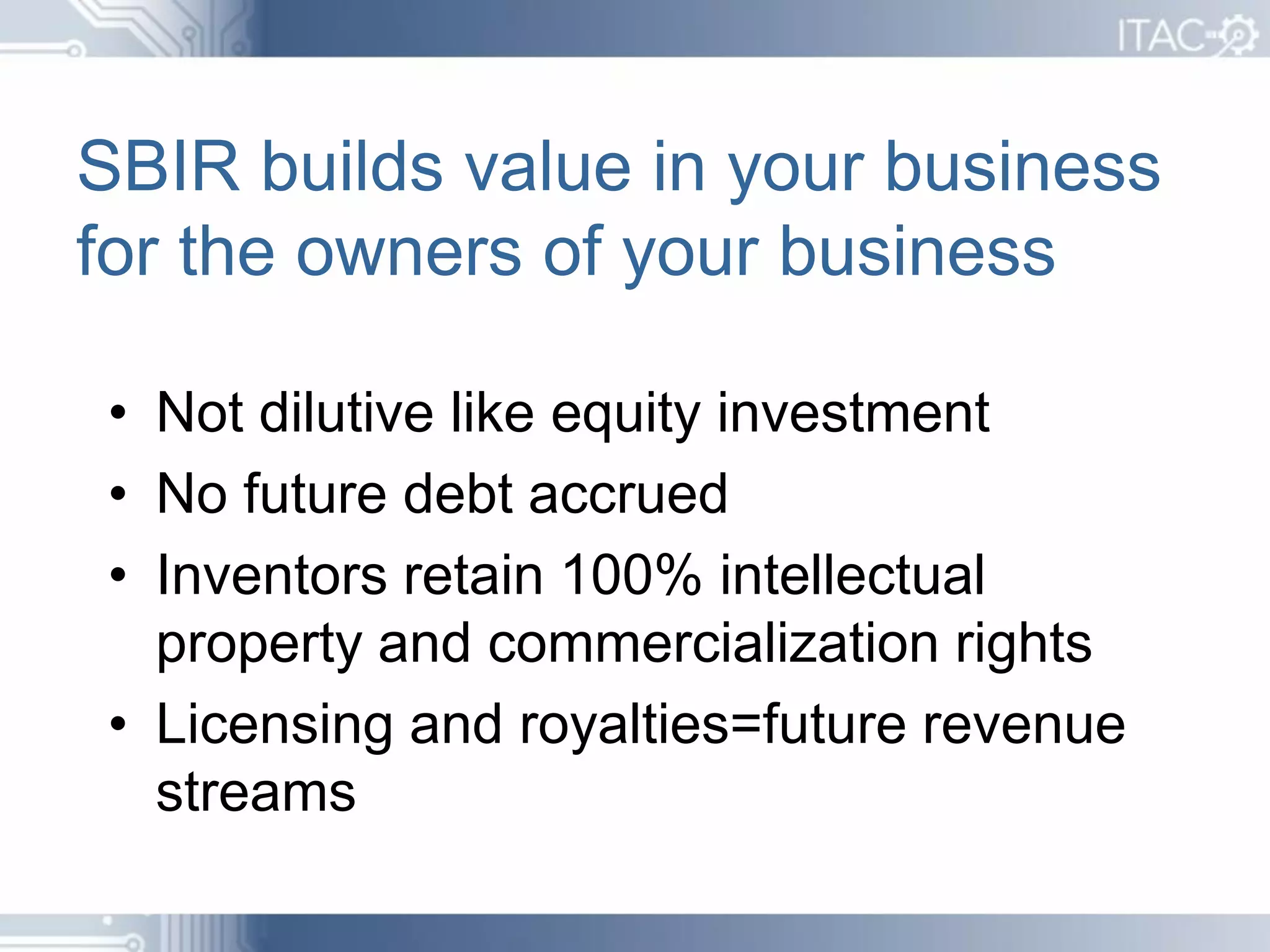
SBIR builds value in your business
for the owners of your business

• Not dilutive like equity investment
• No future debt accrued
• Inventors retain 100% intellectual
  property and commercialization rights
• Licensing and royalties=future revenue
  streams
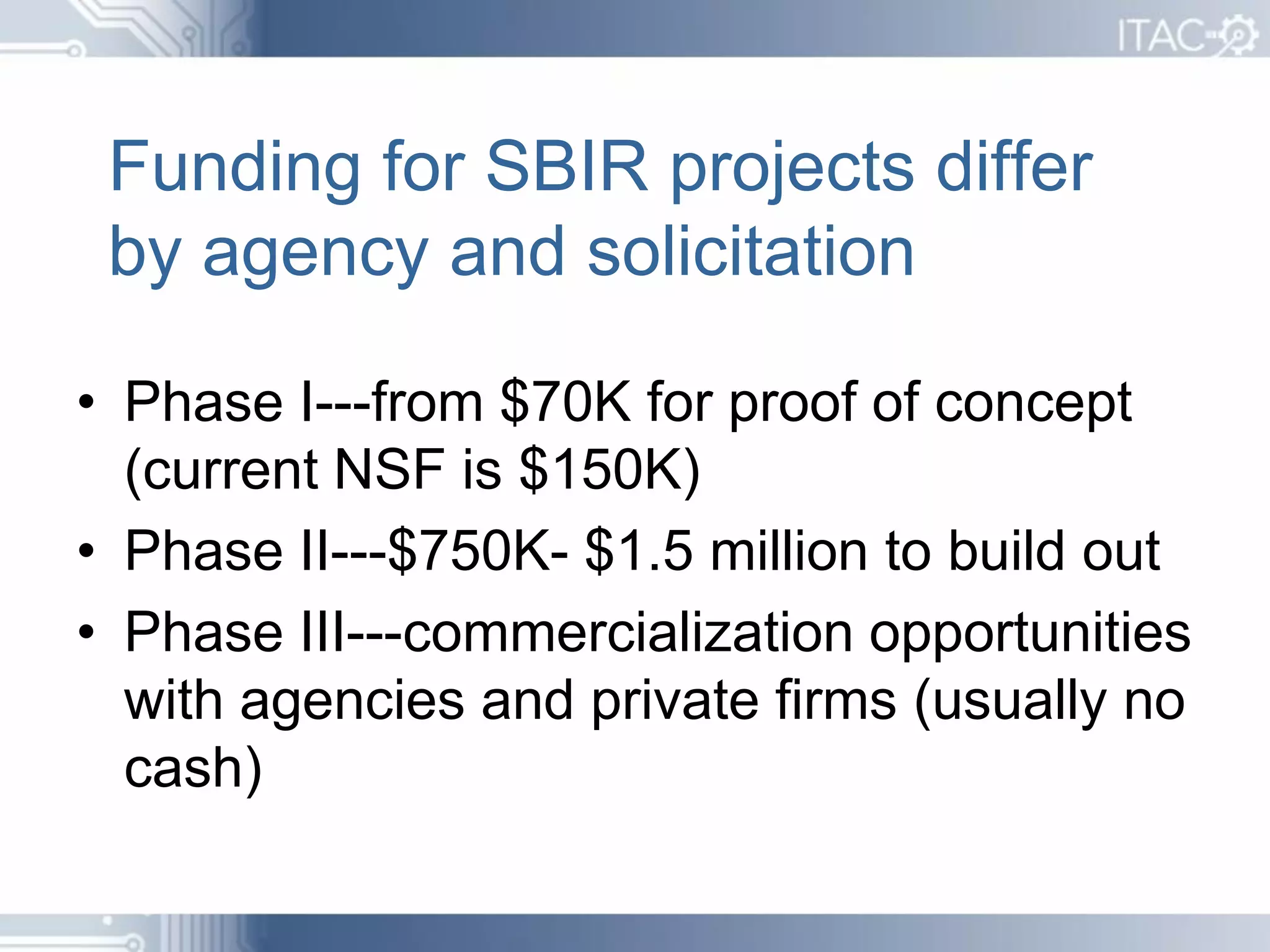
Funding for SBIR projects differ
 by agency and solicitation

• Phase I---from $70K for proof of concept
  (current NSF is $150K)
• Phase II---$750K- $1.5 million to build out
• Phase III---commercialization opportunities
  with agencies and private firms (usually no
  cash)
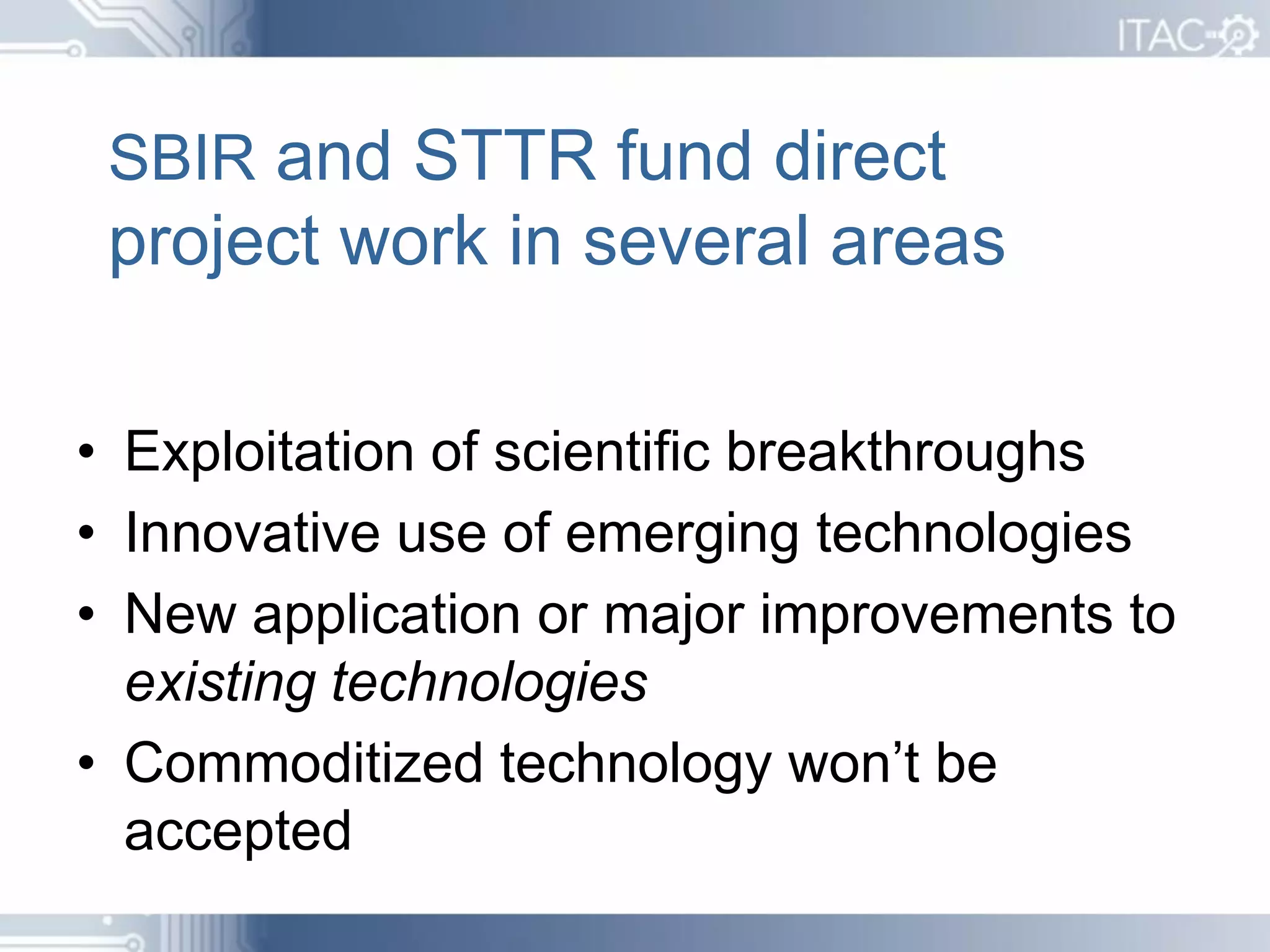
SBIR and STTR fund direct
 project work in several areas

• Exploitation of scientific breakthroughs
• Innovative use of emerging technologies
• New application or major improvements to
  existing technologies
• Commoditized technology won’t be
  accepted
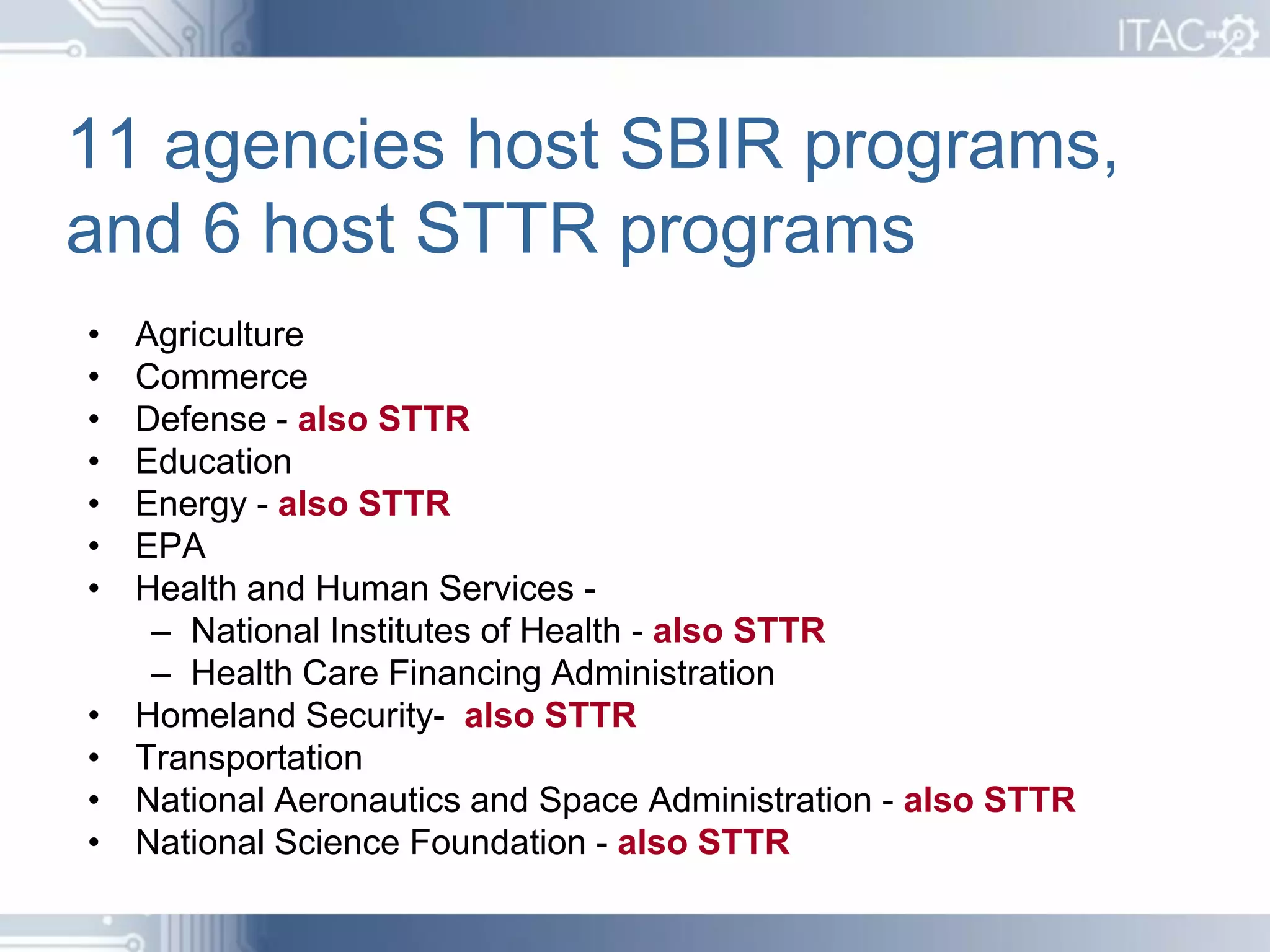
11 agencies host SBIR programs,
and 6 host STTR programs
•   Agriculture
•   Commerce
•   Defense - also STTR
•   Education
•   Energy - also STTR
•   EPA
•   Health and Human Services -
     – National Institutes of Health - also STTR
     – Health Care Financing Administration
•   Homeland Security- also STTR
•   Transportation
•   National Aeronautics and Space Administration - also STTR
•   National Science Foundation - also STTR
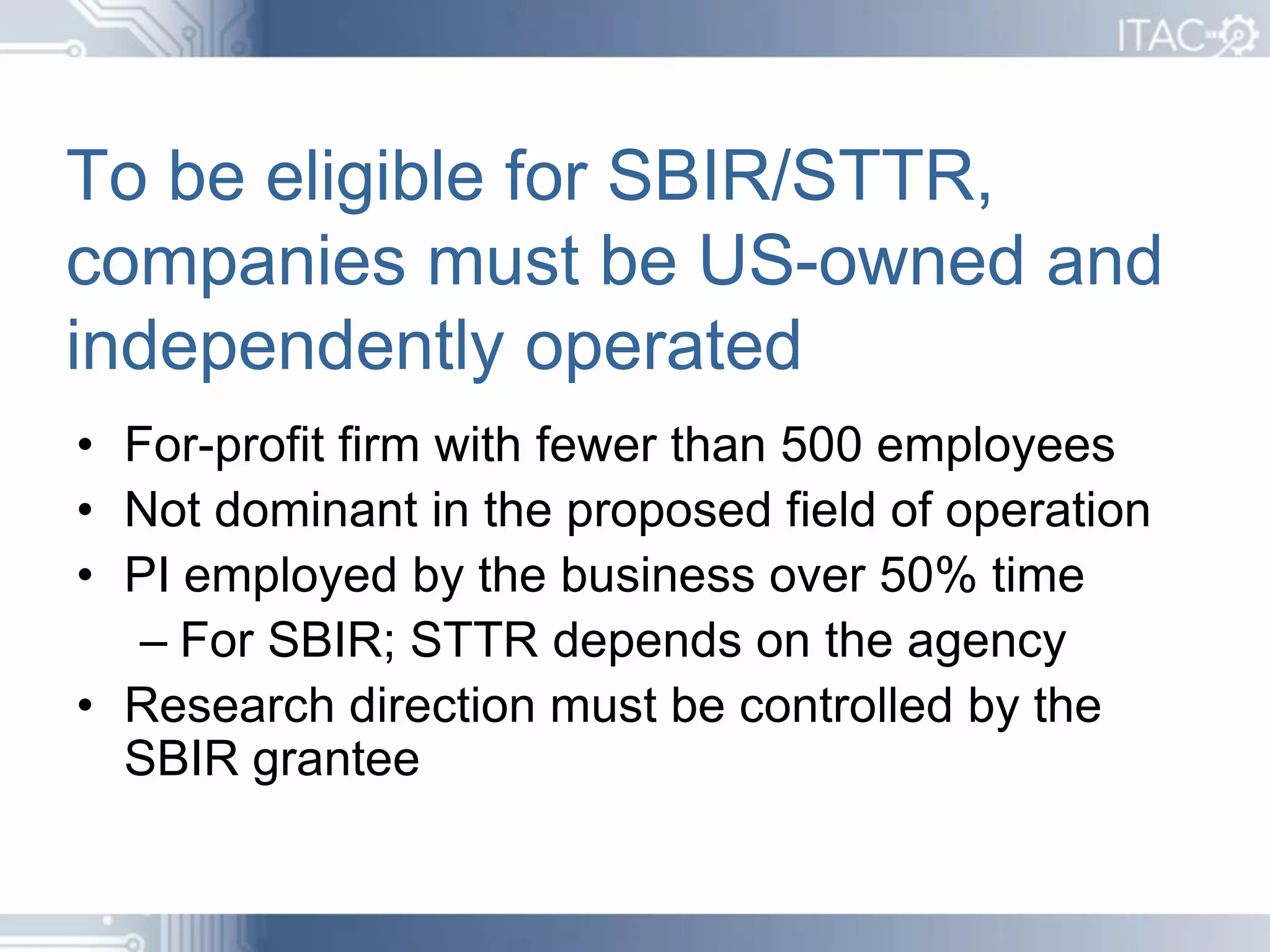
To be eligible for SBIR/STTR,
companies must be US-owned and
independently operated
• For-profit firm with fewer than 500 employees
• Not dominant in the proposed field of operation
• PI employed by the business over 50% time
   – For SBIR; STTR depends on the agency
• Research direction must be controlled by the
  SBIR grantee
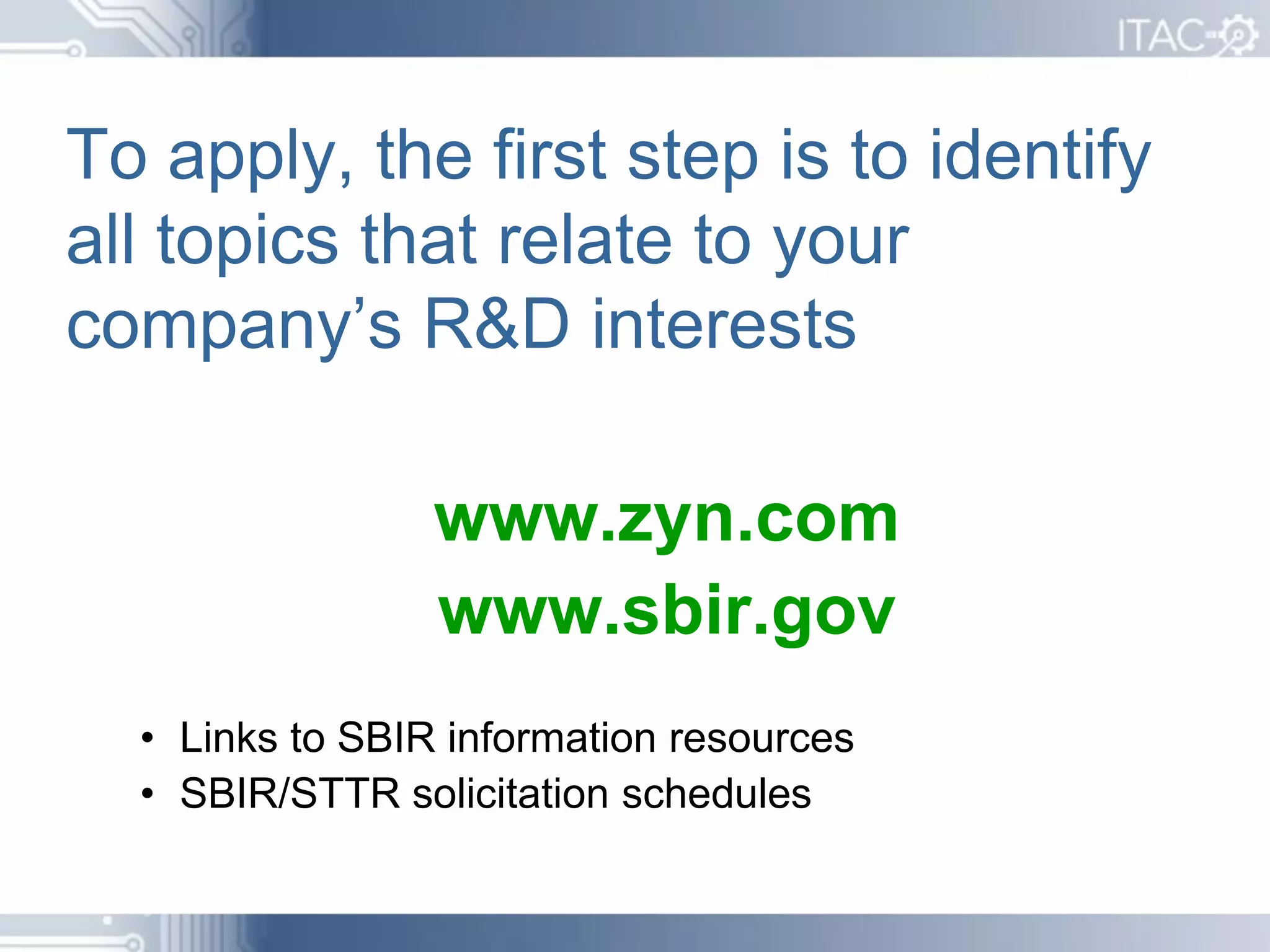
To apply, the first step is to identify
all topics that relate to your
company’s R&D interests

                 www.zyn.com
                 www.sbir.gov
  • Links to SBIR information resources
  • SBIR/STTR solicitation schedules
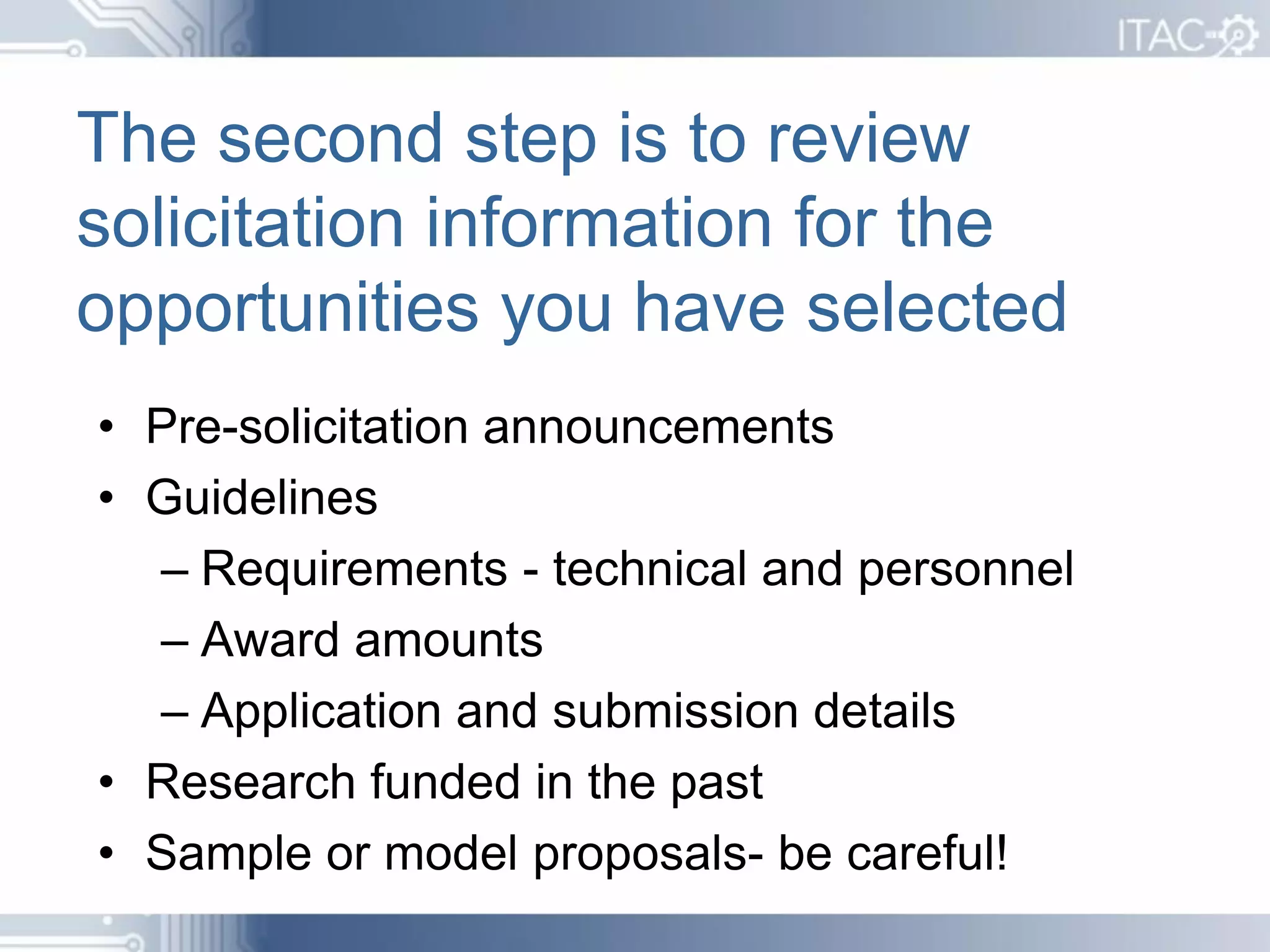
The second step is to review
solicitation information for the
opportunities you have selected
• Pre-solicitation announcements
• Guidelines
  – Requirements - technical and personnel
  – Award amounts
  – Application and submission details
• Research funded in the past
• Sample or model proposals- be careful!
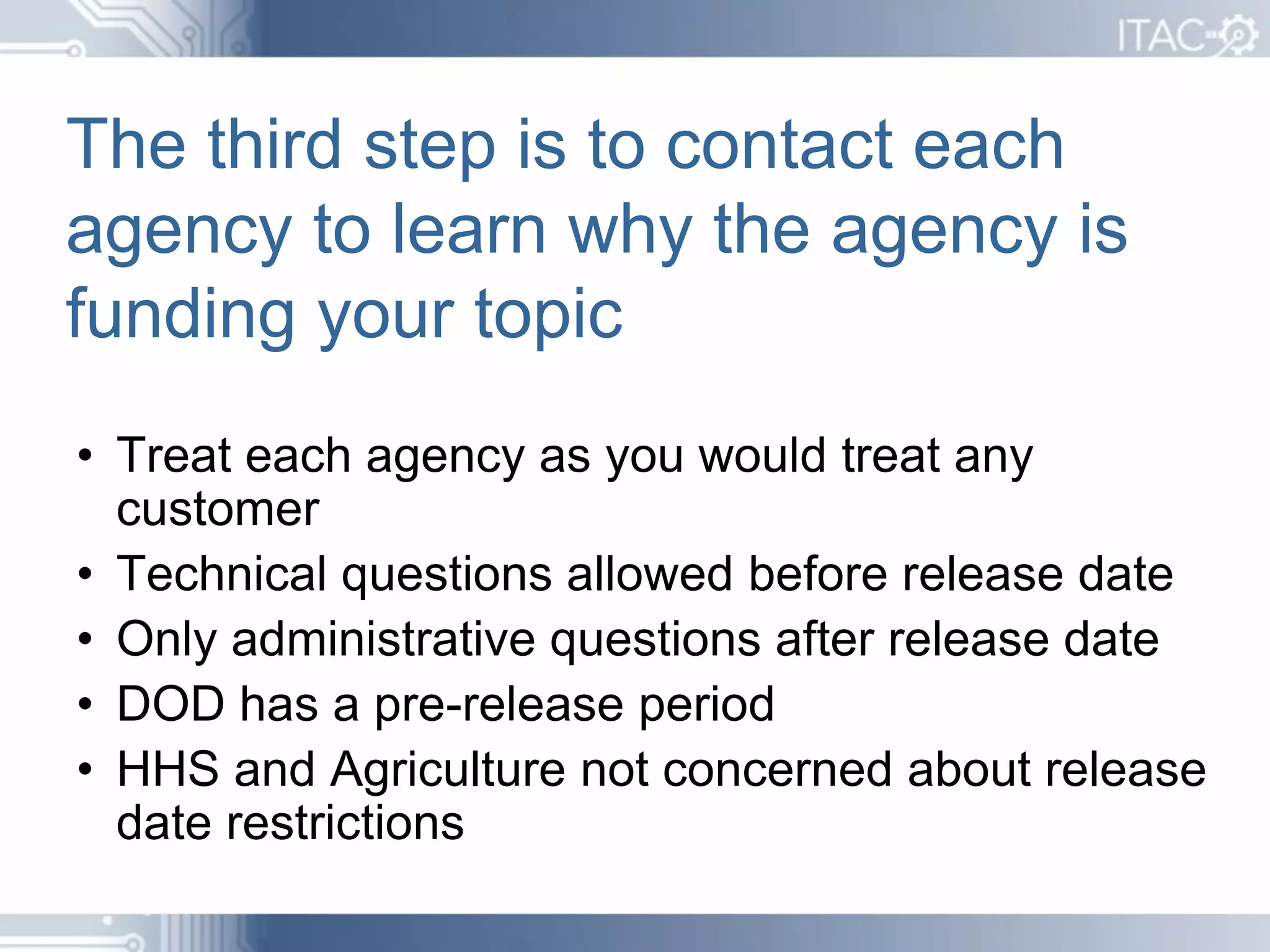
The third step is to contact each
agency to learn why the agency is
funding your topic
• Treat each agency as you would treat any
  customer
• Technical questions allowed before release date
• Only administrative questions after release date
• DOD has a pre-release period
• HHS and Agriculture not concerned about release
  date restrictions
Tactical strategies are necessary to
be competitive – you will need a
plan to win
•   Have a clear vision of the customer
•   Leverage federal and state resources
•   Leverage relationships with outside
    organizations
•   Consider the use of experts
•   Leverage personal resources
•   Ask for letters from potential customers
You must be prepared to sell the
value of your idea
• An investor is an investor
• Evaluate how you fit the funder’s needs
• Understand the funder’s motives and
  values
• Be able to articulate how your approach is
  different from competing technologies
• Show that you know your market
The proposal will require more than
‘filling out a form’—write for your
reader!
• Proposal quality is key
• The text should be engaging and easy to
  read, but avoid marketing-speak
• Don’t make the reader dig for
  information; highlight key points
• Use pictures, tables and figures
ITAC SBIR specialists can lead you
through the SBIR/STTR maze
We can:
• Help you find the right opportunity
• Match you with a research lab partner
• Match you with a small business
• Advise you on proposal strategy
• Read your proposal with comments
We can’t:
• Write the proposal for you
Thank you, and feel free to
contact me with any questions or
for a copy of this presentation
Colleen Gibney
Technology Project Manager
ITAC

 ITAC
 www.ITAC.org
 CGibney@ITAC.org
 212-442-2990

Special thanks to Marcene Sonneborn, TDO

Introduction to sbir program 032510

  • 1.
  • 2.
    SBIR funding isaccessible to a wide range of innovators • Small US-citizen owned company or start-up with new IP • Researcher* with an applied technology but no funding to create a prototype • Inventor with concept funded out of your own pocket *Restrictions apply
  • 3.
    Grants are anoverlooked source of early stage funding • Federal SBIR/STTR grants to build and test innovative new products • State NYSERDA grants—energy-related • TIP, ARPA-e…
  • 4.
    SBIR Innovation Model Private Sector Investment/ Non-SBIR Federal Funds (before/during/after) PHASE III PHASE II Product PHASE I Research Development Feasibility towards to Research Prototype Commercial Market Taxes Federal Investment
  • 5.
    The SBIR programprovides small businesses the opportunity to propose innovative ideas that meet federal R&D needs • Small Business Innovation Research • Highly competitive • Three-phase award system • The Government is your customer for now
  • 6.
    The STTR programis SBIR’s sister program, encouraging cooperative R&D between small businesses and research institutions • Small Business Technology Transfer Program • Works like SBIR, but a research partner is required
  • 7.
    Both SBIR andSTTR allow you to test the feasibility of ideas with commercial potential • Congress has mandated that agencies with significant external R&D budgets reserve a percentage for SBIR and STTR • SBIR permits research institution partners • STTR requires research institution partners
  • 8.
    SBIR provides fundingfor high-risk R&D and enables you to prove your concept • First level of investment • Verification of your innovative technology • Peer-reviewed • Reduces technological risk for investors (angels/VCs will NOT fund R&D) • Has grown increasingly competitive • Under a CR; rules may change in 2011
  • 9.
    SBIR builds valuein your business for the owners of your business • Not dilutive like equity investment • No future debt accrued • Inventors retain 100% intellectual property and commercialization rights • Licensing and royalties=future revenue streams
  • 10.
    Funding for SBIRprojects differ by agency and solicitation • Phase I---from $70K for proof of concept (current NSF is $150K) • Phase II---$750K- $1.5 million to build out • Phase III---commercialization opportunities with agencies and private firms (usually no cash)
  • 11.
    SBIR and STTRfund direct project work in several areas • Exploitation of scientific breakthroughs • Innovative use of emerging technologies • New application or major improvements to existing technologies • Commoditized technology won’t be accepted
  • 12.
    11 agencies hostSBIR programs, and 6 host STTR programs • Agriculture • Commerce • Defense - also STTR • Education • Energy - also STTR • EPA • Health and Human Services - – National Institutes of Health - also STTR – Health Care Financing Administration • Homeland Security- also STTR • Transportation • National Aeronautics and Space Administration - also STTR • National Science Foundation - also STTR
  • 13.
    To be eligiblefor SBIR/STTR, companies must be US-owned and independently operated • For-profit firm with fewer than 500 employees • Not dominant in the proposed field of operation • PI employed by the business over 50% time – For SBIR; STTR depends on the agency • Research direction must be controlled by the SBIR grantee
  • 14.
    To apply, thefirst step is to identify all topics that relate to your company’s R&D interests www.zyn.com www.sbir.gov • Links to SBIR information resources • SBIR/STTR solicitation schedules
  • 15.
    The second stepis to review solicitation information for the opportunities you have selected • Pre-solicitation announcements • Guidelines – Requirements - technical and personnel – Award amounts – Application and submission details • Research funded in the past • Sample or model proposals- be careful!
  • 16.
    The third stepis to contact each agency to learn why the agency is funding your topic • Treat each agency as you would treat any customer • Technical questions allowed before release date • Only administrative questions after release date • DOD has a pre-release period • HHS and Agriculture not concerned about release date restrictions
  • 17.
    Tactical strategies arenecessary to be competitive – you will need a plan to win • Have a clear vision of the customer • Leverage federal and state resources • Leverage relationships with outside organizations • Consider the use of experts • Leverage personal resources • Ask for letters from potential customers
  • 18.
    You must beprepared to sell the value of your idea • An investor is an investor • Evaluate how you fit the funder’s needs • Understand the funder’s motives and values • Be able to articulate how your approach is different from competing technologies • Show that you know your market
  • 19.
    The proposal willrequire more than ‘filling out a form’—write for your reader! • Proposal quality is key • The text should be engaging and easy to read, but avoid marketing-speak • Don’t make the reader dig for information; highlight key points • Use pictures, tables and figures
  • 20.
    ITAC SBIR specialistscan lead you through the SBIR/STTR maze We can: • Help you find the right opportunity • Match you with a research lab partner • Match you with a small business • Advise you on proposal strategy • Read your proposal with comments We can’t: • Write the proposal for you
  • 21.
    Thank you, andfeel free to contact me with any questions or for a copy of this presentation Colleen Gibney Technology Project Manager ITAC ITAC www.ITAC.org CGibney@ITAC.org 212-442-2990 Special thanks to Marcene Sonneborn, TDO