2012 SADBOC Government
    Procurement Fair
            April 25, 2012


  SBIR/STTR Basics
                 Becky Aistrup
         SBIR/STTR Program Director
   Minnesota Science & Technology Authority
    www.PositivelyMinnesota.com/SciTech
   www.mnscienceandtechnologyauthority.org
          becky.aistrup@state.mn.us
               (651) 259-7634
Important Info
The SBIR/STTR programs were reauthorized by Congress & signed by the
President Dec. 2011. The SBA is in the process of recommending how these
changes will be implemented by the agencies, so exact mechanisms &
implementation dates are pending. This presentation is the CURRENT
program, but will be changing during 2012 in these key ways:
•   increasing the SBIR allocation from 2.5 percent to 3.2 percent over several years,
•   increasing the STTR allocation from .3 percent to .45 percent over five years,
•   allowing VC, hedge fund and private equity funded companies to participate to 25
    percent for NIH, DOE, and NSF, and 15 percent for other agencies,
•   raising the award levels, allowing for annual inflation adjustments, limiting jumbo
    awards,
•   increasing small business collaborations with federal laboratories,
•   shortening the time for final decisions and the amount of time between decision
    and release of funds
•   increasing oversight to reduce fraud and abuse, and
•   allowing the agencies to use 3 percent of SBIR funds to administer the SBIR
    program, increase oversight, and provide outreach and application assistance to
    address shortcomings in the low participation of women, minorities and states
    with few awards.
PLEASE CHECK RULES IN EFFECT AT THE TIME OF PROPOSAL SUBMISSION!!
CALL OUR OFFICES IF YOU HAVE QUESTIONS (Becky Aistrup 651-259-7634)
SBIR/STTR Program Descriptions
• SBIR (Small Business Innovation Research):
  • 2.6% set-aside of extramural research budget
    for small businesses to participate in federal
    R&D
  • 11 federal agencies with R&D >$100 million
• STTR (Small Business Technology Transfer):
  • 0.35% set-aside program to facilitate
    cooperative R&D between small businesses and
    non-profit research institutions
  • 5 federal agencies with R&D >$1 billion
• Both focus on commercializable technology,
  not “basic” research
Who qualifies for funding?**
•   Small Business (<500 employees) located in U.S.
•   Established for-profit
•   R&D must be performed in the U.S.
•   Company-controlled research facilities
    – Access to special facilities is allowed
• At least 51% U.S. owned & independently
  operated
    – Firms more than 50% owned by large companies, VCs,
      other institutions ARE NOT eligible
    – …unless the majority (single) entity meets the definition of
      a small business (<500 employees, ownership)
**Rules changing: read current instructions carefully!
Why SBIR/STTR as a funding
             source?


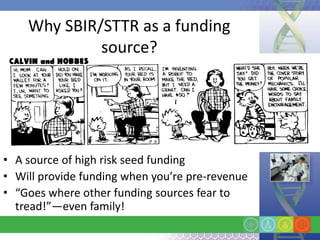
• A source of high risk seed funding
• Will provide funding when you’re pre-revenue
• “Goes where other funding sources fear to
  tread!”—even family!
Why Small Companies Should
            Participate
• No pay-back requirement!
• No equity lost!
• Visibility and credibility
• Seed money for high risk R&D projects that may
  attract strategic partners or future investment
• Small and isolated companies compete on equal
  footing
• Opportunity to establish a sole-source position with
  federal government
• No penalty for failure, other than time invested
                      Plus…
Liberal Patent & Data Rights
• Only in SBIR/STTR
• Recipient can apply for worldwide patents
• Federal government gets royalty free license
  if:
   – Nat’l emergency, failure to commercialize in 4 yrs,
     fail to mfg. in U.S.
• Can still participate if you have a patent on
  the basic technology
• PLUS data rights extend to 4 years after
  completing the contract/grant (5 yrs. for DoD)
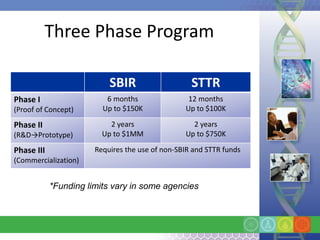
Three Phase Program

                           SBIR                    STTR
Phase I                   6 months                12 months
(Proof of Concept)       Up to $150K             Up to $100K

Phase II                   2 years                 2 years
(R&D→Prototype)          Up to $1MM              Up to $750K

Phase III              Requires the use of non-SBIR and STTR funds
(Commercialization)


            *Funding limits vary in some agencies
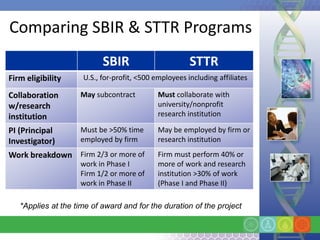
Comparing SBIR & STTR Programs
                           SBIR                        STTR
Firm eligibility     U.S., for-profit, <500 employees including affiliates

Collaboration       May subcontract          Must collaborate with
w/research                                   university/nonprofit
institution                                  research institution

PI (Principal       Must be >50% time        May be employed by firm or
Investigator)       employed by firm         research institution
Work breakdown Firm 2/3 or more of           Firm must perform 40% or
                    work in Phase I          more of work and research
                    Firm 1/2 or more of      institution >30% of work
                    work in Phase II         (Phase I and Phase II)

   *Applies at the time of award and for the duration of the project
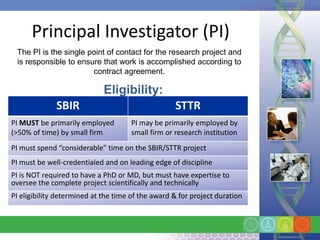
Principal Investigator (PI)
 The PI is the single point of contact for the research project and
 is responsible to ensure that work is accomplished according to
                       contract agreement.

                             Eligibility:
              SBIR                                 STTR
PI MUST be primarily employed        PI may be primarily employed by
(>50% of time) by small firm         small firm or research institution
PI must spend “considerable” time on the SBIR/STTR project
PI must be well-credentialed and on leading edge of discipline
PI is NOT required to have a PhD or MD, but must have expertise to
oversee the complete project scientifically and technically
PI eligibility determined at the time of the award & for project duration
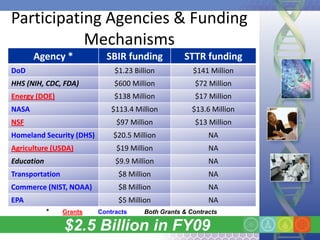
Participating Agencies & Funding
           Mechanisms
       Agency *             SBIR funding            STTR funding
DoD                            $1.23 Billion           $141 Million
HHS (NIH, CDC, FDA)            $600 Million             $72 Million
Energy (DOE)                   $138 Million             $17 Million
NASA                          $113.4 Million           $13.6 Million
NSF                            $97 Million              $13 Million
Homeland Security (DHS)       $20.5 Million                 NA
Agriculture (USDA)             $19 Million                  NA
Education                      $9.9 Million                 NA
Transportation                  $8 Million                  NA
Commerce (NIST, NOAA)           $8 Million                  NA
EPA                             $5 Million                  NA
            *    Grants   Contracts     Both Grants & Contracts

                 $2.5 Billion in FY09
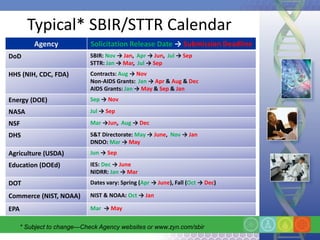
Typical* SBIR/STTR Calendar
          Agency             Solicitation Release Date → Submission Deadline
DoD                          SBIR: Nov → Jan, Apr → Jun, Jul → Sep
                             STTR: Jan → Mar, Jul → Sep
HHS (NIH, CDC, FDA)          Contracts: Aug → Nov
                             Non-AIDS Grants: Jan → Apr & Aug & Dec
                             AIDS Grants: Jan → May & Sep & Jan
Energy (DOE)                 Sep → Nov

NASA                         Jul → Sep

NSF                          Mar →Jun, Aug → Dec

DHS                          S&T Directorate: May → June, Nov → Jan
                             DNDO: Mar → May
Agriculture (USDA)           Jun → Sep

Education (DOEd)             IES: Dec → June
                             NIDRR: Jan → Mar
DOT                          Dates vary: Spring (Apr → June), Fall (Oct → Dec)

Commerce (NIST, NOAA)        NIST & NOAA: Oct → Jan

EPA                          Mar → May


      * Subject to change—Check Agency websites or www.zyn.com/sbir
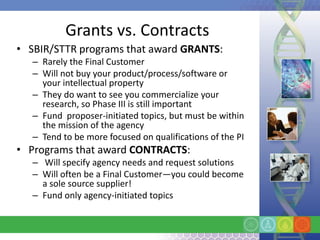
Grants vs. Contracts
• SBIR/STTR programs that award GRANTS:
   – Rarely the Final Customer
   – Will not buy your product/process/software or
     your intellectual property
   – They do want to see you commercialize your
     research, so Phase III is still important
   – Fund proposer-initiated topics, but must be within
     the mission of the agency
   – Tend to be more focused on qualifications of the PI
• Programs that award CONTRACTS:
   – Will specify agency needs and request solutions
   – Will often be a Final Customer—you could become
     a sole source supplier!
   – Fund only agency-initiated topics
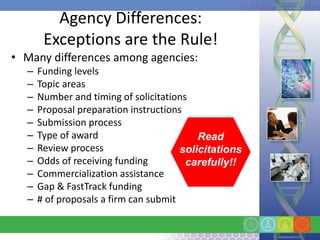
Agency Differences:
       Exceptions are the Rule!
• Many differences among agencies:
  –   Funding levels
  –   Topic areas
  –   Number and timing of solicitations
  –   Proposal preparation instructions
  –   Submission process
  –   Type of award                        Read
  –   Review process                   solicitations
  –   Odds of receiving funding         carefully!!
  –   Commercialization assistance
  –   Gap & FastTrack funding
  –   # of proposals a firm can submit
Duplicate submissions?
• Applications may be submitted to
  different agencies for similar work
  – Multiple submissions and previous
    awards must be revealed
• Awards may not be accepted from
  different agencies for duplicative
  projects
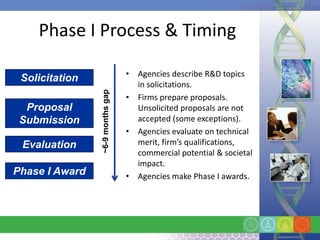
Phase I Process & Timing

                                  • Agencies describe R&D topics
 Solicitation
                                    in solicitations.
   Topics
                ~6-9 months gap
                                  • Firms prepare proposals.
  Proposal                          Unsolicited proposals are not
 Submission                         accepted (some exceptions).
                                  • Agencies evaluate on technical
 Evaluation                         merit, firm’s qualifications,
                                    commercial potential & societal
                                    impact.
Phase I Award                     • Agencies make Phase I awards.
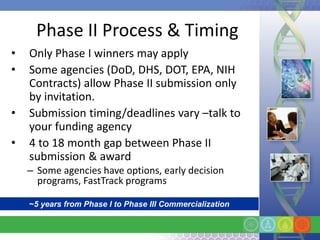
Phase II Process & Timing
•   Only Phase I winners may apply
•   Some agencies (DoD, DHS, DOT, EPA, NIH
    Contracts) allow Phase II submission only
    by invitation.
•   Submission timing/deadlines vary –talk to
    your funding agency
•   4 to 18 month gap between Phase II
    submission & award
    – Some agencies have options, early decision
      programs, FastTrack programs

    ~5 years from Phase I to Phase III Commercialization
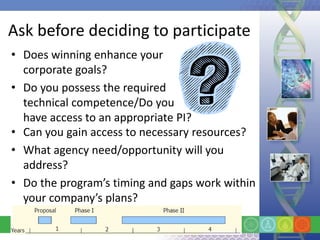
Ask before deciding to participate
• Does winning enhance your
  corporate goals?
• Do you possess the required
  technical competence/Do you
  have access to an appropriate PI?
• Can you gain access to necessary resources?
• What agency need/opportunity will you
  address?
• Do the program’s timing and gaps work within
  your company’s plans?
Unacceptable SBIR Objectives*
• Proposed efforts directed toward systems studies
• Market research
• Commercial development of existing products or
  proven concepts
• Straightforward engineering design for packaging
• Laboratory evaluations
• Incremental product or process improvements
• Evolutionary optimization of existing products
• Modifications to broaden the scope of an existing
  product or application
*From NSF’s FY 2010 SBIR Phase I Solicitation
Proposal Evaluation Criteria

•   Fit with agency mission
•   Technical quality & innovation
•   Credibility of the PI & research team
•   Commercial potential
•   Appropriate budget
•   Suitability/availability of resources
Your Odds of Winning

• Phase I SBIR Proposal: About 1 in 8/9
• Phase I STTR Proposal: About 1 in 5
• Phase II Proposal: About 40%-70%
  – varies by agency
• ½ of Phase I proposals go to
  companies who never won before.
Improve your odds!
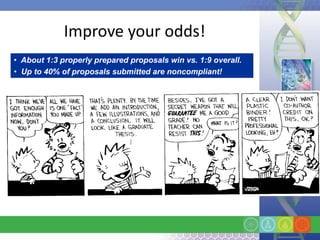
• About 1:3 properly prepared proposals win vs. 1:9 overall.
• Up to 40% of proposals submitted are noncompliant!
Improve your odds!
           Problem                             Solution
• Noncompliance with                • Read solicitation carefully &
  solicitation                        prepare a checklist
• Unaware of public research in     • Have leading edge PI; do
  the field                           literature & online research
• Lack of systematic approach to
  the problem                       • Know how to design an
                                      experiment & project plan
• Lack of necessary “state of the
  art” expertise                    • Use subcontracting &
• Proposal not specifically           consultants to augment
  focused on agency problem         • Know your Customer!!
Typical Award Winner Profile
• Proposed solution meets agency need
• Submitted 2+ proposals before winning
• Understands current state-of-the-art and can
  relate it to their innovation
• Adequately communicates path to market
• Adequate qualifications & experience for
  research & commercialization
• Adequate support staff and equipment
• Provides a defensible budget
• Don’t get discouraged!
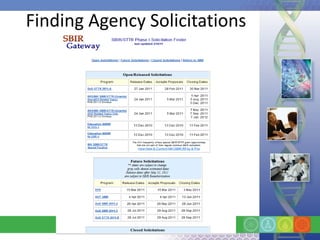
Finding Agency Solicitations
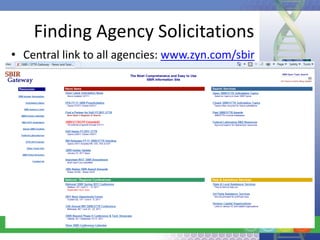
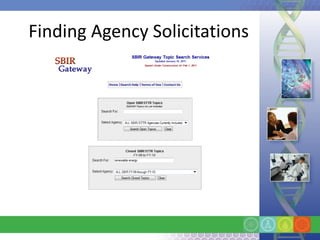
• Central link to all agencies: www.zyn.com/sbir
Finding Agency Solicitations
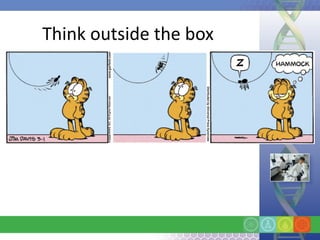
Think outside the box
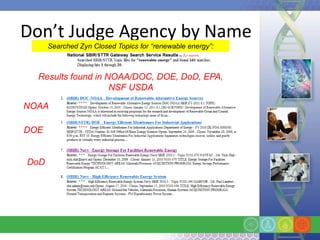
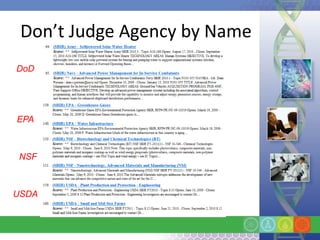
Don’t Judge Agency by Name
      Searched Zyn Closed Topics for “renewable energy”:


  Results found in NOAA/DOC, DOE, DoD, EPA,
                    NSF USDA

NOAA

DOE


DoD
Don’t Judge Agency by Name
DoD


EPA


NSF


USDA
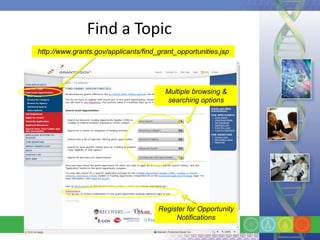
Find a Topic
http://www.grants.gov/applicants/find_grant_opportunities.jsp


                                        Multiple browsing &
                                         searching options


                                      Register for Opportunity
                                           Notifications
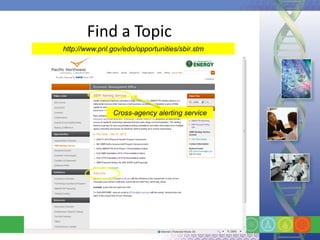
Find a Topic
http://www.pnl.gov/edo/opportunities/sbir.stm


                Cross-agency alerting service
Getting Started:
  Register for Electronic Submission

1. Obtain a DUNS number FIRST
  Dun & Bradstreet: 1-866-705-5711 or
      http://fedgov.dnb.com/webform/displayHomePage.do


2. Register in Central Contractor Registry for a
   CAGE code:
   CCR site: http://www.ccr.gov


  Keep a copy of all usernames/passwords!
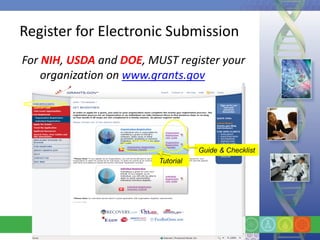
Register for Electronic Submission
For NIH, USDA and DOE, MUST register your
    organization on www.grants.gov


                                    Guide & Checklist
                         Tutorial
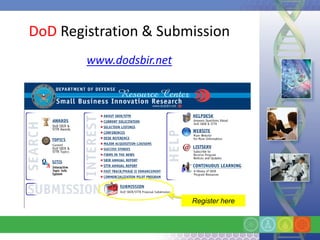
DoD Registration & Submission
        www.dodsbir.net


                          Register here
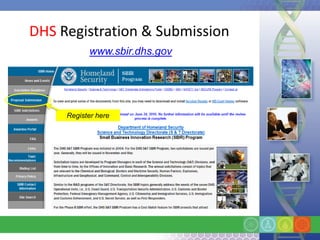
DHS Registration & Submission
           www.sbir.dhs.gov


     Register here
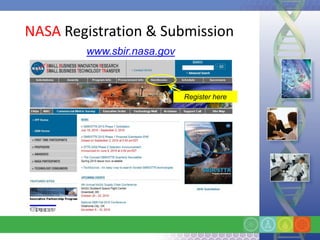
NASA Registration & Submission
        www.sbir.nasa.gov


                            Register here
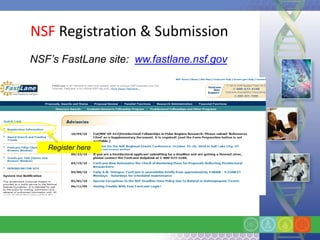
NSF Registration & Submission
NSF’s FastLane site: ww.fastlane.nsf.gov


   Register here
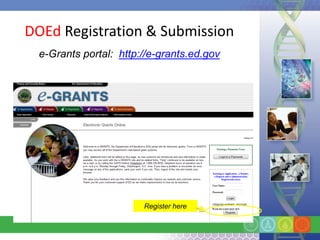
DOEd Registration & Submission
  e-Grants portal: http://e-grants.ed.gov


                        Register here
Submitting to other agencies
• DOC (NIST & NOAA)
  – Requires hard copy submission (see
    solicitation for specifics)
• DOT
  – Requires electronic submission but no
    prior registration; web address is given
    in solicitation
• EPA
  – Requires hard copy submission (see
    solicitation for specifics)
Useful Links
• http://www.zyn.com/sbir/ (SBIR Gateway)
• http://www.pnl.gov/edo/opportunities/sbir.stm
  (SBIR Alert)
• http://www.ccr.gov (CCR registration site)
• http://www.grants.gov (Grants.gov site)
• http://center.ncet2.org/ (NCET2 courses and
  resources site)
• http://www.sbir.gov/ (Official SBIR portal)
MN S&TA SBIR/STTR Services
•   Regular email updates on SBIR/STTR
•   Educational workshops
•   Assistance with agency & topic selection
•   Agency-specific guidance
•   Proposal writing tips/recommendations
•   Pre-submission proposal reviews
•   Debriefing review & recommendations
•   Referral/introduction to other resources
•   Encouragement & Comedic Relief!
Contact information:

        Becky Aistrup
MN SBIR/STTR Program Director
        651.259.7634
  becky.aistrup@state.mn.us

SBIR Basics

  • 1.
    2012 SADBOC Government Procurement Fair April 25, 2012 SBIR/STTR Basics Becky Aistrup SBIR/STTR Program Director Minnesota Science & Technology Authority www.PositivelyMinnesota.com/SciTech www.mnscienceandtechnologyauthority.org becky.aistrup@state.mn.us (651) 259-7634
  • 2.
    Important Info The SBIR/STTRprograms were reauthorized by Congress & signed by the President Dec. 2011. The SBA is in the process of recommending how these changes will be implemented by the agencies, so exact mechanisms & implementation dates are pending. This presentation is the CURRENT program, but will be changing during 2012 in these key ways: • increasing the SBIR allocation from 2.5 percent to 3.2 percent over several years, • increasing the STTR allocation from .3 percent to .45 percent over five years, • allowing VC, hedge fund and private equity funded companies to participate to 25 percent for NIH, DOE, and NSF, and 15 percent for other agencies, • raising the award levels, allowing for annual inflation adjustments, limiting jumbo awards, • increasing small business collaborations with federal laboratories, • shortening the time for final decisions and the amount of time between decision and release of funds • increasing oversight to reduce fraud and abuse, and • allowing the agencies to use 3 percent of SBIR funds to administer the SBIR program, increase oversight, and provide outreach and application assistance to address shortcomings in the low participation of women, minorities and states with few awards. PLEASE CHECK RULES IN EFFECT AT THE TIME OF PROPOSAL SUBMISSION!! CALL OUR OFFICES IF YOU HAVE QUESTIONS (Becky Aistrup 651-259-7634)
  • 3.
    SBIR/STTR Program Descriptions •SBIR (Small Business Innovation Research): • 2.6% set-aside of extramural research budget for small businesses to participate in federal R&D • 11 federal agencies with R&D >$100 million • STTR (Small Business Technology Transfer): • 0.35% set-aside program to facilitate cooperative R&D between small businesses and non-profit research institutions • 5 federal agencies with R&D >$1 billion • Both focus on commercializable technology, not “basic” research
  • 4.
    Who qualifies forfunding?** • Small Business (<500 employees) located in U.S. • Established for-profit • R&D must be performed in the U.S. • Company-controlled research facilities – Access to special facilities is allowed • At least 51% U.S. owned & independently operated – Firms more than 50% owned by large companies, VCs, other institutions ARE NOT eligible – …unless the majority (single) entity meets the definition of a small business (<500 employees, ownership) **Rules changing: read current instructions carefully!
  • 5.
    Why SBIR/STTR asa funding source? • A source of high risk seed funding • Will provide funding when you’re pre-revenue • “Goes where other funding sources fear to tread!”—even family!
  • 6.
    Why Small CompaniesShould Participate • No pay-back requirement! • No equity lost! • Visibility and credibility • Seed money for high risk R&D projects that may attract strategic partners or future investment • Small and isolated companies compete on equal footing • Opportunity to establish a sole-source position with federal government • No penalty for failure, other than time invested Plus…
  • 7.
    Liberal Patent &Data Rights • Only in SBIR/STTR • Recipient can apply for worldwide patents • Federal government gets royalty free license if: – Nat’l emergency, failure to commercialize in 4 yrs, fail to mfg. in U.S. • Can still participate if you have a patent on the basic technology • PLUS data rights extend to 4 years after completing the contract/grant (5 yrs. for DoD)
  • 8.
    Three Phase Program SBIR STTR Phase I 6 months 12 months (Proof of Concept) Up to $150K Up to $100K Phase II 2 years 2 years (R&D→Prototype) Up to $1MM Up to $750K Phase III Requires the use of non-SBIR and STTR funds (Commercialization) *Funding limits vary in some agencies
  • 9.
    Comparing SBIR &STTR Programs SBIR STTR Firm eligibility U.S., for-profit, <500 employees including affiliates Collaboration May subcontract Must collaborate with w/research university/nonprofit institution research institution PI (Principal Must be >50% time May be employed by firm or Investigator) employed by firm research institution Work breakdown Firm 2/3 or more of Firm must perform 40% or work in Phase I more of work and research Firm 1/2 or more of institution >30% of work work in Phase II (Phase I and Phase II) *Applies at the time of award and for the duration of the project
  • 10.
    Principal Investigator (PI) The PI is the single point of contact for the research project and is responsible to ensure that work is accomplished according to contract agreement. Eligibility: SBIR STTR PI MUST be primarily employed PI may be primarily employed by (>50% of time) by small firm small firm or research institution PI must spend “considerable” time on the SBIR/STTR project PI must be well-credentialed and on leading edge of discipline PI is NOT required to have a PhD or MD, but must have expertise to oversee the complete project scientifically and technically PI eligibility determined at the time of the award & for project duration
  • 11.
    Participating Agencies &Funding Mechanisms Agency * SBIR funding STTR funding DoD $1.23 Billion $141 Million HHS (NIH, CDC, FDA) $600 Million $72 Million Energy (DOE) $138 Million $17 Million NASA $113.4 Million $13.6 Million NSF $97 Million $13 Million Homeland Security (DHS) $20.5 Million NA Agriculture (USDA) $19 Million NA Education $9.9 Million NA Transportation $8 Million NA Commerce (NIST, NOAA) $8 Million NA EPA $5 Million NA * Grants Contracts Both Grants & Contracts $2.5 Billion in FY09
  • 12.
    Typical* SBIR/STTR Calendar Agency Solicitation Release Date → Submission Deadline DoD SBIR: Nov → Jan, Apr → Jun, Jul → Sep STTR: Jan → Mar, Jul → Sep HHS (NIH, CDC, FDA) Contracts: Aug → Nov Non-AIDS Grants: Jan → Apr & Aug & Dec AIDS Grants: Jan → May & Sep & Jan Energy (DOE) Sep → Nov NASA Jul → Sep NSF Mar →Jun, Aug → Dec DHS S&T Directorate: May → June, Nov → Jan DNDO: Mar → May Agriculture (USDA) Jun → Sep Education (DOEd) IES: Dec → June NIDRR: Jan → Mar DOT Dates vary: Spring (Apr → June), Fall (Oct → Dec) Commerce (NIST, NOAA) NIST & NOAA: Oct → Jan EPA Mar → May * Subject to change—Check Agency websites or www.zyn.com/sbir
  • 13.
    Grants vs. Contracts •SBIR/STTR programs that award GRANTS: – Rarely the Final Customer – Will not buy your product/process/software or your intellectual property – They do want to see you commercialize your research, so Phase III is still important – Fund proposer-initiated topics, but must be within the mission of the agency – Tend to be more focused on qualifications of the PI • Programs that award CONTRACTS: – Will specify agency needs and request solutions – Will often be a Final Customer—you could become a sole source supplier! – Fund only agency-initiated topics
  • 14.
    Agency Differences: Exceptions are the Rule! • Many differences among agencies: – Funding levels – Topic areas – Number and timing of solicitations – Proposal preparation instructions – Submission process – Type of award Read – Review process solicitations – Odds of receiving funding carefully!! – Commercialization assistance – Gap & FastTrack funding – # of proposals a firm can submit
  • 15.
    Duplicate submissions? • Applicationsmay be submitted to different agencies for similar work – Multiple submissions and previous awards must be revealed • Awards may not be accepted from different agencies for duplicative projects
  • 16.
    Phase I Process& Timing • Agencies describe R&D topics Solicitation in solicitations. Topics ~6-9 months gap • Firms prepare proposals. Proposal Unsolicited proposals are not Submission accepted (some exceptions). • Agencies evaluate on technical Evaluation merit, firm’s qualifications, commercial potential & societal impact. Phase I Award • Agencies make Phase I awards.
  • 17.
    Phase II Process& Timing • Only Phase I winners may apply • Some agencies (DoD, DHS, DOT, EPA, NIH Contracts) allow Phase II submission only by invitation. • Submission timing/deadlines vary –talk to your funding agency • 4 to 18 month gap between Phase II submission & award – Some agencies have options, early decision programs, FastTrack programs ~5 years from Phase I to Phase III Commercialization
  • 18.
    Ask before decidingto participate • Does winning enhance your corporate goals? • Do you possess the required technical competence/Do you have access to an appropriate PI? • Can you gain access to necessary resources? • What agency need/opportunity will you address? • Do the program’s timing and gaps work within your company’s plans?
  • 19.
    Unacceptable SBIR Objectives* •Proposed efforts directed toward systems studies • Market research • Commercial development of existing products or proven concepts • Straightforward engineering design for packaging • Laboratory evaluations • Incremental product or process improvements • Evolutionary optimization of existing products • Modifications to broaden the scope of an existing product or application *From NSF’s FY 2010 SBIR Phase I Solicitation
  • 20.
    Proposal Evaluation Criteria • Fit with agency mission • Technical quality & innovation • Credibility of the PI & research team • Commercial potential • Appropriate budget • Suitability/availability of resources
  • 21.
    Your Odds ofWinning • Phase I SBIR Proposal: About 1 in 8/9 • Phase I STTR Proposal: About 1 in 5 • Phase II Proposal: About 40%-70% – varies by agency • ½ of Phase I proposals go to companies who never won before.
  • 22.
    Improve your odds! •About 1:3 properly prepared proposals win vs. 1:9 overall. • Up to 40% of proposals submitted are noncompliant!
  • 23.
    Improve your odds! Problem Solution • Noncompliance with • Read solicitation carefully & solicitation prepare a checklist • Unaware of public research in • Have leading edge PI; do the field literature & online research • Lack of systematic approach to the problem • Know how to design an experiment & project plan • Lack of necessary “state of the art” expertise • Use subcontracting & • Proposal not specifically consultants to augment focused on agency problem • Know your Customer!!
  • 24.
    Typical Award WinnerProfile • Proposed solution meets agency need • Submitted 2+ proposals before winning • Understands current state-of-the-art and can relate it to their innovation • Adequately communicates path to market • Adequate qualifications & experience for research & commercialization • Adequate support staff and equipment • Provides a defensible budget • Don’t get discouraged!
  • 25.
    Finding Agency Solicitations •Central link to all agencies: www.zyn.com/sbir
  • 26.
  • 27.
  • 28.
  • 29.
    Don’t Judge Agencyby Name Searched Zyn Closed Topics for “renewable energy”: Results found in NOAA/DOC, DOE, DoD, EPA, NSF USDA NOAA DOE DoD
  • 30.
    Don’t Judge Agencyby Name DoD EPA NSF USDA
  • 31.
    Find a Topic http://www.grants.gov/applicants/find_grant_opportunities.jsp Multiple browsing & searching options Register for Opportunity Notifications
  • 32.
  • 33.
    Getting Started: Register for Electronic Submission 1. Obtain a DUNS number FIRST Dun & Bradstreet: 1-866-705-5711 or http://fedgov.dnb.com/webform/displayHomePage.do 2. Register in Central Contractor Registry for a CAGE code: CCR site: http://www.ccr.gov Keep a copy of all usernames/passwords!
  • 34.
    Register for ElectronicSubmission For NIH, USDA and DOE, MUST register your organization on www.grants.gov Guide & Checklist Tutorial
  • 35.
    DoD Registration &Submission www.dodsbir.net Register here
  • 36.
    DHS Registration &Submission www.sbir.dhs.gov Register here
  • 37.
    NASA Registration &Submission www.sbir.nasa.gov Register here
  • 38.
    NSF Registration &Submission NSF’s FastLane site: ww.fastlane.nsf.gov Register here
  • 39.
    DOEd Registration &Submission e-Grants portal: http://e-grants.ed.gov Register here
  • 40.
    Submitting to otheragencies • DOC (NIST & NOAA) – Requires hard copy submission (see solicitation for specifics) • DOT – Requires electronic submission but no prior registration; web address is given in solicitation • EPA – Requires hard copy submission (see solicitation for specifics)
  • 41.
    Useful Links • http://www.zyn.com/sbir/(SBIR Gateway) • http://www.pnl.gov/edo/opportunities/sbir.stm (SBIR Alert) • http://www.ccr.gov (CCR registration site) • http://www.grants.gov (Grants.gov site) • http://center.ncet2.org/ (NCET2 courses and resources site) • http://www.sbir.gov/ (Official SBIR portal)
  • 42.
    MN S&TA SBIR/STTRServices • Regular email updates on SBIR/STTR • Educational workshops • Assistance with agency & topic selection • Agency-specific guidance • Proposal writing tips/recommendations • Pre-submission proposal reviews • Debriefing review & recommendations • Referral/introduction to other resources • Encouragement & Comedic Relief!
  • 43.
    Contact information: Becky Aistrup MN SBIR/STTR Program Director 651.259.7634 becky.aistrup@state.mn.us