P O W E R E D B Y S B A
1/1-1
I
n this tutorial we will introduce you to two important programs: the Small Business Innovation Research Program, also referred to
as SBIR and the Small Business Technology Transfer program, also referred to as STTR. These two initiatives, the SBIR and STTR
programs are sometimes referred to as the nation’s largest source of early stage/high risk funding for start-ups and small business.
To be eligible, the small business must be American-owned, organized as a for-profit entity, and have less than 500 employees.
There are 11 Federal agencies that participate annually in the SBIR program and five that participate in the STTR program.
COURSE 1, TUTORIAL 1
WHAT IS THE PURPOSE OF
THE SBIR AND STTR PROGRAMS?
These agencies designate R&D topics and accept proposals.
They fund innovative research that will meet the objectives of
the agency. Each has a unique mission and should be viewed
as distinct customers. In a subsequent course you will be in-
troduced to the individual requirements of the Federal agencies
that provide SBIR and/or STTR funding.
GOALS OF THE SBIR PROGRAM
The original charter of the SBIR program was to address
four goals.
»» Stimulate technological innovation
»» Use small business to meet Federal R/R&D needs
»» Foster and encourage participation by the socially and
economically disadvantaged small businesses, and
those that are 51 percent owned and controlled by
women, in technological innovation
»» Increase private sector commercialization of innovations
derived from Federal R/R&D, thereby increasing compe-
tition, productivity, and economic growth
Since the SBIR program started in 1982, the charter has
expanded to:
»» Require evaluation of commercial potential in Phase I
and Phase II applications, and
»» Is viewed as seed capital for early stage R&D with com-
mercial potential
›	 The awards are comparable in size to angel invest-
ments in the private sector and indicate the accep-
tance of greater risk in support of agency missions
P O W E R E D B Y S B A
1/1-2
›	 Both the SBIR and STTR programs have three Phases: Following
submission of proposals, agencies make awards based on small
business qualification, degree of innovation, technical merit, and
future market potential. Small businesses that receive awards
then begin a three-phase program.
THE THREE PHASES
»» Phase I is the concept phase. It lasts six to nine months and sup-
ports exploration of the technical merit or feasibility of an idea or
technology.
»» Phase II awards may last for up to 2 years and expand upon the
Phase I results. During this time, the R&D work is performed.
GOALS OF THE STTR PROGRAM
Phase III is the period during which Phase II innovation moves from the lab-
oratory into the marketplace. No SBIR funds support this phase. The small
business must find funding in the private sector or secure it from other non-
SBIR Federal agencies that provide funding for continued development.
The Small Business Technology Transfer program or STTR came later and was modeled after the SBIR program. Its goal however, is
to facilitate the transfer of technology developed by a research institution through the entrepreneurship of a small business concern.
Research institutions include universities and Federally Funded Research and Development Centers, also referred to as FFRDC. It is
important to keep in mind that the applicant for an STTR award is always the small business.
PRE-REQUISITES FOR SUCCESS
To succeed in either the SBIR and STTR programs there are a number of prerequisites:
»» First, you must have a burning desire to conduct innovative research and development
»» AND Second, a desire to develop a viable product that you want to bring to the marketplace – Just wanting to do research
is insufficient – you must want to see that research commercialized or turned into a useful product that you and your firm
will promote either directly or through a variety of commercialization strategies.
P O W E R E D B Y S B A
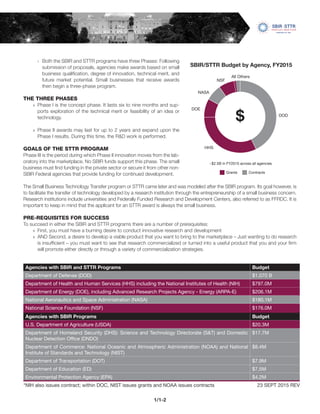
Agencies with SBIR and STTR Programs Budget
Department of Defense (DOD) $1.070 B
Department of Health and Human Services (HHS) including the National Institutes of Health (NIH) $797.0M
Department of Energy (DOE), including Advanced Research Projects Agency - Energy (ARPA-E) $206.1M
National Aeronautics and Space Administration (NASA) $180.1M
National Science Foundation (NSF) $176.0M
Agencies with SBIR Programs Budget
U.S. Department of Agriculture (USDA) $20.3M
Department of Homeland Security (DHS): Science and Technology Directorate (S&T) and Domestic
Nuclear Detection Office (DNDO)
$17.7M
Department of Commerce: National Oceanic and Atmospheric Administration (NOAA) and National
Institute of Standards and Technology (NIST)
$8.4M
Department of Transportation (DOT) $7.9M
Department of Education (ED) $7.5M
Environmental Protection Agency (EPA) $4.2M
*NIH also issues contract; within DOC, NIST issues grants and NOAA issues contracts 23 SEPT 2015 REV
All Others
NSF
NASA
DOE
HHS
DOD
$
SBIR/STTR Budget by Agency, FY2015
Grants Contracts
~$2.5B in FY2015 across all agencies
Agencies wit
Department o
Department o
including the N
Department o
Research Proj
National Aeron
(NASA)
National Scien
Agencies wit
U.S. Departme
Department o
and Technolog
Nuclear Detec
Department o
Atmospheric A
Institute of Sta
Department o
Department o
Environmenta
*NIH also issues co
P O W E R E D B Y S B A
1/1-3
If you can match your interests and talents with the specific
needs of a Federal agency you may be able to secure funding
to conduct research and development with no strings attached.
BENEFITS OF PARTICIPATION
By applying for and winning an SBIR or STTR award, you will
receive funding to conduct the R&D, retain the rights to the
intellectual property and have the opportunity to obtain addi-
tional funding to continue the development of the technology.
The SBIR and STTR programs provide a unique opportunity for
scientists and engineers to develop and grow a small business.
But don’t get ahead of yourself – Often, when people first hear
about the SBIR program we hear the following question – if I
have already developed a solution can I apply? No – the SBIR
and STTR programs fund innovative research and development
– the purpose is not to retroactively pay a company for devel-
opment that they may have already accomplished. However,
it is assumed that you have an area of expertise and perhaps
related work.
The emphasis on innovation is important in both programs and
implies that you are proposing a novel approach to pressing
problems or needs identified by an agency. The approach pro-
posed should be unproven and involve an element of technical
risk. You must clearly identify the innovation in your proposal.
Do not leave the recognition of your innovation to the imagina-
tion of the reviewers. You must be explicit.
As you can see small businesses participating in the SBIR or
STTR program receive many benefits: you receive funding with
no strings attached – you do not give up equity in your compa-
ny, you do not give up rights to the intellectual property, you do
not return the funding – as this is not a loan. What is expected
is good research that will lead to a commercial product and that
will benefit the nation.
TO LEARN MORE ABOUT THIS TOPIC
SBIR.GOV/TUTORIALS

SBIR-STTR Programs Technology

  • 1.
    P O WE R E D B Y S B A 1/1-1 I n this tutorial we will introduce you to two important programs: the Small Business Innovation Research Program, also referred to as SBIR and the Small Business Technology Transfer program, also referred to as STTR. These two initiatives, the SBIR and STTR programs are sometimes referred to as the nation’s largest source of early stage/high risk funding for start-ups and small business. To be eligible, the small business must be American-owned, organized as a for-profit entity, and have less than 500 employees. There are 11 Federal agencies that participate annually in the SBIR program and five that participate in the STTR program. COURSE 1, TUTORIAL 1 WHAT IS THE PURPOSE OF THE SBIR AND STTR PROGRAMS? These agencies designate R&D topics and accept proposals. They fund innovative research that will meet the objectives of the agency. Each has a unique mission and should be viewed as distinct customers. In a subsequent course you will be in- troduced to the individual requirements of the Federal agencies that provide SBIR and/or STTR funding. GOALS OF THE SBIR PROGRAM The original charter of the SBIR program was to address four goals. »» Stimulate technological innovation »» Use small business to meet Federal R/R&D needs »» Foster and encourage participation by the socially and economically disadvantaged small businesses, and those that are 51 percent owned and controlled by women, in technological innovation »» Increase private sector commercialization of innovations derived from Federal R/R&D, thereby increasing compe- tition, productivity, and economic growth Since the SBIR program started in 1982, the charter has expanded to: »» Require evaluation of commercial potential in Phase I and Phase II applications, and »» Is viewed as seed capital for early stage R&D with com- mercial potential › The awards are comparable in size to angel invest- ments in the private sector and indicate the accep- tance of greater risk in support of agency missions
  • 2.
    P O WE R E D B Y S B A 1/1-2 › Both the SBIR and STTR programs have three Phases: Following submission of proposals, agencies make awards based on small business qualification, degree of innovation, technical merit, and future market potential. Small businesses that receive awards then begin a three-phase program. THE THREE PHASES »» Phase I is the concept phase. It lasts six to nine months and sup- ports exploration of the technical merit or feasibility of an idea or technology. »» Phase II awards may last for up to 2 years and expand upon the Phase I results. During this time, the R&D work is performed. GOALS OF THE STTR PROGRAM Phase III is the period during which Phase II innovation moves from the lab- oratory into the marketplace. No SBIR funds support this phase. The small business must find funding in the private sector or secure it from other non- SBIR Federal agencies that provide funding for continued development. The Small Business Technology Transfer program or STTR came later and was modeled after the SBIR program. Its goal however, is to facilitate the transfer of technology developed by a research institution through the entrepreneurship of a small business concern. Research institutions include universities and Federally Funded Research and Development Centers, also referred to as FFRDC. It is important to keep in mind that the applicant for an STTR award is always the small business. PRE-REQUISITES FOR SUCCESS To succeed in either the SBIR and STTR programs there are a number of prerequisites: »» First, you must have a burning desire to conduct innovative research and development »» AND Second, a desire to develop a viable product that you want to bring to the marketplace – Just wanting to do research is insufficient – you must want to see that research commercialized or turned into a useful product that you and your firm will promote either directly or through a variety of commercialization strategies. P O W E R E D B Y S B A Agencies with SBIR and STTR Programs Budget Department of Defense (DOD) $1.070 B Department of Health and Human Services (HHS) including the National Institutes of Health (NIH) $797.0M Department of Energy (DOE), including Advanced Research Projects Agency - Energy (ARPA-E) $206.1M National Aeronautics and Space Administration (NASA) $180.1M National Science Foundation (NSF) $176.0M Agencies with SBIR Programs Budget U.S. Department of Agriculture (USDA) $20.3M Department of Homeland Security (DHS): Science and Technology Directorate (S&T) and Domestic Nuclear Detection Office (DNDO) $17.7M Department of Commerce: National Oceanic and Atmospheric Administration (NOAA) and National Institute of Standards and Technology (NIST) $8.4M Department of Transportation (DOT) $7.9M Department of Education (ED) $7.5M Environmental Protection Agency (EPA) $4.2M *NIH also issues contract; within DOC, NIST issues grants and NOAA issues contracts 23 SEPT 2015 REV All Others NSF NASA DOE HHS DOD $ SBIR/STTR Budget by Agency, FY2015 Grants Contracts ~$2.5B in FY2015 across all agencies Agencies wit Department o Department o including the N Department o Research Proj National Aeron (NASA) National Scien Agencies wit U.S. Departme Department o and Technolog Nuclear Detec Department o Atmospheric A Institute of Sta Department o Department o Environmenta *NIH also issues co
  • 3.
    P O WE R E D B Y S B A 1/1-3 If you can match your interests and talents with the specific needs of a Federal agency you may be able to secure funding to conduct research and development with no strings attached. BENEFITS OF PARTICIPATION By applying for and winning an SBIR or STTR award, you will receive funding to conduct the R&D, retain the rights to the intellectual property and have the opportunity to obtain addi- tional funding to continue the development of the technology. The SBIR and STTR programs provide a unique opportunity for scientists and engineers to develop and grow a small business. But don’t get ahead of yourself – Often, when people first hear about the SBIR program we hear the following question – if I have already developed a solution can I apply? No – the SBIR and STTR programs fund innovative research and development – the purpose is not to retroactively pay a company for devel- opment that they may have already accomplished. However, it is assumed that you have an area of expertise and perhaps related work. The emphasis on innovation is important in both programs and implies that you are proposing a novel approach to pressing problems or needs identified by an agency. The approach pro- posed should be unproven and involve an element of technical risk. You must clearly identify the innovation in your proposal. Do not leave the recognition of your innovation to the imagina- tion of the reviewers. You must be explicit. As you can see small businesses participating in the SBIR or STTR program receive many benefits: you receive funding with no strings attached – you do not give up equity in your compa- ny, you do not give up rights to the intellectual property, you do not return the funding – as this is not a loan. What is expected is good research that will lead to a commercial product and that will benefit the nation. TO LEARN MORE ABOUT THIS TOPIC SBIR.GOV/TUTORIALS