A Report on
“Consolidation in Indian Banking Industry – M & A Way”
Merger of IDBI Bank with Canara Bank
Submitted to: N. L Dalmia Institute of Management Studies and Research
Submitted By: Team United India (THAKUR INSTITUTE OF MANAGEMENT STUDIES
AND RESEARCH)
 Ankit Vora
 Dhrumit Vithlani
 Ekta Thakkar
 Shibani Shetty
Banking sector at a glance:
The financial sector reforms set in motion in 1991 have greatly changed the face of Indian
banking. While the banking system in India has done fairly well in adjusting to the new
market dynamics, survived the global sub-prime financial crisis and is fairly sound and stable
due to strong regulatory framework, it would not be clichéd to say again that greater
challenges lie ahead.
 Indian Banks will have to gear up to meet stringent prudential capital adequacy
norms under Basel-II and Basel III as they compete with other banks with greater
financial strength.
 In the past, mergers and acquisitions were initiated by regulators to protect the
interest of depositors of weak banks. But, it is now expected that market led
mergers may gain momentum in the coming years. The Indian banking sector is
fragmented, with 46 commercial banks jostling for business with dozens of
foreign banks as well as rural and co-operative lenders.
 There are currently 27 public sector banks in India out of which 20
are nationalised banks and 6 are State Bank of and its associate banks.
 In 2011 IDBI was nationalised with 500cr capital and then on 8 March 2014,
Bharatiya Mahela Bank was nationalised with 500cr capital. The state banks
control 80% of the market, leaving relatively small shares for private rivals.
 In 2015, values of public sector bank assets were USD1.4 Trillion. The total
Indian banking sector assets has reached USD1.8 trillion in FY14 from USD1.3
trillion in FY10, with over 70 per cent accounted by the public sector. It is
apparently predicted that the total asset size of the banking sector would be USD
28.5 trillion by FY25.
 The total lending and deposits have increased at CAGR of 20.7 per cent and 19.7
per cent, respectively, during FY07-14 and are further poised for growth, backed
by demand for housing and personal finance.
 Total number of ATMs in India has increased to 182,480 by the end of April‟15
and is further expected to double over the next few years, thereby taking the
number of ATMs per million populations from 105 in 2012, to about 300 in
2017.
 With the Financial Inclusion Plan proposed by PM Narendra Modi, the banking
connectivity in India increased more than threefold to 211,234 villages in 2013
from 67,694, at the beginning of the plan period. (In April 2014, after 12 years of
its last issuance of bank license)
 RBI granted in principle licenses to IDFC and Bandhan Microfinance to promote
rural expansion. At the end of February 2015, 13.7 crore accounts had been
opened under Pradhanmantri Jan Dhan Yojna (PMJDY) and 12.2 crore RuPay
debit cards were issued. These new accounts have mobilised deposits of Rs
12,694 crore (US$ 2.01 billion). Standard & Poor‟s estimates that credit growth
in India‟s banking sector would improve to 12-13 per cent in FY16 from less
than 10% in the second half of CY14.
Introduction:
The Proposal highlights the need for consolidation in the Indian Banking Industry in wake of
the growth in Indian economy, changes in banking regulations and increase in competition
from foreign banks. It discusses the benefits of consolidation in terms of growth, integration
of financial services, synergies, strategic benefits, ease of market entry and regulatory
intervention.
The question of restructuring the Indian banking industry has been a bone of contention for
both the Government of India as well as the Reserve Bank of India. At present the Indian
banking industry is highly fragmented in terms of size, competitiveness and other structural
features which in turn reduce its operational efficiency and distribution efficiency.
We have merged IDBI bank(having huge MSMEs and infrastructure lending and sound
technology with industrial customer base) with Canara bank( having strong presence in south
and large retail customer base) which may lead to win-win situation for both.
To emphasize the need for consolidation, we can compare State Bank of India and Bank of
America. SBI has a customer base of 90 to 100 million while Bank of America has a
customer base of 30 million. But Bank of America‟s assets are about a trillion US dollars
while SBI‟s assets are only about 93.75 billion US dollars. This shows that big banks are able
to reduce costs and enhance revenues more easily than small banks. Also, when Tata Steel
was acquiring Corus Group Plc (Corus) for 12.11 billion US dollars, no Indian PSB was big
enough to finance the acquisition. Hence Indian banks need to enhance their balance sheets to
enable wider extension of credit and meet the demands of fast economic development.
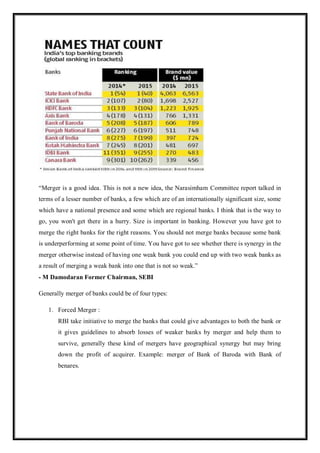
SBI India‟s top bank has obtained 40th
rank globally and ICICI has obtained 80th
rank. This
shows we are lagging behind in size, efficiency, technology, skilled labour, financial
inclusion and globally incompatible.
“Merger is a good idea. This is not a new idea, the Narasimham Committee report talked in
terms of a lesser number of banks, a few which are of an internationally significant size, some
which have a national presence and some which are regional banks. I think that is the way to
go, you won't get there in a hurry. Size is important in banking. However you have got to
merge the right banks for the right reasons. You should not merge banks because some bank
is underperforming at some point of time. You have got to see whether there is synergy in the
merger otherwise instead of having one weak bank you could end up with two weak banks as
a result of merging a weak bank into one that is not so weak.”
- M Damodaran Former Chairman, SEBI
Generally merger of banks could be of four types:
1. Forced Merger :
RBI take initiative to merge the banks that could give advantages to both the bank or
it gives guidelines to absorb losses of weaker banks by merger and help them to
survive, generally these kind of mergers have geographical synergy but may bring
down the profit of acquirer. Example: merger of Bank of Baroda with Bank of
benares.
2. Market Driven Merger:
These mergers take place purely to take advantage of synergies. They are voluntary
mergers to consolidate the position of resulting entity. Recent example is ING Vysya
with Kotak Mahindra Bank.
3. Convergence of financial institution into bank:
To take advantage of larger customer base and to increase asset size many financial
institutes transforms into banks. Recent example is Bandhan and IDSC bank.
4. Regulatory Compulsion :
The Bharat Overseas Bank was formed in 1973 with seven banks holding more than
5% stake which wasn‟t allowed as per RBI norms. Since IOB had the majority shares,
it finally acquired Bharat Overseas Bank.
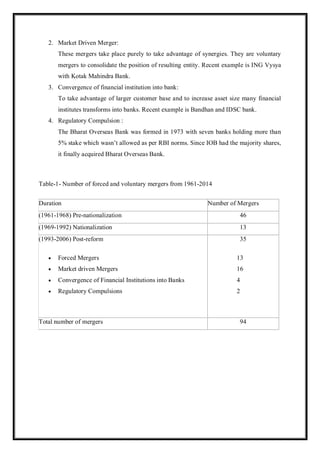
Table-1- Number of forced and voluntary mergers from 1961-2014
Duration Number of Mergers
(1961-1968) Pre-nationalization 46
(1969-1992) Nationalization 13
(1993-2006) Post-reform
 Forced Mergers
 Market driven Mergers
 Convergence of Financial Institutions into Banks
 Regulatory Compulsions
35
13
16
4
2
Total number of mergers 94
Macro-Economic Overview:
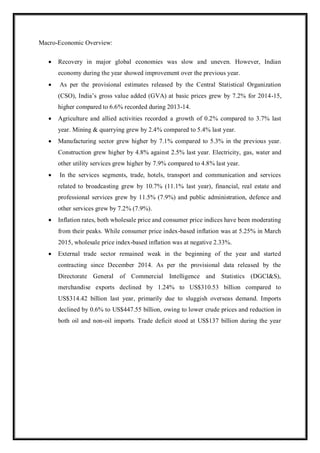
 Recovery in major global economies was slow and uneven. However, Indian
economy during the year showed improvement over the previous year.
 As per the provisional estimates released by the Central Statistical Organization
(CSO), India‟s gross value added (GVA) at basic prices grew by 7.2% for 2014-15,
higher compared to 6.6% recorded during 2013-14.
 Agriculture and allied activities recorded a growth of 0.2% compared to 3.7% last
year. Mining & quarrying grew by 2.4% compared to 5.4% last year.
 Manufacturing sector grew higher by 7.1% compared to 5.3% in the previous year.
Construction grew higher by 4.8% against 2.5% last year. Electricity, gas, water and
other utility services grew higher by 7.9% compared to 4.8% last year.
 In the services segments, trade, hotels, transport and communication and services
related to broadcasting grew by 10.7% (11.1% last year), financial, real estate and
professional services grew by 11.5% (7.9%) and public administration, defence and
other services grew by 7.2% (7.9%).
 Inflation rates, both wholesale price and consumer price indices have been moderating
from their peaks. While consumer price index-based inflation was at 5.25% in March
2015, wholesale price index-based inflation was at negative 2.33%.
 External trade sector remained weak in the beginning of the year and started
contracting since December 2014. As per the provisional data released by the
Directorate General of Commercial Intelligence and Statistics (DGCI&S),
merchandise exports declined by 1.24% to US$310.53 billion compared to
US$314.42 billion last year, primarily due to sluggish overseas demand. Imports
declined by 0.6% to US$447.55 billion, owing to lower crude prices and reduction in
both oil and non-oil imports. Trade deficit stood at US$137 billion during the year
compared to US$136 billion last year.
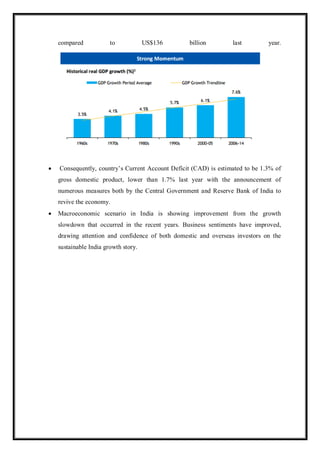
 Consequently, country‟s Current Account Deficit (CAD) is estimated to be 1.3% of
gross domestic product, lower than 1.7% last year with the announcement of
numerous measures both by the Central Government and Reserve Bank of India to
revive the economy.
 Macroeconomic scenario in India is showing improvement from the growth
slowdown that occurred in the recent years. Business sentiments have improved,
drawing attention and confidence of both domestic and overseas investors on the
sustainable India growth story.
Monetary and Banking developments:
 Growth in key monetary aggregates and money supply in 2014-15 reflected the
changing liquidity conditions arising from domestic and global financial environment.
 The monetary policy stance during the year was primarily to contain inflation and
manage liquidity.
 Money supply (M3) growth, which was 13.6% at the beginning of the financial year,
moderated to 11.1% by end-March 2015. During the year, while aggregate deposits
growth of Scheduled Commercial Banks (SCBs) was at 11.4% compared to previous
year growth at 14.1%, credit growth came down to a single–digit at 9.5% against a
growth of 13.9% last year. The credit-deposits ratio remained high at 76.46% as on
March 2015.
 Banking sector is largely influenced by the overall macroeconomic activities. Due to
economic slowdown in the recent years, the banking sector continued to reel under
stressed scenario, which is clearly reflected on business growth, asset quality and
profitability.
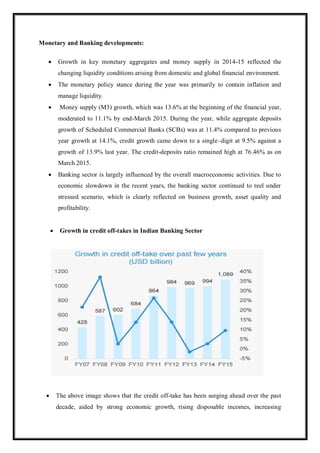
 Growth in credit off-takes in Indian Banking Sector
 The above image shows that the credit off-take has been surging ahead over the past
decade, aided by strong economic growth, rising disposable incomes, increasing
consumerism and easier access to credit Total credit extended went up to USD1089
billion by FY15. Credit to non-food industries increased 9.75 per cent to USD1073.4
billion in FY15, from the previous financial year.Demand has grown for both
corporate and retail loans; particularly the services, real estate, consumer durables and
agriculture allied sectors have led the growth in credit.
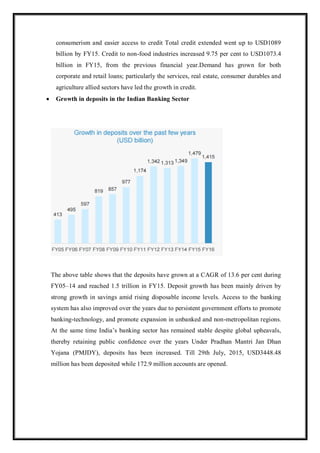
 Growth in deposits in the Indian Banking Sector
The above table shows that the deposits have grown at a CAGR of 13.6 per cent during
FY05–14 and reached 1.5 trillion in FY15. Deposit growth has been mainly driven by
strong growth in savings amid rising disposable income levels. Access to the banking
system has also improved over the years due to persistent government efforts to promote
banking-technology, and promote expansion in unbanked and non-metropolitan regions.
At the same time India‟s banking sector has remained stable despite global upheavals,
thereby retaining public confidence over the years Under Pradhan Mantri Jan Dhan
Yojana (PMJDY), deposits has been increased. Till 29th July, 2015, USD3448.48
million has been deposited while 172.9 million accounts are opened.
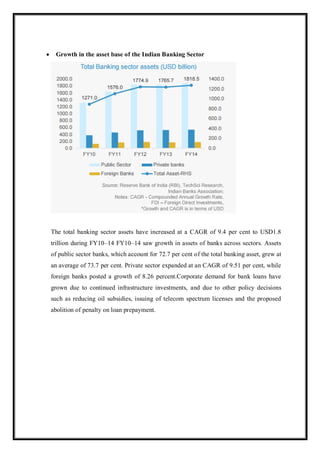
 Growth in the asset base of the Indian Banking Sector
The total banking sector assets have increased at a CAGR of 9.4 per cent to USD1.8
trillion during FY10–14 FY10–14 saw growth in assets of banks across sectors. Assets
of public sector banks, which account for 72.7 per cent of the total banking asset, grew at
an average of 73.7 per cent. Private sector expanded at an CAGR of 9.51 per cent, while
foreign banks posted a growth of 8.26 percent.Corporate demand for bank loans have
grown due to continued infrastructure investments, and due to other policy decisions
such as reducing oil subsidies, issuing of telecom spectrum licenses and the proposed
abolition of penalty on loan prepayment.
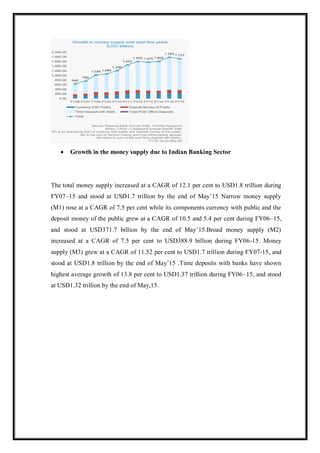
 Growth in the money supply due to Indian Banking Sector
The total money supply increased at a CAGR of 12.1 per cent to USD1.8 trillion during
FY07–15 and stood at USD1.7 trillion by the end of May‟15 Narrow money supply
(M1) rose at a CAGR of 7.5 per cent while its components currency with public and the
deposit money of the public grew at a CAGR of 10.5 and 5.4 per cent during FY06–15,
and stood at USD371.7 billion by the end of May‟15.Broad money supply (M2)
increased at a CAGR of 7.5 per cent to USD388.9 billion during FY06-15. Money
supply (M3) grew at a CAGR of 11.52 per cent to USD1.7 trillion during FY07-15, and
stood at USD1.8 trillion by the end of May‟15 .Time deposits with banks have shown
highest average growth of 13.8 per cent to USD1.37 trillion during FY06–15, and stood
at USD1.32 trillion by the end of May,15.
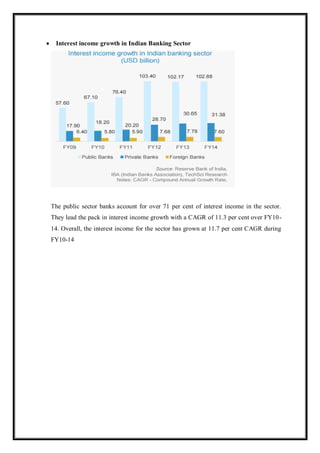
 Interest income growth in Indian Banking Sector
The public sector banks account for over 71 per cent of interest income in the sector.
They lead the pack in interest income growth with a CAGR of 11.3 per cent over FY10-
14. Overall, the interest income for the sector has grown at 11.7 per cent CAGR during
FY10-14
Mandatory Requirements
 As per the latest update of 4th August 2015, the RBI Remains Cautious and there was no
change in the policy Rates.
 The Repo rate under the liquidity adjustment facility (LAF) kept unchanged at 7.25 per
cent; the Reverse repo rate unchanged at 6.25 per cent, and the marginal standing
facility (MSF) rate and the Bank Rate at 8.25 per cent.
 CRR continues to be at 4% [As per Third Bi-monthly Monetary Policy Review, 2015-
16 presented on 4th August, 2015]
According to the Reserve Bank of India (RBI), the banking sector in India is sound,
adequately capitalised and well-regulated. Indian financial and economic conditions are
much better than in many other countries of the world. In spite of India being a
developing nation for over the years, credit, market and liquidity risk studies show that
Indian banks are generally resilient and have withstood the global downturn very well as
compared to all the other developing or developed nations across the world. With a sense
of optimism slowly creeping in, the banking industry in India is expecting that 2015 will
bring better growth prospects. This optimism stems from factors such as the new
government working hard to revitalise the industrial growth in the country and the RBI
initiating a number of measures that would go a long way in helping the banks to
restructure. The recent announcements of RBI, it is felt, are a clear pointer to the future
of the restructured domestic banking industry.
Consolidation in the Banking Industry (M&A Way)
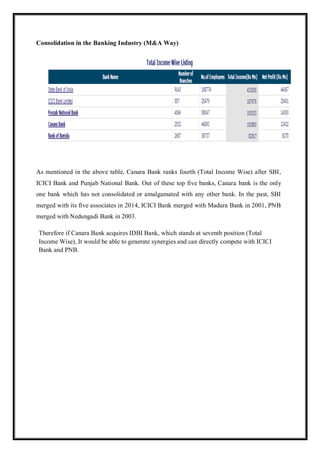
As mentioned in the above table, Canara Bank ranks fourth (Total Income Wise) after SBI,
ICICI Bank and Punjab National Bank. Out of these top five banks, Canara bank is the only
one bank which has not consolidated or amalgamated with any other bank. In the past, SBI
merged with its five associates in 2014, ICICI Bank merged with Madura Bank in 2001, PNB
merged with Nedungadi Bank in 2003.
Therefore if Canara Bank acquires IDBI Bank, which stands at seventh position (Total
Income Wise), It would be able to generate synergies and can directly compete with ICICI
Bank and PNB.
Consolidation of Canara Bank with IDBI Bank (Objective)
Overview of Canara Bank
 Over the years, Canara Bank has been scaling up its market position to emerge as a
major 'Financial Conglomerate' with as many as nine subsidiaries/sponsored
institutions/joint ventures in India and abroad.
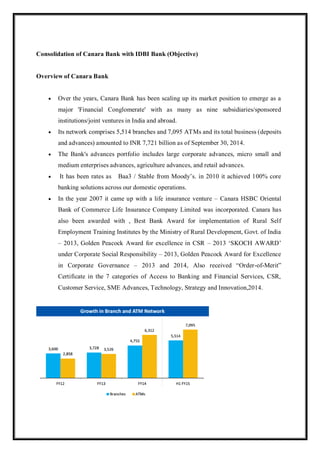
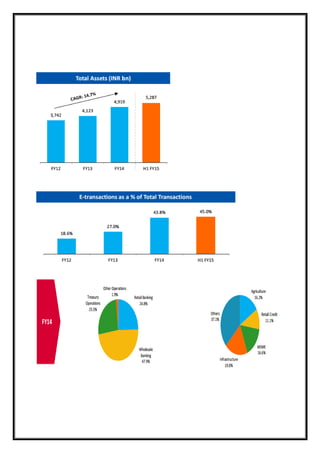
 Its network comprises 5,514 branches and 7,095 ATMs and its total business (deposits
and advances) amounted to INR 7,721 billion as of September 30, 2014.
 The Bank's advances portfolio includes large corporate advances, micro small and
medium enterprises advances, agriculture advances, and retail advances.
 It has been rates as Baa3 / Stable from Moody‟s. in 2010 it achieved 100% core
banking solutions across our domestic operations.
 In the year 2007 it came up with a life insurance venture – Canara HSBC Oriental
Bank of Commerce Life Insurance Company Limited was incorporated. Canara has
also been awarded with , Best Bank Award for implementation of Rural Self
Employment Training Institutes by the Ministry of Rural Development, Govt. of India
– 2013, Golden Peacock Award for excellence in CSR – 2013 „SKOCH AWARD‟
under Corporate Social Responsibility – 2013, Golden Peacock Award for Excellence
in Corporate Governance – 2013 and 2014, Also received “Order-of-Merit”
Certificate in the 7 categories of Access to Banking and Financial Services, CSR,
Customer Service, SME Advances, Technology, Strategy and Innovation,2014.
Areas of Improvement for Canara Bank
 Canara Bank has less number of corporate customers (wholesale banking).
IDBI Bank is known for its expertise in wholesale banking. Since Canara
Bank already has a considerable amount of retail banking , the consolidation
of both the banks would help Canara Bank in maximizing its customer base
even in wholesale banking
 As Canara Bank is less well equipped with technology as compared to IDBI
Bank (which uses the latest technology to support its core banking
operations), the consolidation would result in a technological sound entity
 The consolidation would result in increased profitability of Canara Bank
which would inturn increase the earnings of shareholders of Canara Bank
Reasons for selecting IDBI Bank(Target Bank) to get merged with Canara bank
 Inspite of being one of the leading public sector commercial banks in India, with
Government of India shareholding of 69.0% and a market capitalization of
approximately INR 186.4bn as of November 19, 2014, the Canara bank still has a
long way to go in becoming the top three banks in India.
 However, if it merges with IDBI bank, it will gain synergies and it will be able to
overcome few of its weakness and will become powerful than its competitors. Also, it
would be in a position to compete with the international banks in the long run.
Some of the main reasons for selecting IDBI Bank are as follows:
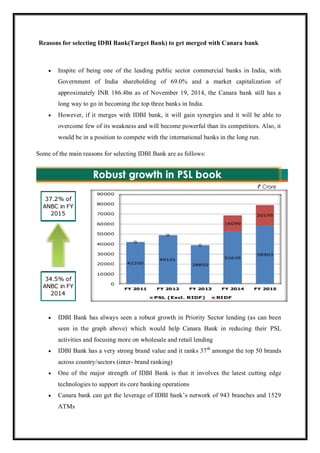
 IDBI Bank has always seen a robust growth in Priority Sector lending (as can been
seen in the graph above) which would help Canara Bank in reducing their PSL
activities and focusing more on wholesale and retail lending
 IDBI Bank has a very strong brand value and it ranks 37th
amongst the top 50 brands
across country/sectors (inter- brand ranking)
 One of the major strength of IDBI Bank is that it involves the latest cutting edge
technologies to support its core banking operations
 Canara bank can get the leverage of IDBI bank‟s network of 943 branches and 1529
ATMs
 The total turnover of IDBI bank is 3,37,584crores in the last FY 2010-11, and earned
a net profit of Rs.1650 Cr which would help in Canara Bank‟s growth. Also, if IDBI
would have incurred loss in any of the previous years, it would still be beneficial for
the Canara Bank to merge with IDBI bank since it would get tax benefits
 IDBI bank has grown at a rate of 60% compared to previous year which shows that it
would be lucrative for Canara Bank to have M&A with them.
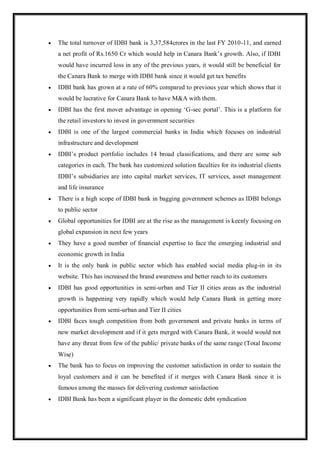
 IDBI has the first mover advantage in opening „G-sec portal‟. This is a platform for
the retail investors to invest in government securities
 IDBI is one of the largest commercial banks in India which focuses on industrial
infrastructure and development
 IDBI‟s product portfolio includes 14 broad classifications, and there are some sub
categories in each. The bank has customized solution faculties for its industrial clients
IDBI‟s subsidiaries are into capital market services, IT services, asset management
and life insurance
 There is a high scope of IDBI bank in bagging government schemes as IDBI belongs
to public sector
 Global opportunities for IDBI are at the rise as the management is keenly focusing on
global expansion in next few years
 They have a good number of financial expertise to face the emerging industrial and
economic growth in India
 It is the only bank in public sector which has enabled social media plug-in in its
website. This has increased the brand awareness and better reach to its customers
 IDBI has good opportunities in semi-urban and Tier II cities areas as the industrial
growth is happening very rapidly which would help Canara Bank in getting more
opportunities from semi-urban and Tier II cities
 IDBI faces tough competition from both government and private banks in terms of
new market development and if it gets merged with Canara Bank, it would would not
have any threat from few of the public/ private banks of the same range (Total Income
Wise)
 The bank has to focus on improving the customer satisfaction in order to sustain the
loyal customers and it can be benefited if it merges with Canara Bank since it is
famous among the masses for delivering customer satisfaction
 IDBI Bank has been a significant player in the domestic debt syndication
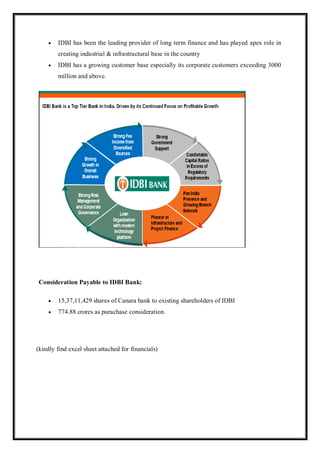
 IDBI has been the leading provider of long term finance and has played apex role in
creating industrial & infrastructural base in the country
 IDBI has a growing customer base especially its corporate customers exceeding 3000
million and above.
Consideration Payable to IDBI Bank:
 15,37,11,429 shares of Canara bank to existing shareholders of IDBI
 774.88 crores as purachase consideration.
(kindly find excel sheet attached for financials)
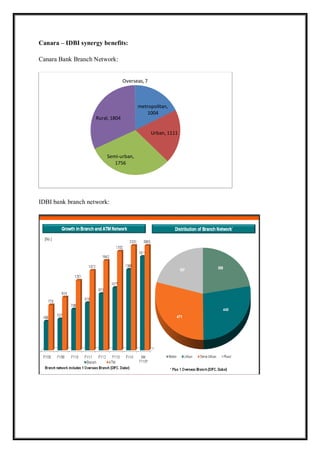
Canara – IDBI synergy benefits:
Canara Bank Branch Network:
IDBI bank branch network:
metropolitan,
1004
Urban, 1111
Semi-urban,
1756
Rural, 1804
Overseas,7
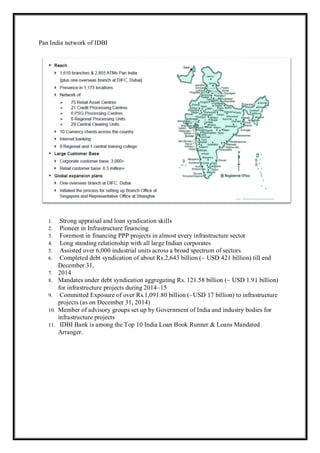
Pan India network of IDBI
1. Strong appraisal and loan syndication skills
2. Pioneer in Infrastructure financing
3. Foremost in financing PPP projects in almost every infrastructure sector
4. Long standing relationship with all large Indian corporates
5. Assisted over 6,000 industrial units across a broad spectrum of sectors
6. Completed debt syndication of about Rs.2,643 billion (~ USD 421 billion) till end
December 31,
7. 2014
8. Mandates under debt syndication aggregating Rs. 121.58 billion (~ USD 1.91 billion)
for infrastructure projects during 2014–15
9. Committed Exposure of over Rs.1,091.80 billion (~USD 17 billion) to infrastructure
projects (as on December 31, 2014)
10. Member of advisory groups set up by Government of India and industry bodies for
infrastructure projects
11. IDBI Bank is among the Top 10 India Loan Book Runner & Loans Mandated
Arranger.
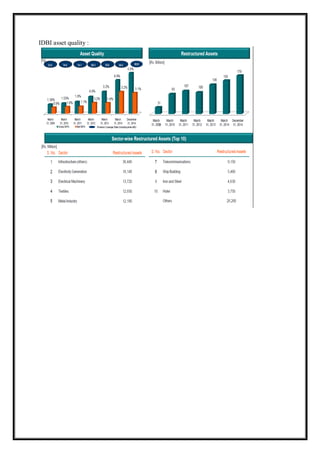
IDBI asset quality :
Synergy Benefit:
Benefits from government initiatives:
 According to us, both the banks are public sector banks and hence they will be
entitled to benefits given by government. Government have recently announced to
infuse 70000 crores in four phases (20000crores,20000 crore,10000 crores, 10000
crores) in PSBs to bring down their NPAs and make them more efficient and
compatible.
Operating Economies:
 Benefit of becoming big/ economies of scale can be achieved through reducing cost
and catering to large market, as we know IDBI has greater private sector lending
combined entity wil benefit as canara will reduce PSL and lend more and earnings
will increase.
 Increase profits by 15%, when at present both has 8% profits. And customer base will
increase by 30%
Geographical Expansion:
 Combined entity will now have 7285 branches pan India direct in competition with
ICICI, Punjab National Bank, and 8 international branches. That would be one of the
best advantage for both the banks.
 Canara bank has significant presence in Karnataka and IDBI in north-west hence
combined entity will have pan India presence.
 It will then have 2141 branches/30% in rural India.
Diversification:
 IDBI is specialised in industrial and infrastructure finance and lacks in customer
relations and retail banking whereas Canara has very good retail business will give
combined entity benefit of diversification. Both entities have technological inclusion
in operations to the great extent which will have greater efficiency and reduced cost.
Market Power:
 This merger will lead combined entity as 3rd
largest public sector bank after SBI and
ICICI and may lead to global expansion and facilitate universal banking. Combined
entity has anticipated growing at 15%. It will also grow as one stop shop for
customers.
Bibliography:
 www.nseindia.com/ http://www.nseindia.com
 IDBI Bank Website http://www.idbibank.com
 Canara Bank Website http://www.canarabank.com
 IBEF website http://www.ibef.com
 Economic Times
Website
http://www.economictimes.com
 RBI website http://www.rbi.org.in
 GK today website http://currentaffairs.gktoday.in/month/current-
affairs-2015-may
 Public Sector Banks |
Open Government
Data (OGD) Platform
India
https://data.gov.in/keywords/public-sector-
banks.com
 IDRBT | Banking
Technology Excellence
Awards
http://www.idrbt.ac.in
Journal Referred:
Journal of Banking, Information Technology and Management (July – December
2014)

TIMSR

  • 1.
    A Report on “Consolidationin Indian Banking Industry – M & A Way” Merger of IDBI Bank with Canara Bank Submitted to: N. L Dalmia Institute of Management Studies and Research Submitted By: Team United India (THAKUR INSTITUTE OF MANAGEMENT STUDIES AND RESEARCH)  Ankit Vora  Dhrumit Vithlani  Ekta Thakkar  Shibani Shetty
  • 2.
    Banking sector ata glance: The financial sector reforms set in motion in 1991 have greatly changed the face of Indian banking. While the banking system in India has done fairly well in adjusting to the new market dynamics, survived the global sub-prime financial crisis and is fairly sound and stable due to strong regulatory framework, it would not be clichéd to say again that greater challenges lie ahead.  Indian Banks will have to gear up to meet stringent prudential capital adequacy norms under Basel-II and Basel III as they compete with other banks with greater financial strength.  In the past, mergers and acquisitions were initiated by regulators to protect the interest of depositors of weak banks. But, it is now expected that market led mergers may gain momentum in the coming years. The Indian banking sector is fragmented, with 46 commercial banks jostling for business with dozens of foreign banks as well as rural and co-operative lenders.  There are currently 27 public sector banks in India out of which 20 are nationalised banks and 6 are State Bank of and its associate banks.  In 2011 IDBI was nationalised with 500cr capital and then on 8 March 2014, Bharatiya Mahela Bank was nationalised with 500cr capital. The state banks control 80% of the market, leaving relatively small shares for private rivals.  In 2015, values of public sector bank assets were USD1.4 Trillion. The total Indian banking sector assets has reached USD1.8 trillion in FY14 from USD1.3 trillion in FY10, with over 70 per cent accounted by the public sector. It is apparently predicted that the total asset size of the banking sector would be USD 28.5 trillion by FY25.  The total lending and deposits have increased at CAGR of 20.7 per cent and 19.7 per cent, respectively, during FY07-14 and are further poised for growth, backed by demand for housing and personal finance.  Total number of ATMs in India has increased to 182,480 by the end of April‟15 and is further expected to double over the next few years, thereby taking the number of ATMs per million populations from 105 in 2012, to about 300 in 2017.
  • 3.
     With theFinancial Inclusion Plan proposed by PM Narendra Modi, the banking connectivity in India increased more than threefold to 211,234 villages in 2013 from 67,694, at the beginning of the plan period. (In April 2014, after 12 years of its last issuance of bank license)  RBI granted in principle licenses to IDFC and Bandhan Microfinance to promote rural expansion. At the end of February 2015, 13.7 crore accounts had been opened under Pradhanmantri Jan Dhan Yojna (PMJDY) and 12.2 crore RuPay debit cards were issued. These new accounts have mobilised deposits of Rs 12,694 crore (US$ 2.01 billion). Standard & Poor‟s estimates that credit growth in India‟s banking sector would improve to 12-13 per cent in FY16 from less than 10% in the second half of CY14.
  • 4.
    Introduction: The Proposal highlightsthe need for consolidation in the Indian Banking Industry in wake of the growth in Indian economy, changes in banking regulations and increase in competition from foreign banks. It discusses the benefits of consolidation in terms of growth, integration of financial services, synergies, strategic benefits, ease of market entry and regulatory intervention. The question of restructuring the Indian banking industry has been a bone of contention for both the Government of India as well as the Reserve Bank of India. At present the Indian banking industry is highly fragmented in terms of size, competitiveness and other structural features which in turn reduce its operational efficiency and distribution efficiency. We have merged IDBI bank(having huge MSMEs and infrastructure lending and sound technology with industrial customer base) with Canara bank( having strong presence in south and large retail customer base) which may lead to win-win situation for both. To emphasize the need for consolidation, we can compare State Bank of India and Bank of America. SBI has a customer base of 90 to 100 million while Bank of America has a customer base of 30 million. But Bank of America‟s assets are about a trillion US dollars while SBI‟s assets are only about 93.75 billion US dollars. This shows that big banks are able to reduce costs and enhance revenues more easily than small banks. Also, when Tata Steel was acquiring Corus Group Plc (Corus) for 12.11 billion US dollars, no Indian PSB was big enough to finance the acquisition. Hence Indian banks need to enhance their balance sheets to enable wider extension of credit and meet the demands of fast economic development. SBI India‟s top bank has obtained 40th rank globally and ICICI has obtained 80th rank. This shows we are lagging behind in size, efficiency, technology, skilled labour, financial inclusion and globally incompatible.
  • 5.
    “Merger is agood idea. This is not a new idea, the Narasimham Committee report talked in terms of a lesser number of banks, a few which are of an internationally significant size, some which have a national presence and some which are regional banks. I think that is the way to go, you won't get there in a hurry. Size is important in banking. However you have got to merge the right banks for the right reasons. You should not merge banks because some bank is underperforming at some point of time. You have got to see whether there is synergy in the merger otherwise instead of having one weak bank you could end up with two weak banks as a result of merging a weak bank into one that is not so weak.” - M Damodaran Former Chairman, SEBI Generally merger of banks could be of four types: 1. Forced Merger : RBI take initiative to merge the banks that could give advantages to both the bank or it gives guidelines to absorb losses of weaker banks by merger and help them to survive, generally these kind of mergers have geographical synergy but may bring down the profit of acquirer. Example: merger of Bank of Baroda with Bank of benares.
  • 6.
    2. Market DrivenMerger: These mergers take place purely to take advantage of synergies. They are voluntary mergers to consolidate the position of resulting entity. Recent example is ING Vysya with Kotak Mahindra Bank. 3. Convergence of financial institution into bank: To take advantage of larger customer base and to increase asset size many financial institutes transforms into banks. Recent example is Bandhan and IDSC bank. 4. Regulatory Compulsion : The Bharat Overseas Bank was formed in 1973 with seven banks holding more than 5% stake which wasn‟t allowed as per RBI norms. Since IOB had the majority shares, it finally acquired Bharat Overseas Bank. Table-1- Number of forced and voluntary mergers from 1961-2014 Duration Number of Mergers (1961-1968) Pre-nationalization 46 (1969-1992) Nationalization 13 (1993-2006) Post-reform  Forced Mergers  Market driven Mergers  Convergence of Financial Institutions into Banks  Regulatory Compulsions 35 13 16 4 2 Total number of mergers 94
  • 7.
    Macro-Economic Overview:  Recoveryin major global economies was slow and uneven. However, Indian economy during the year showed improvement over the previous year.  As per the provisional estimates released by the Central Statistical Organization (CSO), India‟s gross value added (GVA) at basic prices grew by 7.2% for 2014-15, higher compared to 6.6% recorded during 2013-14.  Agriculture and allied activities recorded a growth of 0.2% compared to 3.7% last year. Mining & quarrying grew by 2.4% compared to 5.4% last year.  Manufacturing sector grew higher by 7.1% compared to 5.3% in the previous year. Construction grew higher by 4.8% against 2.5% last year. Electricity, gas, water and other utility services grew higher by 7.9% compared to 4.8% last year.  In the services segments, trade, hotels, transport and communication and services related to broadcasting grew by 10.7% (11.1% last year), financial, real estate and professional services grew by 11.5% (7.9%) and public administration, defence and other services grew by 7.2% (7.9%).  Inflation rates, both wholesale price and consumer price indices have been moderating from their peaks. While consumer price index-based inflation was at 5.25% in March 2015, wholesale price index-based inflation was at negative 2.33%.  External trade sector remained weak in the beginning of the year and started contracting since December 2014. As per the provisional data released by the Directorate General of Commercial Intelligence and Statistics (DGCI&S), merchandise exports declined by 1.24% to US$310.53 billion compared to US$314.42 billion last year, primarily due to sluggish overseas demand. Imports declined by 0.6% to US$447.55 billion, owing to lower crude prices and reduction in both oil and non-oil imports. Trade deficit stood at US$137 billion during the year
  • 8.
    compared to US$136billion last year.  Consequently, country‟s Current Account Deficit (CAD) is estimated to be 1.3% of gross domestic product, lower than 1.7% last year with the announcement of numerous measures both by the Central Government and Reserve Bank of India to revive the economy.  Macroeconomic scenario in India is showing improvement from the growth slowdown that occurred in the recent years. Business sentiments have improved, drawing attention and confidence of both domestic and overseas investors on the sustainable India growth story.
  • 9.
    Monetary and Bankingdevelopments:  Growth in key monetary aggregates and money supply in 2014-15 reflected the changing liquidity conditions arising from domestic and global financial environment.  The monetary policy stance during the year was primarily to contain inflation and manage liquidity.  Money supply (M3) growth, which was 13.6% at the beginning of the financial year, moderated to 11.1% by end-March 2015. During the year, while aggregate deposits growth of Scheduled Commercial Banks (SCBs) was at 11.4% compared to previous year growth at 14.1%, credit growth came down to a single–digit at 9.5% against a growth of 13.9% last year. The credit-deposits ratio remained high at 76.46% as on March 2015.  Banking sector is largely influenced by the overall macroeconomic activities. Due to economic slowdown in the recent years, the banking sector continued to reel under stressed scenario, which is clearly reflected on business growth, asset quality and profitability.  Growth in credit off-takes in Indian Banking Sector  The above image shows that the credit off-take has been surging ahead over the past decade, aided by strong economic growth, rising disposable incomes, increasing
  • 10.
    consumerism and easieraccess to credit Total credit extended went up to USD1089 billion by FY15. Credit to non-food industries increased 9.75 per cent to USD1073.4 billion in FY15, from the previous financial year.Demand has grown for both corporate and retail loans; particularly the services, real estate, consumer durables and agriculture allied sectors have led the growth in credit.  Growth in deposits in the Indian Banking Sector The above table shows that the deposits have grown at a CAGR of 13.6 per cent during FY05–14 and reached 1.5 trillion in FY15. Deposit growth has been mainly driven by strong growth in savings amid rising disposable income levels. Access to the banking system has also improved over the years due to persistent government efforts to promote banking-technology, and promote expansion in unbanked and non-metropolitan regions. At the same time India‟s banking sector has remained stable despite global upheavals, thereby retaining public confidence over the years Under Pradhan Mantri Jan Dhan Yojana (PMJDY), deposits has been increased. Till 29th July, 2015, USD3448.48 million has been deposited while 172.9 million accounts are opened.
  • 11.
     Growth inthe asset base of the Indian Banking Sector The total banking sector assets have increased at a CAGR of 9.4 per cent to USD1.8 trillion during FY10–14 FY10–14 saw growth in assets of banks across sectors. Assets of public sector banks, which account for 72.7 per cent of the total banking asset, grew at an average of 73.7 per cent. Private sector expanded at an CAGR of 9.51 per cent, while foreign banks posted a growth of 8.26 percent.Corporate demand for bank loans have grown due to continued infrastructure investments, and due to other policy decisions such as reducing oil subsidies, issuing of telecom spectrum licenses and the proposed abolition of penalty on loan prepayment.
  • 12.
     Growth inthe money supply due to Indian Banking Sector The total money supply increased at a CAGR of 12.1 per cent to USD1.8 trillion during FY07–15 and stood at USD1.7 trillion by the end of May‟15 Narrow money supply (M1) rose at a CAGR of 7.5 per cent while its components currency with public and the deposit money of the public grew at a CAGR of 10.5 and 5.4 per cent during FY06–15, and stood at USD371.7 billion by the end of May‟15.Broad money supply (M2) increased at a CAGR of 7.5 per cent to USD388.9 billion during FY06-15. Money supply (M3) grew at a CAGR of 11.52 per cent to USD1.7 trillion during FY07-15, and stood at USD1.8 trillion by the end of May‟15 .Time deposits with banks have shown highest average growth of 13.8 per cent to USD1.37 trillion during FY06–15, and stood at USD1.32 trillion by the end of May,15.
  • 13.
     Interest incomegrowth in Indian Banking Sector The public sector banks account for over 71 per cent of interest income in the sector. They lead the pack in interest income growth with a CAGR of 11.3 per cent over FY10- 14. Overall, the interest income for the sector has grown at 11.7 per cent CAGR during FY10-14
  • 14.
    Mandatory Requirements  Asper the latest update of 4th August 2015, the RBI Remains Cautious and there was no change in the policy Rates.  The Repo rate under the liquidity adjustment facility (LAF) kept unchanged at 7.25 per cent; the Reverse repo rate unchanged at 6.25 per cent, and the marginal standing facility (MSF) rate and the Bank Rate at 8.25 per cent.  CRR continues to be at 4% [As per Third Bi-monthly Monetary Policy Review, 2015- 16 presented on 4th August, 2015] According to the Reserve Bank of India (RBI), the banking sector in India is sound, adequately capitalised and well-regulated. Indian financial and economic conditions are much better than in many other countries of the world. In spite of India being a developing nation for over the years, credit, market and liquidity risk studies show that Indian banks are generally resilient and have withstood the global downturn very well as compared to all the other developing or developed nations across the world. With a sense of optimism slowly creeping in, the banking industry in India is expecting that 2015 will bring better growth prospects. This optimism stems from factors such as the new government working hard to revitalise the industrial growth in the country and the RBI initiating a number of measures that would go a long way in helping the banks to restructure. The recent announcements of RBI, it is felt, are a clear pointer to the future of the restructured domestic banking industry.
  • 15.
    Consolidation in theBanking Industry (M&A Way) As mentioned in the above table, Canara Bank ranks fourth (Total Income Wise) after SBI, ICICI Bank and Punjab National Bank. Out of these top five banks, Canara bank is the only one bank which has not consolidated or amalgamated with any other bank. In the past, SBI merged with its five associates in 2014, ICICI Bank merged with Madura Bank in 2001, PNB merged with Nedungadi Bank in 2003. Therefore if Canara Bank acquires IDBI Bank, which stands at seventh position (Total Income Wise), It would be able to generate synergies and can directly compete with ICICI Bank and PNB.
  • 16.
    Consolidation of CanaraBank with IDBI Bank (Objective) Overview of Canara Bank  Over the years, Canara Bank has been scaling up its market position to emerge as a major 'Financial Conglomerate' with as many as nine subsidiaries/sponsored institutions/joint ventures in India and abroad.  Its network comprises 5,514 branches and 7,095 ATMs and its total business (deposits and advances) amounted to INR 7,721 billion as of September 30, 2014.  The Bank's advances portfolio includes large corporate advances, micro small and medium enterprises advances, agriculture advances, and retail advances.  It has been rates as Baa3 / Stable from Moody‟s. in 2010 it achieved 100% core banking solutions across our domestic operations.  In the year 2007 it came up with a life insurance venture – Canara HSBC Oriental Bank of Commerce Life Insurance Company Limited was incorporated. Canara has also been awarded with , Best Bank Award for implementation of Rural Self Employment Training Institutes by the Ministry of Rural Development, Govt. of India – 2013, Golden Peacock Award for excellence in CSR – 2013 „SKOCH AWARD‟ under Corporate Social Responsibility – 2013, Golden Peacock Award for Excellence in Corporate Governance – 2013 and 2014, Also received “Order-of-Merit” Certificate in the 7 categories of Access to Banking and Financial Services, CSR, Customer Service, SME Advances, Technology, Strategy and Innovation,2014.
  • 18.
    Areas of Improvementfor Canara Bank  Canara Bank has less number of corporate customers (wholesale banking). IDBI Bank is known for its expertise in wholesale banking. Since Canara Bank already has a considerable amount of retail banking , the consolidation of both the banks would help Canara Bank in maximizing its customer base even in wholesale banking  As Canara Bank is less well equipped with technology as compared to IDBI Bank (which uses the latest technology to support its core banking operations), the consolidation would result in a technological sound entity  The consolidation would result in increased profitability of Canara Bank which would inturn increase the earnings of shareholders of Canara Bank
  • 19.
    Reasons for selectingIDBI Bank(Target Bank) to get merged with Canara bank  Inspite of being one of the leading public sector commercial banks in India, with Government of India shareholding of 69.0% and a market capitalization of approximately INR 186.4bn as of November 19, 2014, the Canara bank still has a long way to go in becoming the top three banks in India.  However, if it merges with IDBI bank, it will gain synergies and it will be able to overcome few of its weakness and will become powerful than its competitors. Also, it would be in a position to compete with the international banks in the long run. Some of the main reasons for selecting IDBI Bank are as follows:  IDBI Bank has always seen a robust growth in Priority Sector lending (as can been seen in the graph above) which would help Canara Bank in reducing their PSL activities and focusing more on wholesale and retail lending  IDBI Bank has a very strong brand value and it ranks 37th amongst the top 50 brands across country/sectors (inter- brand ranking)  One of the major strength of IDBI Bank is that it involves the latest cutting edge technologies to support its core banking operations  Canara bank can get the leverage of IDBI bank‟s network of 943 branches and 1529 ATMs
  • 20.
     The totalturnover of IDBI bank is 3,37,584crores in the last FY 2010-11, and earned a net profit of Rs.1650 Cr which would help in Canara Bank‟s growth. Also, if IDBI would have incurred loss in any of the previous years, it would still be beneficial for the Canara Bank to merge with IDBI bank since it would get tax benefits  IDBI bank has grown at a rate of 60% compared to previous year which shows that it would be lucrative for Canara Bank to have M&A with them.  IDBI has the first mover advantage in opening „G-sec portal‟. This is a platform for the retail investors to invest in government securities  IDBI is one of the largest commercial banks in India which focuses on industrial infrastructure and development  IDBI‟s product portfolio includes 14 broad classifications, and there are some sub categories in each. The bank has customized solution faculties for its industrial clients IDBI‟s subsidiaries are into capital market services, IT services, asset management and life insurance  There is a high scope of IDBI bank in bagging government schemes as IDBI belongs to public sector  Global opportunities for IDBI are at the rise as the management is keenly focusing on global expansion in next few years  They have a good number of financial expertise to face the emerging industrial and economic growth in India  It is the only bank in public sector which has enabled social media plug-in in its website. This has increased the brand awareness and better reach to its customers  IDBI has good opportunities in semi-urban and Tier II cities areas as the industrial growth is happening very rapidly which would help Canara Bank in getting more opportunities from semi-urban and Tier II cities  IDBI faces tough competition from both government and private banks in terms of new market development and if it gets merged with Canara Bank, it would would not have any threat from few of the public/ private banks of the same range (Total Income Wise)  The bank has to focus on improving the customer satisfaction in order to sustain the loyal customers and it can be benefited if it merges with Canara Bank since it is famous among the masses for delivering customer satisfaction  IDBI Bank has been a significant player in the domestic debt syndication
  • 21.
     IDBI hasbeen the leading provider of long term finance and has played apex role in creating industrial & infrastructural base in the country  IDBI has a growing customer base especially its corporate customers exceeding 3000 million and above. Consideration Payable to IDBI Bank:  15,37,11,429 shares of Canara bank to existing shareholders of IDBI  774.88 crores as purachase consideration. (kindly find excel sheet attached for financials)
  • 22.
    Canara – IDBIsynergy benefits: Canara Bank Branch Network: IDBI bank branch network: metropolitan, 1004 Urban, 1111 Semi-urban, 1756 Rural, 1804 Overseas,7
  • 23.
    Pan India networkof IDBI 1. Strong appraisal and loan syndication skills 2. Pioneer in Infrastructure financing 3. Foremost in financing PPP projects in almost every infrastructure sector 4. Long standing relationship with all large Indian corporates 5. Assisted over 6,000 industrial units across a broad spectrum of sectors 6. Completed debt syndication of about Rs.2,643 billion (~ USD 421 billion) till end December 31, 7. 2014 8. Mandates under debt syndication aggregating Rs. 121.58 billion (~ USD 1.91 billion) for infrastructure projects during 2014–15 9. Committed Exposure of over Rs.1,091.80 billion (~USD 17 billion) to infrastructure projects (as on December 31, 2014) 10. Member of advisory groups set up by Government of India and industry bodies for infrastructure projects 11. IDBI Bank is among the Top 10 India Loan Book Runner & Loans Mandated Arranger.
  • 24.
  • 25.
    Synergy Benefit: Benefits fromgovernment initiatives:  According to us, both the banks are public sector banks and hence they will be entitled to benefits given by government. Government have recently announced to infuse 70000 crores in four phases (20000crores,20000 crore,10000 crores, 10000 crores) in PSBs to bring down their NPAs and make them more efficient and compatible. Operating Economies:  Benefit of becoming big/ economies of scale can be achieved through reducing cost and catering to large market, as we know IDBI has greater private sector lending combined entity wil benefit as canara will reduce PSL and lend more and earnings will increase.  Increase profits by 15%, when at present both has 8% profits. And customer base will increase by 30% Geographical Expansion:  Combined entity will now have 7285 branches pan India direct in competition with ICICI, Punjab National Bank, and 8 international branches. That would be one of the best advantage for both the banks.  Canara bank has significant presence in Karnataka and IDBI in north-west hence combined entity will have pan India presence.  It will then have 2141 branches/30% in rural India. Diversification:  IDBI is specialised in industrial and infrastructure finance and lacks in customer relations and retail banking whereas Canara has very good retail business will give combined entity benefit of diversification. Both entities have technological inclusion in operations to the great extent which will have greater efficiency and reduced cost.
  • 26.
    Market Power:  Thismerger will lead combined entity as 3rd largest public sector bank after SBI and ICICI and may lead to global expansion and facilitate universal banking. Combined entity has anticipated growing at 15%. It will also grow as one stop shop for customers. Bibliography:  www.nseindia.com/ http://www.nseindia.com  IDBI Bank Website http://www.idbibank.com  Canara Bank Website http://www.canarabank.com  IBEF website http://www.ibef.com  Economic Times Website http://www.economictimes.com  RBI website http://www.rbi.org.in  GK today website http://currentaffairs.gktoday.in/month/current- affairs-2015-may  Public Sector Banks | Open Government Data (OGD) Platform India https://data.gov.in/keywords/public-sector- banks.com  IDRBT | Banking Technology Excellence Awards http://www.idrbt.ac.in Journal Referred: Journal of Banking, Information Technology and Management (July – December 2014)