PRESENTED BY:-
SHAILA PANCHAL
M.SC NURSING IIND YEAR
(COMMUNITY HEALTH NURSNG
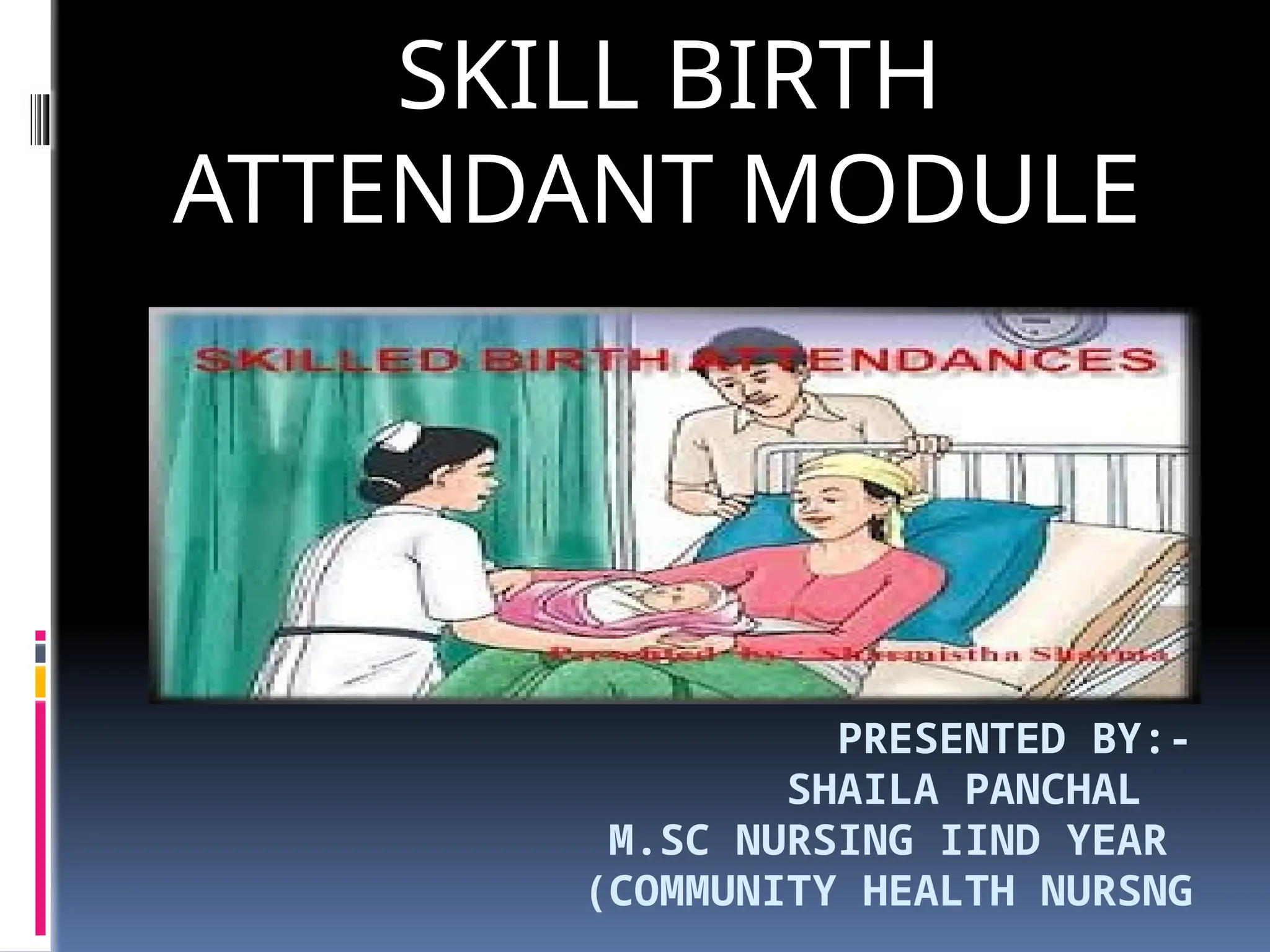
SKILL BIRTH
ATTENDANT MODULE
INTRODUCTION
 A birth attendant, also known as "skilled birth
attendant" ("SBA"), is a midwife, physician,
obstetrician, nurse, or other health care
professional who provides basic and
emergency health care services to women and
their newborns during pregnancy, childbirth
and the postpartum period.
Cont……
 International evidence based practices have
demonstrated that the presence of a skilled birth
attendant at birth can effectively reduce maternal
mortality, and that a package of essential obstetric
services provided close to the woman’s home in the
event of an obstetric emergency is successful in
reducing maternal mortality.
SBA MODULE
 Module 1: Management of normal pregnancy,
labor and the postpartum period
 Module 2: Management of common obstetric
complications, Management of complications
during pregnancy, labor and delivery, and in
the postpartum period
 Module 3: Ensuring the quality of care
SBA MODULE -1
CARE DURING PREGNANCY—ANTENATAL CARE
Key message -
 Register every pregnancy within 12 weeks.
 Track every pregnancy by name for provision of quality ANC, skilled
birth attendance and postnatal services.
 Ensure four antenatal visits to monitor the progress of pregnancy.
 This includes the registration and 1st ANC in the fi rst trimester.
 Give every pregnant woman Tetanus Toxoid (TT) injections and Iron
Folic Acid (IFA) supplementation.
 Test the blood for haemoglobin, urine for sugar and protein at
EVERY VISIT.
 Record blood pressure and weight at EVERY VISIT.
 Advise and encourage the woman to opt (Obstetrics and
Periodontal Therapy )for institutional delivery.
 Maintain proper records for better case
management and follow up.
 Do not give a pregnant woman any medication
during the first trimester unless advised by a
physician.
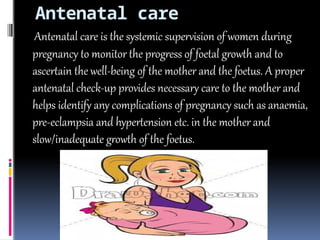
Antenatal care
Antenatal care is the systemic supervision of women during
pregnancy to monitor the progress of foetal growth and to
ascertain the well-being of the mother and the foetus. A proper
antenatal check-up provides necessary care to the mother and
helps identify any complications of pregnancy such as anaemia,
pre-eclampsia and hypertension etc. in the mother and
slow/inadequate growth of the foetus.
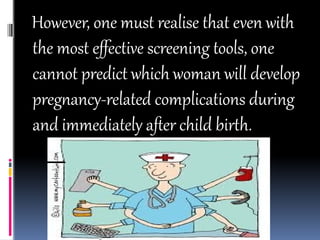
However, one must realise that even with
the most effective screening tools, one
cannot predict which woman will develop
pregnancy-related complications during
and immediately after child birth.
ANM responsibility
 Recognise that ‘Every pregnancy is special
and every pregnant woman must receive
special care’.
 Complications being unpredictable may
happen in any pregnancy/child birth and
we should be ready to deal with them if
and whenever they happen.
 Ensure that ANC is used as an
opportunity to detect and treat existing
problems, e.g. essential hypertension.
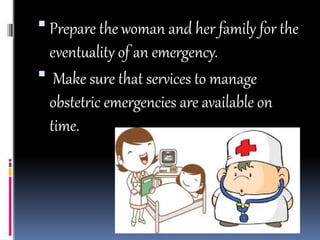
 Prepare the woman and her family for the
eventuality of an emergency.
 Make sure that services to manage
obstetric emergencies are available on
time.
Quality ANC has
several components
A. A few primary steps:
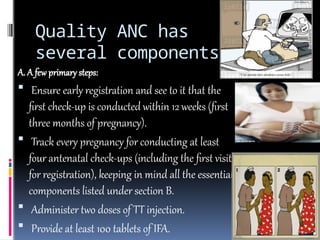
 Ensure early registration and see to it that the
first check-up is conducted within 12 weeks (first
three months of pregnancy).
 Track every pregnancy for conducting at least
four antenatal check-ups (including the first visit
for registration), keeping in mind all the essential
components listed under section B.
 Administer two doses of TT injection.
 Provide at least 100 tablets of IFA.
B. Essential components
of every antenatal check-
up:
 Take the patient’s history.
 Conduct a physical examination–measure the weight, blood
pressure and respiratory rate and check for pallor and oedema.
 Conduct abdominal palpation for foetal growth, foetal lie and
auscultation of Foetal
 Heart Sound (FHS) according to the stage of pregnancy.
 Carry out laboratory investigations, such as haemoglobin
estimation and urine tests (for sugar and proteins).
C. Desirable components
 Determine the blood group, including the Rh factor.
 Conduct the Venereal Disease Research Laboratory
(VDRL)/Rapid Plasma Reagin
 (RPR) test to rule out syphilis.
 Test the woman for Human Immuno defi ciency Virus
(HIV*).
 Check the blood sugar.
 Carry out the Hepatitis B Surface Antigen (HBsAg) test.
D. Counselling
 Help the woman to plan and prepare for birth (birth
preparedness/micro birth plan).
 This should include deciding on the place of delivery and the presence of
an attendant at the time of the delivery.
 Advantages of institutional deliveries and risks involved in home
deliveries.
 Advise the woman on where to go if an emergency arises, and how to
arrange for transportation, money and blood donors in case of an
emergency.
 Educate the woman and her family members on signs of labour and
danger signs of obstetric complications.
 Emphasise the importance of seeking ANC and PNC.
 Advise on diet (nutrition) and rest.
 Inform the woman about breastfeeding, including
exclusive breastfeeding.
 Provide information on sex during pregnancy.
 Warn against domestic violence (explain the consequences
of violence on a pregnant
 woman and her foetus).
 Promote family planning.
 Inform the woman about the Janani Suraksha Yojana
( JSY)/any other incentives offered by the state.
Tie up with the nearest Integrated Counselling
and Testing Centre (ICTC)/Prevention of
Parent-to-Child Transmission (PPTCT) facility
for counselling and testing for HIV.
Early registration
1. Timing of the first visit/registration
Early detection of pregnancy is important for the following reasons:
 It facilitates proper planning and allows for adequate care to be provided
during pregnancy for both the mother and the foetus.
 Record the date of the Last Menstrual Period (LMP), and calculate the
Expected Date of Delivery (EDD).
 The health status of the mother can be assessed and any medical illness
that she might be suffering from can be detected and also to obtain/record
baseline information (on blood pressure, weight, haemoglobin, etc.)
 Helps in timely detection of complications at an early stage and
manage them appropriately by referral as and where required.
 This also helps in providing the woman the option of an early
abortion.
sba module for M.Sc Nursing And B.Sc 5th sem

sba module for M.Sc Nursing And B.Sc 5th sem

  • 1.
    PRESENTED BY:- SHAILA PANCHAL M.SCNURSING IIND YEAR (COMMUNITY HEALTH NURSNG SKILL BIRTH ATTENDANT MODULE
  • 2.
    INTRODUCTION  A birthattendant, also known as "skilled birth attendant" ("SBA"), is a midwife, physician, obstetrician, nurse, or other health care professional who provides basic and emergency health care services to women and their newborns during pregnancy, childbirth and the postpartum period.
  • 3.
    Cont……  International evidencebased practices have demonstrated that the presence of a skilled birth attendant at birth can effectively reduce maternal mortality, and that a package of essential obstetric services provided close to the woman’s home in the event of an obstetric emergency is successful in reducing maternal mortality.
  • 4.
    SBA MODULE  Module1: Management of normal pregnancy, labor and the postpartum period  Module 2: Management of common obstetric complications, Management of complications during pregnancy, labor and delivery, and in the postpartum period  Module 3: Ensuring the quality of care
  • 5.
    SBA MODULE -1 CAREDURING PREGNANCY—ANTENATAL CARE Key message -  Register every pregnancy within 12 weeks.  Track every pregnancy by name for provision of quality ANC, skilled birth attendance and postnatal services.  Ensure four antenatal visits to monitor the progress of pregnancy.  This includes the registration and 1st ANC in the fi rst trimester.  Give every pregnant woman Tetanus Toxoid (TT) injections and Iron Folic Acid (IFA) supplementation.  Test the blood for haemoglobin, urine for sugar and protein at EVERY VISIT.
  • 6.
     Record bloodpressure and weight at EVERY VISIT.  Advise and encourage the woman to opt (Obstetrics and Periodontal Therapy )for institutional delivery.  Maintain proper records for better case management and follow up.  Do not give a pregnant woman any medication during the first trimester unless advised by a physician.
  • 7.
    Antenatal care Antenatal careis the systemic supervision of women during pregnancy to monitor the progress of foetal growth and to ascertain the well-being of the mother and the foetus. A proper antenatal check-up provides necessary care to the mother and helps identify any complications of pregnancy such as anaemia, pre-eclampsia and hypertension etc. in the mother and slow/inadequate growth of the foetus.
  • 8.
    However, one mustrealise that even with the most effective screening tools, one cannot predict which woman will develop pregnancy-related complications during and immediately after child birth.
  • 9.
    ANM responsibility  Recognisethat ‘Every pregnancy is special and every pregnant woman must receive special care’.  Complications being unpredictable may happen in any pregnancy/child birth and we should be ready to deal with them if and whenever they happen.  Ensure that ANC is used as an opportunity to detect and treat existing problems, e.g. essential hypertension.
  • 10.
     Prepare thewoman and her family for the eventuality of an emergency.  Make sure that services to manage obstetric emergencies are available on time.
  • 11.
    Quality ANC has severalcomponents A. A few primary steps:  Ensure early registration and see to it that the first check-up is conducted within 12 weeks (first three months of pregnancy).  Track every pregnancy for conducting at least four antenatal check-ups (including the first visit for registration), keeping in mind all the essential components listed under section B.  Administer two doses of TT injection.  Provide at least 100 tablets of IFA.
  • 12.
    B. Essential components ofevery antenatal check- up:  Take the patient’s history.  Conduct a physical examination–measure the weight, blood pressure and respiratory rate and check for pallor and oedema.  Conduct abdominal palpation for foetal growth, foetal lie and auscultation of Foetal  Heart Sound (FHS) according to the stage of pregnancy.  Carry out laboratory investigations, such as haemoglobin estimation and urine tests (for sugar and proteins).
  • 13.
    C. Desirable components Determine the blood group, including the Rh factor.  Conduct the Venereal Disease Research Laboratory (VDRL)/Rapid Plasma Reagin  (RPR) test to rule out syphilis.  Test the woman for Human Immuno defi ciency Virus (HIV*).  Check the blood sugar.  Carry out the Hepatitis B Surface Antigen (HBsAg) test.
  • 14.
    D. Counselling  Helpthe woman to plan and prepare for birth (birth preparedness/micro birth plan).  This should include deciding on the place of delivery and the presence of an attendant at the time of the delivery.  Advantages of institutional deliveries and risks involved in home deliveries.  Advise the woman on where to go if an emergency arises, and how to arrange for transportation, money and blood donors in case of an emergency.  Educate the woman and her family members on signs of labour and danger signs of obstetric complications.
  • 15.
     Emphasise theimportance of seeking ANC and PNC.  Advise on diet (nutrition) and rest.  Inform the woman about breastfeeding, including exclusive breastfeeding.  Provide information on sex during pregnancy.  Warn against domestic violence (explain the consequences of violence on a pregnant  woman and her foetus).  Promote family planning.  Inform the woman about the Janani Suraksha Yojana ( JSY)/any other incentives offered by the state.
  • 16.
    Tie up withthe nearest Integrated Counselling and Testing Centre (ICTC)/Prevention of Parent-to-Child Transmission (PPTCT) facility for counselling and testing for HIV.
  • 17.
    Early registration 1. Timingof the first visit/registration Early detection of pregnancy is important for the following reasons:  It facilitates proper planning and allows for adequate care to be provided during pregnancy for both the mother and the foetus.  Record the date of the Last Menstrual Period (LMP), and calculate the Expected Date of Delivery (EDD).  The health status of the mother can be assessed and any medical illness that she might be suffering from can be detected and also to obtain/record baseline information (on blood pressure, weight, haemoglobin, etc.)
  • 18.
     Helps intimely detection of complications at an early stage and manage them appropriately by referral as and where required.  This also helps in providing the woman the option of an early abortion.