The 1940s

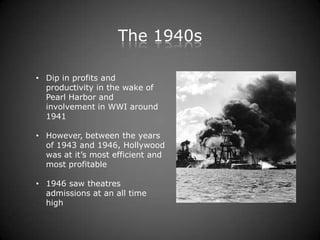
• Dip in profits and
  productivity in the wake of
  Pearl Harbor and
  involvement in WWI around
  1941

• However, between the years
  of 1943 and 1946, Hollywood
  was at it’s most efficient and
  most profitable

• 1946 saw theatres
  admissions at an all time
  high
The 1940s
• Hollywood responded to the
  war effort whether as
  combatants, propagandists,
  documentary, newsreel or
  short film-makers,
  educators, fund-raisers for
  relief funds or war bonds,
  entertainers, or morale-
  boosters

• Films started to take on a         Clarke Gable joined the Air
  more realistic and escapist        Force in 1943
  tone

•   Male actors were in short
    supply as many of them
    enlisted or were called up for
    duty
The 1940s
• Anti-fascist films were one
  way of attacking the Nazi
  dictators and fascism

• Baring in mind, many of the
  top dogs at the big
  Hollywood studios were from
  oppressed countries or were
  Jewish, undertones of anti-
  fascism and even blatant
  propaganda was not
  uncommon

• Even German actors risked
  their own popularity by
  playing detestable Nazi
  characters
The Birth of Film Noir
            •   Film Noir films depicted the
                way Hollywood felt as it faced
                its greatest challenges during
                the war and post-war periods -
                darker and more cynical

            •   The somber, pessimistic
                'genre', literally meaning
                "black film,” was already
                germinating and evolving from
                30s gangster films - with dark
                plots, untrustworthy femme
                fatales, and tough, but
                cynical, fatalistic heroes

            •   Has its roots in German
                expressionism
The Birth of Film Noir
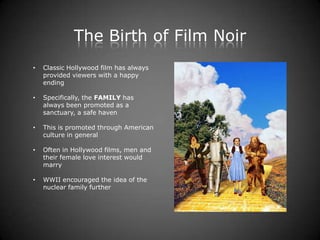
•   Classic Hollywood film has always
    provided viewers with a happy
    ending

•   Specifically, the FAMILY has
    always been promoted as a
    sanctuary, a safe haven

•   This is promoted through American
    culture in general

•   Often in Hollywood films, men and
    their female love interest would
    marry

•   WWII encouraged the idea of the
    nuclear family further
The Birth of Film Noir
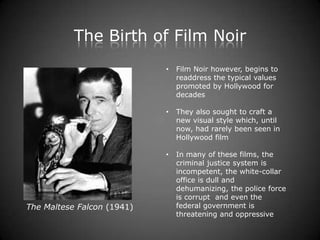
                            •   Film Noir however, begins to
                                readdress the typical values
                                promoted by Hollywood for
                                decades

                            •   They also sought to craft a
                                new visual style which, until
                                now, had rarely been seen in
                                Hollywood film

                            •   In many of these films, the
                                criminal justice system is
                                incompetent, the white-collar
                                office is dull and
                                dehumanizing, the police force
                                is corrupt and even the
The Maltese Falcon (1941)       federal government is
                                threatening and oppressive
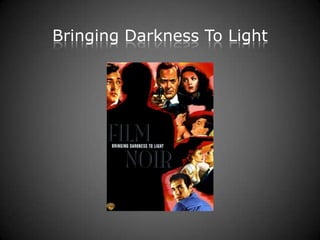
Bringing Darkness To Light
Women in Noir
With few variations, noir films divide women into three
categories:

1. The femme fatale, an independent, ambitious woman who
   feels confined within a marriage or a close male-female
   relationship and attempts to break free, usually with violent
   results;

2. The nurturing woman, who is often depicted as dull,
   featureless, and, in the end, unattainable — a chance at
   conventional marriage that is denied to the hero;

3. The "marrying type," a woman who threatens the hero by
   insisting that he marry her and accept his conventional role
   as husband and father. Each type of film noir woman
   functions in a way that undermines society's image of the
   traditional family.
Women in Noir
• Noir films usually stop short of rejecting the family altogether.

• While criticizing the family and marriage in a fairly overt
  way, film noir cannot resist the urge to restore or reinforce the
  family, even if it is only at the last minute.

• This restoration involves punishing or destroying women (and
  men) who transgress the boundaries of "normal" family
  relations or providing a tacked-on "happy ending" in which the
  hero marries the nurturing woman or even a converted femme
  fatale who has learned to accept her proper role.

• In either case, the ending contradicts the content and style of
  the film itself.
Women American Culture


•   Nina Leibman:

    ‘The dominant social imperative
    of post-war America with its
    emphasis on the importance of
    nuclear family life, the proper role
    of the sexes, the superiority of
    suburbia. . . .

    McCall's magazine launched an
    issue on family "togetherness" as
    the crucial factor in the family
    enclave.
Women American Culture
•   Nina Leibman:

    ‘Housewifery became professionalized
    with a plethora of books and articles
    extolling the virtues of domesticity and
    urging women to leave their "Rosie-the-
    Riveter" jobs for the less tangible
    rewards of child-rearing and
    housekeeping.

    In addition, these articles cautioned
    both men and women to assume their
    proper roles lest their aberrant
    behaviour result in untold psychological
    trauma’

    On The Big Heart (1953) ‘…very much
    constructed along traditional lines: the
    working father, the helpmate mother,
    the child who is both nuisance and
    source of comfort.’
1950s America…

• Post-war affluence
• Increased choice in
  leisure time activities
• The Korean War
• Middle class values
• Rise of fast food
• Drive-ins
• Jazz music
• White racism in the
  South
                            McDonalds had their first
• Advent of television…
                            franchise in 1955
Television

• By the start of the 1950s, television was becoming popular
  and more readily available

• In 1951, NBC became America’s first nationwide TV network

• A few years later, 50% of American households had a TV

• In 1953, the Academy Awards were broadcast for the first
  time, receiving the networks largest audience in TV history

• By 1954, NBC's Tonight Show was becoming one of the
  most popular late-night TV shows
The Studios

• In 1955, the ABC TV show Warner Brothers Presents was
  the first television program produced by Warner Brothers
  Pictures, and marked the introduction of the major
  Hollywood studios into television production

• In the same year, Twentieth Century-Fox Hour played on
  CBS and MGM Parade on ABC

• Warner Bros made the most of the television boom,
  producing more TV shows, such as: their first hit series
  Cheyenne (1955-1963 with Clint Walker), Maverick (1957-
  1962, first with James Garner) and 77 Sunset Strip (1958-
  1964)
The Studios

• One positive aspect of television was that it was giving
  many directors a platform to show off their talents

• Because of the emergence of television as a major
  entertainment medium, many studios converted their sound
  stages for use in television production.

• Because labor was cheaper abroad, many producers were
  taking their film production overseas
The War Against Television

• The width-to-height aspect ratio of most Hollywood films
  before the 50s was 4:3

• This is same as early television sets

• So in its war against television, the film industry had three
  major campaigns involving technical advances with wide-
  screen experiences, color, and scope:

•   Cinerama
•   3-D and Smell-O-Vision
•   CinemaScope
•   Other Widescreen Formats and Processes
• Paramount's wrap-around, big-screen Cinerama debuted in
  1952, a break-through technique that required three
  cameras, three projectors, interlocking, semi-curved (at 146
  degrees) screens, and four-track stereo sound. It made
  audiences feel that they were at the center of the action

• The first film using the three-strip cinerama process was
  This is Cinerama (1952), a travelogue of the world's
  vacation spots, with a thrilling roller-coaster ride

• Popular for about a decade but was costly and the novelty
  wore off
3D Movies
•   In the same year as the debut of
    Cinerama (1952), showmanship and
    gimmicks like 3-D were used to bring
    audiences back

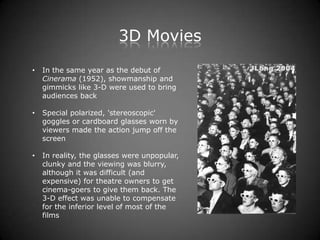
•   Special polarized, 'stereoscopic'
    goggles or cardboard glasses worn by
    viewers made the action jump off the
    screen

•   In reality, the glasses were unpopular,
    clunky and the viewing was blurry,
    although it was difficult (and
    expensive) for theatre owners to get
    cinema-goers to give them back. The
    3-D effect was unable to compensate
    for the inferior level of most of the
    films
3D Movies
•   The first full-length 3-D feature sound
    film was UA's cheaply-made jungle
    adventure Bwana Devil (1952)) by
    writer/director Arch Oboler, and
    starring Robert Stack - its taglines
    advertised: "A Lion in Your Lap" and
    "A Lover In Your Arms.”

•   in horror films (Warners' and B-film
    maker Andre de Toth's House of Wax
    (1953) with horror master Vincent
    Price, a remake of Warners' The
    Mystery of the Wax Museum (1933)) -
    the first 3-D horror film to be in the
    top ten box office hits in its year of
    release
Aroma-rama and Smell-O-vision

• Other short-lived film fads in this decade and afterwards,
  that were designed to tear viewers away from their TVs,
  included Charles Weiss' 1959 system of pumping "Oriental"
  scents into the theatre through the air-conditioning system -
  it was dubbed Aroma-Rama

• Smell-O-Vision was a similar process that came slightly later
  in 1960, developed by the Swiss-born Hans Laube, in which
  30 different smells were injected into a movie theatre's
  seats when triggered by various points in the film's
  soundtrack

• Only one film was made with this gimmicky process -
  Michael Todd Jr.'s' Scent of Mystery (1960)
CinemaScope

•   When Cinerama and stereoscopic 3-D
    died almost as soon as they were
    initiated, 20th Century Fox's
    CinemaScope became cheaper and
    more convenient because it used a
    simple anamorphic lens to create a
    widescreen effect

•   The aspect ratio (width to height) of
    CinemaScope was 2.35:1

•   The first film released commercially in
    CinemaScope was 20th Century Fox's
    and director Henry Koster's Biblical
    sword-and-sandal epic The Robe
    (1953)
EPICS!

•   The 1950s saw several ‘epics’ created

•   These had huge sets, large budgets,
    popular stars and were often
    extremely long

•   Why do you think creating an ‘epic’
    film was a high risk strategy at the
    time?

•   Cinema in decline
•   Novelties (3D, Aromarama…
•   High cost
•   No guarantee of a solid financial
    return

                                            The Egyptian (1954)

Films 1940s & 1950s (TV Y1)

  • 1.
    The 1940s • Dipin profits and productivity in the wake of Pearl Harbor and involvement in WWI around 1941 • However, between the years of 1943 and 1946, Hollywood was at it’s most efficient and most profitable • 1946 saw theatres admissions at an all time high
  • 2.
    The 1940s • Hollywoodresponded to the war effort whether as combatants, propagandists, documentary, newsreel or short film-makers, educators, fund-raisers for relief funds or war bonds, entertainers, or morale- boosters • Films started to take on a Clarke Gable joined the Air more realistic and escapist Force in 1943 tone • Male actors were in short supply as many of them enlisted or were called up for duty
  • 3.
    The 1940s • Anti-fascistfilms were one way of attacking the Nazi dictators and fascism • Baring in mind, many of the top dogs at the big Hollywood studios were from oppressed countries or were Jewish, undertones of anti- fascism and even blatant propaganda was not uncommon • Even German actors risked their own popularity by playing detestable Nazi characters
  • 4.
    The Birth ofFilm Noir • Film Noir films depicted the way Hollywood felt as it faced its greatest challenges during the war and post-war periods - darker and more cynical • The somber, pessimistic 'genre', literally meaning "black film,” was already germinating and evolving from 30s gangster films - with dark plots, untrustworthy femme fatales, and tough, but cynical, fatalistic heroes • Has its roots in German expressionism
  • 5.
    The Birth ofFilm Noir • Classic Hollywood film has always provided viewers with a happy ending • Specifically, the FAMILY has always been promoted as a sanctuary, a safe haven • This is promoted through American culture in general • Often in Hollywood films, men and their female love interest would marry • WWII encouraged the idea of the nuclear family further
  • 6.
    The Birth ofFilm Noir • Film Noir however, begins to readdress the typical values promoted by Hollywood for decades • They also sought to craft a new visual style which, until now, had rarely been seen in Hollywood film • In many of these films, the criminal justice system is incompetent, the white-collar office is dull and dehumanizing, the police force is corrupt and even the The Maltese Falcon (1941) federal government is threatening and oppressive
  • 7.
  • 8.
    Women in Noir Withfew variations, noir films divide women into three categories: 1. The femme fatale, an independent, ambitious woman who feels confined within a marriage or a close male-female relationship and attempts to break free, usually with violent results; 2. The nurturing woman, who is often depicted as dull, featureless, and, in the end, unattainable — a chance at conventional marriage that is denied to the hero; 3. The "marrying type," a woman who threatens the hero by insisting that he marry her and accept his conventional role as husband and father. Each type of film noir woman functions in a way that undermines society's image of the traditional family.
  • 9.
    Women in Noir •Noir films usually stop short of rejecting the family altogether. • While criticizing the family and marriage in a fairly overt way, film noir cannot resist the urge to restore or reinforce the family, even if it is only at the last minute. • This restoration involves punishing or destroying women (and men) who transgress the boundaries of "normal" family relations or providing a tacked-on "happy ending" in which the hero marries the nurturing woman or even a converted femme fatale who has learned to accept her proper role. • In either case, the ending contradicts the content and style of the film itself.
  • 10.
    Women American Culture • Nina Leibman: ‘The dominant social imperative of post-war America with its emphasis on the importance of nuclear family life, the proper role of the sexes, the superiority of suburbia. . . . McCall's magazine launched an issue on family "togetherness" as the crucial factor in the family enclave.
  • 11.
    Women American Culture • Nina Leibman: ‘Housewifery became professionalized with a plethora of books and articles extolling the virtues of domesticity and urging women to leave their "Rosie-the- Riveter" jobs for the less tangible rewards of child-rearing and housekeeping. In addition, these articles cautioned both men and women to assume their proper roles lest their aberrant behaviour result in untold psychological trauma’ On The Big Heart (1953) ‘…very much constructed along traditional lines: the working father, the helpmate mother, the child who is both nuisance and source of comfort.’
  • 12.
    1950s America… • Post-waraffluence • Increased choice in leisure time activities • The Korean War • Middle class values • Rise of fast food • Drive-ins • Jazz music • White racism in the South McDonalds had their first • Advent of television… franchise in 1955
  • 13.
    Television • By thestart of the 1950s, television was becoming popular and more readily available • In 1951, NBC became America’s first nationwide TV network • A few years later, 50% of American households had a TV • In 1953, the Academy Awards were broadcast for the first time, receiving the networks largest audience in TV history • By 1954, NBC's Tonight Show was becoming one of the most popular late-night TV shows
  • 14.
    The Studios • In1955, the ABC TV show Warner Brothers Presents was the first television program produced by Warner Brothers Pictures, and marked the introduction of the major Hollywood studios into television production • In the same year, Twentieth Century-Fox Hour played on CBS and MGM Parade on ABC • Warner Bros made the most of the television boom, producing more TV shows, such as: their first hit series Cheyenne (1955-1963 with Clint Walker), Maverick (1957- 1962, first with James Garner) and 77 Sunset Strip (1958- 1964)
  • 15.
    The Studios • Onepositive aspect of television was that it was giving many directors a platform to show off their talents • Because of the emergence of television as a major entertainment medium, many studios converted their sound stages for use in television production. • Because labor was cheaper abroad, many producers were taking their film production overseas
  • 16.
    The War AgainstTelevision • The width-to-height aspect ratio of most Hollywood films before the 50s was 4:3 • This is same as early television sets • So in its war against television, the film industry had three major campaigns involving technical advances with wide- screen experiences, color, and scope: • Cinerama • 3-D and Smell-O-Vision • CinemaScope • Other Widescreen Formats and Processes
  • 17.
    • Paramount's wrap-around,big-screen Cinerama debuted in 1952, a break-through technique that required three cameras, three projectors, interlocking, semi-curved (at 146 degrees) screens, and four-track stereo sound. It made audiences feel that they were at the center of the action • The first film using the three-strip cinerama process was This is Cinerama (1952), a travelogue of the world's vacation spots, with a thrilling roller-coaster ride • Popular for about a decade but was costly and the novelty wore off
  • 18.
    3D Movies • In the same year as the debut of Cinerama (1952), showmanship and gimmicks like 3-D were used to bring audiences back • Special polarized, 'stereoscopic' goggles or cardboard glasses worn by viewers made the action jump off the screen • In reality, the glasses were unpopular, clunky and the viewing was blurry, although it was difficult (and expensive) for theatre owners to get cinema-goers to give them back. The 3-D effect was unable to compensate for the inferior level of most of the films
  • 19.
    3D Movies • The first full-length 3-D feature sound film was UA's cheaply-made jungle adventure Bwana Devil (1952)) by writer/director Arch Oboler, and starring Robert Stack - its taglines advertised: "A Lion in Your Lap" and "A Lover In Your Arms.” • in horror films (Warners' and B-film maker Andre de Toth's House of Wax (1953) with horror master Vincent Price, a remake of Warners' The Mystery of the Wax Museum (1933)) - the first 3-D horror film to be in the top ten box office hits in its year of release
  • 20.
    Aroma-rama and Smell-O-vision •Other short-lived film fads in this decade and afterwards, that were designed to tear viewers away from their TVs, included Charles Weiss' 1959 system of pumping "Oriental" scents into the theatre through the air-conditioning system - it was dubbed Aroma-Rama • Smell-O-Vision was a similar process that came slightly later in 1960, developed by the Swiss-born Hans Laube, in which 30 different smells were injected into a movie theatre's seats when triggered by various points in the film's soundtrack • Only one film was made with this gimmicky process - Michael Todd Jr.'s' Scent of Mystery (1960)
  • 21.
    CinemaScope • When Cinerama and stereoscopic 3-D died almost as soon as they were initiated, 20th Century Fox's CinemaScope became cheaper and more convenient because it used a simple anamorphic lens to create a widescreen effect • The aspect ratio (width to height) of CinemaScope was 2.35:1 • The first film released commercially in CinemaScope was 20th Century Fox's and director Henry Koster's Biblical sword-and-sandal epic The Robe (1953)
  • 22.
    EPICS! • The 1950s saw several ‘epics’ created • These had huge sets, large budgets, popular stars and were often extremely long • Why do you think creating an ‘epic’ film was a high risk strategy at the time? • Cinema in decline • Novelties (3D, Aromarama… • High cost • No guarantee of a solid financial return The Egyptian (1954)