Exploring Art:A Global,Thematic Approach
Chapter 11
Social Protest and Affirmation
Protests Against Military Action
– Anti-war art 200-year history
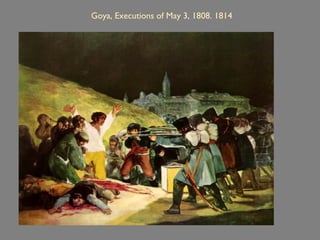
• The Executions of May 3, 1808, from 1814
– Based on Goya’s recollections of the Spanish standing
up to Napoleon
– Spanish executed to suppress revolt
– Anti-war art in the 20th century
• Käthe Kollewitz, The Outbreak, 1903
• Anti-war art further emerged after WWI and
WWII
Goya, Executions of May 3, 1808. 1814
Käthe Kollwitz, Outbreak, 1903
Kä the Kollwitz's interest in ordinary people—in peasants, workers, weavers, mothers—
is best served by the form of the print, its physicality, its materiality, which also suit her
realist tendencies, however symbolic or allegorical her subjects.
German artist Georg Grosz in 1918. It's called either "Fit for Active Duty" or
"A-1: The Miracle workers," depending on who you talk to.
JOHN HEARTFIELD. Goering the
Executioner. Photomontage cover
for AIZ. Germany, 1933.
Reproduced from John Heartfield, by
Wieland Herzfelde Dresden: VEB
Verlag der Kunst, 1964. © 2004
Artists Rights Society (ARS), New
York / VG Bild-Kunst, Bonn.
Echo of a Scream. 1937. Painted by David Alfaro Siqueiros. Enamel on wood,
Many of his paintings such as this focus on
how the past, present, and future of the
Mexican revolution is affecting its people.
This piece was inspired by his experiences
during active combat and his observations
of suffering. By illustrating a baby, this piece
emphasizes the internal suffering of the
innocent victims of the Revolution.
Motherwell's path to becoming an abstract artist was through philosophy, art
history, and poetry. He studied at Stanford, Harvard, and then Columbia, where he
was introduced to émigré … his particular genesis as an abstractionist has its
basis in Mallarmé, whose dictum "To paint, not the thing, but the effect it provides"
was pivotal.
In 1937 in San Francisco, he heard André Malraux speak at a rally on the Spanish
Civil War. There, he found a great moral issue that would drive his work for years.
In his words, it was the realization "that the world could, after all, regress." His
Elegies to the Spanish Republic have been a vehicle to express what Motherwell
has called "a funeral song for something one cared about" in abstract, visual
terms.
Elegy to the Spanish Republic, 1961
Robert Motherwell (American, 1915–1991)
These abstract meditations on life and death share a common structure in
compositional form. The horizontal white canvas is divided by two or three
vertical black bars or bands. Those are punctuated at various intervals by ovoid
shapes—stark blots of black. The whole is a dialogue of formal opposites—
straight, curved, black, white—executed in a painterly, brushy manner in which
the act of creation is evident.
For Motherwell, as for so many other Abstract Expressionists, this is a search for
universal content that stems from form itself: in his words, "…the Elegies use an
essential component of pictorial language that is as basic as the polyphonic
rhythms of Medieval or African or Oriental music."
Robert Motherwell - Elegy to the Spanish Republic No. 34, 1953-54
TOMATSU SHOMEI. Woman with Keloidal Scars (from the series 11:02 –
Nagasaki). Gelatin Silver Print, 11.5" 16". Japan, 1966.
exposes the mutilation of victims who survived the atomic bombing.
Fighting for the Oppressed
– Strategies for protesting oppression in
artwork
• Beauty
• Illustration
• Narrative
• Shock
• Humor
DELACROIX, Liberty Leading the People, France, 1830
Lewis Hine
• Ben Shahn created this
poster to protest the
execution of Vanzetti and
Sacco who were
electrocuted in 1927.
• He chose as the text a
statement Vanzetti made to a
reporter shortly before their
deaths. A few months later,
in February 1928, the
Atlantic Monthly published a
detailed account of Vanzetti's
last conversation with his
attorney the night before the
executions.
Ben Shahn, The Passion of Sacco
and Vanzettim 1931-32
Ferdinando Nicola Sacco (April 22, 1891 –
August 23, 1927) and Bartolomeo Vanzetti
(June 11, 1888 – August 23, 1927) were
two Italian-born laborers and anarchists
who were tried, convicted and executed via
electrocution on August 23, 1927 in
Massachusetts for the 1920 armed robbery
and murder of a pay-clerk and a security
guard in Braintree, Massachusetts.
On August 23, 1977, Massachusetts
Governor Michael Dukakis signed a
proclamation declaring, "Any stigma and
disgrace should be forever removed from
the names of Nicola Sacco and Bartolomeo
Vanzetti. We are not here to say whether
these men are guilty or innocent. We are
here to say that the high standards of
justice, which we in Massachusetts take
such pride in, failed Sacco and Vanzetti."
Jacob Lawrence, No. 36: During the Truce Toussaint Is Deceived and Arrested by
leClerc. LeClerc Led Toussaint to Believe That He Was Sincere, Believing That When
Toussaint Was Out of the Way, the Blacks Would Surrender, USA, 1937-38
Toussaint led a slave revolt in Haiti that resulted in the abolition of slavery there in
1794.
Faith Ringgold, Bitter Nest #2: Harlem Renaissance Party 1988
Acrylic on canvas, dyed, painted and pieced fabric 94 x 82"
YE YUSHAN AND A TEAM OF SCULPTORS FROM THE SICHUAN ACADEMY OF FINE
ARTS, CHONGQING. The Rent Collection Courtyard (detail). Clay, life-size figures. China
(Dayi, Sichuan), 1965.
Ed Kienholz. The State Hospital (interior). 1966.
As in The Rent Collection…realism makes the sculpture seem
more immediate to the viewer.
CILDO MEIRELES. Insertions into Ideological Circuits: Coca-Cola Project. Screen print
on Coca-Cola bottles. Brazil, 1970. Courtesy of the artist and Galerie Lelong,
New York.
Ester Hernandez, Sun Mad, USA, 1981 color serigraph
Raisin growers used insecticides that contaminated groundwater.
Subverts familiar imagery.
"Unflattering images of African Americans
have been common in popular culture
over the past 150 years - Aunt Jemima, a
domestic servant whose title of 'aunt' was
a commonly used term of subordination
and familiarity for domestic servants,
nannies, and maids. Aunt Jemima is a
caricatured jolly, fat character who has
been used recently to sell commercially
prepared pancake mix. Saar used three
versions of Aunt Jemima to question and
turn around such images. The oldest
version is the small image at the center, in
which a cartooned Jemima hitches up a
squalling child on her hip. In the
background, the modern version shows a
thinner Jemima with lighter skin,
deemphasizing her Negroid features. The
older one makes Jemima a caricature,
while the new one implies she is more
attractive if she appears less black..
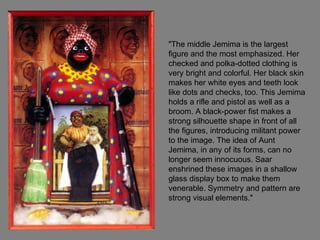
Betye Saar, "The Liberation of Aunt Jemima," 1972
"The middle Jemima is the largest
figure and the most emphasized. Her
checked and polka-dotted clothing is
very bright and colorful. Her black skin
makes her white eyes and teeth look
like dots and checks, too. This Jemima
holds a rifle and pistol as well as a
broom. A black-power fist makes a
strong silhouette shape in front of all
the figures, introducing militant power
to the image. The idea of Aunt
Jemima, in any of its forms, can no
longer seem innocuous. Saar
enshrined these images in a shallow
glass display box to make them
venerable. Symmetry and pattern are
strong visual elements."
KARA WALKER. “They Waz
Nice White Folks While They
Lasted” (Says One Gal to
Another). Cut paper and
projections on wall, 14' 20'.
USA, 2001. Courtesy Brent
Sikkema, New York City.
Affirming the values of the oppressed
• Increase cohesiveness
• Bolster sense of identity
– Late Gothic Italy
– Bahia, Brazil
– Aboriginals
Lorenzetti, Allegory of Good Government, 1338
Questioning the Status Quo
– The social environment
• A critical look at the “normal”
– Hogarth
• Satire, criticism, direct or indirect investigation
of factors that reinforce the status quo, including
government, the economy, and popular wisdom
WILLIAM HOGARTH. Breakfast
Scene (from the series Marriage a
la Mode), England, c. 1745. Oil on
canvas, 28” X 36”. National
Gallery, London. C. National
Gallery Collection; By kind
permission of the Trustees of the
National Gallery, London/Corbus.
MAGDALENA ABAKANOWICZ. Backs. 80 pieces, burlap and glue, each over life-size. Poland, 1976–
1982. © Magdalena Abakanowicz. Courtesy of Marlborough Gallery, New York.
Jenny Holzer is famous for her short
statements, formally
called ‘truisms’. some are common myths
while others
are just phrases on random subjects in the
form of slogans.
the sayings include:
‘a man can't know what it's like to be a
mother’,
‘men are not monogamous by nature’,
‘money creates taste’,
‘a lot of professionals are crackpots’,
‘enjoy yourself because you can't change
anything anyway’,
‘freedom is a luxury not a necessity’,
‘don't place too much trust in experts’.
Art vs. Politics
• Further departure from the status quo
• Political removal of works of art
• Salvadoran artist Miguel Antonio Bonilla
– Political and artistic risks
Gustave Courbet. The Stone Breakers. 1849 (desroyed during World War II).
Oil on canvas, 5 feet, 5 inches x 7 feet, 10 inches.
The men breaking the stones are ordinary road workers,
presented almost life-size. Courbet does not idealize the
struggle for existence; he simply says, "Look at this."
Discussion Topics
• Do you think art should question the status quo?
• Do you think protest art reaches a large enough
audience to be effective?
• Does artwork that depicts oppressed people end
up exploiting them, though artists claim it helps
these people?
• What is the relationship between protest art and
propaganda? Can propaganda be art?

Ncc art100 ch.11

  • 1.
    Exploring Art:A Global,ThematicApproach Chapter 11 Social Protest and Affirmation
  • 2.
    Protests Against MilitaryAction – Anti-war art 200-year history • The Executions of May 3, 1808, from 1814 – Based on Goya’s recollections of the Spanish standing up to Napoleon – Spanish executed to suppress revolt – Anti-war art in the 20th century • Käthe Kollewitz, The Outbreak, 1903 • Anti-war art further emerged after WWI and WWII
  • 3.
    Goya, Executions ofMay 3, 1808. 1814
  • 4.
    Käthe Kollwitz, Outbreak,1903 Kä the Kollwitz's interest in ordinary people—in peasants, workers, weavers, mothers— is best served by the form of the print, its physicality, its materiality, which also suit her realist tendencies, however symbolic or allegorical her subjects.
  • 5.
    German artist GeorgGrosz in 1918. It's called either "Fit for Active Duty" or "A-1: The Miracle workers," depending on who you talk to.
  • 6.
    JOHN HEARTFIELD. Goeringthe Executioner. Photomontage cover for AIZ. Germany, 1933. Reproduced from John Heartfield, by Wieland Herzfelde Dresden: VEB Verlag der Kunst, 1964. © 2004 Artists Rights Society (ARS), New York / VG Bild-Kunst, Bonn.
  • 7.
    Echo of aScream. 1937. Painted by David Alfaro Siqueiros. Enamel on wood, Many of his paintings such as this focus on how the past, present, and future of the Mexican revolution is affecting its people. This piece was inspired by his experiences during active combat and his observations of suffering. By illustrating a baby, this piece emphasizes the internal suffering of the innocent victims of the Revolution.
  • 8.
    Motherwell's path tobecoming an abstract artist was through philosophy, art history, and poetry. He studied at Stanford, Harvard, and then Columbia, where he was introduced to émigré … his particular genesis as an abstractionist has its basis in Mallarmé, whose dictum "To paint, not the thing, but the effect it provides" was pivotal. In 1937 in San Francisco, he heard André Malraux speak at a rally on the Spanish Civil War. There, he found a great moral issue that would drive his work for years. In his words, it was the realization "that the world could, after all, regress." His Elegies to the Spanish Republic have been a vehicle to express what Motherwell has called "a funeral song for something one cared about" in abstract, visual terms. Elegy to the Spanish Republic, 1961 Robert Motherwell (American, 1915–1991)
  • 9.
    These abstract meditationson life and death share a common structure in compositional form. The horizontal white canvas is divided by two or three vertical black bars or bands. Those are punctuated at various intervals by ovoid shapes—stark blots of black. The whole is a dialogue of formal opposites— straight, curved, black, white—executed in a painterly, brushy manner in which the act of creation is evident. For Motherwell, as for so many other Abstract Expressionists, this is a search for universal content that stems from form itself: in his words, "…the Elegies use an essential component of pictorial language that is as basic as the polyphonic rhythms of Medieval or African or Oriental music."
  • 10.
    Robert Motherwell -Elegy to the Spanish Republic No. 34, 1953-54
  • 11.
    TOMATSU SHOMEI. Womanwith Keloidal Scars (from the series 11:02 – Nagasaki). Gelatin Silver Print, 11.5" 16". Japan, 1966. exposes the mutilation of victims who survived the atomic bombing.
  • 12.
    Fighting for theOppressed – Strategies for protesting oppression in artwork • Beauty • Illustration • Narrative • Shock • Humor
  • 13.
    DELACROIX, Liberty Leadingthe People, France, 1830
  • 14.
  • 15.
    • Ben Shahncreated this poster to protest the execution of Vanzetti and Sacco who were electrocuted in 1927. • He chose as the text a statement Vanzetti made to a reporter shortly before their deaths. A few months later, in February 1928, the Atlantic Monthly published a detailed account of Vanzetti's last conversation with his attorney the night before the executions.
  • 16.
    Ben Shahn, ThePassion of Sacco and Vanzettim 1931-32 Ferdinando Nicola Sacco (April 22, 1891 – August 23, 1927) and Bartolomeo Vanzetti (June 11, 1888 – August 23, 1927) were two Italian-born laborers and anarchists who were tried, convicted and executed via electrocution on August 23, 1927 in Massachusetts for the 1920 armed robbery and murder of a pay-clerk and a security guard in Braintree, Massachusetts. On August 23, 1977, Massachusetts Governor Michael Dukakis signed a proclamation declaring, "Any stigma and disgrace should be forever removed from the names of Nicola Sacco and Bartolomeo Vanzetti. We are not here to say whether these men are guilty or innocent. We are here to say that the high standards of justice, which we in Massachusetts take such pride in, failed Sacco and Vanzetti."
  • 17.
    Jacob Lawrence, No.36: During the Truce Toussaint Is Deceived and Arrested by leClerc. LeClerc Led Toussaint to Believe That He Was Sincere, Believing That When Toussaint Was Out of the Way, the Blacks Would Surrender, USA, 1937-38 Toussaint led a slave revolt in Haiti that resulted in the abolition of slavery there in 1794.
  • 18.
    Faith Ringgold, BitterNest #2: Harlem Renaissance Party 1988 Acrylic on canvas, dyed, painted and pieced fabric 94 x 82"
  • 19.
    YE YUSHAN ANDA TEAM OF SCULPTORS FROM THE SICHUAN ACADEMY OF FINE ARTS, CHONGQING. The Rent Collection Courtyard (detail). Clay, life-size figures. China (Dayi, Sichuan), 1965.
  • 20.
    Ed Kienholz. TheState Hospital (interior). 1966. As in The Rent Collection…realism makes the sculpture seem more immediate to the viewer.
  • 21.
    CILDO MEIRELES. Insertionsinto Ideological Circuits: Coca-Cola Project. Screen print on Coca-Cola bottles. Brazil, 1970. Courtesy of the artist and Galerie Lelong, New York.
  • 22.
    Ester Hernandez, SunMad, USA, 1981 color serigraph Raisin growers used insecticides that contaminated groundwater. Subverts familiar imagery.
  • 23.
    "Unflattering images ofAfrican Americans have been common in popular culture over the past 150 years - Aunt Jemima, a domestic servant whose title of 'aunt' was a commonly used term of subordination and familiarity for domestic servants, nannies, and maids. Aunt Jemima is a caricatured jolly, fat character who has been used recently to sell commercially prepared pancake mix. Saar used three versions of Aunt Jemima to question and turn around such images. The oldest version is the small image at the center, in which a cartooned Jemima hitches up a squalling child on her hip. In the background, the modern version shows a thinner Jemima with lighter skin, deemphasizing her Negroid features. The older one makes Jemima a caricature, while the new one implies she is more attractive if she appears less black.. Betye Saar, "The Liberation of Aunt Jemima," 1972
  • 24.
    "The middle Jemimais the largest figure and the most emphasized. Her checked and polka-dotted clothing is very bright and colorful. Her black skin makes her white eyes and teeth look like dots and checks, too. This Jemima holds a rifle and pistol as well as a broom. A black-power fist makes a strong silhouette shape in front of all the figures, introducing militant power to the image. The idea of Aunt Jemima, in any of its forms, can no longer seem innocuous. Saar enshrined these images in a shallow glass display box to make them venerable. Symmetry and pattern are strong visual elements."
  • 25.
    KARA WALKER. “TheyWaz Nice White Folks While They Lasted” (Says One Gal to Another). Cut paper and projections on wall, 14' 20'. USA, 2001. Courtesy Brent Sikkema, New York City.
  • 26.
    Affirming the valuesof the oppressed • Increase cohesiveness • Bolster sense of identity – Late Gothic Italy – Bahia, Brazil – Aboriginals
  • 27.
    Lorenzetti, Allegory ofGood Government, 1338
  • 28.
    Questioning the StatusQuo – The social environment • A critical look at the “normal” – Hogarth • Satire, criticism, direct or indirect investigation of factors that reinforce the status quo, including government, the economy, and popular wisdom
  • 29.
    WILLIAM HOGARTH. Breakfast Scene(from the series Marriage a la Mode), England, c. 1745. Oil on canvas, 28” X 36”. National Gallery, London. C. National Gallery Collection; By kind permission of the Trustees of the National Gallery, London/Corbus.
  • 30.
    MAGDALENA ABAKANOWICZ. Backs.80 pieces, burlap and glue, each over life-size. Poland, 1976– 1982. © Magdalena Abakanowicz. Courtesy of Marlborough Gallery, New York.
  • 31.
    Jenny Holzer isfamous for her short statements, formally called ‘truisms’. some are common myths while others are just phrases on random subjects in the form of slogans. the sayings include: ‘a man can't know what it's like to be a mother’, ‘men are not monogamous by nature’, ‘money creates taste’, ‘a lot of professionals are crackpots’, ‘enjoy yourself because you can't change anything anyway’, ‘freedom is a luxury not a necessity’, ‘don't place too much trust in experts’.
  • 32.
    Art vs. Politics •Further departure from the status quo • Political removal of works of art • Salvadoran artist Miguel Antonio Bonilla – Political and artistic risks
  • 33.
    Gustave Courbet. TheStone Breakers. 1849 (desroyed during World War II). Oil on canvas, 5 feet, 5 inches x 7 feet, 10 inches. The men breaking the stones are ordinary road workers, presented almost life-size. Courbet does not idealize the struggle for existence; he simply says, "Look at this."
  • 34.
    Discussion Topics • Doyou think art should question the status quo? • Do you think protest art reaches a large enough audience to be effective? • Does artwork that depicts oppressed people end up exploiting them, though artists claim it helps these people? • What is the relationship between protest art and propaganda? Can propaganda be art?

Editor's Notes

  • #24 "Unflattering images of African Americans have been common in popular culture over the past 150 years - for example, the pickaninny, Little Black Sambo, and Uncle Tom. Another is Aunt Jemima, a domestic servant whose title of 'aunt' was a commonly used term of subordination and familiarity for African American domestic servants, nannies, and maids. Aunt Jemima is a caricatured jolly, fat character who has been used recently to sell commercially prepared pancake mix. In the 1972 mixed-media piece 'The Liberation of Aunt Jemima,' Betye Saar used three versions of Aunt Jemima to question and turn around such images. The oldest version is the small image at the center, in which a cartooned Jemima hitches up a squalling child on her hip. In the background, the modern version shows a thinner Jemima with lighter skin, deemphasizing her Negroid features. The older one makes Jemima a caricature, while the new one implies she is more attractive if she appears less black. "The middle Jemima is the largest figure and the most emphasized. Her checked and polka-dotted clothing is very bright and colorful. Her black skin makes her white eyes and teeth look like dots and checks, too. This Jemima holds a rifle and pistol as well as a broom. A black-power fist makes a strong silhouette shape in front of all the figures, introduing militant power to the image. The idea of Aunt Jemima, in any of its forms, can no longer seem innocuous. Saar enshrined these images in a shallow glass display box to make them venerable. Symmetry and pattern are strong visual elements."