Presentation on
Efficiency of Different Alkalis in Removing Pollutants
of Chrome Tanning Liquor Waste in Tannery
Industries of Bangladesh
Presented by-
Arnob Barua
(1204181)
Billal Hossain
(1204172)
Supervised by-
Prof .Dr. Md. Delwar Hossain
Dept. of Civil Engineering, BUET, Dhaka-1000
Back Ground of the Study
 The Tannery industries are one of the major polluting industries in
Bangladesh
 Chrome tanning is the widely used tanning process in Bangladesh
because of low cost and soft leather product
 Chrome liquor from tanning process contains high BOD, COD and
compounds of trivalent Chromium
 Chromium has carcinogenic effects on human health
 From the tanning units of Hazaribagh area, roughly 5000 m3 of untreated
wastes containing various chemicals go to the Buriganga river
 Thus the Government of Bangladesh has decided to move the whole
tannery industries to Savar Central Effluent Treatment Plant (CETP)
Scope of The Study
 Chrome tanning liquor contains various types of
toxic chemicals .
 High concentration of pollutants has already taken
considerable dimension to threaten public Health
and environment .This situation creates necessity
to study the pollution problems and to find out
appropriate removal technique for removal of such
pollutants
Objectives of the Study
 To characterize the Chrome liquor of Apex & Reliance Tannery from Savar
CETP area
 To determine the optimum pH for chromium removal
 To determine removal efficiency of Cr, COD, turbidity, and color of different
alkalis as precipitating agent
 To determine cost effectiveness of different combination of alkalis by cost
analysis.
 To Recover Chromium from sludge produced by the Chemical precipitation
 Removal of Chromium from Laboratory Stock Solution of Chromium
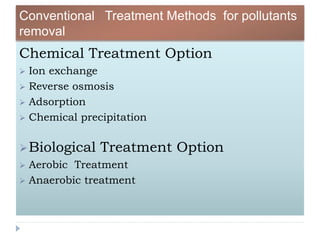
Conventional Treatment Methods for pollutants
removal
Chemical Treatment Option
 Ion exchange
 Reverse osmosis
 Adsorption
 Chemical precipitation
Biological Treatment Option
 Aerobic Treatment
 Anaerobic treatment
Chemical precipitation method
 The Chemical precipitation is carried out in
tanneries to remove pollutants from chrome
liquor.
 Main precipitating agents used are: calcium
hydroxide, sodium hydroxide, magnesium oxide
 Addition of the alkaline substance to the liquid
effluent with stirring at required pH is necessary.
With this methodology, a supernatant with less
pollutants can be obtained.
Methodology
 Collection of chrome liquor from Apex and Reliance
Tannery
 Test procedure for chrome liqor characterization for Cr,
COD ,pH,DO,Color)
 Preparation of Laboratory Chromium stock
solution(potassium Dichromate)
 Performing Jar test
 Determination of Chromium
 Determination of color
 Determination of COD
 Recovery of Chromium from Chromium sludge by adding
Conc.Sulphuric acid
Devices We Used
Devices We Used
AAS Machine Setup Flocculation Chamber
Chrome Liquor Characterization
99.70
99.75
99.80
99.85
99.90
99.95
100.00
100.05
0 2000 4000 6000 8000 10000 12000
%Crremoval
Dose
NaoH
lime
MgO
Data Analysis
0
50
100
150
200
250
300
350
400
0 50 100
sludgevolm(mL)
TIME(min)
NaOH
MgO
Lime
0
50
100
150
200
250
300
NaOH MgO Lime
SludgeVolume(ml)
vv
Removal of Cr from Laboratory Stock Solution
of Potassium Di Chromate
1100
1422
693
973
0
200
400
600
800
1000
1200
1400
1600
5000 10000
RemovalofCr(ppm)
concentration
(mg/l)
MgO
NaOH
0
20
40
60
80
100
120
140
160
0 5000 10000 15000
ResidualColor(pt-counit)
concentration
(mg/l)
NaOH
lime
mgo
0
2000
4000
6000
8000
10000
12000
2000 5000 10000
CODRemoval(ppm)
Concentration
(mg/l)
Lime
MgO
NaOH
0
5
10
15
20
25
30
35
40
45
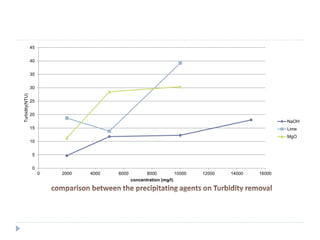
0 2000 4000 6000 8000 10000 12000 14000 16000
Turbidity(NTU)
concentration (mg/l)
NaOH
Lime
MgO
Comparison of Cr Recovery Efficiencies of
MgO and NaOH
3164
2800
2600
2700
2800
2900
3000
3100
3200
MgO NaOH
recoveredCr(ppm)
Recovered Cr(ppm)
Cost Analysis
1800
3650
30.34
0
500
1000
1500
2000
2500
3000
3500
4000
NaOH Mgo Lime
cost(Tk.)/m3
Cost
Comparison of color between different ratios of
Lime and MgO and Lime and NaOH
3930
3946
4019
3974 3972
3999
3880
3900
3920
3940
3960
3980
4000
4020
4040
5:1 6:1 7:1
Residualcolor(pt-counit)
ratios of alkali mixture
Lime:MgO
LIME:NaOH
Comparison of COD between different ratios of
Lime and MgO and Lime and NaOH
55.15
52.68
34.948
50.23
48.36
31.66
0
10
20
30
40
50
60
5:1 6:1 7:1
%CODremoval
ratio
Lime:MgO
Lime:NaOH
Comparison of final concentration of Cr between different
ratios of Lime with MgO and Lime with NaOH
0.517
0.65
0.72
0.337
0.517
0.539
0
0.1
0.2
0.3
0.4
0.5
0.6
0.7
0.8
5:1 6:1 7:1
ResidualCr(ppm)
Lime:NaOH
Lime:MgO
Comparison of recovery efficiencies between
different ratios of Lime with MgO and
Lime with NaOH
2370.7
1836.9
1625
3564.8
3110.4
2841
0
500
1000
1500
2000
2500
3000
3500
4000
5:1 6:1 7:1
RecoveredCr(ppm)
Lime:NaOH
Lime:MgO
391
464
362
657
597
572
0
100
200
300
400
500
600
700
5:1 6:1 7:1
cost(Tk.)/m3
Lime:NaOH
Lime:MgO
Cost analysis of 5000 mg/l solution of
different ratios of Lime and MgO and Lime
and NaOH
391
464
362
657
597
572
0
100
200
300
400
500
600
700
5:1 6:1 7:1
cost(Tk.)/m3
Lime:NaOH
Lime:MgO
Conclusion
 COD removal was insignificant by the chemical treatment
process. There was still a significant amount of biodegradable
waste was present. Therefore effluent should be taken to CETP
for further treatment.
 Color efficiency decreases with the greater concentration of
doses. Among these alkalis, color removal efficiency in lime
was found greater.
 pH is the dominant factor in treating the chrome liquor.
 NaOH is found a better alkaline agent than Ca(OH)2 in shorter
settling time in precipitation process. The performance of the
two alkalis becomes almost same after 24 hour settling.
Conclusion (cont.)
 MgO is the best precipitating agent as its sludge
accumulation rate was found much less than NaOH and
Ca(OH)2. So recovery is easier than other precipitating
agent. NaOH is easily soluble but its settling rate is too
slow that, greater retention time will be needed for the
treatment of waste.
 In this study, cost analysis was done and it was found
that using MgO and NaOH was not cost effective.
Therefore, they can’t be used in large scale in developing
countries. Combination was done for increasing cost
efficiency.
 An attempt was made to see the turbidity removal
characteristics. The turbidity removal characteristics
curves were irregular.
 An attempt was made to remove Cr from laboratory stock
solution potassium di chromate. Removal of chromium
was not effective.
Recommendation
 The samples were taken from two different locations. Analysis
should be done with different sampling locations with a wide
range of chromium concentration and other contaminants in
the wastewater.
 The use of MgO, NaOH is not cost effective, so a relative
economic analysis was performed to see the cost
effectiveness of the different options. But it was limited. We
should try using more ratios to find the optimum doses that are
cost effective and removal efficiency is also good.
 Variation of mixing time can be done to find the effects of
mixing rate of various alkalis on pollutant removal. In this
investigation, same mixing time was used in the expriment for
all the alkalis.
 Alternative methods can be investigated for the removal of
pollutants of chrome liquor. Here nano particle can be used for
the removal of pollutants.

Tannery Effluent treatment

  • 1.
    Presentation on Efficiency ofDifferent Alkalis in Removing Pollutants of Chrome Tanning Liquor Waste in Tannery Industries of Bangladesh Presented by- Arnob Barua (1204181) Billal Hossain (1204172) Supervised by- Prof .Dr. Md. Delwar Hossain Dept. of Civil Engineering, BUET, Dhaka-1000
  • 2.
    Back Ground ofthe Study  The Tannery industries are one of the major polluting industries in Bangladesh  Chrome tanning is the widely used tanning process in Bangladesh because of low cost and soft leather product  Chrome liquor from tanning process contains high BOD, COD and compounds of trivalent Chromium  Chromium has carcinogenic effects on human health  From the tanning units of Hazaribagh area, roughly 5000 m3 of untreated wastes containing various chemicals go to the Buriganga river  Thus the Government of Bangladesh has decided to move the whole tannery industries to Savar Central Effluent Treatment Plant (CETP)
  • 3.
    Scope of TheStudy  Chrome tanning liquor contains various types of toxic chemicals .  High concentration of pollutants has already taken considerable dimension to threaten public Health and environment .This situation creates necessity to study the pollution problems and to find out appropriate removal technique for removal of such pollutants
  • 4.
    Objectives of theStudy  To characterize the Chrome liquor of Apex & Reliance Tannery from Savar CETP area  To determine the optimum pH for chromium removal  To determine removal efficiency of Cr, COD, turbidity, and color of different alkalis as precipitating agent  To determine cost effectiveness of different combination of alkalis by cost analysis.  To Recover Chromium from sludge produced by the Chemical precipitation  Removal of Chromium from Laboratory Stock Solution of Chromium
  • 5.
    Conventional Treatment Methodsfor pollutants removal Chemical Treatment Option  Ion exchange  Reverse osmosis  Adsorption  Chemical precipitation Biological Treatment Option  Aerobic Treatment  Anaerobic treatment
  • 6.
    Chemical precipitation method The Chemical precipitation is carried out in tanneries to remove pollutants from chrome liquor.  Main precipitating agents used are: calcium hydroxide, sodium hydroxide, magnesium oxide  Addition of the alkaline substance to the liquid effluent with stirring at required pH is necessary. With this methodology, a supernatant with less pollutants can be obtained.
  • 7.
    Methodology  Collection ofchrome liquor from Apex and Reliance Tannery  Test procedure for chrome liqor characterization for Cr, COD ,pH,DO,Color)  Preparation of Laboratory Chromium stock solution(potassium Dichromate)  Performing Jar test  Determination of Chromium  Determination of color  Determination of COD  Recovery of Chromium from Chromium sludge by adding Conc.Sulphuric acid
  • 8.
  • 9.
    Devices We Used AASMachine Setup Flocculation Chamber
  • 10.
  • 11.
    99.70 99.75 99.80 99.85 99.90 99.95 100.00 100.05 0 2000 40006000 8000 10000 12000 %Crremoval Dose NaoH lime MgO
  • 12.
    Data Analysis 0 50 100 150 200 250 300 350 400 0 50100 sludgevolm(mL) TIME(min) NaOH MgO Lime 0 50 100 150 200 250 300 NaOH MgO Lime SludgeVolume(ml) vv
  • 13.
    Removal of Crfrom Laboratory Stock Solution of Potassium Di Chromate 1100 1422 693 973 0 200 400 600 800 1000 1200 1400 1600 5000 10000 RemovalofCr(ppm) concentration (mg/l) MgO NaOH
  • 14.
    0 20 40 60 80 100 120 140 160 0 5000 1000015000 ResidualColor(pt-counit) concentration (mg/l) NaOH lime mgo 0 2000 4000 6000 8000 10000 12000 2000 5000 10000 CODRemoval(ppm) Concentration (mg/l) Lime MgO NaOH
  • 15.
    0 5 10 15 20 25 30 35 40 45 0 2000 40006000 8000 10000 12000 14000 16000 Turbidity(NTU) concentration (mg/l) NaOH Lime MgO
  • 16.
    Comparison of CrRecovery Efficiencies of MgO and NaOH 3164 2800 2600 2700 2800 2900 3000 3100 3200 MgO NaOH recoveredCr(ppm) Recovered Cr(ppm)
  • 17.
  • 18.
    Comparison of colorbetween different ratios of Lime and MgO and Lime and NaOH 3930 3946 4019 3974 3972 3999 3880 3900 3920 3940 3960 3980 4000 4020 4040 5:1 6:1 7:1 Residualcolor(pt-counit) ratios of alkali mixture Lime:MgO LIME:NaOH
  • 19.
    Comparison of CODbetween different ratios of Lime and MgO and Lime and NaOH 55.15 52.68 34.948 50.23 48.36 31.66 0 10 20 30 40 50 60 5:1 6:1 7:1 %CODremoval ratio Lime:MgO Lime:NaOH
  • 20.
    Comparison of finalconcentration of Cr between different ratios of Lime with MgO and Lime with NaOH 0.517 0.65 0.72 0.337 0.517 0.539 0 0.1 0.2 0.3 0.4 0.5 0.6 0.7 0.8 5:1 6:1 7:1 ResidualCr(ppm) Lime:NaOH Lime:MgO
  • 21.
    Comparison of recoveryefficiencies between different ratios of Lime with MgO and Lime with NaOH 2370.7 1836.9 1625 3564.8 3110.4 2841 0 500 1000 1500 2000 2500 3000 3500 4000 5:1 6:1 7:1 RecoveredCr(ppm) Lime:NaOH Lime:MgO
  • 22.
  • 23.
    Cost analysis of5000 mg/l solution of different ratios of Lime and MgO and Lime and NaOH 391 464 362 657 597 572 0 100 200 300 400 500 600 700 5:1 6:1 7:1 cost(Tk.)/m3 Lime:NaOH Lime:MgO
  • 24.
    Conclusion  COD removalwas insignificant by the chemical treatment process. There was still a significant amount of biodegradable waste was present. Therefore effluent should be taken to CETP for further treatment.  Color efficiency decreases with the greater concentration of doses. Among these alkalis, color removal efficiency in lime was found greater.  pH is the dominant factor in treating the chrome liquor.  NaOH is found a better alkaline agent than Ca(OH)2 in shorter settling time in precipitation process. The performance of the two alkalis becomes almost same after 24 hour settling.
  • 25.
    Conclusion (cont.)  MgOis the best precipitating agent as its sludge accumulation rate was found much less than NaOH and Ca(OH)2. So recovery is easier than other precipitating agent. NaOH is easily soluble but its settling rate is too slow that, greater retention time will be needed for the treatment of waste.  In this study, cost analysis was done and it was found that using MgO and NaOH was not cost effective. Therefore, they can’t be used in large scale in developing countries. Combination was done for increasing cost efficiency.  An attempt was made to see the turbidity removal characteristics. The turbidity removal characteristics curves were irregular.  An attempt was made to remove Cr from laboratory stock solution potassium di chromate. Removal of chromium was not effective.
  • 26.
    Recommendation  The sampleswere taken from two different locations. Analysis should be done with different sampling locations with a wide range of chromium concentration and other contaminants in the wastewater.  The use of MgO, NaOH is not cost effective, so a relative economic analysis was performed to see the cost effectiveness of the different options. But it was limited. We should try using more ratios to find the optimum doses that are cost effective and removal efficiency is also good.  Variation of mixing time can be done to find the effects of mixing rate of various alkalis on pollutant removal. In this investigation, same mixing time was used in the expriment for all the alkalis.  Alternative methods can be investigated for the removal of pollutants of chrome liquor. Here nano particle can be used for the removal of pollutants.