Technology
Sarah alfadhli
Introduction
 Technology has changed the way teachers and students interact.
 The use of assistive technology has also allowed educators to understand
the needs of students with learning disabilities and responded to them
adequately
 Online learning system complement classroom work and ensure that
students catch up on what was taught in class.
 This presentation outlines the use of IPads in classes and their impact
IPads in Classrooms
 The IPad is being used as a tool for early literacy
instruction in kindergarten classrooms (Cubelic & Larwin,
2014).
 Every student is given an IPad with pre-installed
academic software that allow them to type, read, and
draw.
 Teachers also use videos and inbuilt recorders for
students with learning disabilities.
 Young children also learn the basic instruction on how
to operate and care for the IPads (Cubelic & Larwin,
2014).
Motivates students
 Motivation is key to the fast and successful learning of a young learner.
 The use of IPads increases the level of motivation in class.
 It allows educators to understand the needs of every student and,
therefore, create a conducive environment that will make the student
comfortable and ready to learn (Cubelic & Larwin, 2014).
 Students view learning as meaningful and enjoyable.
 As such, students grasp what they are taught.
Tools for Engagement
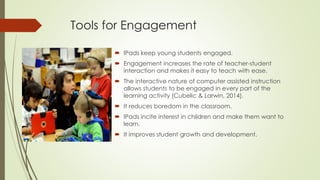
 IPads keep young students engaged.
 Engagement increases the rate of teacher-student
interaction and makes it easy to teach with ease.
 The interactive nature of computer assisted instruction
allows students to be engaged in every part of the
learning activity (Cubelic & Larwin, 2014).
 It reduces boredom in the classroom.
 IPads incite interest in children and make them want to
learn.
 It improves student growth and development.
Students with learning disabilities
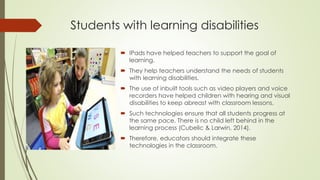
 IPads have helped teachers to support the goal of
learning.
 They help teachers understand the needs of students
with learning disabilities.
 The use of inbuilt tools such as video players and voice
recorders have helped children with hearing and visual
disabilities to keep abreast with classroom lessons.
 Such technologies ensure that all students progress at
the same pace. There is no child left behind in the
learning process (Cubelic & Larwin, 2014).
 Therefore, educators should integrate these
technologies in the classroom.
Works Cited
 Cubelic, C. C., & Larwin, K. H. (2014). The Use of iPad Technology in the
Kindergarten Classroom: A Quasi-Experimental Investigation of the Impact
on Early Literacy Skills. Journal of Educational Research, 2(4), 47-59.

Sarah

  • 1.
  • 2.
    Introduction  Technology haschanged the way teachers and students interact.  The use of assistive technology has also allowed educators to understand the needs of students with learning disabilities and responded to them adequately  Online learning system complement classroom work and ensure that students catch up on what was taught in class.  This presentation outlines the use of IPads in classes and their impact
  • 3.
    IPads in Classrooms The IPad is being used as a tool for early literacy instruction in kindergarten classrooms (Cubelic & Larwin, 2014).  Every student is given an IPad with pre-installed academic software that allow them to type, read, and draw.  Teachers also use videos and inbuilt recorders for students with learning disabilities.  Young children also learn the basic instruction on how to operate and care for the IPads (Cubelic & Larwin, 2014).
  • 4.
    Motivates students  Motivationis key to the fast and successful learning of a young learner.  The use of IPads increases the level of motivation in class.  It allows educators to understand the needs of every student and, therefore, create a conducive environment that will make the student comfortable and ready to learn (Cubelic & Larwin, 2014).  Students view learning as meaningful and enjoyable.  As such, students grasp what they are taught.
  • 5.
    Tools for Engagement IPads keep young students engaged.  Engagement increases the rate of teacher-student interaction and makes it easy to teach with ease.  The interactive nature of computer assisted instruction allows students to be engaged in every part of the learning activity (Cubelic & Larwin, 2014).  It reduces boredom in the classroom.  IPads incite interest in children and make them want to learn.  It improves student growth and development.
  • 6.
    Students with learningdisabilities  IPads have helped teachers to support the goal of learning.  They help teachers understand the needs of students with learning disabilities.  The use of inbuilt tools such as video players and voice recorders have helped children with hearing and visual disabilities to keep abreast with classroom lessons.  Such technologies ensure that all students progress at the same pace. There is no child left behind in the learning process (Cubelic & Larwin, 2014).  Therefore, educators should integrate these technologies in the classroom.
  • 7.
    Works Cited  Cubelic,C. C., & Larwin, K. H. (2014). The Use of iPad Technology in the Kindergarten Classroom: A Quasi-Experimental Investigation of the Impact on Early Literacy Skills. Journal of Educational Research, 2(4), 47-59.