ERP Implementation Methodology 
2014 
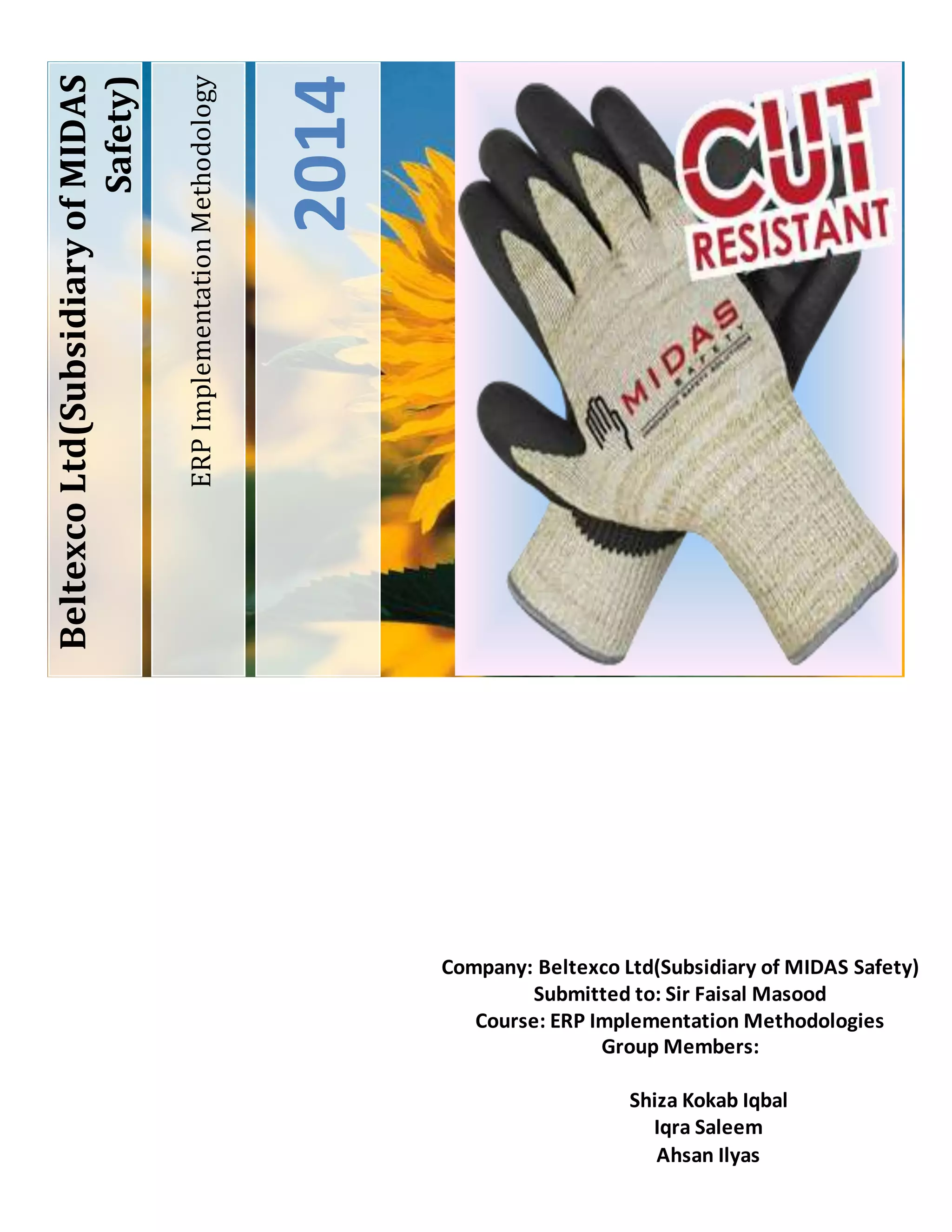
Beltexco Ltd(Subsidiary of MIDAS 
Safety) 
Company: Beltexco Ltd(Subsidiary of MIDAS Safety) 
Submitted to: Sir Faisal Masood 
Course: ERP Implementation Methodologies 
Group Members: 
Shiza Kokab Iqbal 
Iqra Saleem 
Ahsan Ilyas
ACKNOWLEDGEMENT 
First and foremost, I Thank the Almighty God for sustaining the 
enthusiasm with which I plunged into this endeavor. 
I avail this Opportunity to express my profound sense of sincere and deep 
gratitude to many people who are responsible for the knowledge and 
experience I have gained during the Project Work. 
We are heartily thankful to our ERP Implementation teacher, Sir Faisal 
Masood whose encouragement, guidance and support from Initial to the 
final level enabled us to develop this Report of ERP Implementation. With 
his dedicated lectures we were able to practically 
Understand and apply what we have learned in the classes. 
Also it’s a pleasure to mention the name of our very cooperative contact 
person Mr. Amir Ali who did his best to make us understand this project 
efficiently as he is MRP controller in Beltexco Ltd(the company on which 
we researched)
Letter Of Transmittal 
Respected Sir Faisal Masood: 
This is the report which you commissioned on 20 November, 2014 on the 
topic “Research about the implementation of SAP-ERP in the company 
Beltexco Ltd”. This report includes the information of “ERP 
implementation phases & their deliverables”. The company implemented 9 
modules of SAP-ERP & now after implementation of extended ERP 
solutions like BI (Business Intelligence) and SAP-ARIBA (ERP acquired by 
SAP) it is in “Evolution Phase”. I have also discussed the details in the 
report. 
I hope you will find this report satisfactory. 
Yours sincerely 
Shiza Kokab Iqbal(Head of the group)
EXECUTIVE SUMMARY: 
This report is about the practical observation of ERP-implementation 
in industry so we chose “Beltexco Ltd” as a company to explore the facts 
about the ERP implementation life cycle. 
Beltexco Ltd is the subsidiary of MIDAS Safety which is the top most 
safety glove manufacturers & ISO 9001: 2000 certified. MIDAS Safety 
is located in Canada. 
SAP-ERP ECC 6.0 is implemented in this company & 9 modules of SAP-ERP 
they implemented. Also they implemented extended ERP solutions 
like BI & SAP-Ariba which shows that they are in “Evolution Phase”. 
Almost 90% we found that they implemented SAP-ERP solution just as 
theoretical concepts but somewhere they differed which was according 
to the company needs & must be followed for the company sake. 
So this implementation was Pakistan’s largest SAP-ERP 
implementation in terms of expense according to this company. The 
management was so powerful that to do “Organization Change 
Management” was not critical indeed & it had been successful. 
According to us, there some answers in the questionnaire were not 
seem to be appropriate but all other facts were strongly handled that 
reduced the chance to harm the project.
Table of Contents 
RESEARCH OBJECTIVE:........................................................................................................................ 6 
Our Methodology: .......................................................................................................................... 6 
Interview with contact person: ........................................................................................................... 7 
Introduction....................................................................................................................................... 7 
Analysis:......................................................................................................................................... 7 
ERP LIFE CYCLE PHASES: .................................................................................................... 7 
Adoption ................................................................................................................................... 7 
Recommendation................................................................................................................. 8 
Acquisition................................................................................................................................ 8 
Recommendation................................................................................................................. 8 
Implementation .......................................................................................................................... 9 
Recommendation............................................................................................................... 12 
Use & Maintenance .................................................................................................................. 12 
Recommendation............................................................................................................... 12 
Evolution .................................................................................................................................. 12 
Recommendation............................................................................................................... 13 
Conclusion ................................................................................................................................ 13
RESEARCH OBJECTIVE: 
1. To study and explore ERP life cycle of an organization. That includes all the 
phases: 
 Adoption 
 Acquisition 
 Implementation 
 Use and Maintenance 
 Evolution 
 Retirement 
2. Observe the gaps (if any) which found in needs of the organization and the 
available ERP systems. 
Our Methodology: 
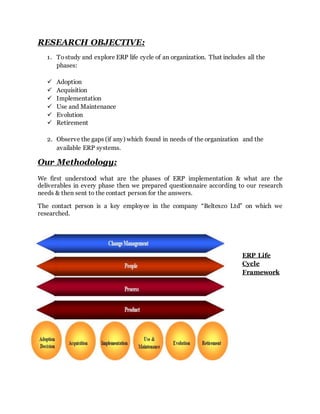
We first understood what are the phases of ERP implementation & what are the 
deliverables in every phase then we prepared questionnaire according to our research 
needs & then sent to the contact person for the answers. 
The contact person is a key employee in the company “Beltexco Ltd” on which we 
researched. 
ERP Life 
Cycle 
Framework
Interview with contact person: 
The Contact person “Mr.Amir Ali(MRP controller)” is in the circle of father of the 
group member “Ms. Shiza Kokab Iqbal” so it is not difficult for her to gain knowledge 
about the company.she sent questionnaire on October 31,2014 and received answers 
on November 10 ,2014. 
Introduction: 
For more than 30 years, Midas Safety has been protecting the Working Hands of the 
World. Our total focus is on hand protection and Midas Safety range of products is one 
of the most diverse in the industry. 
All production facilities are ISO 9001: 2000 Certified and all products are fully tested 
against all applicable standards. Midas Safety is vertically integrated to control our use 
of natural resources like cotton and natural rubber and our state-of-art Spinning Mill 
provides yarns to our knitting facilities. 
Beltexco Ltd is a subsidiary of Midas Safety involved in Manufacturing/Processing of 
Synthetic & Natural Rubber Gloves. 
MIDAS Safety is the Top most Safety Gloves Manufacturer in the world & SAP-ERP ECC 
(Enterprise Central Component) 6.0 is implemented in the company. It was Pakistan‘s 
largest implementation of SAP ERP in terms of expense. 
They mostly focus on exporting their safety gloves across the globe especially in Europe. 
Analysis: 
ERP LIFE CYCLE PHASES: 
Adoption phase: 
(Description: In this phase, company analyze, “Are we ready for ERP 
Implementation”) 
Q1.What is your ERP vision statement? 
Ans. 
Pre Implementation: 
To have a centralized enterprise system which will integrate all the business functions 
together so that the top management can be benefited with the real time reporting in all 
the areas without any interdependencies.
Post Implementation: 
To have a centralized & a group wide common processes & centralized reporting for the 
analytics which will help in long term strategic goals. 
Recommendations: 
No recommendations. 
Q2. Rank the following ERP goals and objectives related to your organization? (1 being 
the highest rank) 
1. Business growth 
2. Cost leadership 
3. Customer service/ satisfaction 
4. KPI monitoring (Key Performance Indicator) 
5. Paperless environment/ automation 
Recommendations: 
No recommendations. 
Q3. Please rank the following factors to check ERP readiness assessment: 
(1 being the highest rank) 
1. Well-defined business processes 
2. IT infra-Structure 
3. Organizational culture 
4. Affordability/Commercial 
5. Employees skill sets 
Recommendations: 
No recommendations. 
Q4. How much time is taken for decision to implement ERP? 
Ans. 6 to 12 months 
Recommendations: 
No recommendations. 
ACQUISITION PHASE: 
(Description: In this phase, “companies select their ERP and consultant”) 
Q1. System requirement specifications (SRS) document the desired functionality 
requirements of an ERP from all the concerned departments. Did you prepare a formal 
SRS or not?
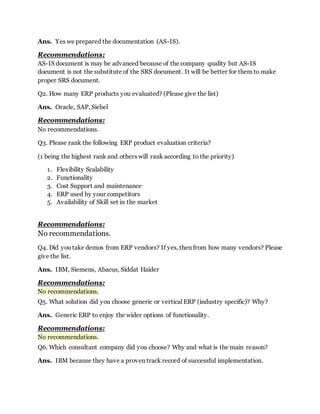
Ans. Yes we prepared the documentation (AS-IS). 
Recommendations: 
AS-IS document is may be advanced because of the company quality but AS-IS 
document is not the substitute of the SRS document. It will be better for them to make 
proper SRS document. 
Q2. How many ERP products you evaluated? (Please give the list) 
Ans. Oracle, SAP, Siebel 
Recommendations: 
No recommendations. 
Q3. Please rank the following ERP product evaluation criteria? 
(1 being the highest rank and others will rank according to the priority) 
1. Flexibility Scalability 
2. Functionality 
3. Cost Support and maintenance 
4. ERP used by your competitors 
5. Availability of Skill set in the market 
Recommendations: 
No recommendations. 
Q4. Did you take demos from ERP vendors? If yes, then from how many vendors? Please 
give the list. 
Ans. IBM, Siemens, Abacus, Siddat Haider 
Recommendations: 
No recommendations. 
Q5. What solution did you choose generic or vertical ERP (industry specific)? Why? 
Ans. Generic ERP to enjoy the wider options of functionality. 
Recommendations: 
No recommendations. 
Q6. Which consultant company did you choose? Why and what is the main reason? 
Ans. IBM because they have a proven track record of successful implementation.
Recommendations: 
No recommendations. 
IMPLEMENTATION PHASE: 
(Description: In this phase, “Configuration of ERP and its implementation”) 
Q1: What was your implementation strategy? Is it big bang/Phased and why? 
Ans. Phased because: 
 the implementation was between different sister concern of the same company 
having interdependencies from manufacturing point of view 
 To reduce the failure risk 
Recommendations: 
No recommendations. 
Q2. How you select power users from your employees? 
Ans. People who were having the sound knowledge of business processes were selected 
as a power user. 
Recommendations: 
No recommendations. 
Q3. Did you prepare the AS-IS processes during implementation or before? 
Ans. Before implementation in a project preparation phase. 
Recommendations: 
No recommendations. 
Q4. To what level you adopt standard ERP functionalities? (Please mention 
percentages)(Modifications in ERP according to these departments) 
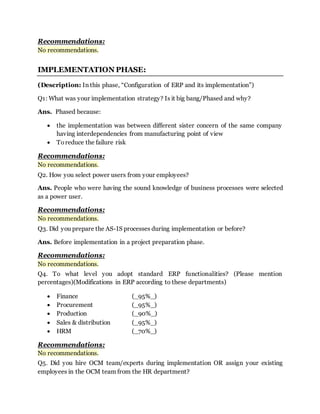
 Finance (_95%_) 
 Procurement (_95%_) 
 Production (_90%_) 
 Sales & distribution (_95%_) 
 HRM (_70%_) 
Recommendations: 
No recommendations. 
Q5. Did you hire OCM team/experts during implementation OR assign your existing 
employees in the OCM team from the HR department?
Ans.No, we did not hire any OCM consultant during the implementation. Each 
module’s internal consultants were also acting as an OCM consultant. 
Recommendations: 
If there may be an OCM team from outside also, it will be more better because internal 
consultants (Power Users) are in the company so their point might be ignored by their 
colleagues. 
Q6.How much time did you take to get the sign off on the business blueprint 
documents? 
Ans.12 Months (this is the duration from AS-IS document till the designing of 
TO-BE document) 
Recommendations: 
No recommendations. 
Q7. Did you use a separate system (Quality Assurance) to perform system testing? How 
many systems use? (Development, Quality Assurance, Production) 
Ans. Yes, we used 3 systems(Dev, Quality, PRD) 
Recommendations: 
No recommendations. 
Q8. What is the number of end-users in your organizations? 
Ans. More than 500 Users 
Recommendations: 
No recommendations. 
Q9. How many consultants implemented your ERP? 
Ans.8 Consultants (IBM), 6 Consultants (Internal) 
Recommendations: 
No recommendations. 
Q10. How much time taken in ERP implement ing period? Did it exceed the project 
timelines? 
Ans.24 Months 
Recommendations: 
No recommendations. 
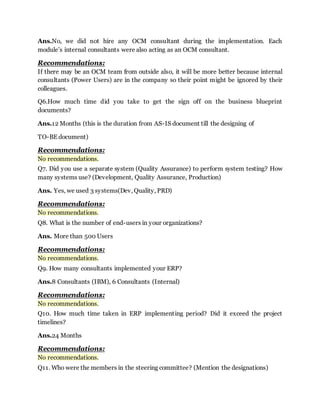
Q11. Who were the members in the steering committee? (Mention the designations)
Ans. CEO, Senior Managers, Managers. 
Recommendations: 
In steering committee, there should be a person “Next to CEO” not CEO himself/herself. 
Q12. In which companies& locations, ERP was implemented? 
Ans. Beltexco (KHI) and MIDAS (CA) 
Recommendations: 
No recommendations. 
Q13. How long you run your legacy applications in parallel after ERP implementations? 
Ans. 6 Months 
Recommendations: 
No recommendations. 
Q14. During system testing, how much difficulties you faced? 
Ans. High level of difficulties 
Recommendations: 
No recommendations. 
Q15. In Go live check list of ERP implementation, which components were present? 
 Master data uploaded 
 Balances uploaded 
 Stocks uploaded 
 Orders uploaded 
Recommendations: 
No recommendations. 
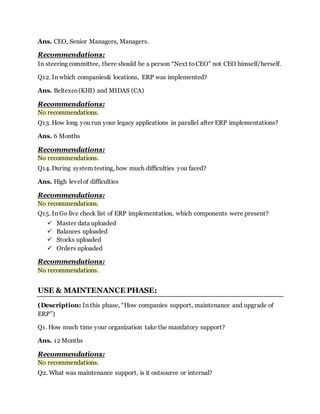
USE & MAINTENANCE PHASE: 
(Description: In this phase, “How companies support, maintenance and upgrade of 
ERP”) 
Q1. How much time your organization take the mandatory support? 
Ans. 12 Months 
Recommendations: 
No recommendations. 
Q2. What was maintenance support, is it outsource or internal?
Ans. Both 
Recommendations: 
No recommendations. 
Q3. Have you done or planning any upgrades in ERP? Is upgrading your decision or 
imposed by the ERP vendor? (Vender may stop the support for the implemented 
version after some time) 
Ans. Yes & because of Internal decision 
Recommendations: 
No recommendations. 
Q4. How much ERP satisfied your expectations? [Mention percentage] 
Ans. 85% 
Recommendations: 
No recommendations. 
EVOLUTION: 
Q.1. Have you done any extended ERP solution after core ERP [For example Business 
Intelligence, Customer Relationship management, Supplier Relationship management] 
Ans. Yes we implemented SAP Ariba, BI, BO, BOBJ, CRM and IBM Production 
Planning Tool. 
Recommendations: 
No recommendations. 
Conclusion: 
This experience was so good. Great learning we have, by doing this project. MIDAS 
Safety is a big name & we researched on its subsidiary “Beltecxco Ltd” by the answers of 
the questions, we determined that the management was so strong. They made their 
decisions regarding implementation of ERP by themselves, not imposed by ERP 
vendors, which was very good. They didn’t make SRS document in the “Acquisition 
phase”. This would have impacted badly on the implementation but they tackled this 
project very strongly so that this ignorance was not be so harmful for the ERP 
implementation which is very appreciable. Now the company is in “Evolution Phase”.

SAP-ERP implementation Report 2014

  • 1.
    ERP Implementation Methodology 2014 Beltexco Ltd(Subsidiary of MIDAS Safety) Company: Beltexco Ltd(Subsidiary of MIDAS Safety) Submitted to: Sir Faisal Masood Course: ERP Implementation Methodologies Group Members: Shiza Kokab Iqbal Iqra Saleem Ahsan Ilyas
  • 2.
    ACKNOWLEDGEMENT First andforemost, I Thank the Almighty God for sustaining the enthusiasm with which I plunged into this endeavor. I avail this Opportunity to express my profound sense of sincere and deep gratitude to many people who are responsible for the knowledge and experience I have gained during the Project Work. We are heartily thankful to our ERP Implementation teacher, Sir Faisal Masood whose encouragement, guidance and support from Initial to the final level enabled us to develop this Report of ERP Implementation. With his dedicated lectures we were able to practically Understand and apply what we have learned in the classes. Also it’s a pleasure to mention the name of our very cooperative contact person Mr. Amir Ali who did his best to make us understand this project efficiently as he is MRP controller in Beltexco Ltd(the company on which we researched)
  • 3.
    Letter Of Transmittal Respected Sir Faisal Masood: This is the report which you commissioned on 20 November, 2014 on the topic “Research about the implementation of SAP-ERP in the company Beltexco Ltd”. This report includes the information of “ERP implementation phases & their deliverables”. The company implemented 9 modules of SAP-ERP & now after implementation of extended ERP solutions like BI (Business Intelligence) and SAP-ARIBA (ERP acquired by SAP) it is in “Evolution Phase”. I have also discussed the details in the report. I hope you will find this report satisfactory. Yours sincerely Shiza Kokab Iqbal(Head of the group)
  • 4.
    EXECUTIVE SUMMARY: Thisreport is about the practical observation of ERP-implementation in industry so we chose “Beltexco Ltd” as a company to explore the facts about the ERP implementation life cycle. Beltexco Ltd is the subsidiary of MIDAS Safety which is the top most safety glove manufacturers & ISO 9001: 2000 certified. MIDAS Safety is located in Canada. SAP-ERP ECC 6.0 is implemented in this company & 9 modules of SAP-ERP they implemented. Also they implemented extended ERP solutions like BI & SAP-Ariba which shows that they are in “Evolution Phase”. Almost 90% we found that they implemented SAP-ERP solution just as theoretical concepts but somewhere they differed which was according to the company needs & must be followed for the company sake. So this implementation was Pakistan’s largest SAP-ERP implementation in terms of expense according to this company. The management was so powerful that to do “Organization Change Management” was not critical indeed & it had been successful. According to us, there some answers in the questionnaire were not seem to be appropriate but all other facts were strongly handled that reduced the chance to harm the project.
  • 5.
    Table of Contents RESEARCH OBJECTIVE:........................................................................................................................ 6 Our Methodology: .......................................................................................................................... 6 Interview with contact person: ........................................................................................................... 7 Introduction....................................................................................................................................... 7 Analysis:......................................................................................................................................... 7 ERP LIFE CYCLE PHASES: .................................................................................................... 7 Adoption ................................................................................................................................... 7 Recommendation................................................................................................................. 8 Acquisition................................................................................................................................ 8 Recommendation................................................................................................................. 8 Implementation .......................................................................................................................... 9 Recommendation............................................................................................................... 12 Use & Maintenance .................................................................................................................. 12 Recommendation............................................................................................................... 12 Evolution .................................................................................................................................. 12 Recommendation............................................................................................................... 13 Conclusion ................................................................................................................................ 13
  • 6.
    RESEARCH OBJECTIVE: 1.To study and explore ERP life cycle of an organization. That includes all the phases:  Adoption  Acquisition  Implementation  Use and Maintenance  Evolution  Retirement 2. Observe the gaps (if any) which found in needs of the organization and the available ERP systems. Our Methodology: We first understood what are the phases of ERP implementation & what are the deliverables in every phase then we prepared questionnaire according to our research needs & then sent to the contact person for the answers. The contact person is a key employee in the company “Beltexco Ltd” on which we researched. ERP Life Cycle Framework
  • 7.
    Interview with contactperson: The Contact person “Mr.Amir Ali(MRP controller)” is in the circle of father of the group member “Ms. Shiza Kokab Iqbal” so it is not difficult for her to gain knowledge about the company.she sent questionnaire on October 31,2014 and received answers on November 10 ,2014. Introduction: For more than 30 years, Midas Safety has been protecting the Working Hands of the World. Our total focus is on hand protection and Midas Safety range of products is one of the most diverse in the industry. All production facilities are ISO 9001: 2000 Certified and all products are fully tested against all applicable standards. Midas Safety is vertically integrated to control our use of natural resources like cotton and natural rubber and our state-of-art Spinning Mill provides yarns to our knitting facilities. Beltexco Ltd is a subsidiary of Midas Safety involved in Manufacturing/Processing of Synthetic & Natural Rubber Gloves. MIDAS Safety is the Top most Safety Gloves Manufacturer in the world & SAP-ERP ECC (Enterprise Central Component) 6.0 is implemented in the company. It was Pakistan‘s largest implementation of SAP ERP in terms of expense. They mostly focus on exporting their safety gloves across the globe especially in Europe. Analysis: ERP LIFE CYCLE PHASES: Adoption phase: (Description: In this phase, company analyze, “Are we ready for ERP Implementation”) Q1.What is your ERP vision statement? Ans. Pre Implementation: To have a centralized enterprise system which will integrate all the business functions together so that the top management can be benefited with the real time reporting in all the areas without any interdependencies.
  • 8.
    Post Implementation: Tohave a centralized & a group wide common processes & centralized reporting for the analytics which will help in long term strategic goals. Recommendations: No recommendations. Q2. Rank the following ERP goals and objectives related to your organization? (1 being the highest rank) 1. Business growth 2. Cost leadership 3. Customer service/ satisfaction 4. KPI monitoring (Key Performance Indicator) 5. Paperless environment/ automation Recommendations: No recommendations. Q3. Please rank the following factors to check ERP readiness assessment: (1 being the highest rank) 1. Well-defined business processes 2. IT infra-Structure 3. Organizational culture 4. Affordability/Commercial 5. Employees skill sets Recommendations: No recommendations. Q4. How much time is taken for decision to implement ERP? Ans. 6 to 12 months Recommendations: No recommendations. ACQUISITION PHASE: (Description: In this phase, “companies select their ERP and consultant”) Q1. System requirement specifications (SRS) document the desired functionality requirements of an ERP from all the concerned departments. Did you prepare a formal SRS or not?
  • 9.
    Ans. Yes weprepared the documentation (AS-IS). Recommendations: AS-IS document is may be advanced because of the company quality but AS-IS document is not the substitute of the SRS document. It will be better for them to make proper SRS document. Q2. How many ERP products you evaluated? (Please give the list) Ans. Oracle, SAP, Siebel Recommendations: No recommendations. Q3. Please rank the following ERP product evaluation criteria? (1 being the highest rank and others will rank according to the priority) 1. Flexibility Scalability 2. Functionality 3. Cost Support and maintenance 4. ERP used by your competitors 5. Availability of Skill set in the market Recommendations: No recommendations. Q4. Did you take demos from ERP vendors? If yes, then from how many vendors? Please give the list. Ans. IBM, Siemens, Abacus, Siddat Haider Recommendations: No recommendations. Q5. What solution did you choose generic or vertical ERP (industry specific)? Why? Ans. Generic ERP to enjoy the wider options of functionality. Recommendations: No recommendations. Q6. Which consultant company did you choose? Why and what is the main reason? Ans. IBM because they have a proven track record of successful implementation.
  • 10.
    Recommendations: No recommendations. IMPLEMENTATION PHASE: (Description: In this phase, “Configuration of ERP and its implementation”) Q1: What was your implementation strategy? Is it big bang/Phased and why? Ans. Phased because:  the implementation was between different sister concern of the same company having interdependencies from manufacturing point of view  To reduce the failure risk Recommendations: No recommendations. Q2. How you select power users from your employees? Ans. People who were having the sound knowledge of business processes were selected as a power user. Recommendations: No recommendations. Q3. Did you prepare the AS-IS processes during implementation or before? Ans. Before implementation in a project preparation phase. Recommendations: No recommendations. Q4. To what level you adopt standard ERP functionalities? (Please mention percentages)(Modifications in ERP according to these departments)  Finance (_95%_)  Procurement (_95%_)  Production (_90%_)  Sales & distribution (_95%_)  HRM (_70%_) Recommendations: No recommendations. Q5. Did you hire OCM team/experts during implementation OR assign your existing employees in the OCM team from the HR department?
  • 11.
    Ans.No, we didnot hire any OCM consultant during the implementation. Each module’s internal consultants were also acting as an OCM consultant. Recommendations: If there may be an OCM team from outside also, it will be more better because internal consultants (Power Users) are in the company so their point might be ignored by their colleagues. Q6.How much time did you take to get the sign off on the business blueprint documents? Ans.12 Months (this is the duration from AS-IS document till the designing of TO-BE document) Recommendations: No recommendations. Q7. Did you use a separate system (Quality Assurance) to perform system testing? How many systems use? (Development, Quality Assurance, Production) Ans. Yes, we used 3 systems(Dev, Quality, PRD) Recommendations: No recommendations. Q8. What is the number of end-users in your organizations? Ans. More than 500 Users Recommendations: No recommendations. Q9. How many consultants implemented your ERP? Ans.8 Consultants (IBM), 6 Consultants (Internal) Recommendations: No recommendations. Q10. How much time taken in ERP implement ing period? Did it exceed the project timelines? Ans.24 Months Recommendations: No recommendations. Q11. Who were the members in the steering committee? (Mention the designations)
  • 12.
    Ans. CEO, SeniorManagers, Managers. Recommendations: In steering committee, there should be a person “Next to CEO” not CEO himself/herself. Q12. In which companies& locations, ERP was implemented? Ans. Beltexco (KHI) and MIDAS (CA) Recommendations: No recommendations. Q13. How long you run your legacy applications in parallel after ERP implementations? Ans. 6 Months Recommendations: No recommendations. Q14. During system testing, how much difficulties you faced? Ans. High level of difficulties Recommendations: No recommendations. Q15. In Go live check list of ERP implementation, which components were present?  Master data uploaded  Balances uploaded  Stocks uploaded  Orders uploaded Recommendations: No recommendations. USE & MAINTENANCE PHASE: (Description: In this phase, “How companies support, maintenance and upgrade of ERP”) Q1. How much time your organization take the mandatory support? Ans. 12 Months Recommendations: No recommendations. Q2. What was maintenance support, is it outsource or internal?
  • 13.
    Ans. Both Recommendations: No recommendations. Q3. Have you done or planning any upgrades in ERP? Is upgrading your decision or imposed by the ERP vendor? (Vender may stop the support for the implemented version after some time) Ans. Yes & because of Internal decision Recommendations: No recommendations. Q4. How much ERP satisfied your expectations? [Mention percentage] Ans. 85% Recommendations: No recommendations. EVOLUTION: Q.1. Have you done any extended ERP solution after core ERP [For example Business Intelligence, Customer Relationship management, Supplier Relationship management] Ans. Yes we implemented SAP Ariba, BI, BO, BOBJ, CRM and IBM Production Planning Tool. Recommendations: No recommendations. Conclusion: This experience was so good. Great learning we have, by doing this project. MIDAS Safety is a big name & we researched on its subsidiary “Beltecxco Ltd” by the answers of the questions, we determined that the management was so strong. They made their decisions regarding implementation of ERP by themselves, not imposed by ERP vendors, which was very good. They didn’t make SRS document in the “Acquisition phase”. This would have impacted badly on the implementation but they tackled this project very strongly so that this ignorance was not be so harmful for the ERP implementation which is very appreciable. Now the company is in “Evolution Phase”.