SAP
CREATED BY:
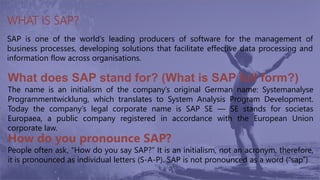
WHAT IS SAP?
SAP is one of the world’s leading producers of software for the management of
business processes, developing solutions that facilitate effective data processing and
information flow across organisations.
What does SAP stand for? (What is SAP full form?)
The name is an initialism of the company’s original German name: Systemanalyse
Programmentwicklung, which translates to System Analysis Program Development.
Today the company’s legal corporate name is SAP SE — SE stands for societas
Europaea, a public company registered in accordance with the European Union
corporate law.
How do you pronounce SAP?
People often ask, “How do you say SAP?” It is an initialism, not an acronym, therefore,
it is pronounced as individual letters (S-A-P). SAP is not pronounced as a word (“sap”).
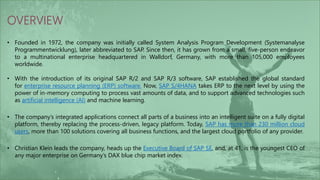
OVERVIEW
• Founded in 1972, the company was initially called System Analysis Program Development (Systemanalyse
Programmentwicklung), later abbreviated to SAP. Since then, it has grown from a small, five-person endeavor
to a multinational enterprise headquartered in Walldorf, Germany, with more than 105,000 employees
worldwide.
• With the introduction of its original SAP R/2 and SAP R/3 software, SAP established the global standard
for enterprise resource planning (ERP) software. Now, SAP S/4HANA takes ERP to the next level by using the
power of in-memory computing to process vast amounts of data, and to support advanced technologies such
as artificial intelligence (AI) and machine learning.
• The company’s integrated applications connect all parts of a business into an intelligent suite on a fully digital
platform, thereby replacing the process-driven, legacy platform. Today, SAP has more than 230 million cloud
users, more than 100 solutions covering all business functions, and the largest cloud portfolio of any provider.

• Christian Klein leads the company, heads up the Executive Board of SAP SE, and, at 41, is the youngest CEO of
any major enterprise on Germany’s DAX blue chip market index.
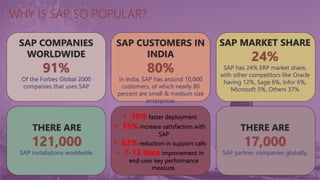
WHY IS SAP SO POPULAR?
SAP COMPANIES
WORLDWIDE
91%
Of the Forbes Global 2000
companies that uses SAP
SAP CUSTOMERS IN
INDIA
80%
In India, SAP has around 10,000
customers, of which nearly 80
percent are small & medium size
enterprises
SAP MARKET SHARE
24%
SAP has 24% ERP market share,
with other competitors like Oracle
having 12%, Sage 6%, Infor 6%,
Microsoft 5%, Others 37%
THERE ARE
121,000
SAP installations worldwide.
THERE ARE
17,000
SAP partner companies globally.
• 10% faster deployment
• 15% increase satisfaction with
SAP
• 62% reduction in support calls
• 7-13 time improvement in
end-user key performance
measure.
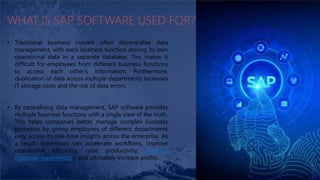
WHAT IS SAP SOFTWARE USED FOR?
• Traditional business models often decentralise data
management, with each business function storing its own
operational data in a separate database. This makes it
difficult for employees from different business functions
to access each other’s information. Furthermore,
duplication of data across multiple departments increases
IT storage costs and the risk of data errors.
• By centralising data management, SAP software provides
multiple business functions with a single view of the truth.
This helps companies better manage complex business
processes by giving employees of different departments
easy access to real-time insights across the enterprise. As
a result, businesses can accelerate workflows, improve
operational efficiency, raise productivity, enhance
customer experiences – and ultimately increase profits.
WHAT IS ERP SOFTWARE ?
• ERP stands for “enterprise resource planning.” ERP
software includes programmes for all core business
areas, such as procurement, production, materials
management, sales, marketing, finance, and human
resources (HR).
• SAP was one of the first companies to develop
standard software for business solutions and continues
to offer industry-leading ERP solutions.
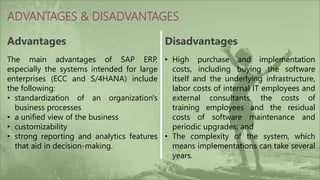
ADVANTAGES & DISADVANTAGES
Advantages
The main advantages of SAP ERP,
especially the systems intended for large
enterprises (ECC and S/4HANA) include
the following:
• standardization of an organization's
business processes
• a unified view of the business
• customizability
• strong reporting and analytics features
that aid in decision-making.
Disadvantages
• High purchase and implementation
costs, including buying the software
itself and the underlying infrastructure,
labor costs of internal IT employees and
external consultants, the costs of
training employees and the residual
costs of software maintenance and
periodic upgrades; and
• The complexity of the system, which
means implementations can take several
years.
SAP & ERP USE CASES
SAP software helps organizations to manage nearly every aspect of the business, from finances to HR,
procurement and logistics.
Business Suite includes a broad range of business applications as well as industry-specific functionality.
Besides ECC, it includes modules for CRM, PLM, SCM and supplier relationship management (SRM).
Among the industry-specific applications in Business Suite or S/4HANA are the following:
• Consumer Industries, including Agribusiness; Consumer Products; Fashion; Life Sciences; Retail;
and Wholesale Distribution.
• Discrete Industries, including Aerospace and Defense; Automotive; High Tech; and Industrial
Manufacturing.
• Energy and Natural Resources, including Building Products; Chemicals; Mill Products; Mining; Oil,
Gas and Energy; and Utilities.
• Financial Services, including Banking and Insurance.
• Public Service, including Defense and Security; Federal and National Government; Future Cities;
Healthcare; Higher Education and Research; and Regional, State and Local Government.
• Service Industries, including Cargo Transportation and Logistics; Engineering, Construction and
Operations; Media; Passenger Travel and Leisure; Professional Services; Sports and Entertainment;
and Telecommunications.
THANK YOU
OASYS TECH SOLUTIONS
PVT LTD
REACH US: M/33, SAMANTA
VIHAR, NEAR NALCO SQUARE,
BHUBANESWAR, ODISHA,
PIN- 751017
VISIT US: www.oasystspl.com
CONTACT US: (0674) 2300178
MAIL US: info@oasystspl.com

SAP.pptx

  • 1.
  • 2.
    WHAT IS SAP? SAPis one of the world’s leading producers of software for the management of business processes, developing solutions that facilitate effective data processing and information flow across organisations. What does SAP stand for? (What is SAP full form?) The name is an initialism of the company’s original German name: Systemanalyse Programmentwicklung, which translates to System Analysis Program Development. Today the company’s legal corporate name is SAP SE — SE stands for societas Europaea, a public company registered in accordance with the European Union corporate law. How do you pronounce SAP? People often ask, “How do you say SAP?” It is an initialism, not an acronym, therefore, it is pronounced as individual letters (S-A-P). SAP is not pronounced as a word (“sap”).
  • 3.
    OVERVIEW • Founded in1972, the company was initially called System Analysis Program Development (Systemanalyse Programmentwicklung), later abbreviated to SAP. Since then, it has grown from a small, five-person endeavor to a multinational enterprise headquartered in Walldorf, Germany, with more than 105,000 employees worldwide. • With the introduction of its original SAP R/2 and SAP R/3 software, SAP established the global standard for enterprise resource planning (ERP) software. Now, SAP S/4HANA takes ERP to the next level by using the power of in-memory computing to process vast amounts of data, and to support advanced technologies such as artificial intelligence (AI) and machine learning. • The company’s integrated applications connect all parts of a business into an intelligent suite on a fully digital platform, thereby replacing the process-driven, legacy platform. Today, SAP has more than 230 million cloud users, more than 100 solutions covering all business functions, and the largest cloud portfolio of any provider. • Christian Klein leads the company, heads up the Executive Board of SAP SE, and, at 41, is the youngest CEO of any major enterprise on Germany’s DAX blue chip market index.
  • 4.
    WHY IS SAPSO POPULAR? SAP COMPANIES WORLDWIDE 91% Of the Forbes Global 2000 companies that uses SAP SAP CUSTOMERS IN INDIA 80% In India, SAP has around 10,000 customers, of which nearly 80 percent are small & medium size enterprises SAP MARKET SHARE 24% SAP has 24% ERP market share, with other competitors like Oracle having 12%, Sage 6%, Infor 6%, Microsoft 5%, Others 37% THERE ARE 121,000 SAP installations worldwide. THERE ARE 17,000 SAP partner companies globally. • 10% faster deployment • 15% increase satisfaction with SAP • 62% reduction in support calls • 7-13 time improvement in end-user key performance measure.
  • 5.
    WHAT IS SAPSOFTWARE USED FOR? • Traditional business models often decentralise data management, with each business function storing its own operational data in a separate database. This makes it difficult for employees from different business functions to access each other’s information. Furthermore, duplication of data across multiple departments increases IT storage costs and the risk of data errors. • By centralising data management, SAP software provides multiple business functions with a single view of the truth. This helps companies better manage complex business processes by giving employees of different departments easy access to real-time insights across the enterprise. As a result, businesses can accelerate workflows, improve operational efficiency, raise productivity, enhance customer experiences – and ultimately increase profits.
  • 6.
    WHAT IS ERPSOFTWARE ? • ERP stands for “enterprise resource planning.” ERP software includes programmes for all core business areas, such as procurement, production, materials management, sales, marketing, finance, and human resources (HR). • SAP was one of the first companies to develop standard software for business solutions and continues to offer industry-leading ERP solutions.
  • 7.
    ADVANTAGES & DISADVANTAGES Advantages Themain advantages of SAP ERP, especially the systems intended for large enterprises (ECC and S/4HANA) include the following: • standardization of an organization's business processes • a unified view of the business • customizability • strong reporting and analytics features that aid in decision-making. Disadvantages • High purchase and implementation costs, including buying the software itself and the underlying infrastructure, labor costs of internal IT employees and external consultants, the costs of training employees and the residual costs of software maintenance and periodic upgrades; and • The complexity of the system, which means implementations can take several years.
  • 8.
    SAP & ERPUSE CASES SAP software helps organizations to manage nearly every aspect of the business, from finances to HR, procurement and logistics. Business Suite includes a broad range of business applications as well as industry-specific functionality. Besides ECC, it includes modules for CRM, PLM, SCM and supplier relationship management (SRM). Among the industry-specific applications in Business Suite or S/4HANA are the following: • Consumer Industries, including Agribusiness; Consumer Products; Fashion; Life Sciences; Retail; and Wholesale Distribution. • Discrete Industries, including Aerospace and Defense; Automotive; High Tech; and Industrial Manufacturing. • Energy and Natural Resources, including Building Products; Chemicals; Mill Products; Mining; Oil, Gas and Energy; and Utilities. • Financial Services, including Banking and Insurance. • Public Service, including Defense and Security; Federal and National Government; Future Cities; Healthcare; Higher Education and Research; and Regional, State and Local Government. • Service Industries, including Cargo Transportation and Logistics; Engineering, Construction and Operations; Media; Passenger Travel and Leisure; Professional Services; Sports and Entertainment; and Telecommunications.
  • 9.
    THANK YOU OASYS TECHSOLUTIONS PVT LTD REACH US: M/33, SAMANTA VIHAR, NEAR NALCO SQUARE, BHUBANESWAR, ODISHA, PIN- 751017 VISIT US: www.oasystspl.com CONTACT US: (0674) 2300178 MAIL US: info@oasystspl.com