Sanitation & Setup & Knife Cuts
Classroom Policy Proper uniform and grooming is required daily. Absenteeism and tardiness will be handled according to school policy as outlined in the student handbook. A professional attitude and positive demeanor should be expressed at all times. It is mandatory to attend the class meal period. There is no smoking while class is in session. No outside food or beverages are allowed in class. Unless documented food allergy prohibits, students are required to participate in all product tasting.
Ten Commandments for a Chef 1.  Practice punctuality every day of employment . 2.  Practice perfect sanitation under any and all circumstances . 3 .Practice patience and politeness. 4. Practice the art of continuing your education. 5.  Practice teamwork at ALL times. 6.  Practice accepting responsibility. 7.  Practice creating atmosphere free of argumentation and tension. 8.  Practice conservation of energy,  materials, and foodstuff. 9.  Practice the production of high quality products . 10.  Practice honesty and straightforwardness.
HACCP  ( H azard  A nalysis  C ritical  C ontrol  P oint)  HACCP- Seven Principle Steps 1. Identify hazards and assess their severity and risks. 2. Determine critical control points (CCP) in food preparation. 3. Determine critical control limits (CCL) for each CCP identified. 4. Monitor critical control points and records data. 5. Establish effective record keeping system to document HACCP system. 6. Establish procedures to verify that HACCP system is working. 7. Take corrective action whenever monitoring indicates a critical limit is exceeded.
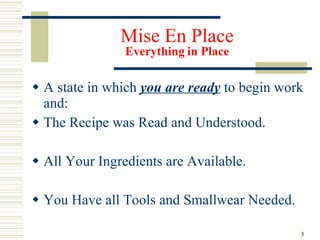
Mise En Place Everything   in Place A state in which  you are ready  to begin work and: The Recipe was Read and Understood. All Your Ingredients are Available. You Have all Tools and Smallwear Needed .
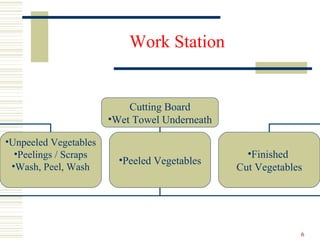
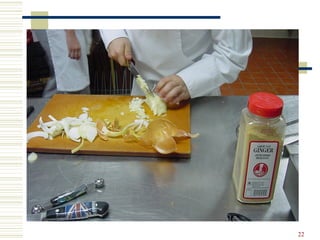
Work Station Cutting Board Wet Towel Underneath Unpeeled Vegetables Peelings / Scraps Wash, Peel, Wash Peeled Vegetables Finished  Cut Vegetables
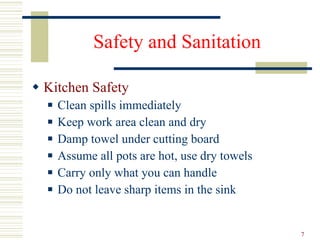
Safety and Sanitation Kitchen Safety Clean spills immediately Keep work area clean and dry Damp towel under cutting board Assume all pots are hot, use dry towels Carry only what you can handle Do not leave sharp items in the sink
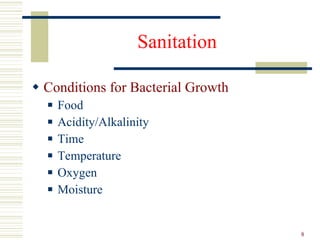
Sanitation Conditions for Bacterial Growth Food Acidity/Alkalinity Time Temperature Oxygen Moisture
Sanitation Temperature Danger Zone (TDZ) 41 °F - 140°F Hazard Analysis Critical Control Points (HACCP) Cross Contamination Sources of Food Contamination
Sanitation  Thaw frozen foods safely Hold food at proper temperatures Reheat to proper temperatures
Kitchen Safety Clean spills immediately Keep work area clean and dry Use a damp towel under the cutting board Assume all pots are hot, use dry towels Carry only what you can handle Never place knives or other sharp items in   the sink
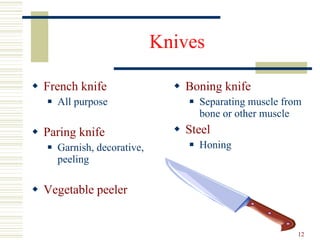
Knives French knife All purpose Paring knife Garnish, decorative, peeling Vegetable peeler Boning knife Separating muscle from bone or other muscle Steel Honing
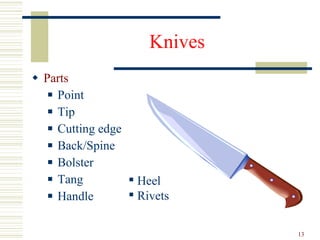
Knives Parts Point Tip  Cutting edge Back/Spine Bolster Tang Handle Heel Rivets
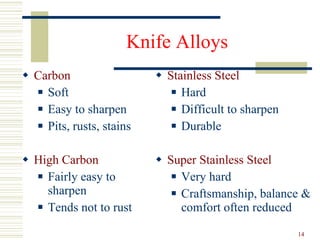
Knife Alloys Carbon Soft Easy to sharpen Pits, rusts, stains High Carbon Fairly easy to sharpen Tends not to rust Stainless Steel Hard Difficult to sharpen Durable Super Stainless Steel Very hard Craftsmanship, balance & comfort often reduced
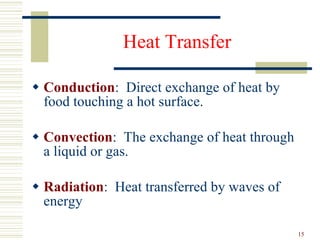
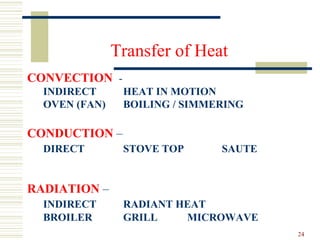
Heat Transfer Conduction :  Direct exchange of heat by food touching a hot surface. Convection :  The exchange of heat through a liquid or gas. Radiation :  Heat transferred by waves of energy
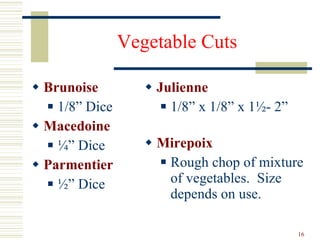
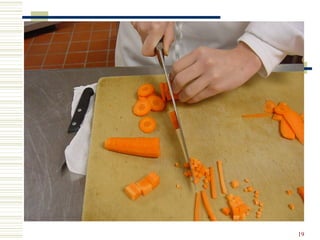
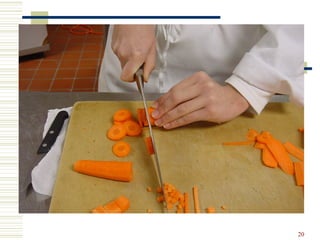
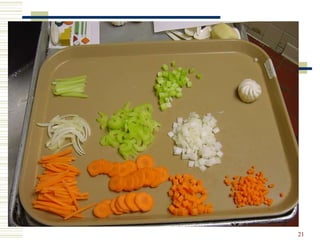
Vegetable Cuts Brunoise 1/8” Dice Macedoine ¼” Dice Parmentier ½” Dice Julienne 1/8” x 1/8” x 1½- 2” Mirepoix   Rough chop of mixture of vegetables.  Size depends on use.
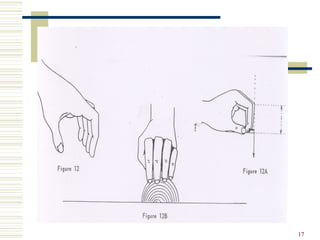
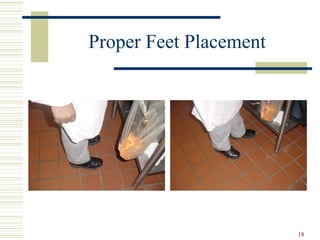
Proper Feet Placement
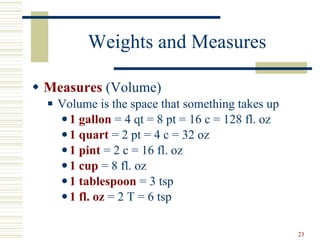
Weights and Measures Measures  (Volume) Volume is the space that something takes up 1 gallon  = 4 qt = 8 pt = 16 c = 128 fl. oz 1 quart  = 2 pt = 4 c = 32 oz 1 pint  = 2 c = 16 fl. oz 1 cup  = 8 fl. oz 1 tablespoon  = 3 tsp 1 fl. oz  = 2 T = 6 tsp
CONVECTION  -  INDIRECT HEAT IN MOTION OVEN (FAN) BOILING / SIMMERING CONDUCTION  –  DIRECT STOVE TOP  SAUTE RADIATION   –  INDIRECT RADIANT HEAT BROILER  GRILL MICROWAVE Transfer of Heat
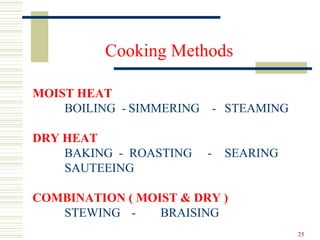
MOIST HEAT BOILING  - SIMMERING  - STEAMING DRY HEAT BAKING  -  ROASTING  - SEARING SAUTEEING COMBINATION ( MOIST & DRY ) STEWING  - BRAISING Cooking Methods
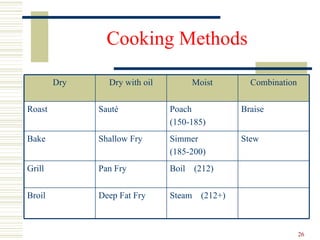
Cooking Methods Dry Dry with oil Moist Combination Roast Sauté Poach  (150-185) Braise Bake Shallow Fry Simmer  (185-200) Stew Grill Pan Fry Boil  (212) Broil Deep Fat Fry Steam  (212+)
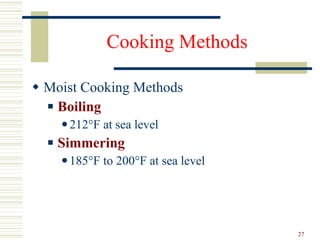
Cooking Methods Moist Cooking Methods  Boiling 212 °F at sea level Simmering 185 °F to 200°F at sea level
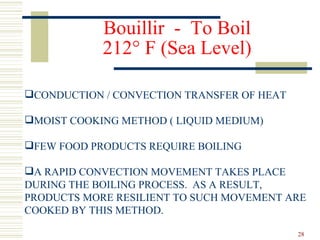
CONDUCTION / CONVECTION TRANSFER OF HEAT  MOIST COOKING METHOD ( LIQUID MEDIUM) FEW FOOD PRODUCTS REQUIRE BOILING A RAPID CONVECTION MOVEMENT TAKES PLACE DURING THE BOILING PROCESS.  AS A RESULT, PRODUCTS MORE RESILIENT TO SUCH MOVEMENT ARE COOKED BY THIS METHOD. Bouillir  -  To Boil 212 °  F (Sea Level)
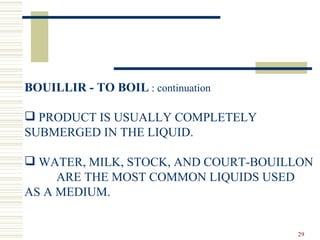
BOUILLIR - TO BOIL  : continuation PRODUCT IS USUALLY COMPLETELY  SUBMERGED IN THE LIQUID. WATER, MILK, STOCK, AND COURT-BOUILLON  ARE THE MOST COMMON LIQUIDS USED  AS A MEDIUM.
CONDUCTION / CONVECTION MOIST HEAT COOKING METHOD SLOW MOVEMENT OF LIQUID ADVANTAGES OVER BOILING LESS SHRINKING LESS EVAPORATION LESS BREAKUP OF FRAGILE FOOD,  i.e.-FISH Mijoter – To Simmer 185 °  F - 200 °F  (Sea Level)

Sanitation, Setup & Knife Skills

  • 1.
    Sanitation & Setup& Knife Cuts
  • 2.
    Classroom Policy Properuniform and grooming is required daily. Absenteeism and tardiness will be handled according to school policy as outlined in the student handbook. A professional attitude and positive demeanor should be expressed at all times. It is mandatory to attend the class meal period. There is no smoking while class is in session. No outside food or beverages are allowed in class. Unless documented food allergy prohibits, students are required to participate in all product tasting.
  • 3.
    Ten Commandments fora Chef 1. Practice punctuality every day of employment . 2. Practice perfect sanitation under any and all circumstances . 3 .Practice patience and politeness. 4. Practice the art of continuing your education. 5. Practice teamwork at ALL times. 6. Practice accepting responsibility. 7. Practice creating atmosphere free of argumentation and tension. 8. Practice conservation of energy, materials, and foodstuff. 9. Practice the production of high quality products . 10. Practice honesty and straightforwardness.
  • 4.
    HACCP (H azard A nalysis C ritical C ontrol P oint) HACCP- Seven Principle Steps 1. Identify hazards and assess their severity and risks. 2. Determine critical control points (CCP) in food preparation. 3. Determine critical control limits (CCL) for each CCP identified. 4. Monitor critical control points and records data. 5. Establish effective record keeping system to document HACCP system. 6. Establish procedures to verify that HACCP system is working. 7. Take corrective action whenever monitoring indicates a critical limit is exceeded.
  • 5.
    Mise En PlaceEverything in Place A state in which you are ready to begin work and: The Recipe was Read and Understood. All Your Ingredients are Available. You Have all Tools and Smallwear Needed .
  • 6.
    Work Station CuttingBoard Wet Towel Underneath Unpeeled Vegetables Peelings / Scraps Wash, Peel, Wash Peeled Vegetables Finished Cut Vegetables
  • 7.
    Safety and SanitationKitchen Safety Clean spills immediately Keep work area clean and dry Damp towel under cutting board Assume all pots are hot, use dry towels Carry only what you can handle Do not leave sharp items in the sink
  • 8.
    Sanitation Conditions forBacterial Growth Food Acidity/Alkalinity Time Temperature Oxygen Moisture
  • 9.
    Sanitation Temperature DangerZone (TDZ) 41 °F - 140°F Hazard Analysis Critical Control Points (HACCP) Cross Contamination Sources of Food Contamination
  • 10.
    Sanitation Thawfrozen foods safely Hold food at proper temperatures Reheat to proper temperatures
  • 11.
    Kitchen Safety Cleanspills immediately Keep work area clean and dry Use a damp towel under the cutting board Assume all pots are hot, use dry towels Carry only what you can handle Never place knives or other sharp items in the sink
  • 12.
    Knives French knifeAll purpose Paring knife Garnish, decorative, peeling Vegetable peeler Boning knife Separating muscle from bone or other muscle Steel Honing
  • 13.
    Knives Parts PointTip Cutting edge Back/Spine Bolster Tang Handle Heel Rivets
  • 14.
    Knife Alloys CarbonSoft Easy to sharpen Pits, rusts, stains High Carbon Fairly easy to sharpen Tends not to rust Stainless Steel Hard Difficult to sharpen Durable Super Stainless Steel Very hard Craftsmanship, balance & comfort often reduced
  • 15.
    Heat Transfer Conduction: Direct exchange of heat by food touching a hot surface. Convection : The exchange of heat through a liquid or gas. Radiation : Heat transferred by waves of energy
  • 16.
    Vegetable Cuts Brunoise1/8” Dice Macedoine ¼” Dice Parmentier ½” Dice Julienne 1/8” x 1/8” x 1½- 2” Mirepoix Rough chop of mixture of vegetables. Size depends on use.
  • 18.
  • 23.
    Weights and MeasuresMeasures (Volume) Volume is the space that something takes up 1 gallon = 4 qt = 8 pt = 16 c = 128 fl. oz 1 quart = 2 pt = 4 c = 32 oz 1 pint = 2 c = 16 fl. oz 1 cup = 8 fl. oz 1 tablespoon = 3 tsp 1 fl. oz = 2 T = 6 tsp
  • 24.
    CONVECTION - INDIRECT HEAT IN MOTION OVEN (FAN) BOILING / SIMMERING CONDUCTION – DIRECT STOVE TOP SAUTE RADIATION – INDIRECT RADIANT HEAT BROILER GRILL MICROWAVE Transfer of Heat
  • 25.
    MOIST HEAT BOILING - SIMMERING - STEAMING DRY HEAT BAKING - ROASTING - SEARING SAUTEEING COMBINATION ( MOIST & DRY ) STEWING - BRAISING Cooking Methods
  • 26.
    Cooking Methods DryDry with oil Moist Combination Roast Sauté Poach (150-185) Braise Bake Shallow Fry Simmer (185-200) Stew Grill Pan Fry Boil (212) Broil Deep Fat Fry Steam (212+)
  • 27.
    Cooking Methods MoistCooking Methods Boiling 212 °F at sea level Simmering 185 °F to 200°F at sea level
  • 28.
    CONDUCTION / CONVECTIONTRANSFER OF HEAT MOIST COOKING METHOD ( LIQUID MEDIUM) FEW FOOD PRODUCTS REQUIRE BOILING A RAPID CONVECTION MOVEMENT TAKES PLACE DURING THE BOILING PROCESS. AS A RESULT, PRODUCTS MORE RESILIENT TO SUCH MOVEMENT ARE COOKED BY THIS METHOD. Bouillir - To Boil 212 ° F (Sea Level)
  • 29.
    BOUILLIR - TOBOIL : continuation PRODUCT IS USUALLY COMPLETELY SUBMERGED IN THE LIQUID. WATER, MILK, STOCK, AND COURT-BOUILLON ARE THE MOST COMMON LIQUIDS USED AS A MEDIUM.
  • 30.
    CONDUCTION / CONVECTIONMOIST HEAT COOKING METHOD SLOW MOVEMENT OF LIQUID ADVANTAGES OVER BOILING LESS SHRINKING LESS EVAPORATION LESS BREAKUP OF FRAGILE FOOD, i.e.-FISH Mijoter – To Simmer 185 ° F - 200 °F (Sea Level)

Editor's Notes

  • #9 Food High protein sources are most common for bacteria to thrive Acidity/Alkalinity (ph) Neutral ph is best for most bacteria Time 4 hours total time in TDZ 2 stage cooling process 2 hours from 140 – 70 4 hours from 70 – 40 Temperature TDZ Foods must be re-heated to 165*F Oxygen Air Moisture The higher the water activity the greater the chance of bacterial growth
  • #10 Temperature danger zone- Max time allowed is 4 hours HACCP- System of monitoring and record keeping that ensures proper documentation of food safety concerns are addressed. Goal is to prevent Food borne illness. Cross Contamination- Transfer of bacteria to food from food, equipment, people and utensils. Sources of Contamination- Hands, coughs, sneezes, equipment, utensils, air, water, vermin, insects, etc.
  • #11 Proper methods to thawing food In the refrigerator. Safest method and allows the food to remain out of the temperature danger zone. Also the best method for quality because slow thawing helps prevent cellular breakdown in the product being thawed. In cold running potable water. If the entire product can be thawed within a two hour time limit. In the microwave if product will then be immediately cooked.
  • #27 Roasting- Dry heat method. Mirepoix, baste on occasion, temperature-approx. 350F Grilling- Heat source below the product. Radiant heat. Broiling- Heat source located above the product. Radiant heat.Gas-180,000 BTU, Electric-15 Kw Advantages of broiling- very high heat, ideal for browning, intense flavor. Sauté- To jump. Minimal oil, hot pan, controlled, high heat. Fry- Deep fry- completely submerged in oil. 350-375F. Shallow fry- not completely submerged. Pan fry- less than ½ covered in oil. Standard Breading procedure- wet, dry, wet, dry. Enemies of Fat- Heat, water, time, Braising- Combination cooking method. Large pieces of meat. Sear, deglaze, cover 2/3 with liquid, cover, fork tender. Stewing- Similar to braising. Smaller pieces of meat, more liquid, longer cooking time. Searing does not retain the juices!!
  • #28 Boiling- Rapid convection movement Simmering- Reduced convection movement,depouillage process,