Flyer 1
Meet evolving
enterprise
mobility
challenges with
Samsung KNOX™
2page
Solve today’s dynamic enterprise mobility demands with the right
solution platform
White Paper
Meet evolving enterprise mobility challenges with Samsung KNOX
The growth of enterprise mobility, driven by the Bring Your Own Device (BYOD) trend, has
recently fostered a rapid shift in the enterprise mobility marketplace. Mobile consumer device
leaders are increasing their presence in the enterprise business world with robust, next-
generation solutions, pushing out platforms that lag behind in innovation or fail to meet
user demands. After failing to meet user demands, the previous standard in business mobile
devices is being replaced by more innovative solutions.
The phenomenal growth of smartphone and tablet shipments and the shifting popularity of
different mobile device brands make it clear why enterprises must continually revisit their
mobility strategies and policies. Two or three years ago, no one could have known that,
according to the market research firm IDG Enterprise1
, nearly 80 percent of the 236.4 million
smartphones shipped in the second quarter of 2013 were Android™-based devices, or that
Samsung alone would hold nearly 40 percent of the Android smartphone market share.
Mobile device vendors that fail to innovate and miss the mark on user demand, can quickly
transition from market leaders to also-rans. These types of shifts can have a big impact on
enterprises, especially given the widespread corporate adoption of BYOD policies.
Companies that support BYOD allow employees to use their personal mobile devices to access
corporate resources and do work. If corporate mobility policies fail to reflect the changing
profile of their employees’ mobile devices, enterprise IT may quickly lose the ability to manage
and control those devices effectively.
As earlier-generation mobile devices fall out of favor, and mobility technologies evolve,
enterprises need to follow a well-thought-out process to optimize their mobility strategies.
That process, which this document discusses, goes well beyond simply evaluating the
functionality of any given mobile device. Also important are everything from employee
preferences to partner ecosystems, along with the management and security requirements
that typically top the list of concerns of CIOs and business executives alike.
Enterprise
Mobility
Trends
3page
White Paper
Meet evolving enterprise mobility challenges with Samsung KNOX
Assessmobilityneedsandemployeepreferences
Any effort to initiate or fine-tune a mobility strategy should not begin with a focus on mobile
devices. Rather, the first step should be an in-depth assessment of the current mobility
practices and processes already in place within the organization. In other words, before
companies can determine how they can best use current-generation mobile devices and
technologies, they first need to understand how mobility intersects with their core business
objectives, and how their employees currently use mobile devices.
In many cases, there will be a generational element that comes into play in such evaluations.
Younger workers, who came of age in a world of pervasive social networking and mobility,
may suggest new use cases that can make them and their employers more efficient and
productive. Simply swapping out old devices for new ones and changing little else can be
a missed opportunity to optimize an enterprise’s mobility operations based on the new
platforms’ capabilities and on new use cases and processes.
A key piece of this macro assessment is learning which mobile devices employees prefer.
Companies that have instituted BYOD programs can get a good sense of these preferences
simply by determining what types of personal mobile devices employees are bringing into the
work environment.
Even when companies follow the traditional model of purchasing, distributing and supporting
corporate-owned mobile devices, they should take employee preferences into account
before deciding to adopt any given platform. If IT and business managers fail to determine
employee preferences, they may discover that the devices they select are either rejected or
underutilized.
Once companies have gained a good understanding of their existing mobility profile and
their employees’ mobile practices and preferences, they can move on to additional stages of
the evaluation process. Failure to perform this first critical step can severely undermine the
ultimate success of any evolving mobility strategy.
4page
Ensure that the mobile platform meets security and compatibility
requirements
White Paper
Meet evolving enterprise mobility challenges with Samsung KNOX
Having completed an overview of the mobile environment and deciding where to take,
enterprises must next ensure they can manage and secure that environment and the
corporate data within it. This step is usually high on enterprises’ evaluation checklists.
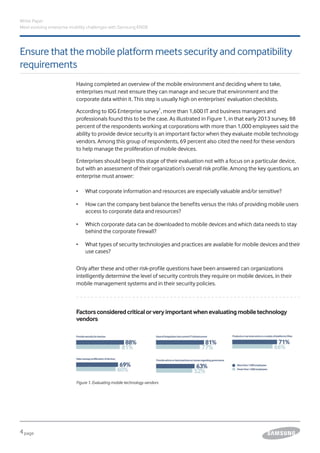
According to IDG Enterprise survey1
, more than 1,600 IT and business managers and
professionals found this to be the case. As illustrated in Figure 1, in that early 2013 survey, 88
percent of the respondents working at corporations with more than 1,000 employees said the
ability to provide device security is an important factor when they evaluate mobile technology
vendors. Among this group of respondents, 69 percent also cited the need for these vendors
to help manage the proliferation of mobile devices.
Enterprises should begin this stage of their evaluation not with a focus on a particular device,
but with an assessment of their organization’s overall risk profile. Among the key questions, an
enterprise must answer:
•	 What corporate information and resources are especially valuable and/or sensitive?
•	 How can the company best balance the benefits versus the risks of providing mobile users
access to corporate data and resources?
•	 Which corporate data can be downloaded to mobile devices and which data needs to stay
behind the corporate firewall?
•	 What types of security technologies and practices are available for mobile devices and their
use cases?
Only after these and other risk-profile questions have been answered can organizations
intelligently determine the level of security controls they require on mobile devices, in their
mobile management systems and in their security policies.
Factorsconsideredcriticalorveryimportantwhenevaluatingmobiletechnology
vendors
Figure 1. Evaluating mobile technology vendors
5page
Meet the full range of enterprise mobility needs with Samsung
White Paper
Meet evolving enterprise mobility challenges with Samsung KNOX
As it grew to become a leading mobile device provider worldwide, Samsung committed itself
to meeting the wide range of requirements that enterprise customers bring to the table.
That commitment extends beyond creating enterprise-grade smartphones, tablets and
other mobile devices. It also encompasses the full scope of programs and partnerships that
enterprise mobility initiatives entail.
Samsung offers a broad portfolio of device form factors, including smartphones and tablets. In
addition to offering different screen sizes and formats, Samsung devices deliver an unmatched
collection of features and functions. As a result, enterprises can find Samsung devices that
match virtually any mobility use case.
When it comes to employee preferences, employees have already voted with their personal
device purchases. As noted in the market figures cited earlier, Android-based devices dominate
smartphone shipments of which Samsung takes nearly 40 percent.
Given these figures, companies with BYOD programs already have large numbers of Samsung
devices active within their employee populations. Enterprises looking to update their mobile
devices from earlier models that have fallen into disfavor should give appropriate weight to the
mobile device choices their employees are making on their own.
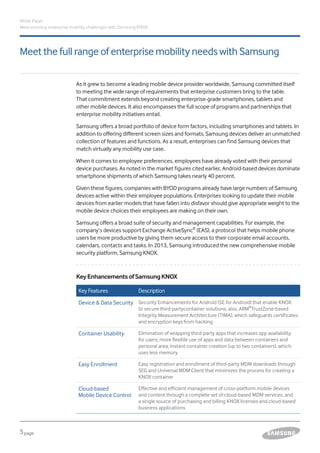
Samsung offers a broad suite of security and management capabilities. For example, the
company’s devices support Exchange ActiveSync®
(EAS), a protocol that helps mobile phone
users be more productive by giving them secure access to their corporate email accounts,
calendars, contacts and tasks. In 2013, Samsung introduced the new comprehensive mobile
security platform, Samsung KNOX.
KeyEnhancementsofSamsungKNOX
Key Features Description
Device & Data Security Security Enhancements for Android (SE for Android) that enable KNOX
to secure third-partycontainer solutions; also, ARM®
TrustZone-based
Integrity Measurement Architecture (TIMA), which safeguards certificates
and encryption keys from hacking
Container Usability Elimination of wrapping third-party apps that increases app availability
for users; more flexible use of apps and data between containers and
personal area; instant container creation (up to two containers), which
uses less memory
Easy Enrollment Easy registration and enrollment of third-party MDM downloads through
SEG and Universal MDM Client that minimizes the process for creating a
KNOX container
Cloud-based
Mobile Device Control
Effective and efficient management of cross-platform mobile devices
and content through a complete set of cloud-based MDM services, and
a single source of purchasing and billing KNOX licenses and cloud-based
business applications
6page
Advance and secure the enterprise with an all-inclusive mobility
platform
White Paper
Meet evolving enterprise mobility challenges with Samsung KNOX
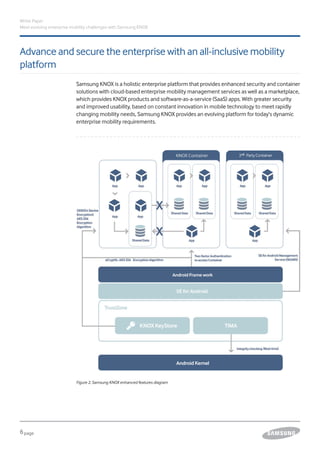
Samsung KNOX is a holistic enterprise platform that provides enhanced security and container
solutions with cloud-based enterprise mobility management services as well as a marketplace,
which provides KNOX products and software-as-a-service (SaaS) apps. With greater security
and improved usability, based on constant innovation in mobile technology to meet rapidly
changing mobility needs, Samsung KNOX provides an evolving platform for today's dynamic
enterprise mobility requirements.
Figure 2. Samsung KNOX enhanced features diagram
7page
Provide safe and flexible enterprise mobility with enhanced security
technology
White Paper
Meet evolving enterprise mobility challenges with Samsung KNOX
Increaseprotectionwithheightenedsecurity
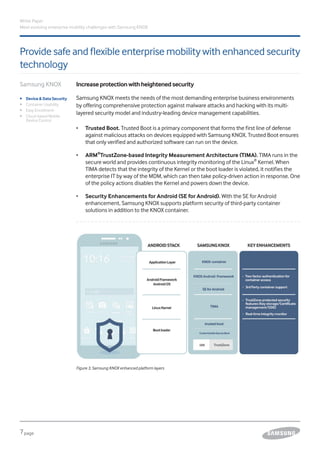
Samsung KNOX meets the needs of the most demanding enterprise business environments
by offering comprehensive protection against malware attacks and hacking with its multi-
layered security model and industry-leading device management capabilities.
•	 Trusted Boot. Trusted Boot is a primary component that forms the first line of defense
against malicious attacks on devices equipped with Samsung KNOX. Trusted Boot ensures
that only verified and authorized software can run on the device.
•	 ARM®
TrustZone-based Integrity Measurement Architecture (TIMA). TIMA runs in the
secure world and provides continuous integrity monitoring of the Linux®
Kernel. When
TIMA detects that the integrity of the Kernel or the boot loader is violated, it notifies the
enterprise IT by way of the MDM, which can then take policy-driven action in response. One
of the policy actions disables the Kernel and powers down the device.
•	 Security Enhancements for Android (SE for Android). With the SE for Android
enhancement, Samsung KNOX supports platform security of third-party container
solutions in addition to the KNOX container.
Figure 3. Samsung KNOX enhanced platform layers
Samsung KNOX
ǰǰ Device & Data Security
ǰǰ Container Usability
ǰǰ Easy Enrollment
ǰǰ Cloud-based Mobile
Device Control
8page
White Paper
Meet evolving enterprise mobility challenges with Samsung KNOX
Samsung KNOX offers key improvements for strengthened hardware and software security.
•	 Enhancements for SE Android. With the security enhancements of SE for Android,
Samsung KNOX supports platform security of third-party container solutions in addition
to the KNOX container. This flexibility enables Samsung KNOX to provide enterprises with
powerful security for leading third-party containers.
•	 Enhancements for TIMA. TIMA performs continuous, real-time monitoring of the system
from within TrustZone to prevent tampering of the Kernel and system partition. It protects
against malicious modifications and injections to the kernel code.
•	 SmartCard Framework. Smartphones are increasingly being used to provide added
authentication with card readers. Instead of carrying a card reader, users can simply
point their phone towards the Bluetooth®
card reader. The KNOX Platform now allows the
smartphone to be used as a safe, authenticated smartcard.
Addconvenienceviaaminimalregistrationprocessandaconsistentuserinterface
Users are able to easily register and enroll their devices through the Samsung Enterprise
Gateway (SEG) cloud server and the Universal MDM Client (UMC), minimizing the steps needed
to create a KNOX container. MDM server registers company profile at SEG. UMC, a preloaded
application in Samsung GALAXY devices, communicates with SEG to download and install MDM
application. After installation, MDM application automatically authenticates user credential
communicating with MDM server.
Providebetter,moreflexiblecontainerusability
Samsung KNOX container provides security for enterprise data by creating a secure zone in the
employee’s device for corporate applications and encrypting enterprise data both at rest and
in motion. Samsung KNOX container is an isolated and secure environment within the mobile
device, complete with its own home screen, launcher, applications and widgets. Applications
and data inside the container are separated from applications outside the container. Samsung
KNOX offers increased container usability.
•	 Support for a variety of apps. Users can have access to a greater variety of apps,
including KNOX and Google Play™ apps, without the need for an app-wrapping process.
This increases app availability while keeping the app secure with KNOX malware scanning
support. As a result, enterprises can easily and safely deploy business apps in the container.
•	 Flexible use of apps and data. KNOX container offers adjustable and flexible use of apps,
data and the clipboard between the user’s personal area and the container. Enterprises
can manage usage flexibility of apps and data within and between the personal area and
the container by receiving, running and managing the container policy.
Samsung KNOX
ǰǰ Device & Data Security
ǰǰ Container Usability
ǰǰ Easy Enrollment
ǰǰ Cloud-based Mobile
Device Control
Samsung KNOX
ǰǰ Device & Data Security
ǰǰ Container Usability
ǰǰ Easy Enrollment
ǰǰ Cloud-based Mobile
Device Control
9page
White Paper
Meet evolving enterprise mobility challenges with Samsung KNOX
Efficientlymanagemobiledeviceswithaconvenientcloud-basedsolution
MDM is simplified with a cloud-based enterprise mobility management solution that does
not require on-premise infrastructure. The solution helps solve common enterprise mobility
adoption issues, such as budget constraints, limited IT skills and integration of diverse devices.
Devices can be managed through an Admin Portal with optional on-premises Active Directory
support, eliminating the need to regularly update the employee directory for on-premise MDM
as a company grows. Through this portal, IT administrators can control and monitor employee
devices and applications. With a rich set of IT policies, IT administrators can easily implement
company guidelines, such as remote wipe, password reset, remote lock, device storage
encryption, restriction on jail broken/rooted devices, restricted use of camera, location report
and more. In addition, the solution provides true BYOD (Bring Your Own Device) and CYOD
(Choose Your Own Device) support with cross-platform support for Android and iOS®
devices.
Convenient, one-click access to various web-based mobile apps is also provided with Single
Sign-On (SSO).
Samsung KNOX
ǰǰ Device & Data Security
ǰǰ Container Usability
ǰǰ Easy Enrollment
ǰǰ Cloud-based Mobile
Device Control
Convenientlysearch,select,andpurchaseKNOXlicensesandbusinesssolution
applicationsononewebsite
To adopt business mobility initiatives, businesses should consider various service providers,
such as MDM, security solution and business application providers as well as device
manufacturers. From a single website, which consolidates all aspects of business mobility
requirements into one, organizations can purchase over 140 leading cloud apps and bundled
apps which include:
•	 	KNOX products
•	 	Hosted email and calendar
•	 	Human resource management
•	 	Customer relationship management
•	 	Business banagement solutions
•	 	Collaboration and file sharing
•	 	Antivirus and IT security
The website enables everything from service provider selection and centralized user and
license management to purchasing, billing and installation while maintaining cost efficiency.
IT Administrators only need to pay one bill for all users and apps and flexible pricing models,
such as pre- and post-paid subscriptions, one-time/recurring and usage-based payments. Also,
a variety of billing methods (credit cards, PayPal™ and direct deposit) in multiple currencies is
available. Enterprises seeking more convenient and efficient ways to simplify the process can
now do so from a single source.
10page
White Paper
Meet evolving enterprise mobility challenges with Samsung KNOX
Partner with Samsung to meet evolving mobility needs
Not much happens slowly in the world of high technology, and the mobility marketplace is
among the most active and fast-evolving technology sectors. The presence of hundreds of
millions of advanced smartphones, tablets and other mobile devices across the business
landscape has dramatically altered the enterprise status quo. Companies hoping to stay
competitive and wanting to achieve maximum operational efficiencies must keep pace
with the evolving capabilities – and shifting fortunes – of different mobile devices. To best
accomplish this goal, they must consider not only the capabilities of the devices themselves,
but also a host of other factors critical to the overall success of enterprise mobility programs.
If they conduct these assessments and evaluations in a comprehensive fashion, enterprises
are likely to find Samsung emerging as an obvious choice as a mobility partner. The company’s
portfolio of mobile devices is arguably the most powerful and popular available from any
vendor today. In tandem with its device innovation, Samsung has created the next secure
enterprise mobile platform to meet the demanding requirements of its enterprise customers.
The breadth of its device portfolio, the sophistication of its technology and the range of its
business-focused partnerships and programs have already established Samsung as a leading
player in the enterprise mobility scene. Based on its commitment to this demanding customer
base, Samsung is likely to hold this leadership position for many years to come.
Samsung for
next enterprise
mobility
11page
Samsung Electronics Co., Ltd. is a global leader in technology, opening new possibilities for
people everywhere. Through relentless innovation and discovery, we are transforming the
worlds of TVs, smartphones, tablets, PCs, cameras, home appliances, printers, LTE systems,
medical devices, semiconductors and LED solutions. We employ 286,000 people across 80
countries with annual sales of US$216.7 billion. To discover more, please visit
www.samsung.com.
For more information about Samsung KNOX,
Visit https://www.samsung.com/KNOX
Copyright © 2014 Samsung Electronics Co. Ltd. All rights reserved. Samsung and KNOX are
either trademarks or registered trademark of Samsung Electronics Co. Ltd. Specifications and
designs are subject to change without notice. Non-metric weights and measurements are
approximate. All data were deemed correct at time of creation. Samsung is not liable for errors
or omissions. All brand, product, service names and logos are trademarks and/or registered
trademarks of their respective owners and are hereby recognized and acknowledged.
Android and Google Play are trademarks of Google Inc.
ARM and TrustZone are registered trademarks of ARM Ltd. or its subsidiaries.
iOS is a registered trademark of Cisco Systems Inc., registered in the U.S. and other countries, and licensed to Apple.
Linux is a registered trademark of Linus Torvalds in the United States, other countries, or both.
Microsoft and ActiveSync are registered trademarks of Microsoft Corporation in the United States and/or other
countries, or both.
1. 2013 Consumerization of IT in the Enterprise survey, IDG Eneterprise
Samsung Electronics Co., Ltd.
416, Maetan 3-dong, Yeongtong-gu
Suwon-si, Gyeonggi-do 443-772, Korea
White Paper
Meet evolving enterprise mobility challenges with Samsung KNOX
About Samsung Electronics Co., Ltd.
www.samsung.com/KNOX

Samsung KNOX™ Meets Evolving Enterprise Mobility Challenges

  • 1.
  • 2.
    2page Solve today’s dynamicenterprise mobility demands with the right solution platform White Paper Meet evolving enterprise mobility challenges with Samsung KNOX The growth of enterprise mobility, driven by the Bring Your Own Device (BYOD) trend, has recently fostered a rapid shift in the enterprise mobility marketplace. Mobile consumer device leaders are increasing their presence in the enterprise business world with robust, next- generation solutions, pushing out platforms that lag behind in innovation or fail to meet user demands. After failing to meet user demands, the previous standard in business mobile devices is being replaced by more innovative solutions. The phenomenal growth of smartphone and tablet shipments and the shifting popularity of different mobile device brands make it clear why enterprises must continually revisit their mobility strategies and policies. Two or three years ago, no one could have known that, according to the market research firm IDG Enterprise1 , nearly 80 percent of the 236.4 million smartphones shipped in the second quarter of 2013 were Android™-based devices, or that Samsung alone would hold nearly 40 percent of the Android smartphone market share. Mobile device vendors that fail to innovate and miss the mark on user demand, can quickly transition from market leaders to also-rans. These types of shifts can have a big impact on enterprises, especially given the widespread corporate adoption of BYOD policies. Companies that support BYOD allow employees to use their personal mobile devices to access corporate resources and do work. If corporate mobility policies fail to reflect the changing profile of their employees’ mobile devices, enterprise IT may quickly lose the ability to manage and control those devices effectively. As earlier-generation mobile devices fall out of favor, and mobility technologies evolve, enterprises need to follow a well-thought-out process to optimize their mobility strategies. That process, which this document discusses, goes well beyond simply evaluating the functionality of any given mobile device. Also important are everything from employee preferences to partner ecosystems, along with the management and security requirements that typically top the list of concerns of CIOs and business executives alike. Enterprise Mobility Trends
  • 3.
    3page White Paper Meet evolvingenterprise mobility challenges with Samsung KNOX Assessmobilityneedsandemployeepreferences Any effort to initiate or fine-tune a mobility strategy should not begin with a focus on mobile devices. Rather, the first step should be an in-depth assessment of the current mobility practices and processes already in place within the organization. In other words, before companies can determine how they can best use current-generation mobile devices and technologies, they first need to understand how mobility intersects with their core business objectives, and how their employees currently use mobile devices. In many cases, there will be a generational element that comes into play in such evaluations. Younger workers, who came of age in a world of pervasive social networking and mobility, may suggest new use cases that can make them and their employers more efficient and productive. Simply swapping out old devices for new ones and changing little else can be a missed opportunity to optimize an enterprise’s mobility operations based on the new platforms’ capabilities and on new use cases and processes. A key piece of this macro assessment is learning which mobile devices employees prefer. Companies that have instituted BYOD programs can get a good sense of these preferences simply by determining what types of personal mobile devices employees are bringing into the work environment. Even when companies follow the traditional model of purchasing, distributing and supporting corporate-owned mobile devices, they should take employee preferences into account before deciding to adopt any given platform. If IT and business managers fail to determine employee preferences, they may discover that the devices they select are either rejected or underutilized. Once companies have gained a good understanding of their existing mobility profile and their employees’ mobile practices and preferences, they can move on to additional stages of the evaluation process. Failure to perform this first critical step can severely undermine the ultimate success of any evolving mobility strategy.
  • 4.
    4page Ensure that themobile platform meets security and compatibility requirements White Paper Meet evolving enterprise mobility challenges with Samsung KNOX Having completed an overview of the mobile environment and deciding where to take, enterprises must next ensure they can manage and secure that environment and the corporate data within it. This step is usually high on enterprises’ evaluation checklists. According to IDG Enterprise survey1 , more than 1,600 IT and business managers and professionals found this to be the case. As illustrated in Figure 1, in that early 2013 survey, 88 percent of the respondents working at corporations with more than 1,000 employees said the ability to provide device security is an important factor when they evaluate mobile technology vendors. Among this group of respondents, 69 percent also cited the need for these vendors to help manage the proliferation of mobile devices. Enterprises should begin this stage of their evaluation not with a focus on a particular device, but with an assessment of their organization’s overall risk profile. Among the key questions, an enterprise must answer: • What corporate information and resources are especially valuable and/or sensitive? • How can the company best balance the benefits versus the risks of providing mobile users access to corporate data and resources? • Which corporate data can be downloaded to mobile devices and which data needs to stay behind the corporate firewall? • What types of security technologies and practices are available for mobile devices and their use cases? Only after these and other risk-profile questions have been answered can organizations intelligently determine the level of security controls they require on mobile devices, in their mobile management systems and in their security policies. Factorsconsideredcriticalorveryimportantwhenevaluatingmobiletechnology vendors Figure 1. Evaluating mobile technology vendors
  • 5.
    5page Meet the fullrange of enterprise mobility needs with Samsung White Paper Meet evolving enterprise mobility challenges with Samsung KNOX As it grew to become a leading mobile device provider worldwide, Samsung committed itself to meeting the wide range of requirements that enterprise customers bring to the table. That commitment extends beyond creating enterprise-grade smartphones, tablets and other mobile devices. It also encompasses the full scope of programs and partnerships that enterprise mobility initiatives entail. Samsung offers a broad portfolio of device form factors, including smartphones and tablets. In addition to offering different screen sizes and formats, Samsung devices deliver an unmatched collection of features and functions. As a result, enterprises can find Samsung devices that match virtually any mobility use case. When it comes to employee preferences, employees have already voted with their personal device purchases. As noted in the market figures cited earlier, Android-based devices dominate smartphone shipments of which Samsung takes nearly 40 percent. Given these figures, companies with BYOD programs already have large numbers of Samsung devices active within their employee populations. Enterprises looking to update their mobile devices from earlier models that have fallen into disfavor should give appropriate weight to the mobile device choices their employees are making on their own. Samsung offers a broad suite of security and management capabilities. For example, the company’s devices support Exchange ActiveSync® (EAS), a protocol that helps mobile phone users be more productive by giving them secure access to their corporate email accounts, calendars, contacts and tasks. In 2013, Samsung introduced the new comprehensive mobile security platform, Samsung KNOX. KeyEnhancementsofSamsungKNOX Key Features Description Device & Data Security Security Enhancements for Android (SE for Android) that enable KNOX to secure third-partycontainer solutions; also, ARM® TrustZone-based Integrity Measurement Architecture (TIMA), which safeguards certificates and encryption keys from hacking Container Usability Elimination of wrapping third-party apps that increases app availability for users; more flexible use of apps and data between containers and personal area; instant container creation (up to two containers), which uses less memory Easy Enrollment Easy registration and enrollment of third-party MDM downloads through SEG and Universal MDM Client that minimizes the process for creating a KNOX container Cloud-based Mobile Device Control Effective and efficient management of cross-platform mobile devices and content through a complete set of cloud-based MDM services, and a single source of purchasing and billing KNOX licenses and cloud-based business applications
  • 6.
    6page Advance and securethe enterprise with an all-inclusive mobility platform White Paper Meet evolving enterprise mobility challenges with Samsung KNOX Samsung KNOX is a holistic enterprise platform that provides enhanced security and container solutions with cloud-based enterprise mobility management services as well as a marketplace, which provides KNOX products and software-as-a-service (SaaS) apps. With greater security and improved usability, based on constant innovation in mobile technology to meet rapidly changing mobility needs, Samsung KNOX provides an evolving platform for today's dynamic enterprise mobility requirements. Figure 2. Samsung KNOX enhanced features diagram
  • 7.
    7page Provide safe andflexible enterprise mobility with enhanced security technology White Paper Meet evolving enterprise mobility challenges with Samsung KNOX Increaseprotectionwithheightenedsecurity Samsung KNOX meets the needs of the most demanding enterprise business environments by offering comprehensive protection against malware attacks and hacking with its multi- layered security model and industry-leading device management capabilities. • Trusted Boot. Trusted Boot is a primary component that forms the first line of defense against malicious attacks on devices equipped with Samsung KNOX. Trusted Boot ensures that only verified and authorized software can run on the device. • ARM® TrustZone-based Integrity Measurement Architecture (TIMA). TIMA runs in the secure world and provides continuous integrity monitoring of the Linux® Kernel. When TIMA detects that the integrity of the Kernel or the boot loader is violated, it notifies the enterprise IT by way of the MDM, which can then take policy-driven action in response. One of the policy actions disables the Kernel and powers down the device. • Security Enhancements for Android (SE for Android). With the SE for Android enhancement, Samsung KNOX supports platform security of third-party container solutions in addition to the KNOX container. Figure 3. Samsung KNOX enhanced platform layers Samsung KNOX ǰǰ Device & Data Security ǰǰ Container Usability ǰǰ Easy Enrollment ǰǰ Cloud-based Mobile Device Control
  • 8.
    8page White Paper Meet evolvingenterprise mobility challenges with Samsung KNOX Samsung KNOX offers key improvements for strengthened hardware and software security. • Enhancements for SE Android. With the security enhancements of SE for Android, Samsung KNOX supports platform security of third-party container solutions in addition to the KNOX container. This flexibility enables Samsung KNOX to provide enterprises with powerful security for leading third-party containers. • Enhancements for TIMA. TIMA performs continuous, real-time monitoring of the system from within TrustZone to prevent tampering of the Kernel and system partition. It protects against malicious modifications and injections to the kernel code. • SmartCard Framework. Smartphones are increasingly being used to provide added authentication with card readers. Instead of carrying a card reader, users can simply point their phone towards the Bluetooth® card reader. The KNOX Platform now allows the smartphone to be used as a safe, authenticated smartcard. Addconvenienceviaaminimalregistrationprocessandaconsistentuserinterface Users are able to easily register and enroll their devices through the Samsung Enterprise Gateway (SEG) cloud server and the Universal MDM Client (UMC), minimizing the steps needed to create a KNOX container. MDM server registers company profile at SEG. UMC, a preloaded application in Samsung GALAXY devices, communicates with SEG to download and install MDM application. After installation, MDM application automatically authenticates user credential communicating with MDM server. Providebetter,moreflexiblecontainerusability Samsung KNOX container provides security for enterprise data by creating a secure zone in the employee’s device for corporate applications and encrypting enterprise data both at rest and in motion. Samsung KNOX container is an isolated and secure environment within the mobile device, complete with its own home screen, launcher, applications and widgets. Applications and data inside the container are separated from applications outside the container. Samsung KNOX offers increased container usability. • Support for a variety of apps. Users can have access to a greater variety of apps, including KNOX and Google Play™ apps, without the need for an app-wrapping process. This increases app availability while keeping the app secure with KNOX malware scanning support. As a result, enterprises can easily and safely deploy business apps in the container. • Flexible use of apps and data. KNOX container offers adjustable and flexible use of apps, data and the clipboard between the user’s personal area and the container. Enterprises can manage usage flexibility of apps and data within and between the personal area and the container by receiving, running and managing the container policy. Samsung KNOX ǰǰ Device & Data Security ǰǰ Container Usability ǰǰ Easy Enrollment ǰǰ Cloud-based Mobile Device Control Samsung KNOX ǰǰ Device & Data Security ǰǰ Container Usability ǰǰ Easy Enrollment ǰǰ Cloud-based Mobile Device Control
  • 9.
    9page White Paper Meet evolvingenterprise mobility challenges with Samsung KNOX Efficientlymanagemobiledeviceswithaconvenientcloud-basedsolution MDM is simplified with a cloud-based enterprise mobility management solution that does not require on-premise infrastructure. The solution helps solve common enterprise mobility adoption issues, such as budget constraints, limited IT skills and integration of diverse devices. Devices can be managed through an Admin Portal with optional on-premises Active Directory support, eliminating the need to regularly update the employee directory for on-premise MDM as a company grows. Through this portal, IT administrators can control and monitor employee devices and applications. With a rich set of IT policies, IT administrators can easily implement company guidelines, such as remote wipe, password reset, remote lock, device storage encryption, restriction on jail broken/rooted devices, restricted use of camera, location report and more. In addition, the solution provides true BYOD (Bring Your Own Device) and CYOD (Choose Your Own Device) support with cross-platform support for Android and iOS® devices. Convenient, one-click access to various web-based mobile apps is also provided with Single Sign-On (SSO). Samsung KNOX ǰǰ Device & Data Security ǰǰ Container Usability ǰǰ Easy Enrollment ǰǰ Cloud-based Mobile Device Control Convenientlysearch,select,andpurchaseKNOXlicensesandbusinesssolution applicationsononewebsite To adopt business mobility initiatives, businesses should consider various service providers, such as MDM, security solution and business application providers as well as device manufacturers. From a single website, which consolidates all aspects of business mobility requirements into one, organizations can purchase over 140 leading cloud apps and bundled apps which include: • KNOX products • Hosted email and calendar • Human resource management • Customer relationship management • Business banagement solutions • Collaboration and file sharing • Antivirus and IT security The website enables everything from service provider selection and centralized user and license management to purchasing, billing and installation while maintaining cost efficiency. IT Administrators only need to pay one bill for all users and apps and flexible pricing models, such as pre- and post-paid subscriptions, one-time/recurring and usage-based payments. Also, a variety of billing methods (credit cards, PayPal™ and direct deposit) in multiple currencies is available. Enterprises seeking more convenient and efficient ways to simplify the process can now do so from a single source.
  • 10.
    10page White Paper Meet evolvingenterprise mobility challenges with Samsung KNOX Partner with Samsung to meet evolving mobility needs Not much happens slowly in the world of high technology, and the mobility marketplace is among the most active and fast-evolving technology sectors. The presence of hundreds of millions of advanced smartphones, tablets and other mobile devices across the business landscape has dramatically altered the enterprise status quo. Companies hoping to stay competitive and wanting to achieve maximum operational efficiencies must keep pace with the evolving capabilities – and shifting fortunes – of different mobile devices. To best accomplish this goal, they must consider not only the capabilities of the devices themselves, but also a host of other factors critical to the overall success of enterprise mobility programs. If they conduct these assessments and evaluations in a comprehensive fashion, enterprises are likely to find Samsung emerging as an obvious choice as a mobility partner. The company’s portfolio of mobile devices is arguably the most powerful and popular available from any vendor today. In tandem with its device innovation, Samsung has created the next secure enterprise mobile platform to meet the demanding requirements of its enterprise customers. The breadth of its device portfolio, the sophistication of its technology and the range of its business-focused partnerships and programs have already established Samsung as a leading player in the enterprise mobility scene. Based on its commitment to this demanding customer base, Samsung is likely to hold this leadership position for many years to come. Samsung for next enterprise mobility
  • 11.
    11page Samsung Electronics Co.,Ltd. is a global leader in technology, opening new possibilities for people everywhere. Through relentless innovation and discovery, we are transforming the worlds of TVs, smartphones, tablets, PCs, cameras, home appliances, printers, LTE systems, medical devices, semiconductors and LED solutions. We employ 286,000 people across 80 countries with annual sales of US$216.7 billion. To discover more, please visit www.samsung.com. For more information about Samsung KNOX, Visit https://www.samsung.com/KNOX Copyright © 2014 Samsung Electronics Co. Ltd. All rights reserved. Samsung and KNOX are either trademarks or registered trademark of Samsung Electronics Co. Ltd. Specifications and designs are subject to change without notice. Non-metric weights and measurements are approximate. All data were deemed correct at time of creation. Samsung is not liable for errors or omissions. All brand, product, service names and logos are trademarks and/or registered trademarks of their respective owners and are hereby recognized and acknowledged. Android and Google Play are trademarks of Google Inc. ARM and TrustZone are registered trademarks of ARM Ltd. or its subsidiaries. iOS is a registered trademark of Cisco Systems Inc., registered in the U.S. and other countries, and licensed to Apple. Linux is a registered trademark of Linus Torvalds in the United States, other countries, or both. Microsoft and ActiveSync are registered trademarks of Microsoft Corporation in the United States and/or other countries, or both. 1. 2013 Consumerization of IT in the Enterprise survey, IDG Eneterprise Samsung Electronics Co., Ltd. 416, Maetan 3-dong, Yeongtong-gu Suwon-si, Gyeonggi-do 443-772, Korea White Paper Meet evolving enterprise mobility challenges with Samsung KNOX About Samsung Electronics Co., Ltd.
  • 12.