SAMSUNG BUSINESS MODEL
UJWAL & DHRUV
CONTENTS:
 Company profile
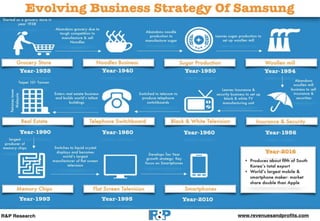
 Samsung strategy evolution
 SWOT analysis
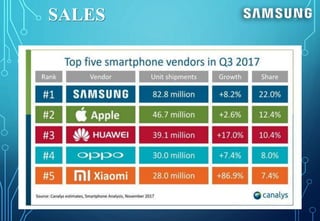
 Sales
 Porters five forces analysis
 Competitive advantage
COMPANY PROFILE
Founder : Lee Byung-chul
Founded : 1st Mar 1938
HQ : Samsung Town, Seoul, South Korea
Revenue : US $224.64 Billion
Employees : 489,000 (2014)
Divisions : Samsung Electronics, Samsung C&T
Corporation, Samsung Heavy Industries, etc
Strengths
• Innovative designs
• Integration of open source
operating system and software
• Low production cost
• Recognized Brand & Brand
reputation
• Too large product diversity (
stability on sale)
Weakness
• Low profit margin
• Damaging image by infringement
• Less quality than Apple
• Lacking of own operating system
• Large dependence on other
software
Opportunities
• Indian smartphone market is
growing
• Demand fir technologically
advanced phones is growing
• Strong financial position for
future
• Acquisition of new companies
Threats
• Large number of competitors
• Strong competitors like Apple
• People looking for better quality
nowadays
• Large number of products, failing
one will affect another
• Threats of Chinese, Taiwanese,
and Indian products
SWOT
SALES
Supplier power
• Suppliers have less power as
Samsung is a large company
and suppliers depend on it
for sales
Buyer Power
• Switching cost low
• Can compare other brand
before purchasing
Threats from
Substitutes
• Apple
• Sony
• LG
Threat of New Entrants
• Threat is low as building
such a large brand is not
easy
Competitive Rivalry
• Intense competition in the
electronic industry against
strong brands such as Apple,
Sony, LG & Tosibha
PORTER’S
FIVE
FORCE
ANALYSIS
Competitive Advantage
Vertical Integration
Vertical integration is a
strategy that expands the
production and distribution
roles of a company in the
supply chain of a particular
industry

Samsung Business Model

  • 2.
  • 3.
    CONTENTS:  Company profile Samsung strategy evolution  SWOT analysis  Sales  Porters five forces analysis  Competitive advantage
  • 4.
    COMPANY PROFILE Founder :Lee Byung-chul Founded : 1st Mar 1938 HQ : Samsung Town, Seoul, South Korea Revenue : US $224.64 Billion Employees : 489,000 (2014) Divisions : Samsung Electronics, Samsung C&T Corporation, Samsung Heavy Industries, etc
  • 6.
    Strengths • Innovative designs •Integration of open source operating system and software • Low production cost • Recognized Brand & Brand reputation • Too large product diversity ( stability on sale) Weakness • Low profit margin • Damaging image by infringement • Less quality than Apple • Lacking of own operating system • Large dependence on other software Opportunities • Indian smartphone market is growing • Demand fir technologically advanced phones is growing • Strong financial position for future • Acquisition of new companies Threats • Large number of competitors • Strong competitors like Apple • People looking for better quality nowadays • Large number of products, failing one will affect another • Threats of Chinese, Taiwanese, and Indian products SWOT
  • 7.
  • 8.
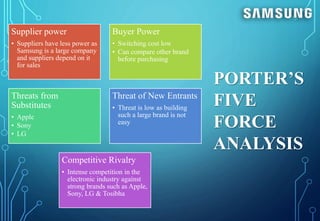
    Supplier power • Suppliershave less power as Samsung is a large company and suppliers depend on it for sales Buyer Power • Switching cost low • Can compare other brand before purchasing Threats from Substitutes • Apple • Sony • LG Threat of New Entrants • Threat is low as building such a large brand is not easy Competitive Rivalry • Intense competition in the electronic industry against strong brands such as Apple, Sony, LG & Tosibha PORTER’S FIVE FORCE ANALYSIS
  • 9.
    Competitive Advantage Vertical Integration Verticalintegration is a strategy that expands the production and distribution roles of a company in the supply chain of a particular industry