Avenir,Chamique
Pacheco Gimuel
Alfred Serato
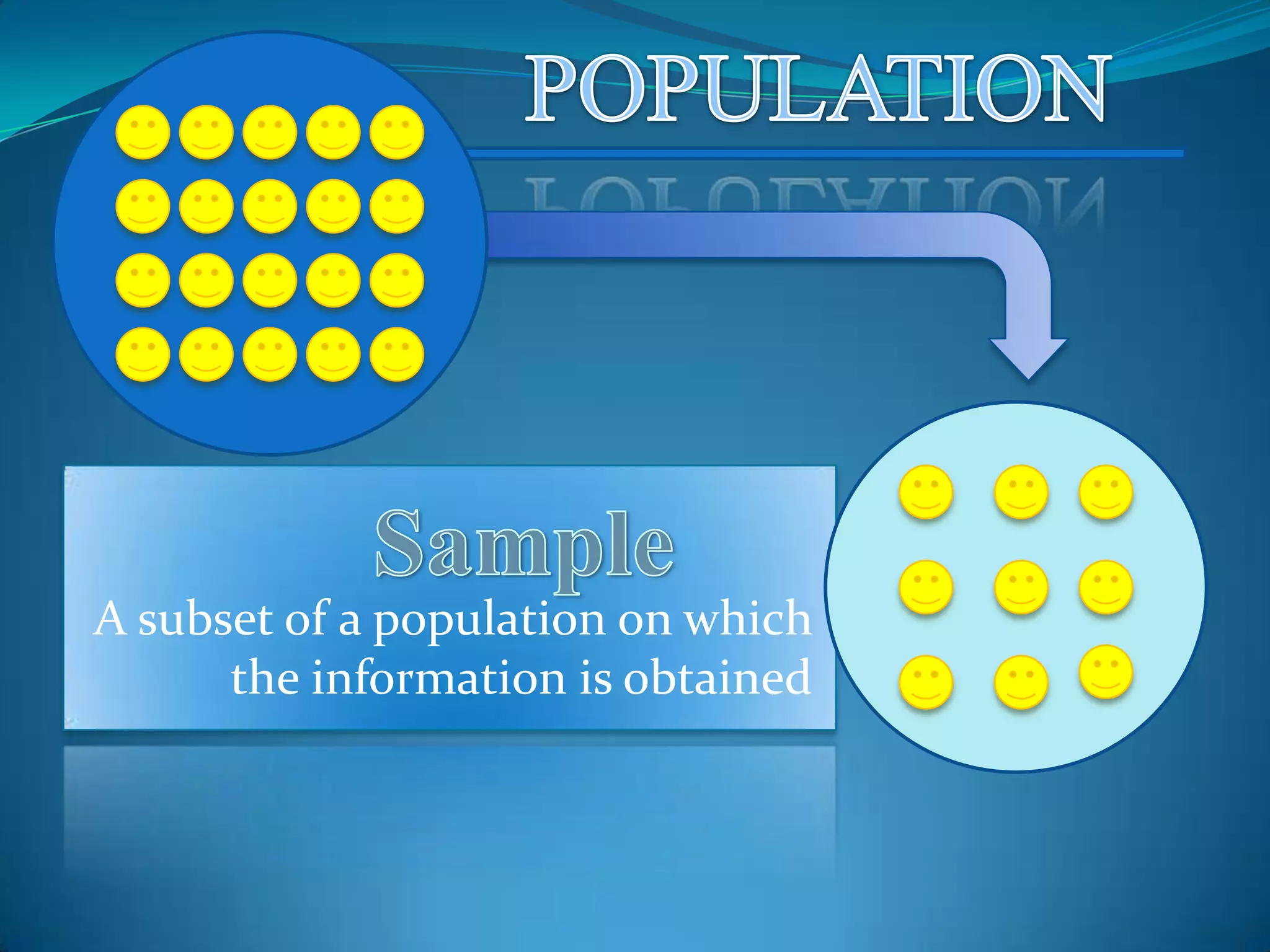
A subset of a population on which
the information is obtained
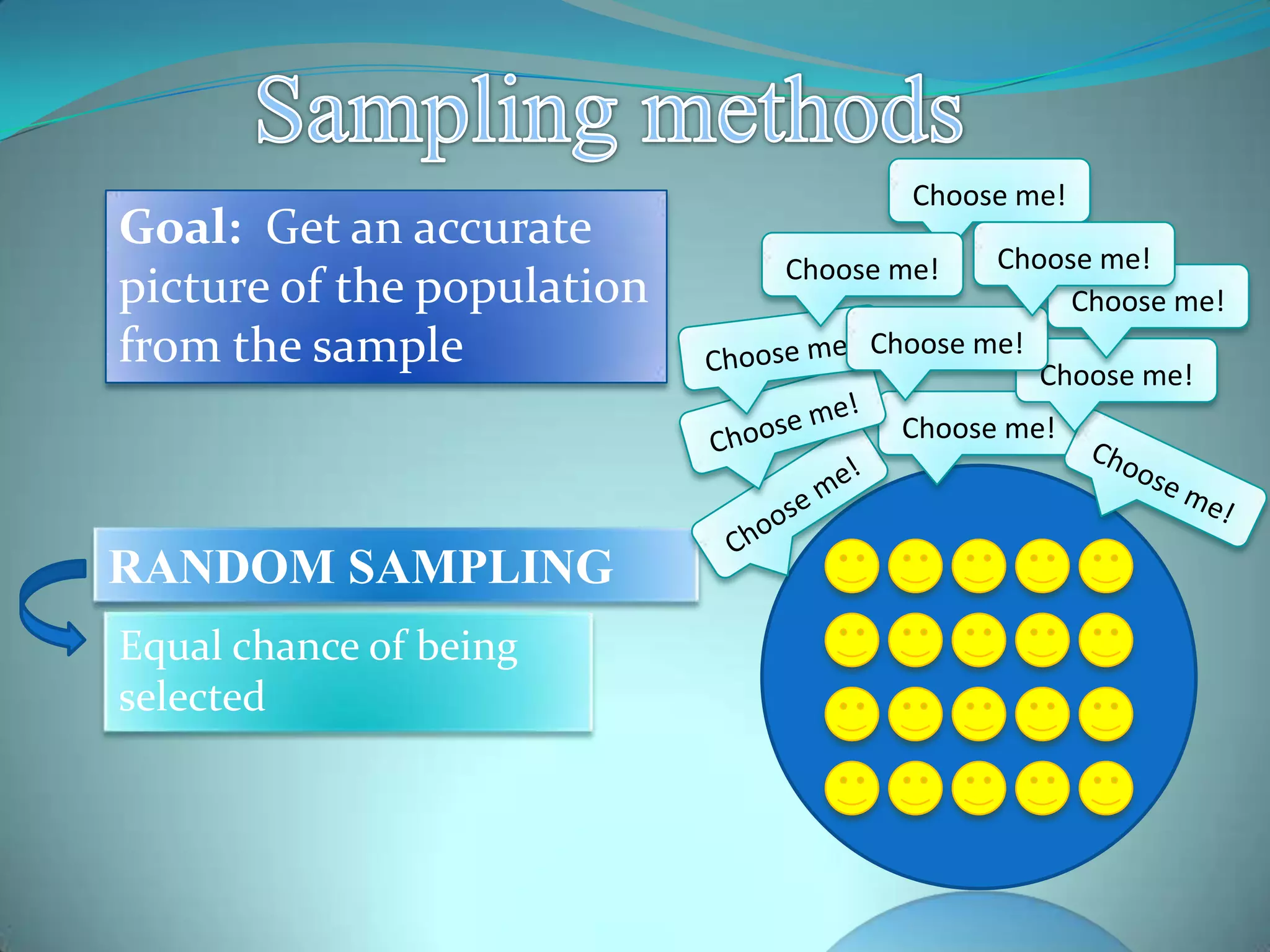
Goal: Get an accurate
picture of the population
from the sample
RANDOM SAMPLING
Equal chance of being
selected
Choose me!
Choose me!
Choose me!
Choose me!
Choose me!
Choose me! Choose me!
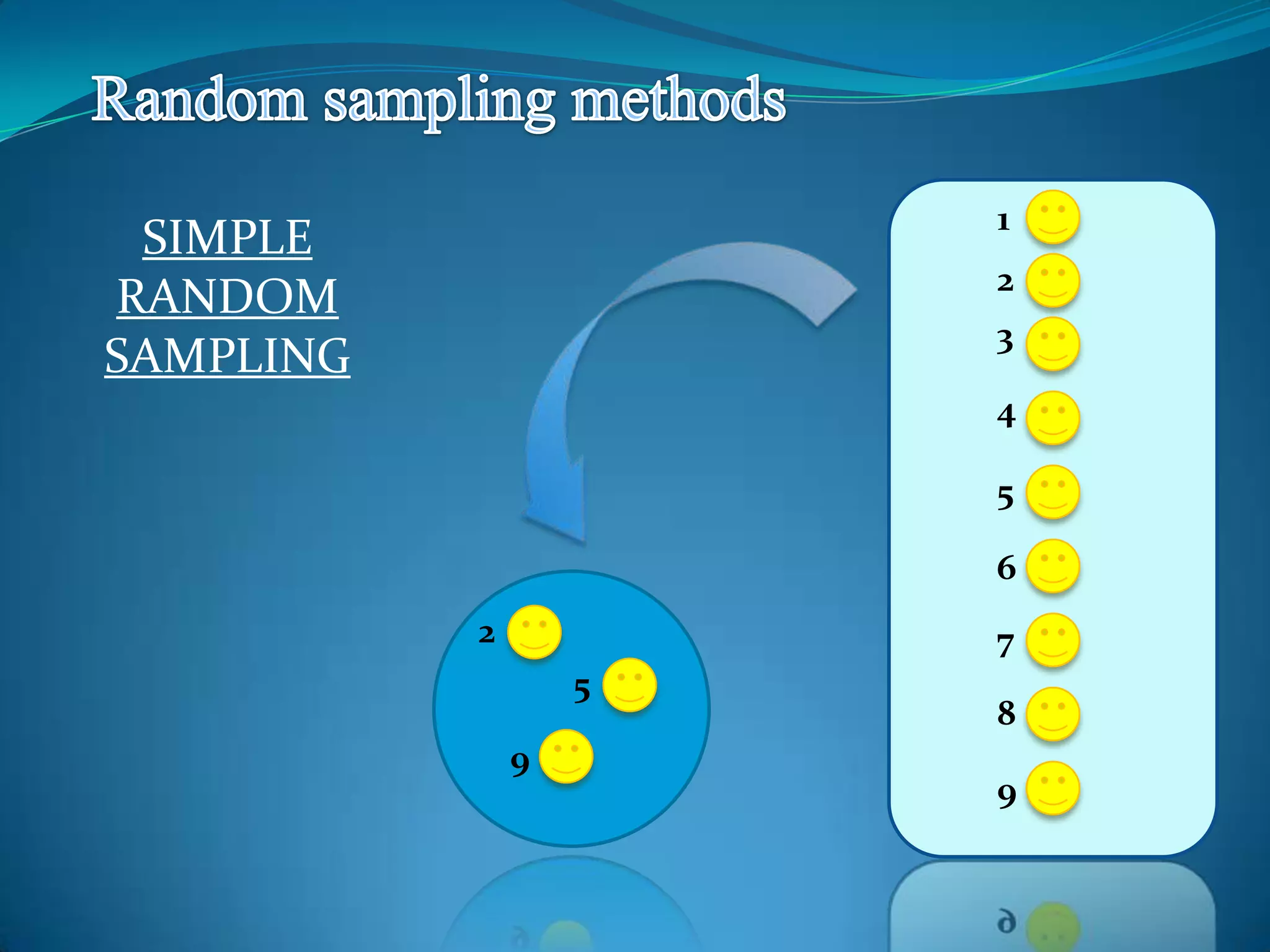
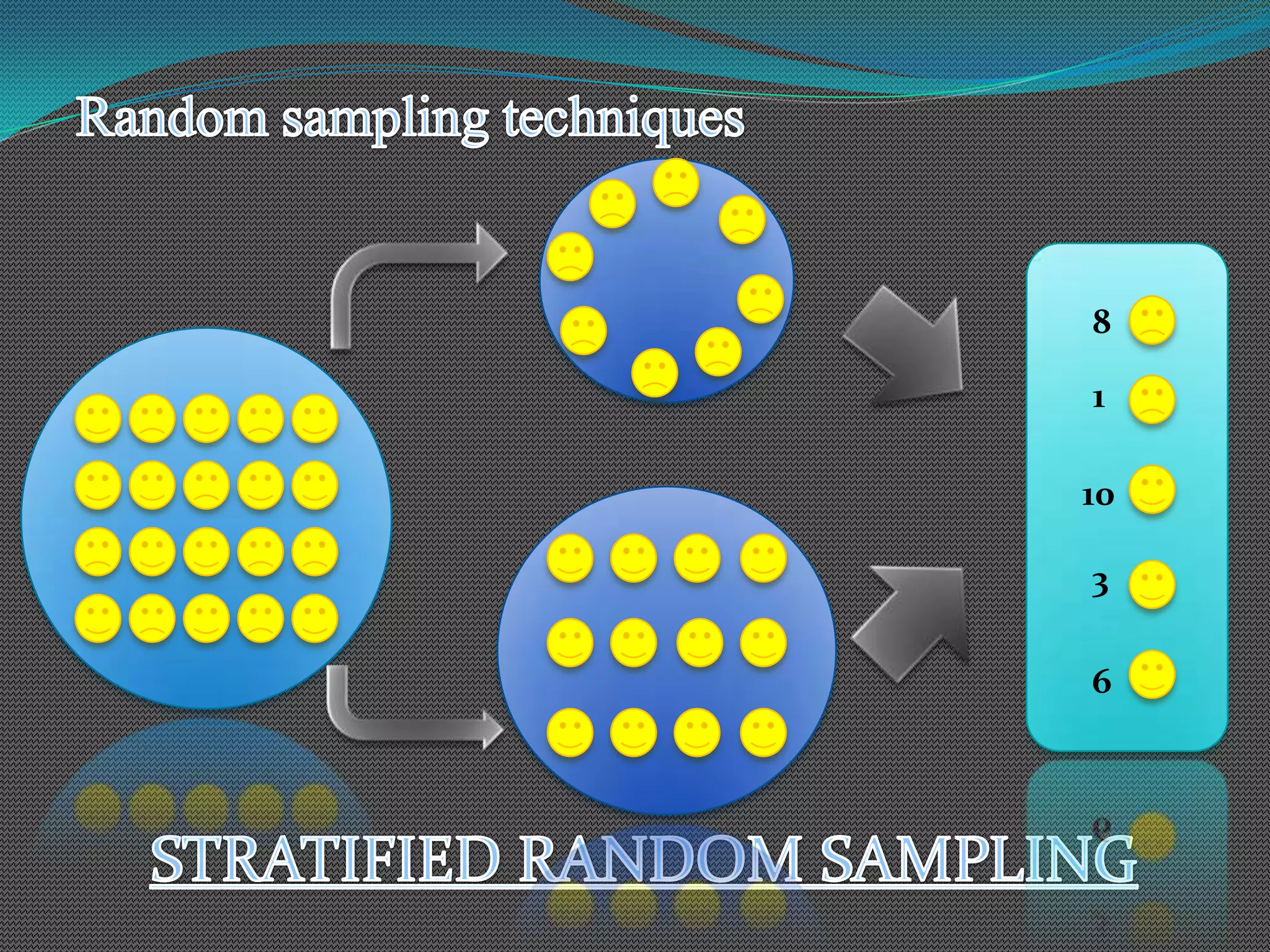
SIMPLE
RANDOM
SAMPLING
1
2
3
4
5
6
7
8
9
2
5
9
1
3
6
8
10
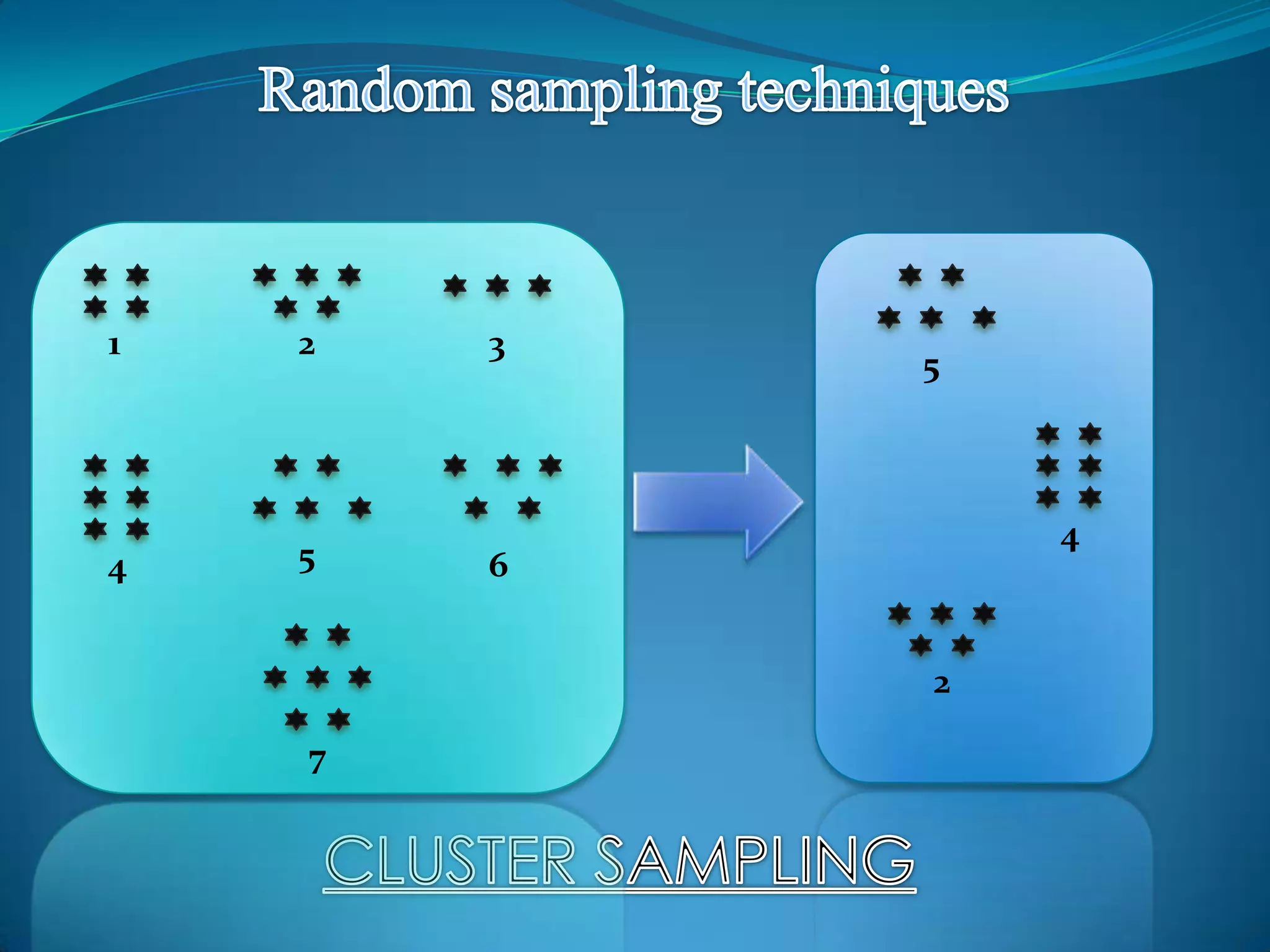
1 2 3
4 5 6
7
5
4
2
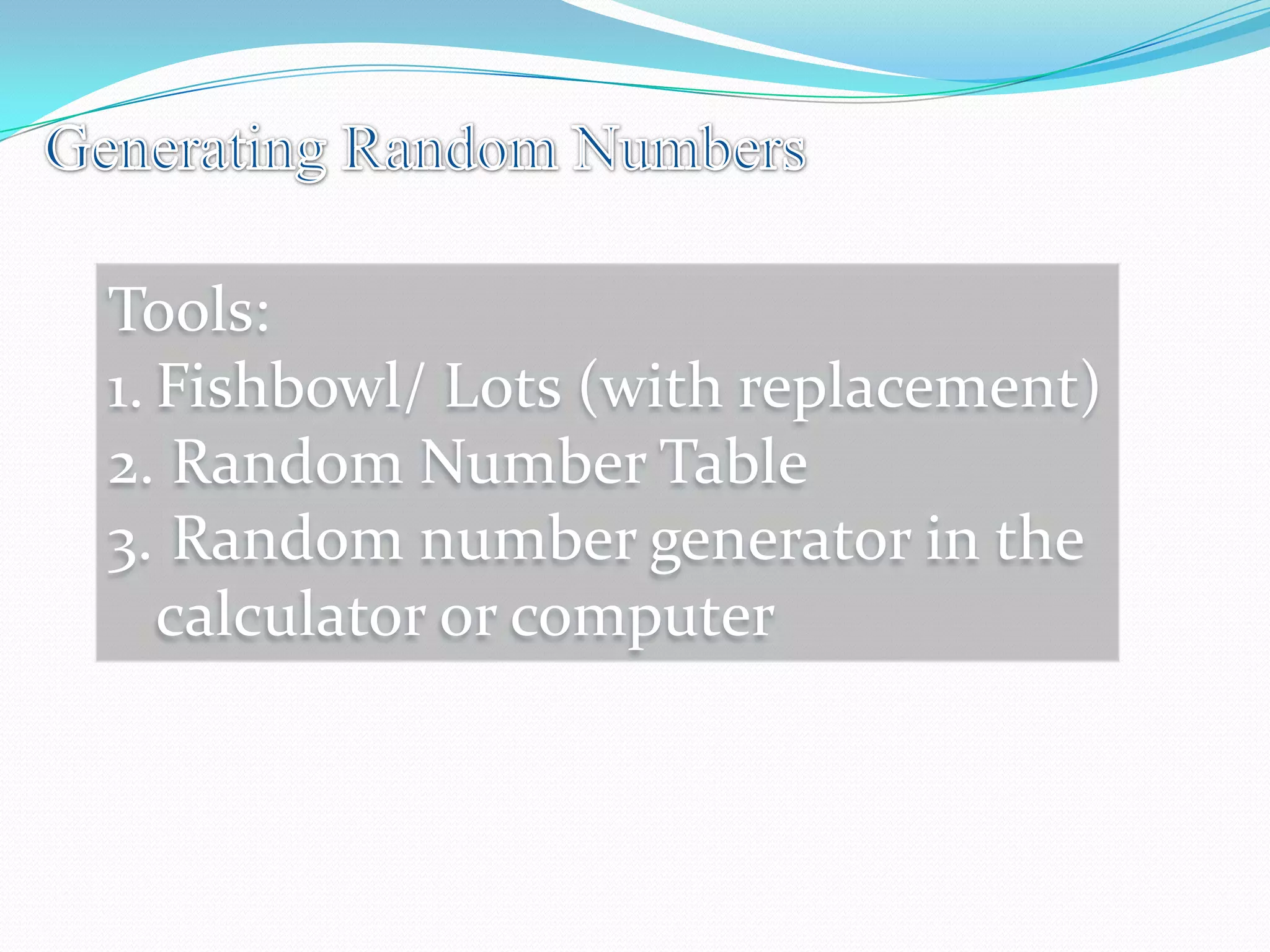
Tools:
1. Fishbowl/ Lots (with replacement)
2. Random Number Table
3. Random number generator in the
calculator or computer
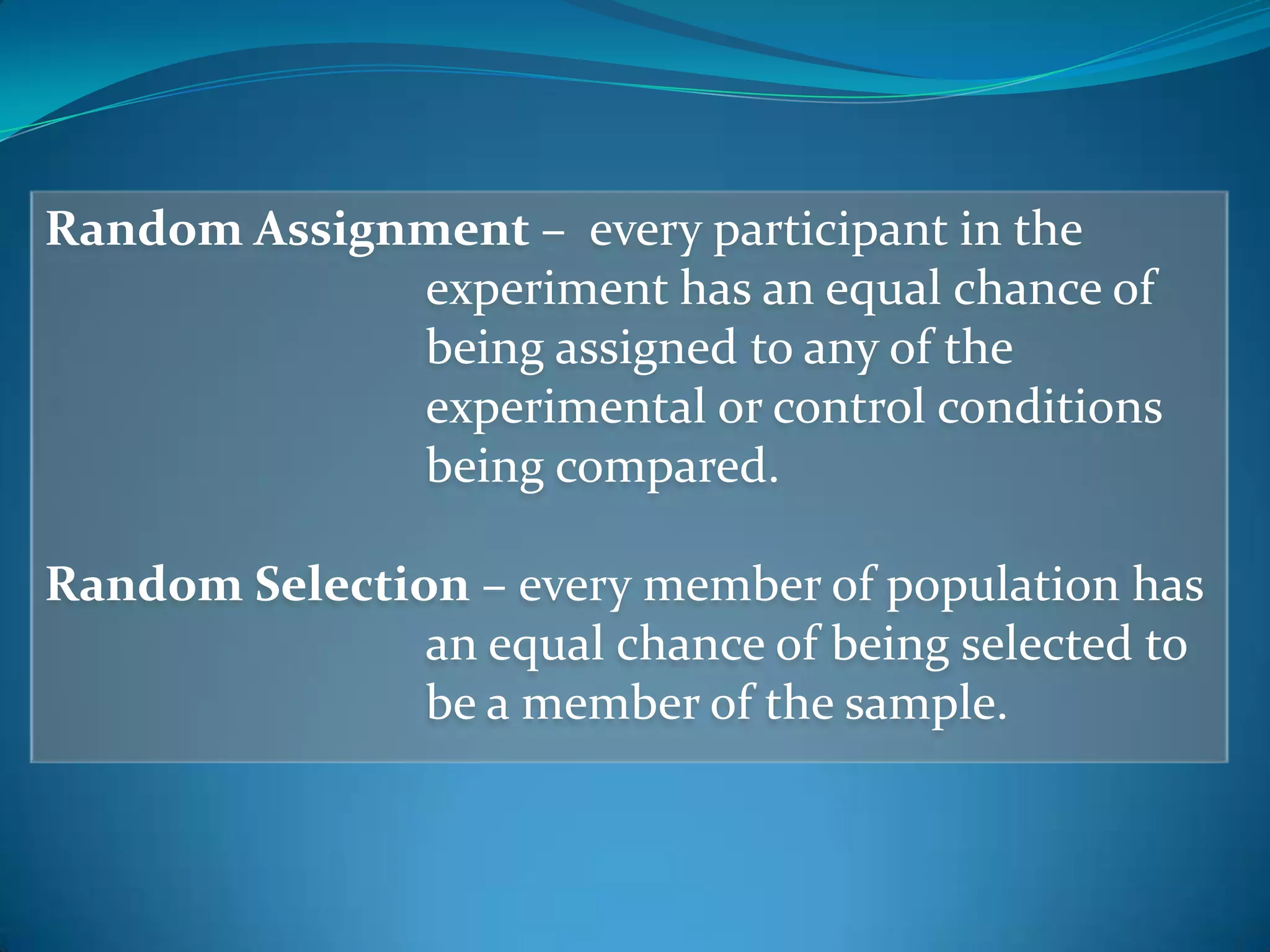
Random Assignment – every participant in the
experiment has an equal chance of
being assigned to any of the
experimental or control conditions
being compared.
Random Selection – every member of population has
an equal chance of being selected to
be a member of the sample.
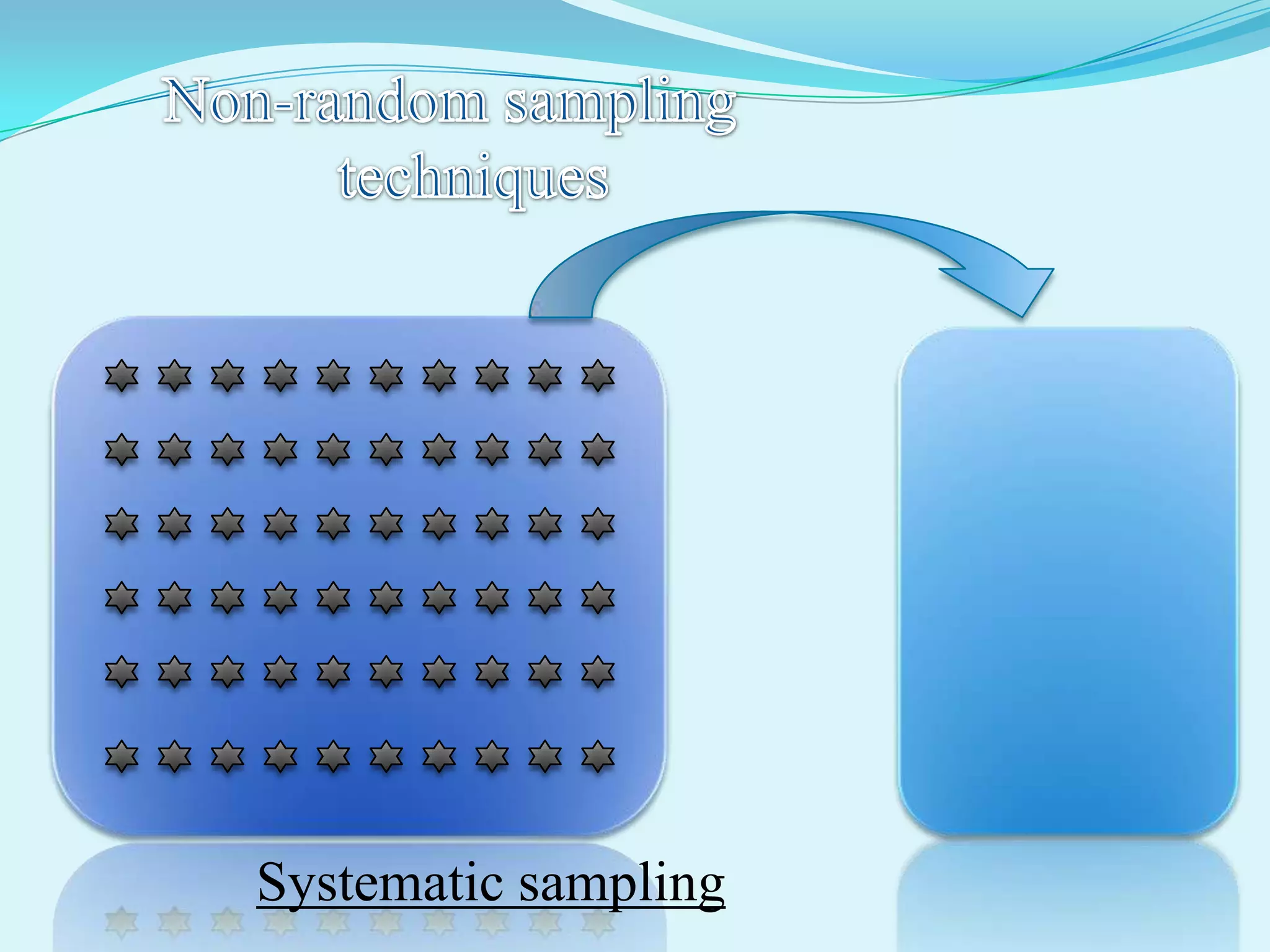
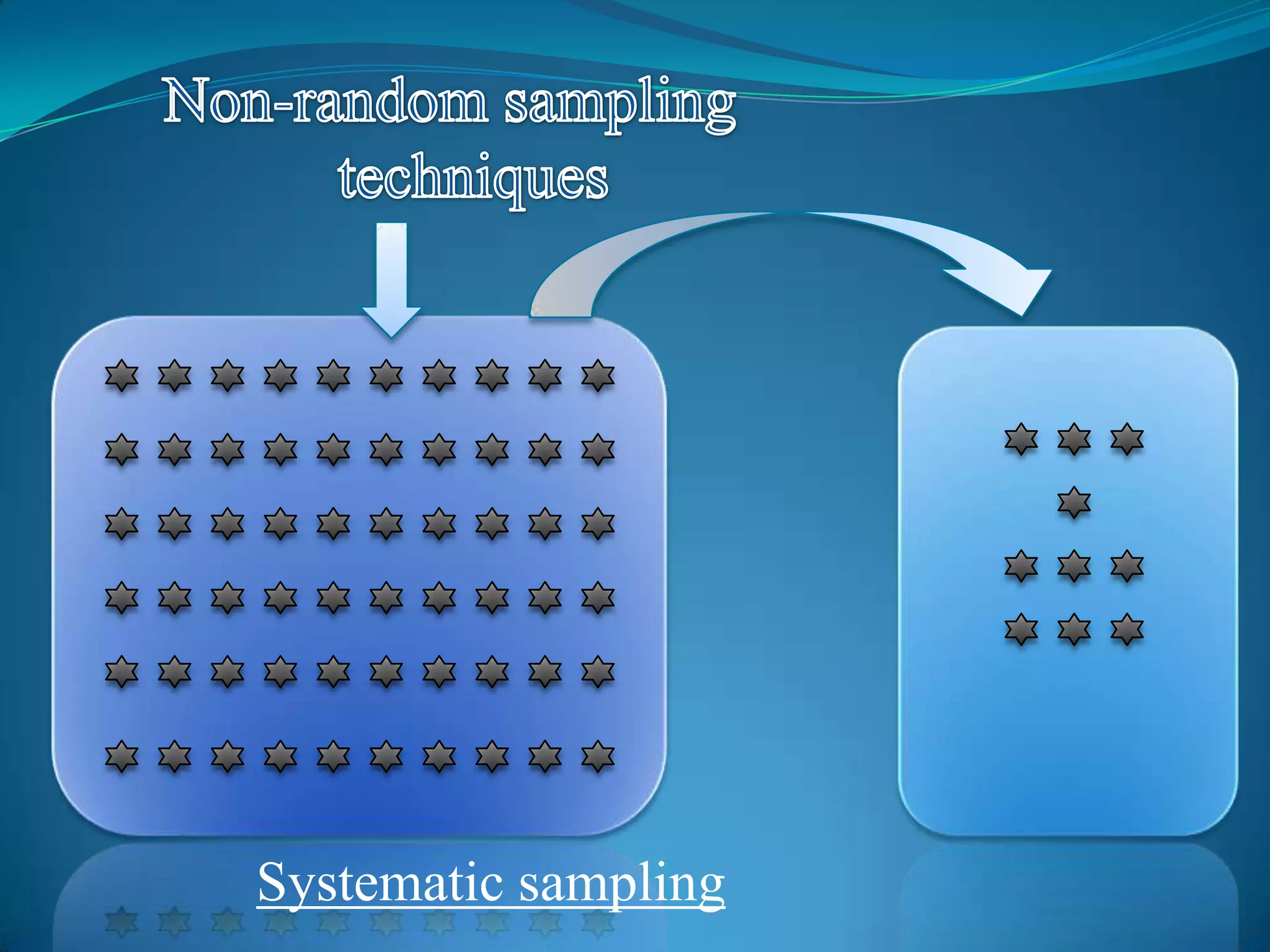
Systematic sampling
Systematic sampling
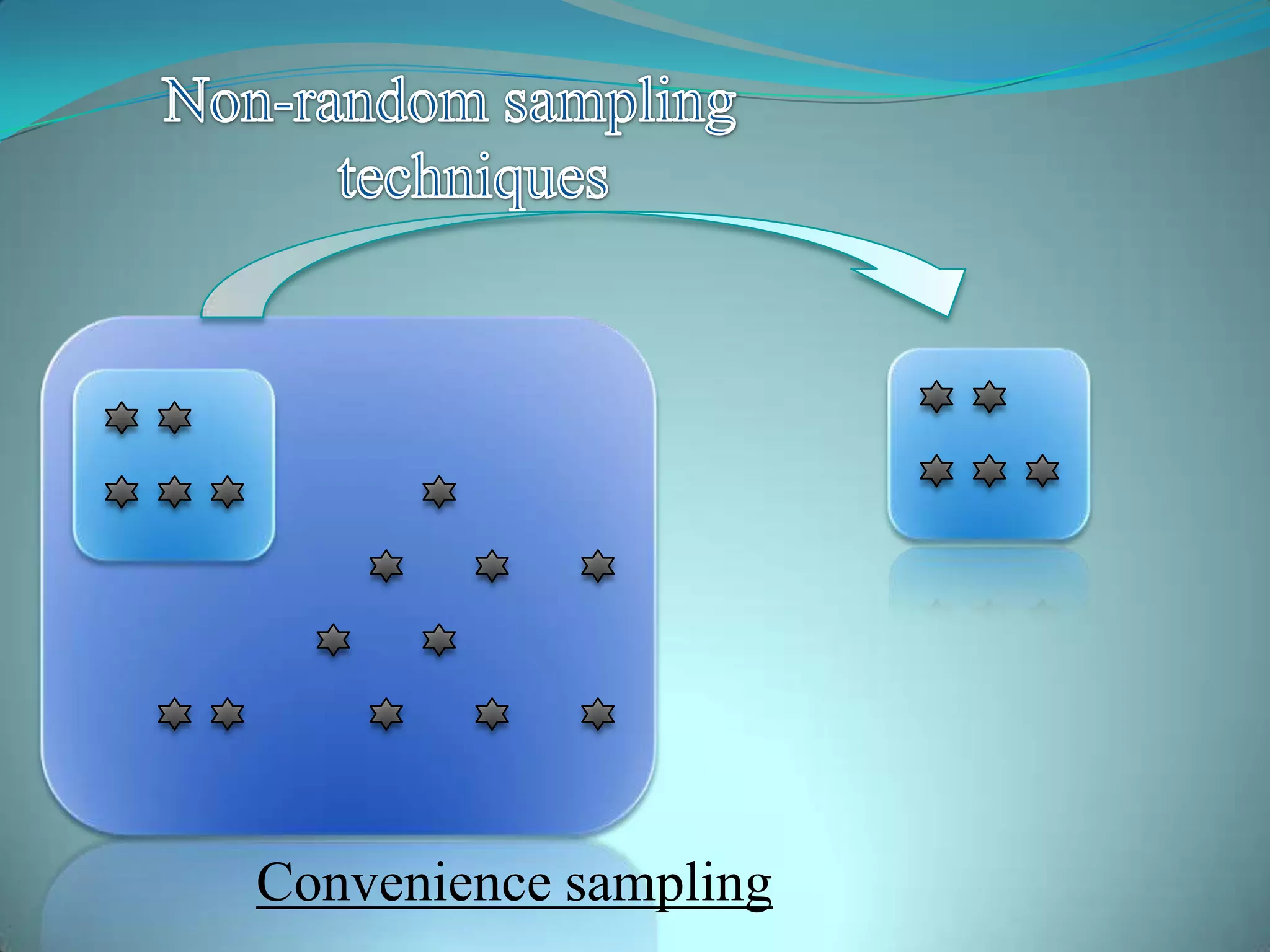
Convenience sampling
Purposive Sampling
The selection of a sample is based on
 previous knowledge of a population
 specific purpose of the research
Purposive Sampling
 different from convenience sampling
 researchers do not simply study whoever is
available
 but use their judgement to select a sample
which they believe will provide the
data they need
 Coning and Quartering
 Quadrat sampling
 Transect Lines
 Water Sampling
 Coning and Quartering
For granular or powdered samples
Procedure
• Form a conical heap
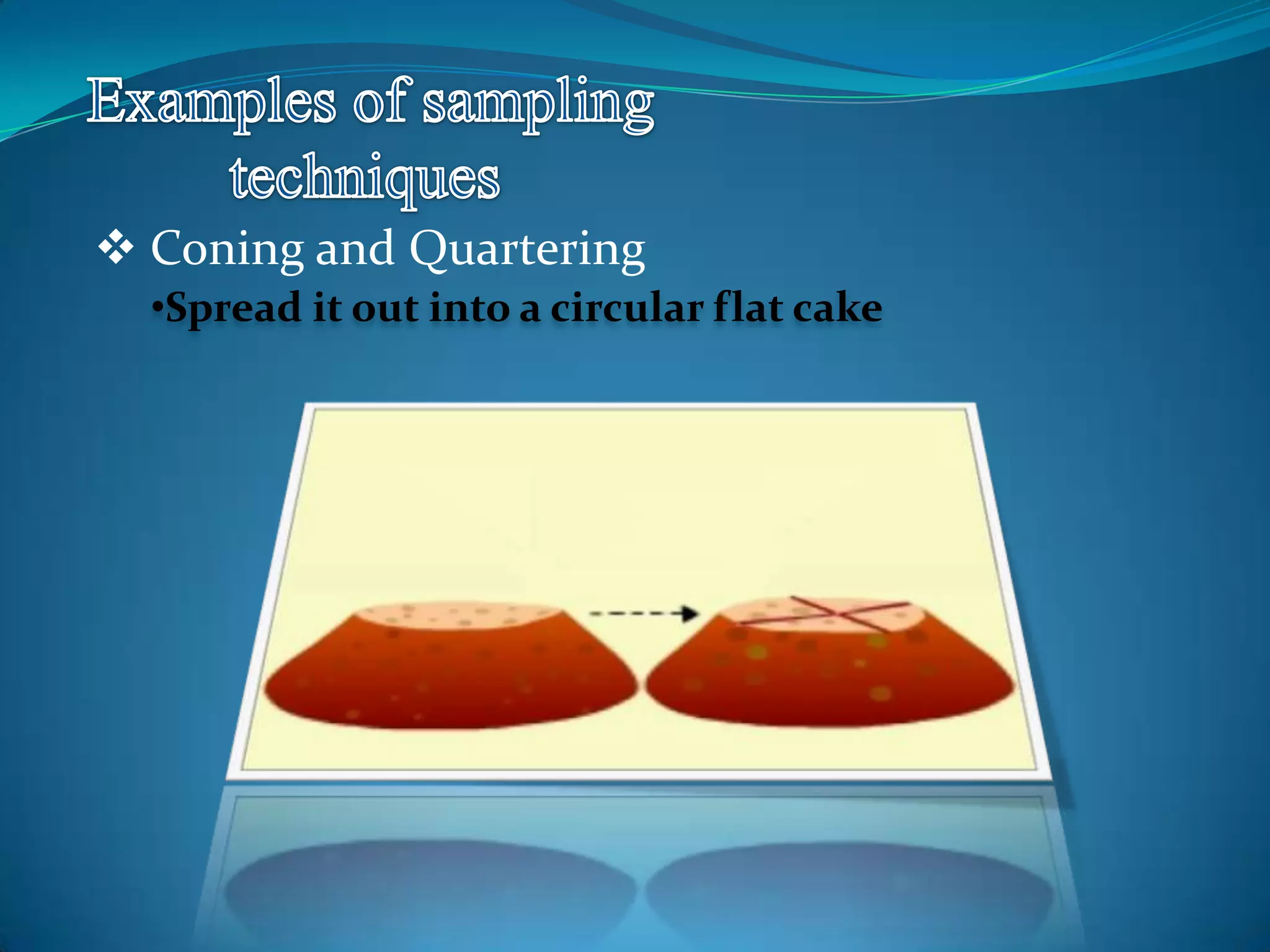
• Spread it out into a circular flat cake
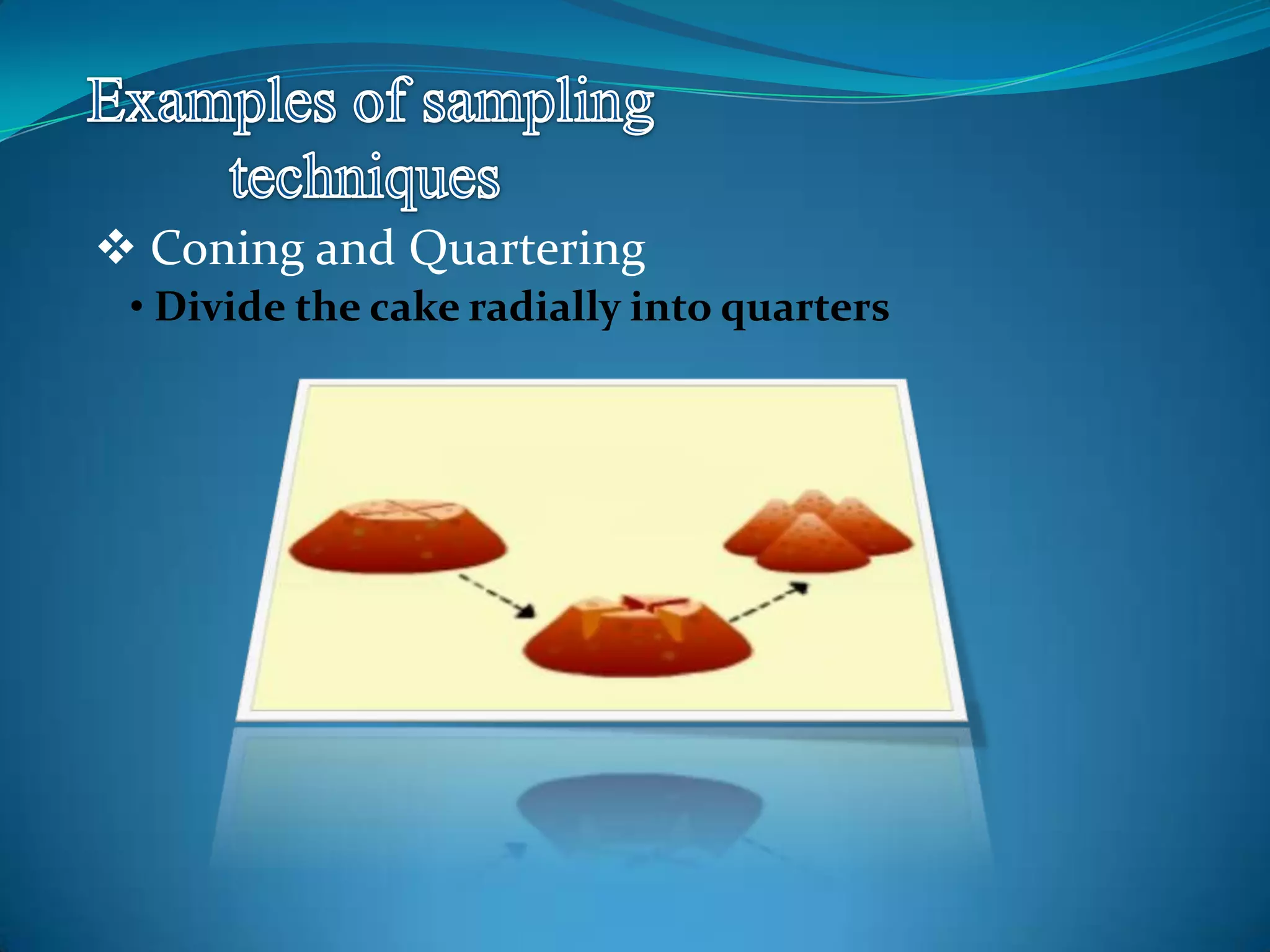
• Divide the cake radially into
quarters
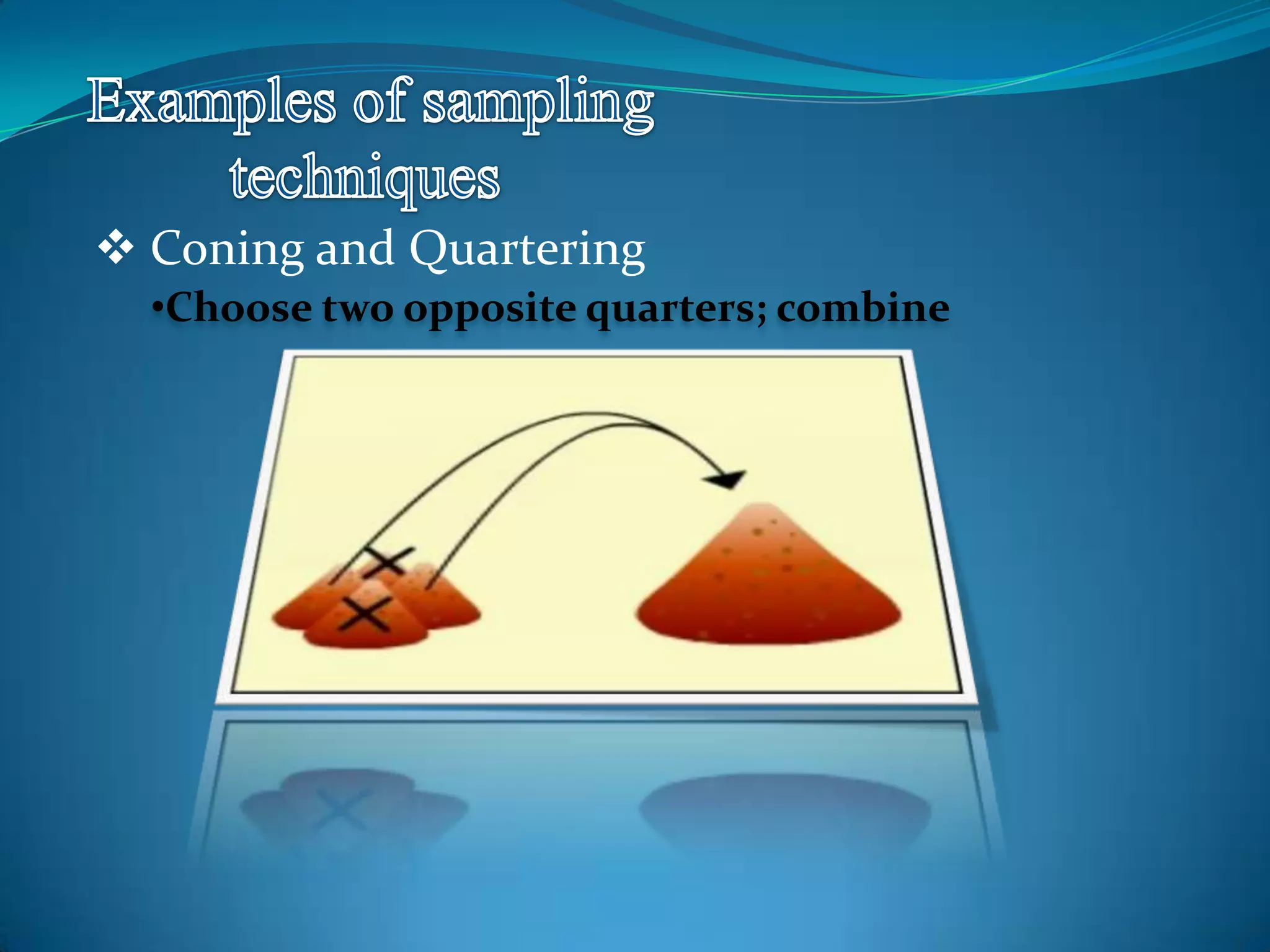
• Choose two opposite quarters;
combine
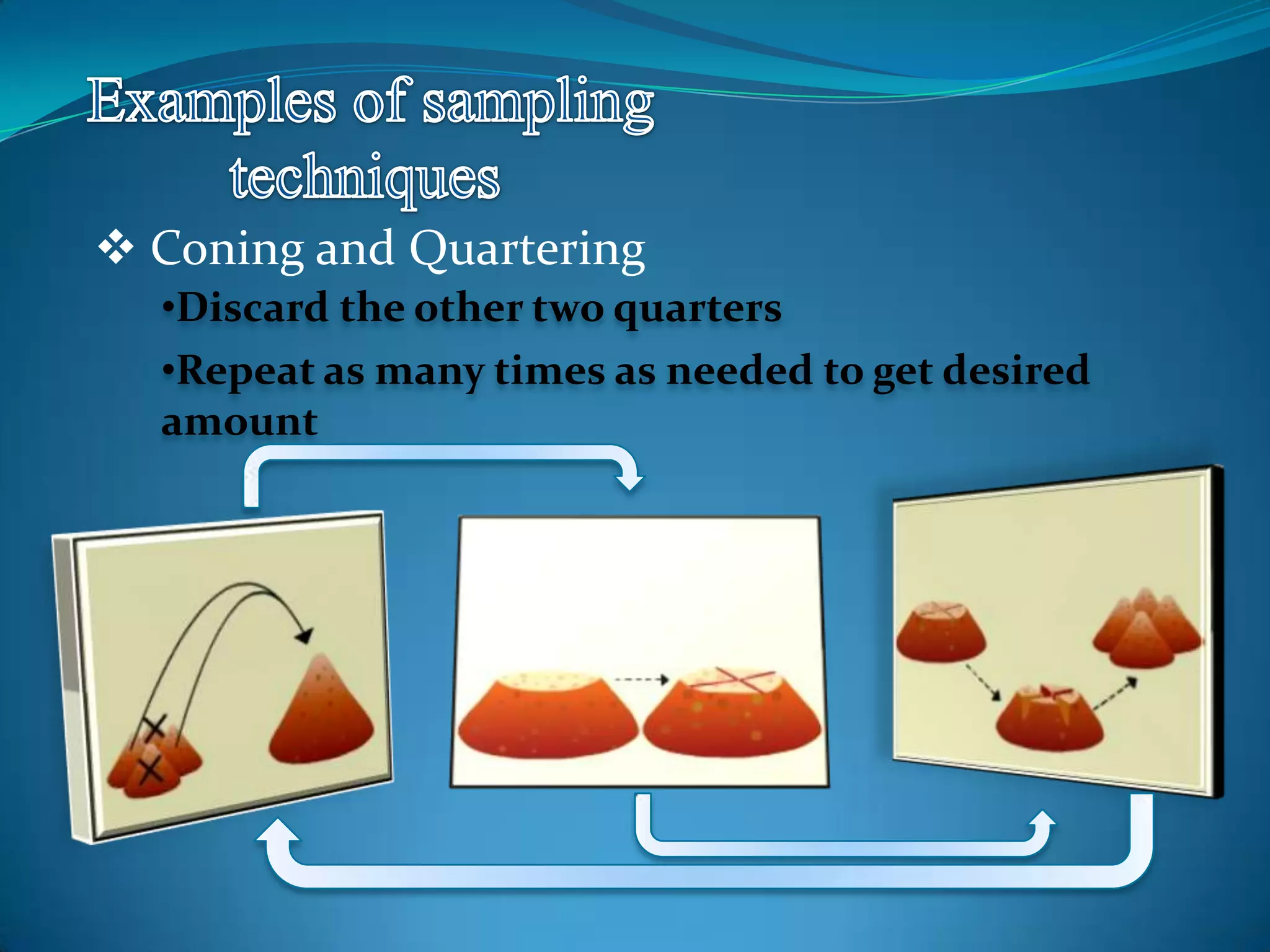
• Discard the other two quarters
• Repeat as many times as needed to
get desired amount
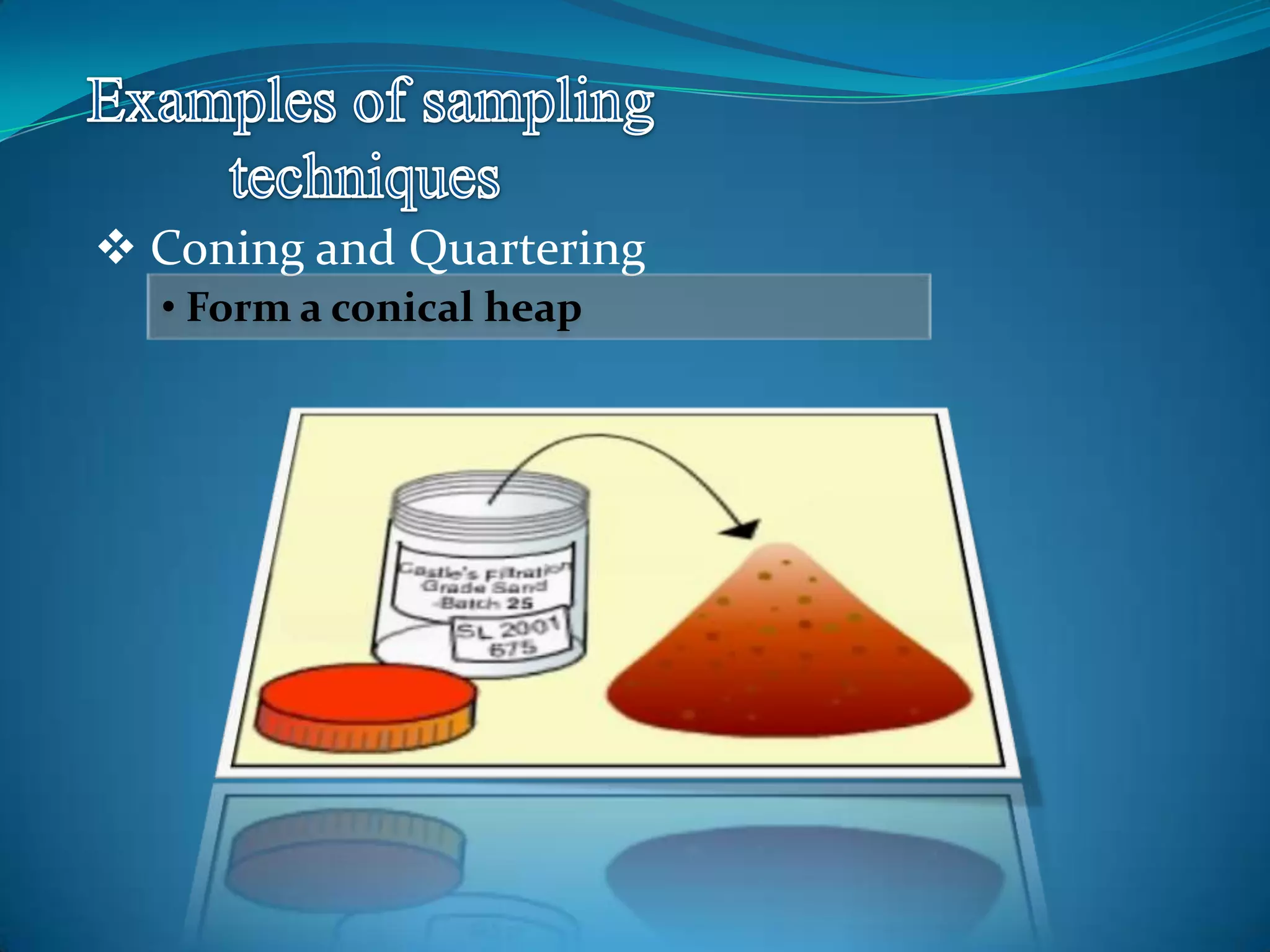
 Coning and Quartering
• Form a conical heap
 Coning and Quartering
•Spread it out into a circular flat cake
 Coning and Quartering
• Divide the cake radially into quarters
 Coning and Quartering
•Choose two opposite quarters; combine
 Coning and Quartering
•Discard the other two quarters
•Repeat as many times as needed to get desired
amount
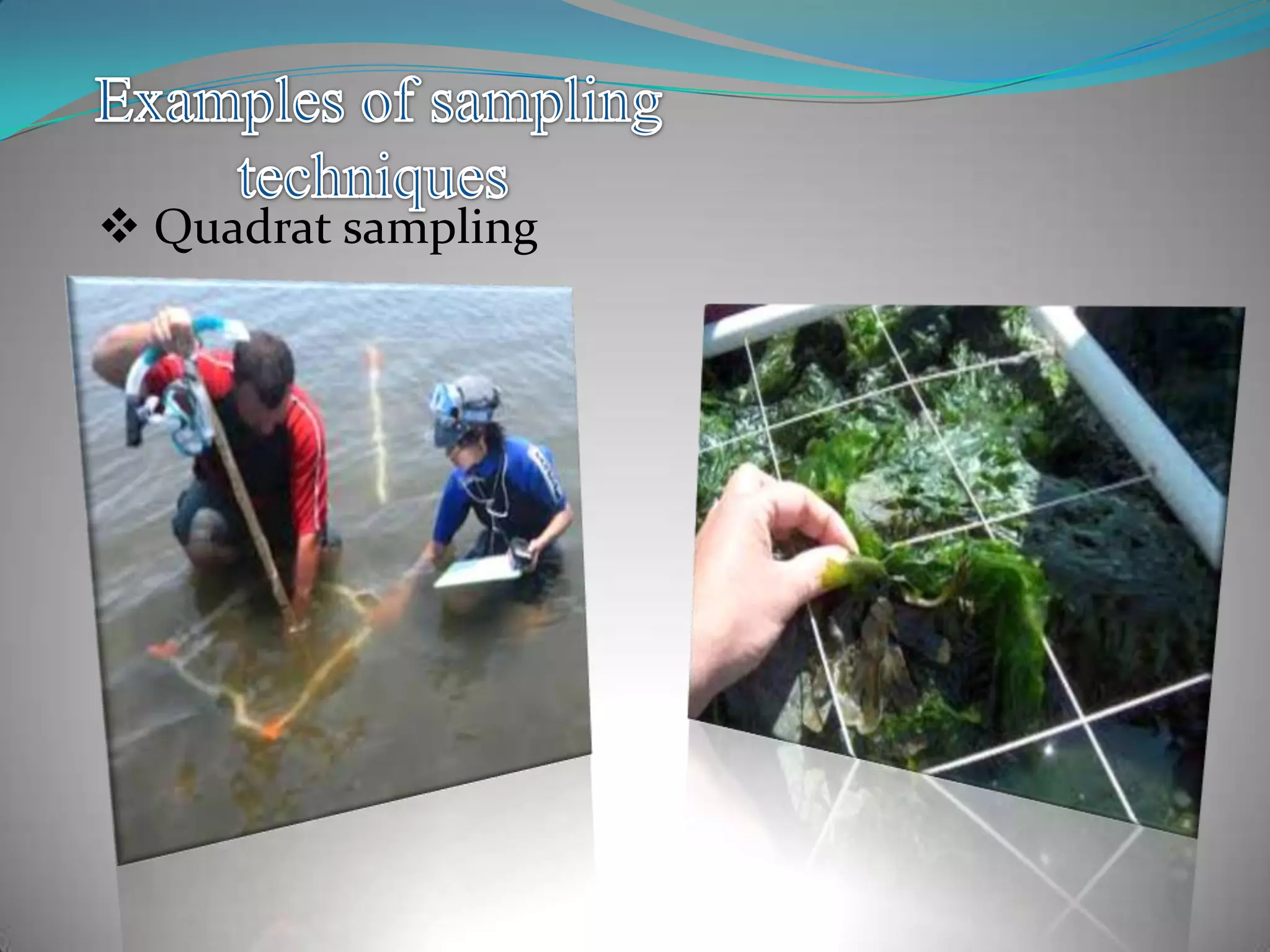
 Quadrat sampling
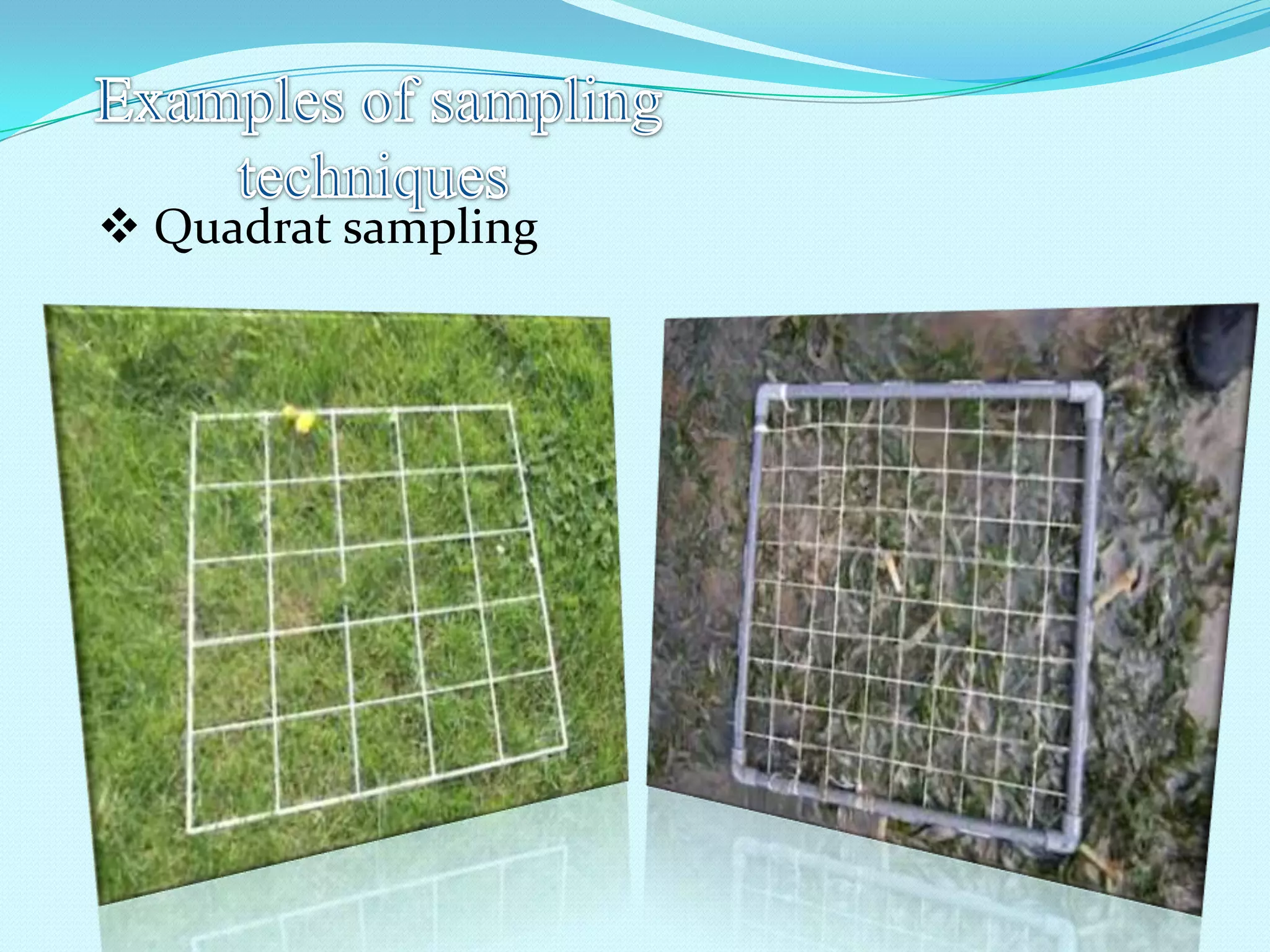
-A small area of ground marked out as sample
of a larger area
Purpose: to make a detailed description and
record numerical data
For sampling objects that do not move –
vegetation or more or less sedentary animals
 Quadrat sampling
 Quadrat sampling
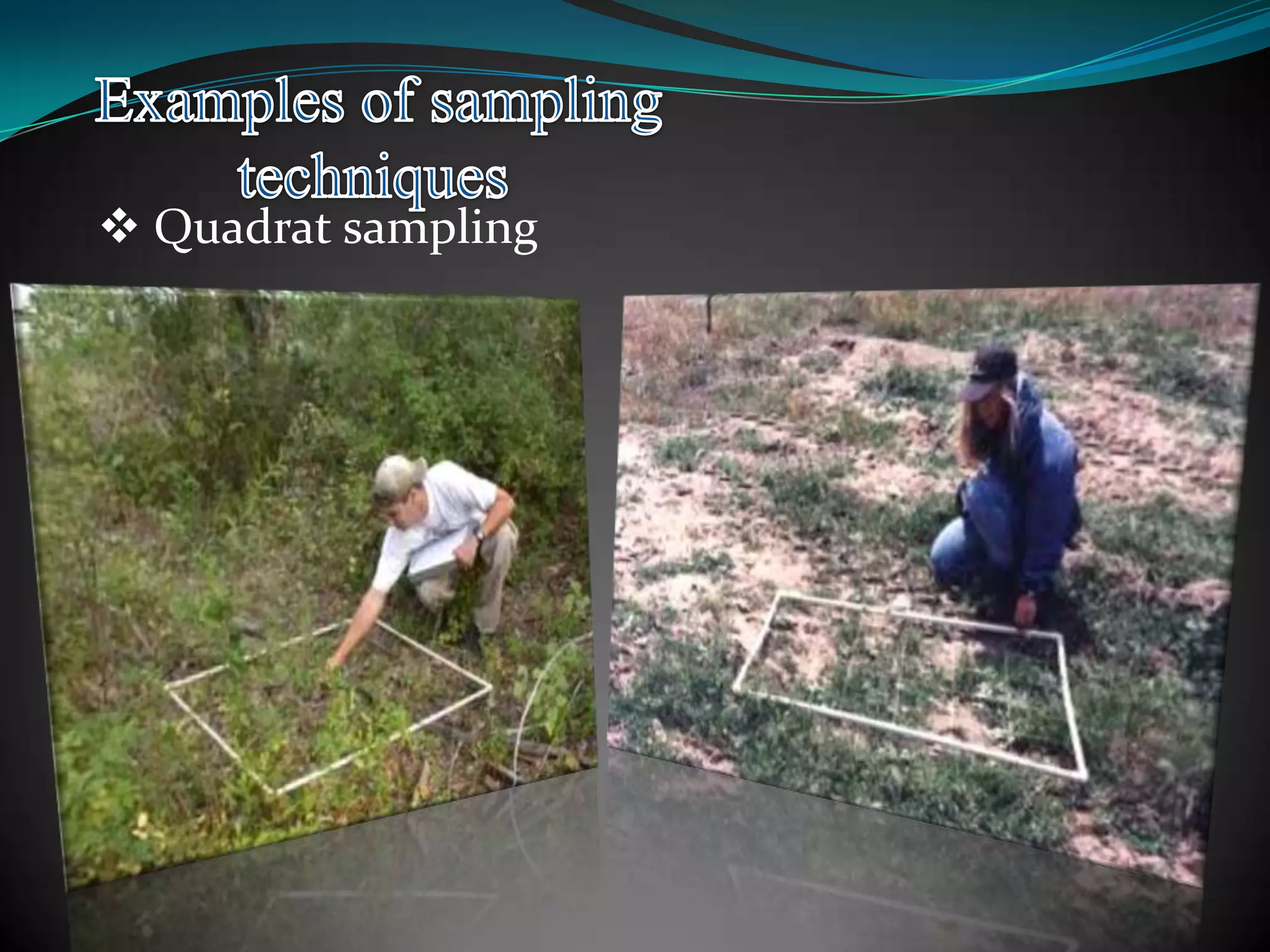
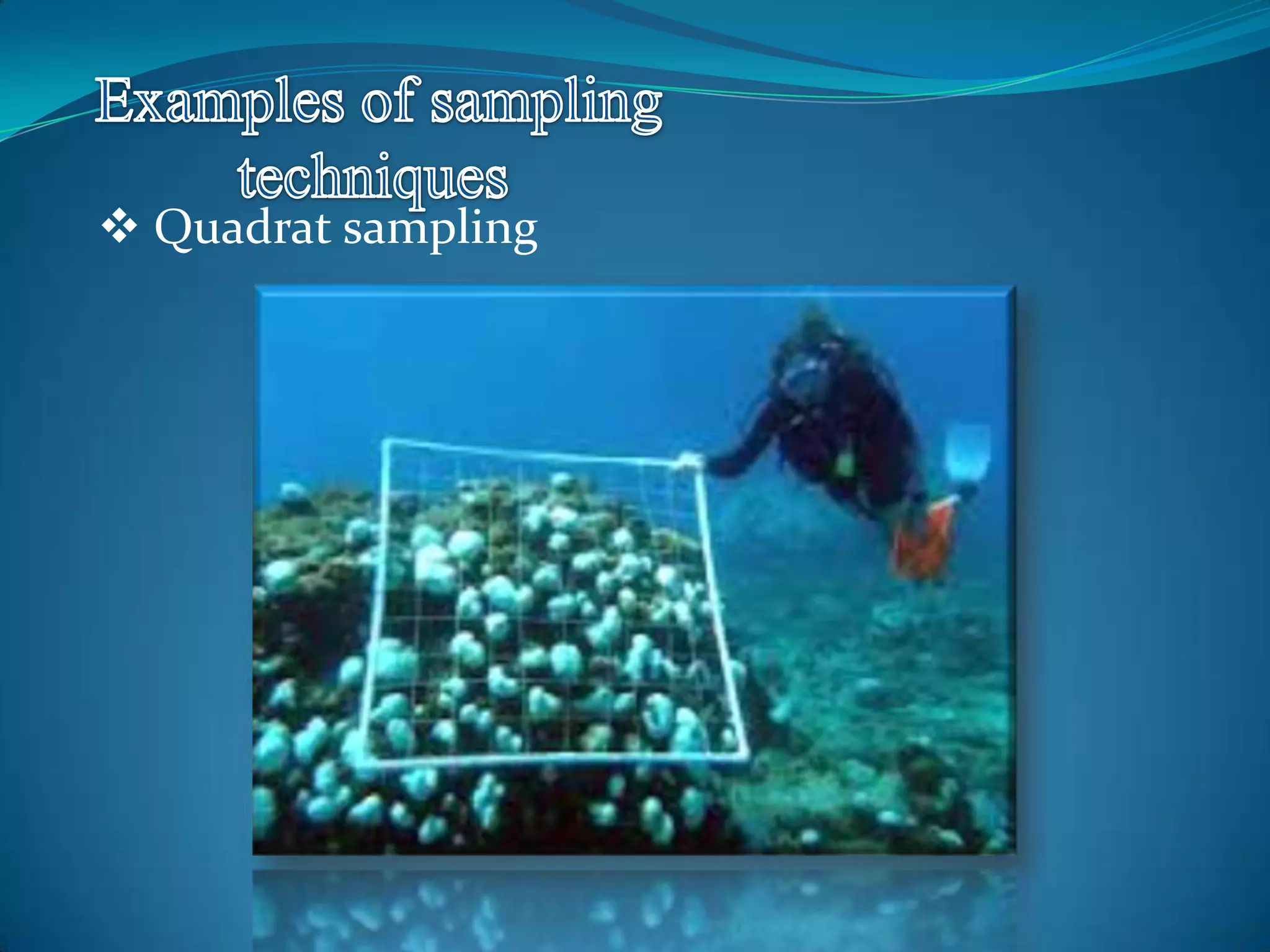
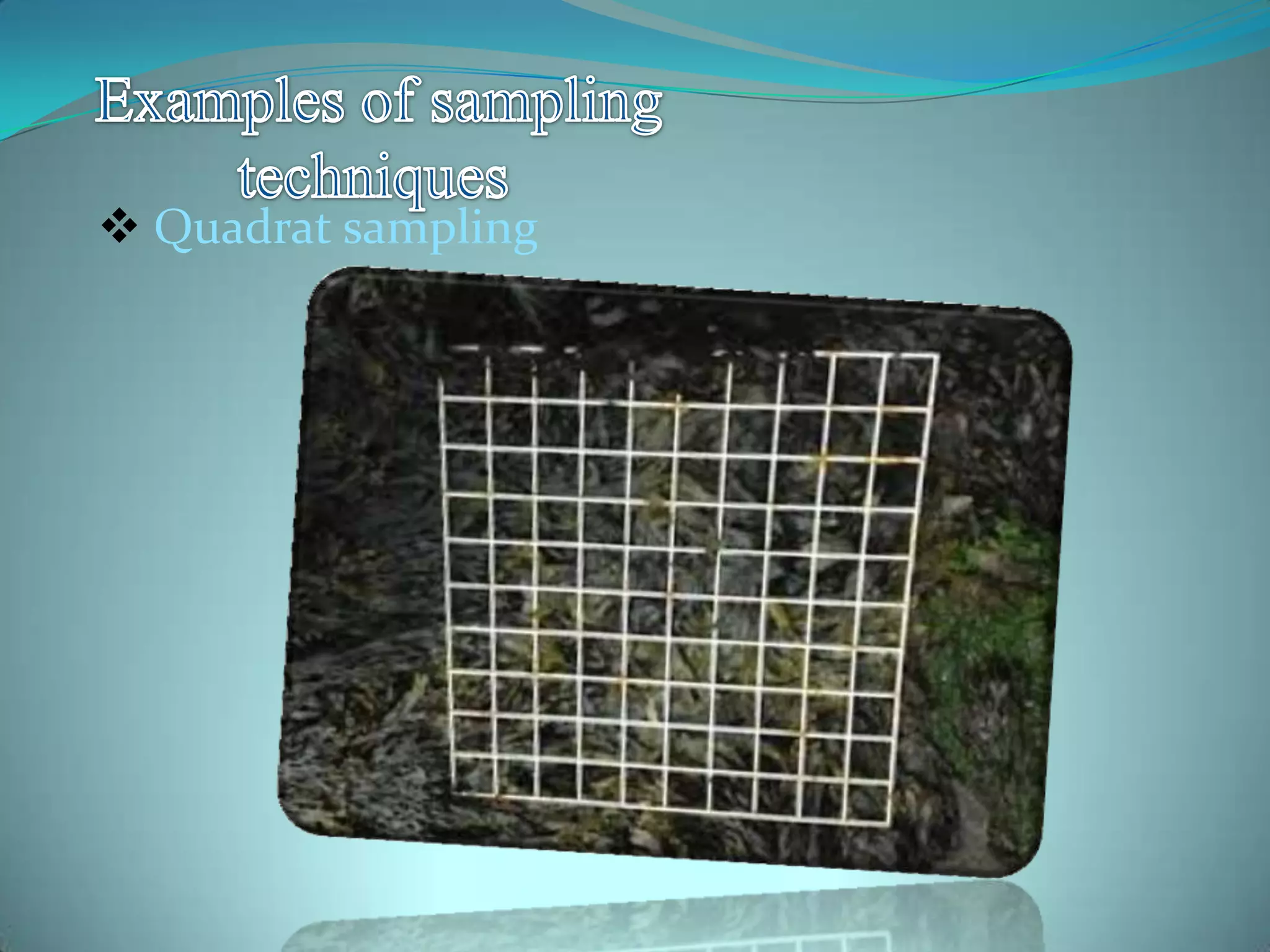
A frame of predetermined area –
placed on the ground
Data: number of individuals per unit area
Decisions:
- quadrat size (usually 1m x 1m)
- quadrat shape (usually square)
- where to put it
- how many quadrats
- what rules to set
 Quadrat sampling
 Quadrat sampling
 Quadrat sampling
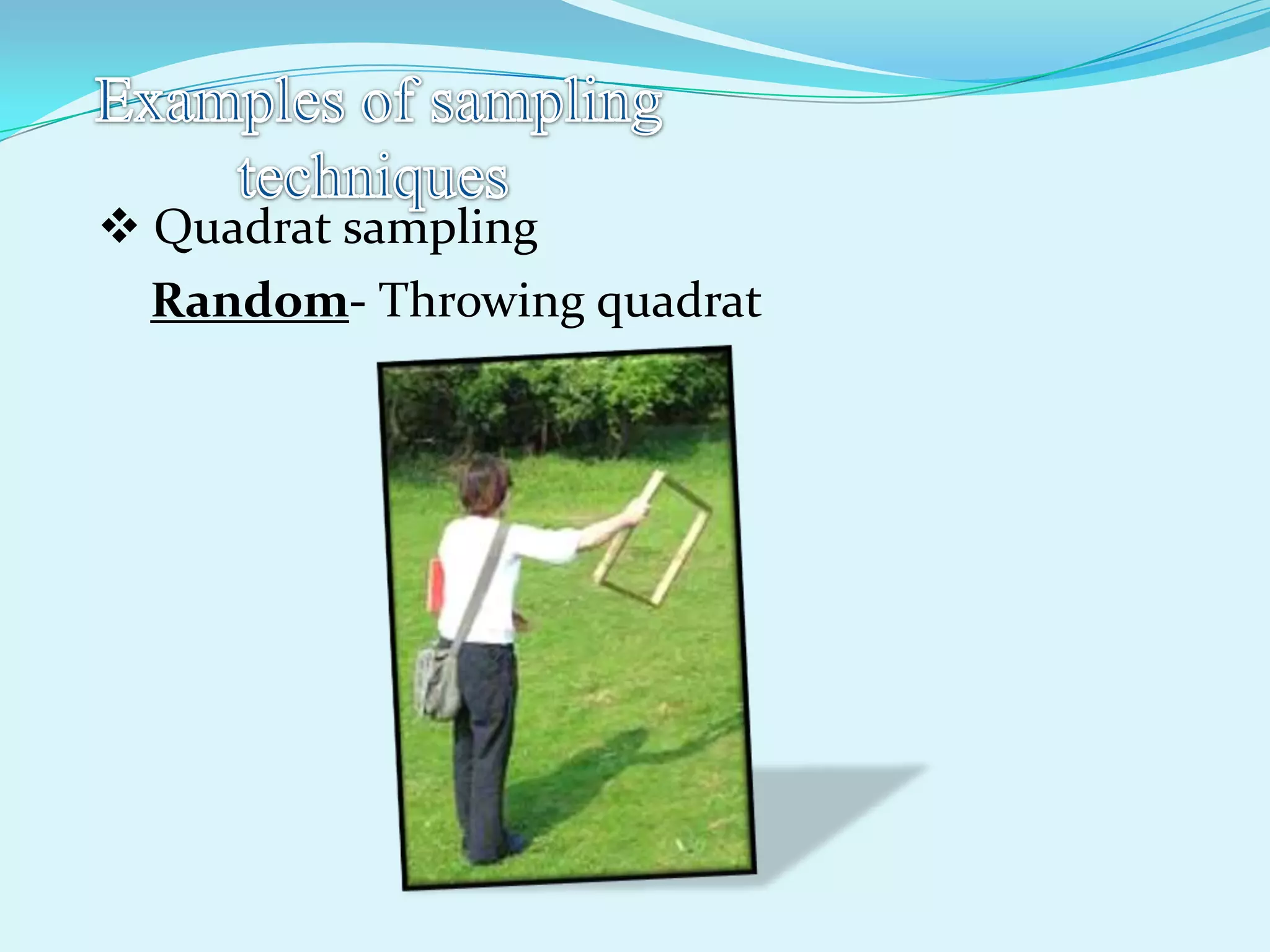
Random- Throwing quadrat
 Quadrat sampling
 Quadrat sampling
 Quadrat sampling
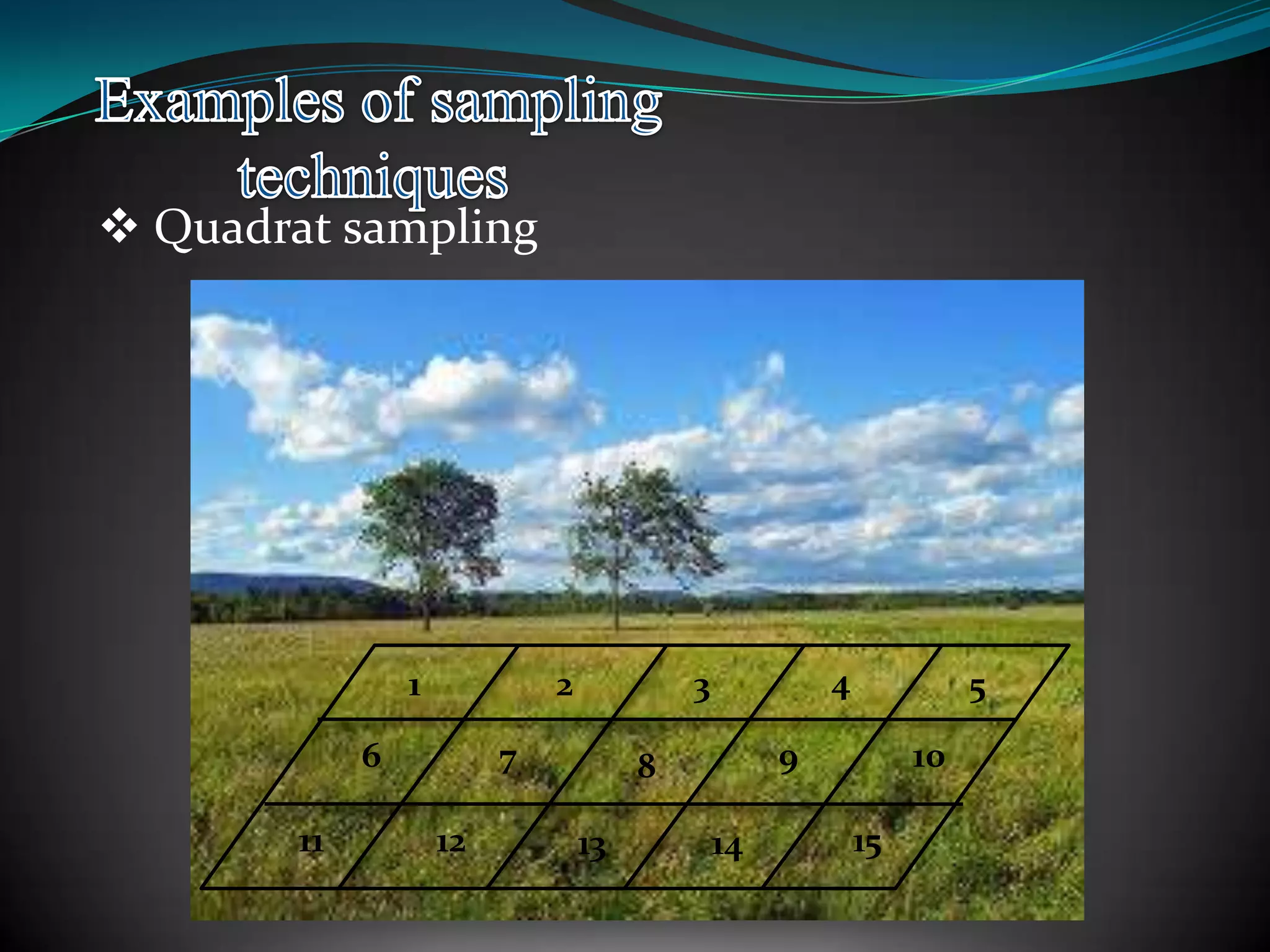
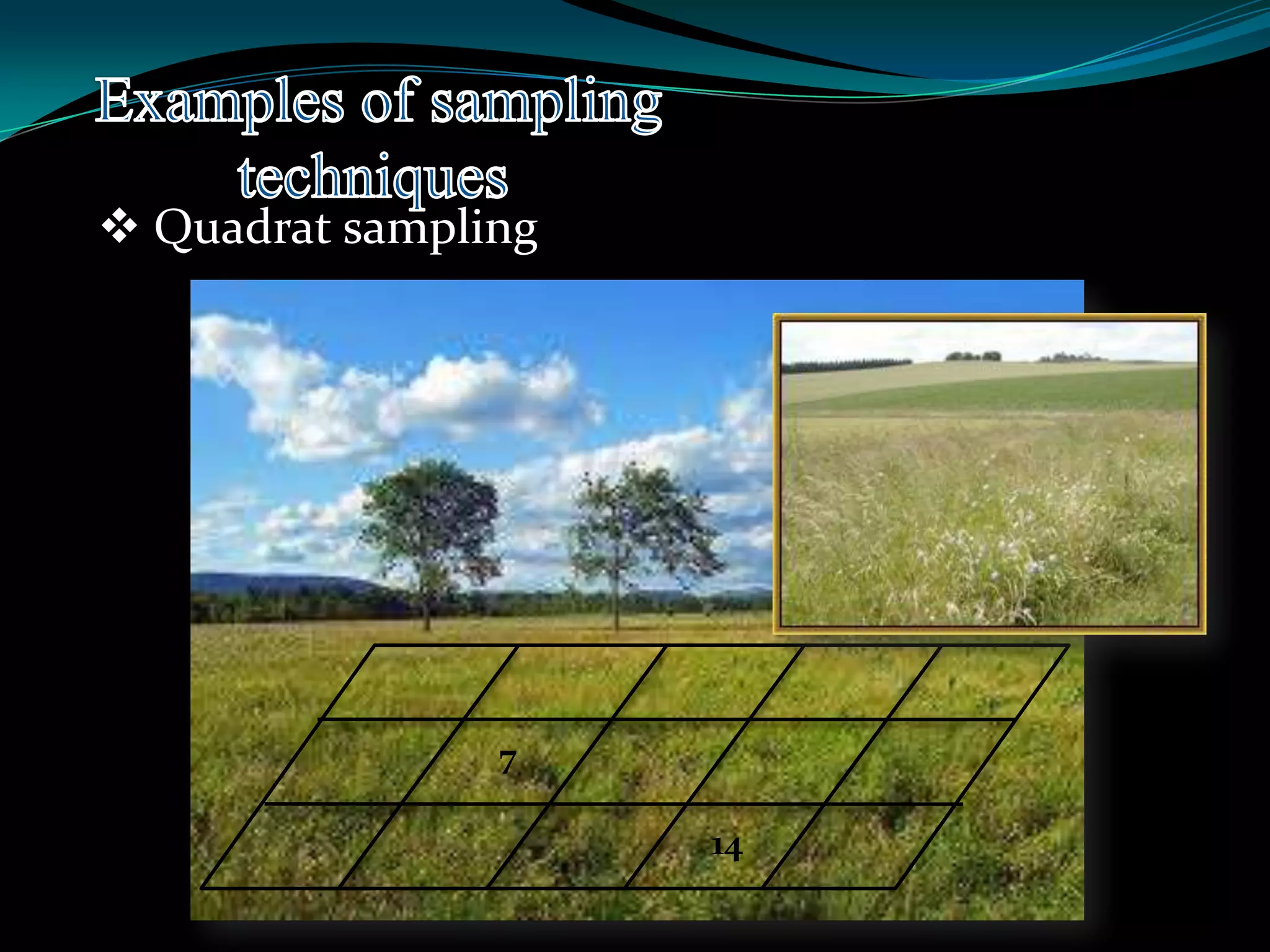
Systematic- using grids
- divide the area into squares of equal sizes
- locate the quadrats by picking coordinates
randomly
 Quadrat sampling
1 2 3 4 5
6 7 8 9 10
11 12 13 14 15
 Quadrat sampling
7
14
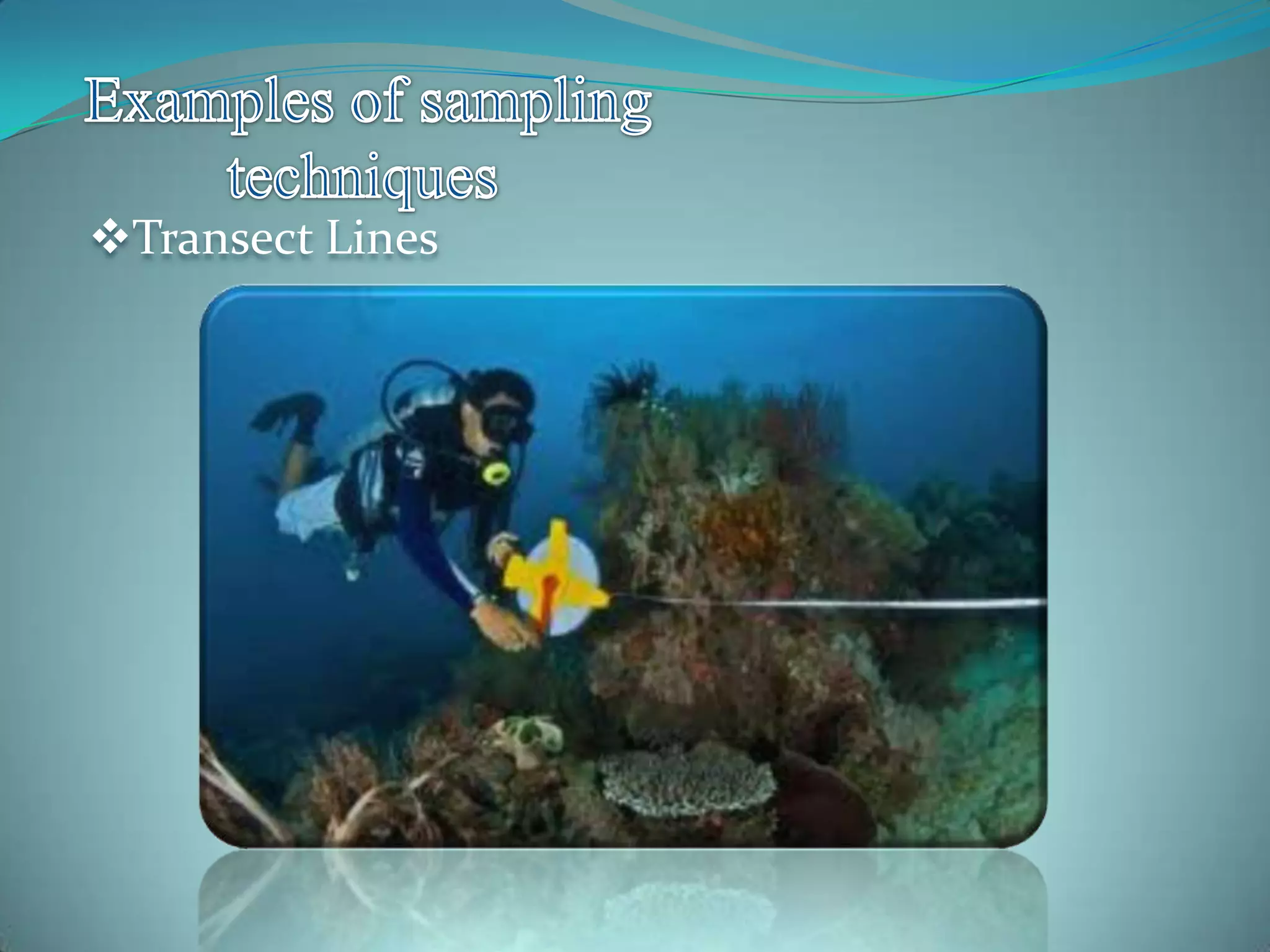
Transect Lines
- A line (usually straight) laid out on
a sampling site
-Observations are made in a systematic way
along the line
Decision:
- where to mark out the transect
- how long
- how many
- how far apart
- intervals between obseervations
Transect Lines
Transect Lines
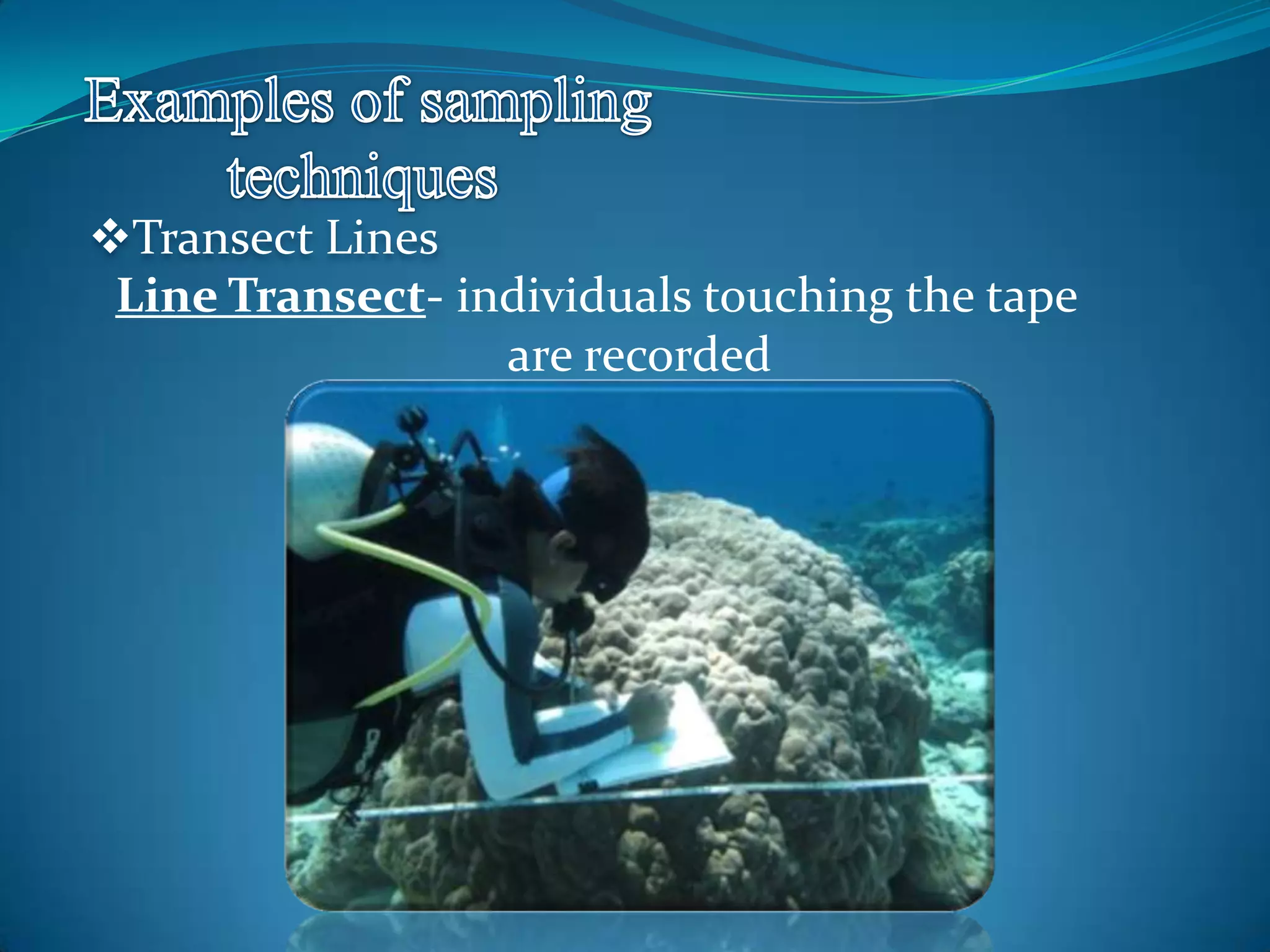
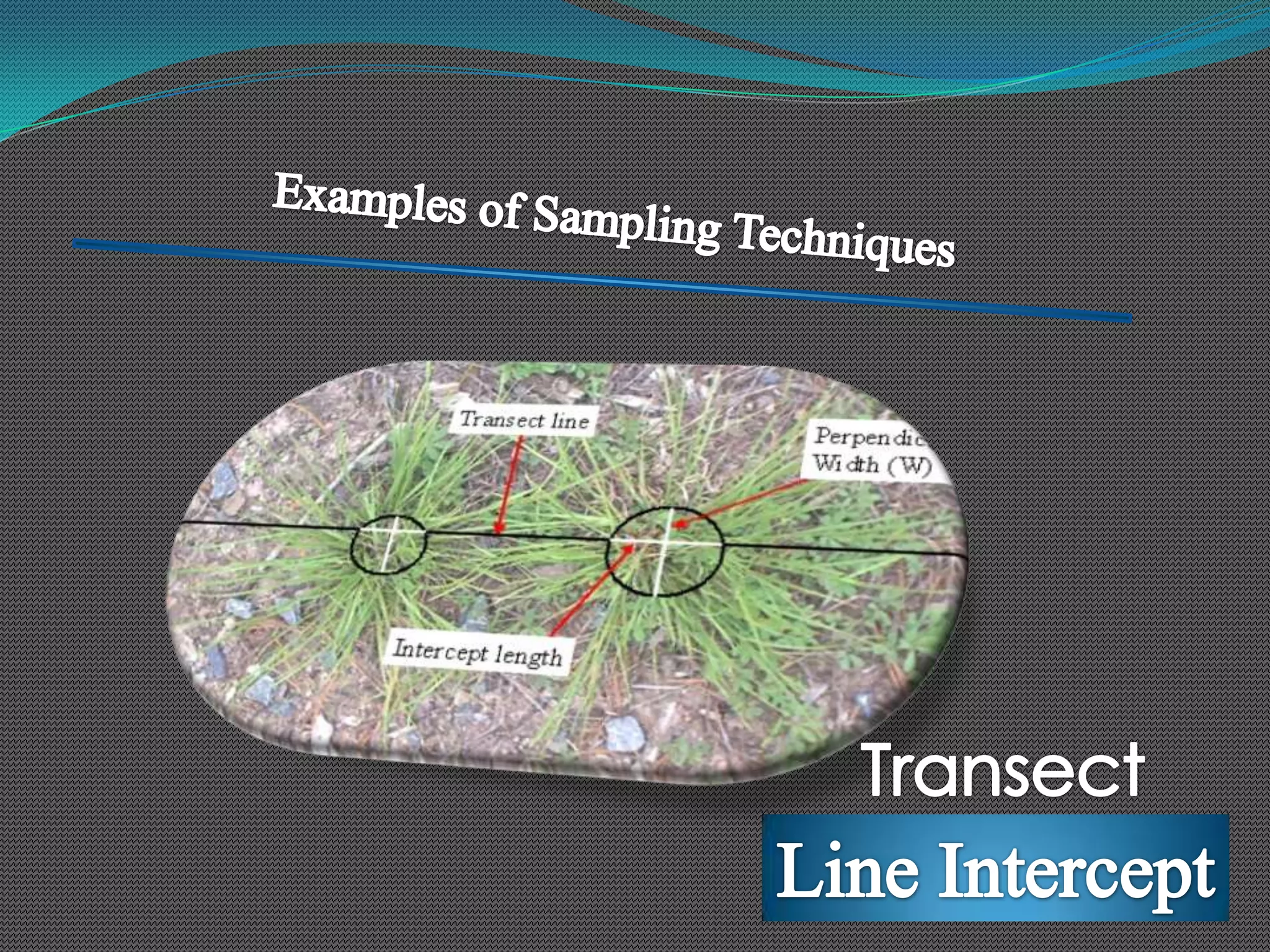
Line Transect- individuals touching the tape
are recorded
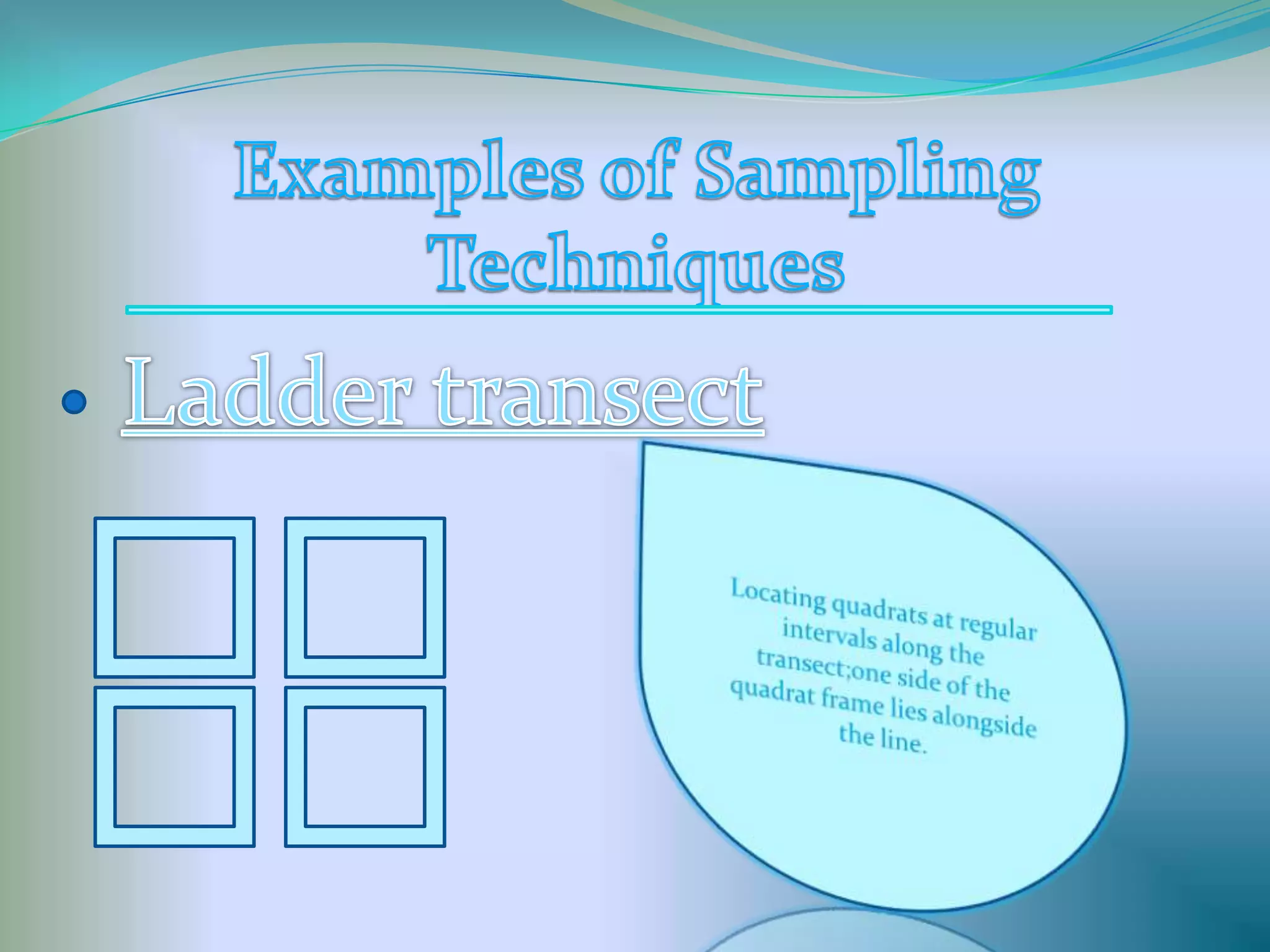
-two parallel lines are marked
out,individuals between these
lines are recorded.
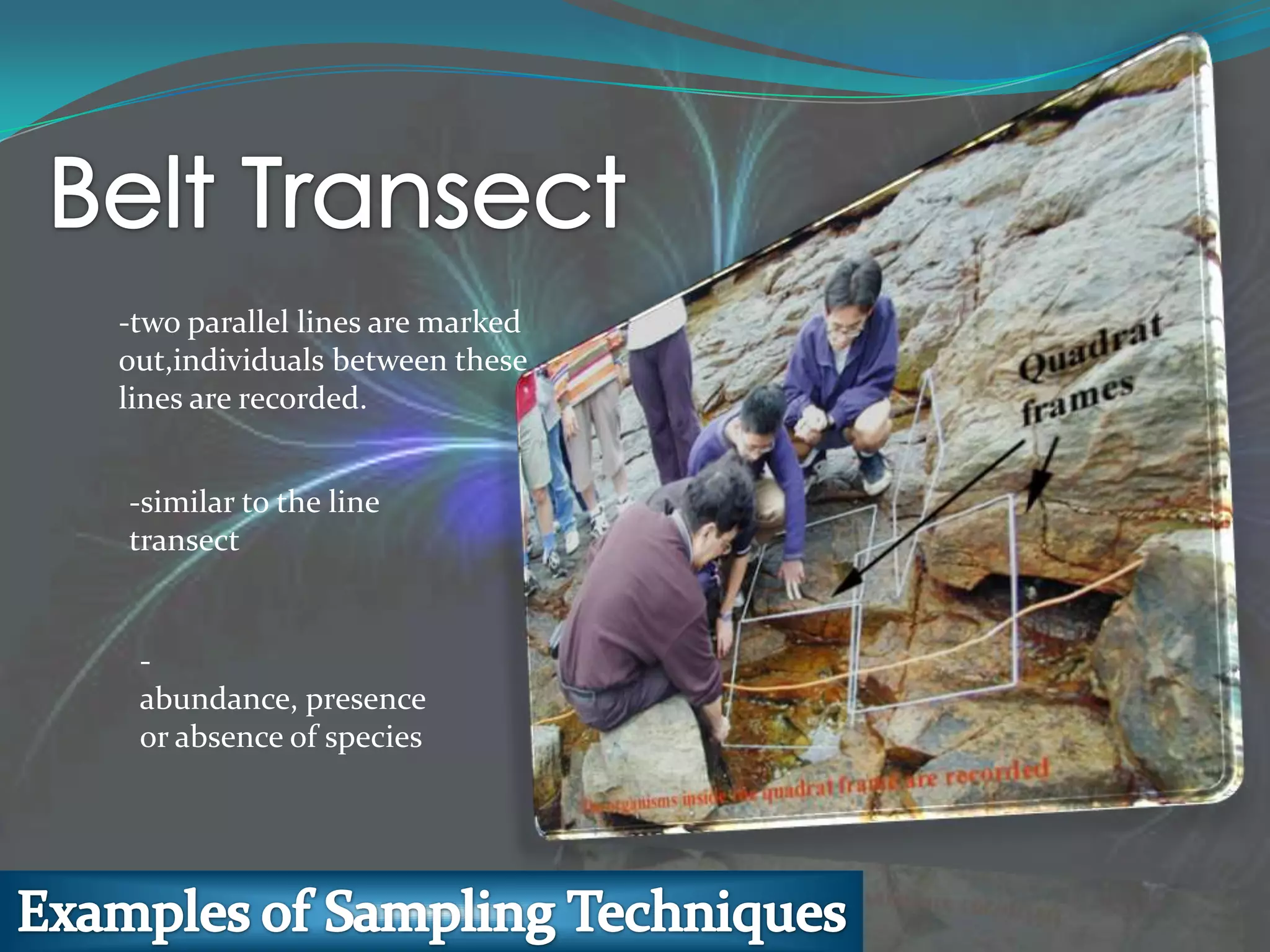
-similar to the line
transect
-
abundance, presence
or absence of species
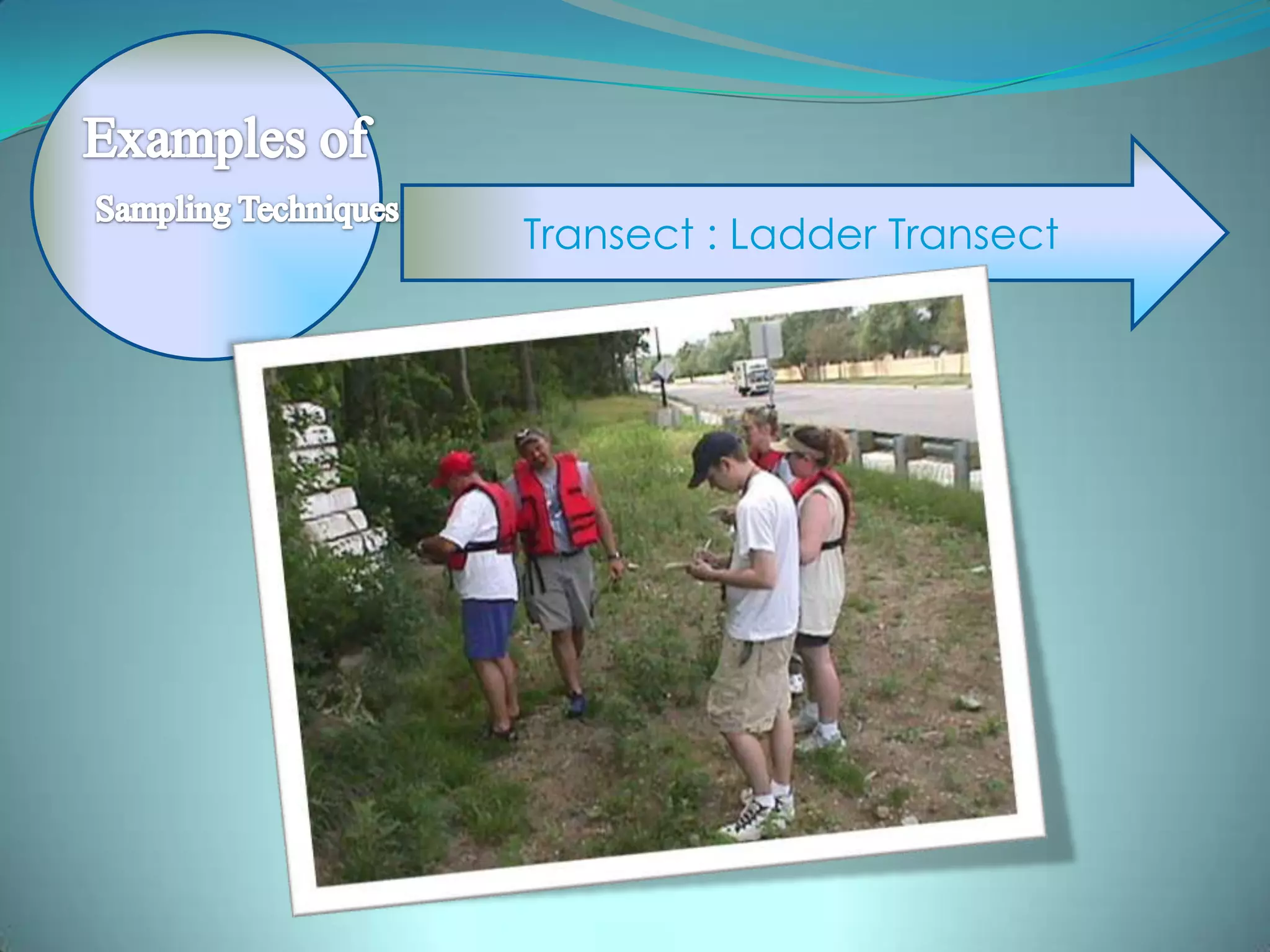
Transect : Ladder Transect
Considerations
1)Type of water body.
2Tests to be performed on the sample.
3)Volume of the sample
4)Container to use
5)Cleaning procedure for container.
6)Water collection technique
7)Transporting and storage
8)How soon to process the sample
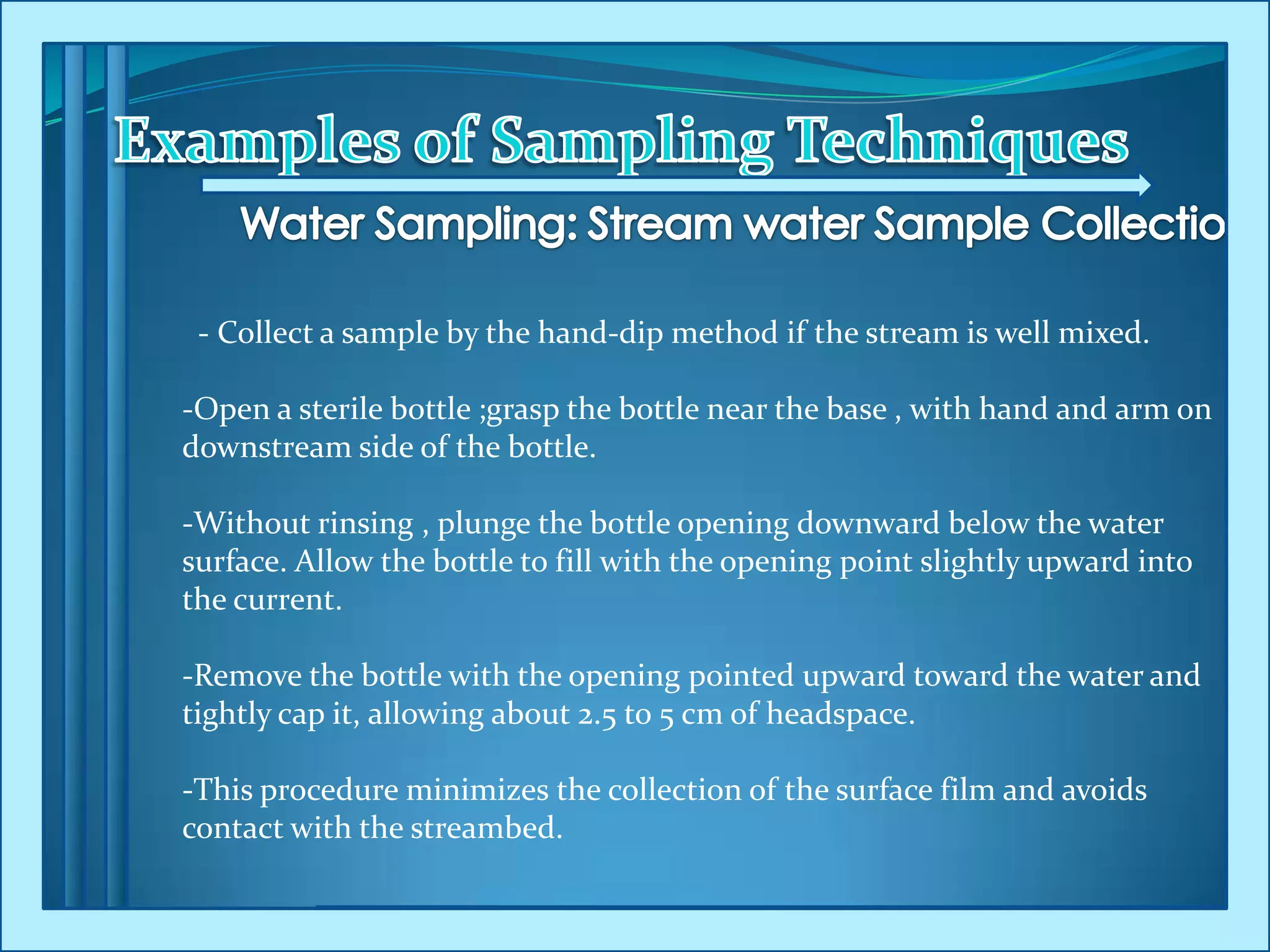
- Collect a sample by the hand-dip method if the stream is well mixed.
-Open a sterile bottle ;grasp the bottle near the base , with hand and arm on
downstream side of the bottle.
-Without rinsing , plunge the bottle opening downward below the water
surface. Allow the bottle to fill with the opening point slightly upward into
the current.
-Remove the bottle with the opening pointed upward toward the water and
tightly cap it, allowing about 2.5 to 5 cm of headspace.
-This procedure minimizes the collection of the surface film and avoids
contact with the streambed.
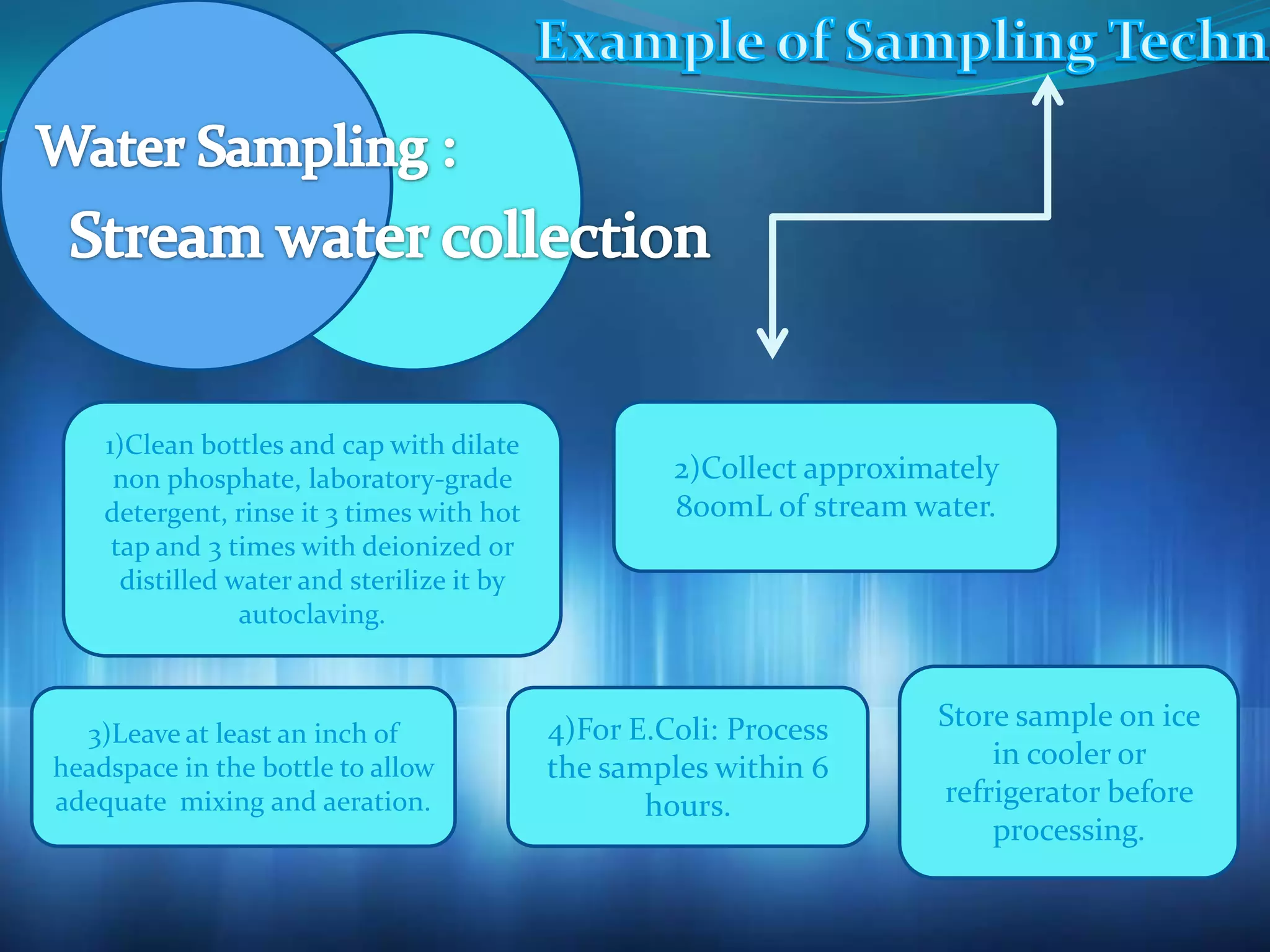
1)Clean bottles and cap with dilate
non phosphate, laboratory-grade
detergent, rinse it 3 times with hot
tap and 3 times with deionized or
distilled water and sterilize it by
autoclaving.
2)Collect approximately
800mL of stream water.
3)Leave at least an inch of
headspace in the bottle to allow
adequate mixing and aeration.
4)For E.Coli: Process
the samples within 6
hours.
Store sample on ice
in cooler or
refrigerator before
processing.
Aczel, Amir D. 1995, Statistics and Concepts and Applications, Chicago , Richard D . Irvin
Inc.
Beach,David P. and Alvager, Torsten K.E,1992. Handbook for Scientific and Technical
Research, New Jersey, Prentice Hall.
Brace, Charles H. and Brase, Corrine P. 1995. Understandable Statistics. Fifth Edition .
Lexington, Massachussetts D.C Health and Company.
David, Fely P.,2002. Understanding and doing Research: A handbook for Beginners.Trial
Edition. Iloilo City.
Kumar, Ranjit, 1996, Research Methodology. Australia Addison Wesley Longman.
Rivera, Maximiano M. Jr. and Rivera, Roela Victoria,1996. Practical Guide to Thesis and
Dissertation Writing. Manila, Philippines.
Sevilla Consuelo,G.et.al 1998. Research Methods, Revised Edition, Manila Rex bookstore.
Field Sampling. Us geological Survey Ohio District Microbiology Laboratory. 2003.
Online. Internet: http://oh.water.usgs.gov/micro/fldsmpl.html/(20 Oct 2006)
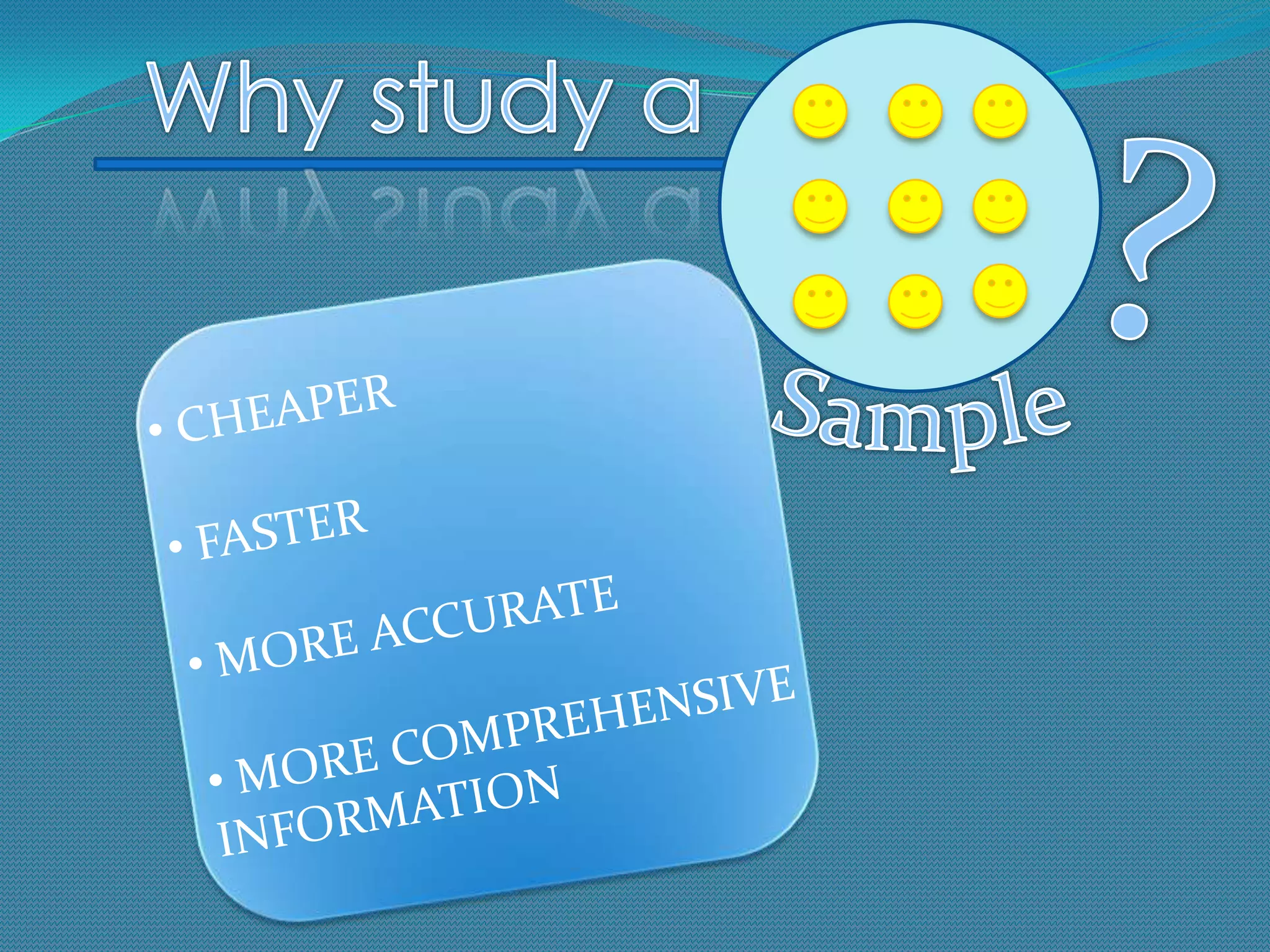
Why it is advantageous to
study a sample.
Generating random numbers.
Random Selection is employed when every
member of a population has an equal
chance of being selected to be a member of
the sample.
Cluster Sampling is a non-random sampling
technique.
Used for granular or powdery samples.
To mark out a small area as a sample out of a
large area.
Two parallel lines are marked out and individuals
between these lines are recorded.
In water sampling.
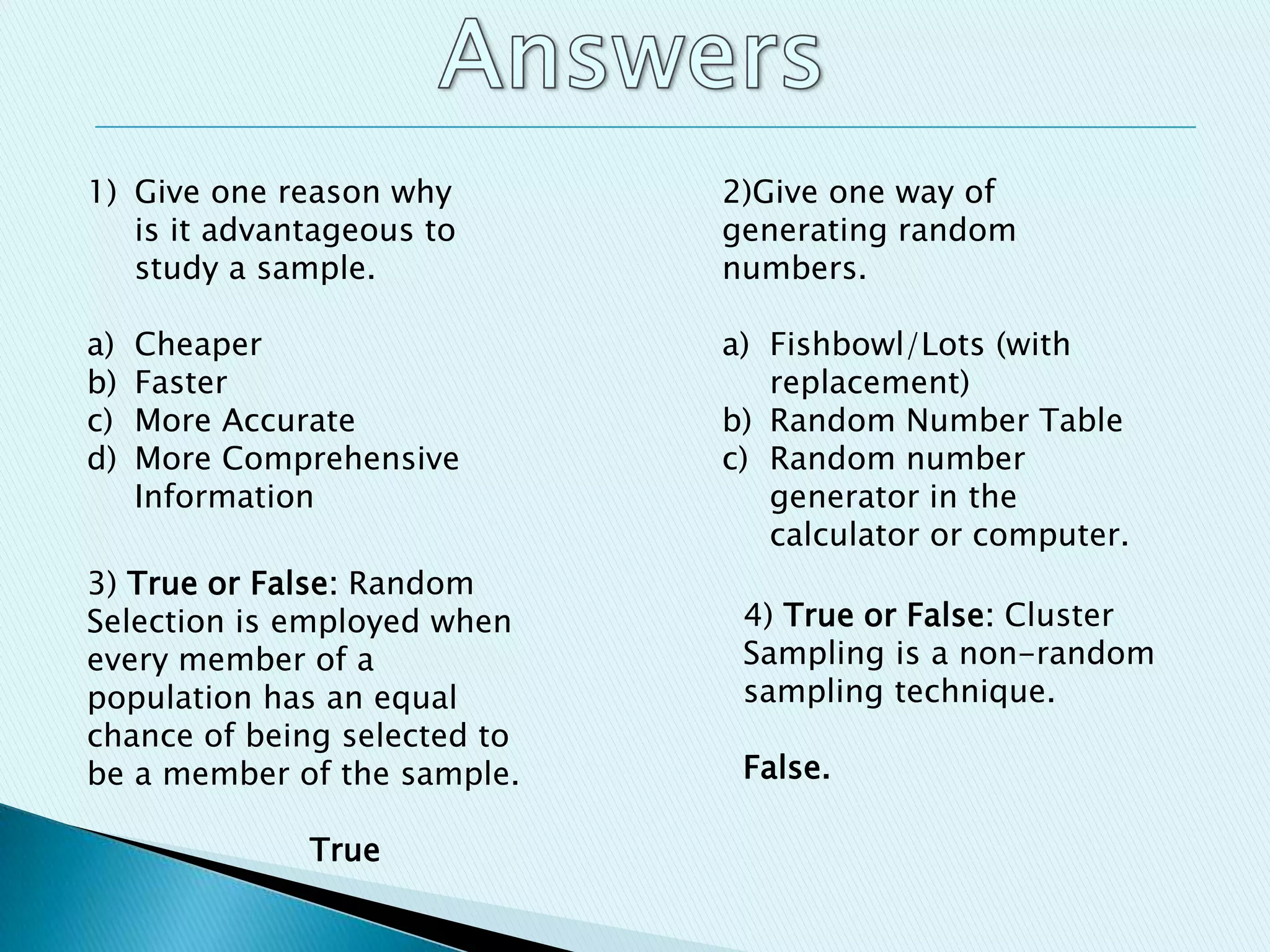
1) Give one reason why
is it advantageous to
study a sample.
a) Cheaper
b) Faster
c) More Accurate
d) More Comprehensive
Information
2)Give one way of
generating random
numbers.
a) Fishbowl/Lots (with
replacement)
b) Random Number Table
c) Random number
generator in the
calculator or computer.
3) True or False: Random
Selection is employed when
every member of a
population has an equal
chance of being selected to
be a member of the sample.
True
4) True or False: Cluster
Sampling is a non-random
sampling technique.
False.
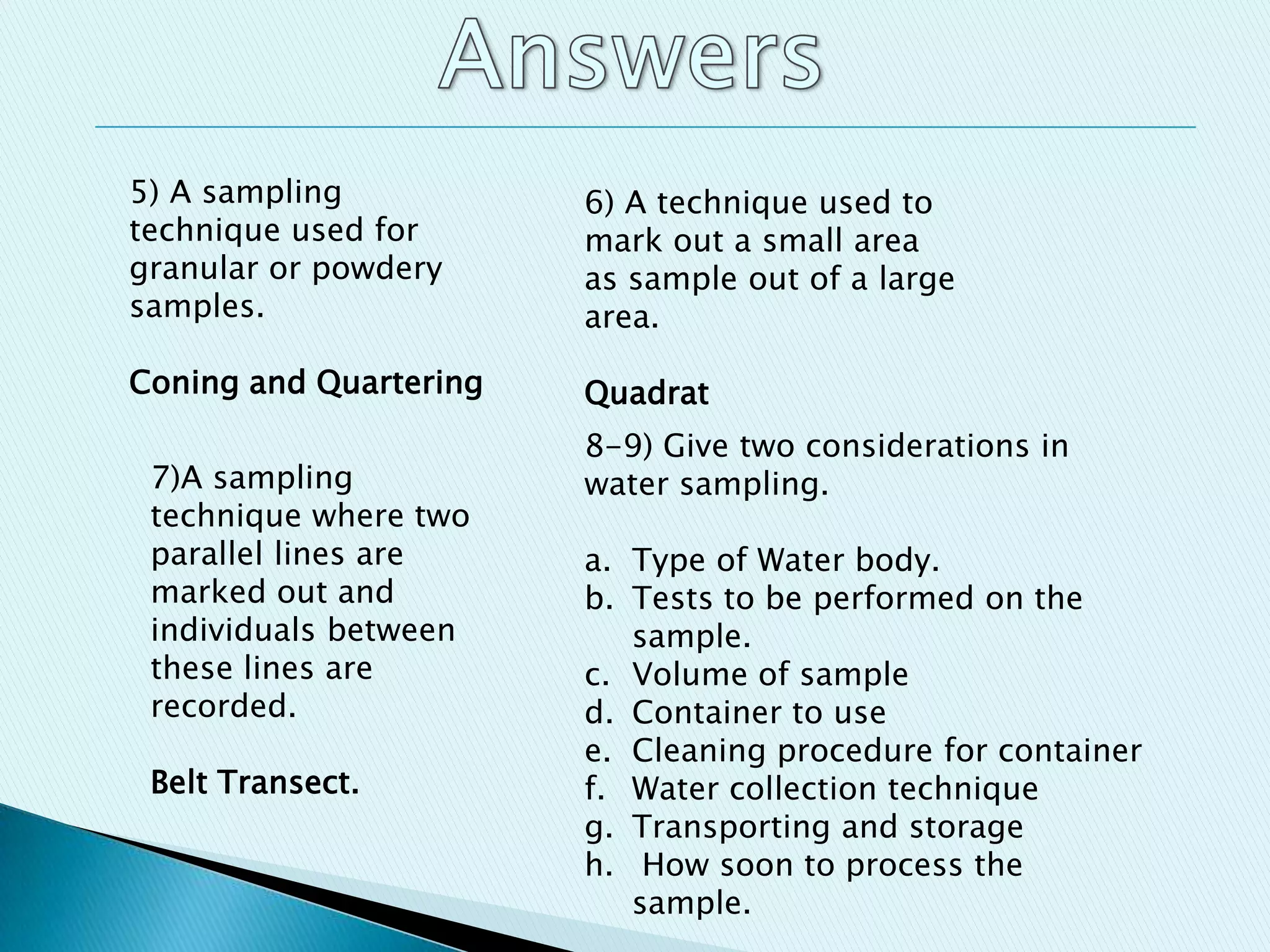
5) A sampling
technique used for
granular or powdery
samples.
Coning and Quartering
6) A technique used to
mark out a small area
as sample out of a large
area.
Quadrat
7)A sampling
technique where two
parallel lines are
marked out and
individuals between
these lines are
recorded.
Belt Transect.
8-9) Give two considerations in
water sampling.
a. Type of Water body.
b. Tests to be performed on the
sample.
c. Volume of sample
d. Container to use
e. Cleaning procedure for container
f. Water collection technique
g. Transporting and storage
h. How soon to process the
sample.
10) It is a subset of a population on which information is
obtained.
Sample.
Sampling Group 8

Sampling Group 8

  • 1.
  • 3.
    A subset ofa population on which the information is obtained
  • 5.
    Goal: Get anaccurate picture of the population from the sample RANDOM SAMPLING Equal chance of being selected Choose me! Choose me! Choose me! Choose me! Choose me! Choose me! Choose me!
  • 6.
  • 7.
  • 8.
    1 2 3 45 6 7 5 4 2
  • 9.
    Tools: 1. Fishbowl/ Lots(with replacement) 2. Random Number Table 3. Random number generator in the calculator or computer
  • 10.
    Random Assignment –every participant in the experiment has an equal chance of being assigned to any of the experimental or control conditions being compared. Random Selection – every member of population has an equal chance of being selected to be a member of the sample.
  • 11.
  • 12.
  • 13.
  • 14.
    Purposive Sampling The selectionof a sample is based on  previous knowledge of a population  specific purpose of the research
  • 15.
    Purposive Sampling  differentfrom convenience sampling  researchers do not simply study whoever is available  but use their judgement to select a sample which they believe will provide the data they need
  • 16.
     Coning andQuartering  Quadrat sampling  Transect Lines  Water Sampling
  • 17.
     Coning andQuartering For granular or powdered samples Procedure • Form a conical heap • Spread it out into a circular flat cake • Divide the cake radially into quarters • Choose two opposite quarters; combine • Discard the other two quarters • Repeat as many times as needed to get desired amount
  • 18.
     Coning andQuartering • Form a conical heap
  • 19.
     Coning andQuartering •Spread it out into a circular flat cake
  • 20.
     Coning andQuartering • Divide the cake radially into quarters
  • 21.
     Coning andQuartering •Choose two opposite quarters; combine
  • 22.
     Coning andQuartering •Discard the other two quarters •Repeat as many times as needed to get desired amount
  • 23.
     Quadrat sampling -Asmall area of ground marked out as sample of a larger area Purpose: to make a detailed description and record numerical data For sampling objects that do not move – vegetation or more or less sedentary animals
  • 24.
  • 25.
     Quadrat sampling Aframe of predetermined area – placed on the ground Data: number of individuals per unit area Decisions: - quadrat size (usually 1m x 1m) - quadrat shape (usually square) - where to put it - how many quadrats - what rules to set
  • 26.
  • 27.
  • 28.
  • 29.
  • 30.
  • 31.
     Quadrat sampling Systematic-using grids - divide the area into squares of equal sizes - locate the quadrats by picking coordinates randomly
  • 32.
     Quadrat sampling 12 3 4 5 6 7 8 9 10 11 12 13 14 15
  • 33.
  • 34.
    Transect Lines - Aline (usually straight) laid out on a sampling site -Observations are made in a systematic way along the line Decision: - where to mark out the transect - how long - how many - how far apart - intervals between obseervations
  • 35.
  • 36.
    Transect Lines Line Transect-individuals touching the tape are recorded
  • 39.
    -two parallel linesare marked out,individuals between these lines are recorded. -similar to the line transect - abundance, presence or absence of species
  • 41.
  • 42.
    Considerations 1)Type of waterbody. 2Tests to be performed on the sample. 3)Volume of the sample 4)Container to use 5)Cleaning procedure for container. 6)Water collection technique 7)Transporting and storage 8)How soon to process the sample
  • 43.
    - Collect asample by the hand-dip method if the stream is well mixed. -Open a sterile bottle ;grasp the bottle near the base , with hand and arm on downstream side of the bottle. -Without rinsing , plunge the bottle opening downward below the water surface. Allow the bottle to fill with the opening point slightly upward into the current. -Remove the bottle with the opening pointed upward toward the water and tightly cap it, allowing about 2.5 to 5 cm of headspace. -This procedure minimizes the collection of the surface film and avoids contact with the streambed.
  • 44.
    1)Clean bottles andcap with dilate non phosphate, laboratory-grade detergent, rinse it 3 times with hot tap and 3 times with deionized or distilled water and sterilize it by autoclaving. 2)Collect approximately 800mL of stream water. 3)Leave at least an inch of headspace in the bottle to allow adequate mixing and aeration. 4)For E.Coli: Process the samples within 6 hours. Store sample on ice in cooler or refrigerator before processing.
  • 46.
    Aczel, Amir D.1995, Statistics and Concepts and Applications, Chicago , Richard D . Irvin Inc. Beach,David P. and Alvager, Torsten K.E,1992. Handbook for Scientific and Technical Research, New Jersey, Prentice Hall. Brace, Charles H. and Brase, Corrine P. 1995. Understandable Statistics. Fifth Edition . Lexington, Massachussetts D.C Health and Company. David, Fely P.,2002. Understanding and doing Research: A handbook for Beginners.Trial Edition. Iloilo City. Kumar, Ranjit, 1996, Research Methodology. Australia Addison Wesley Longman. Rivera, Maximiano M. Jr. and Rivera, Roela Victoria,1996. Practical Guide to Thesis and Dissertation Writing. Manila, Philippines. Sevilla Consuelo,G.et.al 1998. Research Methods, Revised Edition, Manila Rex bookstore. Field Sampling. Us geological Survey Ohio District Microbiology Laboratory. 2003. Online. Internet: http://oh.water.usgs.gov/micro/fldsmpl.html/(20 Oct 2006)
  • 49.
    Why it isadvantageous to study a sample.
  • 50.
  • 51.
    Random Selection isemployed when every member of a population has an equal chance of being selected to be a member of the sample.
  • 52.
    Cluster Sampling isa non-random sampling technique.
  • 53.
    Used for granularor powdery samples.
  • 54.
    To mark outa small area as a sample out of a large area.
  • 55.
    Two parallel linesare marked out and individuals between these lines are recorded.
  • 56.
  • 59.
    1) Give onereason why is it advantageous to study a sample. a) Cheaper b) Faster c) More Accurate d) More Comprehensive Information 2)Give one way of generating random numbers. a) Fishbowl/Lots (with replacement) b) Random Number Table c) Random number generator in the calculator or computer. 3) True or False: Random Selection is employed when every member of a population has an equal chance of being selected to be a member of the sample. True 4) True or False: Cluster Sampling is a non-random sampling technique. False.
  • 60.
    5) A sampling techniqueused for granular or powdery samples. Coning and Quartering 6) A technique used to mark out a small area as sample out of a large area. Quadrat 7)A sampling technique where two parallel lines are marked out and individuals between these lines are recorded. Belt Transect. 8-9) Give two considerations in water sampling. a. Type of Water body. b. Tests to be performed on the sample. c. Volume of sample d. Container to use e. Cleaning procedure for container f. Water collection technique g. Transporting and storage h. How soon to process the sample.
  • 61.
    10) It isa subset of a population on which information is obtained. Sample.