Part 1: SamplePreparation: Getting Ready for the Instrument
The goal of sample preparation is to convert any sample—solid, very thick liquid, or even a gas—into a clear, dilute liquid
solution that the AAS can handle easily.
1. Solid Samples (e.g., Soil, Food, Metal Alloys)
Solid materials are the most challenging. They need to be completely broken down to release the metal atoms.
Decomposition)
Using strong acids (like
HNO_3, HCl, or their
mixture, Aqua Regia) and
heat to dissolve the solid
sample.
To destroy the
organic/inorganic matrix
(the bulk material) and
release the analyte
metals into the solution
as ions (M+).
Imagine a soil sample
being heated in a flask
with a clear, bubbling acid
until only a clear, colored
liquid remains.
Microwave Digestion
The same as acid
digestion, but done inside
a sealed vessel placed in a
special microwave oven.
To speed up the process
and use high
pressure/temperature for
difficult samples,
preventing the loss of
volatile elements.
Imagine small, sealed,
thick-walled containers
inside a carousel in a
microwave oven.
Fusion
Mixing a difficult-to-
dissolve sample (like
ceramic or silicate) with a
chemical flux and heating
it until it melts.
To convert a highly stable
solid into a material that
is easily dissolved in
dilute acid or water
afterward.
Imagine a powder turning
into a molten glass-like
bead in a crucible.
You must get a clear, particle-free solution. Any solid particles will clog the instrument or give false readings.
3.
Liquid Samples (e.g.,Water, Blood Serum, Beverages)
While easier, liquid samples still require attention:
•Filtration: If there are any suspended solids (tiny particles), they must be
removed by filtering to prevent blockages in the instrument's tubing.
•Dilution: If the sample is too concentrated (the metal content is too high), the
instrument will be "overwhelmed," and the reading will be inaccurate. We must
dilute it to bring the concentration into the instrument's working range (the part of
the calibration curve that is straight).
•Matrix Matching/Acidification: It is crucial that the final solution for the sample
is chemically similar to the final solution of your standard solutions. This is called
matrix matching.
•Often, a small amount of acid is added to the sample to prevent the analyte
metals from precipitating (falling out of solution) and to match the acid content of
the standards.
4.
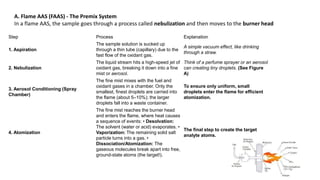
A. Flame AAS(FAAS) - The Premix System
In a flame AAS, the sample goes through a process called nebulization and then moves to the burner head
Step Process Explanation
1. Aspiration
The sample solution is sucked up
through a thin tube (capillary) due to the
fast flow of the oxidant gas.
A simple vacuum effect, like drinking
through a straw.
2. Nebulization
The liquid stream hits a high-speed jet of
oxidant gas, breaking it down into a fine
mist or aerosol.
Think of a perfume sprayer or an aerosol
can creating tiny droplets. (See Figure
A)
3. Aerosol Conditioning (Spray
Chamber)
The fine mist mixes with the fuel and
oxidant gases in a chamber. Only the
smallest, finest droplets are carried into
the flame (about 5–10%); the larger
droplets fall into a waste container.
To ensure only uniform, small
droplets enter the flame for efficient
atomization.
4. Atomization
The fine mist reaches the burner head
and enters the flame, where heat causes
a sequence of events: • Desolvation:
The solvent (water or acid) evaporates. •
Vaporization: The remaining solid salt
particle turns into a gas. •
Dissociation/Atomization: The
gaseous molecules break apart into free,
ground-state atoms (the target!).
The final step to create the target
analyte atoms.
5.
Graphite Furnace AAS(GFAAS)
GFAAS is used for very low concentration samples (ultra-trace analysis) and uses tiny
volumes of sample (5-50 μL).
1.Direct Injection: A micro-syringe or auto-sampler robot injects the small, precise
volume of sample directly into a small graphite tube (the furnace).
2.Temperature Program: The furnace is heated electrically through a series of timed
steps, eliminating the need for a flame and providing much greater sensitivity:
•Drying (100−150∘C): The solvent is
gently evaporated.
•Ashing/Pyrolysis (300−1200∘C): The
organic or unwanted matrix is "burned off"
or volatilized, but the analyte is stabilized
and remains.
•Atomization (2000−3000∘C): The
temperature is rapidly increased, causing
the analyte to instantly atomize as a
concentrated cloud of atoms for the
measurement.
6.
The Use ofOrganic Solvents in Atomic Absorption Spectroscopy (AAS)
Powerful, but sometimes tricky, aspect of AAS: the use of organic solvents
instead of the typical aqueous (water-based) solutions we've been using.
In many real-world applications—like analyzing oil, plastics, or certain
biological samples—the analyte (the metal we want to measure) is found in
an organic or oily matrix. Water and oil don't mix, so we often must use an
organic solvent to dissolve or extract the analyte.
1. Why Use Organic Solvents? (The Advantages)
There are two main reasons we intentionally use an organic solvent:
A. The Chemical Advantage: Solvent Extraction (Pre-concentration)
Sometimes, the metal concentration in an aqueous sample (like river water) is
too low for the AAS to detect, even with a Graphite Furnace. We can use a
technique called Solvent Extraction to solve this.
7.
1.Chelation: We adda chemical (a chelating agent) that selectively binds to our
metal ion (Mn+) to form a neutral, metal-organic compound (a chelate).
2.Extraction: We then mix the aqueous sample with an organic solvent (e.g.,
MIBK - Methyl Isobutyl Ketone). Since the chelate is neutral and organic, it moves
from the water layer into the organic solvent layer.
3.Concentration: Since the volume of the organic solvent layer is much smaller
than the original water sample, we have effectively concentrated the metal, leading
to a much stronger signal.
In Short: Organic solvents allow us to concentrate trace metals from a large
volume of water sample, dramatically increasing the method's sensitivity.
8.
Property Organic Solventvs. Water Effect on AAS Signal
Viscosity (Thickness) Usually Lower
Easier to suck up (Aspiration
Rate ↑) and nebulize into a finer
mist.
Surface Tension Usually Lower
Smaller droplets are produced
during nebulization, improving
the efficiency of atomization.
Volatibility (Ease of evaporation) Usually Higher
The solvent evaporates faster in
the flame, leaving the dry analyte
particle sooner and increasing
the number of free atoms.
B. The Physical Advantage: Enhanced Nebulization
Organic solvents have different physical properties compared to water, which often
leads to a better signal in a Flame AAS (FAAS).
The Result: A combination of higher aspiration rate, finer aerosol, and faster desolvation means more free atoms of the
analyte reach the light beam at any given time, leading to a higher absorbance signal (better sensitivity!).
9.
2. The Challengesand Safety Concerns (The Disadvantages)
Using organic solvents is not without significant risk and complexity.
Safety/Fire Hazard Organic solvents are flammable and volatile. Introducing a flammable vapor into a hot flame or
having a spill near the burner is a serious fire risk. Never use highly volatile solvents like Acetone or Diethyl Ether
directly in a FAAS.
Toxicity Solvents like benzene or carbon tetrachloride are highly toxic. Furthermore, halogenated solvents (e.g.,
Chloroform) can produce highly toxic gases (like Phosgene) when burned in a flame. Good ventilation is
mandatory.
Matrix Mismatch When using an organic solvent, your standards must also be prepared in the same organic
solvent (or a similar organic matrix) to ensure matrix matching. You cannot use an aqueous standard with an
organic sample and expect accurate results.
Burner Wear Some organic solvents can attack the plastic or rubber components of the nebulizer and
burner system, causing them to swell or degrade.
Background AbsorptionThe burning of the organic molecule itself in the flame can create molecular fragments
that absorb light, causing a background signal error. This requires careful use of Background Correction
systems.
10.
Summary for Analysis
•Whento use organic solvents: When the analyte is naturally dissolved in an
organic material (e.g., metals in engine oil) or when you need to use solvent
extraction to increase the concentration of a very dilute sample.
•The main effect in FAAS: A boost in sensitivity due to better physical
properties (lower viscosity, lower surface tension) compared to water.
•Safety First: Always check the solvent's flash point and toxicity. Adequate
ventilation and proper procedures are non-negotiable.
11.
Sample Introduction Methodsin Atomic Absorption Spectroscopy
The goal of sample introduction is to get the analyte (the element of interest) from a liquid solution into the atomizer
(the flame or the furnace) to create a cloud of free, ground-state atoms.
We will focus on the two major techniques: Flame AAS (FAAS) and Graphite Furnace AAS (GFAAS).
1. Flame Atomic Absorption Spectroscopy (FAAS)
FAAS uses a continuous process where the sample is drawn into a flame. The sample introduction system consists of
a nebulizer, a spray chamber, and a burner head.
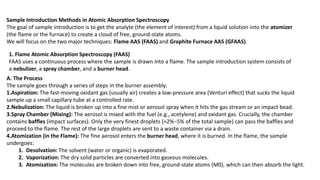
A. The Process
The sample goes through a series of steps in the burner assembly:
1.Aspiration: The fast-moving oxidant gas (usually air) creates a low-pressure area (Venturi effect) that sucks the liquid
sample up a small capillary tube at a controlled rate.
2.Nebulization: The liquid is broken up into a fine mist or aerosol spray when it hits the gas stream or an impact bead.
3.Spray Chamber (Mixing): The aerosol is mixed with the fuel (e.g., acetylene) and oxidant gas. Crucially, the chamber
contains baffles (impact surfaces). Only the very finest droplets (≈2%−5% of the total sample) can pass the baffles and
proceed to the flame. The rest of the large droplets are sent to a waste container via a drain.
4.Atomization (in the Flame): The fine aerosol enters the burner head, where it is burned. In the flame, the sample
undergoes:
1. Desolvation: The solvent (water or organic) is evaporated.
2. Vaporization: The dry solid particles are converted into gaseous molecules.
3. Atomization: The molecules are broken down into free, ground-state atoms (M0), which can then absorb the light.
12.
B. Conceptual Diagram:FAAS Burner Assembly
Imagine the sample going on a journey to the flame:
Key Features:
•Long-Slot Burner: The burner head has a long, narrow slot (typically 5−10 cm) to increase the
path length of the light beam through the atom cloud, maximizing the absorption signal.
•High Sample Flow: Requires a relatively large sample volume (2−5 mL) for stable, continuous
measurement.
•Low Efficiency: Only a small percentage of the sample reaches the flame, which limits
sensitivity.
13.
2. Sample Introductionfor Graphite Furnace AAS (GFAAS)
Graphite Furnace AAS is a much more sensitive technique, requiring far less sample volume, often
just 5−50μL. The sample introduction process here is fundamentally different; it involves a discrete
sample injection directly into the furnace.
A. Autosampler Injection
GFAAS almost always uses an autosampler because the injection volume and positioning must be
highly precise.
•Injection: A micropipette from the autosampler draws up a very small, exact volume (e.g., 20μL) of
the liquid sample.
•Deposition: The pipette tip extends and precisely deposits this small droplet onto the center of the
graphite tube wall, which is inside the furnace.
[Imagine an image of a close-up of a graphite tube with a precise autosampler needle depositing a
tiny droplet of sample.]
Programmed Heating Steps (Atomization Cycle)
The introduction is now complete, but the analysis doesn't happen instantly. The entire process relies on a
precisely controlled heating program inside the graphite tube, which serves as the "micro-flame."
The typical temperature program involves four steps, ensuring only the analyte remains for the final
measurement:
14.
Step Function Temperature(Approx. ∘C) Purpose
1. Drying Solvent evaporation 100−150
Gently removes the solvent
(water, acid, etc.) to prevent
splattering.
2. Ashing (Pyrolysis) Decomposition of matrix 300−1200
Destroys the organic or
inorganic matrix components
without volatilizing the
analyte. This is critical for
interference removal.
3. Atomization Measurement phase 1500−3000
Rapidly heats the tube,
converting the solid analyte
residue into free atoms. This
is when the absorbance
measurement is taken.
4. Cleaning Burnout >2800
Heats the tube to maximum
to remove any remaining
residue before the next
sample.
Sample Introduction for Graphite Furnace AAS (GFAAS)
sample introduction is more than just pouring liquid into a funnel. It is a carefully engineered process—whether it's the
continuous, controlled mist of a nebulizer for FAAS or the precise, volume-controlled injection for GFAAS—that ensures
the analyte reaches the atomization source correctly. Getting this step right is essential for stable signals and reliable data.





![2. Sample Introduction for Graphite Furnace AAS (GFAAS)
Graphite Furnace AAS is a much more sensitive technique, requiring far less sample volume, often
just 5−50μL. The sample introduction process here is fundamentally different; it involves a discrete
sample injection directly into the furnace.
A. Autosampler Injection
GFAAS almost always uses an autosampler because the injection volume and positioning must be
highly precise.
•Injection: A micropipette from the autosampler draws up a very small, exact volume (e.g., 20μL) of
the liquid sample.
•Deposition: The pipette tip extends and precisely deposits this small droplet onto the center of the
graphite tube wall, which is inside the furnace.
[Imagine an image of a close-up of a graphite tube with a precise autosampler needle depositing a
tiny droplet of sample.]
Programmed Heating Steps (Atomization Cycle)
The introduction is now complete, but the analysis doesn't happen instantly. The entire process relies on a
precisely controlled heating program inside the graphite tube, which serves as the "micro-flame."
The typical temperature program involves four steps, ensuring only the analyte remains for the final
measurement:](https://image.slidesharecdn.com/sampleinjectionandatomizationlecture-251124123919-2d6a9f90/85/sample-injection-and-atomization-lecture-pdf-13-320.jpg)


