Eve Theory By: Kamil Przychodzien & Alexander Kozeniauskas
Objective Is The Eve Theory fact or fiction, can this explain where we came from, and do we really have a common ancestor?
Eve Theory   Was thought up by Rebecca Cann, Mark Stoneking, and Allan Wilson in 1987. Mitochondrial Eve Theory  States that the mitochondrial DNA in all humans is inherited from one common female ancestor. There are many theories of human evolution, but this is one of the more supported theories with evidence to back it up.
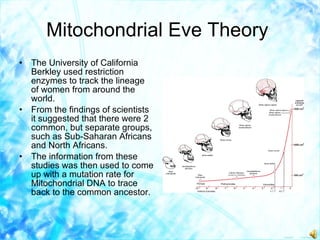
Mitochondrial Eve Theory   The University of California Berkley used restriction enzymes to track the lineage of women from around the world. From the findings of scientists it suggested that there were 2 common, but separate groups, such as Sub-Saharan Africans and North Africans. The information from these studies was then used to come up with a mutation rate for Mitochondrial DNA to trace back to the common ancestor.
What exactly is Mitochondrial  Eve Theory? This also refers to the Mitochondrial DNA: Mitochondria have double-stranded DNA, thus replication of the mitochondrial DNA is independent of the DNA replication in the nucleus. Only Women can pass on Mitochondria.
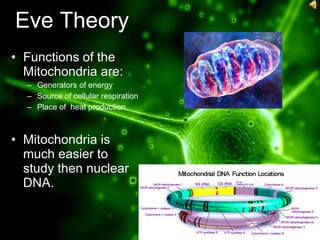
Eve Theory Functions of the Mitochondria are: Generators of energy Source of cellular respiration Place of  heat production Mitochondria is  much easier to  study then nuclear DNA.
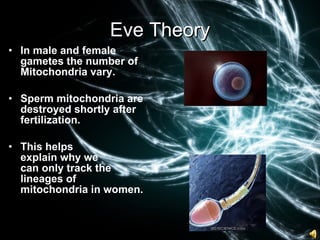
Eve Theory In male and female gametes the number of Mitochondria vary. Sperm mitochondria are destroyed shortly after fertilization. This helps  explain why we  can only track the lineages of mitochondria in women.
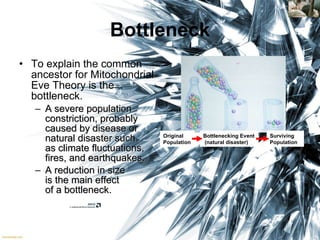
Bottleneck To explain the common ancestor for Mitochondrial Eve Theory is the bottleneck. A severe population constriction, probably caused by disease or natural disaster such  as climate fluctuations, fires, and earthquakes.  A reduction in size  is the main effect  of a bottleneck. Original Population Bottlenecking Event  (natural disaster) Surviving Population
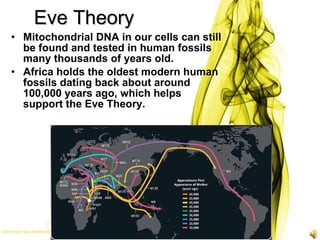
Eve Theory Mitochondrial DNA in our cells can still  be found and tested in human fossils  many thousands of years old. Africa holds the oldest modern human  fossils dating back about around  100,000 years ago, which helps  support the Eve Theory.
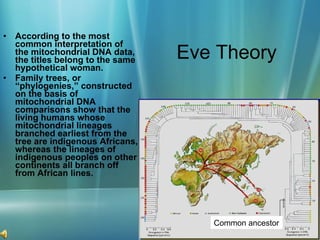
Eve Theory According to the most common interpretation of the mitochondrial DNA data, the titles belong to the same hypothetical woman.  Family trees, or “phylogenies,” constructed on the basis of mitochondrial DNA comparisons show that the living humans whose mitochondrial lineages branched earliest from the tree are indigenous Africans, whereas the lineages of indigenous peoples on other continents all branch off from African lines. Common ancestor
Conclusion Mitochondrial DNA Analysis provided the scientific community with conceptive evidence. A valuable finding regarding the most common ancestor is the she came from Africa which supports theories about the spread of hominids. Africans have the greats diversity of Mitochondrial DNA sequences making it a supporting factor that is hard to dispute among researchers.

Sample 4th Q - The real eve theory2.1

  • 1.
    Eve Theory By:Kamil Przychodzien & Alexander Kozeniauskas
  • 2.
    Objective Is TheEve Theory fact or fiction, can this explain where we came from, and do we really have a common ancestor?
  • 3.
    Eve Theory Was thought up by Rebecca Cann, Mark Stoneking, and Allan Wilson in 1987. Mitochondrial Eve Theory States that the mitochondrial DNA in all humans is inherited from one common female ancestor. There are many theories of human evolution, but this is one of the more supported theories with evidence to back it up.
  • 4.
    Mitochondrial Eve Theory The University of California Berkley used restriction enzymes to track the lineage of women from around the world. From the findings of scientists it suggested that there were 2 common, but separate groups, such as Sub-Saharan Africans and North Africans. The information from these studies was then used to come up with a mutation rate for Mitochondrial DNA to trace back to the common ancestor.
  • 5.
    What exactly isMitochondrial Eve Theory? This also refers to the Mitochondrial DNA: Mitochondria have double-stranded DNA, thus replication of the mitochondrial DNA is independent of the DNA replication in the nucleus. Only Women can pass on Mitochondria.
  • 6.
    Eve Theory Functionsof the Mitochondria are: Generators of energy Source of cellular respiration Place of heat production Mitochondria is much easier to study then nuclear DNA.
  • 7.
    Eve Theory Inmale and female gametes the number of Mitochondria vary. Sperm mitochondria are destroyed shortly after fertilization. This helps explain why we can only track the lineages of mitochondria in women.
  • 8.
    Bottleneck To explainthe common ancestor for Mitochondrial Eve Theory is the bottleneck. A severe population constriction, probably caused by disease or natural disaster such as climate fluctuations, fires, and earthquakes. A reduction in size is the main effect of a bottleneck. Original Population Bottlenecking Event (natural disaster) Surviving Population
  • 9.
    Eve Theory MitochondrialDNA in our cells can still be found and tested in human fossils many thousands of years old. Africa holds the oldest modern human fossils dating back about around 100,000 years ago, which helps support the Eve Theory.
  • 10.
    Eve Theory Accordingto the most common interpretation of the mitochondrial DNA data, the titles belong to the same hypothetical woman. Family trees, or “phylogenies,” constructed on the basis of mitochondrial DNA comparisons show that the living humans whose mitochondrial lineages branched earliest from the tree are indigenous Africans, whereas the lineages of indigenous peoples on other continents all branch off from African lines. Common ancestor
  • 11.
    Conclusion Mitochondrial DNAAnalysis provided the scientific community with conceptive evidence. A valuable finding regarding the most common ancestor is the she came from Africa which supports theories about the spread of hominids. Africans have the greats diversity of Mitochondrial DNA sequences making it a supporting factor that is hard to dispute among researchers.

Editor's Notes

  • #6 What does it mean to add notes