African Eve
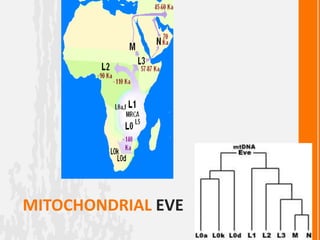
MITOCHONDRIAL EVE
-   According to skeletal evidence, the first group traveled to the Middle East
-   After 80,000 frigid years , homosapiens crossed into Yemen through “Gates of Grief” (DNA Evidence).
-   In 60,000 years H. Sapiens had traveled into Southeast Asia and Volcanic eruptions covered Asia, India
    and Malaysia.
-   Only about 70,000 years ago Modern men came across Australia.
-   50,000 years ago: Modern man began inhabiting Europe
-   1856 Neander, Germany – skeleton found – had different facial features, more adapted to climate.


    WHERE HER MITOCHONDRIAL DNA
    TRAVELED TO….
WHERE HER MITOCHONDRIAL DNA
TRAVELED TO….
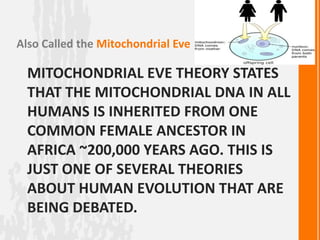
Also Called the Mitochondrial Eve

  MITOCHONDRIAL EVE THEORY STATES
  THAT THE MITOCHONDRIAL DNA IN ALL
  HUMANS IS INHERITED FROM ONE
  COMMON FEMALE ANCESTOR IN
  AFRICA ~200,000 YEARS AGO. THIS IS
  JUST ONE OF SEVERAL THEORIES
  ABOUT HUMAN EVOLUTION THAT ARE
  BEING DEBATED.
There are multiple explanations for how the Mitochondrial Eve theory, an example of it is
the bottleneck theory. The bottleneck theory is when a population undergoes a serve
evolutionary change, probably caused by a disease or natural disaster.
• The bottleneck effect could have occurred in that a large population of modern humans
    may have greatly dwindled in size, therefore losing mitochondrial DNA. Some of the
    remaining mating partners may not produce daughters where additional mitochondrial
    DNA.
• Another possible way was a population of humans where a highly restricted speciation
    event took place that caused some of the individuals to begin to evolve into modern
    humans.


HOW IT OCCURRED
Cann et al

 Cann et al. had examined the DNA of a group of people from five geographic populations.
 He had discovered that

 • All mtDNA genotypes could be traced back to a single, ancestral, mtDNA genotype.
 • The woman responsible for the mtDNA, had lived in Africa about 200,000 years ago.
 Cann et al. supported his findings with a parsimonious evolutionary tree that showed how
 mtDNA derived from roots in Africa.

 • He also found that the African population shows the most overall
 mtDNA diversity.


 THE DISCOVERY
During the 1980’s, several groups at UC Berkely used DNA restriction analysis to trace
maternal lineages of people sampled from around the world. Non-coding regions within
mitochondrial DNA accumulate neutral mutations rapidly and steadily. The number of
individuals sampled varied with each group, where 21, 147, and 241 individuals were
involved. They found many types of mitochondrial DNA that were separated into 2 groups, a
group of sub-Saharan Africans and a group consisting of N. Africans and all other population
groups. The fact that Africans are present in both groups suggest an African origin for
modern humans. They also showed that within the African population, there was much
more variation in mitochondrial DNA that any other group, indicating that the African
population has been established longer. The information generated from these studies was
used to calculate a mutation rate using geographical groups of known colonization or by
comparing the mutations among humans with the divergence of humans and chimpanzees.
It has been estimated that Mitochondrial Eve lived 150,000-200,000 years ago and that
mitochondrial DNA mutates 2-4% per million years.


MORE DISCOVERIES
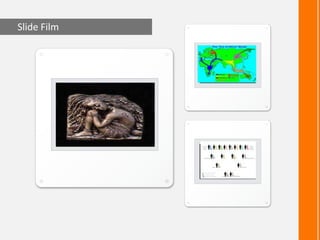
Slide Film
Photo Corners
Spread of DNA into world.   Mitochondrial DNA
Trace on your map with EXPO markers

SO WHERE DID HER
MITOCHONDRIAL DNA TRAVEL TO?

African eve

  • 1.
  • 2.
  • 3.
    - According to skeletal evidence, the first group traveled to the Middle East - After 80,000 frigid years , homosapiens crossed into Yemen through “Gates of Grief” (DNA Evidence). - In 60,000 years H. Sapiens had traveled into Southeast Asia and Volcanic eruptions covered Asia, India and Malaysia. - Only about 70,000 years ago Modern men came across Australia. - 50,000 years ago: Modern man began inhabiting Europe - 1856 Neander, Germany – skeleton found – had different facial features, more adapted to climate. WHERE HER MITOCHONDRIAL DNA TRAVELED TO….
  • 4.
    WHERE HER MITOCHONDRIALDNA TRAVELED TO….
  • 5.
    Also Called theMitochondrial Eve MITOCHONDRIAL EVE THEORY STATES THAT THE MITOCHONDRIAL DNA IN ALL HUMANS IS INHERITED FROM ONE COMMON FEMALE ANCESTOR IN AFRICA ~200,000 YEARS AGO. THIS IS JUST ONE OF SEVERAL THEORIES ABOUT HUMAN EVOLUTION THAT ARE BEING DEBATED.
  • 6.
    There are multipleexplanations for how the Mitochondrial Eve theory, an example of it is the bottleneck theory. The bottleneck theory is when a population undergoes a serve evolutionary change, probably caused by a disease or natural disaster. • The bottleneck effect could have occurred in that a large population of modern humans may have greatly dwindled in size, therefore losing mitochondrial DNA. Some of the remaining mating partners may not produce daughters where additional mitochondrial DNA. • Another possible way was a population of humans where a highly restricted speciation event took place that caused some of the individuals to begin to evolve into modern humans. HOW IT OCCURRED
  • 7.
    Cann et al Cann et al. had examined the DNA of a group of people from five geographic populations. He had discovered that • All mtDNA genotypes could be traced back to a single, ancestral, mtDNA genotype. • The woman responsible for the mtDNA, had lived in Africa about 200,000 years ago. Cann et al. supported his findings with a parsimonious evolutionary tree that showed how mtDNA derived from roots in Africa. • He also found that the African population shows the most overall mtDNA diversity. THE DISCOVERY
  • 8.
    During the 1980’s,several groups at UC Berkely used DNA restriction analysis to trace maternal lineages of people sampled from around the world. Non-coding regions within mitochondrial DNA accumulate neutral mutations rapidly and steadily. The number of individuals sampled varied with each group, where 21, 147, and 241 individuals were involved. They found many types of mitochondrial DNA that were separated into 2 groups, a group of sub-Saharan Africans and a group consisting of N. Africans and all other population groups. The fact that Africans are present in both groups suggest an African origin for modern humans. They also showed that within the African population, there was much more variation in mitochondrial DNA that any other group, indicating that the African population has been established longer. The information generated from these studies was used to calculate a mutation rate using geographical groups of known colonization or by comparing the mutations among humans with the divergence of humans and chimpanzees. It has been estimated that Mitochondrial Eve lived 150,000-200,000 years ago and that mitochondrial DNA mutates 2-4% per million years. MORE DISCOVERIES
  • 9.
  • 10.
  • 11.
    Spread of DNAinto world. Mitochondrial DNA
  • 12.
    Trace on yourmap with EXPO markers SO WHERE DID HER MITOCHONDRIAL DNA TRAVEL TO?

Editor's Notes

  • #2 This template can be used as a starter file for a photo album.